Journal of Ecology 2009, 97, 450– 462 doi: 10.1111/j.1365-2745.2009.01481.x
Blackwell Publishing Ltd
Frayed at the edges: selective pressure and adaptive
response to abiotic stressors are mismatched in low
diversity edge populations
Gareth A. Pearson*, Asuncion Lago-Leston and Catarina Mota
CCMAR-CIMAR, University of Algarve, 8005-139 Faro, PortugalSummary
1.
Theory predicts that population structure and dynamics affect a population’s capacity for
adaptation to environmental change. For isolated, small and fragmented populations at the trailing
edge of species distributions, loss of genetic diversity through random genetic drift may reduce
adaptive potential and fitness levels for complex traits. This has important consequences for
under-standing population responses to, for example changing climate, but has rarely been tested in natural
populations.
2.
We measured the intertidal thermal environment and tidal exposure (emersion) times for natural
populations of the intertidal seaweed
Fucus serratus
at the centre (southwest UK) and southern
edge (northern Portugal) of its range in the Eastern Atlantic, and for a congener,
F. vesiculosus
,
whose range extends further south to Morocco. Fitness-related traits of individuals at each location
were measured in common garden experiments: physiological resilience to desiccation and heat
shock (PSII quantum yield), and the molecular phenotype of the heat shock response (quantitative
PCR of heat shock protein gene transcripts).
3.
The realized thermal environment experienced by
F. serratus
was similar at the centre and southern
edge of its distribution because the maximum shore height (and emersion period) was reduced in
southern populations. For
F. vesiculosus
, thermal maxima were higher and occurred more frequently
in the south, although maximum vertical height (emersion time) remained similar to central
populations.
4.
Edge populations of
F. serratus
were less resilient to desiccation and heat shock than central
populations, and expression of heat shock genes was higher at the same temperature, suggesting
greater cellular stress. In contrast, there was no evidence for physiological divergence in heat shock
response in
F. vesiculosus
, and little variation in gene expression.
5.
Synthesis.
We provide evidence that compared with range-centre populations upper intertidal
limits of
F. serratus
at the southern edge are ‘pruned back’ by abiotic stressors. Rather than being
locally adapted, these small populations are less resilient to abiotic stresses and experience greater
cellular stress during heat shock. These results suggest that ongoing climate forcing factors may
threaten small, fragmented rear edge populations because of inherently reduced fitness and lower
adaptive capacity relative to larger central populations.
Key-words:
abiotic stress, adaptation, adaptive capacity, biogeographic distribution limits,
desiccation tolerance, evolvability, heat shock response, intertidal stress, marginal populations
Introduction
Key questions in ecology, evolution and conservation biology concern peripheral populations: the nature of range margins and the limits to adaptive evolution (Bridle & Vines 2006; Eckert
et al. 2008), the probable ecological and evolutionary responses to rapid environmental change (Jump & Penuelas 2005; Parmesan 2006; Willi et al. 2006), and the potential importance of low-latitude rear-edge populations for biodiversity conservation (Hampe & Petit 2005). Furthermore, populations that exist at the limits of species’ distributions are at the front line of the gathering pace of climate-related environmental change. The
Adaptive response in low diversity edge populations 451 general assertion that peripheral populations exhibit low
genetic diversity resulting from low effective population size and the effects of genetic drift, and high differentiation due to spatial isolation, habitat fragmentation or heterogeneity that reduces gene flow, has received qualified support (Eckert et al. 2008). Despite this, little is understood about the relative performance of fitness-related traits in peripheral vs. central populations, and their adaptive potential under current condi-tions and predicted climate change scenarios.
Recent empirical work in coastal marine systems has challenged both the ‘abundant centre’ view of species dis-tribution (Sagarin & Gaines 2002) and what might be termed the ‘benign centre’ view in relation to gradients of abiotic stress (Helmuth et al. 2002, 2006; Sagarin & Somero 2006). Their place is taken now by a more complex view in which combinatorial variation in several environmental factors (e.g. air temperature, timing of tides) results in a mosaic of stress intensities (Helmuth et al. 2002; Williams & Dethier 2005), emphasising the need to sample local physical conditions when making comparisons among populations. Steep vertical gradients of abiotic stressors in intertidal habitats, with established roles in setting the upper boundaries of species distributions (Connell 1972; Dring & Brown 1982; Chapman 1995; Davison & Pearson 1996; Somero 2002; Davenport & Davenport 2005), may make intertidal species particularly susceptible to the effects of climatic factors (Southward et al. 1995; Hawkins et al. 2003). Their susceptibility, in turn, makes them important early warning indicators of change, and there is therefore a strong argument for the study of their ecology, genetics and physiology.
The effect of climatic variables should be greatest where a distributional boundary or range edge is set mainly by physical factors, rather than biotic interactions, such as at biogeographic transition zones. The Atlantic coast of Portugal on the Iberian Peninsula is a cold- to warm-temperate transition zone where several species of habitat-structuring algae have their southern distributional limit (Lüning 1990), and where sea surface temperature has shown a rising trend over the last 50 years (Lima et al. 2007). The congeneric fucoids Fucus serratus L. and F. vesiculosus L. often occur in sympatry on temperate rocky shores in the eastern Atlantic, but while F. serratus reaches its southern limit in northern Portugal, F. vesiculosus is found as far south as Morocco in N. Africa. The distribution of small, isolated populations of F. serratus along the northern coast of Spain fluctuates on a decadal scale (Arrontes 1993, 2002). These populations were shown to have the lowest genetic diversity across the species range, while neighbouring populations were highly differentiated (Coyer et al. 2003). More recently, northwest Iberia was identified as one of three glacial refugia for F. serratus based on mitochondrial diversity and unique haplotypes (Hoarau et al. 2007). This area is thus a trailing, rear edge (Hampe & Petit 2005), whose persistence, compared with areas of post-glacial range expansion, may have favoured locally adaptive features. On the other hand, under less favourable present-day con-ditions, allelic losses because of drift may have led to reduced evolvability in these small and fragmented populations.
In this study we tested the hypothesis that fitness and adaptive potential are reduced at distributional range edges by investigating the functional differentiation in the heat shock response (HSR) between central and southern (rear) edge populations of F. serratus, as well as the resilience to desiccation, another major emersion stress in the intertidal zone. The congener F. vesiculosus, which has a more southerly distribution limit, provided a ‘non-edge’ control for HSR at the same locations. First, the potential of climate-forcing abiotic factors as selective agents was assessed in the field by comparing the maximum emersion times (upper vertical limits) and summer thermal regimes from in situ temperature profiles experienced by central and southern edge populations. Secondly, in common garden experiments, both photosynthetic indicators and heat shock protein (Hsp) gene expression were used to test the resilience to heat shock (HS), and the relative HSR, respectively, of central and southern edge populations. A second set of common garden experiments compared resilience to desiccation in F. serratus. Our results provide empirical support for the idea that fitness is eroded along with genetic diversity in marginal populations, suggesting that they may be poorly equipped to respond to climate-induced environmental change.
Methods
S T U D Y S I T E S
,
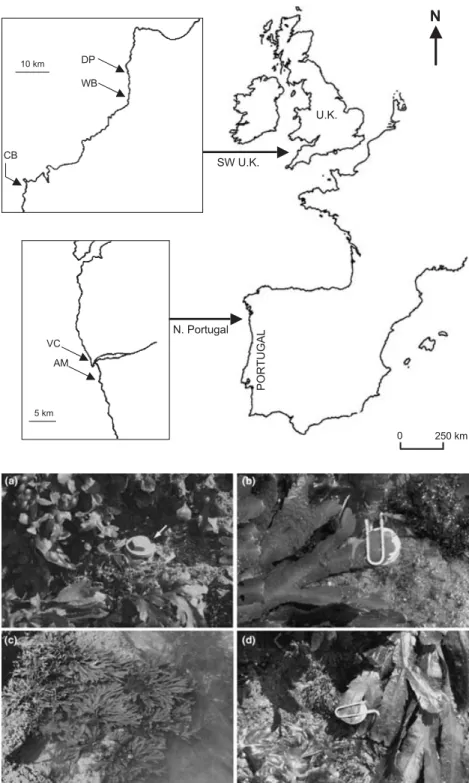
A L G A L P O P U L A T I O N S A N D E N V I R O N M E N T A L T E M P E R A T U R E STwo locations were chosen (Fig. 1); southwest UK (SW UK) in the central area of both species distributions, and N. Portugal at the southern edge of distribution for F. serratus. Samples (n = 10 mature individuals) for experiments to investigate resilience to thermal (F. serratus and F. vesiculosus) and desiccation stress (F. serratus) were taken at replicate sites in N. Portugal: Viana do Castelo (VC: 41°41′27′′ N, 8°50′57′′ W), and Praia de Amorosa (AM: 41°38′30′′ N, 8°49′18′′ W). In the SW UK, visual assessment suggested that F. serratus extended higher up the shore than in N. Portugal. Therefore replicate samples of both species were collected from the high and low shore extremes at Widemouth Bay, Cornwall (WB: 50°47′10′′ N, 4°33′35″ W). Samples for gene expression experiments were taken at VC and WB in June–July 2006.
Temperature data was collected at central and edge locations during the summer of 2007 using dataloggers (iButtons®, Maxim Integrated Products, Dallas Semiconductor, USA) fixed at the high shore limits of both species, and near the lower limit of F. serratus. Dataloggers were placed inside protective brass housings, sealed with o-rings and silicon grease, and glued flush to the chiselled rock surface using fast-curing epoxy (Z-Spar Splashzone compound) (Fig. 2a). Data from two to four replicate loggers per zone were collected at 1 h intervals between May and September 2007.
To assess the appropriateness of rock temperature in algal stands as a proxy for thallus temperatures in the field, iButtons® were clipped directly to the underside of F. serratus apical vegetative tissue using modified paper clips during low tide on 22 and 23 August 2008, under sunny conditions with moderate winds of c. 10 km h−1. The waning quarter moon occurred on 24 August, and low tide on these 2 days occurred at 13:11 h and 14:07 h, respectively (Mr. Tides 3.0 – http://www.mrtides.com/Tides3/Home.html). Data were collected from the following microhabitats at the southern locations: (i) an extensive subtidal pool that does not drain at low tide, but is isolated from
452 G. A. Pearson, A. Lago-Leston & C. Mota
seawater exchange (Viana do Castelo), (ii) smaller pools and depressions containing whole or partial plants (Figs 2b,c), (iii) drying apices at the canopy surface (Figs 2d), and (iv) sub-canopy apices exposed to the air. Rock and air temperatures were monitored during the same period.
The tissue water content of the same apices was determined before re-immersion on the incoming tide. This was done by placing apical tissue (blotted if wet) into pre-weighed tubes containing seawater. Control tubes were taken to the shore, but left without algal samples to control for possible evaporation effects. In the laboratory, the pre-weighed tube value was subtracted from the weight of the tube plus algal tissue to obtain the ‘intermediate’ algal weight (IntW; reflecting the water content when collected on the shore). The algae were then
removed, blotted dry and weighed to obtain the fresh weight (FW), after which they were dried overnight at 60 °C to obtain the dry weight (DW). Tissue water contents (TWC) were then estimated from:
C O M M O N
-
G A R D E N E X P E R I M E N T S,
S T R E S ST R E A T M E N T S A N D P H Y S I O L O G I C A L M E A S U R E M E N T S
Algae were returned to the laboratory in cool-boxes within 36 h of collection. Apical tips were cut and placed into culture in 10 L tanks of aerated and re-circulating natural filtered seawater at 15 °C for Fig. 1. Sampling and field sites for Fucus spp. collections and in situ temperature measurements. Fucus vesiculosus and F. serratus were collected in SW UK from Widemouth Bay (WB), and in N. Portugal from Viana do Castelo (VC) and Praia de Amorosa (AM). Temperature dataloggers were placed at Duckpool (DP), Widemouth Bay (WB) and Constantine Bay (CB) in the SW UK, and at Viana do Castelo (VC) in N. Portugal.
Fig. 2. Photographs from the upper Fucus serratus zone in N. Portugal showing (a) a datalogger assembly (arrow) for measuring rock temperature in the upper F. serratus zone (Viana do Castelo), (b) F. serratus individuals partially or wholly immersed in a pool at low tide. iButtons® and clips for measuring thallus temperature, (c) submersed in seawater, and (d) drying on the canopy surface, both at low tide. TWC(%) 1 (IntW DW) (FW DW) 100 = − − − ⎡ ⎣ ⎢ ⎤ ⎦ ⎥ ×
Adaptive response in low diversity edge populations 453
gene expression experiments and 18 °C for physiological experiments, under ambient day length conditions and low photosynthetic photon flux density (PPFD: 30–50 μmol m−2 s−1). Half the seawater volume was replaced every 2 days throughout the acclimation period. After between 14 days and 1 month of acclimation in common-garden conditions, the algae were exposed to heat shock (HS) or desiccation.
For the gene expression experiments, algae were exposed to HS at 28 °C in seawater for 3 h, at a PPFD of 250–300 μmol m−2 s−1 (high light, HL), supplied by sodium vapour lamps. Samples were taken for RNA extraction after 15, 30, 60, and 180 min HS, and after 1 h recovery in acclimation conditions. An additional sample taken before the stress treatment served as the control, or reference condition.
Fig. 3. Thermal profiles from dataloggers (iButtons®) placed on the shore in the summer of 2007 at the upper vertical limit of Fucus vesiculosus (a, b), the upper vertical limit of F. serratus (c, d), and near the lower vertical limit of F. serratus (e, f ) in SW UK (a, c, e) and N. Portugal (b, d, f ). Inset plots (a–d) show the estimated emersion times (grey bars, time in h) for F. vesiculosus and F. serratus at the upper limits of distribution on the shore at the two locations on 3– 4 August 2007. Data from the SW UK are from DP (a), CB (c), and CB + WB (e); those from N. Portugal are from VC (see Fig. 1 for sampling locations). Plots are combined data from 2 (f ), 3 (a, c), 4 (b, d) or 6 (e) dataloggers. Lunar phase (full or new moon) is shown near the x-axis in each plot. Further details can be found in the text (Methods).
454 G. A. Pearson, A. Lago-Leston & C. Mota
Physiological resilience to HS was determined by exposing acclimated algae to HS for 3 h at 24, 28, 32 and 36 °C (± 0.5 °C) under HL in thermostatically controlled water baths with re-circulating seawater. Ramping to the final temperature was by sequential 15-min transfers between water baths. Controls were manipulated as for HS treatments, but were maintained at acclimation temperature (18 °C) and PPFD. After a 24 h recovery, photoinhibition of PSII maximum quantum yield, Fv/Fm, was measured (n = four replicate tips from five individuals per treatment) with a chlorophyll fluorometer (FMS 2, Hansatech Instruments Ltd, UK). By relating the capacity for photochemical quenching (Fv) to the total fluorescence emission of closed PSII reaction centres (Fm), Fv/Fm is directly proportional to the quantum efficiency of PSII photochemistry (Butler 1978), and its reduction from maximal values (0.7–0.8 in brown algae) is a sensitive and rapid screening tool for stress responses. The experimental design therefore had genotype (five levels) nested within population (four levels), fully crossed at each temperature (five levels); genotype (population) × temperature.
Physiological resilience to desiccation (F. serratus only) was tested as follows: apical tips from each of the 10 individuals were allowed to desiccate at 25–29 °C under an irradiance of 260 μmol photons · m−2 s−1 for 90, 120, and 180 min. To account for temperature variation over the drying surface, an iButton® was placed in each of the 10 drying positions to record the temperature, and one tip per individual from each of the four populations were placed at each position. Physiological responses were determined by measuring Fv/Fm prior to desiccation, and again following a 20 h recovery under acclimation conditions. The experiment in this case was therefore a fully factorial design with the two factors population (four levels) and desiccation time (four levels).
The results were analysed using the PERMANOVA module (Anderson 2001; McArdle & Anderson 2001) within Primer 5 software (Clarke & Gorley 2006). Unlike least-squares anova, PERMANOVA requires
no implicit assumptions about the underlying distribution (i.e. normality) or spread (i.e. variance) of the data within treatment groups and, whereas results are dependent upon the underlying distributions in the sense that observed differences between treatments may be because of differences between the means and/or spread, PERMANOVA does not assume either normality or homoscedasticity. For HS experiments, the data for each species were analysed separately under the nested design described above. Distance-based homogeneity of dispersion tests, tests of main effects and pair-wise tests on significant interactions were performed as recommended using the permutation of residuals under a reduced model, with 999 permutations on a data matrix of average distance measures.
The rate of water loss over the range of desiccation times was determined from TWC as outlined above. In addition, FW : DW, area: FW, and area : DW were determined for each population (n = 10– 12 tips). Area was estimated from pixel counts of high-resolution photographs using ImageJ, a public domain Java-based program from the National Institutes of Health (http://rsb.info.nih.gov/ij/).
Q U A N T I T A T I V E P C R O F H S P G E N E E X P R E S S I O N
Samples were prepared and total RNA was extracted as described previously (Pearson et al. 2006). DNase-treated RNA was cleaned (RNeasy RNA kit, Qiagen), quantified by UV-spectrophotometry and quality was verified on denaturing agarose gels before being stored at −80 °C until use.
Two micrograms of total RNA was reverse-transcribed with SuperScript III RT (Invitrogen) and oligo-dT(18) primer (Fermentas) in parallel 20 μL reactions that were then pooled. Before the analysis of gene expression in experimental samples, the efficiency of PCR reactions was calculated for the target and reference genes (see the following equation); for each species and population, aliquots of cDNA from all experimental conditions were pooled (Pfaffl et al. 2002), Fig. 4. Estimates of thallus temperature from dataloggers clipped onto thalli of Fucus serratus at AM and VC (N. Portugal) during low tides of 22 and 23 August 2008; (a) Canopy surface and sub-canopy thalli, and (b) high and low shore pools. Air (n = 3) and rock temperatures (n = 2) are shown on each plot for comparison. (c) Desiccation status (TWC) of thalli from canopy (n = 12) and sub-canopy (n = 10) microhabitats, and (d) TWC of thalli in high (n = 10) and low pools (n = 5) at the end of the low tide.
Adaptive response in low diversity edge populations 455
and a dilution series (10–1, 10–2, and 10–3) was amplified in triplicate for each gene. Efficiencies were calculated from the slope after plotting the threshold cycle (Ct) vs. cDNA concentration in the standard way from:
E = 10–1/slope (Pfaffl et al. 2002)
where E = amplification efficiency between 1 (minimum) and 2 (theoretical maximum).
Hsp genes were selected from EST libraries for heat and desiccation stress in F. vesiculosus and F. serratus (G.A. Pearson, G. Hoarau, A. Lago-Leston, J.A. Coyer, M. Kube, R. Reinhardt, K. Henckel, E.A. Serrão, E. Core and J.L. Olsen, unpublished data). Forward and reverse primers were designed (Primer3: http://frodo.wi.mit.edu/, Tm of 68–70 °C, amplicon size of 100–150 bp) for the following genes, (i) Hsp70 (F: 5′-CGAAGGGCCAGATCCACGAG-3′, R: 5′-ACACG-GCTCCTTGCCGTTGA-3′), (ii) Hsp90 (F: 5′-CGTGAAGGGCGT-GGTGGACT-3′, R: 5′-CGTCCTCGGCAAGCTCGTTG-3′), (iii) sHsp (F: 5′-TGACAGCGAGTCCGGGGTTC-3′, R: 5′-AGGCGAACGG-TACGGGTGGT-3′), and (iv) the reference (housekeeping) gene Tubulin (F: 5′-CACGAATTGGATCGTGCGCTTG-3′, R: 5′-TACTTGCCG-TGCCTAGGGTCGC-3′). PCR reactions were performed in a total volume of 20 μL using a SYBR green-based detection kit (BioRad), 1 μL of cDNA template from a 10–1 dilution and 0.5 μM of each primer. Triplicate reactions were amplified using an iCycler iQ Detection System (BioRad). Cycle parameters were 95 °C for 2 min and then 40 cycles at 95 °C for 10 s and 68 °C for 30 s. Results were analysed using rest-mcs software (Pfaffl et al. 2002), using the control treatment (non-stressed acclimation conditions) as a reference.
Results
T E M P E R A T U R E A N D E X P O S U R E T I M E S A T C E N T R A L A N D E D G E L O C A T I O N S
The thermal conditions recorded from three biologically defined shore heights in SW UK and N. Portugal are summarized in Fig. 3. Temperature dataloggers were placed near the upper observed limits of F. vesiculosus (Fig. 3a,b) and F. serratus (Fig. 3c,d), and as low in the F. serratus zone as could be accessed during a spring tide series (Fig. 3e,f ). The plots are data overlayed from two to six dataloggers to illustrate the thermal range recorded, and in the case of SW UK, where some were lost, are from different and/or combined shores (see legend, Fig. 3). Temperature profiles are shown for the entire sampling periods, but the comparisons below refer only to the measuring dates in common between both locations (7 July to 29 August 2007). Near-shore seawater temperatures at the field locations during July–August were 16 –17 °C in SW UK and were slightly lower in N. Portugal, 14 –15 °C reflecting the upwelling conditions that prevail along this coast (data are night-time seawater temperatures from three to four iButtons®). Location-specific (and/or latitudinal) differences in potentially stressful thermal events were more apparent higher on the shore, at the upper vertical limit of F. vesiculosus where both maximum temperatures and the number of common measurement days with ≥ 30 °C, and ≥ 35 °C were 12 and 2 at SW UK, and 25 and 4 at N. Portugal (Fig. 3a,b). The maximum emersion time of F. vesiculosus at the two locations was similar at c. 7 h (Fig. 3a,b insets).
Temperature variations within the vertical limits of the F. serratus zone were surprisingly similar between SW UK and N. Portugal, with 12 vs. 13 days ≥ 28 °C, and 5 vs. 9 days ≥ 30 °C, respectively. Potential thermal stress closely tracked daytime spring low tides in N. Portugal, which was linked to the vertical distribution of F. serratus on the shore; as shown in the insets of Fig. 3c,d, emersion times estimated from the thermal data decreased from c. 7 h on SW UK shores, to ≤ 5 h in N. Portugal. Finally, near the lower shore limit of F. serratus, thermal regimes were very similar, and thermal maxima were always below 30 °C (Fig. 3e,f ).
Natural populations of F. serratus are exposed to a wide variety of thermal and water stress regimes in the intertidal zone, dependent upon microhabitat. Thermal data from rock surfaces were similar to temperatures of desiccating algae exposed at the canopy surface (Fig. 4a) and of hydrated thalli in exposed pools (Fig. 4b). However, rock temperature was (spatially) variable and clearly exceeded thallus temperatures in certain microhabitats, for example hydrated sub-canopy thalli, suggesting that caution be used in extrapolating rock temperatures, used to measure thermal regimes in the long-term study, to tissue temperatures. Furthermore, these data were collected on relatively cool days when air temperature in the shade was c. 20 °C. Direct measures of tissue temperature in a variety of microhabitats, under a range of climatic conditions and at several locations, will be necessary to under-stand the range of thermal conditions experienced by algae in natural populations. Sub-canopy thallus temperatures were only c. 2 °C above air temperature, and similar to those measured for low-tide submersed algae (cf. Fig. 4a,b). Under these moderate conditions, water stress was still considerable for exposed thalli where TWC ranged between 4% and 37% (Fig. 4c), whereas most sub-canopy thalli retained 80–90% tissue water (Fig. 4d).
P H Y S I O L O G I C A L R E S I L I E N C E T O H E A T S T R E S S
After acclimation, Fv/Fm was consistently higher in N. Portugal
population samples of F. serratus than in those from SW UK (AM = 0.823 ± 0.016, VC = 0.836 ± 0.008; WBL = 0.782 ± 0.015; WBH = 0.778 ± 0.021 (means ± SD)). There were significant differences between the population means (one-way anova, F. serratus: F3,79 = 70.818; P < 0.0001), and SNK tests indicated
that VC > AM > WBL = WBH. A smaller, but significant dif-ference in Fv/Fm was observed between locations in F. vesiculosus
in the opposite direction (one-way anova, F. vesiculosus: F3,79 = 14.739; P < 0.0001), and SNK tests indicated that
WBL = WBH > VC > AM. Therefore, all Fv/Fm data were
normalized as a proportion of control values (adjusted mean = 1) to account for these intrinsic differences and to allow comparisons of HS resilience across populations and locations.
When Fv/Fm was measured after a 24 h recovery from HS
in F. serratus, location-specific responses were seen between population samples (Fig. 5). All the PERMANOVA main effects and interactions were highly significant (Table 1a). Pair-wise tests on the population × temperature interaction at each
456 G. A. Pearson, A. Lago-Leston & C. Mota
HS temperature indicated no significant differences between any populations at 18, 24 or 28 °C, whereas at both the higher temperatures of 32 and 36 °C, both high and low shore samples from the SW UK grouped together (Fig. 5a,b) and showed significantly greater recovery than the two southern populations, VC and AM, which also grouped together (Fig. 5c,d).
In F. vesiculosus, the HSR was very similar to SW UK F. serratus: flat between 24 and 32 °C, with a sharp threshold in resilience between 32 and 36 °C for all populations (Fig. 6a–d). However, while there was a significant main effect because of temperature, and an interaction between temperature and the random nested factor genotype (population), there were no differences between population samples (Table 1b). Pair-wise tests on temperature indicated that recovered Fv/Fm
at 18 °C > 24 °C = 28 °C > 32 °C > 36 °C (Table 2).
P H Y S I O L O G I C A L R E S I L I E N C E T O D E S I C C A T I O N
The capacity of Fv/Fm to recover following desiccation between
90 min and 3 h, is shown in the boxplots in Fig. 7a–d for each
population. All the populations were slightly affected 20 h after a 90 min desiccation, and Fv/Fm was significantly different
from non-desiccated controls (Fig. 7). The effect was marginal in the case of WBH however, since after 120 min desiccation, Fv/Fm was not significantly different from controls (Fig. 7a).
Following 120 min desiccation, the central (SW UK) population samples were significantly more resilient than either southern edge population; WBH > WBL > AM = VC, and after 180 min, WBH > WBL = AM = VC. Therefore, in common with HS resilience, there was a small but significant reduction in resilience to desiccation stress in southern edge populations. However, in contrast to HS, desiccation tolerance was strongly associated with shore height in F. serratus, and acclimation in common-garden conditions did not overcome this effect. The WBL, VC and AM populations were all collected from approximately the same shore height and emersion time (1–2 m above extreme low water spring tides), whereas at the height corresponding to maximum emersion time for WBH (c. 7 h; Fig. 3c), F. serratus was absent in N. Portugal.
Greater resilience to desiccation in WBH was correlated with lower desiccation rate and greater TWC at a given
Fig. 5. Boxplots showing normalized maximum quantum yield (Fv/Fm) 24 h after heat shock in Fucus serratus at the temperatures shown. (a) WBH, (b) WBL, (c) VC and (d) AM. The horizontal line and box show the median and 50% quartiles, respectively, and the error bars display the range of the data, with outliers displayed as open circles. Data are four replicates of n = 5 individuals at each temperature. Letters above the boxplot bars indicate treatment groups that are not significantly different.
Adaptive response in low diversity edge populations 457
desiccation time (Fig. 8a). However, the rate of water loss was essentially the same for the other three populations and therefore cannot explain the greater resilience of WBL to intermediate desiccation intensity (120 min). Apical tissue from both WB high and low individuals had a greater water content per unit area than the southern populations, reflected in a lower area : FW ratio (Fig. 8b, one-way anova, F = 41.547; d.f.3,47; P < 0.0001). WBH individuals also had a
greater DW content per unit area (Fig. 8b, one-way anova, F = 14.318; d.f.3,47; P < 0.0001). In both cases, differences
between group means were identified using SNK tests (spss 11).
H S P G E N E E X P R E S S I O N A N D T H E H S R
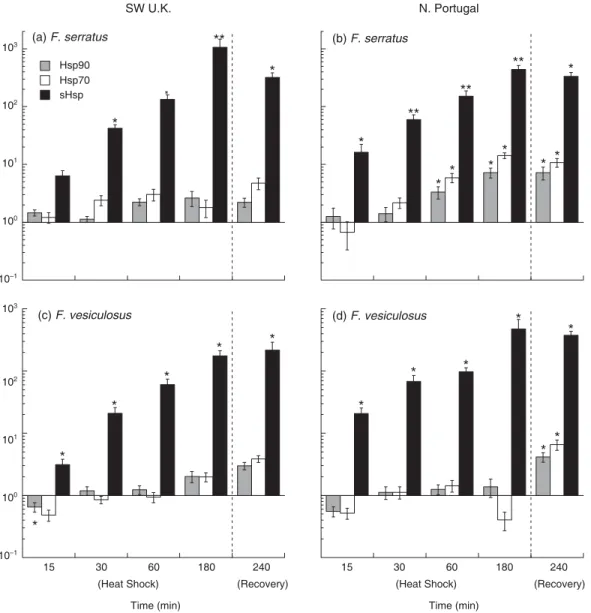
Gene expression experiments confirmed the existence of population or location-specific differentiation in HSR in F. serratus. A HSR was detected after 1 h HS in F. serratus from N. Portugal for both Hsp70 and Hsp90, while in contrast, no significant over-expression occurred in F. serratus from SW UK (Fig. 9a,b). The HSR was lower in the mid-high shore species F. vesiculosus and was not significantly different from controls except after 1 h recovery from HS in the N. Portugal population (Fig. 9c,d).
sHsp expression was highly inducible, indicating that the HSR was activated at 28 °C in both species from both locations. Such levels of over-expression (500–1000 fold) make it difficult to detect differences between populations, and no clear variation was observed.
Discussion
Three main conclusions emerge from our observations and experiments: first, climatic factors during emersion play a role in limiting the vertical distribution of F. serratus on southern shores, since the similarity in realized thermal environment between central and southern locations was accompanied by
a reduction in maximum emersion time on southern shores. Secondly, southern margin populations are maladapted to desiccation and heat stress, both major abiotic stressors in intertidal habitats. This is in contrast to expectations under local adaptation, as shown by experimental approaches at the physiological and molecular (gene expression) level for HSR. The resilience of maximum PSII quantum yield to HS above a critical temperature threshold was lower in N. Portugal than in SW UK. Furthermore, induction of the HSR was greater at a common HS temperature, as assayed by Hsp90 and Hsp70 transcript levels, which is indicative of greater cellular stress. The resilience of maximum PSII quantum yield to desiccation was more complex in that a location by shore height inter-action was observed. Nevertheless, southern edge populations were again shown to be less resilient than a central population from an equivalent shore height, and much less resilient than higher shore individuals from the central location. Thirdly, populations of a congener from the same sample locations, but whose distribution extends much further south, behaved differently in that the estimated vertical range and physiological resilience to HS were unchanged between the centre and the south, and Hsp induction patterns were similar. Thus, although the number of populations and locations studied was small, it seems reasonable to conclude that, in terms of intrinsic capacity to withstand emersion stresses, the ecological potential of F. serratus at the southern edge in N. Portugal is lower than in central populations. Differences in physiological resilience and gene expression persisting after common-garden treatment suggest a genetic component to this variation; a reduction in adaptive potential at the southern edge. However compelling these data, additional tests using other southern edge locations (eastern limit on the N. Spain coast, and northern Bay of Biscay) would strengthen the general conclusion.
Emersion periods were invariant between locations for F. vesiculosus (c. 7 h; Fig. 3a,b). In the SW UK, the maximum
Table 1. PERMANOVA main effects for Fv/Fm after a 24 h recovery from HS in (a) Fucus serratus and (b) F. vesiculosus: Pop = population, Temp = HS temperature, Geno = genotype
Source d.f. SS MS Pseudo-F P (perm) Perms
(a) F. serratus
Pop 3 0.430 0.143 16.226 0.001 999
Temp 4 17.146 4.287 1141.4 0.001 999
Geno (Pop) 16 0.141 0.00883 4.852 0.001 998
Pop × Temp 12 0.756 0.0630 16.772 0.001 999
Temp × Geno (Pop) 64 0.240 0.00376 2.065 0.001 997
Residual 300 0.546 0.00182 Total 399 19.259 (b) F. vesiculosus Pop 3 0.0434 0.0145 1.929 0.161 999 Temp 4 13.813 3.453 435.08 0.001 999 Geno (Pop) 16 0.120 0.00751 3.026 0.001 998 Pop × Temp 12 0.015 0.00125 0.158 1.00 999
Temp × Geno (Pop) 64 0.508 0.00794 3.198 0.001 997
Residual 300 0.745 0.00248
458 G. A. Pearson, A. Lago-Leston & C. Mota
height extension and emersion period of F. serratus on the shore is similar to F. vesiculosus (although densities are lower), but emersion periods decreased by c. 2 h for F. serratus at the southern margin, suggesting that the reduction in vertical zonation height of this species is caused by abiotic conditions during emersion at the southern edge. At local scales, emersion time, by including effects such as wave splash, is a good pre-dictor of vertical zonation patterns, while temperature-dominated effects become important at latitudinal scales
(Harley & Helmuth 2003). A factor that may well moderate thermal stress on rocky shores in the Iberian peninsula is the marked latitudinal variation in the timing of lowest spring tides (Helmuth et al. 2002; Schmidt et al. 2008), which occur in mid-morning in N. Portugal (10–11 h), c. 3 h earlier than on SW UK shores, and before peak daily temperatures are reached. This has the effect that extreme high temperatures coincide with peak spring tides and longest emersion times on SW UK shores, but 4–5 days later in N. Portugal (cf. Fig. 3e and f ).
A caveat concerning our temperature data is that measure-ments were of rock temperatures, which are better proxies for early microscopic stages (Brawley & Johnson 1991), or invertebrates (Harley & Lopez 2003), than for adult thalli. The variation between organismal temperatures and those recorded by dataloggers in the same microhabitats can be large (Fitzhenry et al. 2004), because of the multiple environmental factors affecting body temperature. Our short-term measure-ments during daytime low tides indicated that rock temperatures exceeded moderate air temperatures (c. 20 °C) by 5–8 °C. Under moderate climatic conditions, rock temperature was a
Fig. 6. Boxplots showing normalized maximum quantum yield (Fv/Fm) 24 h after heat shock in F. vesiculosus at the temperatures shown. (a) WBH, (b) WBL, (c) VC, and (d) AM. The horizontal line and box show the median and 50% quartiles, respectively, and the error bars display the range of the data, with outliers displayed as open circles. Data are four replicates of n = 5 individuals at each temperature.
Table 2. PERManova main effects for Fv/Fm after a 20 h recovery from desiccation in Fucus serratus: Pop = population, Des = desiccation
Source d.f. SS MS Pseudo-F P (perm) perms
Pop 3 0.5486 0.1829 21.777 0.001 998 Des 3 14.612 4.8706 580.02 0.001 999 Pop × Des 9 0.89004 0.09889 11.777 0.001 999 Residual 136 1.142 0.008397
Adaptive response in low diversity edge populations 459
reasonable proxy for thallus temperature in key microhabitats identified as potentially stressful. Thalli (or apices) that remained immersed during low tide in small pools and those that desiccated on the canopy surface reached temperatures within the range of those measured at the rock surface, while those in sub-canopy microhabitats, or submersed in extensive low-shore pools, were effectively protected from both thermal changes and desiccation. Rock temperature clearly does not reflect tissue temperature across all microhabitats: more importantly, data are currently lacking for more extreme climatic conditions and for comparisons between Portugal and the UK, where differences in air temperature, humidity and solar radiation, as well as trait variation in, for example desiccation rate, may affect the relationship. Clearly, direct measures of tissue temperature or the use of effective proxies (Fitzhenry et al. 2004) in future studies are needed to address these uncertainties.
Physiological experiments showed that resilience to HS is compromised in southern margin populations of F. serratus compared with central populations from SW UK. The capacity to recover from photoinhibition was lower in both populations
of F. serratus from the southern margin after HS at ≥ 32 °C, than in a central population. No population differences were detected immediately after the stress (data not shown), which is unsurprising since, physiologically, photoinhibition consists of both photoprotection and photodamage, both of which reduce Fv/Fm. However, F. serratus from marginal
populations had a reduced capacity to recover to pre-stress levels of Fv/Fm, either as a result of more damage during the
stress or less efficient and/or impaired PSII repair (Kim et al. 1993). Photosynthesis is heat sensitive, with the primary site of thermal damage considered to be associated with PSII (Berry & Björkman 1980; Weis & Berry 1988; Rokka et al. 2000), the repair of which can be impeded by oxidative stress (Nishiyama et al. 2001).
The molecular phenotypes observed for Hsp gene expression in acclimated algae showed patterns of inter- and intraspecific variation that corresponded well with the physiological data. Under moderate HS, none of the central populations (SW UK) of either species significantly accumulated Hsp70 and Hsp90 transcripts, while southern edge populations of F. serratus did. The main aspects of the transcriptional control
Fig. 7. Boxplots showing normalized maximum quantum yield (Fv/Fm) 20 h after desiccation in Fucus serratus for the times shown. (a) WBH, (b) WBL, (c) VC, and (d) AM. The horizontal line and box show the median and 50% quartiles, respectively, and the error bars display the range of the data, with outliers displayed as open circles. Data are 10 replicate apical tips (individual algae) at each desiccation time. Letters above the boxplot bars indicate treatment groups that are not significantly different.
460 G. A. Pearson, A. Lago-Leston & C. Mota
of the HSR are described under the ‘cellular thermometer’ model (Tomanek & Somero 2002), in which Hsps autoregu-late their own transcript accumulation: protein-protein inter-actions between heat shock transcription factor-1 (HSF1) and a cytoplasmic Hsp protein complex (containing Hsp70, Hsp90 and Hsp40) prevents transcription under normal cellular conditions (Shi et al. 1998; Zou et al. 1998). During stress, damaged proteins sequester Hsps, and the released HSF1 moves to the nucleus, where in an active trimeric form it activates the transcription of Hsp genes. Under this model, increased transcript levels (Hsp70, Hsp90) in N. Portugal relative to SW UK populations of F. serratus at a common HS temperature are indicative of a greater degree of stress (= cellular protein damage) – an interpretation which is borne out by the physiological data.
The similarity in the thermal maxima experienced by F. serratus living in the range centre and at the southern limit
cannot, however, explain why tolerance to HS and desiccation is lower at the southern range edge. Indeed, physiological variation in HSR between central and edge populations of F. serratus exceeded that between the two species at the centre of the range (cf., Figs 5a,b and 6a,b). This is consistent with their respective vertical ranges on UK shores, which were very similar and differed mainly in relative density (Schonbeck & Norton 1978). Our finding that desiccation tolerance increases with shore height in SW UK may have been due to physical–structural differences between thalli that remain after acclimation. On a thallus area basis, greater TWC in SW UK individuals may have a protective effect near the critical water content at which desiccation-induced damage occurs (Pearson et al. 2000). In contrast, this kind of variation would be expected to have little effect on heat transfer in seawater during HS experiments, or in hydrated thalli in the field.
In order to understand why edge populations of F. serratus, despite downward adjustment in their vertical range on the shore, display clear evidence for maladaptation to emersion stress compared with central populations, it is necessary to consider biogeography and population structure at the southern periphery. The current populations of F. serratus in northern Iberia are typical of isolated and fragmented low latitude rear edge populations (Hampe & Petit 2005), with low genetic diversity and high between-population differentiation (Coyer et al. 2003) and poor dispersal capacity (Arrontes 1993, 2002). While the densities of southern edge populations, including those studied here, are similar to those in the centre of the range (R. Araujo, personal communication), the population sizes are much smaller. The area of F. serratus in Amorosa and Viana do Castelo (N. Portugal) were estimated from GPS coordinates as < 200 m−2 and c. 8000 m−2, respectively, while at Widemouth Bay (SW UK), F. serratus covers an area of at c. 80 000 m−2 and is one of several adjacent populations along an extended stretch of coast (10 s of km). Edge populations in NW Iberia are isolated from those further north by the warm waters and unsuitable substrates of the Bay of Biscay, and appear to undergo periodic east–west range expansion and contraction in Northern Spain, that is repeated bottlenecks and founder events (Arrontes 2002, and references therein). Historically, the Iberian peninsula was one of three glacial refugia from the last glacial maximum (Hoarau et al. 2007), from which northward expansion has been limited by the barrier formed by the Bay of Biscay.
Historical biogeography and present-day distributions suggest that the Iberian populations of F. serratus exist in an island-like state, so migration load models in which larger central populations prevent local adaptation by gene swamping appear unlikely (Kirkpatrick & Barton 1997). Rather, it seems more likely that the effects of emersion stress on small populations, in which individual fitness may be reduced by inbreeding, or simple Allee effects (discussed by Willi et al. 2006) impose limits to evolvability. Loss of genetic diversity through genetic drift, exacerbated by cycles of local extinction, bottlenecks and founder events may also combine to reduce evolvability in these marginal populations (Eckert et al. 2008). Future studies with (in particular) additional
Fig. 8. (a) Drying rates for the four populations of Fucus serratus expressed as % tissue water content vs. desiccation time (n = 10 apical tips ± SE). Arrows indicate the desiccation times at which physiological comparisons between populations were made. The upper line shows the temperature profile (right-hand y-axis) during desiccation treatments (n = 10 iButtons® ± SD). (b) Tissue area : FW and area : DW ratios for the four F. serratus populations used in desiccation experiments. Letters above the bars indicate treatment means that are not significantly different.
Adaptive response in low diversity edge populations 461
edge populations could allow an explicit investigation of the link between population structure and genetic diversity (based on neutral markers such as microsatellites), and quantitative assessments of trait means such as desiccation or HS resilience as reported here. Such populations already exist in a marginal habitat and, based on our results, appear to be at even greater risk under climate change scenarios than larger, central populations.
Acknowledgements
This work was funded by the network of excellence Marine Genomics Europe (EU) and projects from FCT-FEDER (to G.P.), and a Ph.D. fellowship to A. L. (FCT-ESF). We are very grateful to Ester Serrão and to two anonymous referees, whose comments and suggestions greatly improved earlier versions of the manuscript.
References
Anderson, M.J. (2001) A new method for non-parametric multivariate analysis of variance. Austral Ecology, 26, 32– 46.
Arrontes, J. (1993) Nature of the distributional boundary of Fucus serratus on the north shore of Spain. Marine Ecology Progress Series, 93, 183–193. Arrontes, J. (2002) Mechanisms of range expansion in the intertidal brown alga
Fucus serratus in northern Spain. Marine Biology, 141, 1059–1067.
Berry, J. & Björkman, O. (1980) Photosynthetic response and adaptation to temperature in higher plants. Annual Review of Plant Physiology, 31, 491–543. Brawley, S.H. & Johnson, L.E. (1991) Survival of fucoid embryos in the intertidal zone depends upon developmental stage and microhabitat.
Journal of Phycology, 27, 179–186.
Bridle, J.R. & Vines, T.H. (2006) Limits to evolution at range margins: when and why does adaptation fail? Trends in Ecology and Evolution, 22, 140 –147. Butler, W.L. (1978) Energy distribution in the photochemical apparatus of
photosynthesis. Annual Review of Plant Physiology, 29, 345–378. Chapman, A.R.O. (1995) Functional ecology of fucoid algae: twenty-three
years of progress. Phycologia, 34, 1–32.
Fig. 9. Time-course of qPCR for Hsp90, Hsp70 and sHsp gene expression in response to HS at 28 °C and recovery for 1 h in seawater at 15 °C. Relative gene expression for F. serratus from (a) SW UK and (b) N. Portugal, and for F. vesiculosus from (c) SW UK and (d) N. Portugal. Values (means ± SE for n = 3 independent PCRs) were normalized to α-tubulin. The reference condition for relative expression (as fold change, log scale) was control culture conditions at 15 °C. Samples differing significantly in expression from the reference condition at the P ≤ 0.05 (*) or P ≤ 0.01 (**) level are indicated.
462 G. A. Pearson, A. Lago-Leston & C. Mota
Clarke, K.R. & Gorley, R.N. (2006) PRIMER v6: Manual/Tutorial, Plymouth. Connell, J.H. (1972) Community interactions on marine rocky intertidal
shores. Annual Review of Ecology and Systematics, 3, 169 –192.
Coyer, J.A., Peters, A.F., Stam, W.T. & Olsen, J.L. (2003) Post-ice age recolonization and differentiation of Fucus serratus L. (Phaeophyceae; Fucaceae) populations in Northern Europe. Molecular Ecology, 12, 1817–1829.
Davenport, J. & Davenport, J.L. (2005) Effects of shore height, wave exposure and geographical distance on thermal niche width of intertidal fauna.
Marine Ecology Progress Series, 292, 41–50.
Davison, I.R. & Pearson, G.A. (1996) Stress tolerance in intertidal seaweeds.
Journal of Phycology, 32, 197–211.
Dring, M.J. & Brown, F.A. (1982) Photosynthesis of intertidal brown algae during and after periods of emersion: A renewed search for physiological causes of zonation. Marine Ecology Progress Series, 8, 301–308. Eckert, C.G., Samis, K.E. & Lougheed, S.C. (2008) Genetic variation across
species’ geographical ranges: the central-marginal hypothesis and beyond.
Molecular Ecology, 17, 1170–1188.
Fitzhenry, T., Halpin, P.M. & Helmuth, B. (2004) Testing the effects of wave exposure, site, and behavior on intertidal mussel body temperatures: applications and limits of temperature logger design. Marine Biology, 145, 339–349.
Hampe, A. & Petit, R.J. (2005) Conserving biodiversity under climate change: the rear edge matters. Ecology Letters, 8, 461–467.
Harley, C.D.G. & Helmuth, B.S.T. (2003) Local- and regional-scale effects of wave exposure, thermal stress, and absolute versus effective shore level on patterns of intertidal zonation. Limnology and Oceanography, 48, 1498– 1508.
Harley, C.D.G. & Lopez, J.P. (2003) The natural history, thermal physiology, and ecological impacts of the intertidal mesopredators, Oedoparena spp. (Diptera: Dryomizidae). Invertebrate Biology, 122, 61–73.
Hawkins, S.J., Southward, A.J. & Genner, M.J. (2003) Detection of environ-mental change in a marine ecosystem – evidence from the western English Channel. The Science of the Total Environment, 310, 245–256.
Helmuth, B., Harley, C.D.G., Halpin, P.M., O’Donnell, M., Hofmann, G.E. & Blanchette, C.A. (2002) Climate change and latitudinal patterns of intertidal thermal stress. Science, 298, 1015–1017.
Helmuth, B., Mieszkowska, N., Moore, P. & Hawkins, S.J. (2006) Living on the Edge of Two Changing Worlds: Forecasting the Responses of Rocky Inter-tidal Ecosystems to Climate Change. Annual Review of Ecology, Evolution,
and Systematics, 37, 373– 404.
Hoarau, G., Coyer, J.A., Veldsink, J.H., Stam, W.T. & Olsen, J.L. (2007) Glacial refugia and recolonization pathways in the brown seaweed Fucus serratus.
Molecular Ecology, 16, 3606 –3616.
Jump, A.S. & Penuelas, J. (2005) Running to stand still: adaptation and the response of plants to rapid climate change. Ecology Letters, 8, 1010–1020. Kim, J.H., Nemson, J.A. & Melis, A. (1993) Photosystem II Reaction Center Damage and Repair in Dunaliella salina (Green Alga). Plant Physiology,
103, 181–189.
Kirkpatrick, M. & Barton, N.H. (1997) Evolution of a species’ range. American
Naturalist, 150, 1–23.
Lima, F.P., Ribeiro, P.A., Queiroz, N., Hawkins, S.J. & Santos, A.M. (2007) Do distributional shifts of northern and southern species of algae match the warming pattern? Global Change Biology, 13, 2592–2604.
Lüning, K. (1990) Seaweeds. Their Environment, Biogeography, and Ecophysiology Wiley, New York.
McArdle, B.H. & Anderson, M.J. (2001) Fitting multivariate models to community data: a comment on distance-based redundancy analysis.
Ecology, 82, 290–297.
Nishiyama, Y., Yamamoto, H., Allakhverdiev, S.I., Inaba, M., Yokota, A. & Murata, N. (2001) Oxidative stress inhibits the repair of photodamage to the photosynthetic machinery. EMBO Journal, 20, 587–5594.
Parmesan, C. (2006) Ecological and Evolutionary Responses to Recent Climate Change. Annual Review of Ecology, Evolution, and Systematics, 37, 637–669.
Pearson, G.A., Kautsky, L. & Serrão, E. (2000) Recent evolution in Baltic
Fucus vesiculosus: reduced tolerance to emersion stresses compared to intertidal
(North Sea) populations. Marine Ecology Progress Series, 202, 67–79. Pearson, G.A., Lago-Leston, A., Valente, M. & Serrão, E.A. (2006) Simple and
rapid RNA extraction from freeze-dried tissue of brown algae and seagrasses.
European Journal of Phycology, 41, 97–104.
Pfaffl, M.W., Horgan, G.W. & Dempfle, L. (2002) Relative expression software tool (REST©) for group-wise comparison and statistical analysis of relative expression results in real-time PCR. Nucleic Acids Research, 30, e36. Rokka, A., Aro, E.-M., Herrmann, R.G., Andersson, B. & Vener, A.V. (2000)
Dephosphorylation of Photosystem II Reaction Center Proteins in Plant Photosynthetic Membranes as an Immediate Response to Abrupt Elevation of Temperature. Plant Physiology, 123, 1525–1535.
Sagarin, R.D. & Gaines, S.D. (2002) The ‘abundant centre’ distribution: to what extent is it a biogeographical rule? Ecology Letters, 5, 137–147. Sagarin, R.D. & Somero, G.N. (2006) Complex patterns of expression of
heat-shock protein 70 across the southern biogeographical ranges of the intertidal mussel Mytilus californianus and snail Nucella ostrina. Journal of Biogeography,
33, 622–630.
Schmidt, P.S., Serrão, E.A., Pearson, G.A., Riginos, C., Rawson, P.D., Hilbish, T.J., et al. (2008) Ecological genetics in the North Atlantic: environmental gradients and adaptation at specific loci. Ecology, 89 (Suppl.), S91–S107. Schonbeck, M.W. & Norton, T.A. (1978) Factors controlling the upper limits of
fucoid algae on the shore. Journal of Experimental Marine Biology and Ecology,
31, 303–313.
Shi, Y., Mosser, D.D. & Morimoto, R.I. (1998) Molecular chaperones as HSF1-specific transcriptional repressors. Genes and Development, 12, 654 –666. Somero, G.N. (2002) Thermal Physiology and Vertical Zonation of Intertidal
Animals: Optima, Limits, and Costs of Living. Integrative and Comparative
Biology, 42, 780–789.
Southward, A.J., Hawkins, S.J. & Burrows, M.T. (1995) Seventy years’ observations of changes in distribution and abundance of zooplankton and intertidal organisms in the western English Channel in relation to rising sea temperature. Journal of Thermal Biology, 20, 127–155.
Tomanek, L. & Somero, G.N. (2002) Interspecific- and acclimation-induced variation in levels of heat-shock proteins 70 (hsp70) and 90 (hsp90) and heat-shock transcription factor-1 (HSF1) in congeneric marine snails (genus
Tegula): implications for regulation of hsp gene expression. Journal of Experimental Biology, 205, 677–685.
Weis, E. & Berry, J.A. (1988) Plants and high temperature stress. Symposia of
the Society for Experimental Biology, 42, 329–346.
Willi, Y., Van Buskirk, J. & Hoffmann, A.A. (2006) Limits to the Adaptive Potential of Small Populations. Annual Review of Ecology, Evolution, and
Systematics, 37, 433–458.
Williams, S.L. & Dethier, M.N. (2005) High and dry: variation in net photo-synthesis of the intertidal seaweed Fucus gardneri. Ecology, 86, 2373–2379. Zou, J., Guo, Y., Guettouche, T., Smith, D.F. & Voellmy, R. (1998) Repression of heat shock transcription factor HSF1 activation by HSP90 (HSP90 complex) that forms a stress-sensitive complex with HSF1. Cell, 94, 471– 480.
Received 27 October 2008; accepted 12 January 2009 Handling Editor: Rien Aerts