Corresponding Author: www.eerp.usp.br/rlae
Corresponding Author: Divane de Vargas
Universidade de São Paulo. Escola De Enfermagem. Departamento de Enfermagem Materno Infantil e Psiquiátrica. Av. Dr. Enéas de Carvalho Aguiar, 419
Bairro Cerqueira Cesar
CEP: 05403-000 São Paulo, SP, Brasil E-mail: [email protected]
Depression prevalence in Intensive Care Unit nursing workers: a
study at hospitals in a northwestern city of São Paulo State
Divane de Vargas
1Ana Paula Vieira Dias
2This study aimed to estimate the prevalence of depression in nursing staff working in
Intensive Care Units of hospitals from a city in Northwestern São Paulo State - Brazil,
examining its association with participants’ socio-demographic characteristics. The Beck
Depression Inventory was applied to a sample of 67 nursing workers from three general
hospitals, showing an 28.4% prevalence of depression. The analysis based on the multiple
model showed a significant association between depression and marital status (OR=1.52),
night work (OR=1.46) and double shifts (OR=2.11). Also, there were significant percentages
of workers who reported discouragement, sadness and hopelessness. In conclusion, the
prevalence of depression is significant and more attention should be paid to this problem
workers at these units face. Further studies are needed in the attempt to broaden knowledge
on the subject, which can support strategies to guarantee attention to ICU nursing workers’
physical and mental health needs.
Descriptors: Depression; Prevalence; Nurse; Nursing; Intensive Care Units.
Prevalência de depressão em trabalhadores de enfermagem de Unidade de Terapia Intensiva: estudo em hospitais de uma cidade do noroeste do Estado São Paulo
Estudo realizado com o objetivo de estimar a prevalência de depressão em trabalhadores
de enfermagem de Unidades de Terapia Intensiva (UTI) de hospitais, de uma cidade
do noroeste do Estado São Paulo, analisando sua associação às características
sociodemográicas dos participantes. Aplicou-se o inventário de depressão de Beck a
uma amostra 67 trabalhadores de enfermagem de três hospitais gerais.
Observou-se prevalência de 28,4% de depressão. A análiObservou-se pelo modelo múltiplo demonstrou
associação signiicativa entre depressão e estado civil (OR=1,52), trabalho noturno (OR=1,46) e dupla jornada (OR=2,11). Foram signiicativos, ainda, os percentuais
de trabalhadores que relataram desânimo, tristeza e desesperança. Conclui-se que é
signiicativa a prevalência de depressão e que maior atenção deve ser dada a esse
problema enfrentado pelos trabalhadores dessas unidades. Sugere-se a realização de
outros estudos na busca por ampliar o conhecimento sobre a temática os quais podem
respaldar estratégias que visem assegurar ao trabalhador de enfermagem, das UTIs,
atenção a suas necessidades de saúde física e psíquica.
Descritores: Depressão; Prevalência; Enfermeiro; Enfermagem; Unidades de Terapia
Intensiva.
Prevalencia de depresión en trabajadores de enfermería de Unidades de Terapia Intensiva: estudio en hospitales de una ciudad del noroeste del Estado de Sao Paulo
Este estudio fue realizado con el objetivo de estimar la prevalencia de depresión,
en trabajadores de enfermería de Unidades de Terapia Intensiva (UTI) de hospitales
de una ciudad del Noroeste del estado de Sao Paulo, analizando su asociación con
las características sociodemográicas de los participantes. Se aplicó el Inventario de
Depresión de Beck a una muestra de 67 trabajadores de enfermería de tres hospitales
generales; se observó una prevalencia de 28,4% de depresión. El análisis por el modelo
múltiple demostró asociación signiicativa entre depresión y estado civil (OR=1,52), trabajo nocturno (OR=1,46) y doble jornada (OR=2,11), fueron signiicativos también
los porcentajes de trabajadores que relataron desanimo, tristeza y desesperanza. Se
concluye que es signiicativa la prevalencia de depresión y que se debe dar mayor
atención a ese problema enfrentado por los trabajadores de esas unidades. Se sugiere
la realización de otros estudios buscando ampliar el conocimiento sobre la temática, los
cuales pueden respaldar estrategias que objetiven asegurar, al trabajador de enfermería
de las UTIs, atención a sus necesidades de salud física y psíquica.
Descriptores: Depressión; Prevalencia; Enfermeras; Enfermeria; Unidades de Terapia
Intensiva.
Introduction
Literature appoints that correlations exist between
task performance and mental illnesses, more precisely
depression. The exhaustion people go through in the
work environment is one of the most signiicant factors
in the emergence of diseases resulting from stressful
stimuli experienced in that environment. Also according
to literature(1), health professional are directly affected
because they live and work with diseases and the feelings
these involve, which constitute an exhausting and
defense mechanisms, so that other people’s disease and
suffering do not interfere in workers’ mental and physical
health. These mechanisms, however, are not always
eficient to cope with these situations and workers may
present some changes, mainly mood swings, manifested
as depression or irritability.
The term depression has been used to designate
a normal affective state (sadness), as well as a
symptom, a syndrome and one or several illnesses. In
those situations characterized as syndrome, depression
presents mood swings (irritability, lack of ability to feel
pleasure, apathy), including cognitive, psychomotor and
vegetative alterations (sleep and appetite). The main
signs and symptoms are characterized by: depressive
mood, feeling of sadness, self-devaluation and feeling
of guilt; reduced ability to experience pleasure in
most part of activities, fatigue or feeling of energy
loss; decreased ability to think, concentrate or make
decisions. Physiological symptoms tend to take the
following forms: sleep alteration, appetite alteration and
reduced sexual interest(2).
Studies(3-4) have appointed that the Intensive Care
Unit (ICU) is characterized as one of the most aggressive,
tense and traumatizing environments in the hospital,
which can entail physical and mental health damage
for patients as well as the multiprofessional team
working there. As a result of increasingly sophisticated,
bureaucratized and mechanized Intensive Care Units
(ICUs), the environment is very unstable and agitated,
with different activities that arouse great anxiety,
exposing the nursing team to great tension as, in these
environments, besides working with their own emotions
and conlicts, these workers also need to deal with their
patients and relatives’ emotional needs.
These demands often end up causing physical and
emotional fatigue, tension and anxiety in professionals.
Besides, the context of life risk, work overload, bad
use of medical skills, dificulty to accept death, pain,
lack of material and human resources, extremely dry
and refrigerated environment, cold and with artiicial
lighting; the constant inter-relation between the same
team members during the shift and conlicting decision
making related to which patients will be attended to are
appointed as factors that trigger anxiety and mental
disorders in nursing workers at these units, including
depression(3-4). Depression is characterized by a generally
depressive mood, sadness, loss of interest or pleasure,
signiicant weight loss or gain, insomnia (in the initial,
middle or end sleep phases) or hypersomnia, agitation
or psychomotor delay, fatigue or energy loss, feeling of
uselessness or excessive or inadequate guilt, indecision
or decreased ability to think or concentrate and recurrent
death thoughts.
In combination with these stressful factors nursing
workers experience at Intensive Care Units, another
factor researchers appoint as a trigger of mental
disorders in this population is the occurrence of nursing
professionals’ shift turnovers, which can cause sleep
alterations, gastrointestinal and cardiovascular disorders
and mental disorders, mainly depression(5). Likewise,
besides entailing dificulties to sleep and wake up, night
work can make workers abuse of alcohol or barbiturates,
causing irritation and aggressiveness and, thus, harming
their family and social life(6).
Researchers(7) have appointed that little has been
reported on the prevalence of depression symptoms
among nursing workers, which is veriied when analyzing
Brazilian and international production on the theme. In
literature, studies address aspects like: anxiety, stress
and Burnout Syndrome in a wide range of activity areas.
Various authors have researched on this theme, but not
as the central focus in depression research(7-10).
These facts demonstrate the need for studies to
assess that type of problem in the nursing population.
In the few studies that mention depression among
ICU nursing workers, researchers unanimously afirm
that exposure to a range of stressful events at the
Intensive Care Unit may be associated with increased
prevalence of depression in nursing workers at these
units(8). Studies have evidenced that ICU nurses,
mainly those working at general ICUs, have shown a
trend towards depression(8). A study aiming to identify
the Burnout Syndrome in Intensive Care Unit nurses
evidenced high prevalence rates of depressive symptoms
in that population, suggesting that qualitative analyses
of depressive symptoms in ICU nurses should be better
investigated(9). In a study involving 130 nursing workers
from a general hospital, it was found that 27% of this
sample complied with criteria for depression(5). In Brazil,
few studies have been published on the theme. Among
the few available publications, one study aimed to
assess the quality of life and prevalence of dysphoria/
depression among nursing residents from a university
hospital in the interior of São Paulo State. This study
evidenced the prevalence of dysphoria/depression in
27.9% of the residents(7).
Another study accomplished to assess quality of
life at work, which involved 211 surgical center nursing
workers, evidenced that 24.2% of the interviewed
In view of the fact that depression has been
documented in health professional working in various
specialties, that the ICU nursing team constitutes a
vulnerable group for the development of depression, due
to the situations that reveal the great emotional burden
these professional are exposed to and considering that
little is known about depression in nursing workers at
these units, besides the lack of studies that investigated
the presence of depression alone in Brazilian nursing
workers, this study aims to verify the prevalence of
depression in Intensive Care Unit workers.
Aim
To verify the prevalence of depression in nursing
workers from Intensive Care Units in hospitals from
a Northwestern city in São Paulo State, analyzing
its association with participants’ socio-demographic
characteristics.
Methods
Data for this cross-sectional study were collected at
three hospital institutions from a Northwestern city in São
Paulo State. One of the study hospitals was classiied as
medium-sized and private, called hospital A in this paper,
while the other two were large philanthropic hospitals
and called hospitals B and C. The study subjects were 67
nursing workers from three categories: nurses, nursing
technicians and auxiliaries, working at the Intensive
Care Units of each of the three institutions involved. The
following inclusion criteria were established: being an
ICU worker, working at the time of data collection and
accepting to participate in the study.
Ethical considerations
The following ethical aspects were observed in
the accomplishment of this research: approval of the
project by the Institutional Review Board of Faculdades
Integradas Faibe, under Number 0051/2006, and the
study participants’ signing of the Informed Consent
Term.
Measurement instruments
To collect data on depression, Beck’s Depression
Inventory (BDI) was used. This depression
self-assessment scale was introduced at the Center for
Cognitive Therapy – CCT of Pennsylvania University
Medical School in 1971(11). The BDI has been widely
used to assess cognitions associated with depression in
psychiatric patients and in normal populations. It is one of
the most accepted instruments to assess the intensity of
depression and displays one of the best performance levels
in this function(11). Besides, the BDI has demonstrated its
reliability, independently of culture, socioeconomic level,
education, age, marital status and partner’s occupation.
In 1998, the BDI was validated in Brazil(12).
Although it is a depression intensity measure, the
tool is not indicated to recognize nosological categories.
The BDI comprises 21 items, including symptoms and
attitudes, each of which consists of four assertions
with intensity levels graduated from 0 (neutral) to
3 (maximum intensity), and a score range from 0 to
63. BDI items refer to sadness, pessimism, feeling of
failure, lack of satisfaction, feeling of guilt, feeling of
punishment, self-accusations, suicidal ideas, crying
crises, irritability, social retraction, indecision, distorted
body image, inhibition to work, sleep disorder, fatigue,
loss of appetite, weight loss, somatic concern and
decreased libido. The cut-off score depends on the
sample type and study aims.
Different cut-off points have been proposed to
use the BDI, depending on the type of sample and
aims of the study. In the BDI’s original psychometric
properties, the obtained results should be interpreted
as follows: >10=no depression or minimum depression;
from 10 to 18=mild to moderate depression; from 19
to 29=moderate to severe depression; from 30 to
63=severe depression(11). In non-diagnosed samples,
however, that is, which have not been medically
diagnosed with depression, like the participants in
this study, literature recommends that the following
measures be adopted: ≤15=normal or mild depression;
16-20=dysphoria; >20=Depression(12). Together with
the BDI, a questionnaire was also applied to identify
the participants socio-demographic proile, comprising
14 questions related to gender, age, marital status,
work shift, time on the job, among others.
Procedures
Data collection instruments were distributed at
the subjects’ places of work, during the three shifts
(morning, afternoon and night). After they accepted,
they were asked to sign the Informed Consent Term and
not identify the questionnaires, so as to preserve their
identity. After they received the tools, a 48 hour-interval
was established for the subjects to return the completed
instruments.
Data analysis was divided in two moments; initially,
Participants were classiied according to BDI results in
two groups: group I with depression (individuals scoring
>20) and group II without depression (individuals
scoring ≤20). After dividing the groups, univariate
logistic regression was applied to identify which variables
signiicantly inluences the workers’ depression, in the
form of measures to estimate the Odds Ratio (OR), with
a 95% conidence interval. All variables with p≤0.20,
(gender, age, marital status, work shift, time on the job,
time working at ICU, being a student) were introduced
in the multiple logistic regression model stepwise.
Statistics with a descriptive p≤0.05 were considered signiicant. All analyses were carried out in SPSS version
13.0 for Windows.
Results
Sample characteristics
In the population of 85 workers who were invited
to participate in the study, 79% returned the completed
80%
70%
60%
50%
40%
30%
20%
10%
0%
IDB < 15 No depression or mild depression
IDB - 16 a 20 = Dysphoria IDB > 20 = Depression
instrument, while 21% did not. Thus, the study sample
consisted of 67 participants, the majority of whom (55%)
were female, with ages ranging between 21 and 30
years (mean = 25 years; SD=3.87), 51% were single,
66% worked as nursing technicians and 58% informed
they had more than one job. As for the work shift, most
participants (40%) worked in the afternoon, 39% had
been working at the Intensive Care Unit between one
and ive years. Regarding sample origin, 17 (25%)
participants came from the ICU at Hospital A, 18 (27%)
from the ICU at Hospital B and 32 (48%) from the ICU
at Hospital C.
Depression prevalence according to the adopted BDI
According to the cut-off points established in data
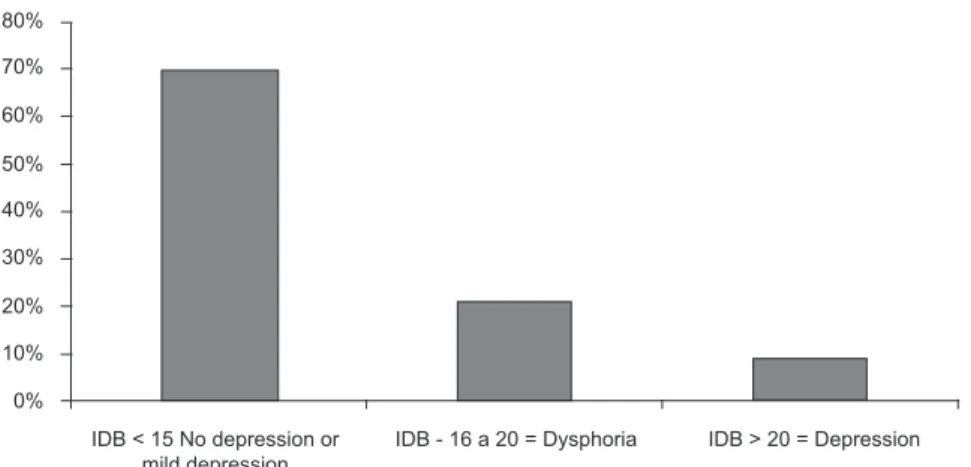
analysis, it was observed that 70% of the interviewees
were classiied as no depression or mild depression;
21% with dysphoria (moderate depression) and 9% with
depression (severe depression), as shown in Picture 1.
Figure 1 – Distribution of study participants according to depression prevalence, in line with the Beck Depression
Inventory. São Paulo, SP, Brazil, 2010
To proceed with the statistical analyses, the
participants were grouped according to their BDI
results, in two groups: I with depression and II
without depression. It was observed that, after this
classiication, 47 (71.6%) participants were considered
without depression, while 20 (28.4%) obtained scores
that suggested depression.
Applying univariate logistic regression, the
association between the study variables showed no
signiicance between depression and the following:
gender, age, professional category, time on the job,
time working at the ICU, graduate degree and being
a student. Therefore, they were not incorporated into
the multiple logistic regression models. In the latter,
those variables were included that had demonstrated
statistical signiicance in the univariate analysis, which
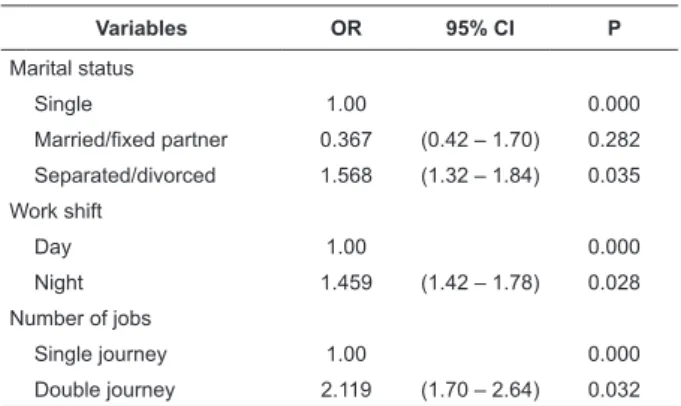
were: marital status, work shift, number of jobs, which
showed a positive association with depression prevalence
among nursing workers. In the analysis according to the
multiple model, the signiicant association between these
variables and depression continued. The main predictor
of this association was observed in participants working
double shifts (OR = 2.11), followed by separated and/
or divorced individuals (OR = 1.56) working night shifts
Table 1 – Logistic regression result analysis, considering
the relation between depression and signiicant study
variables. São Paulo, Brazil, 2010
Variables OR 95% CI P
Marital status
Single 1.00 0.000
Married/fixed partner 0.367 (0.42 – 1.70) 0.282
Separated/divorced 1.568 (1.32 – 1.84) 0.035
Work shift
Day 1.00 0.000
Night 1.459 (1.42 – 1.78) 0.028
Number of jobs
Single journey 1.00 0.000
Double journey 2.119 (1.70 – 2.64) 0.032
The analysis of participants’ answers to the 21
items in the Beck Depression Inventory showed that, as
to the feeling of pleasure, 40% of participants informed
no longer feeling pleasure like before; 46.3% mentioned
feeling guilty sometimes. As for deception, 52% of the
interviewees indicated feeling that their weaknesses
and errors had worsened and that they felt more guilty
for their failures; 30% informed that they tend to cry
more than the usual; on the item addressing irritation,
40% of the subjects said they were irritated all the time;
43% said they do not sleep as well as they used to and
50% get tired more easily than they used to. Regarding
libido, 30% of the participants informed they were not
interested in sex like before.
Discussion
The ICU environment is characterized as highly
stressful and exhausting and can be associated with
high depression rates among ICU workers. Based on
this evidence, the BDI(11) was applied, a self-assessment
instrument that has been widely acknowledged in different
countries and assesses the prevalence and intensity of
depression. It can be used in psychiatric patients as well
as in the non-clinical population. Its predictive value
corresponds to approximately 90%(13-14). The depression
prevalence found in this study was 28.4%. This result
was consistent with international research(8) results,
which found a 27% depression prevalence among
nursing workers and slightly higher when compared with
the results of a Brazilian study(7), in which the prevalence
of depression amounted to 27.9%.
In the total sample, according to BDI scores, 71.6%
of the interviewees were classiied as no depression
or minimum depression; 20% as dysphoria or mild/
moderate depression and 8.4% showed suficient scores
for depression or severe depression. In view of these
results, it needs to be considered that the BDI is not a diagnostic instrument and that depression cannot
be diagnosed based on its results only, demanding
concomitant clinical assessment. The results suggested that more than a quarter of the sample complies with
criteria for depression and that, among these, 8% present severe depression. Data are a source of concern
as, although this situation was detected, workers are still exposed to stressful and anguishing factors at the
ICU. Ignoring the anguish and depression signs these professionals present results in low-quality care and work
burden, including emotional and physical stress(15).
It is highlighted that, as 21% of the 85 workers who were invited to participate in the study did not
return the questionnaire, it can be inferred, as one hypothesis for this non-return percentage, that they
were afraid to reveal their symptoms and be identiied
by the service, although it was informed at the time of
data collection that the provided data would be kept secret. Thus, these workers’ participation could have
interfered in the results, entailing higher depression prevalence rates as, when the data were collected,
many workers were on a leave of absence as a result of
a depression diagnosis.
Regarding depression prevalence in nursing workers,
according to each of the three ICUs under analysis,
no signiicant difference in depression prevalence and
percentages was found, ranging from 29% at the ICU in Hospital A to 18% at the ICU in Hospital B and 23% in
Hospital C. The fact that higher depression prevalence
rates were ind at the ICU of the private hospital may be
due to the greater pressure exerted at these institutions,
which can enhance the exhausting characteristics of ICUs, contributing as an additional factor to trigger
depression in workers.
The study found a statistical association between
the presence of depression and working double shifts (Table 1). Nursing workers need to work double shifts
due to the economic situation in the health area, with
low wages in most cases, which are insuficient for family
maintenance and make professionals seek new income sources. In fact, they need to face double activities,
which can interfere in some aspects of workers’ quality
of life, entailing psychic symptoms, among others(16). The effect of double journeys on nursing workers’
mental health was found in a study aimed at verifying stress prevalence in two groups of workers. The results
evidenced that 70.8% of the group working double journeys was stressed, in comparison with 55.5% in the
At bottom, double work journeys can be associated
with depression in nursing workers due to the deprivation
of leisure and social contact, needed to maintain their
mental health.
Another predictive factor of depression among
participants in this study was night work. Shift work is a characteristic of nursing practice and obligator, as
nursing care happens 24 hours per day, seven days
per week, without interruptions. This condition obliges
care delivery at night, at weekends and during holidays,
when other workers sleep, relax, involve in leisure and
social and family contact.
These aspects contribute to the appearance of depression in workers who perform their activities at
night. This result was consistent with other studies
(16-18), appointing that nursing workers more strongly feel
the psychosocial factors of shift work, which interfere in
health and disease processes(19-20). Night work is harmful
to occupational health, due to the critical, exhausting and
tiresome work conditions, associated with the already exhausting characteristics of the ICU environment,
enhancing its effects on nursing workers’ mental health.
A study that assessed the sleep quality of ICU nursing
workers found that 100% of the nurses and 88% of the
nursing auxiliaries assessed showed bad sleep quality,
which seems to justify experts’ observations on the topic, in that night workers’ main challenge is undoubtedly to
adapt their life rhythm to biological principles and social
contact(21), considering that the combination between
discouragement and fatigue makes the interest in social
life and leisure disappear.
Besides causing an intense form of irritability
in voices and domestic noise, due to constant and/or disturbing sounds, like in the ICU environment(17). Thus,
constant discouragement due to night work and the lack
of social and family contact imposed by the exhaustion
related to night work can lead to manifestations of
depression in workers.
Besides double journeys and night work, another
variable that demonstrated a signiicant association with
depression in ICU nursing workers was marital status. In
this study, the association between depression prevalence
and marital status was signiicant; divorced or separated
workers showed greater chances of depression than
single or married ones, in line with the results observed
in a similar study(22). In view of this result, one may say that the support in family relations and marriages
is inversely related with the development of stress
and physical illnesses(23) and depression and that, in
individuals without this type of support, occupational
stress rates increase(24). This observation corroborates
the evidence that married nurses experience less
occupational depression thanks to family support(25). Despite the lack of isolated scores in depression
assessment according to the BDI, it was considered
important to discuss the results observed on some instrument items, which evidenced a higher prevalence
rate than for depression itself. Signiicant percentages
of ICU professionals informed feeling sad, discouraged
about the future, no longer feeling pleasure in things like before; feeling guilty, getting easily irritated
and presenting sleep problems, although depression prevalence corresponded to 28.4%. These results can
indicate psychic suffering. When not observed and
adequately managed, they can trigger depression. According to literature(2), the most typical characteristics
of depressive people are feelings of sadness or void, complaints about losing pleasure in doing activities in
general, and decreased interest in the environment associated with the feeling of fatigue and/or tiredness.
This study presented various limitations. First, the number of study participants, which did not permit
generalizing the results and may have inluenced the results observed, as no signiicant difference was
found between most research variables, which may
be attributed to the low power of the sample involved. Anyway, the results found were similar to those of
previous studies of the same kind. Second, the fact that, when used alone, the instrument has no diagnostic
power and, thus, with a view to greater reliability of the results, workers whose score suggested depression
should e submitted to clinical assessment with a view to
conirming depression.
Despite the limitations, the study offers advantages
for nursing knowledge, to the extent that it contributes to Brazilian literature on the theme, mainly in view of the
observation that, until date, no studies published in Brazil are available which studied depression in ICU nursing
workers as, despite some studies on these workers’ mental health, none of them adopted depression as the
main research focus.
Conclusion
Prevalence levels of depression in nursing workers
at the ICUs under analysis amount to almost 30%. Working night shifts, working double shifts and being
separated or divorced are characteristics positively associated with depression in this population. Hospital
institutions need to get more concerned with these workers’ physical and mental health, as the percentages
of workers who informed discouragement, sadness and
Received: June 16th 2010
Accepted: Mar. 17th 2011 symptoms of more severe depression among workers
as, at bottom, these factors may negatively inluence
nursing care delivery in the ICU context.
Finally, other studies of this kind should be
accomplished to obtain further knowledge on the theme, which can and should support strategies aimed
at guaranteeing quality of life at work to ICU nursing workers. This presupposes, among other factors, heeding
the presence of depression among these workers.
References
1. Missel ST. A Saúde geral de profissionais da área hospitalar: uma avaliação comparativa entre grupos
com contato direto e indireto compacientes [dissertação
de mestrado]. Canoas (RS): Universidade Luterana do Brasil; 1998. 100 p.
2. Porto JAD. Conceito e diagnóstico. Rev Psiq Clin. 1999;21(1):1-13.
3. Villa VSC, Rossi L. O Significado Cultural do Cuidado Humanizado em Unidade de Terapia Intensiva: Muito
falado e pouco vivido. Rev. Latino-Am. Enfermagem. 2002;10(2):137-44.
4. Leite MA, Villa VSC. Dificuldades vivenciadas pela
equipe multiprofissional na unidade de terapia intensiva. Rev. Latino-Am. Enfermagem. 2005;13(2):145-50.
5. Costa ES, Morita I, Martinez MAR. Percepção dos efeitos do trabalho em turnos sobre a saúde e a vida
social em funcionários da enfermagem em um hospital universitário do estado de São Paulo. Cad Saúde Pública.
2000;16(2):553-5.
6. Carvalho GM. Enfermagem do Trabalho. São Paulo:
EPU; 2001.
7. Franco GP, Barros ALBL, Nogueira-Martins LA.
Qualidade de vida e sintomas depressivos em residentes
de enfermagem. Rev. Latino-Am. Enfermagem. 2005;13(2):139-44.
8. Özgencil E, Ünal N, Oral M, Okyavuz Ü, Alanoglu Z. Depression and burnout syndrome in intensive care unit
nurses. J Int Women’s Study. 2004;8(Suppl 1):340. 9.Schmidt DRC. Qualidade de vida no trabalho e sua
associação com o estresse ocupacional, a saúde física e mental e o senso de coerência entre profissionais de
enfermagem do Bloco Cirúrgico [tese de doutorado].
Ribeirão Preto (SP): Escola de Enfermagem de Ribeirão Preto da Universidade de São Paulo; 2009. 243 p.
10 Poncet MC, Toullic P, Papazian L, Kentish-Barnes N, Timsit J-F, Pochard F, et al. Burnout Syndrome in Critical
Care Nursing Staff 2001. Am J Respir Crit Care Med. 2007;175:698-704.
11. Silveira DS, Jorge MR. Propriedades psicométricas da escala de rastreamento populacional para depressão
CES-D em populações clínica e não-clínica de adolescentes
e adultos jovens. Rev Psiq Clin. 1998;25(5):251-61. 12. Gorenstein C, Andrade L. Inventário de Beck:
Propriedades Psicométricas da Versão em Português.
Rev Psiq Clin. 1998;25(5):245-50.
13. Donchin Y, Seagull FJ. The hostile environment of the
intensive care unit. Curr Opin Crit Care. 2002;8:316-20. 14. Soupios MA, Lawry K. Stress on personnel working
in a critical care unit. Psychiatr Med. 1987;5:187-98. 15. Andrade C. Cuidados Intensivos. Rio de Janeiro:
McGraw-Hill; 2002. 436 p.
16. Pafaro RC, Martino MMF. Estudo do estresse do
enfermeiro com dupla jornada de trabalho em um
hospital de oncologia pediátrica de Campinas. Rev Esc Enferm USP. 2004; 38(2):152-60.
17. Barboza JIRA, Moraes EL, Pereira EA, Reimão RNAA. Avaliação do padrão de sono dos profissionais
de Enfermagem dos plantões noturnos em Unidades de Terapia Intensiva. Einstein. 2008; 6(3):296-301.
18. Abdalkader RH, Hayajneh FA. Effect of Night Shift on Nurses Working in Intensive Care Units at Jordan
University Hospital. Eur J Sci Res. 2008;23(1):70-86. 19. Moreno CRC, Fischer FM, Rotenberg L. A saúde do
trabalhador na sociedade 24 horas. São Paulo Perspec.
2003;17(1):34-46.
20. Fischer MF, Teixeira LR, Borges FNS, Gonçalves MBL,
Ferreira RM. Percepção de sono: duração, qualidade e alerta em profissionais da área de enfermagem. Cad
Saúde Pública. 2002;18(5):1261-9.
21. Rotenberg L, Portela LF, Marcondes WB, Moreno
C, Nascimento CP. Gênero e trabalho noturno: sono, cotidiano e vivências de quem troca a noite pelo dia.
Cad Saúde Publica. 2001;17(3):639-49.
22. Habibollah Kavari, Mahnaz Helyani, Vida Dehghani. A Study of Depression Prevalence
in Nurses and it’s Effective Factors in Shiraz Namazi Hospital. Rawal Med J. 2007;32(2):184-6.
23. Norbeck JS. Types and sources of social support for managing Job stress in critical care nursing. Nurs Res.
2001;34(4):223-5.
24. McAbee R. Occupational stress and burnout in the
nursing progression, a mode of prevention. AAOHN J.
1991;39(12):568-85.
25. Morano J. The relationship of workplace social
support to perceived work-related stress a many staff