www.rpped.com.br
REVISTA
PAULISTA
DE
PEDIATRIA
ORIGINAL
ARTICLE
Influence
of
polymorphisms
of
the
beta-2
adrenergic
receptor
on
the
presence
of
exercise-induced
bronchospasm
in
adolescents
夽
Cássio
Leandro
Mühe
Consentino
a,∗,
Lupe
Furtado-Alle
a,
Larissa
Rosa
da
Silva
a,
Wendell
Arthur
Lopes
b,
Luciane
Viater
Tureck
a,
Gerusa
Einsfeld
Milano
a,
Leilane
Lazarotto
a,
Cláudia
Regina
Cavaglieri
c,
Neiva
Leite
aaUniversidadeFederaldoParaná(UFPR),Curitiba,PR,Brazil bUniversidadeEstadualdeMaringá(UEM),Ivaiporã,PR,Brazil cUniversidadeEstadualdeCampinas(Unicamp),Campinas,SP,Brazil
Received2March2015;accepted9June2015 Availableonline24December2015
KEYWORDS
Adolescent; Exercise-induced bronchospasm;
ADRB2gene
Abstract
Objective: Todetermine theinfluence ofpolymorphismsof thebeta-2 adrenergicreceptor (ADRB2)intriggeringexercise-inducedbronchospasm(EIB)inadolescents.
Methods: Thesubjectsweredividedintotwogroups:presentEIB(EIB+)(n=45)andabsentEIB (EIB−)(n=115).Thebronchialprovocationtestwithexercisewasperformedwithaprotocol thatconsistedofwalking/runningfor atleasteight minutesathigh intensity,i.e.,>85%of maximumheartrate,consideringEIB+asa10%decreaseinforcedexpiratoryvolumeinone second(FEV1).ThegenotypingoftheADRB2genewasperformedbytheTaqmanmethod,using theStepOnePlussystem.Independentt-test,Mann---WhitneyandChi-squaretests,aswellas Spearman’scorrelationcoefficientwereusedforthestatisticalanalysis.
Results: Age,bodyweight,height,FEV1,FVCandFEV1/FVCratiowerelowerintheEIB+group whencomparedtoEIB−(p<0.05).Therewerenosignificantdifferencesintheproportionof thealleleatposition27 andArg16GlyandGln27Glugenotypesbetween theEIB+ andEIB− groups(p=0.26;p=0.97andp=0.43,respectively).However,therewasatrendtowardstatistical significanceregardingthegreaterproportionoftheGly16allelefortheEIB+whencompared totheEIB−group(p=0.08).
Conclusions: Thepresence ofpolymorphismsassociatedwiththe Glu27alleleandArg16Gly
andGln27GlugenotypeshadnoinfluenceonEIB.However,thestatisticaltrendtowardgreater frequencyoftheGly16alleleinindividualswithEIB+canbeconsideredevidenceoftheinfluence ofpolymorphismsoftheADBR2geneonEIBinadolescents.
©2015SociedadedePediatriadeSãoPaulo.PublishedbyElsevierEditoraLtda.Thisisanopen accessarticleundertheCCBYlicense(https://creativecommons.org/licenses/by/4.0/).
夽
ThisarticleispartoftheMaster’sDegreeDissertationofCássioLeandroMüheConsentino.
∗Correspondingauthor.
E-mail:[email protected](C.L.M.Consentino). http://dx.doi.org/10.1016/j.rppede.2015.06.021
PALAVRAS-CHAVE
Adolescente; Broncoespasmo induzidopelo exercício; GeneADRB2
Influênciadospolimorfismosnoreceptorbeta2adrenérgiconapresenc¸a
debroncoespasmoinduzidopeloexercícioemadolescentes
Resumo
Objetivo: Determinar a influência dos polimorfismos dos receptores adrenérgicos beta 2 (ADRB2)nodesencadeamentodebroncoespasmoinduzidopeloexercício(BIE)emadolescentes.
Métodos: Ossujeitosforamdivididosemdoisgrupos:BIEpresente(BIE+)(n=45)eBIEausente (BIE−)(n=115).Otestedebroncoprovocac¸ãocomexercíciofoifeitocomprotocoloque con-sistiuemcaminhar/correrdurantenomínimooitominutosemintensidadesuperiora85%da frequênciacardíacamáxima,considerandocomoBIEpresenteumaquedade10%dovolume expiratórioforc¸adonoprimeirosegundo(VEF1).AgenotipagemdogeneADRB2foifeitapelo métodoTaqmanpormeiodoaparelhoStepOnePlus.Paraanáliseestatísticausaram-seostestes
tindependente,UdeMann-Whitney,qui-quadradoecoeficientedecorrelac¸ãodeSpearman.
Resultados: Idade,massacorporal, estatura,VEF1,CVFe relac¸ãoVEF1/CVF forammenores no grupoBIE+ em comparac¸ão comoBIE−(p<0,05).Nãohouvediferenc¸as significativasna proporc¸ãodoalelonaposic¸ão27edosgenótiposArg16GlyeGln27GluentreosgruposBIE+ eBIE−(p=0,26;p=0,97ep=0,43,respectivamente).Entretanto,verificou-seumatendênciaà significânciaestatísticanamaiorproporc¸ãodoaleloGly16paraogrupoBIE+comparadocomo BIE−(p=0,08).
Conclusões: A presenc¸adepolimorfismosassociados aoaleloGlu27eosgenótiposArg16Gly
eGln27GlunãoinfluenciamnoBIE.Porém,atendênciaestatísticaobservadaparaumamaior frequênciadoaleloGly16nosindivíduoscomapresenc¸adeBIEpodeserconsideradoindício dainfluênciadepolimorfismosnogeneADBR2noBIEemadolescentes.
©2015SociedadedePediatriadeSãoPaulo.PublicadoporElsevierEditoraLtda.Esteéumartigo OpenAccesssobalicençaCCBY(https://creativecommons.org/licenses/by/4.0/deed.pt).
Introduction
Exercise-induced bronchospasm(EIB) is definedas tempo-rary narrowingof the airways that occursafter strenuous exerciseinupto90%ofasthmaticindividuals1andinalmost 20% of individuals withnohistory of respiratorydisease.2 Thepresenceofexcessweightcancontributetoincreased severity of EIB in asthmatics.3 The excessive accumula-tion of fatty tissue in the central region can change the pulmonary mechanics and airway inflammatory response, leading to increased contractility and responsiveness of bronchial smooth muscle4 and thus limit the practice of physicalexercises5astherapyforasthma6andobesity.7
Somegeneticalterations,suchaspolymorphismsofthe betaadrenergicreceptor2(ADRB2),havebeen associated withthepresenceofasthma8andobesity.9TheADRB2gene islocatedonchromosome5q31andcanbefoundinseveral regionsofthebody,includingsmoothmuscle.10 ADRB2act throughmediationbyadrenalineandnoradrenalineaction and promote smooth muscle relaxation, even in the pul-monary region,11 as well as playing an important role in bronchodilationduringexerciseinhealthyindividuals.12The Arg16GlyandGln27Glupolymorphismsofthe ADRB2gene have been associated with asthma symptoms,7 including reductioninthepulmonaryfunctionandinthe bronchodila-tionresponsetomedication,astheyhavenegativeinfluence onthebronchodilatoreffect,13 atherapeuticresourcethat ispartofpre-exerciseEIBprevention.14
Recently,ourresearchgroupfoundahigherpresenceof Arg16Gly polymorphism in children and adolescents with asthma when compared withcontrols. Additionally, there
wasatrendforahigherfrequencyofpolymorphismGly16 inasthmaticswithexcessweight.15 However,theinfluence ofthepolymorphismpresenceontheADRB2receptorinthe presenceof EIB in childrenand adolescentshas not been investigated.Ourhypothesisisthatthehigherfrequencyof polymorphismsinADRB2receptorcouldberelatedtohigher presenceofEIBinthispopulation.Therefore,theaimofthis studywastodetermine theinfluenceofpolymorphismsin theADRB2geneonthetriggeringofEIBinadolescents.
Method
Thiswasacross-sectionalstudyof160adolescentsofboth genders, of Caucasian ethnicity, aged between 9 and 17 years,selectedforconvenienceandfrompublicschoolsin thecityofCuritiba,stateofParana,Brazil.Thesamplewas dividedintwogroups,withEIB(EIB+)(n=45)andwithoutEIB (EIB−)(n=115).ThepresenceofEIBwasverifiedwhenthere wasadecrease≥10%inFEV1inrelationtothebaselinevalue
Body weight (kg) was measured on a digital scale (Toledo®) with0.1kgresolution,and height(cm)in a sta-diometer (Sanny®) with a resolution of 0.1cm. The body mass index (BMI) was calculated using the formula: BMI (kg/m2)=bodymass(kg)/height2(m).Thisvariablewas con-vertedtoBMIz-score,usingthe WHOAnthroplussoftware v.1.0.4developedbytheWorldHealthOrganization(WHO), classified according tothe cutoff points proposed by the WHOin2006.17
Waist circumference (WC) was measured in centime-ters (cm) using an inextensible anthropometric tape (Cardiomed®),measuredat midpointbetweenthe lastrib andtheiliaccrest,withtheindividualinthestanding posi-tion,relaxedabdomenandarmspositionedalongthebody. The classification usedthe values proposed by Fernández etal.in2004.18
The diagnosis of asthma, according to the III Brazil-ian Consensus onAsthma Management (SBPT, 2002)19 was performedusingmedicalassessmentandtheInternational StudyofAsthmaandAllergiesinChildhood(ISAAC) question-naireandthediseasewasconfirmedthroughtheanswerto questionnumber6.
Pulmonary function wasassessed by spirometry in the pre-exerciseandpost-exercise(5,10and15min).Theywere madethreemaneuverswiththeevaluatedinasitting posi-tionandnoseclip.The curveswereselectedthatshowed thehighestvaluesforthevariablesofforcedexpiratory vol-umein onesecond (FEV1)andforced vitalcapacity(FVC) in liters (L).The predicted valuesand the forced expira-torycoefficient (FEV1/FVC)wereshownby thespirometer software(OnebrandFlow®),usingasreferencevaluesthose proposedbyKnudsonetal.20
Thebronchialprovocationtestwithexercisewascarried outinacontrolledenvironment(temperaturebetween20 and25◦C andrelativehumidityof 50%),in theafternoon,
onatreadmill(MasterSuperATL-Inbramed)withaprotocol thatconsisted in walking/running for eightminutes at an intensity >85% of maximum heart rate (HRmax), according tothe American Thoracic Society guidelines.14 HR
max was calculatedusingtheformulaproposedbyTanakaetal.21and monitoredduringthetestusingaheartratemeter(Polar®). Theassessedsubjectswereinstructednottodrink caffeine-baseddrinkstwohoursbeforetheevaluation,discontinue useofshortandlong-actionbronchodilators48hand5days beforetheevaluations,respectively.
Theexercisewasnotperformedwhentherewerereports of asthma crisis or viral infection of theairways in the 4 weeksbeforethetest.Themagnitudeofthedecreasewas calculatedfrom the maximum decrease in FEV1 (MDVEF1) throughtheequation:MDFEV1=[(pre-exerciseFEV1−lowest post-exercise FEV1)/pre-exercise FEV1]×100.14 DNA was extracted from blood samples and genotyping polymor-phismsArg16GlyandGln27GluofADRB2genebyperformed throughtheTaqmanmethod,usingaTaqManSNP genotyp-ingassaykitofAppliedBiosystemsandEppendorfrealplex v.1.5software, with the StepOne Plus equipment.Next, a scatter plot (XY) was made for the FAM-VIC separation and subsequent genotyping of each adolescent for each polymorphism. The individuals homozygous for the amino acidarginineatcodon16(ArgArg)andglutamineatcodon 27(GlnGln)wereclassifiedasnormal,whereasindividuals homozygousatposition16fortheaminoacidglycine(Gly)
andatposition27,forglutamicacid(GluGlu)wereclassified ascarriers,aswellastheheterozygousindividuals.
Statistical analysis was performed using SPSS soft-ware, version 19. Normality was verified using the Kolmogorov---Smirnov test, Student’s ttest wasapplied in parametric variables tocompare thegroups, whereas the Mann---WhitneyUtestwasappliedonnon-parametricones. The chi-square test was used to analyze the proportions betweenthegroups.Thecorrelationbetweenvariableswas assessedusingSpearman’scorrelationcoefficientand classi-fiedaccordingtoDanceyandReidy.22Thesignificancelevel wassetatp<0.05.
Results
The baseline characteristics of the groups are shown in Table 1.Differenceswere observed for thevariables age, bodyweight,height,FEV1(bothinlitersandpercentageof predictedvalue)andFVCinlitersandintheFEV1/FVCratio, beinglowerintheEIB+group.
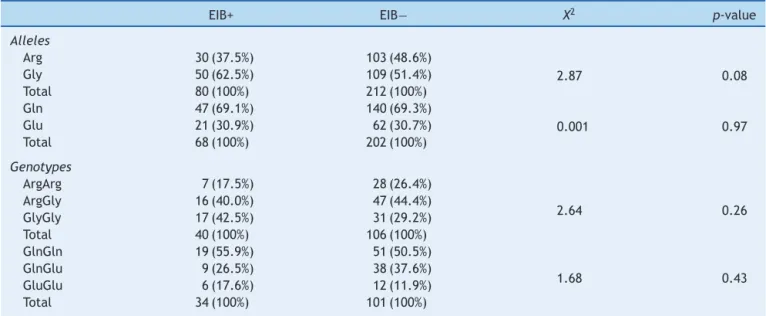
Regarding the polymorphisms of the ADRB2 gene, no significant differences were found for allele 27 and for genotypesofArg16GlyandGln27Glupolymorphismbetween the EIB+ and EIB− groups (p=0.26; p=0.97 and p=0.43, respectively).However,therewasatrendtoward statisti-calsignificancefor agreater proportionofpolymorphisms atallele16intheEIB+groupwhencomparedtotheEIB− (p=0.08)(Table2).
The percentage of maximum FEV1 decrease showed a moderate correlation with the presence of asthma (rho=0.47;p<0.01).However,forthevariablesBMIz-score (rho=0.01),WC(rho=0.20),polymorphismsArg16Gly(−0.01) and Gln27Glu (rho=−0.07) showed no significant correla-tions.
Discussion
The aim of this study was to determine the influence of polymorphismsintheADRB2 geneonthetriggering ofEIB in adolescents. There were no significant differences in frequencies for allele 27 and for the genotypes of allele
Arg16GlyandGln27GluintheEIB+groupcomparedtothe EIB−,whichpartlyrefutesourinitialhypothesis.However, therewasatrendtowardstatisticalsignificanceforahigher frequencyofallele16intheEIB+groupwhencomparedto theEIB−.Thisfindingmayberegardedasevidenceofthe associationbetweenpolymorphismsintheADRB2geneand thepresenceofEIB.
IndividualsdiagnosedwithEIB+havereducedpulmonary functioncomparedtoEIB−individuals,exceptforFVC(%of predicted),whichdidnotdifferbetweenthetwogroups.23
Ontheotherhand,previousstudiesdidnotidentifysuch differenceswhen assessingobeseadolescents,3 andobese asthmatics24 and obese individuals with rhinitis.25 These divergences may be explained by differences in age and initialheightofthegroupsinthepresentstudy.
Table1 Anthropometricandbaselinespirometriccharacteristicsofthegroupspresent(+)andabsent(−)exercise-induced bronchospasm.
Variables EIB+
(n=45)
EIB− (n=115)
torU p-value
Age(years)a 13.6±1.6 14.5±1.5** 4.05 0.00
Bodymass(kg) 65.0±15.2 74.5±18.3** −3.09 0.00
Height(cm) 160.4±9.4 165.5±8.9** −3.18 0.00
BMI(kg/m2) 25.3±5.5 27.0±5.3 −1.88 0.06
BMIz-score 1.6±1.3 1.9±1.2 −1.30 0.19
WC(cm) 84.6±13.6 84.9±13.9 1.57 0.12
VEF1(L) 2.9±0.5 3.4±0.6** −4.28 0.00
FEV1(%predicted) 95.4±10.8 102.0±18.8* −2.21 0.02
FVC(L) 3.4±0.7 3.9±0.8** −3.57 0.00
FVC(%predicted) 102.3±12.2 106.0±13.4 −1.61 0.10
FEV1/FVC(%)a 86.7±10.3 88.5±7.0* 2.01 0.04
BMI,bodymassindex;WC,waistcircumference;FEV1,forcedexpiratoryvolumeinonesecond;FVC,forcedvitalcapacity;FEV1/FVC,
FEV1/FVCratio.
Valuesexpressedinmean±standarddeviation.
* p<0.05. ** p<0.01.
a Variableswithoutnormaldistribution.
Table2 FrequencyofallelesandgenotypesofADRB2genebetweenthegroupspresent(+)andabsent(−)exercise-induced bronchospasm.
EIB+ EIB− X2 p-value
Alleles
Arg 30(37.5%) 103(48.6%)
2.87 0.08
Gly 50(62.5%) 109(51.4%)
Total 80(100%) 212(100%)
Gln 47(69.1%) 140(69.3%)
0.001 0.97
Glu 21(30.9%) 62(30.7%)
Total 68(100%) 202(100%)
Genotypes
ArgArg 7(17.5%) 28(26.4%)
2.64 0.26
ArgGly 16(40.0%) 47(44.4%)
GlyGly 17(42.5%) 31(29.2%)
Total 40(100%) 106(100%)
GlnGln 19(55.9%) 51(50.5%)
1.68 0.43
GlnGlu 9(26.5%) 38(37.6%)
GluGlu 6(17.6%) 12(11.9%)
Total 34(100%) 101(100%)
Arg,arginine;Gly,glycine;Gln,glutamine;Glu,glutamicacid;valuesexpressedinabsoluteandrelativefrequencies.
provocationtestontreadmillandinthestudyofCichalewski et al.,26 it was performed 45min after a physical educa-tionclass.On the other hand, neitherstudy identifiedan associationbetweenEIBandBMI.
Nopreviousstudieswerefoundtoassessthefrequencyof ADRB2polymorphismsinindividualswithandwithoutEIB.In thisstudy,thefrequencyofalleleGly16was62.5%and30.7% foralleleGlu27.Theproportionofthefirstwashigherthan theonefoundinastudyinasthmatics,whichwas46.6%.8 However,it is similartothe findingsfor the general pop-ulation(61%).27 The frequencyof alleleGlu27wassimilar betweenthestudies.8,27
AstudycarriedoutbySnyderetal.28observedinhealthy adults that individuals with the Arg16Arg and Gly16Gly
outbyFukuietal.30showedthatindividualswithincreased responsivenesstomethacholinechallengetesthada poly-morphismatcodon16.EIBcanbeconsideredanexaggerated airwayresponse.1Thus,itwasexpectedthatpolymorphisms hadaneffectonthebronchoconstrictorresponseto exer-cise,whichultimatelydidnotoccur.
Thecross-sectionalstudydesignlimitsthecausal associa-tionsbetweenthevariables.Anotherissuetobeemphasized asa limiting factor is the low number of participants for theanalysisofgeneticpolymorphisms,leadingtoacautious interpretationofthestudyfindings.Wesuggeststudieswith largersamplesizestoconfirmtheassociationbetweenthe presenceoftheGly16alleleandthemanifestationofEIB. Furtherstudiesarerequiredwiththecontrolofthe afore-mentionedlimitationsandtheuseofspirometryattimes3; 5;10;15and30minafterbronchialprovocation challenge teststopreventpossibleEIBmisdiagnosis.
Weconcludethatthepresenceofpolymorphisms associ-atedwithGlu27alleleandArg16GlyandGln27Glugenotypes did not influence EIB expression. However, the statistical trendforincreasedfrequencyofalleleGly16inindividuals withEIBcanbeconsideredanindicationoftheinfluenceof polymorphismsonthegeneADBR2inEIBinadolescents.
Funding
Fundac¸ãoAraucária,processn.19.281.
Conflicts
of
interest
The authors declare no conflicts of interest. LFA is a researcherat AraucariaFoundation, LRSisCapes doctoral fellow,WALisCNPqdoctoralfellow,CRCandNLhaveCNPq productivitygrants.
References
1.Weiler JM, Anderson SD, Randolph C, Bonini S, Craig TJ, Pearlman DS, et al. Pathogenesis, prevalence, diagnosis, and management ofexercise-induced bronchoconstriction: a practice parameter. Ann Allergy Asthma Immunol. 2010;105 Suppl.6:1---47.
2.JohannsonH,NorlanderK,HedenströmH,JansonC,Nordang L, Nordvall L, et al. Exercise-induced dyspnea is a prob-lem among the general adolescent population. Respir Med. 2014;108:852---8.
3.Lopes WA, Rosário N, LeiteN. Broncoespasmo induzido pelo exercícioemadolescentesasmáticosobesosenãoobesos.Rev PaulPediatr.2010;28:36---40.
4.Poulain M,Doucet M, Major GC,Drapeau V,Sériès F,Boulet LP, et al. The effect of obesity on chronic respiratory dis-eases: pathophysiology and therapeutic strategies. CMAJ. 2006;174:1293---9.
5.OliveiraMA,LeiteN.Asmabrônquica,doenc¸aobstrutiva pul-monar eexercíciofísico.In: Nabil G, Dioguardi GS, editors. Cardiologiadoesporteedoexercício.SãoPaulo:Atheneu;2007. p.443---54.
6.WelshL,KempJG,RobertsRG.Effectsofphysical condition-ing on children and adolescents with asthma. Sports Med. 2005;35:127---41.
7.HillJO,WyattHR,PetersJC.Energybalanceandobesity. Cir-culation.2012;126:126---32.
8.PaivaAC,MarsonFA,RibeiroJD,BertuzzoCS.Asthma:Gln27Glu andArg16Glypolymorphismsofthebeta2-adrenergicreceptor geneasriskfactors.AllergyAsthmaClinImmunol.2014;10:8.
9.AngeliCB,KimuraL,AuricchioMT,VicenteJP,MatteviVS, Zem-brzuskiVM,etal.Multilocusanalysesofsevencandidategenes suggestinteractingpathwaysforobesity-relatedtraitsin Brazil-ianpopulations.Obesity(SilverSpring).2011;19:1244---51.
10.TurnerSW,KhooSK,LaingIA,PalmerLJ,GibsonNA,RyeP,etal. Beta2adrenoceptorArg16Glypolymorphism,airway responsive-ness,lungfunctionandasthmaininfantsandchildren.ClinExp Allergy.2004;34:1043---8.
11.Alexander SP, Mathie A, Peters JA. Guide to receptors and channels(GRAC),5thedition.BrJPharmacol.2011;164Suppl. 1:S1---324.
12.AntonelliA,TorchioR,BertolacciniL,TerziA,RolfoF,Agostini P,etal. Contributionof2-adrenergicreceptorsto exercise-induced bronchodilatation in healthy humans. RespirPhysiol Neurobiol.2012;184:55---9.
13.FusoL, DiPerna A, LongobardiA, TrovéA, BiscegliaM, Bibi BF,etal.PolymorphismofBeta2-adrenoceptorandregularuse offormoterolinasthma:preliminary results.ISRNPulmonol. 2013;2013:1---6.
14.ParsonsJP,HallstrandTS,MastronardeJG,KaminskyDA,Rundell KW,HullJH,etal.AnofficialAmericanThoracicSocietyclinical practiceguideline:exercise-inducedbronchoconstriction.AmJ RespirCritCareMed.2013;187:1016---27.
15.LeiteN,LazarottoL,MilanoGE,TitskiAC,ConsentinoCL,Mattos F,etal.ADRB2geneassociationwithoverweightandasthma inchildrenandadolescentsanditsrelationshipwithphysical fitness.RevPaulPediatr.2015;33:381---6.
16.Publicac¸ões de Turismo [página na Internet]. Cálculo amostral: calculadora on-line. Available at: http://www. calculoamostral.vai.la[accessed03.02.15].
17.World Health Organization. WHO child growth standards: length/height-for-age, weight-for-age, weight-for-length, weight-forheightand bodymassindex-for-age:methodsand development.Geneva:WHO;2006.
18.FernándezJR,ReddenDT,PietrobelliA,AllisonDB.Waist cir-cumference percentiles in nationally representative samples ofAfrican-America,European-American,andMexican-American childrenandadolescents.JPediatr.2004;145:439---44. 19.SociedadeBrasileiradePneumologiaeTisiologia.IIIConsenso
Brasileirodemanejodaasma.JPneumol.2002;28:S6---51. 20.KnudsonRJ,SlatinRC,LebowitzMD,BurrowsB.Themaximal
expiratoryflow-volumecurvenormalstandards,variability,and effectsofage.AmRevRespirDis.1976;113:587---600. 21.TanakaH,MonahanKD,SealsDR.Age-predictedmaximalheart
raterevisited.JAmCollCardiol.2001;37:153---6.
22.DanceyC,ReidyJ.Estatísticasemmatemáticaparapsicologia: usandoSPSSparaWindows.PortoAlegre:Artmed;2006. 23.Vogt B, FalkenbergC,Weiler N, Frerichs I.Pulmonary
func-tion testing in children and infants. Physiol Meas. 2014;35: 59---90.
24.UlgerZ,DemirE,Tanac¸R,Göks¸enD,GüllenF,DarcanS,etal. Theeffectofchildhoodobesityonrespiratoryfunctiontestsand airwayhyperresponsiveness.TurkJPediatr.2006;48:43---50. 25.Rakkhong K, Kamchaisatian W, Vilaiyuk S, Sasisakulporn C,
Teawsomboonkit W, Pornsuriyasak P, et al. Exercise-induced bronchoconstrictioninrhinitischildrenwithoutasthma.Asian PacJAllergyImmunol.2011;29:278---83.
26.Cichalewski Ł, Majak P, Jerzy´nska J, Stelmach W, Kacz-marek A, MalewskaK, et al.Prevalence of exercise-induced cough in schoolchildren: a pilotstudy. Allergy Asthma Proc. 2015;36:65---9.
27.Liggett SB. 2-Adrenergicreceptor pharmacogenetics. Am J RespirCritCareMed.2000;161:197---201.
airway function during exercise in healthy adults. Chest. 2006;129:762---70.
29.PapaiwannouA,ZarogoulidisP,PorpodisK,SpyratosD,Kioumis I,PitsiouG,etal.Asthma-chronicobstructivepulmonary dis-ease overlap syndrome (ACOS): current literature review. J ThoracDis.2014;6:146---51.