type and sample size: an analysis on different fragmented landscapes
Menezes, JFS.* and Fernandez, FAS.
Laboratório de Ecologia e Conservação de Populações, Departamento de Ecologia, Instituto de Biologia, Universidade Federal do Rio de Janeiro, Ilha do Fundão, CP 68020, CEP 21941-590, Rio de Janeiro, RJ, Brazil
e-mail: [email protected]
Received: February 2, 2012 – Accepted: August 14, 2012 – Distributed: August 31, 2013
Abstract
Nestedness, the pattern in which the species of a species-poor community are a subset of species-rich communities, can provide information regarding species order of extinction, which is vital knowledge for conservation biology. We tested the hypotheses that the nestedness of mammal communities in forest remnants is influenced by sampling effort, mean remnant area, range of remnant areas, matrix type, and presence or absence of forest corridors, and compared the results with multi-taxa reviews. We used 24 published datasets to test this hypothesis and ran simple regressions for each variable. Our results provide evidence that area was the main determinant of nestedness in mammalian communi-ties. We also found a significant effect on the range of areas as measured through area ratio. However we conclude that nestedness is not affected by sample size.
Keywords:nestedness, effort; matrix type, forest fragments, mammals, area.
Aninhamento em mamíferos florestais depende da área mas não do tipo da matriz
ou do tamanho amostral: uma análise com diferentes paisagens fragmentadas
Resumo
Aninhamento, o padrão no qual espécies de comunidades mais pobres são subconjuntos de comunidades mais ricas, pode fornecer informações sobre a ordem de extinção de espécies, conhecimento vital para a conservação. Testamos a hipótese que o aninhamento das comunidades de mamíferos em fragmentos florestais é influenciado pelo esforço amostral, média e variação de área dos fragmentos, assim como pela presença de corredores florestais e pelo tipo de matriz circundante, e comparamos com revisões multi-taxa. Usamos 24 conjuntos de dados publicados para testar essa hipótese. Nossos resultados forneceram evidencia de que a área foi o principal determinante do aninhamento de comunidades de mamíferos. Nós também concluímos que aninhamento não é afetado por esforço amostral.
Palavras-chave: aninhamento, esforço amostral, matriz, fragmentos florestais, mamíferos, área.
1. Introduction
The concept of nested subsets (Patterson and Atmar, 1986) proposes that species which form an impoverished insular biota are a non-random subset of the ones found in species-rich biotas. In a perfectly nested structure, all species from poorer communities are present in richer communities, whereas the reverse is not true (Patterson, 1987; Patterson and Atmar, 1986). Although perfect nestedness is seldom found in nature, natural communi-ties are often more nested than what would be expected by chance (Patterson, 1990; Worthen, 2011; Wright et al., 1998), and the degree of nestedness varies among communities (Wright et al., 1998).
Besides true (geographical) islands, nestedness can also be found in fragmented landscapes where this pat-tern is brought about mostly by extinction after habitat remnants become isolated (Cutler, 1991; Wright et al., 1998). Extinction-generated nested patterns in
frag-mented landscapes are of particular interest for conserva-tion, as they imply a predictable order for the loss of spe-cies (Ganzhorn and Eisenbeiss, 2001; Martinez-Morales, 2005). Such an order, coupled with inferences on the numbers of species taken from species-area relation-ships, can be used to predict which species will be lost following an eventual reduction in the area of available habitats (Macdonald and Brown, 1992). Because of this application, understanding what processes affect nested-ness in fragmented landscapes is important for conserva-tion (Fischer and Lindenmayer, 2005).
only be shown by comparing communities with different richness (and thus fragments with different sizes) within a landscape, the range of differences in size among rem-nants may influence nestedness. In a wide discrepancy scenario, the smallest fragments would contain a more restricted fraction of the largest fragment’s biota than in a low discrepancy situation. Therefore, we expect that nes-tedness would increase along with fragment size range.
Another factor affecting nestedness in fragmented landscapes is the type of the matrix between fragments. Several studies have pointed to the matrix for its impor-tance in fragmented landscapes (see Prevedello and Viei-ra, 2009), as the matrix – interacting with the species’ features - affects isolation and thus extinction rates (Lau-rance, 1991; Viveiros de Castro and Fernandez, 2004; Watling and Donnelly, 2006). However, few studies in fragmented areas have considered the importance of the matrix for nestedness (Watling and Donnelly, 2006; Wright et al., 1998).
Two other factors which have seldom been studied as determinants of nestedness are sampling effort and the presence or absence of corridors. Although the effects of these variables on species richness have been studied (Torre et al., 2004), their effects on nestedness have never been tested explicitly. The lack of information about the importance of sampling effort is most concern-ing, because a small sampling effort would result in a sample bias towards common species, and therefore make community composition similar between sites, thereby decreasing estimated nestedness.
We also addressed the effect of time after isolation on nestedness. We reason that time might affect the nestedness values, as studies indicate that the processes generating nestedness changes through time (Meyer and Kalko, 2008; Watling et al., 2009). We hypothesise that nestedness should be lower in newly fragmented regions, as it tends to lean towards an asymptote.
Although several studies on the determinants of nestedness have been carried out, most of them analysed only a single landscape (e.g. Cutler, 1991; Fischer and Lindenmayer, 2005; Martinez-Morales, 2005; Nupp and Swihart, 2000; Wang et al., 2010). This might produce results that lack generality, which may explain the ab-sence of a general pattern (Wright et al., 1998). There-fore, a comparative analysis of different landscapes could be a more fruitful approach. However, existing re-views went straight for the other extreme of investigating nestedness by pooling data of different taxa and land-scape types (Watling and Donnelly, 2006; Wright et al., 1998). Therefore, their results may be of little use in the conservation framework, as they have little applicability for specific taxa. Thus, in this article we address the ef-fect of the variables mentioned above (mean fragment size, variation in fragment size, matrix type, time since isolation, sampling effort and presence of forest corri-dors) on nestedness, specifically addressing non-volant forest-dwelling mammals on a global scale.
Non-volant mammals in fragmented landscapes are a useful category for our study. They are the second most
studied group, regarding the importance of the matrix in fragmented landscapes (Prevedello and Vieira, 2009). Also, most studies on this taxon are based on community richness and composition (Prevedello and Vieira, 2009). Therefore they contain information which can be con-verted to presence-absence information. Besides, we choose forest fragments due to logistical reasons as well. Forest fragments are usually easily distinguished from the matrix, and in general the species which inhabit the matrix and the forest are different, thus avoiding con-founding the communities of both types of habitat.
Summing up, we aim to test if the variables pointed as drivers of nestedness by multi-taxa global and gle-taxa local studies have the same effect on a sin-gle-taxa global scale. Therefore, we test if the nestedness of non-volant forest mammals is affected by the variables analysed, and compare the results with previous multi-taxa reviews (Watling and Donnelly, 2006; Wright et al., 1998).
2. Materials and Methods
To analyse the effects of all the variables on the de-gree of nestedness in fragmented forests, we searched for studies that included information on occurrence and/or abundance of mammals in different fragments to be able to calculate nestedness. We used the ISI Web of Knowl-edge®and the following searching expressions: (matrix OR community) AND (fragments OR remmants OR patches OR fragmentation) AND mammals. We set all the keywords to be searched in “topic”. This search re-turnedc.988 matches.
We considered only forest-dwelling non-flying mammal species in order to reduce specific differences. We considered a landscape, i.e. a set of fragments which the authors analysed together, as our sampling unit. Hence, studies which analysed multiple landscapes con-tributed with multiple points to our analysis. From each source article, we recorded the analysed variables, when-ever this information was available. We excluded any control plots or sampling in continuous forests, due to the following problems. Such sites might have a richer fauna and/or being isolated from the set of fragments. There-fore, we cannot guarantee that they have a non-over-lapping set of biomes, and a common biological ancestry. These conditions are fundamental to nestedness (Wang et al., 2010).
To calculate the nestedness of each mammal commu-nity we used the NODF metric (Nestedness metric based on Overlap and Decreasing Fill, Almeida-Neto et al., 2008), because NODF is less affected by the size of the presence-absence matrix than other available metrics (Almeida-Neto et al., 2008). The value of NODF was cal-culated using the softwareANINHADO(Guimarães and Guimarães, 2006).
ex-pected to be related to isolation which in turn depends on matrix permeability, we expected a negative relation be-tween nestedness and this index of permeability. We based our scores on the assumption that the permeability of the matrix is correlated with its structural resemblance to the original forest (Gascon et al., 1999).
We used the following scores to assign a permeabil-ity value to a matrix: 1 for an urban or suburban matrix, 2 for pastures, 3 for regular plantations, 4 for shrub vegeta-tion or natural grasslands, 5 for tree plantavegeta-tions and 6 for secondary and regenerating forests. If a matrix had com-ponents which fell in two or more different classes, a mean between the indexes was used as the matrix index.
We used three metrics to quantify the effect of area: the mean area of the fragments in each landscape, the size range (area of the largest fragment minus the area of the smallest fragment), and the size ratio (area of the largest fragment divided by the area of the smallest fragment). The two last metrics intended to express the range of fragment areas found in a given landscape. We used size range instead of standard deviation of fragment areas, be-cause many articles only provided the range, allowing only the calculation of a mean and size range. Besides, we also used size ratio because this index has been used in the important study of Wright et al. (1998), and thus it is useful for comparative purposes.
To analyse the effect of the sampling effort, we ana-lysed studies which used trap and/or walked transects as sampling methods. We used trap-nights and kilometers for movement in transects as measures of effort. Other methods were seldom used, and therefore, did not pro-vide enough data to allow statistical inference. We also considered whether the remnants were connected by cor-ridors or not, as a binary variable in the model. We ex-pected that landscapes with corridors would have lower nestedness than the ones without them, as corridors should reduce isolation (Gilbert-Norton, 2010; Rocha et al., 2010; Worthen, 1996).
Not all the articles provided information on all vari-ables. Therefore, model selection with all variables was not possible. Besides, several independent pieces of data correlated with each other (e.g. size measures). There-fore, to avoid a large number of models, with few degrees of freedom, we tested the effect of the independent vari-able on NODF through simple regressions.
3. Results
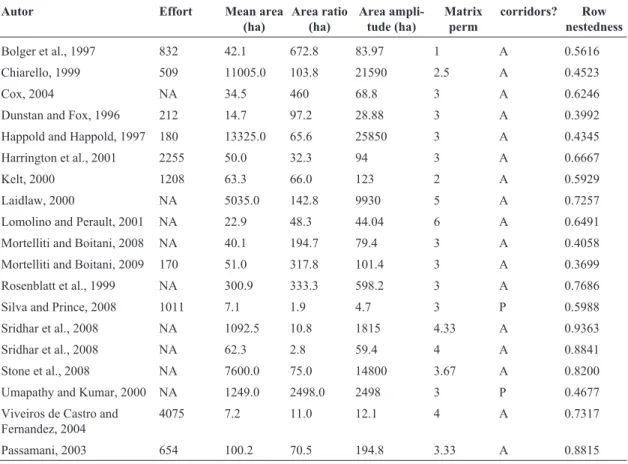
We obtained 24 articles that had the necessary data (Table 1). The studies were concentrated in South Amer-ica (34%), but North AmerAmer-ica and Asia accounted for a significant contribution (21% each). The least studied re-gion was Europe (8%). Australia accounted for 13% of the studies. Most of the matrices were composed by agri-culture (58%) only. Forests were present in 16% of matri-ces, pastures in 12.5% and urban in 8%. Lastly, Rodentia were the order which were studied the most (28% of the studies), followed by Carnivora (13%) and Insectivora (12%). Marsupials were present in 10% of the studies.
All other orders were present in less than 10% of the stud-ies.
Our simple regression indicated that only size ratio affected nestedness. We found a negative relationship between area ratio and nestedness (Table 2), the opposite of the pattern found in other studies (Wright et al., 1998). It is worth keeping in mind that our regressions differ in sample sizes as not all articles sampled brought informa-tion for all variables.
4. Discussion
Our results disagree with the literature. One of the multi-taxa meta-analysis also indicates the absence of re-lation between matrix type and nestedness (Watling and Donnelly, 2006), contrasting with the importance of ma-trix for population persistence (Fischer and Linden-mayer, 2005; Viveiros de Castro and Fernandez, 2004). We can conclude that nestedness is not affected by matrix type, in spite of the growing body of evidence in litera-ture that points out the importance of the matrix for per-sistence and dispersal among populations (Franklin and Lindenmayer, 2009).
The effect of sample size in different landscapes had not been compared yet. To our knowledge, the few stud-ies that evaluated the effect of sample size on nestedness focused on webs of interactions (Nielsen and Bascompte, 2007). Besides, we add to the discussion by providing a test with independent samples, instead of resampling the same community with different effort. We found results similar to previous studies; mean nestedness was not af-fected by sample size. The explanation provided by Niel-sen and Bascompte (2007) can explain the effect on fragments. Even if some specialist species were not sam-pled, the structure would still be perceived, as richness in larger fragments would still be larger. However, it is im-portant to note that sample size also affects matrix size and fill (Nielsen and Bascompte, 2007). Nestedness met-rics answer differently to these characteristics (Almei-da-Neto, 2008). Thus, the choice of metric affects the sensitivity of the study to sample size. From Almeida-Neto (2008)’s correlations, we can infer that standardised NODF is the least sensible metric for sample size, and therefore we recommend it for future studies. This find-ing also simplifies the complex discussion on null mod-els. Ulrich et al. (2009) pointed out that some null models do consider passive sampling, although it is confused with sampling bias. We now provide evidence that the ef-fect of sampling bias is negligible, therefore models like RANDOM1 (Cutler et al., 1994) are in fact controlling passive sampling and mass effect dynamics. Additionaly, the independence of sampling effort enhances the value of equiprobable null models. Ulrich et al. (2009) pointed out that one of the flaws of this model is its susceptability to sample size. Therefore, our results vindicate methods which had been disregarded for being sample sensitive.
and nestedness. Multi-taxa analyses have also found this relation, but with positive correlations (Watling and Donnelly, 2006; Wright et al., 1998). This difference might result from the spatial scale of our work. It is possi-ble that the fragments analysed were distant enough to
promote a turnover of species. Therefore, nestedness would be low. However, this paper only has data to de-scribe the pattern, not the process. We think that size ratio is often the best way of expressing the effect of size varia-tion on nestedness.
Table 1- Summary of the studies used in this analysis. Sampling effort was measured with the number of individuals captured or sighted. Mean area refers to the mean of the remnants area. Area ratio is calculated as the maximum area divided by the minimum. The matrix perm is a semi-quantitative index of permeability of the matrix surrounding the remnants. Corridors is a categorical variable addressing the presence (P) or absence (A) of corridors. Row nested is the value of the NODF nestedness index, referring only to nestedness between remnants. NA indicates that data is not available.
Autor Effort Mean area
(ha)
Area ratio (ha)
Area ampli-tude (ha)
Matrix perm
corridors? Row nestedness
Bolger et al., 1997 832 42.1 672.8 83.97 1 A 0.5616
Chiarello, 1999 509 11005.0 103.8 21590 2.5 A 0.4523
Cox, 2004 NA 34.5 460 68.8 3 A 0.6246
Dunstan and Fox, 1996 212 14.7 97.2 28.88 3 A 0.3992
Happold and Happold, 1997 180 13325.0 65.6 25850 3 A 0.4345
Harrington et al., 2001 2255 50.0 32.3 94 3 A 0.6667
Kelt, 2000 1208 63.3 66.0 123 2 A 0.5929
Laidlaw, 2000 NA 5035.0 142.8 9930 5 A 0.7257
Lomolino and Perault, 2001 NA 22.9 48.3 44.04 6 A 0.6491
Mortelliti and Boitani, 2008 NA 40.1 194.7 79.4 3 A 0.4058
Mortelliti and Boitani, 2009 170 51.0 317.8 101.4 3 A 0.3699
Rosenblatt et al., 1999 NA 300.9 333.3 598.2 3 A 0.7686
Silva and Prince, 2008 1011 7.1 1.9 4.7 3 P 0.5988
Sridhar et al., 2008 NA 1092.5 10.8 1815 4.33 A 0.9363
Sridhar et al., 2008 NA 62.3 2.8 59.4 4 A 0.8841
Stone et al., 2008 NA 7600.0 75.0 14800 3.67 A 0.8200
Umapathy and Kumar, 2000 NA 1249.0 2498.0 2498 3 P 0.4677
Viveiros de Castro and Fernandez, 2004
4075 7.2 11.0 12.1 4 A 0.7317
Passamani, 2003 654 100.2 70.5 194.8 3.33 A 0.8815
Table 2- Results of the simple regressions, showing the effect of each variable alone in the NODF index of nestedness. As
in-dicated, only ratio had a significant effect, respectively. Logarithm was employed in an attempt to normalise independent variables, and assure that all studies had values on the same scale (10^1).
Model Coefficient R2 n F p value
row nestedness ~ log(trapnights) 0.04162 0.1502 14 2.121 0.1709
row nestedness ~ log(kilometer walked in transects) -0.01124 0.01407 11 0.1285 0.7283
row nestedness ~ log(size range) -0.007434 0.01118 24 0.2488 0.6228
row nestedness ~ log(mean area) -0.005689 0.005938 24 0.1314 0.7204
row nestedness ~ log(size ratio) -0.04686 0.2395 24 6.93 0.0152
row nestedness ~ log(time since isolation) -0.006446 0.001358 16 0.01903 0.8922
row nestedness ~ matrix index 0.05109 0.09681 24 2.358 0.1389
The last variable inserted in the model was the pres-ence or abspres-ence of corridors, whose effect on nestedness had not been directly tested before. Our results indicate that corridors do not affect nestedness.
Although several reviews have analysed nestedness across taxa (Watling and Donnelly, 2006; Wright et al., 1998), this is the first one to focus only on mammalian communities in fragmented landscapes. Our finding that nestedness was not related to matrix type or to the pres-ence of corridors hinders nestedness as an indicator of anthropogenic disturbance, and therefore its use as in re-serve design (Boecklen, 1997; Donlan et al., 2005). We also found that variation in size (size ratio) affects nes-tedness (as Watling and Donnelly 2006 and Wright et al., 1998 also found out), but the absolute area value (that is, the spatial scale) does not. We also found that nestedness is independent of effort. These results, when brought to-gether, indicate that nestedness might be independent of scale. However, this is only true if the metric is insensi-tive to community fill and size. Therefore we support the use of standardised NODF as a nestedness metric for mammals and provide evidence that equiprobable null models are recommended in analysis with mammals.
Acknowledgments
To all colleagues who helped in field work and with data analysis for the dataset we produced. We are greatly in debt to Alexandra Pires, Marcelo Passamani and to Ernesto Viveiros de Castro, for his contribution to the previous versions of this article. We also thank the Fun-dação O Boticário de Proteção à Natureza for funding, and PIBIC-SR2-UFRJ and CNPq for personal grants for the first two authors.
References
ALMEIDA-NETO M., GUIMARÃES, PR., GUIMARÃES JU-NIOR, PR., LOYOLA, RD. and ULRICH, W., 2008. A consistent metric for nestedness analysis in ecological systems: reconciling concept and measurement.Oikos, vol. 117, p. 1-13.
BOECKLEN, WJ., 1997. Nestedness, biogeographic theory, and the design of nature reserves.Oecologia, vol. 112, p. 123-142.
BOLGER, DT., ALBERTS, AC., SAUVAJOT, RM., POTEN-ZA, P., MCCALVIN, C., TRAN, D., MAZZONI, S. and SOULE, ME., 1997. Response of rodents to habitat frag-mentation in coastal southern California.Ecological Ap-plications, vol. 7, p. 552-563.
CHIARELLO, AG., 1999. Effects of fragmentation of the At-lantic Forest on mammal communities in south-eastern Brazil.Biological Conservation, vol. 89, p. 71-82. COX, M., 2004. Effects of rainforest fragmentation on
non-flying mammals of the eastern Dorrigo Plateau, Australia. Biological Conservation, vol. 115, p. 175-189. CUTLER, A., 1991. Nested faunas and extinction in fragmented
habitats.Conservation Biology, vol. 5, p. 496-505. -, 1994. Nested biotas and biological conservation - metrics,
mechanisms, and meaning of nestedness.Landscape and Urban Planning, vol. 28, p. 73-82.
DONLAN, CJ., KNOWLTON, J., DOAK, DF. and BIAVAS-CHI, N., 2005. Nested communities, invasive species and
holocene extinctions, p. evaluating the power of a poten-tial conservation tool.Oecologia, vol. 145, p. 475-485. DUNSTAN, CE. and FOX, BJ., 1996. The effects of
fragmenta-tion and disturbance of rainforest on ground-dwelling small mammals on the Robertson plateau, New South Wales, Australia. Journal of Biogeography, vol. 23, p. 187-201.
FISCHER, J. and LINDENMAYER, D.B., 2005. Nestedness in fragmented landscapes: a case study on birds, arboreal marsupials and lizards.Journal of Biogeography, vol. 32, p. 1737-1750.
FRANKLIN, JF. and LINDENMAYER, DB., 2009. Importance of matrix habitats in maintaining biological diversity. Proceedings of the National Academy of Science, vol. 106, p. 349-350.
GANZHORN, JU. and EISENBEISS, B., 2001. The the concept of nested species assemblages and its utility for under-standing effects of habitat fragmentation.Basic and Ap-plied Ecology, vol. 2, p. 87-99.
GASCON, C., LOVEJOY, TE., BIERREGAARD, RO., MAL-COLM, JR., STOUFFER, PC., VASCONCELOS, HL., LAURANCE, WF., ZIMMERMAN, B., TOCHER, M. and BORGES, S., 1999. Matrix habitat and species rich-ness in tropical forest remnants.Biological Conservation, vol. 91, p. 223-229.
GILBERT-NORTON, L., WILSON, R., STEVENS, JR. and BEARD, KH., 2010. A meta-analytic review of corridor effectiveness.Conservation Biology, vol. 24, p. 660-668. GUIMARÃES JUNIOR, PR. and GUIMARÃES, P., 2006. Im-proving the analyses of nestedness for large sets of matri-ces. Environmental Modeling and Software, vol. 21, p. 1512-1513.
HAPPOLD, DCD. and HAPPOLD, M., 1997. Conservation of mammals on a tobacco farm on the highlands of Malawi. Biodiversity and Conservation, vol. 6, p. 837-852. HARRINGTON, GN., FREEMAN, AND. and CROME, FHJ.,
2001. The effects of fragmentation of an Australian tropi-cal rain forest on populations and assemblages of small mammals.Journal of Tropical Ecology, vol. 17, p. 225-240.
KELT, DA., 2000. Small mammal communities in rainforest fragments in central southern Chile.Biological Conserva-tion, vol. 92, p. 345-358.
LAIDLAW, RK., 2000. Effects of habitat disturbance and pro-tected areas on mammals of peninsular Malaysia. Conser-vation Biology, vol. 14, p. 1639-1648.
LAURANCE, WF., 1991. Ecological correlates of extinction proneness in australian tropical rain-forest mammals. Conservation Biology, vol. 5, p. 79-89.
LOMOLINO, MV. and PERAULT, DR., 2001. Island biogeo-graphy and landscape ecology of mammals inhabiting fragmented, temperate rain forests. Global Ecology & Biogeography, vol. 10, p. 113-132.
MacARTHUR, R. H. and WILSON, EO., 1967.The theory of is-land biogeography. Princeton: Princeton University Press. 203 p.
MARTINEZ-MORALES, MA., 2005. Nested species assem-blages as a tool to detect sensitivity to forest fragmenta-tion: the case of cloud forest birds. Oikos, vol. 108, p. 634-642.
McDONALD, KA. and BROWN, JH., 1992. Using montane mammals to model extinctions due to global change. Con-servation Biology, vol. 6, p. 409-415.
model analyses of species co-occurrence patterns. Diver-sity and Distributions, vol. 14, p. 644-654.
MORTELLITI, A. and BOITANI, L., 2008. Evaluation of scent-station surveys to monitor the distribution of three european carnivore species (martes foina,meles meles, vulpes vulpes) in a fragmented landscape.Mammalian Bi-ology- Zeitschrift fur Saugetierkunde, vol. 73, p. 287-292. -, 2009. Distribution and coexistence of shrews in patchy
land-scapes: A field test of multiple hypotheses. Acta Oecologica, vol. 35, p. 797-804.
NIELSEN, A. and BASCOMPTE, J., 2007. Ecological net-works, nestedness and sampling effort.Journal of Ecol-ogy, vol. 95, p. 1134-1141.
PASSAMANI, M., 2003.O efeito da fragmentação da mata atlântica serrana sobre a comunidade de pequenos ma-míferos de Santa Teresa, Espírito Santo. Rio de Janeiro: Universidade Federal do Rio de Janeiro. 105 p. Tese de Doutorado em Ecologia.
PATTERSON, BD., 1987. The principle of nested subsets and its implications for biological conservation.Conservation Biology, vol. 1, p. 323-334.
-, 1990. On the temporal development of nested subset patterns of species composition.Oikos, vol. 59, p. 330-342. PATTERSON, BD. and ATMAR, W., 1986. Nested subsets and
the structure of insular mammalian faunas and archipela-gos.Biological Journal of the Linnean Society, vol. 28, p. 65-82.
PREVEDELLO, JA. and VIEIRA, MV., 2009. Does the type of matrix matter? A quantitative review of the evidence. Biodiversity and Conservation, vol. 19, p. 1205-1223. ROCHA, MF., PASSAMANI, M. and LOUZADA, J., 2011. A
small mammal community in a forest fragment, vegeta-tion corridor and coffee matrix system in the Brazilian At-lantic forest.PloS one, vol. 6, e23312.
ROSENBLATT, DL., HESKE, EJ., NELSON, SL., BARBER, DM. and MACALLISTER, MAMAB., 1999. Forest frag-ments in east-central Illinois: islands or habitat patches for mammals? American Midland Naturalist, vol. 141, p. 115-123.
NUPP, TE. and SWIHART, RK., 2000. Landscape-Level Cor-relates of Small-Mammal Assemblages in Forest Frag-ments of Farmland. Journal of Mammalogy, vol. 81, p. 512-526.
SILVA, M. and PRINCE, ME., 2008. The conservation value of hedgerows for small mammals in Prince Edward Island,
Canada.American Midland Naturalist, vol. 159, p. 110-124.
SRIDHAR, H., RAMAN, TRS. and MUDAPPA, D., 2008. Mammal persistence and abundance in tropical rainforest remnants in the southern Western Ghats, India.Current Science, vol. 94, p. 748-757.
STONE, AI., LIMA, EM., AGUIAR, GFS., CAMARGO, CC., FLORES, TA., KELT, DA., MARQUES-AGUIAR, SA., QUEIROZ, JAL., RAMOS, RM. and SILVA JÚNIOR, JS., 2008. Non-volant mammalian diversity in fragments in extreme eastern Amazonia.Biodiversity and Conserva-tion, vol. 18, p. 1685-1694.
TORRE I., ARRIZABALAGA, A. and FLAQUER, C., 2004. Three methods for assessing richness and composition of small mammal communities. Journal of Mammalogy, vol. 85:524-530.
UMAPATHY, G. and KUMAR, A., 2000. The occurrence of ar-boreal mammals in the rain forest fragments in the Ana-malai Hills, south India.Biological Conservation, vol. 92, p. 311-319.
ULRICH, W., ALMEIDA-NETO, M. and GOTELLI, N. J., 2009. A consumer’s guide to nestedness analysis.Oikos, vol. 118, p. 3-17.
VIVEIROS DE CASTRO, EB. and FERNANDEZ, FAS., 2004. Determinants of differential extinction vulnerabilities of small mammals in Atlantic Forest fragments in Brazil. Bi-ological Conservation, vol. 119, p. 73-80.
WANG, Y., BAO, Y., YU, M., XU, G. and DING, P., 2010. Nestedness for different reasons: the distributions of birds, lizards and small mammals on islands of an inun-dated lake.Diversity and distributions, vol. 16, p. 862-873.
WATLING, JI. and DONNELLY, MA., 2006. Fragments as is-lands: A synthesis of faunal responses to habitat patchi-ness.Conservation Biology, vol. 20, p. 1016-1025. WATLING, JI., GEROW, K. and DONNELLY, MA., 2009.
Nested species subsets of amphibians and reptiles on Neo-tropical forest islands. Animal Conservation, vol. 12, p. 467-476.
WORTHEN, WB., 1996. Community composition and nested-subset analyses: basic descriptors for co mmunity ecol-ogy.Oikos, vol. 76, p. 417-426.