No nco nve ntio nal am ide bo nd fo rm atio n
catalysis: pro gram m ing e nzym e
spe cificity with substrate m im e tics
Max-Planck Society, Research Unit “Enzymology of Protein Folding”, Halle/Saale, Germany
Department of Biochemistry, Faculty of Biosciences,
Pharmacy and Psychology, University of Leipzig, Leipzig, Germany F. Bordusa
Abstract
This article reports on the design and characteristics of substrate mimetics in protease-catalyzed reactions. Firstly, the basis of pro-tease-catalyzed peptide synthesis and the general advantages of sub-strate mimetics over common acyl donor components are described. The binding behavior of these artificial substrates and the mechanism of catalysis are further discussed on the basis of hydrolysis, acyl transfer, protein-ligand docking, and molecular dynamics studies on the trypsin model. The general validity of the substrate mimetic concept is illustrated by the expansion of this strategy to trypsin-like, glutamic acid-specific, and hydrophobic amino acid-specific pro-teases. Finally, opportunities for the combination of the substrate mimetic strategy with the chemical solid-phase peptide synthesis and the use of substrate mimetics for non-peptide organic amide synthesis are presented.
Co rre spo nde nce
F. Bordusa
Max-Planck Society, Research Unit “Enzymology of Protein Folding” Weinbergweg 22
D-06120 Halle/Saale Germany
Fax: + 49-345-551-1972 E-mail: bordusa@ uni-leipzig.de
Research supported by the Deutsche Forschungsgemeinschaft (JA 559/9-1 and INK 23), and Fonds der Chemischen Industrie, ASTA Medica AG, and Fluka AG.
Presented at the XXVIII Annual Meeting of the Brazilian Society of Biochemistry and Molecular Biology, Caxambu, MG, Brasil, May 22-25, 1999.
Received November 5, 1999 Accepted January 3, 2000
Ke y wo rds
·Bioorganic chemistry ·Enzyme catalysis ·Peptide synthesis ·Proteases
·Substrate mimetics
Intro ductio n
In addition to the natural function of en-zymes, their capability of catalyzing selec-tive transformations also makes these bio-molecules useful catalysts in synthetic or-ganic chemistry. The enzyme of choice for the synthesis of peptides or proteins should be the ribosomal peptidyl transferase or, al-ternatively, the microbial nonribosomal mul-tienzyme complexes. Both enzyme systems catalyze the synthesis of peptides and pro-teins in vivo with remarkable properties, i.e., high reaction rates, independence of the side-chain functions of the amino acids, mild reaction conditions using water as solvent, regio- and stereospecificity and, therefore,
peptide antibiotics (2) are only limited to special purposes. Owing to the prediction of the general reversibility of chemical reac-tions by vant Hoff, only the reverse hy-drolysis potential of proteases can alterna-tively be used to catalyze peptide bond for-mation. Like the original in vivo pathways of peptide synthesis, the protease-mediated pep-tide bond formation occurs with a compa-rable high degree of regio- and stereospeci-ficity and, furthermore, reactions can also be performed in aqueous solvents under mild reaction conditions (3-5). However, as al-ready indicated by the natural function of these enzymes for the cleavage of peptides and proteins, proteases do not act as perfect acyl transferases. The amidase activity of proteases which may cause undesirable pro-teolytic cleavages of the peptide chain formed and the limited substrate specificities of these enzymes which restricts the amino acid resi-dues accepted for coupling are the major disadvantages of this approach. This article reviews the strategy of substrate mimetics as a general and powerful concept for program-ming the substrate specificity of proteases in the direction of a more flexible utility of these enzymes as biocatalysts in synthetic organic chemistry. Furthermore, enzymologi-cal insights at the molecular level in binding of substrate mimetics and kinetics of sub-strate mimetic-mediated protease reactions are described.
Basis o f pro te ase -catalyze d pe ptide bo nd fo rmatio n
Generally, within the methods of pro-tease-catalyzed peptide bond formation two basic strategies are distinguished, i.e., a ther-modynamic and a kinetically controlled ap-proach (6). The thermodynamic strategy rep-resents the direct reversal of catalytic pro-teolysis and ends with a true equilibrium. Since this equilibrium-controlled approach is an endergonic process, manipulation of reaction conditions is essentially required to shift the equilibrium in the direction of the peptide product to increase the yield of the coupling reaction (7). In the kinetically con-trolled approach the serine or cysteine pro-tease acts as a transferase catalyzing the acyl transfer from a substrate ester to an Na -unprotected amino acid or peptide deriva-tive forming a new peptide bond. Compared to the thermodynamic strategy, the kineti-cally controlled approach is faster and usu-ally allows a more efficient manipulation resulting in higher product yields. Figure 1 illustrates the general kinetic scheme of the kinetically controlled peptide bond forma-tion. Initially, the binding of the substrate ester to the enzyme leads to a tetrahedral enzyme-substrate complex which collapses to the covalent acyl enzyme intermediate Ac-E. In the common course of protease action, the deacylation step is initiated by the attack of water finally resulting in the hy-drolysis product Ac-OH and the free enzyme EH. The value of the kinetic approach for peptide synthesis is based on the fact that Ac-E can be intercepted not only by water, but also by nucleophiles acting as amino components in peptide synthesis. The sig-nificant enhancement of esterase versus ami-dase activity of such acyl enzyme-forming proteases leads to a high rate of peptide bond formation while the rate of proteolysis of the newly formed amide bond is lower. Conse-quently, these different rates lead to a tempo-rary accumulation of the peptide product. In
EH + Ac-X EH + Ac-OH
Ks k2 k3
[E..Ac-X]
HX
HN
Ac-E
Ac-E..HN KN
k5
k4 H2O
HN
EH + Ac-N
Figure 1 - Kinetic model of a protease-catalyzed acyl transfer reaction. EH, Free enzyme; Ac-X, acyl donor; HAc-X, leaving group; Ac-E, acyl enzyme complex; Ac-OH, hydrolysis product; HN, acyl acceptor; Ac-N, aminolysis product.
contrast to proteolytic cleavage, the protease-catalyzed formation of a peptide bond is a two-substrate reaction (Figure 1). While the acyl donor binds to the S-subsite of the en-zyme the amino component acting as an acyl acceptor interacts with the S-binding site (subsite notation according to Ref. 8). The efficiency of the nucleophilic attack of the added amino component depends on an op-timal binding in the S-subsite region of the protease. Since the S-subsite specificity is an individual parameter for each enzyme, the efficiency of peptide bond formation and, thus, the synthetic utility as a biocata-lyst differs from enzyme to enzyme and can be predicted by subsite mapping based on acyl transfer studies (2).
Characteristics of protease-catalyzed kinetically controlled peptide synthesis
The synthetic value of proteases as bio-catalysts for peptide synthesis is based on a number of advantages of this approach over chemical synthesis methods. The extraordi-narily mild reaction conditions, the possibil-ity of using immobilized enzyme technology with catalyst recovery, the scope for indus-trial scale-up, and especially the high degree of regio- and stereospecificity, which guar-antees freedom from racemization and from the need for side-chain protection, represent the major advantages of the protease ap-proach. Because of these characteristics, in particular the protease-catalyzed condensa-tion of side-chain unprotected peptide frag-ments represents a promising method for the synthesis of larger peptides and even of pro-teins (9,10).
On the other hand, the classical protease approach used so far has several serious drawbacks: i) Since proteases do not func-tion as perfect acyl transferases, these en-zymes catalyze both the acyl transfer to amino components and, simultaneously, the hy-drolysis of the acyl donor components (cf. Figure 1). Thus, the resulting hydrolysis
prod-uct, which possesses a very low acylation potential, lowers the yield of the desired peptide product. ii) Most important, the speci-ficities of the available proteases do not enable all proteinogenic sequences to be assembled, and non-proteinogenic amino acids usually are not acceptable substrates of these enzymes. Therefore, only the coupling of peptide sequences closely related to pre-ferred amino acid residues is of practical relevance. iii) In the synthesis of longer pep-tides, there is a permanent risk of proteolytic side reactions both of the starting peptide fragments and the peptide product formed.
As a general result of these drawbacks, the protease approach requires a very careful planning and often time-consuming optimi-zation of the reaction conditions which usu-ally restricts the use of proteases. Therefore, a more flexible use of proteases as biocata-lysts for peptide synthesis essentially needs the development of efficient strategies to overcome the causes of the mentioned limi-tations. Besides the engineering of the reac-tion media (11-14) or the enzyme itself (15-18), the application of substrate mimetics as acyl donor components particularly appears to be a promising strategy achieving irre-versible coupling of nonspecific acyl com-ponents.
Me chanism o f pro te ase -catalyze d hydro lysis o f substrate mime tics
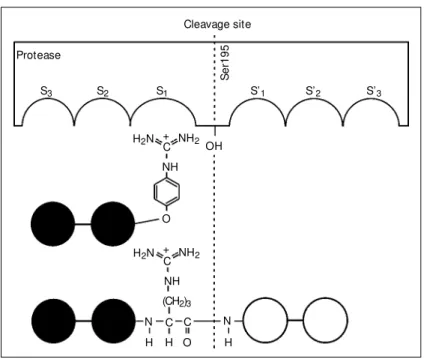
proteases that have a nonspecific acyl resi-due, but bear a highly specific leaving group. The first examples of such inhibitors were 4-amidino- and 4-guanidinophenyl esters (OGp), at that time termed as inverse esters, which were found to be hydrolyzed by these proteases nearly independent of their acyl moieties (23,24). Although this fact was first reported in 1973 (23), only little was known about the basic mechanism of the hydrolysis of these esters. On the basis of the familiar model of substrate recognition (Figure 2), conventional ester substrates bind with their acyl residue to the S-binding site of the enzyme having the leaving group at the S-subsite and the scissile ester bond between attacked by the active amino acid residue of the enzyme (Ser195 in the case of trypsin). In contrast, applying the same binding prin-ciples to inverse esters leads to a catalyti-cally unproductive binding as indicated by Figure 2. The acyl residue would bind at the S-subsite, but the scissile ester bond would be far away from the active site and could not be attacked by Ser195. Hence, hydrolysis would not occur and, therefore, cannot be
explained on the basis of the conventional model of substrate hydrolysis.
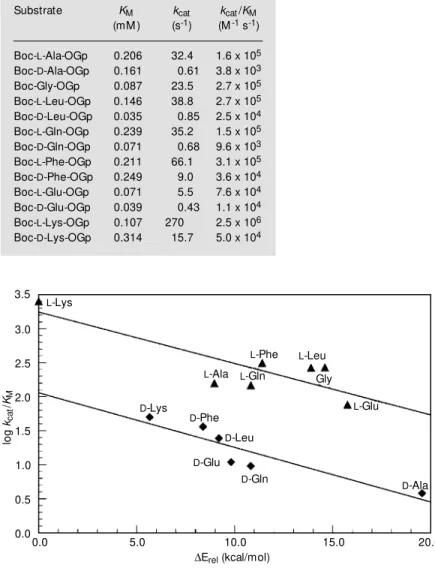
Undisputably, the elucidation and under-standing of the hydrolysis mechanism of substrate mimetics need a detailed knowl-edge of the enzyme-substrate interactions. X-ray structures of enzyme-substrate com-plexes would be helpful but are not easily accessible due to the low intrinsic stability of these esters. Alternatively, we have used a non-conventional combination of experimen-tal and theoretical approaches, i.e., hydroly-sis and aminolyhydroly-sis kinetics, protein-ligand dockings, and molecular dynamics studies, utilizing trypsin as a model catalyst to demystify the mechanism of substrate mi-metic hydrolysis (25). Table 1 indicates ki-netic data for the trypsin-catalyzed hydroly-sis of a library of Boc-Xaa-OGp substrates derived from both L- and D-amino acids. Although all substrates were hydrolyzed by the enzyme despite the lacking trypsin-spe-cific acyl moieties, the table shows differ-ences in the second order rate constants kcat/
KM of more than three orders of magnitude.
On the basis of linear free energy relation-ships, the values for kcat/KM should be equally
reflected by the calculated binding energies. Therefore, the same substrate library was computationally docked towards trypsin. The results of these studies reveal similar speci-ficity data and, therefore, lead to a good correlation between the calculated binding energies and the values for kcat/KM (Figure
3). The splitting up of the data into two sets is based on the distinct lower kcat-values
found for the D-configured substrates which cannot be simulated by the theoretical dock-ing approach. Because of the correlation between experimentally observed and theo-retically calculated specificities the enzyme-substrate complexes were analyzed in detail. A representative enzyme-substrate complex of trypsin and Boc-L-Ala-OGp was superim-posed on the trypsin-BPTI complex (26) which was found by X-ray structure analy-sis. Indicated by the trypsin-Boc-L-Ala-OGp
Cleavage site
Protease
S3 S2 S1 S’1 S’2 S’3
S
e
r1
9
5
OH NH2 H2N
C
NH
NH2 H2N C
NH O +
+
(CH2)3
N C C
O H H
N
H
complex, the OGp-group binds to the S1
-binding pocket of the enzyme like the site-specific Lys side chain of BPTI, as already postulated in Figure 2. Because of this novel binding mode we introduced the denomina-tion substrate mimetics for this type of artifi-cial protease substrates (27). Comparison of both complexes shows that despite of the OGp-binding at the S1-position of the
en-zyme the scissile ester bond of Boc-L -Ala-OGp is exactly located at the same position as the scissile peptide bond between P1
-Lys15 and P1-Ala16 in the trypsin-BPTI
complex. Interestingly, this arrangement re-sults from a reverse binding of the acyl resi-due of Boc-L-Ala-OGp which, contrary to the acyl residue of BPTI (Pro13-Cys14-Lys15), binds to the S-subsite of trypsin instead of binding to the enzymes S-subsite. Due to the correlation of data for hydrolysis and computational docking, this reverse rec-ognition should further result in the forma-tion of an acyl enzyme intermediate having the acyl residue at the S-subsite. The fol-lowing deacylation step, however, needs an unoccupied S-subsite. Thus, water can at-tack from the S-side without hindrance. Hence, prior to the deacylation step, the acyl residue has to flip to the S-subsite of the enzyme. Because of this additional interme-diate of catalysis, the kinetic model has to be extended by a rearrangement step between the two acyl enzyme species E-Ac and Ac-E characterized by the equilibrium constant KR
(Figure 4). The experimental findings show (cf. Table 1) that D-configured substrates indeed exhibit lower kcat-values which might
be related to lower KR-values. The high
cata-lytic efficiency for L-configured substrates could be explained by significantly higher rearrangement equilibrium constants. In or-der to study the dynamic behavior of various acyl residues, their time-dependent occu-pancies in the S- and S-subsites for Boc-L -Ala- and Boc-D-Ala-trypsin have been cal-culated. Both the rearrangement step itself and the preferred binding of D-configured
acyl residues to the S-subsite and L -config-ured counterparts to the S-subsite could be confirmed (25). For the experimental inves-tigation of the S-subsite accessibility, ami-nolysis studies are suitable. By their S-spe-cific binding, peptide nucleophiles should be able to push aside the acyl residue more efficiently from the S-region than water.
Table 1 - Steady-state kinetic parameters for the hydrolysis of Boc-Xaa-OGp by trypsin (25).
Conditions: 25 mM M OPS-buffer, pH 7.6, 100 mM NaCl, 5 mM CaCl2, 25oC; errors are less than 15% .
Substrate KM kcat kcat/KM (mM ) (s-1) (M-1 s-1)
Boc-L-Ala-OGp 0.206 32.4 1.6 x 10⁵ Boc-D-Ala-OGp 0.161 0.61 3.8 x 10³ Boc-Gly-OGp 0.087 23.5 2.7 x 10⁵ Boc-L-Leu-OGp 0.146 38.8 2.7 x 10⁵ Boc-D-Leu-OGp 0.035 0.85 2.5 x 10⁴ Boc-L-Gln-OGp 0.239 35.2 1.5 x 10⁵ Boc-D-Gln-OGp 0.071 0.68 9.6 x 10³ Boc-L-Phe-OGp 0.211 66.1 3.1 x 10⁵ Boc-D-Phe-OGp 0.249 9.0 3.6 x 10⁴ Boc-L-Glu-OGp 0.071 5.5 7.6 x 10⁴ Boc-D-Glu-OGp 0.039 0.43 1.1 x 10⁴ Boc-L-Lys-OGp 0.107 270 2.5 x 10⁶ Boc-D-Lys-OGp 0.314 15.7 5.0 x 10⁴
lo
g
kca
t
/
KM
3.5
3.0
2.5
2.0
1.5
1.0
0.5
0.0
L-Lys
L-Phe L-Leu
Gly
L-Gln
L-Ala
L-Glu
D-Lys
D-Phe
D-Leu
D-Glu
D-Gln
D-Ala
0.0 5.0 10.0 15.0 20.0
DErel (kcal/mol)
Therefore, the aminolysis of acyl enzymes bearing the acyl moiety in S should occur at higher rates than their hydrolysis. Conse-quently, the ratio of hydrolysis to aminoly-sis, as given by the partition value p, should be low for D-configured acyl residues and higher for their L-configured counterparts. The more their KR-values differ, the more
their p-values should vary. Indeed, the ex-perimental results show dramatically lower
p-values for the deacylation of Bz-D -Ala-than for Bz-L-Ala-trypsin. In the case of the L-Leu and D-Leu analogs, the same situation occurs but with lower differences in the p -values corresponding to the smaller differ-ences in the hydrolysis kinetic constants (Fig-ure 5). Consequently, the experimental
re-sults support this unique catalysis mechan-ism for substrate mimetics too.
Substrate m im e tics fo r Arg-spe cific pro te ase s
Beside proposing a unique catalysis mech-anism for substrate mimetics, the hydrolysis and analytical acyl transfer experiments also indicate the general ability of 4-guanidi-nophenyl esters to act as acyl donors in trypsin-catalyzed peptide syntheses. This assumption was confirmed for the first time in 1991 by model syntheses of short peptides using various nonspecific Na-protected amino acid-4-guanidinophenyl esters as acyl do-nors and several amino acid amides as acyl
Figure 5 - Partition values p for the aminolysis of Boc-D/L -Ala-OGp and Boc-D/L-Leu-OGp com-pared to the common substrate Bz-Arg-OEt by trypsin (25). Con-ditions: 0.2 M HEPES-buffer, pH 8.0, 0.2 M NaCl, 20 mM CaCl2, 25oC; [substrate]: 2 mM , [amino component]: 20 mM ; errors are less than 15% .
Figure 4 - Scheme of the extended kinetic model of a protease-catalyzed hydrolysis of substrate mimetics introducing the novel rearrangement equilibrium constant KR (25). EH, Free enzyme; Ac-X, substrate; [E..Ac-X], M ichaelis-M enten complex; HX, leaving group; E-Ac, acyl enzyme intermediate bearing the acyl residue at the S’-subsite; Ac-E, acyl enzyme intermediate bearing the acyl residue at the S-S’-subsite; Ac-OH, hydrolysis product.
S3S2S1S’1S’2S’3 EH
S3S2S1S’1S’2S’3 S3S2S1S’1S’2S’3 S3S2S1S’1S’2S’3 Ac-E
S3S2S1S’1S’2S’3 EH
Ks E..Ac-X k2 E-Ac KR k3
Ac-X HX
acceptors (28,29) and later extended by fur-ther examples (30,31). Our own studies dem-onstrated that, in addition to single amino acid derivatives, the 4-guanidinophenyl es-ter functionality also mediates coupling of nonspecific acyl moieties derived from pep-tides (Table 2) (27). Furthermore, Table 2 contains data obtained with other Arg-spe-cific proteases like thrombin and clostripain, indicating that the concept of substrate mimetics is not limited to trypsin but also holds for trypsin-like enzymes. The largely varying product yields reflect the distinct synthetic utility of the individual enzymes. Generally, the highest yields were obtained with the cysteine protease clostripain, which also provided yields of over 90% for other 4-guanidinophenyl esters of acylated amino acids. An additional decisive advantage of clostripain in substrate mimetic-mediated peptide synthesis results from its low P1
specificity for the N-terminal amino acid residue of the amino component.
A further important advantage of sub-strate mimetic-mediated synthesis reactions results from the fact that the C-terminal amino acid residue to be coupled does not function as a specificity determining moiety. Conse-quently, in contrast to enzymatic reactions using normal-type acyl donors, the peptide bond formed cannot be recognized and, there-fore, cannot be cleaved again by the enzyme. As shown by the course of the (3+5) segment condensation of Boc-Phe-Gly-Gly-Ala-Phe-Ala-Ala-Gly-OH (Figure 6), the maximum product concentration achieved after a few minutes remains unchanged after 72 h; this clearly proves the irreversibility of this C-N bond forming method.
Substrate m im e tics fo r Glu-spe cific pro te ase s
On the basis of the insights in the binding and kinetics of substrate mimetic-mediated protease-catalyzed reactions it can be con-cluded that the concept of substrate mimetics
might be a general principle in enzyme ca-talysis which is not only limited to trypsin and trypsin-like proteases. Assuming this, we expanded the substrate mimetic strategy to anionic leaving groups based on the speci-ficity determinants of Glu-specific endopep-tidase from Staphylococcus aureus (V8 pro-tease) (32).
As shown by our docking studies on the trypsin-type model, the leaving group moi-ety of a substrate mimetic binds in place of the specificity-determining amino acid side chain of common substrates (25). Thus, an important condition for this function is a high affinity of the leaving group to the primary substrate specificity of the
appropri-Figure 6 - Course of the clostri-pain-catalyzed (3+ 5) fragment condensation of Boc-Phe-Gly-Gly-OGp and H-Ala-Phe-Ala-Ala-Gly-OH (27). Gly-OGp (triangles); Boc-Phe-Gly-Gl y -A l a-Ph e -A l a-A l a-Boc-Phe-Gly-Gl y -O H (squares); Boc-Phe-Gly-Gly-OH (circles). Condit ions: 50 m M HEPES-buffer, pH 8.0, 100 mM NaCl, 10 mM CaCl2, 25oC; [clos-tripain]: 1.6 µM , [acyl donor]: 2 m M , [H-Ala-Phe-Ala-Ala-Gly-OH]: 4 mM ; x = product yield. Table 2 - Product yields of the trypsin-, thrombin-,
and clostripain-catalyzed fragment condensation of Boc-Phe-Gly-Gly-OGp (2 mM ) and H-Ala-Phe-Ala-Ala-Gly-OH as a function of the concentration of the amino component (27).
Conditions: 50 mM HEPES-buffer, pH 8.0, 100 mM NaCl, 10 mM CaCl2, 25oC; [trypsin]: 9.6 µM , [thrombin]: 22 µM , [clostripain]: 1.6 µM ; n.d.: not determined.
AFAAG (mM ) Product yield (% )
Trypsin Thrombin Clostripain
2.4 n.d. n.d. 83
4 21 10 94
6 29 14 96
8 38 18 98
x
(
%
)
100
80
60
40
20
0
0 1 2 4 24 48 72
ate enzyme, i.e., to the strong Glu-prefer-ence of V8 protease at the S1-subsite.
Unfor-tunately, the still unknown 3-D structure of this enzyme allows only the design of suit-able mimetic moieties by empirical struc-ture-function relationship studies based on the known natural enzyme specificity. Along this line, the carboxymethyl thioester group was selected as a potentially suitable leaving group for imitating specific Glu residues.
The ability of the carboxymethyl thioester group to serve as an artificial recognition site for V8 protease was first been examined by steady-state hydrolysis kinetic studies. The resulting specificity constants (kcat/KM)
cal-culated from the linear slopes of the corre-sponding curves are listed in Table 3. Gener-ally, the carboxymethyl thioester group was found to mediate a specific hydrolysis of all substrates independently of its C-terminal amino acid by V8 protease. This also holds for Pro and even for the non-coded D -con-former of Ala. Remarkably, D-Ala causes only a slight decrease in specificity com-pared to the L-counterpart. In contrast to this non-specificity of the enzyme for the acyl residue, the negative charge of the leaving group is essential to mimic substrates. Ac-cordingly, the lack of this charge in the case of Z-Phe-SCam causes a complete loss of specificity. Analyzing the specificity con-stants for the carboxymethyl thioesters, a one to four orders of magnitude lower speci-ficity compared to the common substrate was found. Interestingly, the elongation of the peptide chain in the case of Z-Pro-Leu-Gly-SCm increases the specificity by one order of magnitude compared to the shorter counterparts, resulting in a 35-fold lower
kcat/KM value than found for Z-Glu-SMe.
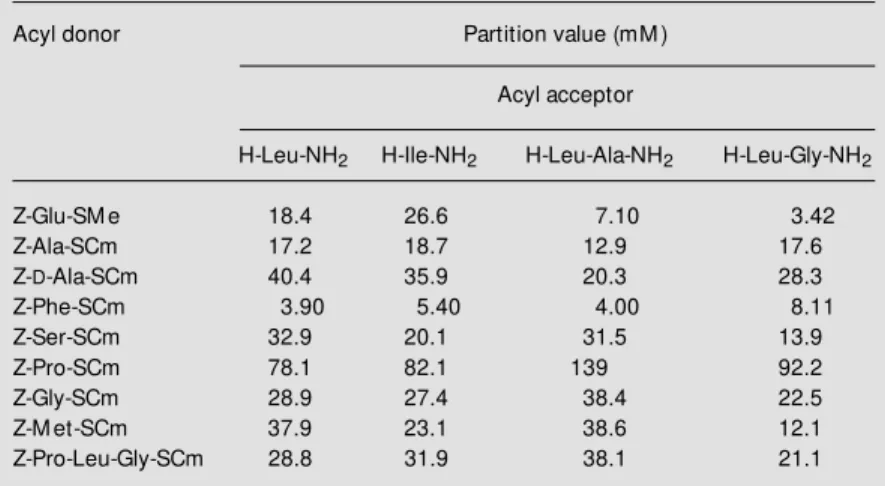
Further studies have evaluated the utility of carboxymethyl thioesters for V8 protease-catalyzed peptide synthesis. For this pur-pose, the newly developed substrates listed in Table 3 served as acyl donors in model acyl transfer reactions using amino acid and dipeptide amides as acyl acceptors (Table 4). It was found that each carboxymethyl thioester was able to act as an acyl donor for V8 protease-catalyzed peptide synthesis in-dependently of its acyl moiety, as predicted by the hydrolysis kinetic studies. Table 4 shows that the p-values observed for the substrate mimetics are comparable to that of the normal-type acyl donor Z-Glu-SMe in most cases. Moreover, when dipeptide amides were used as acyl acceptors lower p -Table 3 - Kinetic constants for V8
protease-cata-lyzed hydrolysis of carboxymethyl thioester strate mimetics compared to the normal-type sub-strate Z-Glu-SM e (32).
Conditions: 0.2 M HEPES-buffer, pH 8.0, 37oC; [substrate]: 0.0125-3 mM , [enzyme]: 0.003-9.9 µM ; errors are less than 15% .
Substrate kcat/KM (M-1s-1)
Z-Glu-SM e 1.12 x 10⁴
Z-Ala-SCm 1.58 x 101
Z-D-Ala-SCm 0.97 x 101
Z-Phe-SCm 2.01 x 101
Z-Ser-SCm 0.87 x 101
Z-Pro-SCm 0.13 x 101
Z-Gly-SCm 3.34 x 101
Z-M et-SCm 4.60 x 101
Z-Pro-Leu-Gly-SCm 3.18 x 10²
Z-Phe-SCam no hydrolysis
Table 4 - Partition values of V8 protease-catalyzed acyl transfer reactions of carboxy-methyl thioester substrate mimetics w ith amino acid and dipeptide amides compared to Z-Glu-SM e (32).
Conditions: 0.2 M HEPES-buffer, pH 8.0, 37oC; [acyl donor]: 2 mM , [acyl acceptor]: 20 mM , [enzyme]: 0.3-4 µM ; errors are less than 15% .
Acyl donor Partition value (mM )
Acyl acceptor
H-Leu-NH2 H-Ile-NH2 H-Leu-Ala-NH2 H-Leu-Gly-NH2
Z-Glu-SM e 18.4 26.6 7.10 3.42
Z-Ala-SCm 17.2 18.7 12.9 17.6
Z-D-Ala-SCm 40.4 35.9 20.3 28.3
Z-Phe-SCm 3.90 5.40 4.00 8.11
Z-Ser-SCm 32.9 20.1 31.5 13.9
Z-Pro-SCm 78.1 82.1 139 92.2
Z-Gly-SCm 28.9 27.4 38.4 22.5
Z-M et-SCm 37.9 23.1 38.6 12.1
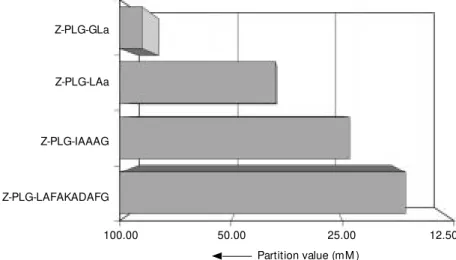
values were found for substrate mimetics than for Z-Glu-SMe in most cases. These findings imply a yield-increasing effect of longer acyl acceptors, especially when car-boxymethyl thioesters serve as acyl donors. The results of model segment condensations reported in Figure 7 confirmed this sugges-tion. Consequently, for the penta- and deca-peptide for both acyl acceptors lower p -values and, therefore, higher product yields could be obtained than found for the small dipeptide amides, whereas the decapeptide is more effective than the pentapeptide.
In addition to carboxymethyl thioesters, other types of esters mediate acceptance by V8 protease (33). Beside the one methylene group extended carboxyethyl thioester ana-logs, various carboxyphenyl esters and thioesters were found to be specifically hy-drolyzed by V8 protease. Surprisingly, de-spite the lower degree of structural similar-ity, the aromatic part of the leaving groups led to even higher specificity constants than found for the aliphatic counterparts. This finding indicates that the degree of structural similarity between site-specific amino acid side chain and leaving group obviously does not represent the only parameter to be con-sidered for the design of substrate mimetics.
Substrate mime tics fo r aro matic and hydro pho bic amino acid-spe cific pro te ase s
Beside proteolytic enzymes with a speci-ficity for positively and negatively charged amino acid residues, a third important class of proteases are represented by enzymes which are specific for aromatic and hydro-phobic amino acid moieties. The most well-known representatives of this class are the serine proteases chymotrypsin and subtili-sin. Both enzymes have been well investi-gated for classical enzymatic peptide synthe-sis and have been found to be suitable bio-catalysts (3,4,7). Therefore, the two enzymes are interesting targets for substrate
mimetic-mediated reactions.
With respect to natural specificity, chy-motrypsin and subtilisin primarily prefer large hydrophobic and aromatic amino acid resi-dues. Furthermore, the S1-binding pocket of
subtilisin contains a carboxylic acid moiety (Glu156) which causes additional activity towards Arg and Lys (34). Thus, aromatic leaving groups with additional positively charged substitutions, e.g., 4-guanidinophe-nyl esters, should fit well the natural speci-ficity of the enzymes.
In addition to this empirical design of specific mimetic moieties, the known pro-tein structures of the two proteases also al-low the use of rational approaches. Espe-cially, the already described computer-as-sisted protein-ligand docking approach seems to be helpful for the design and optimization of leaving groups with a high binding speci-ficity. Moreover, on the basis of knowledge about substrate mimetic recognition and the mechanism of catalysis, this approach may also allow an estimation of whether the cal-culated binding leads to hydrolysis. Thus, we utilized the docking approach to predict the function of the 4-guanidinophenyl ester functionality to act as an artificial recogni-tion site for chymotrypsin (Günther R, Thust S, Hofmann H-J and Bordusa F, unpublished
Z-PLG-GLa
Z-PLG-LAa
Z-PLG-IAAAG
Z-PLG-LAFAKADAFG
100.00 50.00 25.00
Partition value (mM )
12.50
results). For this purpose, Boc-L-Ala-OGp was selected as a model ligand and docked towards the enzyme. Figure 8 shows the arrangement of the ligand at the active site of chymotrypsin in the lowest energy complex (A) in comparison to that found for trypsin (B) (25). Corresponding to the natural speci-ficity of chymotrypsin, hydrophobic con-tacts between the phenyl moiety of the ester group and the amino acid residues Cys191 and Val213 of the enzyme predominate. Moreover, the guanidino functionality
fa-vors this binding mode by formation of addi-tional hydrogen bonds with several serine residues which are located at the bottom of the S1-binding pocket. Mediated by the
spe-cific binding of the leaving group, the condi-tions for the catalytic mechanism and the binding behavior of substrate mimetics, namely the orientation of the carbonyl oxy-gen to Gly193 (oxanion hole), the distance between the carbonyl carbon of the scissile ester bond and the active Ser195, and the reversed binding of the acyl moiety are ful-filled. Since this arrangement leads to spe-cific cleavage of the substrate in the case of trypsin, chymotrypsin should also be ca-pable of hydrolyzing acyl-4-guanidinophen-yl esters. This prediction was confirmed by steady-state hydrolysis kinetic studies using several Boc-Xaa-OGp esters and the non-amino acid-derived analog benzoic acid es-ter (Bz-OGp) (Table 5). These findings im-pressively show that the computer-assisted protein-ligand docking approach can serve as a useful tool to predict a priori acceptance of a given substrate mimetic by the enzyme. Further studies on the applicability of this rational approach to the optimization or de-sign of novel types of substrate mimetics leading to more specific binding and higher acylation rates are currently underway.
Since substrate mimetics are obviously meaningful in protease-mediated peptide synthesis, the predictions of the computa-tional approach were also examined by acyl transfer reactions (Figure 9). The results of these studies show that the 4-guanidinophenyl ester functional group enables chymotrypsin to catalyze the peptide bond formation be-tween nonspecific coded and non-coded acyl residues and numerous amino acid and pep-tide derivatives. By analyzing the efficiency of catalysis for substrate mimetics, yields similar to those found for the normal-type acyl donor Bz-L-Phe-OMe could be obtained. This also holds for reactions with the non-amino acid-derived Bz-OGp, indicating that 4-guanidinophenyl esters of simple car-Figure 8 - Arrangements of Boc-L-Ala-OGp at the active sites of chymotrypsin (A) and trypsin
(B) derived from the low est-energy complexes (Günther R, Thust S, Hofmann H-J and Bordusa F, unpublished results). Show n are the amino acid residues of the enzymes w hich either form hydrogen bonds (Asp189/Ser189, Ser190, Ser217/Gly219) or have catalytical functions (His57, Asp102,and Ser195).
Table 5 - Steady-state kinetic parameters for the chymotrypsin-catalyzed hydrolysis of 4-guanidinophenyl esters (Günther R, Thust S, Hofmann H-J and Bordusa F, unpub-lished results).
Conditions: 25 mM M OPS-buffer, pH 7.6, 0.1 M NaCl, 5 mM CaCl2, 25oC, 20% M eOH. aCalculated as linear slope of the initial M ichaelis-M enten curve in relation to the active
enzyme concentration; all errors are less than 15% .
Substrate KM (mM ) kcat (s-1) kcat/KM (M-1 s-1)
Boc-Gly-OGp 2.81 1.18 4.20 x 10²
Boc-L-Ala-OGp 2.88 10.4 3.61 x 10³
Boc-D-Ala-OGp 4.94 0.56 1.13 x 10²
Boc-L-Glu-OGpa - - 1.48 x 10²
Boc-L-Pro-OGpa - - 0.45 x 101
Boc-D-Phe-OGp 2.58 5.45 2.11 x 10³
Boc-D-Leu-OGp 1.49 3.04 2.04 x 10³
Bz-OGp 0.44 0.13 2.96 x 10²
boxylic acids can also act as efficient acyl donor components for chymotrypsin-cata-lyzed coupling. Consequently, chymotryp-sin can be used as an efficient biocatalyst for coupling a wide spectrum of acyl compo-nents different from those of its natural speci-ficity in form of their 4-guanidinophenyl esters. Furthermore, due to the acceptance of 4-guanidinophenyl esters by trypsin and pro-teases with trypsin-like specificity, this type of substrate mimetics becomes of general utility for several proteases.
Alternatively, the computer-assisted docking approach can also be used for the design of enzyme-selective mimetic moi-eties. Simple phenyl ester analogs, for ex-ample, are practically no substrates for tryp-sin or tryptryp-sin-like enzymes but are specifi-cally hydrolyzed by chymotrypsin (Bigl K and Bordusa F, unpublished data).
Co mbinatio n o f so lid-phase pe ptide synthe sis and substrate mime tic-me diate d se gtic-me nt co nde nsatio n
An important field of application of
pro-teases is the synthesis of longer peptides by the condensation of peptide fragments. An essential condition for this function is the chemical synthesis of peptide esters which can further be used as acyl donors in enzy-matic reactions. Consequently, the utiliza-tion of the substrate mimetic strategy for the protease-mediated condensation of peptide fragments indisputably needs a combination with chemical methods, primarily with solid-phase peptide synthesis. As known from the literature, the synthesis of peptide esters can be achieved by utilizing the oxime resin strategy (35-37). While earlier work estab-lished the general applicability of this meth-odology, we investigated its usefulness for the synthesis of peptide esters in the form of various substrate mimetics (cf. Figure 10A) (38). The synthesis protocol involves cova-lent attachment of the first Na-Boc-protected amino acid to the oxime resin, acetylation of free hydroxylic groups by acetic anhydride, deprotection of the Na-amino group of the attached amino acid, followed by in situ
coupling of the next Na-Boc-protected amino acid. The peptide esters can be generated by
donors for trypsin-, V8 protease-, and chy-motrypsin-catalyzed fragment condensation, as schematically illustrated in Figure 10B. The reactions were performed on a prepara-tive scale using 1:2 ratios of acyl donors to acyl acceptors (V8 protease and chymotryp-sin) or 1:2.5 (trypchymotryp-sin). The appropriate pep-tide products 4, 7, and 11 were obtained in 60-70% yields, demonstrating the high syn-thetic utility of substrate mimetics for the protease-mediated condensation of peptide fragments.
Substrate mime tic-me diate d synthe sis o f carbo xylic acid amide s
In contrast to the mostly high primary specificity of proteases, the specificity to-wards the acyl acceptor (S-subsite specific-ity) is frequently more relaxed, generally allowing the coupling of a wider spectrum of acyl acceptors (7). Nevertheless, the product yields usually drop with increasing degree of modification of both the amino acid side chain and the backbone structure, particu-larly at the P1-position. Therefore, only the
coupling of acyl acceptors closely related to preferred amino acid residues is of practical relevance, as shown for selected synthesis (39-41). The enzymatic synthesis of peptide isosteres or analogs, however, requires strat-egies which allow the coupling of a broader variety of modified amino acid derivatives and also non-amino acid-derived building blocks. In this context, the use of esterases and particularly of lipases seems to be of higher synthetic utility (42-44). Due to the broader substrate specificities of these en-zymes, an extended structural diversity of amines and esters undergo the esterase- and lipase-catalyzed aminolysis reaction in pref-erably anhydrous solvents. However, the or-ganic solvent itself considerably affects the activity of these enzymes, as well as the yield, regio- and stereospecificity of such reactions (45). Thus, a very careful and often time-consuming optimization of reaction con-Figure 11 - Combination of
solid-phase peptide syn-t hesis via oxim e resin strategy w ith trypsin- (A), V8 protease- (B), and chy-motrypsin-catalyzed frag-m ent condensat ion (C) (38).
A
B
C
Figure 10 - General course of peptide ester synthesis via oxime resin strategy (A) and substrate mimetic-m ediat ed pept ide f rag-m ent condensat ion by protease catalysis (B).
Protecting group Individual amino acid Specific leaving group NO2
+ Protease
A
B
aminolysis of the oxime ester linkage be-tween peptide and resin using appropriate
ditions is required, which prevents the use of esterases and lipases from being easily and universally applicable. Recently, we pre-sented an alternative protease-mediated ap-proach to the coupling of non-coded and non-amino acid-derived amines with esters (46). The key feature of this method is the combination of the substrate mimetic strat-egy with the use of clostripain which pos-sesses a broad tolerance toward amines (47). The general ability of the 4-guanidinophenyl ester functionality to mediate acceptance of non-coded and non-amino acid-derived acyl components by clostripain was demonstrated in reactions of the acyl donors Pbu-OGp and Bz-ß-Ala-OGp with several amino acid and peptide units used as amino components (Table 6). Typical time courses of such reac-tions are illustrated in Figure 12. Generally, the data show that productive binding and acylation of the enzyme, finally resulting in proteolytically stable amide products, are found with the non-coded but naturally oc-curring ß-Ala-derivative as well as the non-amino acid-derived 4-phenylbutyric acid es-ter. Analysis of the efficiency of catalysis showed that product yields within a range of 83 to 98% were reached in all cases, usually higher than 90%. Remarkably, reducing the excess of acyl acceptor, studied for reactions with the pentapeptide, does not decrease the efficiency of coupling reactions with both esters. This atypical behavior indicates that reaching satisfactory yields does not require a large excess of either reactant. This shows the synthetic utility of clostripain also for the coupling of more valuable carboxyl and amino components.
Apart from the highly restricted primary specificity, clostripain practically accepts all coded amino acids and also some D -config-ured counterparts as amino components (48,49). Moreover, using a wide range of non-coded acyl acceptors we surprisingly found that clostripain even tolerates amino components considerably different from coded amino acids, such as simple aliphatic,
aromatic or substituted amines including un-natural amino acids, amino alcohols, and diamines (47). This unique specificity dis-tinguishes clostripain from most other known proteases, although little is known about the structural bases of this remarkable behavior. From the synthetic point of view, this broad specificity combined with the substrate mi-metic strategy might open an entirely new field of application of this protease to the synthesis of organic amides completely out-side of peptide synthesis. To investigate
Figure 12 - Course of the clostripain-catalyzed coupling of Bz-ß-Ala-OGp and Pbu-OGp w ith H-Ala-Phe-Ala-Ala-Gly-OH (44). A, Bz-ß-Ala-OGp; B, Pbu-OGp. Triangles, Ala-OGp/Pbu-OGp; squares, Ala-Ala-Phe-Ala-Ala-Gly-OH/Pbu-Ala-Phe-Ala-Ala-Gly-OH; circles, Bz-ß-Ala-OH/ Pbu-OH. Conditions: 0.2 M HEPES-buffer, pH 8.0, 0.1 M NaCl, 0.01 M CaCl2, 5% DM F, 25oC; [acyl donor]: 2 mM , [acyl acceptor]: 4 mM ; x = product yield.
x
(
%
)
100
80
60
40
20
0
100
80
60
40
20
0
3 5 24 48 72 0
2
1 1 2 3 4 5 24 48 72
0 4
Time (h)
Table 6 - Clostripain-catalyzed coupling of Bz-ß-Ala-OGp and Pbu-OGp w ith selected amino acid amides and peptides (46).
Conditions: 0.2 M HEPES-buffer, pH 8.0, 0.1 M NaCl, 10 mM CaCl2, 5% DM F, 25oC; [acyl donor]: 2 mM , [acyl acceptor]: 25 mM . a[H-Lys-NH
2]: 15 mM . b[H-Glu-NH2]: 50 mM . c[H-AFAAG-OH]: 4 mM .
Acyl donor Acyl acceptor Amide product Yield (% )
Pbu-OGp H-Leu-NH2 Pbu-Leu-NH2 98
Pbu-OGp H-Lys-NH2a Pbu-Lys-NH2 96
Pbu-OGp H-Glu-NH2b Pbu-Glu-NH2 87
Pbu-OGp H-Pro-NH2 Pbu-Pro-NH2 83
Pbu-OGp H-Ala-Pro-OH Pbu-Ala-Pro-OH 93
Pbu-OGp H-AAP-OH Pbu-AAP-OH 86
Pbu-OGp H-AFAAG-OHc Pbu-AFAAG-OH 92
Bz-ß-Ala-OGp H-Leu-NH2 Bz-ß-Ala-Leu-NH2 98
Bz-ß-Ala-OGp H-Lys-NH2a Bz-ß-Ala-Lys-NH2 93
Bz-ß-Ala-OGp H-Glu-NH2b Bz-ß-Ala-Glu-NH2 89
Bz-ß-Ala-OGp H-Pro-NH2 Bz-ß-Ala-Pro-NH2 90
Bz-ß-Ala-OGp H-Ala-Pro-OH Bz-ß-Ala-Ala-Pro-OH 91
Bz-ß-Ala-OGp H-AAP-OH Bz-ß-Ala-AAP-OH 85
Bz-ß-Ala-OGp H-AFAAG-OHc Bz-ß-Ala-AFAAG-OH 93
whether this approach can be used in such a manner, enzymatic reactions were performed between 4-guanidinophenyl esters of ben-zoic acid (Bz-OGp) and 4-phenylbutyric acid (Pbu-OGp), and a number of non-amino acid-derived amino components (46). Generally, the results listed in Table 7 show that
clostri-pain is capable of catalyzing the coupling of both non-amino acid-derived carboxyl and amino components as indicated by individual experiments. With respect to the efficiency of catalysis, most enzymatic reactions led to product yields higher than 70%. Accord-ingly, only small amounts of hydrolysis
prod-Table 7 - Clostripain-catalyzed coupling of non-amino acid-derived carboxyl and amino components (46).
Conditions: 0.2 M HEPES-buffer, pH 8.0, 0.1 M NaCl, 10 mM CaCl2, 5% DMF, 25 o
ucts (Bz-OH and Pbu-OH) were formed. These results become even more impressive if we consider that only traces (0.22 to 3.7% depending on the respective pK value) of the amino components are deprotonated under the pH conditions used and, therefore, can serve as deacylating components. Contrary to most chemical methods, an increase in pH to completely deprotonate the amino group of the nucleophilic component is restricted by the limited intrinsic stability of enzyme and acyl donor ester. Figure 13 shows the dependence of the product yield on the con-centration of pentylamine which possesses the highest pK value (10.65) of all amines used. The plots for both acyl donor esters illustrate that even an initial nucleophile con-centration of 4 mM, which corresponds to a concentration of deprotonated pentylamine of only 0.009 mM, already leads to product yields of approximately 50%. The results obtained at higher pentylamine concentra-tions reveal that an increase of nucleophile excess results in nearly complete conversion of the acyl donor esters to the appropriate amides. Accordingly, from the synthetic point of view, this enzymatic approach achieves highly efficient amide bond formation com-bined with extraordinarily mild reaction con-ditions. Moreover, neither additional hy-droxyl groups nor amine groups within the amino component seem to limit this high synthetic utility. Apart from this high effi-ciency, clostripain catalyzes the acylation of substituted amines with a remarkably high degree of regiospecificity. As indicated by the lack of acceptance of 1-pentanol, no competitive formation of O-acylated prod-ucts could be detected for the amino alcohols. In the same way, the acylation of ethanol, 1-propanol, and 1-octanol failed (data not shown), indicating that clostripain generally does not tolerate alcohols as deacylating com-ponents. Interestingly, the asymmetric 1,3-diaminopentane was acylated by the enzyme exclusively on the amino group at position 1,
with no acylation of the amino group at position 3. This finding indicates that clos-tripain accepts amines containing a neigh-boring branch less well than comparable non-branched derivatives. On the basis of this distinct specificity, clostripain should be a useful tool for selective acylation forming isomerically pure products, without large experimental efforts to protect additional functionalities.
In summary, the data described here con-vincingly show that the substrate mimetic strategy combined with the use of proteases possessing a broad specificity towards the amino component represents a powerful ap-proach to the coupling of both non-amino acid-derived carboxyl and amino compo-nents. Since the classical protease-mediated synthesis used so far is usually restricted to the coupling of amino acid and peptide moi-eties, this approach could open up a new field of synthetic applications of these en-zymes completely outside peptide synthesis. This combines efficient and selective or-ganic amide bond formations with the possi-bility of using extraordinarily mild reaction conditions.
Ackno wle dgm e nts
I am grateful to Prof. Dr. H.-D. Jakubke for advice and discussions. Furthermore, I thank Prof. Dr. H.-J. Hofmann, Prof. Dr. G. Fischer and my co-workers, who are listed in the references, for their contributions.
100
80
60
40
20
0
0 4 8 12 16 20
x
(
%
)
Pentylamine (mM )
Re fe re nce s
1. Gassen H-G (1982). Das bakt erielle Ribosom: ein programmierbares Enzym. Angew andte Chemie, 94: 15-26. 2. Kleinkauf H, van Liempt H, Palissa H &
van Döhren H (1992). Biosynthese von Peptiden: Ein nichtribosomales System. Naturw issenschaften, 79: 153-162. 3. Schellenberger V & Jakubke H-D (1991).
Protease-catalyzed kinetically controlled peptide synthesis. Angew andte Chemie International Edition in English, 30: 1437-1449.
4. Wong C-H (1989). Enzymatic catalysis in organic synthesis. Science, 244: 1145-1152.
5. Hoppe D (1998). In: Rehm HJ & Reed G (Editors), Biotechnology. 2nd edn. Vol. 8a. Wiley-VCH, Weinheim, 244-262. 6. Jakubke H-D, Kuhl P & Könnecke A (1985).
Basic principles of protease-catalyzed peptide bond form ation. Angew andte Chemie International Edition in English, 24: 85-93.
7. Jakubke H-D (1987). In: Udenfriend S & M eienhofer J (Editors), The Peptides: A-nalysis, Biology. Vol. 9. Academic Press, New York, 103-165.
8. Schechter I & Berger A (1967). On the size of the active site in proteinases. I. Papain. Biochemical and Biophysical Re-search Communications, 27: 157-162. 9. Cerovsky V, Wünsch W & Brass J (1997).
Enzymatic semisynthesis of dicarba ana-logs of calcitonin. European Journal of Bio-chemistry, 247: 231-237.
10. Jackson DY, Burnier J, Quan C, Stanley M , Tom J & Wells JA (1994). A designed peptide ligase for total synthesis of ribo-nuclease A w ith unnatural catalytic resi-dues. Science, 266: 243-247.
11. Jakubke H-D (1994). Protease-catalyzed peptide synthesis: basic principles, new synthesis strategies and medium engi-neering. Journal of Chinese Chemical So-ciety, 41: 355-370.
12. Zhong Z, Liu JL-C, Dint erm an LM , Finkelman M AJ, M ueller WT, Rollence M L, Whitlow M & Wong C-H (1991). Engi-neering subtilisin for reaction in dimethyl-f orm am ide. Journal of t he Am erican Chemical Society, 113: 683-684. 13. Janssen AEM & Halling PJ (1994).
Speci-ficities of enzymes “ corrected for solva-tion” depend on the choice of the stan-dard state. Journal of the American Chem-ical Society, 116: 9827-9830.
14. Affleck R, Xu Z-F, Suzaw a V, Focht K, Clark DS & Dordick JS (1992). Enzymatic
catalysis and dynamics in low -w ater envi-ronment. Proceedings of the National A-cademy of Sciences, USA, 89: 1100-1104. 15. Dom inguez A, Cabezas N, Sanchez-M ont ero JSanchez-M & Sinist erra JV (1995). Chemoselectivity of chemically modified alpha-chym ot rypsin. Tet rahedron, 51: 1827-1844.
16. Arnold FH & Chen K (1994). Tuning the activity of an enzyme for unusual environ-ments: Sequential random mutagenesis of subtilisin E for catalysis in dimethyl-formamide. Proceedings of the National Academy of Sciences, USA, 90: 5618-5622.
17. West JB, Scholten J, Stolow ich NJ, Hogg JL, Scott AI & Wong C-H (1988). M odifi-cation of proteases to esterases for pep-tide synthesis: M ethylchymotrypsin. Jour-nal of the American Chemical Society, 110: 3709-3710.
18. Sears P, Schuster M , Wang P, Witte K & Wong C-H (1994). Engineering subtilisin for peptide coupling: Studies on the ef-fects of counterions and site-specific modifications on the stability and specific-ity of the enzyme. Journal of the Ameri-can Chemical Society, 116: 6521-6530. 19. Fersht A (1984). Enzyme Structure &
M echanism. 2nd edn. W.H. Freeman & Co., New York.
20. Imperiali B & Abeles RH (1987). Extended binding inhibitors of chymotrypsin that in-teract w ith leaving group subsites S’1-S’3. Biochemistry, 26: 4474-4477. 21. Butenas S, Kalafatis M & M ann KG (1997).
Analysis of tissue plasminogen activator specificity using peptidyl fluorogenic sub-strate Titel. Biochemistry, 36: 2123-2131. 22. Breddam K & M eldal M (1992). Substrate preferences of glutamic acid-specific en-dopeptidases assessed by synthetic pep-tide substrates based on intramolecular fluorescence quenching. European Jour-nal of Biochemistry, 206: 103-107. 23. Wagner G & Horn H (1973). Synthese
antiproteolytisch w irksamer Arylcarbon-, Aralkylcarbon- und Arylsulfonsäureester von Amidinophenolen. Pharmazie, 28: 428-431.
24. Tanizaw a K, Kasaba Y & Kanaoka Y (1977). “ Inverse substrates” for trypsin. Efficient enzymatic hydrolysis of certain esters w ith a cationic center in the leaving group. Journal of the American Chemical Soci-ety, 99: 4484-4488.
25. Thormann M , Thust S, Hofmann H-J & Bordusa F (1999). Protease-catalyzed
hy-drolysis of substrate mimetics: A new ap-proach reveals a new mechanism. Bio-chemistry, 38: 6056-6062.
26. Huber R, Bode W , Deisenhof er J & Schw ager P (1983). The geometry of the reactive site and of the peptide groups in trypsin, trypsinogen and its complexes w ith inhibitors. Acta Crystallographica, Section B, 39: 480-490.
27. Bordusa F, Ullmann D, Elsner C & Jakubke H-D (1997). Substrate mimetic-mediated peptide synthesis: An irreversible ligation strategy that is independent of substrate specificity. Angew andte Chemie Interna-tional Edition in English, 36: 2473-2475. 28. Schellenberger V, Jakubke H-D,
Zape-valova NP & M itin YV (1991). Protease-catalyzed peptide synthesis using inverse substrates: The influence of reaction con-ditions on the trypsin acyl transfer effi-ciency. Biotechnology and Bioengineer-ing, 38: 104-108.
29. M itin YV, Schellenberger V, Schellenber-ger U, Jakubke H-D & Zapevalova NP (1991). Protease-catalyzed peptide syn-thesis using inverse substrates. In: Giralt E & Andreu D (Editors), Peptides 1990. ESCOM , Leiden, 287-288.
30. Sekizaki H, Itoh K, Toyota E & Tanizaw a K (1996). Synthesis and tryptic hydrolysis of p-guanidinophenyl esters derived from amino acids and peptides. Chemical and Pharmaceutical Bulletin, 44: 1577-1579. 31. Sekizaki H, Itoh K, Toyota E & Tanizaw a K
(1996). Trypsin-catalyzed peptide synthe-sis w ith various p-guanidinophenyl esters as acyl donors. Chemical and Pharmaceu-tical Bulletin, 44: 1585-1587.
32. Wehofsky N & Bordusa F (1998). Pro-gramming of enzyme specificity by sub-strate mimetics: investigations on the Glu-specific V8 protease reveals a novel gen-eral principle of biocatalysis. FEBS Let-ters, 443: 220-224.
33. Wehofsky N, Wissmann J-D, Alisch M & Bordusa F (2000). Engineering of sub-strate mimetics as novel-type subsub-strates for glutamic acid-specific endopeptidases. Biochimica et Biophysica Acta (in press). 34. M orree WJ, Sears P, Kaw ashiro K, Witte
K & Wong C-H (1997). Exploitation of sub-tilisin BPN’ as catalyst for the synthesis of peptides containing noncoded amino ac-ids, peptide mimetics, and peptide conju-gates. Journal of the American Chemical Society, 119: 3942-3947.
solid-phase peptide synthesis. Preparation of protected peptide fragments. Journal of Organic Chemistry, 45: 1295-1300. 36. Degrado WF & Kaiser ET (1982).
Solid-phase synthesis of protected peptides on a polymer-bound oxime: preparation of segments comprising the sequence of a cytotoxic 26-peptide analogue. Journal of Organic Chemistry, 47: 3258-3261. 37. M ihara H, Chmielew ski JA & Kaiser ET
(1993). Synthesis of the 60 amino acid homeo domain and smaller fragments of the Drosophila gene regulatory protein Antennapedia by a segment synthesis-condensation approach. Journal of Or-ganic Chemistry, 58: 2209-2215. 38. Cerovsky V & Bordusa F (2000).
Protease-catalysed fragment condensation via sub-strate mimetic sub-strategy: a useful combi-nation of solid-phase peptide synthesis w ith enzymatic methods. Journal of Pep-tide Research (in press).
39. Cerovsky V & Jakubke H-D (1994). Enzy-matic approach to the synthesis of tau-rine-containing peptides. International
Journal of Peptide and Protein Research, 44: 466-471.
40. Schuster M , M unoz B, Paulson JC & Wong C-H (1994). Papain-catalyzed syn-thesis of peptide isosteres. Tetrahedron Letters, 34: 1247-1250.
41. Bordusa F, Dahl C, Jakubke H-D, Burger K & Koksch B (1999). Synthesis of a -fluoro-alkyl substituted peptides via enzymatic f ragm ent condensat ion. Tet rahedron: Asymmetry, 10: 307-313.
42. Gutman AL, M eyer E, Yue X & Abell C (1992). Enzymatic formation of lactams in organic solvents. Tetrahedron Letters, 33: 3943-3946.
43. Quiros M , Sanchez VM , Brieva R, Rebolledo F & Gotor V (1993). Lipase-catalyzed synthesis of optically active amides in organic media. Tetrahedron: Asymmetry, 4: 1105-1112.
44. Puertas S, Rebolledo F & Gotor V (1995). Selective ammonolysis and aminolysis of dimethyl succinate. Synthesis of optically active N-alkylsuccinimides. Tetrahedron, 51: 1495-1502.
45. Hoppe D (1998). In: Rehm HJ & Reed G (Editors), Biotechnology. 2nd edn. Vol. 8a. Wiley-VCH, Weinheim, 262-267. 46. Günther R & Bordusa F (1999). Substrate
mimetic-mediated protease catalysis: A novel enzymatic approach to the synthe-sis of carboxylic acid amides. Chemistry -A European Journal, 6: 463-467. 47. Günther R, Stein A & Bordusa F (2000).
Investigations on the enzyme specificity of clostripain: A new efficient biocatalyst for the synthesis of peptide isosteres. Journal of Organic Chemistry (in press). 48. Ullmann D & Jakubke H-D (1994). The
specificity of clostripain from Clostridium histolyticum mapping the S’ subsites via acyl transfer to amino acid amides and peptides. European Journal of Biochemis-try, 223: 865-872.