Urban vegetation as a strategy to reduce heat island effects in the
Mediterranean climate context, Lisbon - Portugal
Caio Silva1, Teresa Santos2 e José Antonio Tenedório3
1 Professor of the Postgraduate Program of the Faculty of Architecture and Urbanism of the
University of Brasília.
2 Forester, PhD in Geography of Interdisciplinary Centre of Social Sciences (CICS.NOVA),
Faculty of Social Sciences and Humanities (FCSH/NOVA), Lisbon, Portugal.
3 Professor of Interdisciplinary Centre of Social Sciences (CICS.NOVA), Faculty of Social
Sciences and Humanities (FCSH/NOVA), Lisbon, Portugal
Abstract: The use of trees in cities is an important strategy for beauty and health in the urban context. The
shading strategy provoked by the trees, in turn, promotes besides the beauty, thermal gains important for the increase of the sensation of comfort of the user, and the quality of the air of the city. In the city of Lisbon, an important avenue - Republic Avenue will undergo urban intervention, with an increase in the area of afforestation and expansion of mobility corridors (bike path and pedestrian sidewalks). In this sense, the objective of this article is to evaluate the thermal gain of the increase of afforestation along the Republic avenue. For this, the research method uses the ENVI-met microclimatic modeling software, through the tool it is possible to compare the current situation of the road with the urban afforestation increment project - where double the number of trees in the avenue. The results show that the intervention in the avenue provided an increase in the level of comfort by reducing the PMV index and reducing the air temperature in addition to increasing the relative humidity rate of the air. The article concludes that other places around Republic Avenue were also benefited by the reduction of air temperature values ??and increase of humidity. The research proves that the alteration of the urban design of a road can positively influence the comfort of the surroundings. With the new avenue project there was a reduction of up to 3 degrees celcius in the afternoon hours. There was an increase in humidity from 50 to 70% in the morning and from 40 to 50% in the afternoon. This article show that the use of trees in this climatic type creates more comfortable areas and mitigating the negative effects of the urban heat island.
Keywords: envi-met, urban climate, simulation, greenroof
Introduction
The studies by Conry, Sharna and Potosnak (2015) assess the impact of the urban heat island in the Chicago metropolitan area. In this area, impacts were observed in the Chicago Climate Masterplan. The study evaluated the meso and microclimatic scales in the ENVI-met 3.1 software. The study used the PMV Fanger indicators and the PPD to assess the number of people dissatisfied.
The other parameter can be measured the urban quality in terms of thermal comfort is the surface temperature and albedo. The albedo is the ratio of reflected radiation to incident radiation from at a surface. The use of heat absorbing materials, the reduction in vegetated or green spaces, the characteristics of urban canyons and the production of anthropogenic heat have caused the UHI potential to markedly increase in metropolitan areas (Razzaghmanesh et all, 2016; Santamouris et all, 2011, 2014).
In this study (Razzaghmanesh et all, 2016) the heat potential of three common urban environmental materials was investigated. The results show that low albedo materials are one of the main causes of increased temperature in cities. Furthermore, urban development and the reduction of vegetated green spaces also contribute to increasing temperatures.
Furthermore, the results show that the thermal distribution is quite stable at deeper layers within the growing media but it fluctuated more in the upper substrate layers. This UHI mitigation potential of green roofs was used in the development of a numerical model to investigate the effects of adding green roofs to the top of buildings (Razzaghmanesh et all, 2016).
In this sense, it is possible to demonstrate how cities have been concerned with assessing their degree of comfort in open spaces. This research therefore intends to evaluate the degree of thermal comfort and the consequent reduction of areas of heat islands with the new proposal of avenue forestation in the Lisbon city.
Method and Lisbon Climate
Lisbon has a Mediterranean climate, with mild winters and hot and dry summers, classified as Csa according to Köppen system. According to the climatological normal for the period 1970-2000, August was the hootest month, with an average temperature of 22.5ºC.
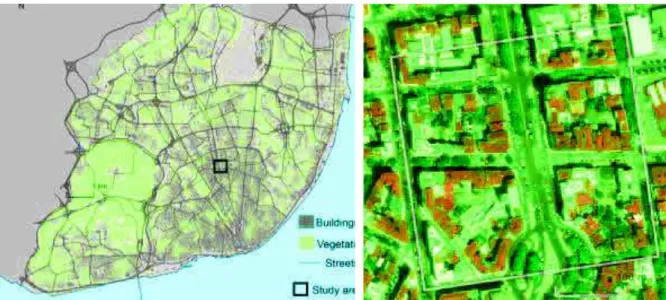
The study area is located in Avenidas Novas neighbourhood, and includes part of the Central Business District of Lisbon, thus concentrating commercial and tertiary activities. The urban requalification project impact in the thermal comfort of the zone was evaluated in an area of 11,4 ha (Figure 1), including part of the square area and the two first blocks of Republic Avenue.
It presents differents pictures about the changes of avenue. In the first collumn, we show the current situation, and in the second collumn we show the hypothetical project. The main changes between the two scenarios were: increase in number of trees and
Figure 1. Lisbon and the study area
Scenario 1 – Avenue in Current situation Scenario 2 – Avenue with trees
Scenario 1 – Avenue in Current situation Scenario 2 – Avenue with trees Figure 2. Current and projected scenario. Source: Costa, 2015
For this month, the parameters air temperature, wind speed and direction, and relative humidity in 2 m above ground were retrieved from www.portalclima.pt. And about the value for the roughness length was retrived from the Wyoming University site was consulted (http://weather.uwyo.edu/upperair/sounding.html).
Table 1. Parameters about Lisbon climate archive
Parameter Value
Initial atmospheric temperature (K) 295.65
Wind speed measured at 10m height (m/s) 4.27
Wind direction (deg) 315
Roughness length of study area (m) 1
Speci•c humidity at 2500 m (g/kg) 3.28
Relative humidity at 2m (%) 62
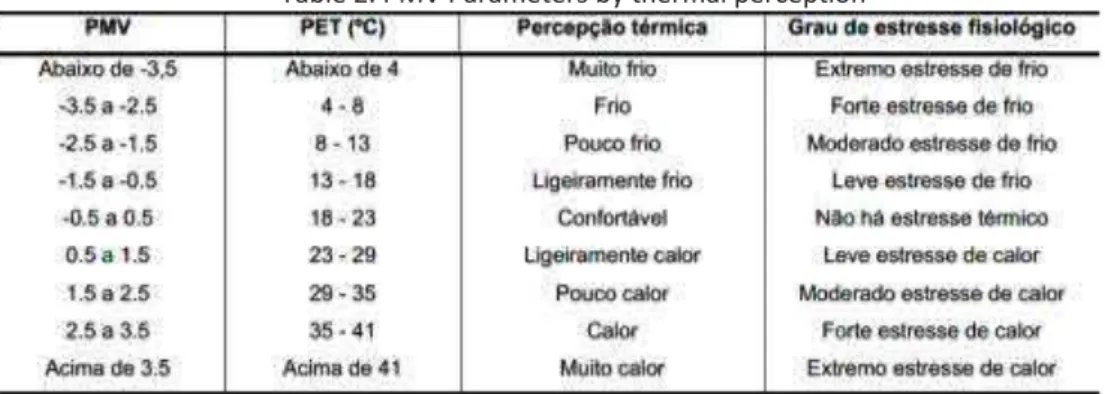
Table 2. PMV Parameters by thermal perception
Source: Hirashima (2010, p. 455)
PMV Analysis
The PMV index of Fanger was developed from statistical analysis of the thermal conditions preferred by most people (BITTENCOURT and CÂNDIDO, 2008). The index is based on international standardization. One can cite, for example, the reference in the standard ISO1 - 7730 "Moderate thermal environments - Determination of the PMV and PPD indices and specification of the conditions for thermal comfort".
In this sense, Águas (2001) discusses this norm, stating about the standard has the general principles been adapted by ASHRAE in the standard 55-1981 "Thermal environment conditions for human occupancy". The verification of ISO-7730 requires measurements of thermal parameters. The definition of the quantities to be measured and the instruments were subject to ISO-7726 "Thermal environments - Specifications relating to instruments and methods for measuring physical characteristics of the environment" published in 1985. Finally a third standard, ISO-7243 "(1982), defines the level of environmental discomfort and applies in situations where for technical-economic reasons it becomes impossible to apply the standard ISO-7730 (Águas, 2001, p.17).
The Fanger index represents one of the most used indices in the thermal comfort literature. It was used in a survey conducted in the city of Cambridge, where about a thousand people were analyzed. The results indicated that in addition to the
thermophysiological response, people respond subjectively to the election of the places where they walk and usually stay.
Results and Discussion
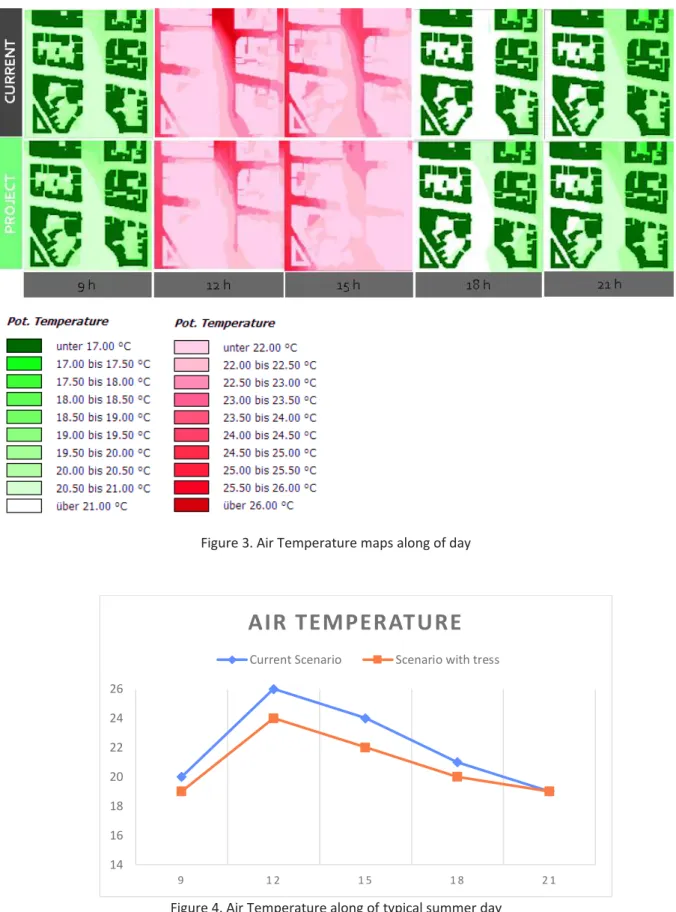
About the air temperature (Figure 3 and Figure 4), the pictures show the
temperature reduction along the day, especially during the morning and afternoon, about 2 degrees less than current scenario.
Figure 3. Air Temperature maps along of day
Figure 4. Air Temperature along of typical summer day
14 16 18 20 22 24 26
9 1 2 1 5 1 8 2 1
AIR TEMPERATURE
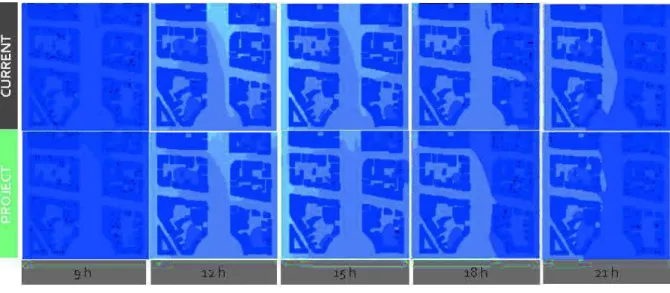
About the specific humidity (Figure 5 and Figure 6), we can see the humidity increase along the day, especially at night, about 10 percent more than current scenario.
Figure 5. Specific Humidity maps along of day
Figure 6. Specific Humidity along of typical summer day
65
50
40
45 45
70
55
45
55 55
9 12 15 18 21
Specific Humidity
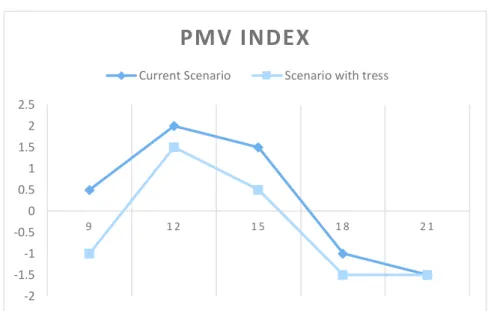
We can see that the projected scenario (with more trees) was more comfortable than the current scenario. At morning, the difference is bigger (Figure 7 and Figure 8).
Figure 7. PMV Index maps along of typical summer day
Figure 8. PMV Index along of day
-2 -1.5 -1 -0.5 0 0.5 1 1.5 2 2.5
9 1 2 1 5 1 8 2 1
PMV INDEX
Conclusions
Planting trees is critical to reducing environmental extremes, mainly during morning and afternoon. At night, the powder of plants can be support the humidity parameters for air quality and preserved the environmental systems.
In the case, it was concluded that the planting of trees reduced the maximum air temperature along the day and increase the humidity parameter along the night. About the urban form, we can proven the east side of the avenue had better thermal performance than the west side, which shows the influence of the shading of the buildings on the sidewalk.
Regarding the level of thermal stress, it is stated that the design of the avenue with more trees made the environment more comfortable all day. The projected scenario made the avenue with more humidity of the air at night proving the reduction of the effect of the urban heat island.
It is recommended that the government implement further improvements in order to assess the gains after the actual implementation of afforestation in the area.
It is also worth noting that other studies of urban simulations have made this assessment for other climatic periods in the city of Lisbon, making it possible to overcome the comfort gains for other periods that characterize the city's climate.
References
Conry, P. Sharna, A. Potosnak, M. Et all (2015). Chicago’s Heat ISland and Climate Change: Briding the Scales via Dynamical Downscaling in Journal of Applied Meteorology and
Climatology. Volume 54, pp. 1430-1448, United States of America: American Meteorological Society.
Razzaghmanesh, M.; Beecham, S.; Salemi, T. (2016). The role of green roofs in mitigating Urban Heat Island effects in the metropolitan area of Adelaide, South Australia in Urban Forestry and Urban Greening vol. 15, pp. 89-102, Germany: Elsevier.
Santos, T, Silva, C, Tenedorio, J. (2017). Modelling urban thermal comfort: evaluating the impact of the urban requalification project of Praça Duque de Saldanha and Avenida da República in Lisbon in GISTAM, 3 International Conference on Geographical Information Systemns Theory, Applications and Management, Porto, Portugal.
Águas, Miguel P. N. (2001). Conforto Térmico: Métodos Instrumentais em Energia e Ambiente. Editora do Instituto Superior Técnico de Lisboa, Lisboa.
Bittencourt, L. e Cândico (2008). Introdução à Ventilação Natural. 3ª edição. Maceió: Editora UFAL, Maceió, Brasil.
Fanger, P.O. and Toftum, J. (2002). Extension of the PMV model to non-air-conditioned buildings in warm climates. Energy and Buildings, 34, 533-536.
Hirashima, S. O. (2010). Calibração do índice de conforto térmico temperatura fisiológica equivalente (PET) para espaços abertos do município de Belo Horizonte, MG (Dissertação de Mestrado). UFMG. Belo Horizonte, Brasil.
Costa, F. S. (2015). Veja como Lisboa Vai Mudar. Disponível em:
http://expresso.sapo.pt/sociedade/2015-09-05-Veja-como-Lisboa-vai-mudar