Scorpion poisoning in t he Acost a and Caripe
Count ies of M onagas St at e, Venezuela.
Part 1: Charact erizat ion of some
epidemiological aspect s
1Esc o rp io nismo no s Munic íp io s Ac o sta e Carip e ,
Estad o Mo nag as, Ve ne zue la.
Parte 1: Carac te rizaç ão d e alg uns asp e c to s
e p id e mio ló g ic o s
11 Funded by Fundacite-Anzoátegui (Project PI-015-95). 2 School of Medicine, Center for Health Sciences Research, Anzoátegui Institute of Research and Development, Universidad de Oriente. Apartado 4327, Puerto La Cruz, Estado Anzoátegui, Venezuela.
3 Department of Physiological Sciences, Pharmacology Division, School of Medicine, Universidad de Oriente, Núcleo Bolívar, Ciudad Bolívar, Venezuela. 4 Deparment of Parasitology and Microbiology, School of Medicine, Universidad de Oriente, Núcleo Bolívar,
Ciudad Bolívar, Venezuela. Leonardo De Sousa 2 Pedro Parrilla 3 Luis Tillero 4 Ana Valdiviezo 4 Eliades Ledezma 2 Alicia Jorquera 2 Mercedes Quiroga 4
Resumo No presente trabalho os autores procuram mostrar o perfil epidemiológico do
escor-pionismo nos Municípios Acosta e Caripe, localizados na subregião geográfica do maciço mon-tanhoso do Turimiquire do Estado de Monagas, Venezuela. Durante o período de 1987 a 1993, re-gistrou-se um total de 298 acidentes causados por escorpiões, correspondendo 212 ao Município de Acosta e 86 ao de Caripe. Acosta apresentou um índice de incidência anual de 18,3 casos por 10.000 habitantes e 128% para o período meio de estudo; o índice de escorpionismo foi 4,18 vezes maior que o apresentado em Caripe. Os dados indicam que o Município de Acosta é hiperendê-mico para este acidente, com um comportamento variável e uma tendência ao incremento ao longo dos anos. Os resultados obtidos evidenciam que estas regiões do Estado de Monagas são endêmicas para o acidente peçonhento causado por escorpiões que assumem importância como problema de saúde pública, mais ainda quando são áreas de dispersão do gênero Tityus.
Palavras-chave Escorpiões; Envenenamento; Picada de Escorpião; Epidemiologia
Abst ract Scorpion poisoning was surveyed in Acosta and Caripe counties, located in the
Turim-iquire subregion of Monagas State, Venezuela, aiming to expand information on stings by char-acterizing some epidemiological aspects. From 1987 to 1993, 298 cases of scorpion stings were recorded in Acosta and Caripe counties. Acosta had 212 cases, with an annual incidence rate of 18.3‰(cases per 10,000 inhabitants) and a period median incidence rate of 128‰. The scorpion poisoning index is 4.18 times greater in Acosta than in Caripe, confirming the former as a hyper-endemic zone for this type of injury, with a phenomenon of cyclical temporal fluctuations and an upward trend. This area is infested with scorpions of the genus Tityus. Our results show that the region surveyed in Monagas State is endemic for scorpion stings, posing a major public health problem.
Stings and by venomous animals are a concern to health authorities in many countries be-cause of the severity, magnitude, and transcen-dence of the poisoning they cause (Chippaux et al., 1984). Within this group, scorpions are of major medical importance due to the morbidi-ty/mortality caused by them (González-Spon-ga, 1984). They pose a serious public health problem in certain regions of the Americas (Dehesa-Dávila, 1989; Biondi-Queiroz et al., 1995). The Buthidae family includes the major-ity of the species that are hazardous to humans (Broglio & Goyffon, 1980; Illanes, 1981). Amongst other genera, this family is
represent-ed in Venezuela by the Tityusgenus, which is
exclusive to the American Continent and is re-sponsible for most of the cases in Brazil and Venezuela (González-Sponga, 1984; Porras et al., 1994; Biondi-Queiroz et al., 1995). Alter-ations in cardiovascular and pulmonary func-tions are the most frequent clinical manifesta-tions and causes of death amongst victims of scorpion stings (Broglio & Goyffon, 1980; Il-lanes, 1981; Abroug et al., 1991; Amaral et al., 1992, 1994).
In Venezuela, in the endemic zones of Mon-agas State located in the Turimiquire subre-gion, scorpion poisoning has been classified as a relevant public health problem (Figueredo et al., 1985). During the 1989-1991 triennium,
Ve-incidence rate of 2.82‰ (398 cases), establish-ing the existence of a hyper-endemic zone for scorpion stings. An example of the severity of scorpion poisoning within Venezuela’s North-eastern Region was attested by De Sousa et al., (1995a). They describe the case of a nine-year-old child from the Turimiquire subregion of Anzoátegui State, bordering on Monagas State, who developed a cerebral parenchymatous le-sion, cardiorespiratory alterations, blood coag-ulation disorders, and upper digestive hemor-rhage following scorpion poisoning.
The scarce epidemiological research on scorpion poisoning to date in Venezuela poses a barrier to adequate understanding of how relevant this problem is for the public health sector. We thus proposed to characterize some epidemiological aspects of scorpion stings in two bordering counties (Acosta and Caripe) of the Turimiquire subregion of Monagas State in Northeastern Venezuela. Our results show that the two are endemic for scorpion poisoning, and thus pose a public health problem.
M et hodology
M at erial and met hods
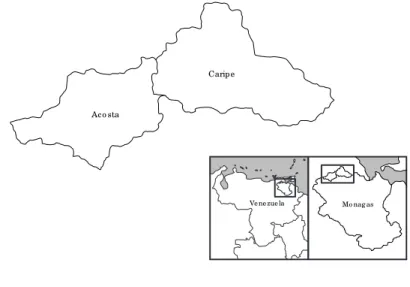
This is a retrospective epidemiological study carried out in Acosta and Caripe counties in the Turimiquire subregion of Monagas State, in Northeastern Venezuela (Figure 1). The data cover a longitudinal chronological series from January 1987 to December 1993. All cases with-in this area, attended and recorded with-in the daily morbidity records of the emergency service of the county hospitals in the town of San Anto-nio de Capayacuar (Acosta) and Caripe (Caripe) were included in the study.
Scorpion sting incidence rates were ex-pressed on a base of 10,000 inhabitants per year, considering the population progression. This progression was calculated with figures obtained from the Settlement Population Nomenclator Report of the Northeastern Re-gion of Venezuela, published by the statistics bureau, or Oficina Central de Estadística e In-formática (OCEI). For each county, the inci-dence rates for each year of the study period (1987-1993), the average annual rate (AAR), and the reference period median (RPM) were calculated. The scorpion poisoning index for both counties was obtained as a quotient that relates their average incidence rate values.
Fig ure 1
Re lative g e o g rafic situatio n o f Mo nag as state in the no rth-e aste rn re g io n o f
Ve ne zue la, sho wing the lo c atio n o f the Ac o sta and Carip e munic ip alitie s.
Ve ne zue la Mo nag as
Aco sta
Data processing
Statistical analysis of variables was done by applying parametric methods: 1) descriptive measurements for univariate central tendency and dispersion of data; 2) distribution of
Stu-dent’s t differences between means; 3)
demonstrations concerning proportions of large samples’ inference test with respect to the difference of proportions with independent sampling; and 4) time series analysis test of cyclical fluctuations. A significance value of 95% confidence (p<0.05) was considered.
Result s
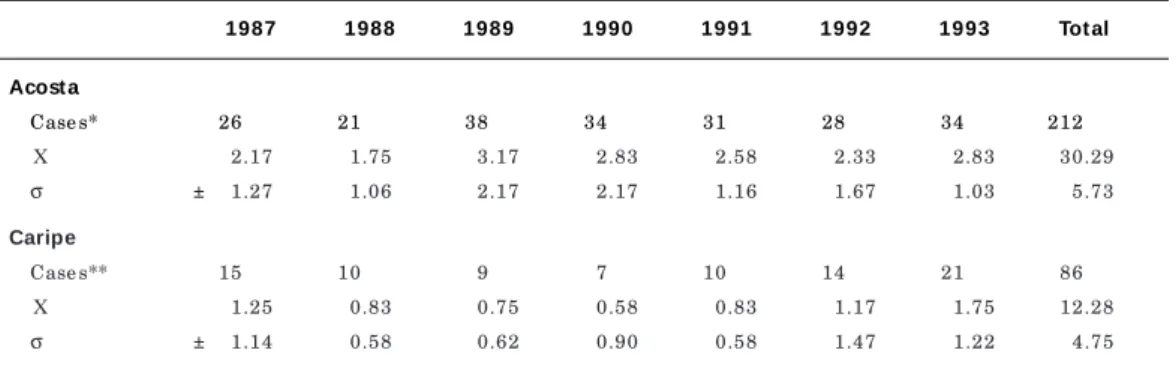
Cases of scorpion poisoning in Acosta and Caripe counties from 1987 to 1993 are shown in Table 1. Acosta recorded 212 scorpion stings during the study period. The highest frequency of scorpion poisoning was in 1989 and the low-est in 1988. Caripe recorded a total of 86 cases of scorpion poisoning, with 1993 having the most cases and 1990 the least. Cases for Acosta ranged from 2 to 3 per month and about 30 per year. Caripe averages about one patient per month and twelve per year. Comparison of the monthly mean cases of scorpion poisoning for each year among both counties is shown in Figure 2; Acosta as compared to Caripe show-ing statistically significant differences in all years evaluated (p<0.05).
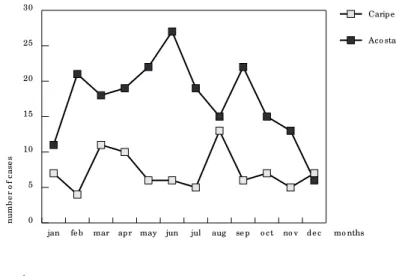
The observed seasonal behavior of poison-ing in both counties, accumulated for each month during the 1987-1993 period is shown in Figure 3. Acosta County displays a cyclical fluctuation phenomenon that is statistically
significant (p<0.05). It presents approximately three cycles a year with three peaks of maxi-mum incidence, in February, June, and Sep-tember. The month of June accumulates the highest frequency with 27 scorpion stings in the 1987-1993 period. For Caripe, this cyclical fluctuation did not show statistically signifi-cant differences (p>0.05), presenting only two peaks of maximum incidence, in the months of March and August; the latter accumulating the most number of cases with 13 scorpion stings. An opposite trend in both counties is observed when comparing the fluctuation trends in the frequency of cases; that is, when the incidence in Acosta increases, it decreases in Caripe, and
Tab le 1
Case s o f sc o rp io n sting s p e r ye ar in Ac o sta and Carip e Co untie s, Mo nag as State , Ve ne zue la.
1987 1988 1989 1990 1991 1992 1993 Tot al
Acost a
Case s* 26 21 38 34 31 28 34 212
X 2.17 1.75 3.17 2.83 2.58 2.33 2.83 30.29
σ ± 1.27 1.06 2.17 2.17 1.16 1.67 1.03 5.73
Caripe
Case s** 15 10 9 7 10 14 21 86
X 1.25 0.83 0.75 0.58 0.83 1.17 1.75 12.28
σ ± 1.14 0.58 0.62 0.90 0.58 1.47 1.22 4.75
X
: Ave rag e p e r mo nth fo r e ac h ye ar σ: Stand ard d e viatio n o f the me an
* Numb e r o f c ase s re c o rd e d in the San Anto nio d e Cap ayac uar Ho sp ital (Ac o sta Co unty) ** Numb e r o f c ase s re c o rd e d in the Carip e Ho sp ital (Carip e Co unty)
Fig ure 2
Co mp ariso n o f ave rag e o f sc o rp io n sting p e r mo nth fo r e ac h ye ar in Ac o sta
and Carip e munic ip alitie s o f Mo nag as state , Ve ne zue la.
1987 1988 1989 1990 1991 1992 1993 To tal
1987
1988
1989
1990
1991
1992
1993
To tal
1.85 p < 0.05
2.61 p < 0.01
3.68 p < 0.005
3.29 p < 0.005
4.63 p < 0.005
1.76 p < 0.05
2.32 p < 0.025
6.35 p < 0.0005
Aco sta
the months of maximum incidence in each re-gion do not coincide.
Table 2 shows that the scorpion poisoning incidence was higher in Acosta County, with an average annual rate of 18.30‰, and lower in Caripe County, with a corresponding value of 4.37‰. The reference period median was 30.63‰ for Caripe and 128‰ for Acosta. The scorpion poisoning incidence coefficient was 4.18 times higher in Acosta County than in Caripe. In Acosta, the years of greatest epi-demiological importance for scorpion poison-ing were 1989, 1990, and 1993, with incidences
presenting a significantly higher incidence rate than other years in the study period (p<0.05). For Caripe, the most significant epidemiologi-cal year was 1993 (p<0.05). As shown in Figure 4, incidence rates were higher in Acosta for all the study period, displaying statistically signif-icant differences when compared to those of Caripe (p<0.05).
Discussion
Previous research by Figueredo et al., (1985) in Monagas State shows that scorpion sting mor-bidity/mortality is relevant in this region. Ve-lasquez et al., (1992a, 1992b) determined an average annual incidence of 2.82‰ in this State for the 1989-1991 triennium. They also established Acosta County as a hyperendemic area (18.30‰) in comparison to the other re-gions of the same State. Expanding the longitu-dinal period of study (1987-1993) in Acosta County, our results yield an average annual rate of 18.30‰ and an RPM of 128.00‰. The scorpion poisoning index confirms the conclu-sions of Velasquez et al., (1992a, 1992b) classi-fying Acosta County as a hyperendemic zone for such injuries. We observed greater inci-dence values in 1989, 1990, and 1993 for Acos-ta, leading us to assume that the frequency of scorpion stings has tended to increase. The in-cidence for Caripe shows a much greater sta-bility throughout the study period. The signifi-cantly greater frequency of cases for Acosta in-dicates that 2 or 3 reported scorpion stings per month and about 30 per year may be expected in this region. However, we expect one patient per month and around twelve per year within the Caripe area.
Plotting of the frequency of recorded scor-pion sting cases shows cycles of maximum and minimum peaks that display an opposite be-havior when comparing the two counties; when the number of cases increases in Acosta, it decreases in Caripe. This phenomenon of cyclical fluctuations over time is statistically significant for Acosta. As in other countries, the maximum peaks of scorpion poisoning inci-dence coincide with the beginning of rainy sea-son cycles (Velasco-Castrejon et al., 1976; Il-lanes, 1981; Dehesa-Dávila, 1989). The appear-ance of the maximum peaks in different months for the two counties (Acosta and Caripe) is probably due to the variation in the beginning of the rainy season in these two ar-eas of the Turimiquire subregion of Monagas State.
Plo tting o f se aso nal b e havio r o f sc o rp io n p o iso ning ac c umulate d fo r e ac h mo nth
in the c hro no lo g ic al se rie s (1987-1993) in Ac o sta and Carip e munic ip alitie s
o f Mo nag as state , Ve ne zue la.
0 5 10 15 20 25 30 Carip e Aco sta
d e c no v o ct se p aug jul jun may ap r mar fe b
jan mo nths
n u m b e r o f c a se s
Fig ure 4
Co mp ariso n o f annual inc id e nc e rate s p e r 10,000 inhab itants o f sc o rp io n
p o iso ning s b e twe e n 1987 and 1993 in Ac o sta and Carip e munic ip alitie s o f Mo nag as
state , Ve ne zue la.
1987 1988 1989 1990 1991 1992 1993 AAR
1987 1988 1989 1990 1991 1992 1993 AAR 5.41 3.59 3.22 2.49 3.55 4.95 7.39 4.37 7.70 p < 0.05
4.13 p < 0.05
11.95 p < 0.005
18.51 p < 0.005
11.17 p < 0.005
7.44 p < 0.005
6.52 p < 0.005
9.84 p < 0.005
16.32 13.02 23.30 20.54 18.50 16.50 19.80 18.30
‰ Aco sta
De Sousa et al. (1995b) describe a scorpion poisoning epidemic in Montes County, Sucre State, during 1993. This county borders on Acosta and shares the same physical-geo-graphic and ecological area of the Turimiquire subregion, located in Venezuela’s Northeastern Region. This subregion has several different ecosystems within its area of influence (Man-zanilla-Puppo, 1992), including a tropophilous jungle and evergreen woods (rain and misty forests) (González-Sponga, 1984). The tropo-philous jungle occupies the foothills region and is characteristic of the three States making up the Turimiquire subregion (Anzoátegui, Monagas, and Sucre). With an average annual
temperature between 25 and 28oC, average
an-nual precipitation between 1,000 and 2,500 mm, vegetation with trees 30 to 40 meters high, scarce epiphytes, and a well-developed herba-ceous stratum, this tropophilous jungle is one of the habitats described as harboring the Tityusgenus in Venezuela.
In Venezuela, scorpions have a wide geo-graphical distribution (González-Sponga, 1984). Potential risk areas for poisoning coincide with
the dispersion of the Tityusgenus
(González-Sponga, 1984; De Sousa et al., 1996). In the country’s central regions, such as the Federal District and Miranda State, cases of scorpion stings are related to the presence of Tityus
dis-crepans(González-Sponga, 1984; Porras et al., 1994). A new species of this genus (Quiroga, 1988) has been reported in Punceres and Bolí-var Counties in the Northern-Central Region of Monagas State (Velasquez et al., 1992a, 1992b). This suggests that scorpion poisoning in Acos-ta and Caripe, especially severe cases, is asso-ciated with the presence of this genus. We have collected several specimens of this taxonomic classification in field captures.
In other regions of the Americas, severe stings by these arthropods have also been cor-related with different species belonging to this
genus. In Brazil, Tityus serrulatus, Tityus
bahiensis(Bücherl, 1953, 1969, 1978; Spiran-deli-Cruz et al., 1995; Lourenço & Cuellar,
1995), and Tityus stigmurushave been involved
in most cases; the latter predominant in the Northeastern Region of Brazil (Eickstedt, 1983/ 84; Azevedo-Marquez et al., 1992). In Bahía State, Biondi-Queiroz et al. (1995) have verified an increase in the scorpion poisoning inci-dence during the period 1992-1994 in the Greater Salvador Metropolitan Area. In this
study, the Tityusgenus was identified as the
etiologic agent in 98.1% of the cases.
It would be interesting to characterize the geographical distribution of the scorpionic fauna in Acosta and Caripe, determining which species of scorpions are present there.
Regard-Tab le 2
Sc o rp io n p o iso ning inc id e nc e rate p e r 10,000 inhab itants in Ac o sta and Carip e Co untie s,
Mo nag as State , Ve ne zue la.
Acost a Caripe
Case s / Po p ulatio n£ Inc id e nc e Rate Case s / Po p ulatio n£ Inc id e nc e Rate
‰ ‰
1987 26/ 15,931 16.32 15/ 27,745 5.41
1988 21/ 16,133 13.01 10/ 27,856 3.59
1989 38/ 16,338 23.30* 9/ 27,967 3.22
1990 34/ 16,546 20.54* 7/ 28,079 2.49
1991 31/ 16,754 18.50 10/ 28,191 3.55
1992 28/ 16,963 16.50 14/ 28,304 4.95
1993 34/ 17,175 19.80* 21/ 28,417 7.39*
AAR 212/ 16,546/ 7 18.30 86/ 28,079/ 7 4.37
RPM 212/ 16,546 128.00 86/ 28,079 30.63
Ind e x: 128.00‰ = 4.18**
30.63‰
AAR: ave rag e annual rate , c alc ulate d as the q uo tie nt b e twe e n the c ase s fo r the se ve n-ye ar p e rio d and the p o p ulatio n fo r 1990
RPM:re fe re nc e p e rio d me d ian, c alc ulate d as the q uo tie nt b e twe e n the c ase s fo r the to tal p e rio d and the p o p ulatio n fo r 1990
Ind e x:O b taine d b y d ivid ing the RPM fo r Ac o sta and Carip e c o untie s
£ Ce nsus re c o rd e d b y the O fic ina Ce ntral d e Estad ístic a e info rmátic a (O CEI) * p < 0.05
References
ABROUG, F.; BOUJDARIA, R.; BELGHITH, M.; NOUI-RA, S. & BOUCHOUCHA, S., 1991. Cardiac dys-function and pulmonary edema following scorpi-on envenomatiscorpi-on. Chest, 100:1057-1059. AMARAL, C.; FERREIRA, D.; CAMPOLINA, D.;
OLORTEGUI, C. & DINIZ, C., 1992. Evidências de mecanismo não cardigênico na gênese do edema pulmonar agudo secundário a acidente escorpiô-nico (Tityus serrulatus). XXVIII Congresso da So-ciedade Brasileira de Medicina Tropical. Belém. AMARAL, C.; BARBOSA, A.; RIOS LEITE, V.; TAFURI,
W. & ALVES DE REZENDE, N., 1994. Scorpion sting-induced pulmonary oedema: evidence of increased alveolocapillary membrane permeabil-ity. Toxicon, 32:999-1003.
AZEVEDO-MARQUEZ, M. M. de; CUPO, P. & HERING, S. E., 1992. Acidentes por animais peçonhentos. Medicina, 25: 539-554.
BIONDI-QUEIROZ, I.; FREITAS, I. E. S.; SANTANA, V. P. G. & RODRIGUES, D. S., 1995. Epidemiologia de acidentes por escorpiões na Região Metropolita-na de Salvador (BA). III Congresso Brasileiro, II Congresso Iberoamericano e I Congresso Latino-americano de Epidemiologia. Salvador.
BROGLIO, N. & GOYFFON, M., 1980. Les accidents d’envenimation scorpionique.Le Concours Médi-cale, 102:5615-5622.
BÜCHERL, W., 1953. Escorpiões e escorpionismo no Brasil. I. Manutenção de escorpiões em viveiros e extração do veneno. Memórias do Instituto Butantan, 25:53-82.
BÜCHERL, W., 1969. Escorpionismo no Brasil. Memórias do Instituto Butantan, 34:9-24. BÜCHERL, W., 1978. Venoms of Tityinae. In:
Arthro-pod Venoms. (S. Bettini, ed.). pp. 371-379, Berlin: Ed. Springer-Verlag.
CHIPPAUX, J.; GALTIER, J. & LEFAIT, J., 1984. Épidémio-logie des envenimations en Guyane Française. Bulletin de la Société de Pathologie Exotique, 77:206-207.
morphometric study, Truss Network and other techniques, characterized in Venezuela the ge-ographical distribution and ecological niches
of the Rhopalurusgenus. Application of this
methodology or its alternatives would help ex-tend the knowledge on the scorpionic fauna of this region and its relation to venomous stings.
Northwestern area of Monagas State is a hyper-endemic zone for scorpion poisoning, thus constituting a public health problem. The sults of this study lead us to more detailed re-search on the epidemiological characterization of such poisoning and the identification of species within the study area.
DEHESA-DAVILA, M., 1989. Epidemiological charac-teristics of scorpion sting in Leon, Guanajuato, Mexico. Toxicon, 27:281-286.
DE SOUSA, L.; KIRIAKOS, D.; JIMENEZ, J.; MICHIELI, D.; RODRIGUEZ, C.; MIRABAL, J. & QUIROGA, M., 1995a. Accidente cerebrovascular isquémico por emponzoñamiento escorpiónico: Observación clínica. SABER, Revista Científica del Consejo de Investigación de la Universidad de Oriente, 7:7-14. DE SOUSA, L.; GARCIA, Y.; CAMPAÑA, J.; PARRILLA, P.; LEDEZMA, E.; JORQUERA, A. & QUIROGA, M., 1995b. Epidemia por escorpionismo en la Sub-región Turimiquire del Estado Sucre, Venezuela. III Congresso Brasileiro, II Congresso Iberoameri-cano e I Congresso LatinoameriIberoameri-cano de Epidemio-logia. Salvador.
DE SOUSA, L.; BONOLI, S.; QUIROGA, M. & PARRILLA, P. 1996. Scorpion sting epidemiology in Montes Municipality of the State of Sucre, Venezuela: geo-graphic distribution. Revista do Instituto de Medi-cina Tropical de São Paulo, 38:147-152.
EICKSTEDT, V. R. D. von., 1983/84. Escorpionismo por Tityus stigmurusno Nordeste do Brasil (Scor-piones; Buthidae). Memórias do Instituto Butan-tan, 47/48:133-137.
FIGUEREDO, V.; BADDOUR, Z. & LEON, B., 1985. Es-corpionismo en Algunas Regiones del Estado Mo-nagas. Lapso 1981-1983. Tesis de Grado, Ciudad Bolívar: Escuela de Medicina, Universidad de Ori-ente.
GONZALEZ-SPONGA, M. A., 1984. Escorpiones de Ve-nezuela. Caracas: Ed. Lagoven.
ILLANES, A., 1981. Farmacología de los Venenos de Es-corpiones. Trabajo de Ascenso a Profesor Titular. Ciudad Bolívar: Escuela de Medicina, Universi-dad de Oriente.
LOURENÇO, W. R. & CUELLAR, O., 1995. Scorpions, scorpionism, life history strategies and partheno-genesis. A review article. Journal of Venomous An-imals and Toxins, 1:51-62.
Acknowledgment s
MANZANILLA-PUPPO, J., 1992. El género Rhopalurus Thorell (Scorpionida: Buthidae) en Venezuela. Consideraciones Biogeográficas, Taxonómicas y Ecológicas. Tesis de Maestría. Maracay: Instituto de Zoología Agrícola, Facultad de Agronomía, Universidad Central de Venezuela.
PORRAS, J. L.; ROSILLO-GONZÁLEZ, M. & GUIRA-DO-PASTOR, M., 1994. Escorpionismo por Tityus discrepans. Estudio retrospectivo 1983-1986. Ar-chivos Venezolanos de Pediatría y Puericultura, 57:98-105.
QUIROGA, M., 1988. Descripción de una nueva es-pecie de escorpión del género Tityus (Koch, 1836) Tityus caripitensissp.n. Estudio histológico de la glándula del veneno. Trabajo de Ascenso a Profe-sor Asociado. Ciudad Bolívar: Escuela de Medici-na, Universidad de Oriente.
SPIRANDELI-CRUZ, E. F.; WINTHER-YASSUDA, C. R.; JIM, J. & BARRAVIERA, B., 1995. Programa de
con-trole de surto de escorpião Tityus serrulatus, Lutz e Melo 1922, no Município de Aparecida, SP (Scorpiones, Buthidae).Revista da Sociedade Bra-sileira de Medicina Tropical, 28:123-128. VELASCO-CASTREJON, O.; LARA-AGUILERA, R. &
ALATORRE, H., 1976. Aspectos epidemiológicos y clínicos de la picadura de alacrán en un área hi-perendémica. Revista de Investigación de Salud Pública, 36:93-103.
VELASQUEZ, A.; DE SOUSA, L.; QUIROGA, M. & RO-DRIGUEZ, R., 1992a. Escorpionismo en el Estado Monagas, Venezuela. Parte I: Algunos aspectos epidemiológicos. Memorias II Congreso Científi-co, Universidad de Oriente. Nueva Esparta. VELASQUEZ, A.; QUIROGA, M. & DE SOUSA, L.,