Site-specific microinjection of liposomes into the brain for local
infusion of a short-lived peptide
Neila M. Silva-Barcellos
a, Sordaini Caligiorne
b,
Robson A.S. dos Santos
b, Fre´de´ric Fre´zard
b,*
aFaculdade de Farma´cia, Escola de Farma´cia, Universidade Federal de Ouro Preto, 35400-000 Ouro Preˆto, MG, Brazil b
Departamento de Fisiologia e Biofı´sica, Instituto de Cieˆncias Biolo´gicas, Universidade Federal de Minas Gerais, Av. Antoˆnio Carlos 6627, 31270-901 Belo Horizonte, MG, Brazil
Received 1 October 2003; accepted 15 December 2003
Abstract
The short-lived peptide, angiotensin-(1-7) (Ang-(1-7)), was encapsulated in different liposome preparations, in order to evaluate the influence of membrane fluidity, membrane surface, liposome size and dose of peptide on the cardiovascular effects of the encapsulated peptide at a specific site of the brain. These preparations were microinjected unilaterally into the rostral ventrolateral medulla (RVLM) of Wistar rats, and mean arterial blood pressure (MAP) and heart rate (HR) were registered by telemetry. Pegylated, rigid and calibrated (200 nm) liposomes, containing 50 ng of Ang-(1-7), elicited a significant increase of MAP for at least 7 days, in contrast to empty liposomes or non-pegylated liposomes. When a two-fold higher peptide dose was employed or when pegylated liposomes were used in the fluid state or uncalibrated, less pronounced pressor effects were observed. These data show that the cardiovascular responses to the microinjection of Ang-(1-7)-containing liposomes into the RVLM can be modulated through the manipulation of liposome characteristics. These results can be explained by the influence of liposome characteristics on the flux of peptide release. It is expected that this new method will encounter numerous applications in the study of the chronic actions of short-lived bioactive peptides in specific sites of the brain.
D2004 Elsevier B.V. All rights reserved.
Keywords:Liposomes; Pegylation; Angiotensin-(1-7); Rostral ventrolateral medulla; Renin – angiotensin system
1. Introduction
A major obstacle to the study of the physiology of short-lived peptides is the lack of appropriate meth-odology for assessing their chronic actions. This is
particularly true when these actions have to be eval-uated in a specific site of the brain and in freely moving awake animals.
Several recent studies indicated that angiotensin-(1-7) (Ang-angiotensin-(1-7)), an endogenous short-lived peptide of the Renin – Angiotensin System, acts as an impor-tant neuromodulator at the rostral ventrolateral me-dulla (RVLM), a brain area related to the tonic and reflex control of arterial blood pressure [1].
Microin-0168-3659/$ - see front matterD2004 Elsevier B.V. All rights reserved.
doi:10.1016/j.jconrel.2003.12.010
* Corresponding author. Tel.: 3134992940; fax: +55-3134992924.
E-mail address:[email protected] (F. Fre´zard).
jection of Ang-(1-7) into the RVLM of normotensive rats resulted in a significant increase of arterial pressure [2]. This effect was found to be mediated by a specific surface receptor, presumably the G protein-coupled receptor Mas[3]in sympathetic pre-motor neurons, as microinjection of the Ang-(1-7) receptor Mas antagonist (A-779) induced a significant fall of blood pressure and heart rate [3]. In these studies, 25 to 50 ng of Ang-(1-7) produced an increase of 15 mm Hg for about 10 min. The short duration of this effect was attributed to the rapid in vivo metabolism of the peptide, essentially through inactivation by the ectoenzyme, Angiotensin-convert-ing enzyme[4].
To get insight into the chronic cardiovascular actions of this peptide at the RVLM, a method was recently introduced that combines and takes advantage of three different techniques: liposome encapsulation, site-specific microinjection and telem-etry. Ideally, liposomes may be designed to remain located at the injection site for a long period of time, where they protect encapsulated peptide from rapid degradation and act as a sustained release system. Secondly, microinjection allows the admin-istration of bioactive substances in some specific sites of the brain with minimal side effects. Finally, using telemetry, it is possible to register physiolog-ical parameters and their circadian variations in undisturbed freely moving animals for days and even months. In a previous work, it has been shown that microinjection of liposome-containing Ang-(1-7) into the RVLM elicited a prolonged pressor effect for several days [5], in contrast to the free peptide that increased blood pressure for only a few minutes [2]. This long-lasting action also led to unmask a new physiological role for Ang-(1-7): its modulation of the circadian rhythms of mean arterial blood pressure [5]. However, in order to fully evaluate the potential of this new method and, more specif-ically, the possibility of manipulating the peptide actions through the control of its release rate from liposomes, the influence of liposome characteristics, such as vesicle size, membrane surface, membrane fluidity and amount of encapsulated peptide, still has to be determined. The present study reports the influence of liposome characteristics on the cardio-vascular actions of liposome-encapsulated Ang-(1-7) at the RVLM.
2. Materials and methods
2.1. Materials
L-a-distearoylphosphatidylcholine (DSPC),
dio-leylphosphatidylcholine (DOPC) and cholesterol (CHOL) were purchased from Sigma (St. Louis, MO, USA). Distearoylphosphatidylethanolamine-polyethylene glycol 2000 (DSPE-PEG2000) was obtained from Avanti Polar Lipids (Alabaster, AL, USA). Angiotensin-(1-7) was obtained from Bachem (Los Gatos, CA, USA). All other reagents were of reagent grade and used without further purification.
2.2. Animals
Wistar rats (male weighing 250F10 g), bred at the animal facility of the Biological Sciences Institute (CEBIO, UFMG, Belo Horizonte, MG, Brazil), were used throughout the experiments.
2.3. Preparation and characterization of liposomes
Ang-(1-7) was encapsulated in five different prep-arations of liposomes(Table 1), using as a first step, the dehydration – rehydration method [6]. Liposomes were either kept uncalibrated or were extruded repeat-edly through polycarbonate membrane of 200 nm pore size. The liposomes were then separated from non-encapsulated peptide by dialysis against PBS (0.15 M NaCl, 0.01 M phosphate, pH 7.2) and finally sterilized by filtration through 0.22 Am membranes. Calibrated and uncalibrated empty liposomes were obtained using
Table 1
Characteristics of liposome preparations containing encapsulated Ang-(1-7)
Liposome preparation
Lipid composition (molar ratio)
Peptide to lipid ratio (w/w) (1) Pegylated, rigid DSPC:CHOL:DSPE-PEG (5:4:0.3) 0.004 (2) Pegylated, rigid, conc. DSPC:CHOL:DSPE-PEG (5:4:0.3) 0.009 (3) Pegylated, fluid DOPC:CHOL:DSPE-PEG (5:4:0.3) 0.004 (4) Conventional, rigid
DSPC:CHOL (5:4) 0.004
(5) Pegylated, rigid, uncal.
DSPC:CHOL:DSPE-PEG (5:4:0.3)
the same procedure, but omitting the peptide. The amount of encapsulated peptide was determined by exploiting its intrinsic fluorescence. The mean hydro-dynamic diameter of the vesicles, as determined by photon correlation spectroscopy, was found to be equal to 200F15 nm for calibrated liposomes.
2.4. Microinjection of liposome preparations and measurements of MAP and HR
Ang-(1-7)-containing liposomes (50 ng of peptide/ 200 nl for Preparations 1, 3, 4, 5 and 100 ng/200 nl for Preparation 2) or empty liposomes (control group) were unilaterally microinjected into the RVLM of Wistar rats (3 – 10 animals per group), under tribro-moethanol anesthesia (250 mg/kg i.p.), with an injec-tion needle (30 G) that was slowly inserted in the brain tissue through the dorsal surface, using the following extereotaxis coordinates: 1.8 mm anterior, 1.8 mm lateral to the obex and just above the pia-mater. Mean arterial pressure (MAP) and heart rate (HR) were registered by telemetry during 10 s every 10 min, for 4 days before and for up to 12 days after microinjec-tion of the liposome preparamicroinjec-tions in the undisturbed freely moving animals, as previously described[5].
2.5. Treatment of data and statistical analysis
From telemetry data, daytime and nighttime mean MAP and HR were determined on each day for each animal. The changes in these parameters were then determined by calculating the difference between the value of the parameter on each day and the mean of the parameter over the 3 days preceding microinjec-tion (control period). The values for cardiovascular parameters after microinjection were compared to those before microinjection (control period), using the One-way ANOVA for repeated measures (with Dunnett post test). The changes in cardiovascular parameters were compared between the different ex-perimental groups, using the Two-way ANOVA fol-lowed by Bonferroni post test.
3. Results
Ang-(1-7) was encapsulated in different liposomal preparations(Table 1), in order to evaluate the
influ-ence of membrane fluidity, membrane surface, lipo-some size and amount of encapsulated peptide on the cardiovascular effects of encapsulated Ang-(1-7) at the RVLM. Encapsulation of Ang-(1-7) in liposomes was achieved with an efficiency of 15% for prepara-tions calibrated through 200 nm polycarbonate mem-branes (Preparations 1, 2, 3, 4) and 45% for uncalibrated preparation.
These liposomal preparations were microinjected unilaterally into the RVLM of Wistar rats, and MAP and HR were registered by telemetry in the undis-turbed freely moving animals.
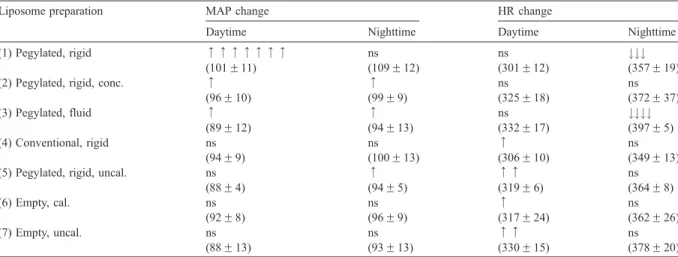
Table 2 summarizes the cardiovascular effects elicited by the different liposome preparations, show-ing the baseline values for MAP and HR durshow-ing the control period and indicating the number of days during which these cardiovascular parameters were significantly altered when compared to the baseline values.
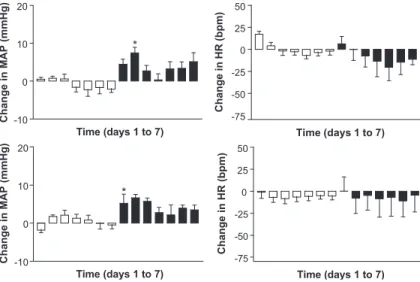
Microinjection of Ang-(1-7) encapsulated in pegy-lated, rigid and calibrated liposomes (Preparation 1) produced a significant increase of MAP for 7 days, specifically on the daytime period. Bradycardia was also observed during nighttime (P< 0.05 on days 1, 2, 3). Strikingly, none of these effects was observed after microinjection of empty liposomes (Preparation 6) at the same lipid dose. As shown in Table 2, empty liposomes produced daytime tachycardia on day 1, which could be attributed to mechanical stimulation. Fig. 1 displays the changes in MAP and HR elicited by Preparation 1 and the comparison of these effects with those produced by empty liposomes. Significant differences were observed for daytime MAP on days 1 to 7 and for nighttime HR on day 2.
When pegylated, rigid and calibrated liposomes were given at the same lipid dose, but with a two-fold higher peptide dose (Preparation 2), pressor effects of short duration were produced on both daytime and nighttime periods (P< 0.05 only on day 2)(Table 2). In this case, no significant alteration of HR was detected. As illustrated in Fig. 2, the changes in MAP promoted by this preparation were significantly different from those elicited by empty liposomes. However, these alterations did not differ significantly from those produced by Preparation 1.
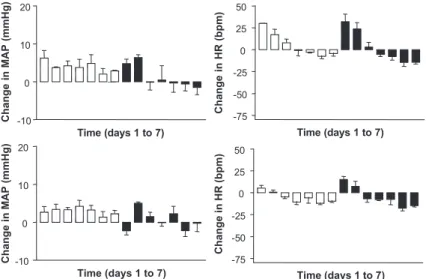
and a late bradycardia on the nighttime period (P< 0.05 on days 3, 4, 6, 7) (Table 2). As illustrated inFig. 3, the changes in MAP and HR promoted by this preparation were significantly higher than those produced by empty liposomes. Moreover, the changes
in MAP were significantly lower than those produced by Preparation 1 (P< 0.05 on day 1, nighttime; P< 0.05 on day 2, daytime).
It is noteworthy that pegylation of liposomes was found to be required for producing significant
alter-Fig. 1. Daytime (upper) and nighttime (lower) changes in MAP and HR induced by microinjection of pegylated, rigid and calibrated liposomes, containing (filled bars) or not (empty bars) 50 ng of Ang-(1-7), into the RVLM of Wistar rats. Data represent the means of observed changesFS.E. *P< 0.05 for comparisons between the changes induced by peptide-containing liposomes (n= 5) and those induced by empty liposomes (n= 10) (Two-way ANOVA with Bonferroni post test).
Table 2
Chronic cardiovascular actions elicited by Ang-(1-7) at the RVLM from different liposome preparations
Liposome preparation MAP change HR change
Daytime Nighttime Daytime Nighttime
(1) Pegylated, rigid zzzzzzz ns ns ###
(101F11) (109F12) (301F12) (357F19)
(2) Pegylated, rigid, conc. z z ns ns
(96F10) (99F9) (325F18) (372F37)
(3) Pegylated, fluid z z ns ####
(89F12) (94F13) (332F17) (397F5)
(4) Conventional, rigid ns ns z ns
(94F9) (100F13) (306F10) (349F13)
(5) Pegylated, rigid, uncal. ns z zz ns
(88F4) (94F5) (319F6) (364F8)
(6) Empty, cal. ns ns z ns
(92F8) (96F9) (317F24) (362F26)
(7) Empty, uncal. ns ns zz ns
(88F13) (93F13) (330F15) (378F20)
ation of cardiovascular parameters, as non-pegylated, rigid and calibrated liposomes (Preparation 4) showed neither pressor effect nor bradycardia(Table 2). The changes in daytime MAP elicited by Prep-aration 1 were found to be significantly higher than
those produced by Preparation 4 (P< 0.05 on days 1, 2, 3). Moreover, the changes in nighttime HR elicited by Preparation 3 were significantly higher than those produced by Preparation 4 (P< 0.05 on days 3, 4, 6, 7).
Fig. 3. Daytime (upper) and nighttime (lower) changes in MAP and HR induced by microinjection of pegylated, fluid and calibrated liposomes, containing (filled bars) or not (empty bars) 50 ng of Ang-(1-7), into the RVLM of Wistar rats. Data represent the means of observed changesFS.E. *P< 0.05 for comparisons between the changes induced by peptide-containing liposomes (n= 3) and those induced by empty liposomes (n= 10) (Two-way ANOVA with Bonferroni post test).
When pegylated and rigid liposomes were admin-istered in the uncalibrated form (Preparation 5, lip-osomes with large and heterogeneous size distribu-tion), a significant pressor effect was detected specifically on nighttime (P< 0.05 on day 2) (Table 2). However, no significant difference was observed between the change produced by this preparation and that produced by uncalibrated empty liposomes(Fig. 4). The changes in daytime MAP elicited by Prepara-tion 1 were found to be significantly higher than those produced by Preparation 5 (P< 0.05 on day 3).
4. Discussion
It has been reported previously that microinjection of Ang-(1-7)-containing liposomes into the RVLM of Wistar rats elicited a prolonged pressor effect for several days, in contrast to the microinjection of empty liposomes or of the free peptide[5]. This long-lasting action was achieved using pegylated, rigid and cali-brated (200 nm) liposomes. Moreover, microinjection of the same liposomes labeled with the lipophilic fluorescent dye, diI, showed that vesicles remained concentrated at the RVLM even after 7 days[5].
In the present work, the potential of this new method was further investigated, by evaluating the
influence of liposome characteristics on the cardio-vascular actions of encapsulated peptide. It is expected that manipulation of vesicle size, membrane surface, membrane fluidity and amount of encapsu-lated peptide would result in the modulation of the flux of peptide infusion. Ultimately, physiologically relevant information on the relationship between the flux of peptide release and the cardiovascular responses may be obtained.
Pressor effects and bradycardia were the main actions elicited by the liposome preparations at the RVLM. However, the period, duration and intensity of these effects were found to depend markedly on liposome characteristics. The most intense and pro-longed effects were produced by pegylated, rigid and calibrated liposomes (Preparation 1). Less pronounced effects were observed when liposomes were uncali-brated (Preparation 5), contained a higher amount of peptide (Preparation 2) or were presented with a fluid membrane (Preparation 3).
The dependence of cardiovascular responses upon liposome characteristics, as evidenced in this study, may be explained by the different release profiles of the liposome preparations. Since the spontaneous release of Ang-(1-7) was found to be insignificant on a week period, when these liposome preparations were resuspended in isotonic saline (data not shown),
cell-Fig. 4. Daytime (upper) and nighttime (lower) changes in MAP and HR induced by microinjection of pegylated, rigid and uncalibrated liposomes, containing (filled bars) or not (empty bars) 50 ng of Ang-(1-7), into the RVLM of Wistar rats. Data represent the means of observed changesFS.E.P> 0.05 for comparisons between the changes induced by peptide-containing liposomes (n= 3) and those induced by empty
mediated release is expected to be the predominant mechanism of peptide release in vivo. The presence of active endocytic cells at the microinjection site, most probably microglial cells[7], is also supported by the observation that pegylation, that essentially slows down the uptake of liposomes by cells [8], was required for producing long-lasting responses. Assum-ing that fluid liposomes are more susceptible to phos-pholipase degradation than rigid ones [9], that large (uncalibrated) liposomes are captured more avidly by endocytic cells than smaller ones [10] and that lip-osomes containing higher amount of peptide exhibit a higher flux of peptide release, one expects indeed that pegylated, rigid and calibrated liposomes would be-have as the slowest release system.
From the physio-pharmacological point of view, this study confirms, in chronic conditions, the pressor effect of Ang-(1-7) at the RVLM and unmasks a new action of the peptide on HR. Moreover, it suggests that MAP changes are influenced by HR changes, since bradycardia was usually accompanied by a loss of pressor effect (observed in the case of Preparations 1 and 3) and the pressor effect was usually observed in the absence of bradycardia (in the case of Prepara-tion 2). This data also suggests that cardiovascular responses to Ang-(1-7) strongly depend on the local peptide concentration, the intensity of the pressor effect and the bradycardia being reduced at high concentrations. Such effect may be related to the presence of Ang-(1-7) receptors in both excitatory (glutamatergic-) and inhibitory neurons at the RVLM, as recently described for Ang II[11].
5. Conclusion
This study shows that the cardiovascular responses to the microinjection of Ang-(1-7)-containing lipo-somes into the RVLM can be modulated by manipu-lating liposome characteristics, the most intense and prolonged effects being produced by pegylated, rigid and calibrated liposomes. Further insights into the neuromodulator actions of Ang-(1-7) at the RVLM and its role in the central control of blood pressure were obtained. It is expected that this new method will encounter numerous applications in the study of the chronic actions of short-lived bioactive peptides in specific sites of the brain.
Acknowledgements
This work was supported by the Brazilian agencies: CNPq (Brazilian Nanobiotechnology Net-work), FAPEMIG and CAPES.
References
[1] R.A.S. Santos, M.J. Campagnole-Santos, S.P. Andrade, An-giotensin-(1-7): an update, Regul. Pept. 91 (1 – 3) (2000) 45 – 62.
[2] M.A.P. Fontes, M.C.M. Pinge, V. Naves, M.J. Campagnole-Santos, O.U. Lopes, M.C. Khosla, R.A.S. Campagnole-Santos, Cardiovas-cular effects produced by micro-injection of angiotensins and angiotensin antagonists into the ventrolateral medulla of freely moving rats, Brain Res. 750 (1 – 2) (1997) 305 – 310. [3] R.A. Santos, A.C. Simo˜es e Silva, C. Maric, D.M. Silva, R.P.
de Buhr, I. de Buhr, S. Heringer-Walther, S.V. Pinheiro, M.T. Bader, M. Bader, E.P. Mendes, V.S. Lemos, M.J. Campag-nole-Santos, H.P. Schultheiss, R. Speth, T. Walther, Angioten-sin-(1-7) is an endogenous ligand for the G-protein-coupled receptor Mas, Proc. Natl. Acad. Sci. U. S. A. 100 (14) (2003) 8258 – 8263.
[4] M.C. Chappell, N.T. Pirro, A. Sykes, C.M. Ferrario, Metabo-lism of angiotensin-(1-7) by angiotensin-converting enzyme, Hypertension 31 (1 Pt. 2) (1998) 362 – 367.
[5] N.M. Silva-Barcellos, F. Fre´zard, S. Caligiorne, R.A.S. Santos, Long-lasting cardiovascular effects of liposome-entrapped angiotensin-(1-7) at the rostral ventrolateral medul-la, Hypertension 38 (6) (2001) 1266 – 1271.
[6] C. Kirby, G. Gregoriadis, Preparation of liposomes containing factor VIII for oral treatment of haemophilia, J. Microencap-sul. 1 (1) (1984) 33 – 45.
[7] T. Magnus, A. Chan, J. Savill, K.V. Toyka, R. Gold, Phago-cytotic removal of apoptotic inflammatory lymphocytes in the central nervous system by microglia and its functional impli-cations, J. Neuroimmunol. 130 (1 – 2) (2002) 1 – 9.
[8] T.M. Allen, G.A. Austun, A. Chonn, L. Lin, K.C. Lee, Uptake of liposomes by cultured mouse bone marrow macrophages: influence of liposome composition and size, Biochim. Bio-phys. Acta 1061 (1) (1991) 56 – 64.
[9] M. Menashe, D. Lichtenberg, C. Gutierrez-Merino, R.L. Biltonen, Relationship between the activity of pancreatic phospholipase A2 and the physical state of the
phos-pholipid substrate, J. Biol. Chem. 256 (9) (1981) 4541 – 4543.
[10] R. Zeisig, K. Shimada, S. Hirota, D. Arndt, Effect of sterical stabilization on macrophage uptake in vitro and on thickness of the fixed aqueous layer of liposomes made from alkyl-phosphocholines, Biochim. Biophys. Acta 1285 (2) (1996) 237 – 245.
[11] L. Hu, D.N. Zhu, Z. Yu, J.Q. Wang, Z.J. Sun, T. Yao, Expres-sion of angiotensin II type 1 (AT1) receptor in the rostral