Optimization of the
in-situ
U
e
Pb age dating method via
LA-Quadrupole-ICP-MS with applications to the timing of U
e
Zr
e
Mo
mineralization in the Poços de Caldas Alkaline Complex, SE Brazil
Lynthener Bianca Takenaka, Cristiano Lana
*, Ricardo Scholz, Herminio Arias Nalini Jr.,
Adriana Tropia de Abreu
Departamento de Geologia, Universidade Federal de Ouro Preto, Morro do Cruzeiro, Campus, Ouro Preto, MG 35400000, Brazil
a r t i c l e
i n f o
Article history:
Received 19 November 2014 Accepted 29 April 2015 Available online 14 May 2015
Keywords:
LA-ICP-MS
Poços de Caldas alkaline complex Zircon
UePb method
a b s t r a c t
The high spatial resolution of the LA-ICP-MS systems allows rapid extraction of vital isotopic information from individual growth zones of minerals. This paper describes in detail the optimization of a relatively inexpensive LA-ICP-MS system consisting of a UV 213 Laser Ablation and a Quadrupole ICP-MS. The results of optimization take into account laser energy, beam diameter, frequency and ICP-MS gas con-ditions. The optimized conditions were tested for precision and accuracy on a number of well-characterized zircons, commonly used as primary and secondary quality control standards. The acqui-sition of the UePb data is carried out in automated mode (pre-set points) for up to 12 h/day with only minimal operator presence. Individual UePb zircon analysis lasts 80 s. The 2suncertainties of the standards ranged between 1.4 and 8.2%, and overall their relative deviations ranged from 0.02 to 0.87%. The results are comparable to techniques that use more complex and time-consuming approaches such as LA-MC-ICP-MS and ion-microprobe. We have applied this method to obtain ages of numerous granitoid rocks from the Southern S~ao Francisco Craton and a well-known Archean granitoid of the Kaapvaal Craton, South Africa. We furthermore provide thefirst results of UePb age dating of UeZreMo mineralization in the Poços de Caldas Alkaline Complex, SE Brazil, with a UePb age of 85±3 Ma for zircon-bearing hydrothermal veins.
©2015 Elsevier Ltd. All rights reserved.
1. Introduction
Laser Ablation system (LA) attached to Inductively Coupled Plasma Mass Spectrometer (ICP-MS) is a relatively simple and
affordable combination of instruments that is capable of in situ
isotope measurements with extremely low detection limits (Fryer et al., 1993). In geochronology, LA-ICP-MS systems are adequate because of sensitivity, high spatial resolution and higher rates of material transference during analysis. Recent advances in gas/solid state laser ablation and in ICP-MS sensitivity has allowed
deter-mination of important isotopes (e.g., Hf-, B-, Sr-, Nd-, Pb-) and trace
element data from individual growth zones of various minerals
such as zircon, monazite, titanite, apatite and tourmaline (e.g.,
Kinny et al., 1991; Hinton and Upton, 1991; Thirlwall and Walder, 1995; Rubato et al., 2001; Storey et al., 2006;Darlin et al., 2012;
Sarkar et al., 2014). Improvements in the through put rates of ICP-MS systems and intelligent automation of laser ablation in-struments has allowed acquisition of large datasets in relatively short analytical sections. On the other hand, less sensitive systems such as Quadrupole ICP-MS (Q-ICP-MS) coupled to 213 (or 266)-nm solid-state lasers have to be systematically optimized, in order to avoid recurring problems such as low sensitivity and high elemental fractionation.
The wide dynamic range of Quadrupole-ICP-MS systems per-mits UePb isotopic and trace element analysis of narrow growth zones from a number of minerals such as zircon, monazite and titanite (Jeffries et al., 1998, 2003; Jackson et al., 2004; Storey et al., 2006). Several studies have demonstrated the accuracy and preci-sion of such instruments for UePb geochronology (Jackson et al., 2004; Storey et al., 2006) but information about tuning/optimiza-tion/data reduction protocols is often scarce. In this paper, we describe the technique and show how a full optimization of the LA-Q-ICP-MS provided optimum results at the end of one year. We *Corresponding author. Tel.:þ55 31 31 98483538.
E-mail address:[email protected](C. Lana).
Contents lists available atScienceDirect
Journal of South American Earth Sciences
j o u r n a l h o m e p a g e : w w w . e l s e v i e r . c o m / l o c a t e / j s a m e s
http://dx.doi.org/10.1016/j.jsames.2015.04.007
noted that the slightest modifications in the system can result in higher counts (especially for the less abundant masses like
204(Pb þ Hg), 202Hg and 207Pb), prevent high oxide formation
(ThO<<1%) and produce low elemental fractionation. After sys-tematic normalization against external standards, the system can give ages with high accuracy and acceptable analytical errors. The
methodology was tested using five well-characterized zircon
standards and a number of magmatic zircons from well-known granitoids in Brazil and South Africa.
As an application to our system, we attempted to estimate the
timing of fluid circulation and ZreUeMo mineralization in the
Poços de Caldas (PC) Alkaline Complex, one of the largest alkaline
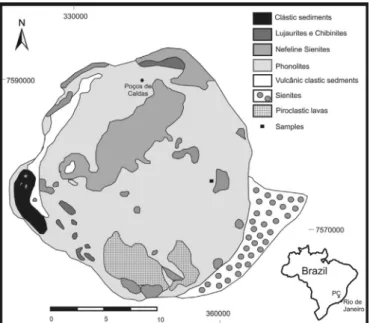
intrusions in South America (Fig. 1). We provide 34in situUePb
analysis from samples of the eastern portion of the PC alkaline complex. These samples came from supergene-enriched deposits of
zircon and caldasites located a few kilometers west of theOsamu
Utsumiuranium mine. Late-stage alkalinefluid activity affected the
main body of phonolites and tinguaites and reflects the timing of
UeZreMo mineralization in the PC complex. The samples yielded abundant, largely translucent zircons that gave highly concordant and Pb-common free isotopic (UePb) ages.
2. Instrumentation and data acquisition
LA-Q-ICP-MS analyses were carried out in an Agilent 7700x mass spectrometer coupled to a laser system LUV213 (New Wave Research/Merchantek, Nd: YAG). The Agilent 7700x ICP-MS is
configured for routine analysis with very low concentrations of
elements (0.1e2% relative standard deviations), providing sufficient
counts on masses such as202Hg,204Pbþ204Hg and207Pb for UePb
applications in minerals like zircon, monazite and titanite (Lana et al., 2010a,b). The software packages of the Laser Ablation unit and ICP-MS are synchronized via a trigger cable in order to auto-mate the analytical procedure. Individual analyses are produced in
less than a minute, and a minimum of 40e50 individual dates can be acquired per hour. The analyses are performed keeping all pa-rameters constant (from laser and ICP-MS) for standards and samples throughout the run. The laser is kept always focused, thus reducing any shifts of the laser beam during ablation. The operating
conditions of ICP-MS and laser are specified inTable 1.
Standard and sample mounts are placed in a tear-drop shaped sample chamber that was customized at the University of
Stellen-bosch (Lana et al., 2013;Romano et al., 2013) (Fig. 2). It has two
compartments: one of 1 cm-diameter for standard mounts and one of 2.5 cm-diameter for sample mounts (Fig. 2a). In the path be-tween the ablation cell and ICP-MS, the commonly used Y-tube was replaced by a gas mixer (Squid) in the form of a splitter, with ten PTFE tubes of 3 mm diameter and 80 cm in length (Fig. 2b) for better homogenization of the mixtures. The Squid keeps wash out time short and produces a strikingly smooth signal that is perfect for counting statistics (it eliminates the noise) and consequently gives better averaged signal counts.
The integration times used are 40 ms for207Pb, 15 ms to206Pb
and 10 ms to29Si,202Hg,204(PbþHg),208Pb,232Th and238U, with a
total scan of the masses occurring in 60 s (20 s background/40 s
ablation). The relevant isotopic ratios 207Pb/206Pb, 208Pb/206Pb,
208Pb/232Th, 206Pb/238U and 207Pb/235U (235U is calculated from
counts of 238U by natural abundant reason235U ¼238U/137.88)
were calculated by the data reduction program Glitter (Van Achterbergh et al., 2001). Background values are measured (20 s) at the beginning of each analysis.
The initial data reduction is done on line via the software Glitter (GEMOC Laser ICP-MS Total Trace Element Reduction), which pro-vides an interactive environment for analytic selection of back-ground and sample signals besides enabling a fast, real-time and online data reduction (Van Achterbergh et al., 2001; Jackson et al., 2004). The program calculates the significant isotopic ratios
(207Pb/206Pb, 208Pb/232Th, 206Pb/238U and 207Pb/235U) which are
displayed in time-resolved mode. For our laser system, isotopic
ratios generated during thefirst 5 s of each analysis were discarded.
The integration window for the remainder of each analysis is chosen so as to exclude signal segments that were related to
in-clusions, zones of Pb loss (e.g., fractures), high common Pb or
in-heritance. Mass bias and drift corrections are based on sets of measured standard ratios that bracket sets of 7e10 analysis of
Fig. 1.Geological map of the Poços de Caldas alkaline complex (PC) in SE Brazil. The geology of the complex includes volcanic (breccia, tuff and agglomerate), effusive and hypabyssal (phonolite and tinguaite, respectively), and plutonic (mainly foyaite) rocks in the massif (Fraenkel et al., 1985; Ulbrich and Ulbrich, 1992).Ulbrich and Ulbrich (1992) described a range of rock types that were sequentially emplaced in the following order: 1-tinguaites, 2-phonolites and 3-syenites, and the last basic to ul-trabasic volcanic rocks and dikes (sometimes associated with carbonatite occurrences). An early volcanism involving olivine nephelinites, phonolite lavas and volcanoclastics gave way to a caldera subsidence and nepheline syenite intrusions forming minor ring dykes and circular structures (Ellert, 1959).
Table 1
Operating conditions of the LA-Quadrupole-ICP-MS system. ICP-MS Agilent 7700x Mass analyzer Quadrupole RF Power (W) 1550 Sampler cone Ni; 1.0 mm Skimmer cone Ni; 0.4 mm Sampling depth (cm) 5 Plasma gas (L min 1) 15
Auxiliary gas (L min 1) 1.2
Optional gas (L min 1) 1
Carrier gas (L min 1) 1.00 e1.10
Dwell times (ms) 40, 15, 10, 10, 10,10, 10 ThOþ
/Thþ
(%) <0.5
Isotopes (m/z) 207Pb,206Pb,208Pb,232Th,238U, 29Si,202Hg,204Pb
þHg
Laser New Wave UV 213 Wavelength (nm) 213
Frequency (Hz) 10 Fluency (J/cm2) 10
Energy (%) 50
Beam type Spot
Beam diameter (mm) 30e40
Ablation time (s) 40e50
unknowns. The measured standard ratios are interpolated through a linear regression and the obtained correction factor is applied to the bracketed unknowns. Common Pb corrections are done using
the interference and background-corrected204Pb signal in
combi-nation with the Pb model composition of Stacey and Kramers
(1975). This is done offline with an in-house excel spreadsheet that takes all mass-bias and drift corrected counts exported from
Glitter. Relative uncertainties of the 206Pb/207Pb and 206Pb/238U
ratios combines the external reproducibility of the primary stan-dard with the within-run uncertainties in the quadrature. A further
1% uncertainty (1
s
) is assigned to the measured TIMS values of theisotope ratios for the standard and propagated through the analysis
error. The207Pb/235U ratio is derived from the normalized and error
propagated207Pb/206Pb and206Pb/238U ratios assuming a238U/235U
natural abundance ratio of 137.88, and the uncertainty is derived by quadratic addition of the propagated uncertainties of both
(207Pb/206Pb and206Pb/238U) ratios. We note that for more than 80%
of the analysis, the204Pb counts were often too low (10e30 cps) and
the206Pb/204Pb ratios are too high for any signi
ficant common Pb
correction.
3. Samples and quality control standards
In this study the precision (on errors) and accuracy (for valida-tion of results) were monitored through alternating measurements between the primary GJ-1 standard zircon and several secondary
(quality control) standards (zircons Plesovice, M127, BB9 and
91500). Our GJ-1 standard zircon (Jackson et al., 2004; Elhlou et al., 2006) is a gem-quality yellowish crystal with no apparent zoning in cathodoluminescence. Previous UePb TIMS dating of this zircon
gave and intercept age of 608.5±0.3 Ma (Jackson et al., 2004). The
Plesovice standard comprises round to well-shaped short prismatic
crystals of approximately 0.1 cm in length. The concordant ID-TIMS
age of 337.17±0.18 Ma (Slama et al., 2008) is conventionally used as
the accepted age of this standard. The BB9 zircon comes from a secondary placer deposit in the Sri Lankan Highland Complex (Santos et al., 2014). The crystal is light purple, transparent and
shows no internal fracture or significant inclusion that can be
observed microscopically. It records a TIMS of 562±1.4 Ma (Santos
et al., 2014). The M127 is a homogeneous zircon crystal from Sri
Lanka with a TIMS age of 526.42±1.9 Ma (207Pb/206Pb) (Nasdala,
2007; Nasdala et al., 2008). The 91500 zircon from Lake Ontario,
Canada (Wiedenbeck et al., 1995), is marked by a dark red colorflat
faces, well-defined edges and no visible inclusion. Previous
char-acterizations provided UePb ages by ID-TIMS of 1062.4±0.8 Ma for
the 207Pb/206Pb ratio and 1065.4 ± 0.6 Ma for the 206Pb/238U
(Wiedenbeck et al., 1995).
Four Palaeoproterozoic and Archaean granitoid samples were used to evaluate the ability of the instrument to date zircons much
older (>2000 Ma) than natural standards (300e600 Ma) used for
calibration. The chosen granitoidsepreviously dated by TIMSeare
the Kaap Valley Pluton from the Kaap Vaal Craton (South Africa)
and the Samanbaia, Moeda and Alto Maranh~ao granitoids from the
S~ao Francisco Craton (Brazil). The Kaap Valley is a regionally
extensive Archean pluton (Robb et al., 1983; Anhaeusser and Robb, 1983), which was dated byKamo and Davis (1994)at 3227±1 Ma.
Less precise ages of 3226±14 Ma and 3229±5 Ma were obtained
byArmstrong et al. (1990)(SHRIMP) andTegtmeyer and Kroner (1987)(single grain evaporation). The Samambaia tonalite records
crystallization age of 2780 ± 3 Ma (Machado et al., 1996). The
Moeda granodiorite was dated at 2721 Ma byMachado et al. (1992)
andRomano et al. (2013)whereas the Alto Maranh~ao pluton is a
tonalite intrusion with a TIMS age of 2124±1 Ma (Noce et al., 1998).
Zircons from the Poços de Caldas complex (SE Brazil;Fig. 1) were
analyzed here to obtain information on the age of UeZreMo mineralization. The complex comprises a 33 km-diameter round chimney of alkaline intrusions, with a surface extent of about
800 km2and estimated depth of 10e12 km (Fig. 1) (Ulbrich and
Ulbrich, 1992). Several samples of a hydrothermally altered phonolite were collected in the eastern portion of the complex, in a deposit named Morro do Taquarí at approximately 6 km northeast
from theOsamu Utsumiuranium mine (Fig. 1). The interaction
be-tween the country rocks and hydrothermalfluids led to
crystalli-zation of large crystals of zircon in a baddeleyite-rich
microcrystalline groundmass (Fig. 3). These hydrothermal systems are found within large alteration zones of the phonolite, which are observed in and around UeZreMo mines. The outcrops are heavily altered due to supergene enrichment, and the exposures were limited to boulders of the dominant phonolite, that covers more than 60% of the main alkaline complex. The samples consist of a
brown cryptocrystalline groundmass with a number of zircon-filled
cavities. The groundmass is a Zr rich amorphous phase riddled with baddeleyite microcrystals (Fig. 3).
4. Results
4.1. Optimization
Parameters such as laser beam diameter, ablation time, fre-quency and extra parts such as the low volume cell, gas splitters and homogenizers were tested in order to obtain the best results with higher counts, precision and accuracy. Tests with 10 Hz laser
frequency, 20 and 30
m
m-wide beam and 40 s ablation time gavewell-shaped 17 and 25
m
m-diameter craters respectively and veryuniform/stable analytical signals, but undesirable low counts
(Condition A e Table 2). Keeping the same gas conditions, but
changing the beam to 40
m
m-wide, the system produced 33m
m-wide flat craters, stable analytical signal and precise ages
(described below) with nearly double counting statistics than the
previous condition (Condition B Table 2). The precision of the
207Pb/206Pb ratios increased substantially once the dwell time of
the207Pb mass was modified from 30 ns to 40 ns (Table 2). Tests
with 10 Hz frequency, 30
m
m-wide beam, and higher ablation timesof 50 s, yielded a stable signal but some elemental fractionation affected reproducibility of accepted ages from standards. Moreover, the counts were not satisfactorily high for the purpose of this study. The problem with this last condition is that each individual analysis
takes too long, making it difficult to keep a strong stable signal,
without significant down-whole fractionation. Tests carried out at
5 Hz, 40 s, and beams of 30
m
m and 40m
m, provided verysatis-factory analytical signal but with higher analytical errors due to low
counts per second of the 207Pb mass. The measured counts per
second were 3e4 times lower than those performed in previous conditions A and B.
Table 2 shows results of several runs on the GJ1 zircon for conditions A (30 micron beam) and B (40 micron beam). In both conditions, the instrument gave accurate results within 1% of the accepted age of the GJ1 standard. However, the combination of signal stability, low fractionation (larger crater size) and increased
40 ns dwell time for mass207Pb (condition B) resulted in much
higher precision on all ratios, particularly for the207Pb/206Pb ratio.
The errors of the 207Pb/206Pb apparent ages in condition B are
30e40 % lower than those of condition A (Table 2). Condition B was proven ideal (giving the Quadrupole performances) for Archean
zircons, as the increase in hole size from 30
m
m to 40m
m resulted inhigher counts, primarily for masses207Pb and206Pb (Table 2).
4.2. Zircon standards
The precision (on errors) and accuracy (for validation of results) of the LA-ICP-MS system were monitored through alternating measurements between the primary GJ-1 standard zircon and
several secondary standards (zircons Plesovice, M127, BB9 and
91500).Table 3shows all Concordia ages obtained from sessions 1
to 20 (see alsoelectronic supplement). The compiled results for GJ 1
show Concordia ages ranging from 607±4 Ma to 610.1±3.8 Ma
(with deviations from the accepted age ranging from 0 to 0.35)
(Table 2;Fig. 4a), fairly consistent with the TIMS intercept age of
607 Ma. The206Pb/238U weighted mean from 746 points gave an age
of 608.7± 0.47 Ma. The relative deviations for individual ratios
were 0.1e3.0% (207Pb/206Pb), 0.04e2.8% (206Pb/238U) and 0.4e1.9%
(207Pb/235U). Our Plesovice zircon (sessions 1 to 20 of Table 3;
Fig. 4b;electronic supplement) gave Concordia ages ranging from
337±1.6 Ma to 340±1.3 Ma and a206Pb/238U weighted mean of
337.6± 0.4 Ma (303 points). Deviations from the accepted value
ranged from 0.02 to 0.35%. The relative deviations for individual
ratios were 0.4e6.6% (207Pb/206Pb), 0.15e2.7% (206Pb/238U) and
0.2e2.42% (207Pb/235U). Zircon BB9 (sessions 1 through 6 ofTable 3;
Fig. 4c) gave a range of Concordia ages from 558 ± 2.4 Ma to
566 ± 4.2 Ma and 2
s
uncertainties between 2.4 and 4.7%. The206Pb/238U weighted mean from 59 points gave an age of
560.8 ± 1.5 Ma. The relative deviations for individual ratios are
0.03e1.7% (206Pb/238U) and 0.2e1.7% (207Pb/235U). The analytical
sessions for M127 (sessions 1 to 13 ofTable 3;Fig. 4d;electronic
supplement) yielded Concordia ages ranging from 520± 3.5 to
528±3.2 Ma and 2
s
uncertainties between 1.4 and 4.3 %. Relativedeviations for the individual ratios were 0.19e3.2% (207Pb/206Pb),
0.1e1.0% (206Pb/238U) and 0.11 to 3.31 (207Pb/235U) %. The206Pb/238U
weighted mean from 179 points gave an age of 525±0.82 Ma. The
calculated Concordia ages for zircon 91500 (sessions 1 to 10 of Table 3;Fig. 4e;electronic supplement) range from 1062±5.1 Ma
and 1070 ± 6.5 Ma. Relative deviations for the individual ratios
were 0.04e0.41% (206Pb/238U), 0.02e0.77% (207Pb/235U) and
0.06e2.22% (207Pb/206Pb). The206Pb/238U weighted mean from 107
points gave an age of 1064.9±2.2 Ma.
4.3. Natural rock samples
Samples of the Kaap Valley pluton were analyzed in two
sepa-rate runs. The first round provided an upper intercept age of
3227.9 ± 4.6 Ma and a lower intercept age of 498 ± 270 Ma
(MSWD¼0.58) (Fig. 5a). The subsequent run provided an upper
intercept age of 3229.4 ± 5.1 Ma and a lower intercept age of
461±210 Ma (MSWD¼1.5) (Fig. 5b). The average ages calculated
for the206Pb/238U and207Pb/235U ratios were 3199±14 Ma and
3216±6.1 Ma, 3225±18 Ma and 3228±7.6 Ma, and the mean ages
of 207Pb/206Pb ratio were 3227 ± 7 Ma and 3229 ± 11 Ma,
respectively.
Zircon ages from the Samambaia Tonalite and Moeda Granodi-orite were obtained in the same run. Zircons from the Samambaia tonalite were pink to purple, fairly transparent and maked by well
defined oscilatory zoning. 32 analyses from these zircons gave
concordant points with mean ages of 2785±12 Ma (207Pb/206Pb),
2777±14 Ma (206Pb/238U) and 2781.5±6.9 Ma (207Pb/235U). The
same analysis gave a Concordia age of 2782.1±3.7 Ma (Fig. 5c).
Most zircons found in the Moeda granodiorite were milky or white and fairly discordant. Only about 20% of the concentrate was
suf-ficient transparent for UePb LA-ICP-MS dating. The analyses on the
most transparent crystals gave an upper intercept age of
2730.5 ± 6.9 Ma and a lower intercept age of 609 ± 160 Ma
(MSWD ¼2.2) (Fig. 5d). Average mean ages were found to be
2729 ± 10 Ma for the 207Pb/206Pb ratio, 2727 ± 13 Ma for the
206Pb/238U ratio and 2728±6.1 Ma for the207Pb/235U ratio.
Fig. 3.a) Electron microscope image (backscattered image) showing the main rock composition with cryptocrystalline rock mass and a number of hydrothermal cavities. Bright spots in the groundmass are baddeleyite crystals b) Detail of one hydrothermal cavity showing well faceted zircon crystals crystallized during hydrothermal alteration. The zircons are surrounded by the baddeleyite bearing groundmass. c) Detailed images of zircons from a large 200mm wide cavity.
Table 2
Compilation of runs on standard GJ1 highlighting reproducibility and precision of distinct beam sizes (30 m and 40 um).
Name U238a Pb207a # 207Pb/206Pbb 206Pb/238Ub 207Pb/235Ub 207Pb/206Pb 206Pb/238U 207Pb/235U
(CPS) (CPS) Ratio 2s(%) Stdev Ratio 2s(%) Stdev Ratio 2s(%) Stdev Agec 2sd Stdeve Age 2s Stdev Age 2s Stdev 30 micron beam diameter
clana42 30 um 34191 2017 20 0.060488 3.60 0.000366 0.099291 3.00 0.000518 0.82819 5.0 0.004739 621 90 13.05 610 16 3.03 613 23 2.62 clana37 30 um 27681 1400 17 0.060229 3.81 0.000567 0.099216 2.77 0.000754 0.82443 4.6 0.007093 612 82 20.28 610 16 4.41 611 22 3.94 clana 35 30 um 24769 2081 19 0.060137 3.60 0.000494 0.098096 2.75 0.000865 0.81281 4.5 0.007039 608 78 17.68 603 16 5.08 604 21 3.95 clana42a30 um 14765 1648 20 0.060459 4.19 0.000366 0.099291 2.70 0.000518 0.82819 5.0 0.004739 621 90 13.05 610 16 3.03 613 23 2.62 clana37 30 um 22980 1410 17 0.060229 4.00 0.000567 0.099285 3.00 0.000754 0.82443 5.0 0.007093 612 82 20.28 610 16 4.41 611 22 3.94 clana51 30 um 19876 1670 24 0.060068 3.07 0.000595 0.099254 2.37 0.001321 0.82185 3.9 0.010566 606 66 21.30 610 14 7.74 609 18 5.86 dlana51 43969 2987 11 0.059936 2.77 0.000645 0.099066 2.46 0.000628 0.81835 3.7 0.005253 601 60 23.45 609 14 3.69 607 17 2.93 A 39809 2699 16 0.060049 2.80 0.00058 0.099586 2.44 0.00094 0.82437 3.7 0.009235 605 61 20.93 612 14 5.51 610 17 5.12
40 micron beam diameter
Clana40 40 um 46740 3129 14 0.060206 2.29 0.00068 0.099494 2.76 0.001216 0.82574 3.04 0.006583 611 49 24.42 611 12 7.12 611 14 3.65 7741 55670 3091 21 0.060215 2.03 0.00051 0.099366 1.93 0.001183 0.824919 2.80 0.0105 611 44 18.33 611 11 6.93 611 13 5.85 astd10 41290 3009 9 0.060076 2.50 0.000553 0.099872 2.25 0.000947 0.82725 3.37 0.014276 606 54 19.83 614 13 5.51 612 16 7.93 7470p27f 43908 2980 21 0.060167 2.40 0.001012 0.098955 2.35 0.001965 0.82067 3.36 0.018494 619 52 35.52 608 14 11.52 608 15.5 10.33 7470p27d 30989 2708 18 0.060219 2.42 0.000944 0.099116 2.16 0.001877 0.82262 3.24 0.015535 611 51 33.79 609 13 11.02 609 14.97 8.65 padrao GJ-1 40989 3298 9 0.060076 2.50 0.000553 0.099872 2.25 0.000947 0.82725 3.37 0.014276 606 54 19.83 614 13 5.51 612 15.58 7.93 7470p27d 43090 2908 18 0.060219 2.42 0.000944 0.099116 2.16 0.001877 0.82262 3.24 0.015535 611 51 33.79 609 13 11.02 609 14.97 8.65 7470p27f 52009 3590 21 0.060167 2.40 0.001012 0.098955 2.35 0.001965 0.82067 3.36 0.018494 619 52 35.52 608 14 11.52 608 15.5 10.33 astd10 49990 3908 9 0.060076 2.50 0.000553 0.099872 2.25 0.000947 0.82725 3.37 0.014276 606 54 19.83 614 13 5.51 612 15.58 7.93 7741 37898 2876 21 0.060215 2.03 0.00051 0.099366 1.93 0.001183 0.82492 2.80 0.0105 611 44 18.33 611 11 6.93 611 12.92 5.85 7741a 39800 2989 24 0.059889 2.29 0.000843 0.098711 2.25 0.002093 0.815 3.22 0.020716 599 50 30.40 607 13 12.31 605 14.75 11.70 7742b 44563 3098 21 0.06022 2.20 0.000639 0.099125 2.18 0.000868 0.82294 3.10 0.008009 611 48 23.11 609 13 5.08 610 14.29 4.45
aWithin-run background-corrected mean207Pb signal in counts per second [cps].
bCorrected for mass-bias by normalizing to reference zircon and common Pb using the model Pb composition ofStacey and Kramers (1975).207Pb/235U calculated using (207Pb/206Pb)/(238U/206Pb.1/137.88). c Average of apparent ages in a single run.
dMean of the error propagated
estandard deviation of all (n) analyses within a run. eStandard deviation of apparent ages in a single run.
L.B.
Takenaka
et
al.
/
Journal
of
South
American
Earth
Sciences
62
(20
15)
70
e
Zircons from the Alto Maranh~ao pluton are pink, euhedral and
had conspicuous colors. They gave a TIMS age of 2124±1 Ma (Noce
et al., 1998). In this study, we obtained an upper intercept age of
2119 ± 18 Ma, with lower intercept at 591 ± 800 Ma
(MSDW¼0.084) (Fig. 5e). Average mean ages from the ratios were
2111 ± 17 Ma (207Pb/206Pb), 2077 ± 16 Ma (206Pb/238U) and
2094.2±9.1 Ma (207Pb/235U).
Zircons from the Poços de Caldas Complex phonolite are mm-to cm-wide, and are red to yellow translucent crystals (Fig. 3d).
Thirty-three analyses on 12 of these grains gave concordant points with
similar206Pb/238U apparent ages in the range of 80e91 Ma. These
points gave 206Pb/238U and 207Pb/235U weighted mean ages of
84.6±1 Ma and 84.8±1 Ma respectively, whereas a Concordia age
of 84.4±1 Ma was given by 23 of the 33 points (Fig. 5f). Identical
but more conservative ages of 85±2.8 (0.03% RSD) Ma and 86±3.1
(0.04% RSD) Ma were calculated by averaging the206Pb/238U and
207Pb/235U apparent ages. All the ages overlap within error and we
assume the conservative age of 85 ± 2.8 Ma as the best
Table 3
Analytical sessions with Concordia ages obtained for the zircon standards in LA-Quadrupole-ICP-MS system, their 2serrors and relative deviations.
Standard Section 1 Section 2 Section 3
n Age (Ma) 2s MSWD Deviation n Age (Ma) 2s MSWD Deviation n Age (Ma) 2s MSWD Deviation
GJ-1 26 608.1 2.3 1.1 0.02 20 608.9 3.1 0.65 0.15 15 608.8 3.1 0.72 0.13 Plesovice 16 337 2 1.5 0.05 19 337 1.9 1.4 0.05 15 337.2 1.5 0.79 0.01 91500 11 1066 4.9 0.87 0.09 21 1066 4.4 0.95 0.09 16 1069 4.5 0.64 0.37 BB9 15 560 3.3 1.4 0.19 13 559 2.8 0.68 0.37 6 566 5.7 1.5 0.87 M127 14 525 2.9 1.04 0.12 19 522 3.4 1.7 0.44 6 528 5.2 1.3 0.69 Standard Section 4 Section 5 Section 6
n Age (Ma) 2s MSWD Deviation n Age (Ma) 2s MSWD Deviation n Age (Ma) 2s MSWD Deviation
GJ-1 20 607.5 3.3 1.5 0.08 11 607.8 3.5 0.36 0.03 37 608.6 2.4 1.6 0.10 Plesovice 18 337.6 2 1.7 0.12 24 338 1.5 1.1 0.24 9 338 3.4 2 0.24 91500 12 1070 6 1.3 0.46 15 1062 5.1 1.04 0.28 9 1068 6.0 1.4 0.28 BB9 4 559 8.1 2.7 0.37 5 564 7.7 2.1 0.51 16 558 3.2 1.6 0.55 M127 52 526 1.6 1.2 0.31 7 523 4.3 0.63 0.25 11 520 4.4 1.5 0.82 Standard Section 7 Section 8 Section 9
n Age (Ma) 2s MSWD Deviation n Age (Ma) 2s MSWD Deviation n Idade (Ma) 2s MSWD Deviation
GJ-1 12 608.3 3.5 0.99 0.05 25 608.5 3.1 1.7 0.08 20 609.1 2.6 0.63 0.18 Plesovice 10 338.2 2 0.57 0.3 9 338 3.2 1.8 0.25 19 339 2.2 1.5 0.54 91500 8 1070 6.5 0.83 0.46 8 1064 11 1.9 0.09 6 1067 6.7 0.27 0.18
BB9 e e e e e e e e e e e e
M127 24 528 3.1 1.7 0.69 9 528 3.2 0.54 0.69 9 523 3.3 0.25 0.25 Standard Section 10 Section 11 Section 12
n Age (Ma) 2s MSWD Deviation n Age (Ma) 2s MSWD Deviation n Age (Ma) 2s MSWD Deviation
GJ-1 19 610 2.7 0.64 0.16 35 609.5 2.6 1.5 0.25 15 609.6 3.1 0.6 0.26 Plesovice 10 339 2.1 1.05 0.54 11 338.5 2.5 0.98 0.39 10 337.5 2.2 1.3 0.09
91500 6 1064 8.2 0.5 0.09 e e e e e e e e
BB9 e e e e e e e e e e e e
M127 9 524 3.4 0.55 0.06 8 524 5.4 2.2 0.06 9 528 4.5 1.8 0.69 Standard Section 13 Section 14 Section 15
n Age (Ma) 2s MSWD Deviation n Age (Ma) 2s MSWD Deviation n Age (Ma) 2s MSWD Deviation
GJ-1 16 609.7 2.8 1.5 0.28 24 609.5 2.7 1.17 0.25 11 607 4 1.2 0.16 Plesovice 30 340 1.5 1.3 0.83 22 339.4 2.3 1.4 0.66 14 339 2.4 1.6 0.54
91500 e e e e e e e e e e e e
BB9 e e e e e e e e e e e e
M127 9 523 4.3 0.45 0.25 e e e e e e e e
Standard Section 16 Section 17 Section 18
n Age (Ma) 2s MSWD Deviation n Age (Ma) 2s MSWD Deviation n Age (Ma) 2s MSWD Deviation
GJ-1 24 609.5 2.7 1.17 0.19 18 609 3.4 1.5 0.16 18 609.5 3.7 1.8 0.26 Plesovice 14 338 2.6 1.8 0.24 9 337 2.2 1.06 0.05 13 338 2.5 1.6 0.25
91500 e e e e e e e e e e e e
BB9 e e e e e e e e e e e e
M127 e e e e e e e e e e e e
Standard Section 19 Section 20
n Age (Ma) 2s MSWD Deviation n Age (Ma) 2s MSWD Deviation
GJ-1 10 608 3.8 1.2 0 17 610.1 3.8 0.42 0.35 Plesovice 9 338 2.1 0.34 0.24 8 338.9 2.6 0.97 0.51
91500 e e e e e e e e
BB9 e e e e e e e e
M127 e e e e e e e e
MSWD: Mean Squares of the Weighted Deviation. 2s: Analytical error.
n: Number of Analysis.
approximation of the crystallization age of the hydrothermal veins that crosscut the phonolites and tinguaites in the western part of the PC complex.
5. Discussion
Optimization tests using a 213 UV Laser Ablation system
coupled to an Agilent 7700x ICP-MS showed a significant
improvement in sensitivity and reproducibility after a series of tests
under varied conditions, including gasflow, laser beam diameter,
laser energy and ablation time. Analysis with 40
m
m beam seemsthe most suitable for low resolutions systems such as Quadrupole
ICP-MS. We noted that a longer dwell time of 40 ms for207Pb mass
can sometimes improve counts and drastically improve precision
on the207Pb/206Pb ratios (Table 2) and ages of Late-Proterozoic and
Archean zircons. With a 30
m
m beam (condition A), the counts arelower but satisfactory; this is verified by similar age reproducibility
observed for conditions A and B (Table 2). Expanding the beam
diameter to 50
m
m increases the amount of sampled material butcompromises the spatial resolution and therefore may not be suitable for complex zircons.
Changing ablation time from 40 s to 50 s improved slightly the counts, but fractionation increased. Long periods of ablation translated to deeper craters and again loss of spatial resolution deep into the crystals. Thus, the crater depth/diameter ratio is an essential factor for the optimization of quadrupoles, and it is directly related to the effect of elemental splitting, differential transport of U and Pb masses during ablation. Increasing this ratio causes the fractionation of elements, which results in undesirable age data. When reducing the usual frequency of 10 Hze5 Hz, regardless of the diameter of the hole, the analytical error becomes extremely high due to low counts. Even increasing the ablation time from 40 s to 50 s, with the aim of supplying the least amount
of material, the laser still does not supply a sufficient quantity of
material to generate satisfactory counts. The analysis performed under these conditions provides a very unstable analytical signal and also very high errors. Thus, our preferable conditions are
30
m
m, 10 Hz and 40 s of ablation time for Proterozoic zircons and40
m
m, 10 Hz and 40 s of ablation time for Archean zircons (depending on the zircon internal complexity).The signal stability is directly linked to the homogeneity of the
gas mixture (HeþAr) and to the material removed by the laser.
Compared to the previously used single tube, the Squid increased
efficiency by decreasing the dispersion of the spectra. The use of the
low-volume sample cell significantly increased the sensitivity of
the signal obtained during the analysis and improved accuracy.
There was a significant reduction in the washing time and a
sub-stantial increase in the rise time of the signal at the beginning of the tests, which in turn reduced the total time spent by the apparatus during the analysis and allowed a greater number of analyses to be conducted daily.
The long term results (using the same conditions) gave adequate reproducibility and acceptable errors. For instance, the GJ-1 zircon
gave Concordia age values between 607±4 Ma and 610.1±3.8 Ma,
2
s
uncertainties of 2e4%, relative deviations of 0.0e0.4%. For zirconPlesovice we obtained ages ranging from 337 ± 1.6 Ma to
340±1.3 Ma (2
s
uncertainties from 1.5 to 2.5%, relative deviations0.02e0.35%) and uncertainties related with the mean ratios of 1.5e4%. The standard BB9 zircon generated Concordia from
558±2.4 Ma to 566±4.2 Ma, with 2
s
uncertainties of 2.4e4.7%,relative deviations from 0.19 to 0.87% and uncertainties regarding the means of the ratios from 2.7 to 14%. The standard M127 zircon
provided Concordia ages of 520±3.5 Ma to 528±3.4 Ma, 2
s
certainties of 1.4e4.3%, relative deviations 0.06e0.82%, and un-certainties regarding the means of the ratios between 1.4 and 12%. Finally, zircon 91500 provided a minimum Concordia age of
1062± 5.1 Ma and a maximum value of 1070± 6.7 Ma, 2
s
certainties of 4.4e8.2%, relative deviations 0.09e0.46%, and un-certainties of averaged ratios of 8.9e5%.
The method was also successful with older, more complex zir-cons, from granitoids of a range of ages. For example, for the Kaap
Valley tonalite we obtained an upper intercept age of 3227±3 Ma
Fig. 5.Concordia diagrams for granitoide zircons: (a) and (b) for Kaap Valley Tonalite, (c) Samambaia Tonalite, (d) Moeda Granodiorite and (e) Alto Maranh~ao Pluton. f) Concordia diagram for several grains (n¼23) of the Poços de Caldas hydrothermal zircons.
and lower intercept age of 447±150 Ma and concordant ages of
3218.3±3.5 Ma to 3227±3.7 Ma for two runs. This is identical,
within error, to the UePb ages obtained by TIMS and SHRIMP
techniques (3226±14 Ma byArmstrong et al., 1990; 3229±5 Ma by
Tegtmeyer and Kroner, 1987; 3227 ± 1 Ma byKamo and Davis, 1994). For the Samambaia tonalite (S~ao Francisco Craton), we
have obtained a Concordia age of 2782.1±3.7 Ma, identical to the
2780± 3 Ma UePb TIMS age ofCarneiro (1992). For the Moeda
Granodiorite we obtained an upper intercept age of 2730.5±6.9 Ma
and a lower intercept age of 609±160 Ma and Concordia age of
2728± 3.3 Ma identical to the 2730± 7 Ma UePb TIMS age of
Machado et al. (1992). Finally, the Alto Maranh~ao Pluton gave an
intercept age of 2119 ± 18 Ma (and lower intercept of
591±800 Ma), slightly divergent but within error of the TIMS age
of 2124±1 obtained byNoce et al. (1998).
5.1. UeTh mineralization in the Poços de Caldas alkaline complex
The Poços de Caldas is considered the largest known alkaline complex of South America and one of the largest in the world
(Woolley, 1987). According to Schorscher and Shea (1992), the
petrographic associations of the PC alkaline rocks are potassium-rich phonolites and nepheline syenites, consisting broadly of K-feldspar, nepheline, sodic pyroxene and accessory minerals. The complex is marked by large deposits of U, Th and rare-earth ele-ments (REEs) (Schorscher and Shea, 1992) in the form of bauxite, clays, zircon, caldasite, UeZreMo, F and Th-REE (-Fe). Many of
these deposits were caused by a late-stage alkalinefluid alteration
(Frayha, 1962; Wedow, 1967; Gorsky and Gorsky, 1974; Putzer, 1976; Santos, 1976; Magno, 1985; Fraenkel et al., 1985; Ulbrich and Ulbrich, 1992).
Despite the number of age data accumulated for the PC complex over the last 60 years, there is still a strong disagreement about the emplacement age. Previously studies have pointed out a critical spread in the obtained ages from 54 Ma to 91 Ma (Ulbrich et al., 2002) which in turn cannot be included within one magmatic evolution of an alkaline complex. For instance, whole-rock Rb/Sr
isochrons (Kawashita et al., 1984) gave ages of 89.8±2.8 Ma (initial
87Sr/86Sr ratio of 0.7050 ± 1) from nepheline syenites and
86.3±6.0 Ma (i.r., 0.7052±1) from lujavrites and khibinites. Other
RbeSr isochrons based on whole-rock samples of a nepheline
sy-enite yielded an age of 74.2± 6.3 Ma (i.r. of 0.70511±1) (Shea,
1992). KeAr dating of a number of samples gave a substantially large spread in ages ranging from 89.3 to 54.2 Ma (see review in Ulbrich et al., 2002). The variances between the age dating methods
may reflect differences in either emplacement ages, cooling of the
rock massif and subsequentfluid-flow alteration. A key problem
relates to late-stagefluid-host rock interactions. Fluid circulation
particularly affects the KeAr and RbeSr systems and therefore the accuracy of the published ages may be compromised by isotopic
disturbance. According toUlbrich et al. (2002)alteration may have
added H2O and K to the rocks, and leached out mainly Ca and Mg.
Loss of radiogenic Ar is also expected to occur during leaching with the result that the whole rock and K-feldspar ages may be too young. To date, no previous study has attempted to constrain UePb ages for the mineralization in the complex.
The UePb method is insensitive to chemical alteration and is thus more adequate to constrain the emplacement age of the
complex and the timing offluid circulation. Textures of these rocks
are essentially volcanic and suggest that the emplacement should have taken place within a period of a few million years. Our
LA-Q-ICP-MS UePb zircon age of 85±3 Ma for the zircon-filed cavities
and veins in the western part of the PC complex is consistent with
most of the older ages (>80 Ma) from whole rock RbeSr and some
KeAr in minerals such as biotite (Kawashita et al., 1984; Ulbrich
et al., 2002). Our UePb age is also within error of the UePb
(76±12 Ma to 82±11 Ma) ages produced from thorite crystals.
These ages indicate that the zircon mineralization took place immediately after the emplacement of the volcanic body of the
complex. According to previous studies,fluid alteration and
asso-ciated mineralization in the PC complex can be compared to those of porphyry copper deposits in granites. The mineralization seems to be a result of both shattering of country rocks followed by
extreme boilingfluid circulation in and above the roofs of
crystal-lizing magma chambers. This is followed by cooling through the circulation of hydrothermal cells, mainly composed of supercritical
water-rich solutions (e.g.,Burnham, 1979; Garda, 1990; Ulbrich and
Ulbrich, 1992; Sawkins, 1990). Our UePb age is likely to reflect the
age of thefluid circulation shortly after the emplacement of the
phonolites. The overlapping ages are also consistent with relatively fast cooling shortly after emplacement. Given the regional extent of the host rock, encompassing much of the central and western part of the circular pipe, it is likely that much of the PC alkaline complex
was emplaced shortly before 85±3 Ma ago.
Acknowledgments
We acknowledge financial support from FAPEMIG (grant
numbers RDP0067-10, RDP 00063-10, APQ03943) and PROPP/ UFOP, grant 03/2014.
Appendix A. Supplementary data
Supplementary data related to this article can be found athttp://
dx.doi.org/10.1016/j.jsames.2015.04.007
References
Anhaeusser, C.R., Robb, L.J., 1983. Geological and geochemical characteristics of the Heerenveen and Mpuluzi batholiths south of the Barberton greenstone belt and preliminary thoughts on their petrogenesis. In: Special Publication of the Geological Society of South Africa, vol. 9, pp. 131e151.
Armstrong, R.A., Compston, M.J.W., Williams, I.S., 1990. The stratigraphy of the 3.5-3.2 Ga Barberton greenstone belt revisited: a zircon ion microprobe study. Earth Planet. Sci. Lett. 101, 90e106.
Bleiner, D., Günther, D., 2001. Theoretical description and experimental observation of aerosol transport processes in laser ablation inductively coupled plasma mass spectrometry. J. Anal. Atom. Spectr. 16, 449e456.
Burnham, C.W., 1979. Magmas and hydrothermalfluids. In: Barnes, H.L. (Ed.), Geochemistry of Hydrothermal Ore Deposits, second ed. Wiley, pp. 71e136. Carneiro, M.A., 1992. O Complexo Metamorfico Bonfim Setentrional (Quadril atero
Ferrífero, Minas Gerais): Litoestratigrafia e evoluç~ao geologica de um segmento de crosta continental do Arqueano. University of S~ao Paulo, Brazil. Unpublished PhD thesis, 233 p.
Darlin, J., Storey, Craig, Hawkesworth, C., Lightfoot, P., 2012. In-situ Pb isotope analysis of FeeNieCu sulphides by laser ablation multi-collector ICPMS: new
insights into ore formation in the Sudbury impact melt sheet. Geochim. Cos-mochim. Acta 99, 1e17.http://dx.doi.org/10.1016/j.gca.2012.09.028.
Elhlou, S., Belousova, E., Griffin, W.L., Pearson, N.J., O'reilly, S.Y., 2006. Trace element and isotopic composition of GJ red zircon standard by laser ablation. Geochim. Cosmochim. Acta 70, 158.
Ellert, R., 1959. Contribuiçao geol~ ogica do maciço alcalino de Poços de Caldas. Boletim de Faculdades de Filosofica, Ci ^encia e Letras, University of S~ao Paulo 237. Geologia 18, 1e64.
Fraenkel, M.O., Santos, R.C., Lourenço, F.E.V.L., Muniz, W.S., 1985. In: DNPM (Ed.), Jazida de ur^anio no planalto de Poços de Caldas, Minas Gerais. Principais Depositos Minerais do Brasil, Brasil, pp. 89e103.
Frayha, R., 1962. Ur^anio e Torio no Planalto de Poços de Caldas. DNPM, 7p. (Boletim 116).
Fryer, B.J., Jackson, S.E., Longerich, H.P., 1993. The application of laser ablation microprobe-inductively coupled plasma-mass spectrometry (LAM-ICP-MS) to in situ (U)-Pb geochronology. Chem. Geol. 109, 1e8.
Garda, G.M., 1990. A alteraç~ao hidrotermal no contexto da evoluç~ao geologica do maciço alcalino de Poços de Caldas, MG - SP. Universidade de S~ao Paulo, S~ao Paulo. Dissertaç~ao de Mestrado, 213p.
Hinton, R.W., Upton, B.G.J., 1991. The chemistry of zircon: variations within and between large crystals from syenite and alkali basalt xenoliths. Geochim. Cos-mochim. Acta 55, 3287e3302.
Horstwood, M.S.A., Foster, G.L., Parrish, R.R., Noble, S.R., Nowell, G.M., 2003. Com-mon-Pb corrected in situ UePb accessory mineral geochronology by LA-MC-ICP-MS. J. Anal. Atom. Spectr. 18, 837e846.
Jackson, S.E., Pearson, N.J., Griffin, W.L., Belousova, E.A., 2004. The application of laser ablation-inductively coupled plasma-mass spectrometry to in situ UePb zircon geochronology. Chem. Geol. 211, 47e69.
Jeffries, T.E., Fernandez Suarez, J., Corfu, F., Gutierrez Alonso, G., 2003. Advances in U-Pb geochronology using frequency quintupled Nd:YAG based laser ablation system (lambda¼213nm) and quadrupole based ICP-MS. J. Anal. Atom. Spec-trom. 18, 847e855.
Jeffries, T.E., Jackson, S.E., Longerich, H.P., 1998. Application of a frequency quintu-pled Nd:YAG source (l¼213 nm) for laser ablation inductively coupled plasma mass spectrometric analysis of minerals. J. Anal. Atom. Spectrosc. 13, 935e940. Kamo, S.L., Davis, D.W., 1994. Reassesment of Archean crustal development in the Barberton Mountain Land, South Africa, based on UePb dating. Tectonics 13, 167e192.
Kawashita, K., Mahiques, M.M., Ulbirich, H.H.G.J., 1984. Idades Rb/Sr de nefelina sienitos do anel norte do Maciço Alcalino de Poços de Caldas, MG-SP. In: Con-gresso Brasileiro de Geologia, vol. 23, pp. 244e245. Salvador, Anais. Kinny, P.D., Compston, W., Williams, I.S., 1991. A reconnaissance ion-probe study of
hafnium isotopes in zircons. Geochim. Cosmochim. Acta 55, 849e859. Lana, C., Kisters, A., Stevens, G., 2010a. Exhumation of Mesoarchean TTG gneisses
from the middle crust: Insights from the Steynsdorp core complex, Barberton granitoid-greenstone terrain, South Africa. Geol. Soc. Am. Bull. 122, 183e197. Lana, C., Tohver, E., Cawood, P., 2010b. Quantifying rates of dome-and-keel
forma-tion in the Barberton granitoid-greenstone belt, South Africa. Precambr. Res. 177, 199e211.
Lana, C., Alkmim, F.F., Armstrong, R., Scholz, R., Romano, R., Nalini, H.A., 2013. The ancestry and magmatic evolution of Archaean TTG rocks of the Quadrilatero Ferrífero province, southeast Brazil. Precambr. Res. 230, 1e30.
Ludwig, K.R., 2001. Isoplot v.2.2-A Geochronological Toolkit for Microsoft Excel. Berkeley Geochronology Center, 53p. (Special Publication 1).
Machado, N., Noce, C.M., Ladeira, E.A., Belo, O.A., 1992. UePb geochronology of Archean magmatism and proterozoic metamorphism in the Quadrilatero Fer-rífero, Southern S~ao Francisco Craton, Brazil. Geol. Soc. Am. Bull. 104, 1221e1227.
Machado, N., Valladares, C., Heilbron, M., Valeriano, C., 1996. U-Pb geochronology of the central Ribeira Belt (Brazil) and implications for the evolution of the Bra-zilian Orogeny. Precambr. Res. 79, 347e361.
Magno Jr., L.B., 1985. The alkaline district of Poços de Caldas. Poços de Caldas, Nuclebras CIPC internal publication, 15p.
Nasdala, L., 2007. TIMS Table with U-Pb Concordia Ages for M127 Standard. Personal communication.
Nasdala, L., Hofmeister, W., Norberg, N., Martinson, J.M., Corfu, F., D€orr, W., Kamo, S.L., Kennedy, A.K., Kronz, A., Reiners, P.W., Frei, D., Kosler, J., Wan, Y., G€otze, J., H€ager, T., Kroner, A., Valley, J.W., 2008. Zircon M257-a homogeneous€ natural reference material for the ion microprobe U-Pb analysis of zircon. Geostand. Geoanal. Res. 32, 247e265.
Noce, C.M., Machado, N., Teixeira, W., 1998. UePb geochronology of gneisses and granitoids in the Quadrilatero Ferrífero (southern S~ao Francisco craton): age constraints for Archean and Paleoproterozoic magmatism and metamorphism. Rev. Bras. Geoci^en. 28, 95e102.
Putzer, H., 1976. Metallogenetische Provinzen in Suedamerika. Schweizerbart'sche, Stuttgart, 316p.
Robb, L.J., Anhaeusser, C.R., Van Nierop, D.A., 1983. The recognition of the Nelspruit batholith north of the Barberton greenstone belt and its significance in terms of
Archaean crustal evolution. In: Special Publication of the Geological Society of South Africa, vol. 9, pp. 117e130.
Romano, R., Lana, C., Alkmim, F.F., Stevens, G.S., Armstrong, R., 2013. Stabilization of the southern portion of the Sao Francisco Craton, SE Brazil, through a long-lived~ period of potassic magmatism. Precambr. Res. 224, 143e159.
Rubato, D., 2001. Zircon trace element geochemistry: partitioning with garnet and the link between UePb ages and metamorphism. Chem. Geol. 184 (1), 123e138. Santos, R., 1976. Geology and Mining Development of the C-09 Uranium Deposit.
LAEA, 28p. (Bulletin 162).
Santos, M.M., Lana, C.C., Cipriano, R.A.S., 2014. Development of zircon standards for U-Pb geochronology by laser ablation. In: South-American Symposium on Isotope Geology, vol. 9, p. 296. S~ao Paulo.
Sarkar, Chiranjeeb, Storey, Craig, Hawkesworth, Chris J., 2014. Using perovskite to determine the pre-shallow level contamination magma characteristics of kimberlite. Chem. Geol. 363, 76e90. http://dx.doi.org/10.1016/ j.chemgeo.2013.10.032.
Sawkins, F.J., 1990. The Olympic Dam Cu-U-Au Deposit, south Australia. In: Min-erals, Rocks, Ando Mountains Metal Deposits in Relation to Plate Tectonic, second ed., vol. 17. Springer, Berlin, pp. 261e264.
Schorscher, H.D., Shea, M.E., 1992. The regional geology of the Poços de Caldas alkaline complex: mineralogy and geochemistry of selected nepheline syenites and phonolites. J. Geochem. Explor. 45, 25e51.
Shea, M.E., 1992. Isotopic geochemical characterization of selected nepheline sye-nites and phonolites from the Poços de Caldas alkaline complex, Minas Gerais, Brazil. J. Geochem. Explor. 45, 25e51.
Slama, J., Kosler, J., Condon, D.J., Crowley, J.L., Gerdes, A., Hanchar, J.M., Horstwood, M.S.A., Morris, G.A., Nasdala, L., Norberg, N., Schaltegger, U., Schoene, B., Tubrett, M.N., Whitehouse, M.J., 2008. Plesovice zirconea new natural reference material for UePb and Hf isotopic microanalysis. Chem. Geol. 249, 1e35.
Stacey, J.S., Kramers, J.D., 1975. Approximation of terrestrial lead isotope evolution by a two-stage model. Earth Planet. Sci. Lett. 26, 207e221.
Storey, C.D., Jeffries, T.E., Smith, M., 2006. Common Pb-corrected laser ablation ICP-MS U-Pb systematics and geochronology of titanite. Chem. Geol. 227, 37e52. Tegtmeyer, A.P., Kroner, A., 1987. U-Pb zircon ages bearing on the nature of early
Archean greenstone belt evolution, Barberton Mountain Land, Southern Africa. Precambr. Res. 36, 1e20.
Thirlwall, M.F., Walder, A.J., 1995. In-situ hafnium isotope ratio analysis of zircon by inductively coupled plasma multiple collector mass spectrometry. Chem. Geol. 122, 241e247.
Ulbrich, H.H., Ulbrich, M.N.C., 1992. O Maciço Alcalino de Poços de Caldas, MG-SP: características petrograficas e estruturais. In: Congresso Brasileiro de Geologia, 37. S~ao Paulo, Anais, Roteiro de Excursoes 5: 64p~ .
Ulbrich, H.H.G.J., Vlach, S.R.F., Ulbrich, M.N.C., Kawashita, K., 2002. Pene-contemporaneous syenitic-phonolitic and basic-ultrabasic-carbonatitic rocks at the Poços de Caldas alkaline massif, SE, Brazil: geologic and geochronologic evidence. Rev. Bras. Geoci^enc. 32, 15e26.
Van Achterbergh, E., Ryan, C.G., Jackson, S.E., Griffin, W.L., 2001. Data Reduction Software for LA-ICP-MS: Appendix. Assocication Canada (MAC), Canada, 239p. (Short Course Series 29).
Wedow Jr., H., 1967. The Morro do Ferro thorium and rare earth are deposits, Poços de Caldas District. U.S. Geological Survey, Brazil. USA, 34p. (Bulletin, 1185-D).
Wiedenbeck, M., Alle, P., Corfu, F., Griffin, W.L., Meier, M., Oberli, F., Von Quadt, A., Roddick, J.C., Spiegel, W., 1995. Three natural zircon standards for UeThePb, LueHf, trace element and REE analysis. Geostand. Newsl. 19, 1e23.
Woolley, A.R., 1987. Alkaline Rocks and Carbonatites of the World. Part 1. North and South America. University of Texas Press, London, 216p.