2010-2011 Worcester Polytechnic Institute Major Qualifying Project
PWM Techniques: A
Pure Sine Wave
Inverter
Advisor: Professor Stephen J. Bitar, ECE
Student Authors: Ian F. Crowley Ho Fong Leung
2
Contents
Figures ... 3
Abstract ... 6
Introduction ... 7
Problem Statement ... 8
Background Research... 10
Prior Art ... 10
Comparison of Commercially Available Inverters ... 11
Examination of an Existing Design ... 15
DC to AC Inversion ... 16
Square Wave Inverters ... 16
Modified Sine Wave Inverters ... 18
Pure Sine Wave Inverters ... 19
PWM ... 20
2-Level PWM ... 20
3-Level PWM ... 22
Examining 3-Level PWM in Practice ... 25
5-Level PWM ... 27
IGBTs vs. Power MOSFETs ... 31
Amplitude Modulation ... 32
H-Bridge Components and Power Losses ... 36
IRFP460A MOSFET... 36
IR2304 MOSFET Driver IC ... 36
Power Loss and Heat ... 38
Typical PWM ... 38
Our Design ... 39
Filter Components ... 41
Control Signal Generation for 2-Level PWM ... 42
A Stable Operation Voltage ... 42
Triangle Wave Generator ... 45
3
PWM Signal from Comparators ... 51
Signal Generation for 3-Level PWM ... 54
Features of the TL494 ... 54
Programmable Switching Frequency ... 54
Two Error Amplifiers ... 54
Minimum Dead Time (Maximum Duty Cycle) ... 54
Using the TL494... 55
Results ... 63
Low-Voltage Test ... 64
High Voltage Testing ... 66
200W Resistive Load ... 66
Inductive Load Test ... 70
Printed Circuit Board ... 71
Power Efficiency ... 75
Conclusion and Recommendations ... 77
References ... 79
Appendix A: Circuit Schematic ... 80
Appendix B: Parts List ... 91
Figures
Figure 1:Square, Modified Sine, and Sine Waves Comparison ... 11Figure 2: A Modified Sine Wave Inverter ... 16
Figure 3: Square Wave ... 17
Figure 4: Square Wave Harmonic Analysis ... 17
Figure 5: Modified Sine Wave ... 18
Figure 6: Modified Sine Wave Harmonic Analysis ... 19
Figure 7: 2-Level PWM Comparison Signals ... 20
Figure 8: 2-Level PWM Output (Unfiltered) ... 21
Figure 9: 2-Level PWM Harmonic Analysis ... 21
Figure 10: 2-Level PWM Output (Filtered) ... 22
Figure 11: 3-Level PWM Comparison Control Signals ... 23
Figure 12: 3-Level PWM Simulation Circuit ... 23
4
Figure 14: Simulated 3-Level PWM Output (Filtered) ... 24
Figure 15: 3-Level PWM Harmonics Analysis of Unfiltered Output ... 25
Figure 16: Block Diagram from "DC/AC Pure Sine Wave Inverter" MQP... 26
Figure 17:5-Level PWM Simulation Circuit ... 28
Figure 18: 5-Level PWM Comparison Signals... 29
Figure 19: PWM Bridge Control Signals (superimposed) ... 29
Figure 20: 5-Level PWM Output (unfiltered) ... 30
Figure 21: 5-Level PWM Output (filtered) ... 30
Figure 22: 5-Level PWM Harmonics Analysis of Unfiltered Output ... 31
Figure 23: Filtered Outputs ma 0.1 to 0.95 ... 34
Figure 24: Bipolar PWM Test Circuit ... 35
Figure 25: IR2304 ... 37
Figure 26: Voltage vs. State of Charge of a Sealed Lead Acid Battery ... 43
Figure 27: Dropout Voltage of the LM317 ... 44
Figure 28: Voltage Regulation Circuit ... 44
Figure 29: Triangle Wave Generator Circuit ... 45
Figure 30: Output of the Triangle Wave Generator ... 46
Figure 31: Schmitt Trigger Oscillator... 47
Figure 32: Butterworth Low-Pass Filter ... 48
Figure 33: Square and Sine Waves from the Above Circuits... 49
Figure 34: Revised Sine Wave Generator ... 50
Figure 35: Sine Wave from the Revised Circuit ... 50
Figure 36: Comparison of Positive and Negative Swings of the 60 Hz Sine Wave ... 51
Figure 37: MC3302 Equivalent Circuit ... 52
Figure 38: Comparator Circuit... 52
Figure 39 PWM Signals for Both Halves of the H-Bridge ... 53
Figure 40: TL494 Dead Time Control... 55
Figure 41: TL494 Inputs ... 55
Figure 42: Precision Rectifiers for Half-Wave Generation ... 57
Figure 43: Half-Wave Rectifier Outputs ... 58
Figure 44: Inverting Gain Stage for the Half Waves ... 58
Figure 45: Outputs of the Inverting Amplfiers ... 59
Figure 46: TL494 Configuration ... 60
Figure 47: Sampling the Input with a Saw-Tooth Wave ... 60
Figure 48: Grounding the Bootstrap Capacitor ... 61
Figure 49: PWM Signal from the TL494 (Top) and its Inversion (Bottom) ... 62
Figure 50: Alternating PWM Signals for Both High Side Gate Half-Cycles ... 62
Figure 51: Final Inverter Design ... 63
Figure 52: Low-Voltage Test Half-Bridge Vgs Waveforms ... 64
Figure 53:Filtered Low-Voltage Output across 12VDC Headlight ... 65
Figure 54: Low-Voltage Output Cross-Over Distortion ... 66
5
Figure 56: High-Voltage Filtered Output Waveform (showing Breakdown Distortion) ... 68
Figure 57: Unfiltered High-Voltage Output with a 200W Load... 68
Figure 58: Unfiltered Output FFT w/200W Resistive Load ... 69
Figure 59: Output FFT showing 60Hz peak ... 70
Figure 60: Unfiltered Output with Inductive Load ... 71
Figure 61: Sine Wave Inverter PCB ... 73
Figure 62: Populated PCB ... 73
Figure 63: PCB gate voltage waveforms (one half-bridge) ... 74
6
Abstract
The ever-increasing reliance on electronic devices which utilize AC power highlights the problems associated with the unexpected loss of power from the electrical grid. In places where the electrical infrastructure is not well-developed, brown-outs can prove fatal when electronic medical instruments become unusable. Therefore, there is a need for inexpensive and reliable pure-sine wave inverters for use with medical devices in the underdeveloped world. This report documents the
7
Introduction
Conventionally, there are two ways in which electrical power is transmitted. Direct current (DC) comes from a source of constant voltage and is suited to short-range or device level transmission. Alternating current (AC) power consists of a sinusoidal voltage source in which a continuously changing voltage (and current) can be used to employ magnetic components. Long distance electrical
transmission favors AC power, since the voltage can be boosted easily with the use of transformers. By boosting the voltage, less current is needed to deliver a given amount of power to a load, reducing the resistive loss through conductors.
The adoption of AC power has created a trend where most devices adapt AC power from an outlet into DC power for use by the device. However, AC power is not always available and the need for mobility and simplicity has given batteries an advantage in portable power. Thus, for portable AC power, inverters are needed. Inverters take a DC voltage from a battery or a solar panel as input, and convert it into an AC voltage output.
There are three types of DC/AC inverters available on the market, which are classified by their output type: square wave, modified-sine wave and pure sine wave. Off-the-shelf inverters are generally either square wave or modified-sine wave. These types of inverters are less expensive to make and the output, though delivering the same average voltage to a load, is not appropriate to delicate electronic devices which rely on precise timing. Pure sine wave inverters offer more accuracy and less unused harmonic energy delivered to a load, but they are more complex in design and more expensive. Pure sine wave inverters will power devices with more accuracy, less power loss, and less heat generation.
8
Problem Statement
In developing countries, healthcare is often of limited access to the local inhabitants. The government is often unable, or unwilling, to direct its attention to the issue of public healthcare because the country is not yet economically or technologically mature enough to support a quality healthcare system. The lack of money available for building a reliable electrical infrastructure stunts the growth of electronics use, which includes the employment of instruments used in modern healthcare. In African villages, villagers may install a solar panel on their homes for the sole reason of charging a cell phone because there are no centralized production facilities or transmission lines for electrical energy.
The lack of reliable power severely limits the quality of healthcare available in developing countries. While it is true that these countries receive donations of medical instruments, the means to operate them reliably often does not exist. An ongoing issue with poorly developed electrical grids is that the production of electricity is not enough to meet demand. Brown-outs are commonplace, and the transients that result damage the donated equipment used in medical procedures. Imagine, during an ope atio , that a patie t’s hea t stopped a d o defi illato as a aila le e ause the g id suffered a brownout. Sadly, this is an all-too-common occurrence in much of the underdeveloped world.
Due to these problems, there is a market for uninterruptible power supplies which can provide a temporary remedy to the lack of electrical infrastructure in developing countries. Enter Waste to Watts, a company devoted to the recycling of electronic waste into useful products in developing countries. Their proposed flagship product, the ENZI interface1, is a multipurpose power conditioner that will be compatible with grid power, battery, and solar power inputs to provide uninterrupted power. The mandatory characteristics of the ENZI interface are that it will be affordable, have high
manufacturability, make use of waste electronic components local to the places they will be used, be capable of reliably powering medical equipment, and tolerate a wide range of power sources.
The design requirements of the ENZI dictate the specifications of a DC/AC power inverter that this project will endeavor to produce. First, the inverter will need to emulate grid power from a DC source such as a recycled battery or solar panel. The output must be a pure sine wave, to allow proper functioning of sensitive medical electronics. An output goal of 250 watts was set to allow the use of medical instruments. The form factor must be small enough to fit inside an enclosure or atop a battery.
1
9
10
Background Research
Prior Art
Electrical power transmission is classified into two methods: alternating current and direct current. Alternating current can be found in AC motor drives and long distance power transmission. The cyclic nature of alternating current enables the use of transformers, which use magnetic principles to alter voltage levels. By stepping up an AC voltage, a large amount of power can be transferred over a long distance with less energy lost in heating up a conductor due to a lower current requirement, since P=I2R. As such, AC power is more conventional than high voltage DC systems due to the ease of stepping up voltage for transmission and stepping voltage down to household outlet levels.
DC voltage also has a place in powering devices. Wherever there is a changing electrical current, a changing magnetic field accompanies it. In a device-level electrical circuit, the magnetic variations introduced by AC current manifest themselves as electrical noise. The effects of this can range from audible line hum in an audio system to inaccurate measurements in an electronic instrument. Thus, it is commonplace for a device such as an MP3 player to employ DC voltages that have been rectified and filtered from an AC wall outlet. An MP3 player also proves one other benefit of DC power transmission: it can be done with a compact form factor. Without a need for transformers or switching circuitry, battery-powered MP3 players, or any other portable device, can be made small enough to fit into a pocket.
However, there may come a time when household AC power is cut off due to a power outage. The multitude of devices that are designed around AC/DC power conversion (computers, for example) would then no longer be able to operate. One solution to this problem is an auxiliary AC power
11
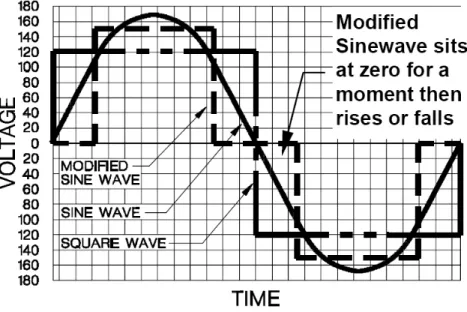
Figure 1:Square, Modified Sine, and Sine Waves Comparison2
A more precise method of DC/AC conversion is the modified sine wave, which introduces a dead time in a normal square wave output so that higher peak voltages can be used to produce the same average voltage as a sinusoidal wall-outlet output. This method produces fewer harmonics than square wave generation, but it still is not quite the same as the AC power that comes from an AC outlet. The harmonics that are still present in a modified sine wave make modified sine-wave inverters unsuitable for use while electrical noise is a concern, such as in medical devices which monitor the vital signs of a human.
Pure sine wave DC/AC conversion will introduce the least amount of harmonics into an electrical device, but are also the most expensive method. Since the AC sine wave must come from a DC source, switching must still take place. However, switching takes place with logic so that the energy delivered to a load approaches that of a pure sine wave. This means that extra components and design
considerations are involved in the control circuitry of a pure sine wave inverter, driving up cost. Comparison of Commercially Available Inverters
Market research revealed some generalizations that can be made about modified-sine and pure-sine wave inverters. A comparison was performed between Duracell (by Xantrex) modified pure-sine wave inverters and the Samlex PST series of pure sine wave inverter. For a more relevant comparison, each series of inverters had variants available in 300-watt and 1000-watt ratings. In general, the Samlex
2
12
inverters have larger dimensions, compared to their modified-sine counterparts, and much higher cost. This is due to the added circuitry necessary to produce a pure sine wave. Note that all inverters operate from 12VDC input power. The commonalities that the inverters share hint at necessary features that any inverter should have. The inclusion of forced-air cooling, input protection, and overload protection are needed for the safe operation of inverters.
It should be noted that modified-sine wave inverters are not rated for Total Harmonic Distortion (THD). Rating a modified-sine wave inverter for harmonic distortion would be useless, for their intended use is not to reduce the harmonics introduced to devices. Their purpose is to provide affordable and portable AC power. A question of efficiency is brought up in the discussion of harmonics. The pure sine wave inverters are 5% less efficient, but this rating is from the conversion of battery energy to modified-sine-wave output. This does not take into consideration the effect of harmonics on battery-to-device output effi ie . As stated “a le A e i a, The high f e ue ha o i o te t i a odified sine wave produces enhanced radio interference, higher heating effect in motors / microwaves and produces overloading due to lowering of the impedance of low frequency filter capacitors / power factor i p o e e t apa ito s. 3 A pure-sine-wave inverter may be less efficient in terms of battery energy conversion, but more of the output energy is used by the load.
3
13
Table 1: Comparison of Inverters, Pure Sine vs. Modified Sine of the Same Capacity 4
Model Duracell Inverter 300 Duracell Inverter 1000 Samlex PST-30S-12A Samlex PST-100S-12A Specification Output Type
Modified Sine -60 Hz
Modified Sine -60 Hz
Pure Sine - 60 Hz
Pure Sine - 60 Hz
Rated Output 300W 1000W 300W 1000W
Overload
Protection Yes
Maximum Output Surge
(<1 sec) 500W 2000W 500W 2000W
Low Battery
Shutdown Yes
Cooling Thermostat-Controlled Forced Air
Outlets 2 2 1 2
Dimensions
152 x 106 x 50 mm
305 x 152 x 76 mm
214 x 146 x 65 mm
395 x 236 x 83 mm
Thermal
Shutdown Yes
Peak Efficiency 90% 90% 85% 85%
THD Not Rated Not Rated <3% <3%
Cost $44 $129 $159 $479
4
14
Table 2: Modified sine wave inverters
Model Rated Output Max Output Outlets Dimensions
L x W x H Efficiency Cost
Cobra 150W 300W 1 . . . 85% $25
Voltec 200W 400W 2 . . 87% $29
Samlex 250W 500W 1 . . . 90% $25
Black&Decker 400W 800W 2 . 90% $37
AIMS 800W 1600W 2 . . 95% $69
Xantrex 1000W 2000W 2 90% $129
Wagan 2000W 4000W 2 . . 90% $219
Table 3: Pure sine inverters
Model Rated Output Max Output Outlets Dimensions
L x W x H Efficiency Cost
Samlex 120W 240W 1 . . . 88% $99
Go Power 150W 260W 2 . . 90% $150
Samlex 300W 500W 2 . . . 90% $149
AIMS 600W 1200W 2 86% $189
Xantrex 900W 2000W 2 . . . 90% $299
15 Examination of an Existing Design
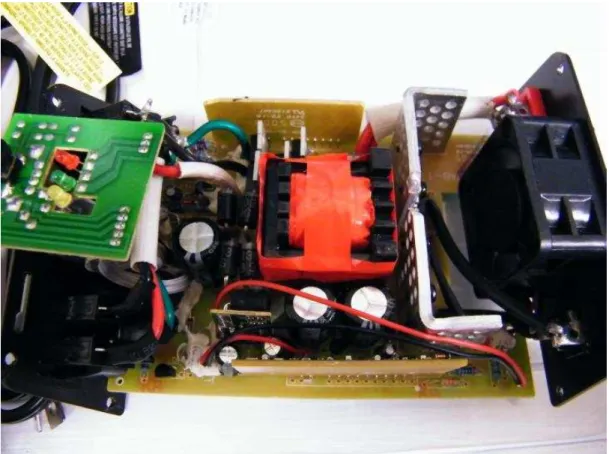
With the dissection of a commercially available DC/AC modified sine wave inverter, some lessons were learned about the design of power inverters. An exterior examination prompted thoughts about cooling, as this particular inverter had a plastic body, but with forced air cooling via an internal fan. There was also a 5V out USB port, but that is not important to this project which aims only to design a device capable of DC/AC inversion. The alligator clip battery leads were used since operation from a 12V car battery was intended. This inverter had two NEMA 5–15 (North American 15 A/125 V grounded) output plugs.
16
Figure 2: A Modified Sine Wave Inverter
DC to AC Inversion
Square Wave Inverters
17
approximation. In addition, a square wave has relatively large 3rd and 5th harmonic components (figure 4), which burn power and severely cut down on the efficiency of devices using such inverters as a power source.
Figure 3: Square Wave
18 Modified Sine Wave Inverters
A very common upgrade to the square wave inverter is the modified sine wave inverter. In the modified sine wave inverter, there are three voltage levels in the output waveform, high, low, and zero (figure 5), with a dead zone between the high and low pulses. The modified sine wave is a closer approximation of a true sine wave than is a square wave, and can be used by most household electrical devices. As such, it is extremely common to see this type of inversion in commercial quality inverters. Despite being much more viable than a simple square wave, the modified sine wave has some serious drawbacks. Like the square wave, modified sine waves have a large amount of power efficiency loss due to significant harmonic frequencies (figure 6), and devices that rely on the input power waveform for a clock timer will often not work properly. Despite the inherent drawbacks, many devices can work while powered by a modified sine source. This makes it an affordable design option for such implementations as household uninterruptible power supplies.
19
Figure 6: Modified Sine Wave Harmonic Analysis
Pure Sine Wave Inverters
20 PWM
2-Level PWM
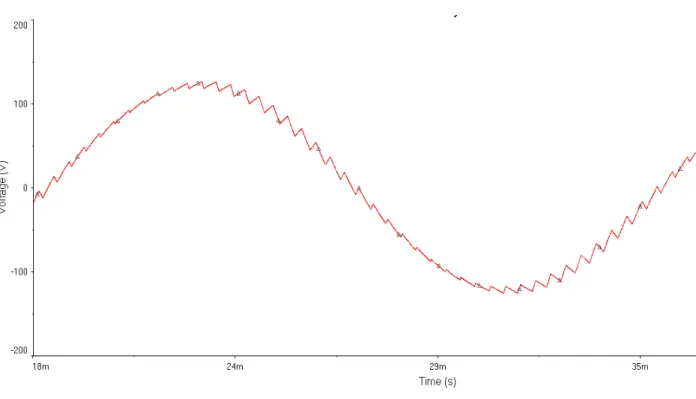
The most common and popular technique of digital pure-sine wave generation is pulse-width-modulation (PWM). The PWM technique involves generation of a digital waveform, for which the duty-cycle is modulated such that the average voltage of the waveform corresponds to a pure sine wave. The simplest way of producing the PWM signal is through comparison of a low-power reference sine wave with a triangle wave (figure 7). Using these two signals as input to a comparator, the output will be a 2-level PWM signal (figure 8). This PWM signal can then be used to control switches connected to a high-voltage bus, which will replicate this signal at the appropriate high-voltage. Put through an LC filter, this PWM signal will clean up into a close approximation of a sine wave (figure 10). Though this technique produces a much cleaner source of AC power than either the square or modified sine waves, the frequency analysis shows that the primary harmonic is still truncated, and there is a relatively high amount of higher level harmonics in the signal (figure 9).
21
Figure 8: 2-Level PWM Output (Unfiltered)
22
Figure 10: 2-Level PWM Output (Filtered)
3-Level PWM
23
Figure 11: 3-Level PWM Comparison Control Signals
24
Figure 13: Simulated 3-Level PWM Output (Unfiltered)
25
Figure 15: 3-Level PWM Harmonics Analysis of Unfiltered Output
The 3-Level PWM frequency plot shown in figure 15 markedly improved over those of the square and modified sine techniques. The primary frequency of 60Hz is the dominant in all three, but the magnitude of the harmonic frequencies is much reduced in 3-Level PWM, and the primary is of larger magnitude. When compared to the 2-level PWM, however, a couple things are noticed. First, the harmonics plot shows no higher level harmonics of significant magnitude. This represents the 3-Level signal following much more closely the desired sine wave. However, the primary frequency has a much lower voltage magnitude than that of the 2-Level design. The reason for this is the presence of other frequencies which are not harmonics of the 60Hz signal, which are caused by the switching of the signal from one polarity to the other, and back.
Examining 3-Level PWM in Practice
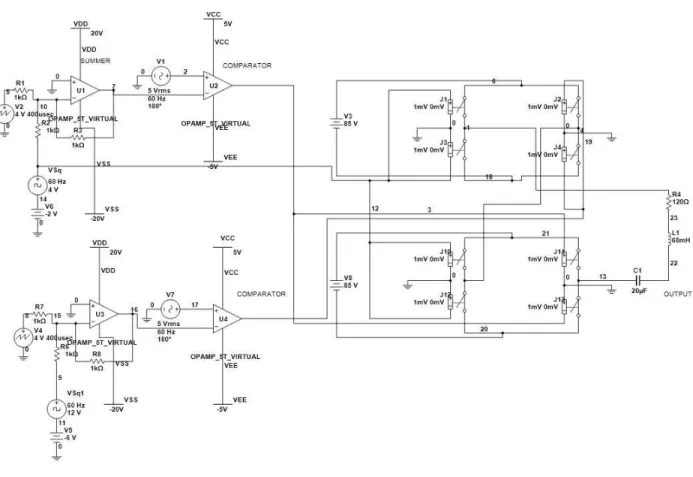
A 2006 – 2007 Worcester Polytechnic Institute (WPI) Major Qualifying Project (MQP) titled DC/AC Pu e “i e Wa e I e te a e o side ed as o pa io to the a al sis of the various PWM options. Some design considerations can be gleaned from it about inverter topology. The design documented in the report was a pure sine wave inverter using 3-level pulse width modulation using an analog logic control circuit. The control circuit, with its function generators, summer, and comparators,
26
resulted from the function generators controlled the two half-bridge MOSFET drivers that had independent high and low side output.
Figure 16: Block Diagram from "DC/AC Pure Sine Wave Inverter" MQP
The report provided a summative perspective of PWM sine wave inverters, but shortcomings of the project can be noted. While the final product produced a sine wave, the project team only tested with a 12 Volt high-side voltage. Thus, this project was more concerned with the generation of a sine wave from a DC source than producing a device that electronic devices can run from. The inverter design relied on a stiff high-side voltage to supply the load without any feedback to control their DC rail. In the
Results se tio of the epo t, the tea e a ked:
While the ope atio of the inverter works under light or medium loads (above 50 [Ohms?] with 12V input), its output was affected by high frequency oscillations when hea ie loads e e o e ted. 5
Such is the effect of lacking a feedback system. One of the goals of this project will be to build upon this MQP and implement a feedback system to provide stable operation up to the output goal. It is also noted that the cost of parts in the MQP was $65, which parallels the tentative budget for the parts in this project.
5
27 5-Level PWM
In order to create a PWM signal which more closely follows the desired sine wave output, the design described for the 3-level PWM technique can be expanded to 5-, 7- and 9+ level PWM. Each additional 2 levels added on top of the 3-level design adds an H-bridge (added in series), a comparator, and a summer. The added accuracy of the signal due to increasing the level therefore brings with it the addition of components, and the space, cooling, and power they require. Control signals must be created separately for each H-bridge (figure 18), each of which correspond to one layer of the sine voltage (figure 19). Higher level PWM also requires multiple isolated voltage buses. For example, the 5-level PWM circuit in figure 17 requires two isolated buses at 1/2 the voltage of the corresponding 3-5-level circuit. The buses must be isolated, as they need to be connected in series. In the 5-level PWM circuit, one half of each H-bridge is controlled by the square wave from the 3-level circuit, and simply controls polarity across the bridge. The other half of each bridge is controlled by the PWM output of each respective comparator. The resulting PWM signal is shown in figure 20, and the filtered sine wave output is shown in figure 21. One of the advantages of higher level PWM generation is that there is less of a voltage swing from the minimum and maximum of each step, which results in less power loss due to the slope up and down for each step (known as dV/dt losses). This reduced power loss results in higher efficiency for the inverter. This increased efficiency must be considered in balance with the addition of components and frequency effects which must be filtered out.
28
Figure 17:5-Level PWM Simulation Circuit
29
Figure 18: 5-Level PWM Comparison Signals
30
Figure 20: 5-Level PWM Output (unfiltered)
31
Figure 22: 5-Level PWM Harmonics Analysis of Unfiltered Output
The major downside of 5-plus level PWM designs is that it requires many more components to implement, with multiple DC voltage rails which must be placed in series. For our purposes, then, such a design is impractical and expensive. Though the potential advantages of these higher-level systems are certainly intriguing, this project focused on 3-level PWM as a balance between cost and efficiency.
IGBTs vs. Power MOSFETs
While designing this circuit, a choice had to be made between the two main types of switches used in power electronics. One is the power MOSFET, which is much like a standard MOSFET, but designed to handle relatively large voltages and currents. The other is the insulated gate bipolar
transistor, or IGBT. Each has its advantages, and there is a high degree of overlap in the specifications of the two.
32
the major disadvantages of IGBTs is their unavoidable current tail when they turn off. Essentially, when the IGBT turns off, the current of the gate transistor cannot dissipate immediately, which causes a loss of power each time this occurs. This tail is due to the very design of the IGBT and cannot be remedied. IGBTs also have no body diode, which can be good or bad depending on the application. IGBTs tend to be used in high power applications, such as uninterruptible power supplies of power higher than 5kW, welding, or low power lighting.
Power MOSFETS have a much higher switching frequency capability than do IGBTs, and can be switched at frequencies higher than 200 kHz. They do not have as much capability for high voltage and high current applications, and tend to be used at voltages lower than 250V and less than 500W. MOSFETs do not have current tail power losses, which makes them more efficient than IGBTs. Both MOSFETs and IGBTs have power losses due to the ramp up and ramp down of the voltage when turning on and off (dV/dt losses). Unlike IGBTs, MOSFETs have body diode.
Generally, IGBTs are the sure bet for high voltage, low frequency (>1000V, <20kHz) uses and MOSFETs are ideal for low voltage, high frequency applications (<250V, >200kHz). In between these two extremes is a large grey area. In this area, other considerations such as power, percent duty cycle, availability and cost tend to be the deciding factors.
Our application in this project is 250W, with a 170VDC bus (ideally), and a switching frequency around 20kHz. These specifications make power MOSFETs the ideal choice for us. If our system was a larger, commercial application with a high power output, IGBTs would be the choice.
Amplitude Modulation
In PWM generation, two very important characteristics are m
aand m
f, where m
fis the
ratio between the frequency of the triangle wave to the sine wave signal, and is generally an
odd integer. This number is significant in that it determines the frequency of the harmonics in
the PWM output signal. The significant components of this output are the primary, the
harmonic at frequency m
f*f
cwhere f
cis the frequency of the sine wave control (as well as the
primary output), and the harmonics at m
f+2*f
cand m
f-2*f
c. M
f, therefore, determines the
frequency of the harmonics of the output, which of course affects how easily they can be
33
M
ais the ratio of the amplitudes of the sine wave and the triangle wave, and is always
kept between 0 and 1, as a value above 1 will result in clipping and non-linear amplitude
relationships. Between 0 and 1, though, the amplitude of the primary is linearly related to m
a.
As the m
aratio decreases, the amplitude of the primary also decreases. At the same time,
though, the amplitude of the harmonics increase, and the m
fharmonic actually becomes larger
than the primary just above 0.8 m
a.
Table 4: Normalized Fourier Coefficients6
M
a1
0.9
0.8
0.7
0.6
0.5
0.4
0.3
0.2
0.1
N=1
1
0.9
0.8
0.7
0.6
0.5
0.4
0.3
0.2
0.1
N=m
f0.6
0.71
0.82
0.92
1.01
1.08
1.15
1.20
1.24
1.27
N=m
f±20.32
0.27
0.22
0.17
0.13
0.09
0.06
0.03
0.02
0.00
In an unfiltered output, this can be very bad, especially if the load is not inductive. If
there is a large inductive component, though, this will act as a low-pass filter, as the impedance
will be very large as long as your triangle wave's frequency is also very high, since Z
L=
ω
L. This
can be further resolved by filtering your output with an added low-pass filter.
In order to test the bipolar PWM, we created two test circuits. The first is a virtual
bipolar PWM circuit with an H-Bridge, which was operated with a bus voltage of 100V (the
figure shows the configuration for the fourier comparison, i.e. 2V bus). The triangle wave signal
was 2V in amplitude with a frequency of 20kHz. The sine wave signal was held at a constant
60Hz, but the amplitude was varied from 0.1414 to 1.3435 Vrms to vary the m
aof the system
from 0.1 to 0.95. The filtered waveform at each value was then displayed. The individual
waveforms were then combined into one graph for easy comparison. It should be noted that
the magnitude of the waves decreased as m
awas decreased, but the wave-forms on the graph
are normalized to magnitude, to show only the distortion present in the filtered output.
6
34
Figure 23: Filtered Outputs ma 0.1 to 0.95
35
Figure 24: Bipolar PWM Test Circuit
If we implement a 3-level PWM circuit in our final design, the effect on the output of having a low ma would be much reduced. In 3-level PWM, the present non-primary harmonics are much higher frequency, and are, in fact, higher than the switching frequency at 2mf±1, 2mf±3 and so on. This
36
H-Bridge Components and Power Losses
IRFP460A MOSFET
In order to move from theory to implementation, we needed to identify specific components for our design. First, we needed to determine what MOSFETs we wanted to use. We know that in an H-bridge, the highest voltage a single MOSFET that is off will experience is double the voltage of the DC power rail, which in our case is 2*170=340V. We want to have a healthy safety margin above this voltage as well, with doubling the value being a good idea. A rated voltage of 500-600V is therefore a good target for our MOSFETs. In addition, we are going to be providing approximately 250W for our output, which will be a 120Vrms sine wave. This means that the max rated current we should have coming out of our inverter will be 2.083A. We should certainly overshoot this value by some healthy margin, and in some ways our eventual choice was a little more than we need but if availability, cost, and other considerations allow this, it's not necessarily a bad thing. Our PWM output signal will switch at a frequency of 40kHz, which means our MOSFETs need to be relatively fast-switching as well. Eventually, we determined that the IRFP460A n-MOSFET will be sufficient for our design. The IRFP460A is rated at 500V, 20A, and is fast switching, with a ton time of 55ns and a toff time of 39ns.
IR2304 MOSFET Driver IC
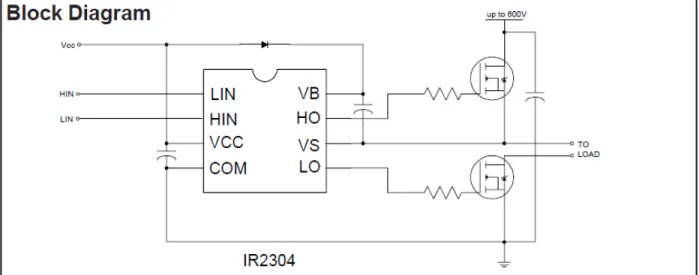
37 Figure 25: IR23047
The capacitor shown between VB and VS is the bootstrap capacitor. This cap is required to keep the top n-MOS switch gate voltage higher than the source rail of 170V. The value for this cap can be found using the equation shown below, taken from IR document AN-9788, and values from the MOSFET data sheet.
The values substituted into this equation were found either in our driver datasheet, our MOSFET datasheet, or in our circuit specifications. Qg is the MOSFET gate charge, which is 105nC9. IqBS is the driver quiescent current, which is 150uA. ILS is the capacitor leakage current, approximately 250uA here, and QIS is 5nC. The frequency is 40kHz, and our Vcc supply voltage will be 10V. Vf will be zero, because we don't have an external diode in this configuration, and VLS is the forward voltage of the MOSFETs,
7
(International Rectifier, 2004) 8
(International Rectifier, 2007) 9
38
which is 1.8V. Finally, Vmin is the minimum difference between Vb and Vs, given as 0.3V in the datasheet. Using these numbers, we can calculate the minimum bootstrap capacitance value.
Power Loss and Heat
In order to determine the efficiency of our H-Bridge, and especially to determine the proper heat sink requirement for our design, we must first calculate of the power lost through each MOSFET while conducting, and due to switching. We will also compare the power loss of our final switching design to the more standard switching technique described in the background section, in order to identify the advantages and disadvantages of each design. First, we will calculate the power loss in the typical design, which has a fast switching PWM driven bridge, and a 60Hz square-wave driven half-bridge.
Typical PWM
In this typical design, the power losses through one half-bridge will be very different than that of the other half. Both MOSFETs in each half-bridge are switched constantly, but at very different rates. In the PWM-driven half-bridge, the switching can be approximated to be 50%, as the PWM wave will range from very high duty cycle to very low duty cycle, but it will do so symmetrically around the 50% rate, and therefore the average duty cycle will be 50%. The energy loss due to a single switching is found using the equation:
39
switches in a period. Assuming, as previously discussed, that the PWM has an average duty cycle of 50%, there will be one switch off and one switch on per switching period. The switching frequency of the PWM half-bridge is 40kHz, which means that the MOSFETs will switch, on average, 40,000 times a second each high and low. The energy lost per second of operation, then, is 40,000*(Won+Woff), which is 1.331J/s=1.331W per MOSFET from switching. The other half-bridge switches at a rate of 60Hz, but otherwise has the same loss per switching, which means it's losses are 60*(Won+Woff)=1.997mW per MOSFET, which is drastically lower. This scheme has the obvious disadvantage, then, of splitting its switching losses between the two bridges, with most of the heat generation being on two MOSFETs, with the other two barely taxed at all.
The power loss from conduction will be the same for the two half-bridges, as the square wave has a duty cycle of 50%, and the PWM has an average duty cycle of 50%. The loss due to conduction per cycle is given by the relationship:
where VCE is given by the IRFP460A data sheet as 1.8V, the current is the previously calculated 2.083A, the duty cycle is 50% and the period is 1/Fs. Because we're interested in losses per second, we can simply drop the T from the equation (since we would be multiplying it by the switching frequency). This gives Wcond=1.87J per second, which means it has a power loss of 1.87W per MOSFET. In this scheme, then, each MOSFET on the PWM half-bridge will have a power loss of 1.87+1.331=3.21W, and each MOSFET on the slow side will have a power loss of 1.87+0.0019=1.88W, slightly more than half that of the fast-switching MOSFETs. The PWM half-bridge as a whole has a power loss of 6.42W, and 3.76W on the low-speed side. The entire H-bridge, therefore has a power loss of 10.18W.
Our Design
In our signal design, the load is spread more equally upon each of the MOSFETs in the two bridges. As previously described, each gate in our design switches is driven by PWM for half of each 60Hz period, and is held high for the other half, in the case of the low gates, and held low for the other half, in the case of the high gates. The switching losses will therefore be the same for each gate, and will be the same as the losses of the PWM-driven gates in the previous description, but will be only for a half-cycle. The losses from switching for each gate, therefore, will be
40
same as those of the PWM-gates in the traditional implementation. For the other half-cycle, the high gates will be off, and the low gates will be on. The average duty cycles will therefore be 25% for the high gates, and 75% for the low gates. Using the same relationship given above, the power loss will be 1.8*2.083*0.25=0.937W for the high gates and 1.8*2.083*0.75=2.812W for each low gate.
The overall losses for each gate will be Wswitch+Wcond, which will be 0.665+0.937=1.602W for each high gate, and 0.665+2.812=3.477W for each low gate. The losses for each half-bridge will be 1.602+3.477=5.079W, and 10.158W overall for the H-Bridge. Compared to the original scheme, the overall power losses are nearly identical. The difference is simply how this power is spread. In the original design, the switching losses were concentrated entirely in the two PWM-driven MOSFETs, whereas in our design the switching is spread equally across the entire bridge. To some degree, this is counteracted by the concentration of more conduction losses in the two low MOSFETs, so there are some disadvantages to both schemes. In an eventual PCB implementation, the two MOSFETs of each half-bridge would be adjacent to each other, so spreading the power losses across the two half-bridges will aid in dissipating the heat generated.
To determine the correct heat sinks to use in any final implementation of our design, we must complete a thermal analysis of our H-bridge, using the power losses we calculated above. The
relationship we will use to do this is ΔT=P(Rѳ)
where ΔT is the allowable range of temperatures, P is the power lost through the MOSFET, and Rѳis the thermal characteristic of the MOSFET/heat sink system. First, we will assume that the ambient
temperature will be 27 C, hi h is the high a ge of oo te pe atu e. The a i u ope a g te pe atu e gi e i the MO“FET data sheet is C, ea i g ΔT= - = C. For our power value, we will err on the side of caution and use the higher of the two values, which is that of the low gates, for
hi h P= . W. Rѳ a e oke do i to RѳJC, RѳCS, a d RѳSA. The first two values are inherent to the MOSFET and are given by the data sheet as . a d . C/W, respectively. The third value will be a property of the heat sink, and is the value for which we must solve. Using the relationship given,
41
Filter Components
Our output of our H-bridge is ideally a 60Hz sine wave with a Vrms of 120V. Because it is encoded using a 40 kHz PWM signal it must be filtered. Due to the high voltage of our output, the only option is a passive filter, which is an inductor and capacitor in series, with the load connected across the capacitor. In our implementation, we desired a cut-off frequency comfortably below our switching frequency and above our ideal 60Hz output. In an LC filter, the cutoff frequency is given by the relationship
42
Control Signal Generation for 2-Level PWM
The theory of encoding a sine wave with a PWM signal is relatively simple. A sine wave is needed for the reference that will dictate the output, and a triangle wave of higher frequency is needed to sample the reference and actuate the switches. Generally, op-amps are used in generating sine waves, as they are in this project, but the process can also be done with a microcontroller with crystal oscillators. Within the vast library of op-amp circuits, more than one can serve as a sine-wave oscillator. A Stable Operation Voltage
Signal generation begins with the power supply for the op-a ps a d IC’s. As a atte ’s sto ed energy depletes, its voltage is reduced. Several of the amplifiers in the control signal generation circuits rely on the rail voltages to charge and discharge capacitors which cause a controlled oscillation. If VCC and VEE on the op amps vary during operation, so will the amplitude and frequency of the reference sine wave and sampling triangle wave.
43
Figure 26: Voltage vs. State of Charge of a Sealed Lead Acid Battery10
The lowest assumed supply voltage for our design is 10.5 Volts. With a targeted nominal voltage of 10 Volts to operate the op-a ps a d MO“FET’s, e pla to use a low-dropout (LDO) linear regulator such as the ROHM Semiconductor BAJ0BC0T 10V LDO that will ensure regulation down to Vout + .5V. Currently an LM317 adjustable regulator is used for prototyping purposes, as they are readily available. The LM317 works by maintaining a band gap voltage reference (about 1.25V) between its adjustment and output terminals. While this IC is working to maintain stable signal generation under a changing supply voltage, it can only do so with an adequate supply voltage. The dropout voltage of the LM317 depends on load current, and it ranges between 1 to 2.5 volts. On the test bench the LM317 was
sourcing about 50 milliamps for all the op-amps and comparators, so the regulator failed to provide 10V when the bench supply was turned down to about 11.8V.
10
44
Figure 27: Dropout Voltage of the LM317 11
Figure 28: Voltage Regulation Circuit
11
45
Triangle Wave Generator
The triangle wave generator is a Schmitt-trigger oscillator composed of a Schmitt trigger and an integrator, though it has a semi-regulated input voltage to the integrator with the addition of the 1N4154 fast-recovery clamping diodes. The equation for the frequency of oscillation is:
It should be noted that a major source of error is the diode forward voltage which dictates the charge rate of C1. It depends on the current-limiting resistor R1 and, to some extent, temperature. The best option for determining this was to simulate or measure directly.
It also follows that the peak output voltage of the triangle wave should be:
A high-pass filter is added to the circuit to eliminate the DC offset so that the triangle wave will be offset to the same voltage as the sine wave it is compared to.
Figure 29: Triangle Wave Generator Circuit
46
Figure 30: Output of the Triangle Wave Generator
Sine Wave Generator
Two different techniques for generating a 60 Hz reference sine wave were attempted, though both efforts were based on filtering a Schmitt-trigger oscillator (a square -wave generator). Since a Schmitt-trigger oscillator can produce a square wave by having a symmetric stimulus (such as a sine wave), a low-pass filter can produce a sine wave by filtering the harmonics and leaving the fundamental frequency alone. The spectral components of a square wave consist of a fundamental frequency that is the same as the square wave frequency, and all the odd-numbered harmonics multiplied by 1/k where k is the number of the harmonic. A low-pass filter with poles placed at the fundamental frequency can mitigate much of the harmonics, leaving a sine wave with about 2% THD, a figure deduced from simulation.
The circuit that generates the sine wave is composed of a Schmitt trigger oscillator and a fourth-order Butterworth Low-Pass active filter with a Sallen and Key topology. The whole circuit is made with a single LM348 (a quad 741 chip) and some passive components. The Schmitt trigger is basically a
47
non-inverting terminal. As the open loop gain of the LM348 is very high (104 dB) it will try to amplify the difference between the terminals to very high voltages, but the reality is that it will be limited to within the rails (V+ and V-). So, without negative feedback the op-amp will have two possible output states: V -and V+. The oscillation between output states is controlled by the resistor and capacitor on the inverting terminal. When the output is in its high state, the capacitor (C2) will charge through R7 until the voltage at the inverting terminal is higher than the non-inverting terminal. When it reaches that point, the Schmitt Trigger will change to its low state to allow the capacitor to discharge through R7. The cycle continues and the result is a square wave.
Figure 31: Schmitt Trigger Oscillator
48
Figure 32: Butterworth Low-Pass Filter
49
Figure 33: Square and Sine Waves from the Above Circuits
The output was as expected, an approximately 60 Hz sine wave. The 180 degree phase shift between the square and sine waves is from the filters, but that should not be a problem when
controlling the switches. It appears as though the negative half-cycle on the square wave is longer than the positive half-cycle.
The sho t o i gs of the a plifie a e e posed. Fi stl , it’s slo . The sle ate affe ts the charge and discharge since the transition between charging and discharging is not instantaneous. Secondly, there is some input bias current that is causing some significant DC offset compared to our triangle wave. The worst offense to our attempt at a clean sine wave, though, is the asymmetric
50
Figure 34: Revised Sine Wave Generator
51
Figure 36: Comparison of Positive and Negative Swings of the 60 Hz Sine Wave
PWM Signal from Comparators
Sine wave inverters that utilize PWM for waveshaping have a comparator stage to generate the PWM signal. The high-frequency triangle wave is compared to the sine wave many times per sine wave cycle. The comparator output is a PWM signal whose duty cycle is related to how long the sine-wave amplitude is greater than the triangle wave. In other words, as the sine wave reaches its crest, the switching transistors are held closed longer to develop a greater voltage across the load.
52
Figure 37: MC3302 Equivalent Circuit12
Figure 38: Comparator Circuit
In a two-level PWM system, one pair of switches is turned on to make current flow in one direction. For reference, this can be called the positive voltage direction. Alternately, another pair of switches allows current to flow in a direction opposite to the positive voltage direction. The four
12
(Phillips Semiconductors, 1995)
53
switches form an H-bridge and it is in this manner that the two swings of the sine wave is generated across a load. As the reference sine wave approaches its crest, the PWM signal is dominated by the effect of the sine wave being greater than the triangle wave. Thus, the positive voltage direction switches stay on longer to develop the peak voltage of the sine wave. When the reference sine is at its minimum value (the valley) the PWM signal is dominated by the comparison of the triangle wave being greater than the sine wave most of the time. The result is a PWM signal that is the inverse of the
positive voltage direction PWM signal. In application, we connected the signals to complementary inputs on two different comparators so that both waveforms are generated simultaneously to drive the
N-ha el MO“FET’s of the H-bridge.
Figure 39 PWM Signals for Both Halves of the H-Bridge
One effect of having the reference sine wave amplitude less than the triangle wave amplitude is that the output will not reach the source voltage. This is called amplitude modulation, defined as the ratio of the amplitude of the reference wave to the sampling wave. In our circuit, we achieved an amplitude modulation of about 90%, meaning that the minimum time that the triangle wave will sample beyond the sine wave is 10% of the duty cycle. Since the switch duty cycle never reaches 100%, the peak voltage across the load will be a fraction of the source voltage. The consequence is that we need to have a source voltage greater than our desired peak voltage across the load.
54
Signal Generation for 3-Level PWM
The signal generation circuit for our 3-Level PWM centers around the use of the Texas
Instruments TL494, a common PWM controller chip. The TL494 generates a PWM signal by comparing an internally generated saw-tooth wave with an error signal. Common applications for this chip are DC/DC converters, where an output voltage is programmed by resistors in the error feedback path that is referenced to some DC voltage signal. In make out DC/AC converter, we used the error amplifiers with no feedback from the output so that the error signal is the signal we want encoded in the PWM output.
Features of the TL494
Programmable Switching Frequency
The internal saw-tooth wave which samples the error input can be adjusted by connecting a resistor and capacitor to ground on the RT and CT pins (pins 4 and 5). In our application we, used single-ended output by connected the output transistors in parallel. For single-single-ended output (as opposed to a push-pull output transistor configuration), the switching frequency is determined by the equation
.
Two Error Amplifiers
Depending on design needs, up to two error signals can be used. As an example, one error signal can control the PWM to maintain the desired output while another can be used to limit current. A current sensing resistor would be used to convert current in to a voltage signal which could be compared to some reference threshold.
Minimum Dead Time (Maximum Duty Cycle)
55
Figure 40: TL494 Dead Time Control13
Using the TL494
Our use of the TL494 concerns mainly the manipulation of the input to the error amps on the chip. The TL494 works in the same fashion as the PWM generation of the 2-Level PWM circuit above. An input signal is connected to an error amp input, and it is compared to a saw-tooth wave. Since this IC is catered to DC/DC converters, we had to make accommodations in our reference signals.
Figure 41: TL494 Inputs
A single TL494 can only produce a 2-Level PWM signal. There is no level shifting of the internal saw-tooth wave, nor are there multiple PWM outputs that are needed for a 3-Level PWM system. For a DC/DC converter, this is no need for anything more than a single feedback signal and a single carrier wave to sample it. The chip’s ias to a ds DC/DC o e te s is also appa e t i the PWM eha io . As
13
56
the error signal goes down (the DC level is falling), the chip compensates by increasing duty cycle to bring it back up.
The solution to the problems associated with using the TL494 for our inverter application comes in three parts: externally level shifting the sine wave reference by creating reference half-waves to eliminate the need to level-shift the carrier wave, inverting them to produce the maximum PWM duty cycle as the sine wave reaches its peaks, a d usi g t o TL ’s to p odu e ea h half of the si e a e output.
57
58
Figure 43: Half-Wave Rectifier Outputs
The results of using the precision rectifiers are two half-rectified sine waves that are equal in amplitude and 180° out of phase compared to each other. There is a slight distortion created by the negative feedback compensating for the forward drop across the output diode, but the signals are still usable. These signals should produce the produce the necessary PWM signals when sampled with a carrier wave, but the TL494 produces a smaller duty cycle as the error signal gets larger. This can be thought of as an increasing DC level at the output, and the TL494 compensates by delivering shorter pulses. So, as each of the half-waves reaches its peak, minimum duty cycle occurs. This is the opposite of the desired effect. The solution is simply to invert the half waves.
59
The LM358 is chosen for the inverting gain stage of the half waves due to its ability to output a voltage very close to its minus rail. This translates to more headroom for adjusting maximum duty cycle, as the TL494 reaches maximum PWM duty cycle as the input reaches 0 Volts (while minimum duty cycle occurs when the input is at about 3 volts). It should be noted that R13 and R14 adjust the DC Level of the half-wave and R8 and R7 adjust the amplitude of the half wave. The values above were
experimentally determined to produce the least crossover distortion of the output sine wave while maintaining a reasonable amplitude.
Figure 45: Outputs of the Inverting Amplfiers
60
Figure 46: TL494 Configuration
Figure 47: Sampling the Input with a Saw-Tooth Wave
Upon examination of the output at the pull-down transistor, we realized that the outputs were the inverse of what we need. The duty cycles were correct, but where we expected a logic 1, there was a logic 0. We solved this by dividing the voltage in half at the TL494 collectors to make the output
compatible with 74-series logic inverters. Serendipitously, we already had a 5 Volt source needed for 5-Volt logic chips by way of the TLE2426 we were using for our signal ground. Since VCC for all the chips was 10 Volts, the TLE2426 divides that in half to produce a signal ground while being able to sink or source 20 mA.
61
discovery came about after having charging issues with the bootstrap capacitors. We had been ignorant of the fact that the bootstrap capacitor needs to be grounded in between cycles so that Vcc can replenish the charge on it. We had left the otto gates off he e e e ’t pulsi g u e t f o its
corresponding high gate. Since the bootstrap capacitor is connected to the load filter, bottom plate of the capacitor always stayed at its boosted voltage from being connected to the load. Since Vcc is only 10 Volts and the high-side voltage is much greater than that, the bootstrap diode cannot become forward biased. The solution was to use the inversion of the signal driving the high-hate on the same side, the signal coming directly from the TL494.
Figure 48: Grounding the Bootstrap Capacitor14
14
62
Figure 49: PWM Signal from the TL494 (Top) and its Inversion (Bottom)
Figure 50: Alternating PWM Signals for Both High Side Gate Half-Cycles
63
Results
Once we had determined the specifications of our overall design, we built a prototype of the final circuit shown below, in figure 51. The signals going into each IR2304 driver IC were detailed previously, with LIN1 and HIN2 in phase, and vice versa.
Figure 51: Final Inverter Design
The preliminary prototype consisted of the low-voltage signal generation circuits on
64
Once the prototype was constructed, it was tested both at low-voltage and high-voltage. The low-voltage testing was conducted using the 12VDC car battery both as the VCC regulator source and as the H-bridge DC rail. As such, the output was a 12V PWM signal, which was filtered and used to power a 12V halogen car headlight. Testing at low-voltage allowed us to safely test our setup and perform basic troubleshooting before moving on to high voltage.
Low-Voltage Test
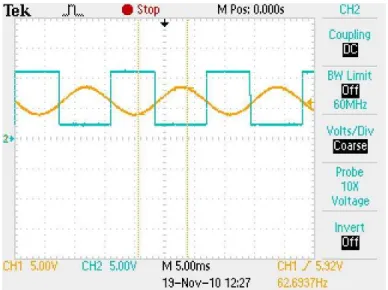
The prototype was tested first at low voltage, with a 12VDC battery supplying both the H-Bridge, and the VCC regulator. Using this source, the inverter was connected to a 12VDC halogen car headlight as a load, with a low-voltage filter of the same value as that described in the previous section. The MOSFET gate voltage wave-forms under this load are shown in figure 53. Some distortion can be seen, but the Waveforms otherwise look as they should. Channel 1 shows Vgs for the high gate of the half-bridge, showing that it must be boosted above that of the DC rail.
Figure 52: Low-Voltage Test Half-Bridge Vgs Waveforms
65
Figure 53:Filtered Low-Voltage Output across 12VDC Headlight
66
Figure 54: Low-Voltage Output Cross-Over Distortion
High Voltage Testing
200W Resistive Load
Once we had confirmed that our prototype operated correctly at low voltage, we tested it at high-voltage, by using the DC-DC boost stage of an off-the-shelf modified sine wave inverter, specifically its 145VDC rail. We still powered the VCC regulator off of the 12VDC car battery, as well as the DC boost. We also ran into some trouble with our filter, which will be detailed as well. For our test, we first connected two 100W incandescent light bulbs in parallel for our load. This load would be close enough to our rated power to let us know if we had any major problems with our design.
67
Figure 55: High Voltage Half-Bridge Vgs Waveforms
68
Figure 56: High-Voltage Filtered Output Waveform (showing Breakdown Distortion)
Figure 57, below, shows the output waveform across the 200W light bulb load, with the capacitor removed, the worst distortion of previous test is now gone, though the voltage still dips to some degree at both extremes. The fact that the sine output was sufficient with the filter, apart from the break-down distortion, and that the output without the filter was essentially the same as before, but with the distortion gone, can be taken to mean that our output would be ideal if we had the filter.
69
The dipping of the waveform in the middle of each section of PWM is due to the voltage drop of our DC bus we used for testing our circuit. The edges are sustained without difficulty, as the duty cycle is low, but as the duty cycle increases to nearly 100% in the middle of the PWM block, the supply has trouble maintaining the voltage. This issue would have been addressed by our initially proposed DC boost stage feedback scheme, where the output voltage drop would have been compensated for by raising and lowering the bus voltage.
Figure 58: Unfiltered Output FFT w/200W Resistive Load
70
tolerance level, and variations from component to component will result in a frequency which is not exactly 40kHz. In our circuit, though, the two PWM signals are isolated, never interacting with each other until they meet at the load. The result is that the two tolerance effects are separate, and will result in two different frequencies, near the ideal 40kHz, but due to two isolated tolerance cascades.
Figure 59: Output FFT showing 60Hz peak
Inductive Load Test
71
Figure 60: Unfiltered Output with Inductive Load
The unfiltered PWM output while running the rotary tool is nearly identical to that of the resistive load. There is no additional noise, and merely a slightly increased dip in the voltage,
representing a different current load from the DC bus. It should be noted that this waveform is after the rotary tool has spun up to speed, with no load apart from spinning the chuck. Torque requires an increase in current, which means that the initial turning on of the motor requires an inrush current. When the rotary tool was initially turned on, the waveform dipped considerably, coming to rest at this steady state after a second or two.
Printed Circuit Board
One of the goals for this project was to produce a working PCB. The final product took on a two-tier design to keep the footprint within a 3" by 5" design constraint. A logical choice was made to separate the low-voltage control components and the high-voltage power h-bridge, and to connect them together with an inter-board connector. Along with reducing noise through capacitive and
72
h-bridge while the h-bridge itself can be used in a standalone fashion for other purposes. To reduce prototyping cost, the boards were fabricated in a one piece design that would be separated at the time of assembly.
Translating the design to a PCB brought with it various improvements. The PCB has a large copper ground plane which reduces signal noise by coupling capacitance between traces to ground instead of to other traces. Secondly, all the IC's have bypass capacitors placed close to their physical location to decouple them from the power supply in order to decrease input ripple. The virtual ground IC (TLE2426) now has the noise reduction pin connected to ground for better noise performance, as well as a capacitive divider at its output for voltage stability and accuracy under load.
73
Figure 61: Sine Wave Inverter PCB
Figure 62: Populated PCB
The boards performed as expected once assembled (figs. 63, 64), but there are several
74
Figure 63: PCB gate voltage waveforms (one half-bridge)
Figure 64: PCB filtered output waveform
75
Power Efficiency
In order to determine the power losses, and therefore the efficiency of our PCB design, the power into and out of the inverter were experimentally determined. In order to determine the powers, we needed to determine first the voltage and current at the two points. Voltage was a simple matter of using a digital multimeter to measure the voltage of the H-bridge, and again to measure the RMS voltage of the output voltage waveform. In order to determine the currents, though, we needed to use an indirect measurement, using a known resistance in-line with the circuit, and measuring the voltage drop across this resistance. This allowed us to calculate the current going into and out of our inverter. The results of these measurements are shown below.
Vin/out (Measured) Resistance (Measured) Vdrop (Measured) Current (Calculated) Power (Calculated)
Input 130VDC 0.05 0.11VDC 2.2ADC 286W
Output 91.55Vrms 0.017 0.046Vrms 2.76Arms 252W
Using these values, we calculate a power efficiency of 88% for our inverter, which is well within design specifications of Efficiency ≥ %. It should be noted that this power efficiency is for the
77
Conclusion and Recommendations
Ongoing blackouts exacerbate the problem of inaccessible healthcare in developing countries. While it is commonplace in the United States to have hospitals equipped with uninterruptible power systems, such a practice only serves to bolster a grid developed with ample funding and technology. While Americans give nary a thought to the possibility, power outages are an everyday expectation for sub-Saharan African villagers.
Affordable pure-sine wave inverters are necessary to provide an expedient, if not total, solution to underdeveloped grids. This logic can be taken further with the concept of microgrids. By lacking centralized power generation, developing countries have an opportunity to use solar panels to create localized grids. This is a driving force behind low-cost inverter technology.
This WPI MQP consisted of the design of an affordable pure-sine wave inverter using 3-level PWM and MOSFET switches in an H-bridge configuration, in which an op-amp based logic control circuit was used to control MOSFET drivers to actuate H- idge MO“FET’s. Due to o pli atio s mid-way through the project, the DC-DC boost stage is assumed, and not created. Feedback was included in our DC-DC design, and was removed with the removal of its system. A major focus for potential future improvement is therefore to implement a feedback system, which our design lacks. This can be done in two ways: to alter the DC rail voltage in the DC-DC boost phase, as was the case in our initial design, or to alter the duty cycle of the PWM signal in the DC-AC inverter phase.
If cost and simplicity had not been design constraints, it also would have been interesting to pursue a 5-level PWM implementation of the same inverter. It would have brought with it higher efficiency, less noise, and easier filtering, and, despite the additional complexity, it would be an exciting area of potential future work.
Perhaps the biggest area of potential improvement of our project is the design and
implementation of a DC-DC boost phase which would convert the 12VDC car battery source to a 170VDC rail for use with the H-bridge. Our workaround using an off-the-shelf inverter's DC boost rail allowed us to sufficiently prototype and test our inverter, but it was certainly not the same as a DC-DC phase specifically designed and optimized for our implementation.
78
phase of the off-the-shelf inverter, we showed that our inverter design was able to take a 140VDC source, and convert it to a pure-sine wave using 3-level PWM with minimal power loss. The major source of power loss in our system, the H-Bridge, burns only 10W, merely 4% of the rated power of our design. That means that any DC-DC boost phase designed in future implementations would be able to burn 16% of the power, and still be within the design specifications.
It should be noted that efficiency suffers while using our designed filter. The filter components are not rated for high frequency use, so the component values are severely derated from the
manufacturers' specifications. Due to this, we feel that the inductor was not sufficiently choking the current into the capacitor. Since the PWM is acting like a series of turn-on transients, the peak current into the capacitor is very high, leading to the heating of the MOSFET's. The solution to this would be to increase filter component size or to increase switching frequency to a point where small components rated for high frequencies can be used. As a proof of this concept, we noted that MOSFET heating was decreased when we doubled our effective inductance in the filter by connecting another inductor of the same value in series.