CASE
André Quinderé Carneiro1, Antônio Nunes de Miranda Filho2, Thaís da C. L. Alves3, Kilson Nascimento4, Renato Quinderé Carneiro5 and José de P. Barros Neto6
ABSTRACT
A way to better comprehending the production strategy is by looking at it from two complementary perspectives: content and process. However, most research papers tend to focus on the content of a successful production system while few explore the process in which it was developed. Because lean construction literature is no different, this paper aims to fill this gap by describing the method applied by a Brazilian construction company when designing the project production system. The method called PS-37 (three Ps and seven Ss) is named after the initials of four steps based on Goldratt’s Theory of Constraints (Presuppose, Predetermine, Process, Subordinate), the five senses of organization (Seiri, Seiton, Seiso, Seiketsu, Shitsuke), and safety. It has become such a source of competitive advantage that the firm has reaped many financial gains in projects and even changed its strategic orientation. The authors present a formal description of the method, which evolved from the decision to implement the Lean philosophy at construction sites into a framework that embraces several activities necessary to deliver a project. In doing so, the authors hope to bring awareness to the benefits of understanding a successful production strategy through the process in which it was developed.
KEY WORDS
Lean project delivery system, theory of constraints, production system design.
INTRODUCTION
Although project management is considered a developed technology, system design in project production is still a developing topic, lacking a comprehensive understanding. Making temporary complex organizations more integral and their workflows more stable represents a challenge not only to firms in the construction sector, but also to
1
Construction Manager, Construtora Castelo Branco, Fortaleza-CE, Brazil, [email protected]
2
Construction Manager, Construtora Santo Amaro, Fortaleza-CE, Brazil, [email protected]
3 Assistant Professor, Structural Engineering and Construction Department, Federal University of
Ceará, [email protected]
4
Director, Construtora Castelo Branco, Fortaleza-CE, Brazil, [email protected]
5
Civil Engineering Intern, Construtora Castelo Branco, Fortaleza-CE, Brazil, [email protected]
6
firms in different industries that focus on high added-value customized products. As different from one another as business organizations might appear on the surface, the underlying goal of stability is the same.
But the way top competitors find different, effective designs to achieve workflow stability and to satisfy customer needs within a particular industry is poorly understood. The simple notion that both conjunctural needs and internal characteristics influence the specific key decisions does not explain how top competitors rationalize when shaping their organizations internally. Nevertheless, a route to better comprehending the production strategy is by looking at it from two perspectives: content and process (e.g., Acur et al. 2003). The content of production strategy comprises the specific key decisions which set the production system’s competitive criteria and structural and infrastructural aspects. As for the process of production strategy, it is defined as the method to make the specific content decisions that originate the production system. The focus on the content is concerned with what the organization is going to compete while the focus on the process is on how the production strategy is developed.
Both perspectives are perceived to be interrelated. However, research efforts to understand best-in-class production models have focused mostly on structural decisions concerning resource capacity, facilities, equipment, and technology (e.g., Wheelright 1984). Differently, very little attention has been given to the methods top competitors use to make the specific content decisions that originate their production systems. The process of production strategy formulation has been very much neglected even though it strongly helps to understand some important aspects of the content.
The little knowledge on the process of production strategy is likely to be partially a consequence of the difficulty in understanding the underlying principles and assumptions behind the content decisions. The need to consider these soft factors comes from the notion that, at least in the case of top competitors, there are guiding principles and assumptions creating coherence between design and operation decisions. As discussed by Spear and Bowen (1999), due to the existence of contextual factors that vary from firm to firm, the focus of production system design should not be on the tools of best-in-class production models. Instead, the focus should be on their underlying principles.
Owing to the increasing interest on production system design in construction, this paper aims to highlight the benefits of understanding a successful production strategy through the process in which it was developed. To explore this proposition this paper investigates the so-called PS-37 method used by the Construtora Castelo Branco (one of the leaders in the practice of Lean Construction in the Brazilian northeast) as a framework for the design of its project production systems. It is also proposed that construction companies need to develop frameworks for the specific content decisions in order to take advantage from the benefits of a formalized production strategy.
THE DIVERSITY OF PRODUCTION MODELS
of some conceptualizations has not been widespread. Boyer and Freyssenet (2000) argue that business strategies and the subordinate functional strategies are not equally adequate everywhere, at all times. This includes the production strategy. The reason lies in the fact that companies control the emergence of production models only to a certain extent. The emergence of the models can escape their control because it is partially the result of non-intentional processes. As well as the external context, there are many contextual factors within organizations responding for the complexity and evolution of a production model. For instance, there is tacit knowledge, which is dificult to imitate and is originated from everyday problems and experience.
In accordance with Contingency Theory, this implies that there is no best way to make decisions, to lead a group, or to organize a company (e.g., Chiavenato 1999). In fact, there has never been a one best way, neither in the past nor today (e.g., Boyer and Freyssenet 2000). In other words, the effectiveness of a production model is contingent upon various internal and external constraints: macro economic context; local economic and social contexts; competitive strategy; technologies available; the size of the organization; differences among resources and operational activities; assumptions of managers and employees; local and organizational cultures; etc.
This has generated the notion of equifinality, which states that there are multiple, equally effective ways in which an organization can achieve environmental or internal fit to compete within a particular industry (e.g., Christiansen et al. 2003). Thus, the plurality of production models inside a project based industry is not only a reality to be accepted but also a necessity. Boyer and Freyssenet (2000) point two main reasons: (1) firms have to find original solutions because of market and labour instability in their own areas and (2) when they find themselves in the same areas different strategies are developed to differentiate or avoid competing directly with one another.
Even though firms may try to maintain a competitive edge by using different sources of competitive advantages like brand or trade secrets, just to mention a few, it is agreed that they should primarily compete through their production and service capabilities (e.g., Voss 2005). But as discussed above, companies have only partial control over the emergence of production models. Therefore, caution is recommended when pursuing a single best practice model in the different spaces. Under different contextual factors, firms are more likely to initially amalgamate ideas from different theoretical foundations or best-in-class production models and start evolving from there.
RESEARCH METHOD
Some of the discussions presented in this paper are not new to the Brazilian academic community because the subject of the study, one of the most advanced Brazilian construction companies in terms of practising lean construction, is very open to scholarly inquiry and has already been the subject of several studies (e.g., Ferraz et al. 2005; Carneiro 2007). However, as discussed throughout the paper, the company’s project delivery system has evolved over the years and gained new attributes that needed to be explored. Therefore, the research format was defined as qualitative in terms of approach and as partially exploratory and partially descriptive in terms of objectives.
in-depth interviews regarding production system design procedures, semi-structured interviews about contextual conditions, visits to construction sites, and tours of the production areas. The secondary data came from documents existing in some of the sites and provided by management teams. In accordance with Telem et al. (2006), documentation of primary data was done using simple and reliable equipment - pen and paper - that served the research needs optimally as it was less intimidating to the interviewed or observed persons compared with audio or video documentation. Furthermore, the location of most interviews was the construction site. It was picked for being the place where the project managers felt the most comfortable in speaking openly.
THE PS37 CASE
The Construtora Castelo Branco is a member of the INOVACON Building Technology Programme, which aims at transferring state of the art technology from various fields of the AEC industry to the participating firms. This includes innovative production principles and practices. As a member of the Programme, the construction company first implemented the lean philosophy alongside with a set of production practices like workload and production rate balancing with Line of Balance (LOB), production shielding with Last Planner System (LPS), site scheduling based on Just-in-Time (JIT) principles, Kanban signalling, fool proof (Poka-Yoke) devices, Andon alert system, and site organization with 5S.
Over the years, workforce management strategies and other theoretical foundations, such as Theory of Constraints (e.g., Goldratt 1990), were introduced and blended with the first set of techniques. With time the ideas converged towards a single best practice model. The company’s method to designing the project production system, named PS-37, captures these ideas and unique features. It presents several steps to production system design that have significantly improved quality and productivity rates at the construction sites. The method has become such a source of competitive advantage that the firm has reaped many financial gains in projects and even changed its strategic orientation. This will be further discussed in the next topics.
DESCRIPTION OF THE SYSTEM
The PS-37 (three Ps and seven Ss) is named after the initials of four steps based on Goldratt’s Theory of Constraints (Presuppose, Predetermine, Process, Subordinate), the five senses of organization (Seiri, Seiton, Seiso, Seiketsu, Shitsuke), and safety. The description and analysis of the method’s unique features is presented below. As mentioned previously, the discussion is largely based on the authors’ research experience and in previously published papers on the topic.
PRESSUPOSE (P-1)
indicators to the reality of each job. This factor is defined based on a careful study of the plans and specs which will define whether or not the project has to use target indicators that have to be majored or minored based on its actual site and design conditions.
Predetermine (P-2)
The second step defines which activities should start and when, how many workers should be assigned to carry out the activities and in which fashion. At this moment, all the resources necessary to carry out the tasks are analyzed and a simulation (rehearsal) of how the resources should be combined is performed. Overall, the company organizes the crew in production cells which are assigned a bigger chunk of work than traditionally assigned in construction. The defined batch is usually a floor and there are 10 different production cells for the process found in a high-rise building (like the ones built by the company).
The production cells are organized so that a group of workers, sometimes of different trades, are in charge of finishing an entire batch of work as a group by a certain date, e.g., execute the external and internal masonry of an entire floor in addition to installing small items such as light switches and power outlets in 10 days. Before production cells were used, the workers used to perform only a small part of the batch which generated a higher amount of hand-offs that had to be micro-managed and the batch used to take longer to be completed. By working as a group and being rewarded as such, workers try their best to perform all the tasks in the best way so that the group does not stop the flow of work, it can deliver the product defined in the plans and specs and finish the batch by the deadline. All the workers in a production cell know well their clients and suppliers needs as they work as a group next to one another, therefore there is an improvement in the transparency of the process. Also, in the production cell, there are many activities that are performed in parallel thus reducing the cycle time to finish the assigned batch. The production cell, as a group, can only be moved to the next batch of work once it has finished 100% of the batch currently assigned.
Finally, after the workers are assigned to a production cell and a specific batch of work, the start and end dates for the job to be done are defined based on the links the cell has with other processes. Regarding the materials needed to perform the work, the quantity take-off has to be precisely carried out and an internal logistic system for the job site has to be put in place to assure a continuous flow of work in each cell.
Subordinate (S-1)
The Theory of Constraints (Goldratt 1990, p.75) suggests that in order to improve a system one has to: 1. Identify the system’s constraints; 2. Decide how to exploit the system’s constraints; 3. Subordinate everything else to the above decision; and 4. Elevate the system’s constraints. The company identified four major constraints for its high-rise projects production system: the beginning of the foundations, end of the reinforced concrete structure, end of the services on the façade, and end of the project.
The identified constraints set the pace for the project master plan which is developed using the Line of Balance (LOB) method. Instead of representing isolated activities in the long term plan, each production cell and its pace is represented in the LOB. The production cells that do not represent constraints for the project are subordinated to the pace set to meet the needs of the four production cells that represent the constraints. Several rounds of simulation using the LOB are performed to assure the best possible distribution of cells and the definition of the paces to meet the project deadline.
To support the definition of the project’s master plan, the company uses a document to register the actual number of workers that will be used to perform the tasks. The document called “Adopted Resources” contains all the information necessary for the implementation of the production cells: all the processes to be carried out by the workers in a cell, the resources needed, and the takt time. The document also brings how much each specific task inside a production cell is worth in terms of money. The information about the resources needed also includes the material that has to be stored on each floor before the cell starts working, the equipment, and all the workers in charge of the process. Finally, the pace is depicted in a LOB.
Process (P-3)
Ohno (1988) points out that production should flow without interruptions, excess of inventory, unplanned outages, etc. To assure a continuous flow of work it is necessary to provide the production cells with all the resources they need in timely fashion. According to Rother and Harris (2002) a few questions should be asked to assure the continuous flow of work at every production cell:
(cycle time), places where inventory is located, plans and specs, the crew in charge of the work. The company also uses an Andon whose signs are triggered by workers on different floors of the building to alert managers about problems in their production cells.
• Materials flow? In order to assure the continuous flow of work for all the production cells, the company delivers the materials to every floor shortly ahead of the beginning of the task. The location of each inventory is indicated in a map made available to the production cell members. Three factors are taken into account when distributing the materials: easy access, proximity to the production cell work station, and freedom of the workers to move around. Even though the previous distribution of materials goes against one of just in time ideals, i.e., the material is delivered only when needed, the company managers believe that this causes no harm to the production system as the demand for raw materials is set based on the quantity take-offs necessary to finish every floor (the demand is certain = all the floors have to be completed as planned). The focus of the advanced distribution is to protect the flow of work of the production cells.
• Workers flow? The company plans the job site and workstations layouts so that workers do not have to walk long distances to get materials and equipment, go to the restroom, and get water.
5S and Safety
Finally, the company follows the basics of the five senses of organization: sort through and sort out; Scrub the workplace; Secure safety; Select locations; Set locations. In addition to the five senses, there is a strong concern with the safety of workers (Galsworth, 1997). By keeping the job site clean and with clear floor plans, and complying with regulations (in terms of occupational health and safety) the company gives safety a major role in the system.
ANALYSIS OF PS-37 BENEFITS
The advantages of the use of the PS-37 method can be found in different managerial areas. According to one of the company’s senior directors, the planning and control process is now clearer, leaner, and results in faster information flows. As the method provides managers with a bigger picture of what happens at the job sites, they avoid micro-managing activities and can focus on what really matters in terms of engineering and strategic decisions. The same director highlights that the production system becomes so simple that it is largely managed by interns and the staff at the job site. Regarding possible disadvantages, the company does not see any as they have developed the method internally based on their own needs.
It is worth noting that when the company decided to change the way it managed its projects some engineers and top-level personnel did not buy the idea. Conversely, the workers and low-level managers and technicians wholeheartedly embraced the change. In order to keep the changes happening the company had to let go some of its top-level engineers.
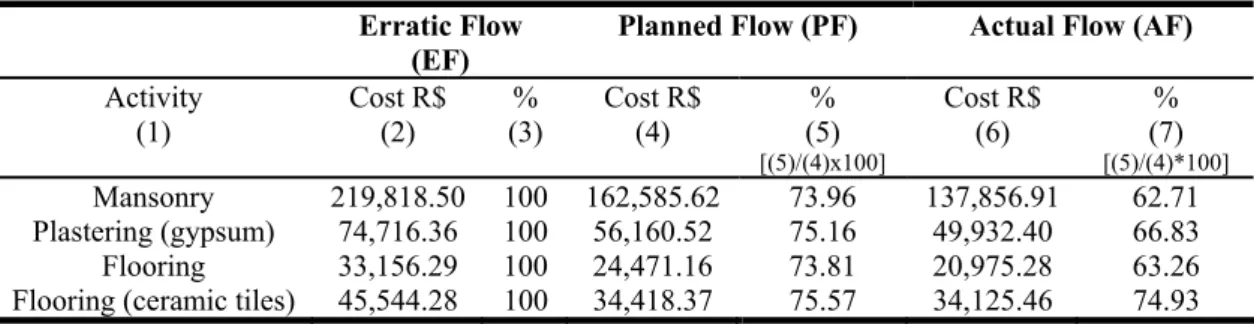
job site namely erratic flow, planned flow, and actual flow. The Erratic Flow (EF) refers to the development of activities without careful planning, and using regular budget and productivity indexes commonly found in the literature. The Planned Flow (PF) refers to the values the company has achieved on previous jobs that were planned using the PS-37 to achieve continuous flow. The Actual Flow (AF) refers to the results obtained for building 17 floors for a particular job site. The results show that when compared to the erratic flow, the planned and actual flows resulted in cost savings that amounted 24% to 36%.
Table 1: Cost Comparison for the Erratic Flow, Planned Flow, and Actual Flow
Erratic Flow
(EF)
Planned Flow (PF) Actual Flow (AF)
Activity (1)
Cost R$ (2)
% (3)
Cost R$ (4)
% (5)
[(5)/(4)x100]
Cost R$ (6)
% (7)
[(5)/(4)*100]
Mansonry 219,818.50 100 162,585.62 73.96 137,856.91 62.71 Plastering (gypsum) 74,716.36 100 56,160.52 75.16 49,932.40 66.83
Flooring 33,156.29 100 24,471.16 73.81 20,975.28 63.26 Flooring (ceramic tiles) 45,544.28 100 34,418.37 75.57 34,125.46 74.93
Finally, the PS-37 has brought a competitive advantage to the company. Besides being invited to present their method to broader audiences throughout Brazil, the company has also been invited as a partner in different projects. Recently the company has migrated from the real state business (it worked as a developer) in the private sector to a service provider business (general contractor) in “cost plus” types of contracts for the private sector and government funded projects. The geographic area of its activities has also changed. Once limited to the city of Fortaleza (Brazil), the firm is currently performing residential and office building projects in other cities of the Brazilian northeast. The ability to master the construction techniques and a well-organized planning system allowed the company to change its niche market and work in different sectors.
CONCLUSION
In the context of construction projects, construction peculiarities cause the physical part of the production system to be redesigned for every new project and even many times during a project life cycle. This has led the concept of production system design to be misinterpreted by many academics and practitioners. The great concern with the match between resources and tasks to accomplish the project schedule has made production system design an issue mostly approached from a project management perspective and not really from an organizational one. Consequently, the development of project production models has been very much restricted and deviated to structural decisions, such as resource capacity, facilities, equipment, and technologies to be used.
production models, it is the way decision makers rationalize and the methods they use when shaping their organizations internally that makes the difference.
The PS-37 case study showed the strong impact that theoretical foundations and underlying assumptions have on the production system design. It confirmed that the roots of an innovative production system very often contain strategic decisions and a paradigm shift. These “soft” factors strongly contribute to originating the intangible competences that cannot be copied by the competition and that really make a difference in a successful production model.
The success of the PS-37 method has also shown the importance of establishing frameworks for the content decisions. The framework provides support to aligning decisions. It also helps project managers to analyse and understand why they do what they do. Thus, it becomes a basis for discussing and experimenting improvements. In closing, such frameworks allow firms to have a more formalized production strategy and to take advantage from its benefits.
REFERENCES
Acur, N.; Gertsen, F.; Sun, H.; and Frick, J. (2003). “The formalization of manufacturing strategy and its influence on the relationship between competitive objectives, improvement goals and action plans.” International Journal of Operations and Production Management, 23 (10), 1114-1141.
Boyer, R. and Freyssenet, M. (2000). “The world that changed the machine: synthesis of GERPISA research programs, 1993-1999.” GERPISA report. 32p.
Carneiro, A.Q. (2007) Estudo sobre a aplicação sobre o conceito de células de produção na construção civil. (in Portuguese) Final report. Civil Engineering Course. Federal University of Ceará (UFC), Fortaleza/CE, Brazil, 46pp.
Chiavenato, I. (1999). Introdução à teoria geral da administração. ed. compacta. Rio de Janeiro: Campus.
Christiansen, T.; Berry, W.L.; Bruun, P.; and Ward, P. (2003). “A mapping of competitive priorities, manufacturing practices, and operational performance in groups of Danish manufacturing companies.” International Journal of Operations & Production Management 23 (10), 1163-1183.
Ferraz, J.L.M., Nascimento, K., Romano, W.C.B.T., Souza, D.P., Barros Neto, J.P., and Heineck, L. (2005) “Um modelo para o planejamento e controle de obras – a transição de um processo de racionalização tecnológica e administrativa para um ambiente de produção enxuta.” (in Portuguese) IV Simpósio Brasileiro de Gestão e Economia da Construção (IV SIBRAGEC), 8pp.
Galsworth, G. (1997) Visual systems: harnessing the power of the visual workplace
Amacon, New York. 320pp.
Goldratt, E.M. (1990) What is this thing called theory of constraints and how should it be implemented? Great Barrington, MA, North River Press, 160pp.
Hyer N. L. and Brown K. A. (1999) “The Discipline of Real Cells.” Journal of Operations Management. 17(5), 557-574.
Merrian, S.B. (1998). Qualitative research and case study applications in education. San Francisco: Jossey-Bass.
Ohno, T. (1988) Toyota Production System: beyond Large-Scale Production.
Rother, M. and Harris, R. (2002) Criando fluxo contínuo – um guia de ação para gerentes, engenheiros e associados da produção. São Paulo, Lean Entreprise Institute.
Spear, S. and H. Bowen (1999). "Decoding the DNA of the Toyota Production System." Harvard Business Review, September-October: 96-106.
Telem, D.; Laufer, A.; and Shapira, A. (2006). “Only dynamics can absorb dynamics.” Journal of Construction Engineering and Management, Vol. 132, No. 11.
Voss, C.A. (2005). “Paradigms of manufacturing strategy re-visited.” International Journal of Operations and Production Management, Vol. 25 No. 12, pp. 1223-1227.
Wheelwright, S. (1984). “Manufacturing strategy: defining the missing link.”