*e-mail: [email protected]
Properties and Structural Features of Iron Doped BABAL Glasses
Signo Tadeu dos Reisa*, Walter M. Pontuschkab, Jinbo B. Yanga, Dalva L A. Fariac
aGraduate Center for Materials Research, 301 Strautmanis Hall, University of Missouri-Rolla, MO65409, U.S.A.
bInstitute of Physics, University of São Paulo, C.P. 66318, 053890-970 São Paulo - SP, Brazil
cInstitute of Chemistry, University of São Paulo, C.P. 26077, 05389-970 São Paulo - SP, Brazil
Received: February 26, 2002; Revised: May 15, 2003
The chemical durability, density and structure of the BABAL glasses with batch compositions (100-x)(0.30BaO·0.50B2O3·0.20Al2O3)·xFe2O3 (1 ≤ x ≤ 10 mol%), were investigated using
Mössbauer spectroscopy, electron paramagnetic resonance (EPR), X-ray diffraction, Raman and differential thermal analysis (DTA). The chemical durability for the glass of composition 27BaO·45B2O3·18Al2O3·10Fe2O3 (mol%) at 90 °C in distilled water was 700 times lower than that of iron phosphate glass 40Fe2O3·60P2O5 (mol%). The Mössbauer spectra indicate the presence of
iron (II) and iron (III) in tetrahedral or octahedral coordination. The results obtained from the gef = 4.3 EPR line are typical of the occurrence of iron (III) occupying substitutional sites and the
line gef = 2.0 is related to the association of two or more Fe ions found in the interstices (or holes occupied by the glass modifier cations) of the glass network. The paths of X-ray diffraction are typical for glasses based in borate glasses. The Raman spectra showed that the boroxol ring disap-pears with the increase of iron content, concomitant with the appearance of BO4 and tetraborate
structural units. At these conditions, an increase of dissolution rate and clustering of iron ions is observed.
Keywords: aluminoborate glass, structure, and chemical durability
1. Introduction
As long been known1, the considerable practical
inter-est of borate glasses stems mainly from the complex
influ-ence of boron oxide on the physical properties2. Some
ap-propriate values of constants such as low melting point, high thermal expansion coefficients and several optical data make these glasses potential candidates for many technological
applications such as optical3, medical use4, and solid state
electrolytes5.
The local structure of iron doped aluminoborate glasses
has been studied using 57Fe Mössbauer, Raman spectroscopy
and electron paramagnetic resonance (EPR)6,7. The boroxol
ring is the main structural group present in borate glasses and the addition of modifier oxide like CaO gradually con-verts three-coordinated boron into four-coordinated boron units, resulting in the formation of diborate, tetraborate and
pentaborate glass network superstructural units7.
Iron is one of the most pervasive impurities in borate and phosphate glasses. Some specific features of the EPR
line width and shape of Fe3+ ions in glass matrices depend
on the glass composition and the concentration of
paramag-netic ions8. The EPR spectra of most glasses containing iron
exhibit the two well known resonances at the effective g
values gef≈ 2 and gef≈ 4.3 that have been considered as a
signature of the presence of Fe3+ ions in a glassy host9. The
X-band EPR spectra (~ 9 GHz) of most oxide glasses with
low Fe3+ concentrations show a g
ef = 4.3 line, and in most
cases the gef = 2 line is also present. A low field feature
(gef ~ 9.7) is also observed in X-band EPR spectra of oxide
glasses10. At low iron concentrations (< 1 mol%), only a
sharp gef≈ 4.3 resonance is commonly observed9. As the
concentration is increased, a broad line begins to grow at
about gef≈ 2 11. In many oxide glasses the intensity of the
line with g = 2 increases much faster than that of g = 4.3
result leads to the hypothesis of Fe3+ clustering, which
ef-fectively contributes to the former broad line12. As the
linewidth of the gef ~ 4.3 resonance remains roughly
con-stant, in practice the peak-to-peak amplitude of its
deriva-tive is proportional to the Fe concentration of the sample13,
while the relative concentrations of the Fe2+ and Fe3+ ions
are easily determined by Mössbauer spectroscopy.
Bogomolova and Henner14 showed how the X-band the
gef≈ 2 line width can be explained by a clustering of Fe3+
ions. Nevertheless, the Fe3+ concentration determines not
only the number of EPR lines and their positions, but the line shapes as well. The theory predicts an increase of line width with spin concentration due to the dipolar broaden-ing. The exchange interaction appears at a sufficiently high concentration of paramagnetic ions (molar contents
> 5 mol%)15, when neighboring spins become highly
cou-pled14.
The aim of the present work is to investigate the condi-tions of the chemical durability of BABAL glasses. Evidence of the presence of diads and microclusters of iron ions and structural studies of the glass matrix were provided by EPR, X-ray diffraction and Mössbauer spectroscopy. The chemi-cal durability of BABAL glasses was determined and com-pared with those of the iron phosphate glasses.
2. Experimental Procedure
Samples of BABAL glasses with compositions
(100-x)(0.30BaO·0.50B2O3·0.20Al2O)·xFe2O3 where
x = 0, 1, 2, 4, 8 and 10 mol% (see Table 1) were produced by melting the batches in dense alumina crucibles at 1200 °C for 1 h. The melt was quenched in air by pouring
into 1 × 1 × 5 cm3 steel mold. The samples were transferred
to an annealing furnace and held at 350 °C for 3 h. The densities of the samples were measured by the Archimedes method using distilled water at room temperature. A por-tion of the glass samples was crystallized on heating at 750 °C for 8 h in air. Room temperature X-ray powder
dif-fraction (XRD) patterns for both glasses and crystalline counterparts were collected on a X-ray diffractometer (Scintag XDS2000). The chemical durability of the bulk
glasses with approximate size of 1 × 1 × 1 cm3 was
evalu-ated by weight loss measurements from glasses exposed to deionized water at 90 °C for 2-8 days. Glasses were pol-ished to 600 grit, finpol-ished with SiC paper, cleaned with ac-etone and suspended in glass flasks containing 100 ml of deionized water at 90 °C. Duplicated measurements were conducted for each glass and the average dissolution rate (DR), normalized to the glass surface area, and the corro-sion time was calculated from the weight loss.
The Mössbauer spectra were obtained at room tempera-ture on a spectrometer provided with a 50 mCi rhodium matrix cobalt-57 source. The amount of iron found at the
sample holder was 4 mg/cm2. The velocity of the source
was calibrated using a pure iron foil that was also used as a reference for the isomer shift value.
The Raman spectra of the glass samples were taken at room temperature using a Renishaw Raman system 3000, coupled to an Olympus metallurgical microscope. The spec-tra were excited at 6328 nm (He-Ne Specspec-tra Physics mod.
127) and recorded in the 200-1800 cm-1 range. EPR spectra
of powdered samples were taken with a Bruker EMX 10/12 homodyne, X-band spectrometer.
3. Results
3.1 Chemical durability
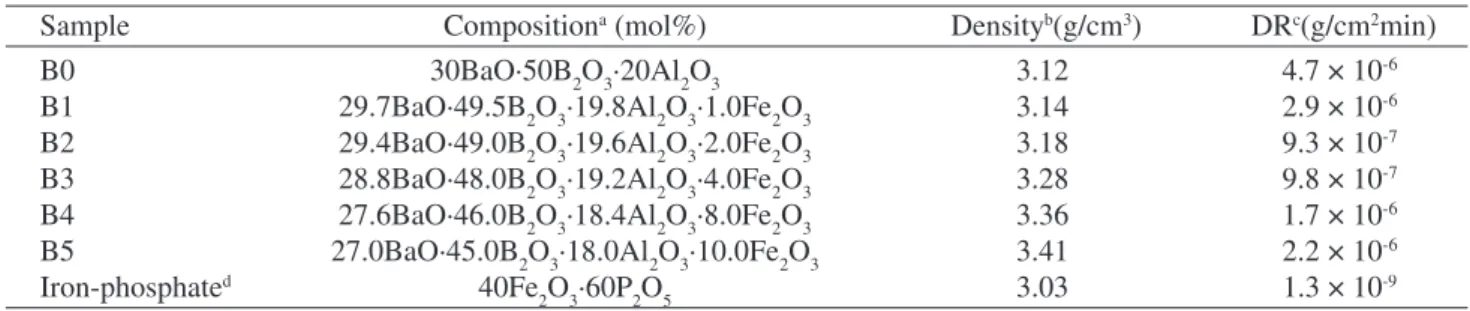
The dissolution rates (DRs) of the BABAL glasses meas-ured from the weight loss experiments conducted in dis-tilled water at 90 °C are given in Table 1 and Fig. 1. Clearly
DR varies with Fe2O3 content: it decreases from
4.7 × 10⁻⁶ g/cm2min. for glasses containing 0 mol% Fe
2O3
containing glass to about 1.0 × 10⁻⁷ g/cm2min for glasses
containing about 4 mol% of Fe2O3. Even though the
sam-ples with Fe2O3 content between 2 and 4 mol% had the
low-Table 1. Batch composition and measured of DR and density of the glasses studied.
Sample Compositiona (mol%) Densityb(g/cm3) DRc(g/cm2min)
B0 30BaO·50B2O3·20Al2O3 3.12 4.7 × 10⁻⁶
B1 29.7BaO·49.5B2O3·19.8Al2O3·1.0Fe2O3 3.14 2.9 × 10⁻⁶
B2 29.4BaO·49.0B2O3·19.6Al2O3·2.0Fe2O3 3.18 9.3 × 10⁻⁷
B3 28.8BaO·48.0B2O3·19.2Al2O3·4.0Fe2O3 3.28 9.8 × 10⁻⁷
B4 27.6BaO·46.0B2O3·18.4Al2O3·8.0Fe2O3 3.36 1.7 × 10⁻⁶
B5 27.0BaO·45.0B2O3·18.0Al2O3·10.0Fe2O3 3.41 2.2 × 10⁻⁶
Iron-phosphated 40Fe
2O3·60P2O5 3.03 1.3 × 10
-9
a Raw materials used were BaCO
3, B2O3, Al2O3 and Fe2O3. b The error is ± 0.01 g/cm3.
est chemical durability (see Table 1 and Fig. 1), there is an increase in DR for samples containing more than 4 mol%
Fe2O3. As a comparison, the iron phosphate glass
contain-ing 40 mol% Fe2O3 16 had a dissolution rate 100 times less
than the dissolution rate for window glass and 700 times less than the dissolution rate for the BABAL glass
contain-ing 10 mol% of Fe2O3, as shown in the Fig. 2.
The pH of the solution after the corrosion tests for a
BABAL glass with 2 mol% Fe2O3 is shown in Fig. 3. The
reduction in the pH values for the iron phosphate glass dur-ing the first four days is consistent with the observed rela-tively higher DR values as a result of corrosion in these glasses to be correlated with the amount of phosphoric acid formed from the release of phosphorus from this glass. However for the BABAL glass the higher pH values indi-cates the formation of considerably higher amount of basic
compounds from the release of Ba and Al from interstitial (glass modifier) positions.
3.2 X-ray diffraction and density measurements
All of the compositions listed in Table 1 formed glasses, as no crystalline phases were detected by XRD. The XRD
pattern of crystalline counterpart of a sample with x = 0 mol%
is given in Fig. 4 which indicates that the major crystalline
phase in the crystallized sample is the Ba2Al2B8O1717.
As shown in Fig. 5, the density of the BABAL glasses at
room temperature increased linearly from 3.12 to 3.41 g/cm3
with increasing Fe2O3 content (see Table 1).
3.3 EPR
Figure 6 shows the X-band EPR spectra of BABAL glasses containing increasing amounts of 1 to 10 mol% of
Figure1. Variation of dissolution rates measured for 2, 4, and 8 days in distilled water at 90 °C with Fe2O3 content.
Figure 2. Dissolution rates of glass B5 and iron phosphate glass in distilled water at 90°C for 2, 4, and 8 days.
Figure 3. Variation of pHs with the iron content for BABAL and iron phosphate glasses.
Fe2O3. The intensities were progressively decreased in order to show the evolution of the relative line shapes and intensities at g = 4.3 from a) isolated ions in local tetrahedral (and
even-tual octahedral) sites9 and b) at g = 2.0 from clusters of two
or more Fe3+ ions which interact among themselves.
No significant changes were observed in the line width
and shape of the g = 4.3 EPR spectra, with the Fe2O3
con-centrations ranging from 1 to 8 mol%, indicating that the
increase of Fe has occurred mainly by substitutions of Fe3+
ions at the sites of the BO4 tetrahedra of the glass forming
network.
As the Fe2O3 content reaches about 10 mol% there is
ob-served a significant increase of the resonance at g = 2.0
to-gether with a strong line broadening which is also observed in the resonance at g = 4.3 before it is going to be completely obscured by the former which becomes dominant.
A similar evolution has been observed by H.O. Hooper
et al.18 in the EPR spectra of iron containing sodium borate
glasses, with the disappearance of the g = 4.3 resonance at
about the same relative amount of Fe2O3 (8- 0 mol%). Later
on D.W. Moon et al.19 have reported that in the glass
sys-tem xFe2O3·(100-x)[BaO·4B2O3] at concentrations greater
than 3 mol% Fe2O3, iron ions associated in pairs (diads)
and groups of three (triads) became predominant, in
addi-tion to the isolated Fe3+ ions. They assigned the shoulder at
g = 6.0 to weak crystal field terms and the g = 2.0 resonance to clusters of more than one iron atom with antiferromagnetic interaction.
More recently, L. Cugunov et al.20, E.M. Yahiaoui11, and
R. Berger et al.9,21 carried out studies with computer
simulations of the Fe3+ resonance in borate glass. The
ex-perimental EPR spectra were well described by assuming
that the environment of Fe3+ ions are highly distorted and in
addition to the orthorhombic distortion related to the
g = 4.3 feature, an important part of Fe3+ arises from axial
or slightly rhombic distortions.
3.4 Raman
The Raman spectra for the lower concentration of Fe2O3
are dominated by a narrow and intense band at 806 cm-1
(Fig. 7). The 806 cm-1 and 540 cm-1 line intensities decrease
with the increasing concentration of Fe2O3 and other bands
centered at 580, 780 and 920 cm-1 appear. For higher
con-centration of Fe2O3 the bands between 580, 780 and
920 cm-1 are predominating in the spectra.
3.5 Mössbauer
The room temperature Mössbauer spectra of the BABAL glasses with iron content > 2 mol% are shown in Fig. 8. The
iron valence and hyperfine parameters, isomer shift δand
quadrupole splitting ∆EQ, calculated from the Mössbauer
spectra are given in Table 2. It is found that some of the Fe(III) ions in the starting batch are reduced to Fe(II) ions Figure 5. Variation of density values with the Fe2O3 content. Line
is drawn as guide for the eye.
Figure 6. The EPR spectra of BABAL glasses containing
addi-tional amounts of Fe2O3 (1 to 10 mol%). The successive ampli-tudes were gradually reduced in order to show the relative evolu-tion of the intensities and line shapes of the g = 4.3 and g = 2.0 resonance.
Table 2. Room temperature Mössbauer hyperfine parameters and
iron valence for BABAL glasses glasses. The estimated error in these parameters is ±0.03 mm/s.
Glass (δ)a (∆E
Q) Fe(II)
a
(mm/s) (mm/s) fraction (%)
Fe(II) Fe(III) Fe(II) Fe(III)
B3 1.23 0.36 2.31 1.12 2.9
B4 1.12 0.38 2.09 1.12 3.9
B5 0.97 0.37 1.84 1.15 5.1
Figure 7. The Raman spectra of BABAL glasses (1 < x < 10).
as all of the glasses contain varying amounts of Fe(II) as determined from the Mössbauer spectra. The isomer shift values for Fe(III) and Fe(II) ions range between 0.39 mm/s and 1.08 mm/s while the quadrupole splitting values range between 1.10 mm/s and 2.09, respectively. These values of isomer shifts correspond to tetrahedral coordination for both Fe(II) and Fe(III) in these glasses.
4. Discussion
The chemical durability for the (100-x)
(0.30BaO·0.50B2O3·0.20Al2O3)·xFe2O3 glasses with iron
content of 2 mol% is 700 times less than that iron
phos-phate glass containing 40 mol% of Fe2O3. In general the
chemical durability for phosphate glasses improves with the
increase in iron content16, however the decrease in the
chemi-cal durability of BABAL glasses for iron content > 4 mol% could be attributed to the formation of microclusters in
substitutional sites in the glass network22.
Figure 6 shows that the EPR lines gef ≈ 2.0 and gef≈ 4.3 on
the spectra these glasses are due to the diluted Fe3+ ions in
tetrahedral or orthorhombic coordination9,23 and small clusters
of exchange coupled Fe3+ ions in substitutional sites of the glass
network. Figure 6 also shows a low field feature, as a shoulder,
in the g ≈10 region. Moreover, this shoulder seems to
disap-pear in the samples with the higher iron concentration.
The Raman band around 806 cm-1 is attributed to boroxol
rings, which is the main structural unit of the B2O3 glasses6,7.
The addition of Fe2O3 converts tree-coordenated boron into
four-coordinated boron units (see Fig. 7), resulting in the
formation of tetraborate groups (780 cm-1). The band in
540 cm-1 is attributed to “loose” BO
4 groups and “loose”
diborate groups24, and the band in the 920 cm-1 can be
at-tributed to the formation of pentaborate groups25. These
re-sults are consistent with the investigation of Fe(II) and Fe(III)
properties in calcium aluminoborate glasses7.
5. Conclusions
The BABAL glass corrosion rate in neutral environment is caused, respectively, by the increase in the pH of the
solu-tion (water) due to the attack of OH- and by the reaction
be-tween H+ and metallic ions (Fe2+ and Fe3+). EPR lines
gef ≈ 2.0 and gef≈ 4.3 on the spectra of these glasses can be
due to the diluted state of Fe3+ ions in tetrahedral or
orthorhombic coordination and small clusters of
exchange-coupled Fe3+ ions in substitutional sites of the glass network.
Acknowledgements
S.T. Reis thanks Fundação de Amparo a Pesquisa do Estado de São Paulo (FAPESP) for a post-doctoral fellow-ship. The authors also thank Mr. Hannes Fischer and Mr. José Mário Prison for the analyses of the XRD and EPR.
References
1. Joo, C.; Werner-Zwanziger, U.; Zwanziger, J.W. J.
Non-Cryst. Solids, v. 261, p. 282, 2000.
2. Kamitsos, E.I.; Chryssikos, G.D. J. Mol. Struct, v. 247,
p. 1, 1991.
3. Guang, H.E.; Przemyslaw, P.; Chau Lin, T. Nature,
v. 415, p. 767, 2002.
4. Conzone, S.D.; Brown, F.R.; Day, D.E.; Ehrhardt, G.J.
B. Mater Res., v. 60, p. 260, 2002.
5. Friedrich, G.K.; Duffy, J.A. J.Chem.Soc.Faraday Trans.,
v. 79, p. 661, 1983.
6. Pascoal, H.B.; Pontuschka, W.M.; Rechenberg, H. Appl.
Phys, A 70, p. 211, 2000.
7. Pascoal, H.B.; Pontuschka, W.M.; Rechenberg, H. J. of
Non-Cryst. Solids, v. 258, p. 92, 1999.
8. Donald, I.W.; Metcalfe, B.L.; Taylor, R.N.J. J. Mater. Sci.,
v. 32, p. 5851, 1997.
9. Berger, R.; Kliava, J.; Yahiaoui, E.M.; Bissey, J.C.; Zinsou,
P.K.; Béziade, P. J. of Non-Cryst. Solids, v. 180, p.151,
1995.
10. Yunfei, L.; Weiwei, H. J. of Non-Cryst. Solids, v. 112,
p.136, 1989.
11. Yahiaoui, E.M.; Berger, R.; Servant, Y.; Kliava, J.;
Cugunov, L.; Mednis, A. J. Phys.: Condens. Matter,
v. 6, p. 9415, 1994.
12. Bogomolova, L.D.; Krasil’nikova, N.A.; Mitrofanov,
V.V. Glass Phys. Chem. v. 21, p. 303, 1995.
13. Del Nery, M.; Pontuschka, W.M.; Isotani, S.; Rouse,
C.G. Phys. Rev. B49, p. 3760, 1994.
14. Bogomolova, L.D.; Henner, E.K. J. Magn. Reson.,
v. 41, p. 422, 1980.
15. Stoyanova, R.; Gorova, M. Journal. of Physics and
Chemistry of Solids, v. 61, p. 615, 2000.
16. Reis, S.T.; Karabulut, M.; Day, D.E. J. of Non-Cryst.
Solids, v. 292, p. 150, 2001.
17. Hubmer, A.K. Neies Jajrb. Mineral, Abh, v. 112, p. 150, 1970.
18. Hooper, H.O.; Beard, G.B.; Catchings, R.M.; Bukrey, R.R.; Forrest, M.; Kenealy, P.F.; Kline, R.W.; Moran Jr., T.J.; O’Keefe, J.G.; Thomas, R.L.; Verhelst, R.A. “Mag-netic order in Alkaliborate and Aluminosilicate Glasses Containing Large Concentrations of Iron-Group Ions”, in: Amorphous Magnetism, ed. by H.O. Hooper and A.M. de Graaf, Plenum New York, p. 47-63, 1972.
19. Moon, D.W.; Aitken, J.M.; MacCrone, R.K. Phys. Chem.
Glasses, v. 16, p. 91, 1975.
20. Cugunov, L.; Mednis, A.; Kliava, J. J. Magn. Resonance,
A106,p. 153, 1994.
21. Berger, R.; Bissey, J.C.; Kliava, J.; Soulard, B. J.
Mag-netism and Magnetic Materials, v. 167, p. 129, 1997. 22. Reis, S.T.; Pontuschka, W.M.; Martinelli, J.R. The
exist-ence of iron microsclusters related to the chemical dura-bility of sintered LIP glasses, (submitted for publication). 23. Fuxi, G. “Optical and Spectroscopic properties of glass,
Chap. 6, Springer Verlag, 1992.
24. Merra, B.N.; Ramakrishkna, J. J. of Non-Cryst. Solids,
v. 159,p. 1, 1993.
25. Maniu, D.; Ardelean, I.; Illiescu, T.; Pantea, C. J. Mater.
Sci. Lett., v. 16, p. 19, 1997.
Figure 8. Mössbauer spectra obtained of glasses of