Vol. 5, No. 2, 2002 Elimination of Lubricants from Aluminum Cold Rolled Products Using Short Laser Pulses 205
Materials Research, Vol. 5, No. 2, 205-208, 2002. © 2002
Elimination of Lubricants from Aluminum Cold Rolled
Products Using Short Laser Pulses
M.S.F. Limaa*, J.-D. Wagnièrea, S.P. Moratob, N.D. Vieira Jr.c
a Center for Laser Treatment of Materials, Swiss Federal Institute of Technology Lausanne,
C. P. 110, CH-1015 Lausanne, Switzerland.
b LaserTools Technology Ltd.
C. P. 11049, 05422-970 Sao Paulo - SP, Brazil
c Center for Lasers and Applications
C. P. 11049, 05422-970 Sao Paulo - SP, Brazil
Received: February 6, 2002; Revised: April 24, 2002
This work presents a new technique to remove the surface impurities from the aluminum cold-worked sheets. The method consists to concentrate a short-time high-power pulsed laser on the materials surface and scan it in order to cover a desired area. Incrustations ablation is obtained as long as the fluency and the peak power are high enough to produce vaporization of the contami-nated layer without affecting the material surface properties. The present problem consists in eliminating a desiccated soap of about 1 g/m2 from the surface of a 6016-class aluminum alloy sheet. The soap is originated from the rolling process. The present laser method is intended to replace water washing when the piece cannot be soaked, when drying is difficult due to the geom-etry, or when environmental restrictions apply. Best results were obtained when the pulse length was 100 ns and the average laser power was 95 W. In these conditions, the surface was completely cleaned and the aluminum alloy did not suffer any structural modification.
Keywords: laser cleaning, laser ablation, aluminum alloys
1. Introduction
Laser technology has attracted considerable interest for the cleaning of materials when conventional methods present unsatisfactory or costly results. This is the case of artwork restoration where lasers can be used to eliminate oxides, dirt, paint and mosses in a very controlled manner1. Lasers
have been used also in microelectronics2,3 and metallurgy4,5
to clean surfaces with or without surface modification. Two processes can achieve laser cleaning: athermal and thermal ablation. Athermal processing is obtained when the surface incrustation is fragmented and ejected due to a me-chanical shock wave. This effect is usually controlled by the energy density: low values are ineffective and high val-ues lead to substrate damage. In order to drive shockwave ablation, pulse lengths in the range of picoseconds up to some few nanoseconds should be produced6-9. On the other
hand, thermal ablation is obtained for longer pulse
lengths10,11. The volatilization of a surface layer is due to
the rapid conversion of the laser energy in latent heat of vaporization. The former practice has two advantages: a) The process window, i.e. the set of variables to produce cleaning is larger than in the case of athermal process. The same laser workstation can be used to process a variety of materials.
b) The laser workstation has a relative low cost and can be also used for marking and engraving thus conferring versatility.
These facts motive for the use of a flexible workstation with pulse lengths of some hundreds of nanoseconds and an energy per pulse of less than one joule.
In the present case, it is intended to use the pulsed laser power to clean aluminum surfaces which are contaminated with a saponaceous solution. The solution is the ALUB ZX12
dry lubricant used for the cold rolling of aluminum alloys. This product minimizes staining and provides excellent lu-brication. The aluminum sheets are utilized in the
206 Lima et al. Materials Research
tion of blanks for automobiles after assembly by TIG weld-ing. The problem of cleaning appeared when it was noticed that bobles were present in the welding. These bobbles were associated to a volatile surface contaminant, which is origi-nated from the lubricant.
The objective of the present contribution is to determine the best conditions for laser cleaning of the aluminum sheets, where: surface contamination is eliminated and the substrate material is not modified. The final goals are to reduce de-fects in welding and to eliminate the emission of aqueous pollutants.
2. Experimental
Cold rolled aluminum sheets of 2-mm thick were pro-duced in the Alusuisse Swiss Aluminum Ltd. at Chippis, Swit-zerland. The alloy is a high-strength AA6016 in the T4 con-dition before rolling. One milligram per square meter of the dry lubricant ALUB ZX is applied at each surface in order to enhance conformation and reduce stain. The lubricant consists of natural and synthetic esters, fatty alcohols, gly-cols, non-ionic surfactants, soap and water. Once dried out the residues look like a chalky layer of soap. This lubricant has a partial solubility in water and complete removal is possible by manual operation or in an ultrasonic bath of alcohol. The biological accumulation leads to a partial al-kalization of the ecosystem, thus waste products should be treated with ultra-filtration or inverse osmosis systems13.
The laser workstation consisted of a F94S, Q-Switched Nd:YAG lamp pumped laser from FOBA with a galvanometric scanning head to direct the beam in the xy plane. The Nd:YAG laser has a maximum average power of 95 W and can be operated in continuous wavelength (CW) or in Q-switched mode. The lamp current controls the laser output power in the range 10-95 W. The pulse length, in the range 100-1000 ns, and the frequency, in the range 1-30 kHz, are correlated. The energy per pulse is the ratio of the aver-age power to the frequency.
The laser ablation produces a dense cloud of hot vapors and debris that will condense and recontaminate the sur-face if not removed immediately. Contamination could be prevented by entrainment into a flowing gas stream or by an air suction system. Both methods are effective if the metallic surface remains unmelted. In the present case, it was used an industrial aspiration system.
The scanning head had two independent mirrors mounted on galvos which allows a xy scan of the laser beam over a surface of 10×10 cm2 at speeds up to 400 mm/s. The
treat-ment zone, which is restricted to 1 cm2 in the present study,
was obtained by a partial superposition of parallel tracks. The microstructural analyses were carried out using a Scanning Electron Microscope Cambridge S-360 with a LaB6 anode and spatial resolution of 4-nm at 30 kV.
3. Results and discussion
The process parameters in laser processing are intercon-nected. The lamp current in the laser cavity controls the average output power (P). This later controls three other variables: the energy per pulse (E), the pulsing frequency (f), and the temporal pulse length (tp). For the maximum average power of 95 W, for instance, one can set the fre-quency at 1 kHz, but the values of energy and pulse length are fixed as 0.095 J (P = E.f) and 100 ns, respectively. The focusing device (a f-theta lens) also controls the beam spot diameter (D) via the focusing distance. For a single shot, the fluency (F) is the ratio of the pulse energy by the irradi-ated area. However, the motion of the beam over the mate-rial surface implies in a partial superposition of individual laser shots. For a linear scanning speed Vb the overlapping times is:
(1)
The fluency can be expressed as the sum of the energy of each laser shot when the beam travel a distance of the beam spot diameter:
(2)
Substituting the terms of Eq. 1, considering the area as a function of spot diameter and adding a term β, the frac-tion of energy absorbed by the surface, one obtains:
(3)
Another important parameter is the peak power, Pp, which is:
(4)
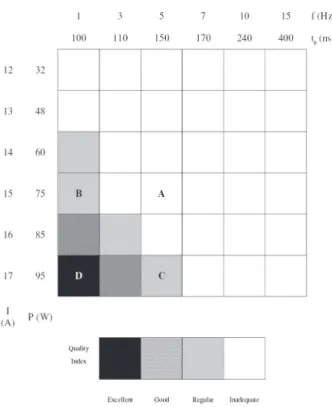
Both fluency and peak power were varied in the present work in order to produce a process chart. For this, the scan-ning velocity and the beam spot diameter must be fixed. The velocity was fixed at an intermediary value (Vb=100 mm/s), giving N between 4.8 and 72 for frequen-cies between 1 and 15 kHz. The beam diameter was 420 µm at focus, and increased to about 480 µm when defocused by –20 mm or +20 mm. The best cleaning effect was ob-tained when the focus was in the sample at –20 mm. There-fore, considering β= 1 (total absorption in the layer), the fluency at P = 95 W is 2.5 J/mm2. However, this value should
be something lower because the overlapping shots (N) do not supply the same heat at every position and because the laser absorption in the incrustation is not complete (β < 1). A processing chart was then constructed by changing the current lamp and the frequency, (Fig. 1). The black square
b V . D P . 4 F β π
= (J.m-2)
f . t P . P p p β = (W)
f . A P . N F=
(J.m-2)
b
Vol. 5, No. 2, 2002 Elimination of Lubricants from Aluminum Cold Rolled Products Using Short Laser Pulses 207
represents the condition where the surface was completely cleaned. Dashed squares represent good results, i.e. most of surface was uncontaminated but some spots remain. Grey squares indicate surfaces with various points and plates of incrustations. Finally, white squares represent surfaces where the cleaning did not occur. The scanning electron micro-graphs of four representative cases were presented in Fig. 2. The best result was obtained when the laser parameters were set-up to give 2.5 J/mm2 and 950 kW. These results
indicate that both fluency and peak power are important factors in the cleaning mechanism.
Literature results4,14 indicate that the fluency level
(2-2.5 J/mm2) and pulse length are pertinent to a process of
ablation based in heterogeneous nucleation of vapor bob-bles with consequent fragmentation. Thus thermal transfer to the incrustation mainly controls the process. This trans-fer only slight changes the topography of the sheet, Fig. 2, and must not affect the macroscopic material properties. Additionally considering that these regions are going to be welded after cleaning, the small roughness increases the absorptivity when laser weld is employed.
Since the displacement of the laser beam is fully auto-mated, it is possible to integrate the cleaning solution di-rectly in the welding head. Some preliminary tests of
Figure 1. Process chart for the laser cleaning of aluminum sheets. Letters refer to the micrographs in Fig. 2.
208 Lima et al. Materials Research
weldability of laser cleaned AA6016 sheets have shown ex-cellent results15.
4. Conclusions
This work presents an alternative technique to clean sur-faces of aluminum cold rolled products based on the laser technology. For the specific case of an ALUB ZX contami-nant on a AA6016 it had been show that the surfaces can be conveniently cleaned using 2.5 J/mm2 fluency and a peak
power of 950 kW. The results were summarized in a proc-ess chart (Fig. 1) and in the micrographs showing different laser parameters (Fig. 2). The combination of laser clean-ing and laser weldclean-ing is also proposed as a way to increase weldability in these alloys.
Acknowledgements
This work is funded by FAPESP (Fundação de Amparo à Pesquisa do Estado de São Paulo, Brazil) under grants 01/ 04159-7 and 98/07319-0 and by Swiss Federal Institute of Technology, Lausanne, Switzerland.
References
1. Drollette, D. Photonics Spectra, March, pp. 90-98, 2001. 2. Illyefalvi-Vitez, Z., Microelectronics Reliability, v. 41, p.
563-570, 2001.
3. Ozono, K.; Obara, M.; Usui, A.; Sunakawa, H. Optics Communications, v. 189, p. 103-106, 2001.
4. Song, K.H.; Xu, X. Applied Surface Science, v. 127-129, p. 111-116, 1998.
5. Coddet, C.; Montavon, G.; Ayrault-Costil, S.; Freneaux, O.; Rigolet, F.; Barbezat, G.; Folio, F.; Diard, A.; Wazen, P. J. Thermal Spray Tech., v. 8, p. 213, 1999.
6. Chen, J.P.; Ni, X.W.; Lu, J.; Bian, B.M. Optics Commu-nications, v. 176, p. 437-440, 2000.
7. Jeong, S.H.; Greif, R.; Russo, R.E. Applied Surface Sci-ence, v. 127-129, p. 1029-1034, 1998.
8. Stauter, C.; Fontaine, J.; Engel, Th. Applied Surface Sci-ence, v. 96-98, p. 522-527, 1996.
9. Psyllaki, P.; Oltra, R. Materials Science and Engineer-ing, v. A282, p. 145-152, 2000.
10. Zhou, X.; Imasaki, K.; Furukawa, H.; Umino, H.; Sakagishi, K.; Nakai, S.; Yamanaka, C. Optics and La-ser Technology, v. 33, p. 189-194, 2001.
11. Lima, M.S.F.; Vieira, N.D.; Morato, S.P.; Vencovsky, P. accepted Materials Science and Engineering A, 2001. 12. ALUB ZX is a product and a trademark of Alusuisse
Aluminium of Switzerland Ltd.
13. ALUB ZX technical data worksheet, Alusuisse Alu-minium of Switzerland Ltd., 1998.
14. Sobol, E.N. Phase Transformations and Ablation in La-ser-treated Solids, John Wiley and Sons, USA, p. 75, 1995.