OR IGINAL ARTICLE
134 J Vasc Bras. 2016 Apr.-June; 15(2):134-137 http://dx.doi.org/10.1590/1677-5449.000816
EVLTraining
: mobile app for training and calculating linear
endovenous energy density
EVLTraining
: aplicativo para treino do cálculo da densidade de
energia endovenosa linear
Alexandre Campos Moraes Amato1
*
, Salvador José de Toledo Arruda Amato2
Abstract
Background: Recognition of endovenous thermal ablation as a treatment for saphenous vein insuiciency brings a need for greater knowledge and understanding of the method. Linear endovenous energy density (LEED) is the most accepted variable for standardization and it has been covered in a growing number of publications. However, it should not exclusively be used for comparison of scientiic results, it should also be used intraoperatively so that the procedure is conducted safely. Objectives: To develop a mobile app for measurement of LEED and evaluate its applicability.
Method: he application for iOS EVLTraining was developed for portable devices in order to standardize energy emission in endovenous thermal ablation procedures. Results: he application developed demonstrated equivalence to measures applied during surgical procedures. Conclusion: he EVLTraining software enables surgeons and staf to train the optical iber pullback speed to be applied prior to surgery.
Keywords: varicose veins; software validation; software; lasers.
Resumo
Contexto: O reconhecimento da termoablação endovenosa como tratamento da insuiciência de veias safenas traz a necessidade de maior conhecimento e compreensão do método. A densidade de energia endovenosa linear (linear endovenous energy density – LEED) é a variável mais aceita para padronização, cada vez mais amplamente divulgada. Não deve ser utilizada apenas para comparação de resultados cientíicos – deve também ser usada no intraoperatório para a realização do procedimento com segurança. Objetivos: Desenvolver aplicativo para mensuração da LEED e avaliar sua aplicabilidade. Métodos: O aplicativo para iOS EVLTraining foi desenvolvido para equipamentos portáteis com o intuito de padronizar a emissão energética em procedimentos de termoablação endovenosa. Resultados: O aplicativo criado mostrou equivalência com as medidas aplicadas no procedimento cirúrgico. Conclusões: O software
EVLTraining permite o treino prévio de cirurgião e equipe para a velocidade de tração da ibra ótica que será aplicada.
Palavras-chave: varizes; validação de programas de computador; software; lasers.
1 Universidade de Santo Amaro – UNISA, São Paulo, SP, Brazil. 2 Amato – Instituto de Medicina Avançada, São Paulo, SP, Brazil.
Financial support: None.
Conlicts of interest: No conlicts of interest declared concerning the publication of this article. Submitted: March 15, 2016. Accepted: May 19, 2016.
135 J Vasc Bras. 2016 Apr.-June; 15(2):134-137 Alexandre Campos Moraes Amato, Salvador José de Toledo Arruda Amato
INTRODUCTION
Recognition of endovenous thermal ablation as a
treatment for saphenous vein insuficiency1 brings a need
for greater knowledge and understanding of the method. In contrast with radio frequency ablation, in which the equipment has few variables to be conigured and the method is more easily reproduced, endovenous thermal ablation by laser demands knowledge of wavelength, power, energy, irradiance, luence, time and distance, when choosing equipment and while conducting the procedure safely. The type of optical iber used also has an inluence on the quantity of energy administered to biological tissues. These are concepts from physics transposed to medicine and they need to be thoroughly elucidated. Linear endovenous energy density (LEED) is the most accepted variable for standardization and it is covered in a growing number of publications. However, it should not be used exclusively for comparison of scientiic results, it should also be used intraoperatively so that the procedure is conducted safely. In order to apply LEED, it is necessary to understand the physics and mathematics used in the formula. Additionally, in contrast with what is commonly believed, it is not necessary to make rough approximate estimates or use dificult mental arithmetic techniques, it can easily be calculated in real time.
Since there are differences between different types of equipment available for laser surgery, including differences in presentation of data, standardization is necessary so that the energy levels chosen can be compared.
Venous endolaser treatment has a greater learning curve than other techniques, exactly because of the large number of variables that inluence the inal result. These multiple variables also make it dificult to make comparisons between scientiic studies. The great variety of equipment available and the great variation in the information presented could confuse inexperienced surgeons, who may not know which information is the most important to achieving the best inal results.
Prior training with real and virtual models2 has proven effective for simulation of medical procedures for the purposes of education, and could also prove effective for standardization of the technique.
Our aim is to explain how LEED can be used in training for acquisition of the competence necessary to conduct successful thermal ablation.
METHOD
The EVLTraining app for iOS (Amato, São
Paulo, Brazil)3 was developed in Objective-C for
portable devices with the objective of standardizing
energy emission during endovenous thermal ablation procedures. From among the many parameters for measurement of energy levels that are employed in practice and in scientiic studies, LEED was chosen as the software’s standard because it is suficiently reproducible. This method is dependent on the strategy for use and handling of the laser and the learning curve involved is accentuated. The most reproducible method is to set all parameters except pull-back velocity at ixed levels, but it demands training and dexterity. The app offers a virtual environment for calculating LEED, with a free choice of the parameters to be used, and allows the user to practice the iber pull-back velocity.
For the software test, an iPhone (Apple, Cupertino,
United States) device was wrapped in sterile plastic
and used to run EVLTraining during a saphenous
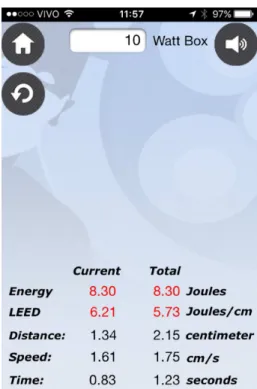
endovenous thermal ablation procedure. As the operator pulled the optical iber back with the irst and second ingers of the dominant hand, these slid along the capacitive screen of the device, allowing it to calculate the parameters applied in real time. The surgical procedure was video-recorded for later analysis. The parameters shown by the software (Figure 1) were compared with those registered on the laser equipment (partial energy), clock (time) and graded iber (distance in centimeters).
Figure 1. Main window of the EVLTraining app showing
136 J Vasc Bras. 2016 Apr.-June; 15(2):134-137 EVLTraining: mobile app for calculating LEED
RESULTS
The app demonstrated equivalence to the measures used during the surgical procedure. The pull-back velocity and LEED compared on the video were equivalent to those employed during the surgical procedure.
DISCUSSION
Wavelength is the distance between successive repeated values in a waveform. In the case of lasers, the wavelength is determined by the thermal vibration of atoms, by the presence of impurities in the material that emits the light, by the way it is energized and by the optical system applied. It is normally a ixed value, although it can be altered with speciic ilters. It is therefore determined at the time at which the laser equipment is purchased. Each wavelength has a different chromophore, i.e., a target tissue that exhibits greatest absorption.4
Energy is an abstract magnitude that is linked to the dynamic state of a closed system and remains unchanged over time. Thermal energy is, fundamentally, kinetic energy. Thermal energy must not be confused with temperature and it is also a mistake to think that temperature is a direct measurement of the thermal energy of a system. Thermal energy is measured in joules (J) within the International System of Units (SI). One joule is the quantity of energy equivalent to a 1 Newton force applied through a distance of 1 meter. In other words, it is the energy needed to accelerate a mass of 1 kg at 1 m/s2 through a 1 m distance in space.5 1J = 1kg x m2/s2. Energy is the result of power multiplied by the pulse duration (J=W*s), so control of energy allows two variables to be controlled: time and power.4
Power is the magnitude that determines the quantity of energy delivered by a source for each unit of time. In other terms, power is the speed with which a certain quantity of energy is transformed, or it is the speed with which work is performed. It can also be understood as force multiplied by velocity. The SI unit of power is the watt (W). It is equivalent
to 1 joule per second (1 J/s).4,5
Therefore, LEED consists of power x time / distance, or W x s / cm. Measuring LEED, although imperfect, takes in four important variables of laser treatment: power, time, distance and, consequently, energy. Since wavelength is ixed, this amounts to control over ive of the variables in the procedure. Using just a single variable, it becomes possible to have real-time intraoperative control over ive important characteristics of the laser treatment.
Irradiance is a synonym of power density, which is deined as the usable optical power of the laser, expressed in W, divided by the area irradiated,
expressed in square centimeters (cm2).
Fluence is a term used to describe the proportion of energy that is being administered to the tissues. Multiplying irradiance by exposure time (s), gives us the luence or energy density, expressed in joules
per square centimeter (J/cm2).6 Fluence is most
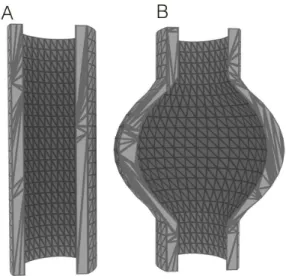
used as a parameter for transcutaneous lasers since it is associated with the area reached by the laser. The concept underlying LEED is the variation in luence, in which the denominator, rather than being area, is linear distance, making it applicable to tubular structures, such as veins. Obviously, when veins are more dilated, the internal cylindrical surface area
is greater (Figure 2). Thus, the same LEED (which
does not consider area) will result in lower energy density applied to the biological tissue. For this reason, more recent studies relate the diameter of the vein to
be treated to the LEED to be administered,7 which
increases as the diameter increases. In this case, the luence calculated using the internal area of the vein will be the same: when the denominator, which is the area, increases, the numerator, which is energy, must also increase to keep luence stable. However, when LEED alone is used as the parameter, increases in the internal vein area are not calculated and must be compensated for by increasing the LEED applied.
Automated mechanical pull-back equipment makes it possible to set the parameters and calculate the energy administered to the patient in advance, but
Figure 2. 3D models of (A) cylindrical vein and (B) dilated vein,
137 J Vasc Bras. 2016 Apr.-June; 15(2):134-137 Alexandre Campos Moraes Amato, Salvador José de Toledo Arruda Amato
there are disadvantages, such as contamination of a iber that would be reused in the same procedure and dificulties with varying the LEED in veins with different diameters.
If the laser equipment employed displays to the user the variable partial energy per pulse, it is understood that the machine is multiplying the duration of the pulse (s) by power (W). It should be noted that this value increases as time passes. In this case, according to the formula, if just 1 cm of the optical iber is pulled back, then the denominator will be 1, the equation will be easy to calculate and the resulting value will be equivalent to the LEED. Continuous pulses over distances greater than 1 centimeter make it more dificult to calculate LEED using mental arithmetic, and so it becomes necessary to observe the velocity (cm/s).
The EVLTraining software offers the possibility
of calculating the pull-back velocity (cm/s), distance pulled-back (cm), time (s), and energy (J) and, consequently, LEED (J/cm) for training the surgical team.8 When the laser equipment employed displays the partial energy, or when the team does not use the proposed method for calculation of LEED, it is necessary to perform multiple mental calculations. In this case, prior training of the surgeon in pull-back velocity should be beneicial.
Of the intraoperative variables, it is power (W), total energy (J), partial energy, time (s) and distance pulled-back (cm) that control the procedure.
Observation of all of these variables at the same time makes the procedure more dificult, unnecessarily increasing its complexity.
CONCLUSIONS
The EVLTraining software enables surgeons and
staff to train the optical iber pullback speed to be applied prior to surgery.
REFERENCES
1. Gloviczki P, Gloviczki ML. Guidelines for the management of varicose veins. Phlebology. 2012;27(Supl 1):2-9. http://dx.doi. org/10.1258/phleb.2012.012S28. PMid:22312060.
2. Amato ACM, Freitas SL, Veloso PM, Correia TCV, Santos RV, Amato SJTA. Treinamento de punção ecoguiada em modelo de gelatina. J Vasc Bras. 2015;14(3):200-4. http://dx.doi.org/10.1590/1677-5449.0088.
3. Amato Software. EVLTraining [software]. São Paulo; 2012. [citado 2016 mar 15]. http://software.amato.com.br/content/evltraining
4. van den Bos RR, Kockaert MA, Neumann HA, Nijsten T. Technical review of endovenous laser therapy for varicose veins. Eur J Vasc Endovasc Surg. 2008;35(1):88-95. http://dx.doi.org/10.1016/j. ejvs.2007.08.005. PMid:17920307.
5. Barrow GM. Físico-química. Rio de Janeiro: Reverté; 1982.
6. Proebstle TM, Krummenauer F, Gül D, Knop J. Nonocclusion and early reopening of the great saphenous vein after endovenous laser treatment is fluence dependent. Dermatol Surg. 2004;30(2):174-8. PMid:14756646.
7. Maurins U, Rabe E, Pannier F. Does laser power influence the results of endovenous laser ablation (EVLA) of incompetent saphenous veins with the 1 470-nm diode laser? A prospective randomized study comparing 15 and 25 W. Int Angiol. 2009;28(1):32-7. PMid:19190553.
8. Mueller RL, Bridget M, Mueller J. Digital metronomes and metric devices for venous ablation procedures. J Vasc Ultrasound. 2013;37:142-4.
*
Correspondence Alexandre Campos Moraes Amato Av. Brasil, 2283 - Jardim América CEP 01431-001 - São Paulo (SP), Brazil Tel.: +55 (11) 5053-2222 E-mail: [email protected]
Author information ACMA - PhD in Sciences from Universidade de São Paulo (USP); Professor of Vascular Surgery at Universidade de Santo Amaro (UNISA); Member of Sociedade Brasileira de Angiologia e Cirurgia Vascular; Board-certiied in Vascular and Endovascular Surgery by Sociedade Brasileira de Angiologia e Cirurgia Vascular (SBACV) and in Vascular Eco-Doppler by Colégio Brasileiro de Radiologia. SJTAA - Chief of the vascular team at Amato – Instituto de Medicina Avançada.
Author contributions Conception and design: ACMA, SJTAA Analysis and interpretation: ACMA, SJTAA Data collection: ACMA, SJTAA Writing the article: ACMA Critical revision of the article: ACMA Final approval of the article*: ACMA, SJTAA Statistical analysis: N/A. Overall responsibility: ACMA