DOI: http://dx.doi.org/10.1590/1980-5373-MR-2016-0008
Materials Research. 2016; 19(2): 474-477 © 2016
*e-mail: [email protected]
Capacitor is one of the main components used in electronic devices on a large scale [1], whether in industry, agriculture,
national defense, scientiic research, or in everyday life,
which has a wide range of applications 1. Ceramic capacitors
are widely used in bypass, coupling and iltering circuits.
Miniaturization, high-capacity, high-quality and low-cost are long-term goals of producing ceramic capacitors 2. Because of its high dielectric constant, low dielectric loss, excellent ferroelectric, piezoelectric and insulated properties, BaxSr1-xTiO3 (BST) ceramics are important electronic ceramic materials and widely used in small size and large-capacity mini-capacitors, thermistors, very large scale dynamic random access memory and tuning microwave devices 3.
In order to meet the requirements of producing miniaturized-high-capacity and high-quality ceramic capacitors, a lot of study has been done on the basis of BST ceramics to modify the system. It has been found that the size and type of the substituting ions in different positions
have a very important inluence on the dielectric properties
of the capacitors.4-7. La3+ ions dissolved in the A-sites and effectively suppressed the grain growth of BST ceramics 8, 9. However, research effort towards the dielectric properties of La2O3-doped BST ceramics is still scant. In this experiment, we investigated the effects of different amounts of lanthanum oxide doped and sintering temperature on the dielectric properties of BST ceramics.
1. Experiment
The raw materials used in the experiment are: BaCO3 (Beijing Hongxing Chemical Factory), SrCO3 (Tianjin Chemical Reagent Factory three), TiO2 (Tianjin Chemical
Reagent Factory three) and a small amount of dopant Sm2O3 (Shanghai Yuelong Chemical Factory), All raw materials are analytical reagent.
The main formula of this experiment is (Ba0. 8Sr0.2)TiO3 (BST20), Sm2O3 doping amount is 0.2 mol%, La2O3 doping amount is 0.0mol%, 0.05mol%, 0.1mol%, 0.2mol%, 0.4mol%, 0.6mol%, respectively, denoted by A - F, The results are shown in Table 1. Reagent-grade oxide powders TiO2 (AR, China), SrCO3 (AR, China), BaCO3 (AR, China), Sm2O3 (99.99%, China) and La2O3 (99.99%, China) were used as received. According to the main formula, we weighed BaCO3, SrCO3, TiO2 etc as primary materials, according to primary material: ball: water = 1:1:2, mixed with deionized water ball-milling for 4 h, and then to be dried. The ball-milled raw mixture was pre-synthesised at 1080 °C for 2h, After doping Sm2O3, according to regrind material: ball: water =1:1:1.5, mixed with deionized water ball-milling for 6 h again, and then to be dried. 7%PVA (5at%) solution was added into the above ball-milled material to granulate, The granulated materials were sifted on 40 mesh sieve, an then pressed into
the desired form (Φ × d = 13 mm × 1.00 mm) at 150 MPa,
and then sintered at 1260 °C, 1270 °C, 1280 °C, 1290 °C and 1300 °C for 2 h in the air, respectively. The heating and cooling rate is 5 °C / min, and then the ceramic samples were obtained. The samples were coated by a layer of silver at 470 °C after cleaned with ultrasonic cleaning instrument for 10min, and then to be tested.
The crystal structures of the specimens were conirmed
by X-ray diffraction analysis (XRD, Rigaku D/max 2500v/pc)
with Cu Kα radiation. In this experiment, we use an Automatic
LCR Meter (Automatic LCR Meter 4425, Tianjin) at 1 kHz to test the Capacitance C and dielectric loss factor
D. The dielectric coeficient of the sample is measured by
Effects of La
2O
3-Doping and Sintering Temperature on the
Dielectric Properties of BaSrTiO
3Ceramics
HongWei Zhaoa*, YuanLiang Lib, ChunRui Changa and ChunLiang Yanc
a College of Science, North China University of Science and Technology,
Tangshan 063009, Hebei Province, China.
b Hebei Provincial Key Laboratory of Inorganic Nonmetallic Materials, North China University
of Science and Technology, Tangshan 063009, Hebei Province, China. c Analysis & Testing Center, North China University of Science and Technology,
Tangshan 063009, Hebei Province, China.
Received: January 7, 2016; Revised: January 25, 2016; Accepted: February 9, 2016
Using BaCO3, SrCO3 and TiO2, et al as crude materials, La2O3 as dopant, Ba0.8Sr0.2TiO3 (BST) Ceramics of perovskite structure were prepared by solid state reaction method. We investigated the effects of La2O3-doping and sintering temperature on the dielectric properties of BaSrTiO3 ceramics. The experiment results show that: The amount of La2O3 can increase the dielectric constant of the sample, with the doping amount increasing, the dielectric constant increases. The sintering temperature
has also signiicant impact on the dielectric properties. The dielectric constant of the sample reaches
its highest point at 1280 °C.
2016; 19(2) Effects of La2O3-Doping and Sintering Temperature on the Dielectric Properties of BaSrTiO3 Ceramics 475
LCR Meter Automatic 4225 and the intelligent temperature control system at 1 kHz.
The dielectric constant and dielectric loss tanδ of the sample were calculated based on the following formulation:
14.4 2
r Ch
ε ϕ
= (1)
tan 1000
fD
δ = (2)
In the formulation : h - the thickness of the sample
(cm); Ф- the diameter of the electrode of the sample (cm); C - capacitance of the sample (PF) ; f - test frequency; D - dielectric loss factor.
2. Results and discussion
2.1 XRD analysis
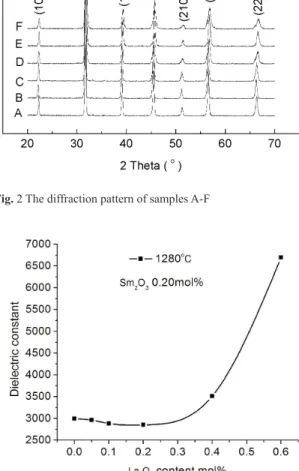
In all formulas, the dopants such as Sm2O3 and La2O3 etc were added after the raw material was pre-synthesised, the synthesis conditions of all formulas were the same, so the XRD analysis of the pre-synthesised sample A was selected. The results are shown in Figure 1. From Figure 1 it can be seen that the raw material was well pre-synthesised, the main crystal phase of the pre-synthesised material is Ba0.8Sr0.2TiO3, without any other impurity phase. After sintered for 2h at 1280 °C, the diffraction patterns of the samples were shown in Figure 2. It can be seen From Figure 2 that: the diffraction peaks of (100), (110), (111), and (200) appeared in the sample, all of the samples have a typical perovskite structure, which indicates that the doping of La2O3 has not changed the structure of the main crystal phase.
2.2 Samarium oxide content unchanged to
determine the effect of doping different
contents of lanthanum oxide on the dielectric
properties of the sample
Under the condition of sintering at 1280 °C for 2h, the dielectric constant of the sample with the different content addition of La2O3 was shown in Figure 3.
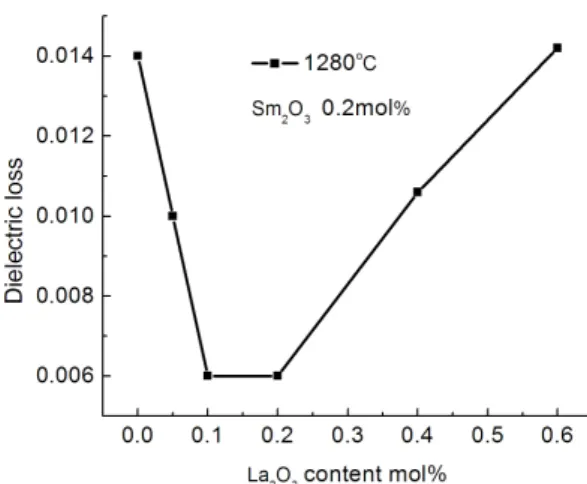
As can be seen from Figure 3, at a certain temperature, the dielectric constant gradually decreased with the increase of the doping amount of La2O3, after the doping amount reached 0.20mol%, the dielectric constant increased sharply. When the maximum amount of 0.60mol% reached, the trend was still on the rise. Under the condition of being sintered at 1280 °C for 2h, the dielectric loss of the sample with the different content addition of La2O3 was shown in Figure 4. As can be seen from Figure 4, at a certain temperature, With
the increase of La2O3 doping amount, the dielectric loss
irst decreases and then increases, and reached its lowest
point when the doping amount of La2O3 were 0.1 mol% and 0.2 mol%, respectively.
Table 1. Chemical composition of the samples (g)
Number La2O3 Sm2O3 Ba0.8Sr0.2TiO3
A 0.0000 0.1551 49.8000
B 0.0362 0.1550 49.7637
C 0.0723 0.1549 49.7274
D 0.1445 0.1546 49.6551
E 0.2881 0.1542 49.5110
F 0.4309 0.1538 49.3677
Fig. 1 The diffraction pattern of pre-synthesised sample A
Fig. 2 The diffraction pattern of samples A-F
Zhao et al.
476 Materials Research
The trend of dielectric properties of the sample with different doping amounts of La2O3 is related to the substitution mechanism of La3+ ion in BST ceramics. The radius of La3+ ion in the six ligand (0.103 nm) is larger than the radius of Ti4+ (0.061 nm), while the radius of La3+ ion in the twelve ligand (0.136 nm) is less than that of Ba2+ (0.161 nm), but larger than the radius of Sr2+ (0.118 nm) 10. Therefore, in terms of the ionic radius, La3+ ions can replace Ba2+ ions and Sr2+ ions in the A position respectively.
It can be concluded that when the La2O3 doping amount is less than 0.2 mol%, La3+ ions enter the A site to replace Sr2+ ions, which results in the increase of lattice and decrease of the internal stress, and both of the dielectric constant and the dielectric loss decline. When the La2O3 doping amount is more than 0.2 mol%, La3+ ions enter the A site to replace Ba2+ ions, the lattice contracts, the internal stress increases, so the dielectric constant increases.
After excessive La3+ ions entered the A site, the Ti4+ ions can be reduced to Ti3+ ions, which leads to the deterioration of the dielectric loss. This is consistent with our experimental results.
2.3 Effect of sintering temperature on dielectric
properties of BaSrTiO
3ceramics
Sintering is the process of densiication and re-grains
of the ceramic body. At high temperatures, with the exhaust gas in the body, the contact area between the Billet particles expand, a series of physical and chemical changes have occurred, and gradually formed grains and grain boundaries, the movement of grain boundary makes the grain growth. The Porosities in the body are separated from each other by
the mutual connection, and gradually reduced, and inally
discharged from the body by the grain boundary, so the
body densiication.
Figure 5 shows the relationship curves between the dielectric constant and the sintering temperature of each sample, it can be seen from Figure 5 that with the increasing sintering temperature, the dielectric constant of the sample
irst increased and then decreased and reached its highest
point at 1280 °C.
For BST ceramics, its high dielectric constant is partly related to the lattice structure, since the special lattice structure can cause spontaneous polarization, which is the fundamental reason for the high dielectric constant of BST ceramics 11. Meanwhile, it is also partly related to its’ polycrystalline structure, and the interaction between grains and grain boundaries in polycrystalline structure have an important effect on its dielectric properties as well. In the solid state reaction, the sintering temperature is an essential parameter, the ideal structure and properties can be obtained at a temperature which is close enough to the best sintering temperature. When the sintering temperature is too low, the sample cannot be sintered completely, which will cause the point defect concentration in the sample to increase, and the lattice constant to be larger, It can lead to a smaller dielectric constant, and more frequency dielectric. In addition, when the sintering temperature is too high, it will accelerate the grain boundary’s moving
speed and make some grain’s growth speed signiicantly
higher than other grains, resulted in excessive sintering phenomenon in the sample, which can lead to abnormal interactions between grain and grain boundary. Therefore, the dielectric properties of BST ceramics deteriorate and the reverse trend that the dielectric constant decreases with an increasing temperature appears. However, the effect of sintering condition on other properties of BST ceramics still needs further work.
3. Conclusions
Using BaCO3, SrCO3 and TiO2 as crude materials, Ba0.8Sr0.2TiO3 (BST) ceramics were prepared by the solid-state reaction method, the effects of La2O3 doping amount and sintering temperature on the dielectric properties of BaSrTiO3 ceramics were investigated. At a certain temperature, the dielectric constant gradually decreases with the increasing of the doping amount of La2O3, After the doping amount reaches 0.20mol%, the dielectric constant increases sharply. After the maximum amount of 0.60mol% is added, the upward trend continues; At a certain temperature, with the increase
Fig. 5 The relationship curves between the dielectric constant and the sintering temperature with Sm2O3–doped
2016; 19(2) Effects of La2O3-Doping and Sintering Temperature on the Dielectric Properties of BaSrTiO3 Ceramics 477
of La2O3 doping amount, the dielectric loss irst decreases and then increases, and reaches its lowest point when the doping amount of La2O3 are 0.1 mol% and 0.2 mol%; With the increasing sintering temperature, the dielectric constant
of the sample irst increased and then decreased and reaches
its highest point at a temperature of 1280 °C.
Acknowledgements
This work was supported by Science and Technology Support Project of Hebei Province, China (Grant No. 15211111); Science and Technology Research Program for Colleges and Universities in Hebei Province, China (grant No.Z2012002).
Reference
1. Atsushi N. Capacitors: operating principles, current market and technical trends. Journal of Power Sources. 1996;60(2):137-147. doi:10.1016/S0378-7753(96)80003-6
2. Young HS, Jin HH, Young HH. The effects of Y2O3 on temperature
stability of acceptor-doped BaTiO3. Japanese Journal of Applied Physics. 2005; 44(3):1310-1313.
3. Tian HY, Qi JQ, Wang Y, Chan HL, Choy CL. Improved dielectric properties of BaxSr1–xTiO3-based composite ceramics
derived from core-shell structured nanopowders. Progress in Solid State Chemistry. 2005;33(2-4):207-215. doi:10.1016/j. progsolidstchem.2005.11.019
4. Hu T, Price TJ, Iddles DM, Uusimaki A, Jantunen H. The effect of Mn on the microstructure and properties of BaSrTiO3 with B2O3-Li2CO3. Journal of the European Ceramic Society.
2005;25(12):2531-2535. doi:10.1016/j.jeurceramsoc.2005.03.095
5. Kim SH, Koh JH. Dielectric properties of ZnO Doped (Ba,Sr)
TiO3 ceramics for the low temperature sintering process.
Integrated Ferroelectrics. 2009;110(1):17-24.
6. Zhou ZH, Du P, Wen WJ, Han G, Shen G. Dielectric properties
of 0.7BaO·0.3SrO(1–y)TiO2·yNb2O5 composite ceramics.
Materials Chemistry and Physics. 2004;87(2/3):430-434. doi:10.1016/j.matchemphys.2004.06.022
7. Li YL, Wang RR, Ma XG, Li Z, Sang R, Qu Y. Dielectric behavior of samarium-doped BaZr0.2Ti0.8O3 ceramics. Materials Research Bulletin. 2014;49:601-607. doi:10.1016/j.materresbull.2013.10.001
8. Zhang J, Zhai J, Chou X, Yao X. Influence of rare-earth addition on microstructure and dielectric behavior of Ba0.6Sr0.4TiO3 ceramics. Materials Chemistry and Physics. 2008;111(2-3):
409−413. doi:10.1016/j.matchemphys.2008.04.050
9. Wang XR, Zhang Y, Zhu J, Song X, Lv R, Kiu J, et al. Lanthanum doping effect in barium strontium titanate glass ceramics. Ceramics International. 2014;40(10):16557-16562. doi:10.1016/j.ceramint.2014.08.010
10. Li YL, Ma XG, Li ZQ, Wang R, Zhang Q, Qu Y. Dielectric properties and phase transition of-samarium-doped BaSn0.1Ti0.9O3 ceramics . Ceramics International. 2013;39(4): 4413-4419. doi:10.1016/j.ceramint.2012.11.031