ISSN 0104-6632 Printed in Brazil
www.abeq.org.br/bjche
Vol. 33, No. 04, pp. 863 - 869, October - December, 2016 dx.doi.org/10.1590/0104-6632.20160334s20150193
*To whom correspondence should be addressed
Brazilian Journal
of Chemical
Engineering
BIODEGRADATION OF EFFLUENT
CONTAMINATED WITH DIESEL OIL AND
GASOLINE USING CHITOSAN AS A NATURAL
COAGULANT IN A CONTINUOUS PROCESS
T. V. de Oliveira
1*, S. L. Cardoso
1, R. B. Vieira
2, P. A. Vieira
1and V. L. Cardoso
11
Faculdade de Engenharia Química, Universidade Federal de Uberlândia, Campus Santa Mônica 2121, CEP: 38400-902, Uberlândia - MG, Brazil.
*
E-mail: [email protected]
E-mail: [email protected]; [email protected]; [email protected] 2
Departamento de Engenharia Química, Programa de Pós Graduação em Engenharia Química, Universidade Federal do Paraná, CEP: 81531-980, Curitiba - Paraná, Brasil.
E-mail: [email protected]
(Submitted: March 25, 2015 ; Revised: August 13, 2015 ; Accepted: August 17, 2015)
Abstract - This study evaluated the effects of aeration (constant aeration, intermittent aeration and a lack of aeration) and hydraulic retention time (HRT) (2, 3 and 4 days) on a continuous process with cell recycling, using chitosan as a natural coagulant for the sedimentation of a C1 mixed culture. This culture was used for
the biodegradation of hydrocarbons present in the effluent contaminated with diesel oil and gasoline. The responses monitored included the turbidity removal (TR), total petroleum hydrocarbon (TPH) removal and volatile suspended solids (VSS). Constant aeration and an HRT of 4 days produced the best results for the continuous process, resulting in the highest TPH removals (94% and 75% reductions in the supernatant and reaction tank, respectively) and TR (95%).
Keywords: Continuous process; Biodegradation; Chitosan; Mixed culture.
INTRODUCTION
The effluent generated in terrestrial fuel distribu-tion terminals usually has a high organic load that is the consequence of the presence of the hydrocarbon constituents of gasoline and diesel oil (complex mix-ture consisting basically of paraffinic, olefinic, ali-phatic hydrocarbons and aromatic compounds and, in smaller amounts, molecules containing sulfur, nitro-gen, metals, oxynitro-gen, etc). Therefore, biodegradation is impaired by recalcitrance of some of these com-pounds present in gasoline and diesel oil and the high organic load values occasioned by these hydro-carbons.
The use of pure cultures (bacteria, yeasts or
fila-mentous fungi) and mixed cultures for the decon-tamination of sites contaminated with petroleum and petroleum derivatives is often a promising techno-logical solution, which significantly reduces or elimi-nates the pollution load that may be present in the soil or in liquid media (Bielecka et al., 2002; Díaz et al., 2000; Lakha et al., 2005; Townsend et al., 2004; Gogoi et al., 2003; Grishchenkov et al., 2000).
86 n is w ti co ca ta th 2 sl th p to p ti tr fu se h w th b th co b te u re se M an th th ae ab re re p ai T w E fu li 64
eed for a pos stry and mic well understo
ional flexibil ompounds (R
The use of al stirring fo aminated wi he sedimenta
012). To en ludge contin he effluent is roduces sed osan, due to
roven polym ion of synth reatment (Wi In studies uel distributi erved that th ydrocarbons with intermitt hat, in treati atch process he cases hav ontinuous pr iodegradatio ent aeration a
Studies by se of coagu esults in term equential bat Moringa oleif nd aluminum Thus, the he HRT (2, 3 he reaction t
eration for 3 bsence of a emoval (TR emoval and
loying chitos iming at the The initial an were also mon
MA
Effluent
The efflue uel distributi ine and diese
st-treatment. crobiology o ood, and th lity and a hig Rosa et al., 2 f a process ta or biological th gasoline ation of the m
nable the ap nuous proces
s necessary, dimentation o
o its biodeg mer coagulan hetic materia ibowo et al., on the biod ion terminal he treatment s in a batch p
tent aeration ing this type ses with natu
ing intermitt rocess, it is on using con
and the absen y Vieira et a ulants, such
ms of biode tch reaction fera (natural m sulfate (Vie
objective of 3 and 4 days) tank (contin 30 minutes a aeration), by ), total petr
volatile sus san for the se e cell recycl nd final COD
nitored.
ATERIALS A
ent used wa ion terminal el) occur occ
T. V. de Oli
. Additionally f the aerobic he process p
gh removal e 2006).
ank with vig treatment o and oil dies mixed cultur
pplication o ss, mechanic as well as a of the mixe gradability a nt potential i als widely u
2007). egradation o s, Vieira et t of wastew process gave n. Vieira et a e of wastew ural coagulan tent aeration
important t ntinuous aer
nce of aeratio al. (2012) sh as chitosan, egradability tanks when l coagulant), eira et al., 20 f this study w ) and the leve nuous aeratio at 6 hour in y monitoring roleum hydro spended soli
ettling of the le in a conti D of the cont
AND METH
as obtained f where spills casionally du
iveira, S. L. Card
Brazilian Jou
y, the bioche c processes provides ope efficiency of
orous mecha f effluents c sel may imp re (Vieira et of an activa cal agitation a coagulant t d culture. C and power, h
in the substi used in sewa
of effluent fr al. (2009a) water contain e a better res al. (2012) no ater, sequen nt were better
. However, i to evaluate ation, interm on. howed that showed bet and settling compared w , ferric chlor 010).
was to evalu el of aeration on, intermitt ntervals and g the turbid ocarbon (TP ids (VSS), e e mixed cultu inuous proce tinuous proc
HODS
from an inla s of fuels (ga uring loading
doso, R. B. Vieira
urnal of Chemica
em-are era-the ani- on-pair al., ated n of that Chi-has itu-age rom ob-ning sult oted ntial r in in a the mit-the etter g in with ride uate n in tent the dity PH) em-ure, ess. cess and aso-g of the in NH 0.0 ery of ob co by do ent liq 20 co M ide (20 hav et con me tha of con du cen for Bi Co cal wi Fig bio oil
a, P. A. Vieira and
al Engineering
e fuel onto tr this effluen H4NO3; 0.10
03 MnSO4.H
y yeast were these nutrie tained (Vieir llected accor y the Associa ocument AB titled “Prese quid effluents 07). The sam llection.
icroorganism
The C1 mix
entical to the 007). The m ve been prev al., 2007). I ncentrations edium since an 70% on a removal wa ncentration. ue to success ntrations of c r 12 days at 3
odegradatio
ontinuous Sy
Figure 1 sh lly configure ith acrylic pla
gure 1: Sche odegradation l and gasolin
d V. L. Cardoso
ransport truc nt, 0.40 K2H
0 MgSO4.7H
H2O and 4.00
e added (all ents, a C:N:P ra et al., 2009 rding to the ação Brasilei NT/NBR 98 ervation and s in recipien mples were
ms
xed culture em e mixed cul microorganis viously isola In this study were progr the TPH r average. The
as 15 days The microb sive cultivati combustible 30 ± 1 °C an
on Effluent
ystem
hows the co ed for this s
astic and sea
eme of the c n of wastewa
e.
cks. Due to t HPO4; 1.124
H2O; 0.03 C
0 autolyzed r in g/L). Wit P ratio of 1 9b). Effluent procedures ira de Norma 898 (ABNT d sampling nt containers
stored at 4
employed in lture used by sms in the m
ated and ide y for acclim ressively inc removal rem e time to ach
for each in bial density tions with in
performed e nd 150 rpm.
ontinuous sy study that wa aled with rub
continuous p ater contamin
the low C:N KH2PO4; 3
CaCl2. 2 H2O
residual brew th the additio
00:20:2.7 w t samples we recommende as Técnicas T/NBR, 198 techniques
(Vieira et a °C after the
this study w y Vieira et a mixed cultu ntified (Viei ation, the fu creased in th mained great hieve this lev crease in fu was increase ncreasing co every 48 hou
ystem specif as constructe bber stoppers
rocess used ned with dies
Biodegradation of Effluent Contaminated with Diesel Oil and Gasoline Using Chitosan as a Natural Coagulant in a Continuous Process 865
Brazilian Journal of Chemical Engineering Vol. 33, No. 04, pp. 863 - 869, October - December, 2016
The experimental system employed in this study consisted of a reaction tank (with a working volume of 9 L and containing six ports connected to a me-chanical stirrer, a thermometer, a dissolved oxygen probe, a gas outlet and a pH meter), an alimentation tank (working volume of 4 L), a mixture tank (work-ing volume of 4 L), which provided the mixture of chitosan to the effluent and a sedimentation tank (working volume of 2 L). Reaction tanks operated continuously with an HRT of 2, 3 and 4 days at room temperature (29 ± 2 °C).
For the analysis of TPH and turbidity removals, we adopted the following criteria.
a) Equation (1) was considered for the TPH removal in the reaction tank:
( )
% = o−o
S S
RTPHc
S (1)
b) Equation (2) was considered for the TPH removal in the supernatant:
( )
% = o− eo
S S
RTPHc
S (2)
c) Equation (3) was considered for the turbidity removal:
( )
% = R− CR
T T
RT
T (3)
where:
So = TPH Concentration in the alimentation tank (P1) S = TPH Concentration in the reaction tank output
(P2)
Se = TPH Concentration in the supernatant (P3) Tr = Turbidity in the reaction tank (P2)
Tc = Turbidity in the supernatant (P3).
Reaction Tank Operating Conditions
Constant aeration using a bubble diffuser was performed to obtain a concentration of 1.5 mgO2/L.
Intermittent aeration consisted of air injections every 6 h at a flow rate of 150 L/h for 30 min. The air flow rate was measured with a rotameter and controlled by an in-line valve.
The system was maintained at 29 ± 2 °C and was agitated continuously at 200 rpm/min. At the begin-ning of the process, the pH was adjusted to 7.0 (Vieira et al., 2009a). The reaction tank was operated for 20, 30 and 30 days with HRTs of 2, 3 and 4 days, respectively.
Nine different aeration regimes (Table 1) were tested by varying the aeration time for each HRT condition. The aeration time for the intermittent aera-tion shown in Table 1 represents the sum of all air injection times.
Table 1: Results of Regime, HRT and Aeration Fre-quency under different experimental conditions.
Exp. Regime (total aeration
time /HRT) (hours/days)
HRT in the reaction tank
(days)
Aeration Frequency
1 0/2 2 n/a
2 24/2 2 Intermittent
3 48/2 2 Constant
4 0/3 3 n/a
5 36/3 3 Intermittent
6 72/3 3 Constant
7 0/4 4 n/a
8 48/4 4 Intermittent
9 96/4 4 Constant
Conditions with constant aeration (experiments 3, 6 and 9), without aeration (experiments 1, 4 and 7) and with intermittent aeration (ex-periments 2, 5 and 8).
The produced sludge was continuously removed from the sedimentation tank to maintain the concen-tration of volatile suspended solids (VSS) in the re-action tank.
Our target VSS and solid residence time (SRT) were 1.8 gVSS/L and 10 days, respectively, to main-tain a Food/Microorganism (F/M) ratio of around 0.6 for HRT of 2, 3 and 4 days. If the solids in the aeration tanks increased above 1.8 g/L, the operator released more sludge until the VSS level was again 1.8 g/L. If the VSS dropped below 1.8 g/L, the operator re-leased less sludge and allowed the solids concentra-tion to increase. The SRT was also controlled through these sludge withdrawals.
Natural Coagulants
Chitosan (CH)
One gram of chitosan powder (Sigma Aldrich Inc.) was dissolved in 100 mL of 0.25 mol/L hydro-chloric acid while stirring with a magnetic stirrer at room temperature until a standard solution of 1% had been obtained.
Analytical Techniques
866 T. V. de Oliveira, S. L. Cardoso, R. B. Vieira, P. A. Vieira and V. L. Cardoso
Brazilian Journal of Chemical Engineering
then extracted from the acidic mixture using the sol-vent S-316 (dimer/trimer chlorotrifluoroethylene). Quantification of the extracted material was com-pleted using an infrared spectrophotometer (Horiba, USA model OCMA-350). This spectrophotometes is adapted to measure aliphatic and aromatic hydrocar-bons, independent of the number of carbon atoms in the compound. During the analysis, absorbances associated with CH, CH2 and CH3 groups are
meas-ured at wavelengths close to 3.4 μm, specifically CH (3.8 μm), CH2 (3.42 μm) and CH3 (3.50 μm).
As-sociated software then converts the absorbance into total hydrocarbon content (U.S EPA, 2001). The volatile, total and fixed suspended solids were quan-tified along with SVI, COD (chemical oxygen de-mand) and SOUR according to the Standard methods for the examination of water and wastewater (Stand-ard Methods for the Examination of Water and Wastewater, 1998). The turbidity was measured with a turbidity meter (model 2100N, Hach).
RESULTS AND DISCUSSION
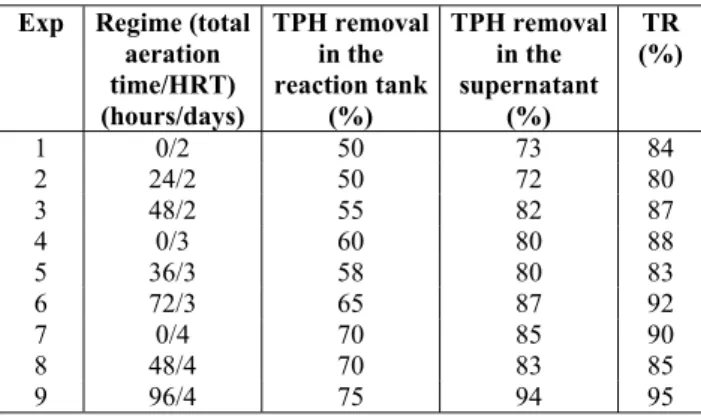
Table 2 shows the average TR and TPH removal in the reaction tank and in the supernatant obtained with different aeration regimes.
Table 2: Results of Regime, TPH removals and TR under different experimental conditions.
Exp Regime (total aeration time/HRT) (hours/days)
TPH removal in the reaction tank
(%)
TPH removal in the supernatant
(%)
TR (%)
1 0/2 50 73 84
2 24/2 50 72 80
3 48/2 55 82 87
4 0/3 60 80 88
5 36/3 58 80 83
6 72/3 65 87 92
7 0/4 70 85 90
8 48/4 70 83 85
9 96/4 75 94 95
TPH Removal in the Reaction Tank
The effluent showed an initial TPH of 7000 ± 400 mg/L. Table 2 shows that the process of constant aeration generally produced the best results for re-moval, with a removal of over 75% for aeration time/HRT of 96/4 (exp.9), followed by values of 65% and 55% for aeration time/HRT of 72/3 (exp.6) and 48/2 (exp.3), respectively.
The experiments without aeration and intermittent aeration demonstrate that, for the same HRT
(experi-ments 1-2, 4-5 and 7-8), the system has a similar behavior, and the results were similar. This is most likely the result of the short period of aeration, which occurred at 6-hour intervals for 30 minutes. How-ever, for this situation (experiments 7 and 8) is inter-esting to note that the amount removed in the reac-tion tank was also 70%. This suggests that low HRT enhances the biodegradation of the effluent by C1
mixed culture.
Vieira et al. (2010, 2012) studied the biodegrada-bility of the same effluent presented in this work in a sequential batch reactor (SBR) tank of 5 L using chitosan, Moringa oleifera and ferric chloride with polyacrylamide as coagulant. In these experiments, the TOC and TPH removals for 4 cycles of operation were: Moringa oleifera (31±1.5% and 28±1.4%), chitosan (82% ± 0.5 and 80 ± 1.0%) and for the com-bination of ferric chloride and polyacrylamide (78.4± 1.0% and 77.1±1.2%), respectively. When compared with the best results obtained in this present study for the aeration regime of 96/4 (Experiment 9, TPH moval in the reaction tank was 75% and COD re-moval was 77%, while in the supernatant the TPH and COD removals were 94% and 95%, respectively. These values demonstrate that the continuous pro-cess is more efficient because the working volume of the reaction tank was 9 L. The initial COD was 6330 ±520 mg/L. The results also show that the bio-degradability of the mixed culture was not impaired by adding chitosan during the experiments. Moreo-ver, this system was operated continuously thereby simulating the actual conditions of a possible treat-ment of contaminated effluent with diesel oil and gasoline. This demonstrates the possibility of operat-ing a pilot scale system to treat large volumes of effluents.
Figure 2 shows the behavior of responses for TPH removal (in the reaction tank and supernatant) and TR as a function of aeration (constant aeration, inter-mittent aeration and a lack of aeration) and HRT of each experiment.
TPH Removal in the Supernatant
ti an p ad co to se m p 2 su re in w su re h th ti th ac d an Biodegrad Crisafully ion of polyc nthracene, a etrochemica dsorption ef oconut shell osan. The l erve as a c molecules, su
olysaccharid 000; Lee et a ubstances ar eleased in th ncrease in TP It is obser with a higher upernatant a emoval of th igher remov hat the large ion. Some of he influence cidic conditi ays that grad nd 4 days wi
dation of Effluent
Brazilian
Fi
et al. (2008 cyclic aroma acenaphthene l wastewater fficiencies f ls > sugar ca literature ind helating age uch as vitam des and mine
al., 2001; Gu re produced b he fermentat PH removal i rved that the r TPH remov and that the hese two cond val in the rea
est HRT pro f this behavio of pH on the ion (pH = 6 dually increa ith values of
Figu
t Contaminated w
Journal of Chem
gure 2: TPH
8) also studi atic hydroca e, naphthale r. Results re followed the ane bagasse dicates that ent for nega mins, protein eral salts (Bo
uibal, 2004) by microorg tion. This m in the sedime lower HRT val in the rea
smallest diff ditions incre action tank. T
ovided great or can also b e supernatan 6) found for ased for the f 6.4 and 6.6,
ure 3: Turbid
with Diesel Oil an
mical Engineering
H removal as
ied the adso arbons (pyre ene) present evealed that
e order: gre > chitin > c chitosan m atively charg ns, fatty aci ssi and Prash . Some of th ganisms and may explain entation tank rate correla action tank a ference in T
ases because This fact sho ter bioremed be explained nt, and the m r the HRT o HRT of 3 d respectively
dity removal
nd Gasoline Using
g Vol. 33, No. 04,
a function o
orp-ene, in the een chi-may ged ids, her, hese are the k. ated and TPH e of ows dia-d by more of 2 days y. Tu to nat (95 Ta a d rel wi 0.5 g/L HR in con jus con wi wi Ra tol wi mo in
as a function
g Chitosan as a N
, pp. 863 - 869,
of HRT and a
urbidity Rem
The turbidit that observe tant (Figure 5%) was fou able 2 shows
decreased T lated to decr ith decreasin 5 g/L in the L at an HRT RT of 4 days turbidity is ncentration o stifies the red It may also nstant aerati ith experime ithout aeratio abus (2001), luene, xylene ithout oxygen ore easily dis
reaction tank
n of HRT and
Natural Coagulant
October - Decem
aeration regim
moval
ty removal ex ed for the T
3). The best und for the
that the decr R. This dec reased VSS p ng HRTs. Th
experiments T of 3 days a s, regardless possibly due observed in duction of TP o be noted t
on presented ents with i on. However for aromatic e and ethylbe
n and are mo spersed, degr ks without ae
d aeration reg
t in a Continuous
mber, 2016
me.
xhibited a be TPH removal value of turb
aeration re rease of the H crease in tur
present in th he values of s at an HRT and, finally, of aeration. e to a decre
the supernat PH with incr that the exp d the best res intermittent r, according c compounds enzene that a ore water-so radation may eration.
gime.
Process 8
ehavior simil l in the supe bidity remov gime of 96/ HRT results rbidity can b he supernata f VSS were of 2 days, 0 0.25 g/L at a
This decrea ase in the ce tant. This al reasing HRT. periments wi sults compare
aeration an to Widdel an s like benzen
are degradab oluble and thu
868 T. V. de Oliveira, S. L. Cardoso, R. B. Vieira, P. A. Vieira and V. L. Cardoso
Brazilian Journal of Chemical Engineering
This behavior was different from that observed by Vieira et al. (2012), where a batch reaction tank with intermittent aeration showed better results. It was noted in this study that, in the continuous process without aeration, the dissolved oxygen concentration was 0.3 mgO2/L. This fact correlates with the
vigor-ous agitation of the medium and the recycle cell, which may also have contributed to the better results with constant aeration for the continuous process under study. Moreover, the continuous process, using a system with activated sludge coagulating agent and chitosan, proved to be very promising for the re-moval of hydrocarbons from wastewater generated in the fuel terminals.
The use of a natural coagulant for the settling had the purpose of obtaining a biodegradable sludge without any other toxic product or heavy metal, in order to ensure the treatment of effluent with hydro-carbons in an environmentally friendly manner.
CONCLUSIONS
The use of chitosan solubilized in HCl proved to be effective in continuous processes, because after 30 days of the process there was no change in the average efficiency of COD and TPH removals. In the continuous process, the best results for removal of TPH and turbidity came from the continuous aera-tion system with a feed flow rate of 1.6 mL / min, which corresponds to the hydraulic residence time of 4 days. In this condition, we obtained turbidity re-moval of 95%, TPH rere-movals of 75% and 94% in the reaction tank and supernatant, respectively, and a VSS concentration of 1.8 g/L in the reaction tank. These results are of interest from an environmental perspective because this process allows the use of biodegradable and natural coagulants for the treat-ment of effluents containing diesel fuel and gasoline, making the treatment sustainable and environmen-tally friendly.
ACKNOWLEDGEMENTS
The authors acknowledge CNPq, CAPES and FAPEMIG (Project TEC-APQ-01859-10), Brazil for financial support.
NOMENCLATURE
CH chitosan (mg/L) TPH total petroleum hydrocarbon TR turbidity removal
HCl hydrochloric acid (mol/L) VSS volatile suspended solids (g/L) HRT hydraulic retention time (days)
REFERENCES
ABNT/NBR 9898, Preservação e técnicas de amos-tragem de efluentes líquidos e corpos receptores, Rio de Janeiro-RJ (1987). (In Portuguese).
Bassi, R., Prasher, S. O. and Simpson, B. K., Re-moval of selected metal ions from aqueous solu-tions using chitosan flakes. Separation Science and Technology, 35, 547-560 (2000).
Bielicka, K., Kaczorek, E., Olszanowski, A. and Voelkel, A., Examination of biodegradation of hy-drocarbons in emulsified systems. Polish Journal of Environmental Studies, 11(1), 11-16 (2002). Crisafully, R., Milhome, M. A. L., Cavalcante, R. M.,
Silveira, E. R., De Keukeleire, D. and Nascimento, R. F., Removal of some polycyclic aromatic hydro-carbons from petrochemical wastewater using low-cost adsorbents of natural origin. Bioresource Technology, 99(10), 4515-4519 (2008).
Gogoi, B. K., Dutta, N. N., Goswami, P. and Mohan, T. K., A case study of bioremediation of petro-leum-hydrocarbon contaminated soil at a crude oil spill site. Advances in Environmental Re-search, 7(4), 767-782 (2003).
Grishchenkov, V. G., Townsend, R. T., McDonald, T. J., Autenrieth, R. L., Bonner, J. S. and Boronin, A. M., Degradation of petroleum hydrocarbons by facultative anaerobic bacteria under aerobic and anaerobic conditions. Process Biochemistry, 35(9), 889-896 (2000).
Guibal, E., Interactions of metal ions with chitosan-based sorbents: A review. Separation and Purifica-tion Technology, 38(1), 43-74 (2004).
Saleh-Lakha, S., Miller, M., Campbell, R. G., Schnei-der, K., Elahimanesh, P., Hart, M. M. and Trevors, J. T., Microbial gene expression in soil: methods, applications and challenges. Journal of Microbio-logical Methods, 63(1), 1-19 (2005).
Lee, S. T., Mi, F. L., Shen, Y. J. and Shyu, S. S., Equilibrium and kinetic studies of copper (II) ion uptake by chitosan-tripolyphosphate chelating resin. Polymer, 42(5), 1879-1892 (2001).
Díaz, M. P., Grigson, S. J., Peppiatt, C. J. and Bur-gess, J. G., Isolation and characterization of novel hydrocarbon-degrading euryhaline consortia from crude oil and mangrove sediments. Marine Bio-technology, 2(6), 522-532 (2000).
enzy-Biodegradation of Effluent Contaminated with Diesel Oil and Gasoline Using Chitosan as a Natural Coagulant in a Continuous Process 869
Brazilian Journal of Chemical Engineering Vol. 33, No. 04, pp. 863 - 869, October - December, 2016
matic preparation produced by Penicillium re-strictum in activated sludge systems treating wastewater with high levels of oil and grease. En-vironmental Engineering Science, 23(5), 814-823 (2006).
Standard Methods for the Examination of Water and Wastewater. 20th Ed. (1998).
Townsend, G. T., Prince, R. C. and Suflita, J. M., Anaerobic biodegradation of alicyclic constitu-ents of gasoline and natural gas condensate by bacteria from an anoxic aquifer. FEMS Micro-biology Ecology, 49(1), 129-135 (2004).
Vieira, R. B., Vieira, P. A., Cardoso, S. L., Ribeiro, E. J. and Cardoso, V. L., Sedimentation of mixed cultures using natural coagulants for the treatment of effluents generated in terrestrial fuel distribu-tion terminals. Journal of Hazardous Materials, 231, 98-104 (2012).
Vieira, R. B., Vieira, P. A., Ribeiro, E. J. and Car-doso, V. L., The sedimentation of mixed cultures used in the treatment of effluents generated from terrestrial fuel distribution terminals. Journal of Hazardous Materials, 184(1), 177-183 (2010). Vieira, P. A., Faria, S., Vieira, R. B., De Franca, F. P.
and Cardoso, V. L., Statistical analysis and opti-mization of nitrogen, phosphorus, and inoculum concentrations for the biodegradation of petro-leum hydrocarbons by response surface meth-odology. World Journal of Microbiology and Bio-technology, 25(3), 427-438 (2009).
Vieira, P. A., Vieira, R. B., Faria, S., Ribeiro, E. J. and Cardoso, V. L., Biodegradation of diesel oil and gasoline contaminated effluent employing in-termittent aeration. Journal of Hazardous Mate-rials, 168(2), 1366-1372 (2009).
Vieira, P. A., Vieira, R. B., De França, F. P. and Car-doso, V. L., Biodegradation of effluent contami-nated with diesel fuel and gasoline. Journal of Hazardous Materials, 140(1), 52-59 (2007). Wibowo, S., Velazquez, G., Savant, V. and Torres, J.
A., Effect of chitosan type on protein and water recovery efficiency from surimi wash water treated with chitosan–alginate complexes. Biore-source Technology, 98(3), 539-545 (2007). Widdel, F. and Rabus, R., Anaerobic