RESUmo
Objeivou-se avaliar o conhecimento, a ai-tude e a práica de presidiárias quanto ao uso do preservaivo masculino e feminino como medida preveniva às DST/HIV. Pesqui-sa quanitaiva e avaliaiva do ipo Conheci-mento, Aitude e Práica (CAP), envolvendo 155 presidiárias. A coleta de dados realizou--se de janeiro a março de 2010 na peniten-ciária feminina do estado do Ceará. Embora ivessem ouvido falar e/ou soubessem as inalidades do uso, apenas 35 mulheres (22,6%) inham conhecimento adequado so-bre o preservaivo masculino e 11 (7,1%) a respeito do feminino. As aitudes foram me-nos favoráveis quanto ao uso no sexo oral. A práica adequada apresentou pouca repre-sentaividade, em especial, do feminino. A homo/bissexualidade, as questões de gêne-ro, a falta de conhecimento e o diícil acesso aos preservaivos representaram obstáculos a serem considerados na promoção da saú-de sexual do grupo estudado.
DEScRIToRES
Mulheres Prisioneiros Preservaivos
Prevenção de doenças transmissíveis Conhecimentos, aitudes e práica em saúde Enfermagem
Knowledge, attitude and practices regarding
condom use among women prisoners: the
prevention of STD/HIV in the prison setting
O
riginal
a
r
ticle
AbSTRAcT
The objecive of this study was to evalu-ate the knowledge, aitude and pracices of women prisoners regarding the use of female and male condoms as a means of prevenion against STD/HIV. This quanita-ive and evaluaquanita-ive Knowledge, Aitude and Pracice (KAP) study included 155 fe-male prisoners. Data collecion was per-formed between January and March 2010 at the State of Ceará Women’s Peniteniary. Although the women had heard of and/ or knew about the purposes of the use of condoms, only 35 (22.6%) had appropriate knowledge regarding male condoms, and 11 (7.1%) in regards to the use of female con-doms. Their aitudes were less favorable regarding oral sex. Appropriate pracice was not signiicantly representaive, paricularly regarding the female condom. Homo/bisex-uality, gender issues, lack of knowledge, and the diicult access to condoms are obstacles that must be considered in the promoio
DEScRIPToRS
Women Prisoners Condoms
Communicable disease prevenion Health knowledge, aitudes, pracice Nursing
RESUmEn
Se objeivó evaluar el conocimiento, la ac-itud y la prácica de presidiarias respecto del uso del preservaivo masculino y feme-nino como medida preveniva a las DST/ HIV. Invesigación cuanitaiva, evaluatoria del ipo Conocimiento, Acitud y Prácica (CAP), involucrando 155 presidiarias. Datos recogidos de enero a marzo 2010 en la cár-cel femenina del Estado de Ceará. Aunque hubiesen oído hablar y/o supiesen la ina-lidad del uso, apenas 35 mujeres (22,63%) tenían conocimiento adecuado sobre el preservaivo masculino y 11 (7,1%) sobre el femenino. Las acitudes fueron menos fa-vorables respecto al uso en el sexo oral. La prácica adecuada presentó escasa repre-sentaividad, especialmente del femenino. La homo/bisexualidad, las cuesiones de género, la falta de conocimiento y el diícil acceso a los preservaivos representaron obstáculos a ser considerados en la promo-ción de la salud sexual del grupo estudiado.
DEScRIPToRES
Mujeres Prisioneros Condones
Prevención de enfermedades transmisibles Conocimientos, acitudes y prácica en salud Enfermería
Ana Izabel oliveira nicolau1, Samila Gomes Ribeiro2, Paula Renata Amorim Lessa3,
Alana Santos monte4, Elizian braga Rodrigues bernardo5, Ana Karina bezerra Pinheiro6 ConheCimento, atitude e prátiCa do uso de preservativos por
presidiárias: prevenção das dst/hiv no Cenário prisional
ConoCimiento, aCtitud y práCtiCa del uso de preservativos por presidiarias: prevenCión de las dst/hiv en el ámbito penitenCiario
1ph.d. student in nursing, universidade Federal do Ceará. assistant professor, undergraduate nursing program, universidade Federal do piauí. Fortaleza,
Ce, brazil. [email protected] 2master’s student in nursing, universidade Federal do Ceará. Fortaleza, Ce, brazil. [email protected].
br 3master’s student in nursing, universidade Federal do Ceará. Fortaleza, Ce, brazil. [email protected] 4undergraduate nursing student,
universidade Federal do Ceará. Grantee, tutorial education program / meC-sesu. Fortaleza, Ce, brazil. [email protected] 5undergraduate
nursing student, universidade Federal do Ceará. Grantee, tutorial education program / meC-sesu. Fortaleza, Ce, brazil. [email protected]
InTRoDUÇÃo
As a product of social construcion, violence has in-creased criminality in small and large centers around the world. Historically, the male gender has been more associ-ated with crime and represents a majority of prisoners in Brazil, so that women’s share in the prison scenario cor-responds to 5.31%(1). Despite their smaller share, women are more vulnerable to the physical and psychological problems inherent in the prison context(2).
The social representaion of female criminals tends to be that of a young woman, of low socioeconomic and edu-caional level, unemployed, prositute, single or divorced, from urban centers and with deicient access to health services, who were mostly arrested for drugs traic(2).
In combinaion with this unfavorable proile, the pris-on envirpris-onment ofers greater exposure to physical and psychological risks and infecious disease transmission, so that prison populaions, in any part of the
world, tend to need further health care(3). Few studies exist, however, about wom-en’s health problems and prevenion forms in Brazilian prisons, more speciically of Sex-ually Transmited Diseases (STD)/HIV, which are more prevalent problems in the occur-rence and adopion of risk behaviors among prisoners than in the general populaion(4).
The main risk factors that further the dis-seminaion of these illnesses among female prisoners include: promiscuity and sexual abuse, bi/homosexual aciviies, cell over-crowding, drugs use, tatoos and body pierc-ing, low usage level of condoms in sexual in-tercourse, prosituion and history of STD. In Brazil, sexual intercourse remains the main HIV transmission route among prisoners(5-6).
The combinaion of all menioned
as-pects with female biological characterisics, gender in-equality, sigma and discriminaion enhance female prisoners’ vulnerability to STD/HIV. Moreover, the major-ity comes from socially marginalized groups, with greater probabiliies of having sufered gender violence or having a history of unprotected sexual behavior(7).
In Brazil, unprotected sexual acivity is considered the most signiicant risk factor for STD/HIV transmission in prisons, which makes condom use in sexual relaions fundamental for prevenion in the prison system. The relevance of STD/HIV prevenion in prisons is empha-sized in the Naional Prison System Health Plan (PNSSP), which establishes STD/HIV/aids diagnosis, counseling and treatment acions, condom distribuion to prisoners and workers, elaboraion of educaion and instrucion mate-rial, speciic drugs supplies, as well as STD diagnosis and treatment acions according to the syndromic approach(8).
Despite the establishment of so many acions for im-plementaion by the health teams in the PNSSP, including the nursing team, the non-adopion of condoms as a pre-venion measure remains a constant among female pris-oners, whether on the occasion of inimate visits or during illegal relaions inside the cells(7-9).
Therefore, further atenion to the health promoion of female prisoners is fundamental, not only because of the risks present in the prison context, but also due to the lack of prevenive acions in the prison health system. This panorama and relecions on nurses’ role to disseminate their aciviies involving sigmaized populaions, in this case as members of the PNSSP, aroused our interest in de-veloping this study.
In view of the inluence of knowledge and the per-ceived importance of adoping prevenive measures in health (aitude) on the transformaion and development of personal skills to conquer health promoion, the
rele-vance of answering the following quesion is understood: what is the knowledge, aitude and pracice of female prisoners concerning the use of male and female condoms as an STD/HIV prevenion measure?
Invesigaing the three components men-ioned will indicate the diagnosic conjunc-ture about what the prisoners know, think and pracice in terms of condom use. This as-sessment provides support for the develop-ment of future policies and educaive strate-gies to facilitate the approach of STD/HIV in a disinguished way and in line with the singu-lariies of the group under analysis.
obJEcTIVE
The aim is to assess the knowledge, at-itude and pracice of female prisoners to-wards the use of male and female condoms as an STD/HIV prevenion measure.
mETHoD
This is a cross-secional Knowledge, Aitude and Prac-ice (KAP) assessment study with a quanitaive approach. KAP surveys are part of a category of assessment research, called formaive assessment, i.e. besides obtaining data on a speciic populaion, these studies idenify possible routes for a more efecive future intervenion. It can be adapted to diferent contexts with a view to the strategic planning of health promoion intervenions(10).
The research context was the female peniteniary in the State of Ceará. This insituion is located in Aquiraz – CE, can received 300 prisoners and is being restructured with a view to compliance with the PNSSP. It is already of-fering a health team (nurse, nursing technicians, general Few studies exist,
about women’s health problems and
prevention forms in brazilian prisons,
more speciically of
sexually transmitted diseases (std)/ hiv, which are more
prevalent problems in the occurrence and adoption of risk
behaviors among prisoners than in the
clinician, pediatrician, gynecologist, denist, denistry aid, social worker and psychologist) and an outpaient clinic.
The study populaion considered women imprisoned at the insituion during data collecion, excluding cases of cogniive limitaions that would impede informaion provision for data collecion purposes. Applying the cal-culaion for inite populaions, the sample resulted in 155 women, based on a populaion size of 258 prisoners, with a 95% conidence interval, 0.05 maximum permited error and 50% prevalence level.
Data collecion took place between January and March 2010. Iniially, the researchers and prison agents held a campaign to disseminate the study across the insituion, which took about one week. Thus, on the informaion col-lecion days, the prison guards escorted the women who had previously manifested their interest from the cells and work places inside the insituion to the school in groups of ive. Individual interviews were held in the classrooms located inside the peniteniary.
The instrument used irst addressed socio-demo-graphic characterisics. Next, the KAP survey was applied (Atachment A), concerning male and female condoms as an STD/HIV prevenion method. This instrument was adapted from a KAP model on colon cancer prevenion(11). In this study, the knowledge, aitude and pracice con-cerning male and female condoms as STD/HIV prevenion methods were assessed as follows:
a)Knowledge
- Adequate: having heard about the male and female
condom, knowing that they serve to prevent STD/HIV in general and unwanted pregnancy and being able to men-ion at least three forms of care needed for the correct use of each method;
- Inadequate: never having heard about the male or female condom or having heard, but not knowing that they serve to prevent STD/HIV; or when the respondent could not menion at least three forms of care needed for the correct use of the methods.
b) Aitude:
- Adequate: when the women menion that using the male or female condom is always necessary in all sexual pracices;
- Inadequate: when the women indicate that using the male or female condom is unnecessary, hardly necessary or not having an opinion on its need.
c) Pracice:
- Adequate: when the women indicate that they al-ways use the male or female condom from the beginning unil the end of the sexual pracices performed; no un-wanted pregnancies; no diagnosis of STD since their insi-tuionalizaion.
- Inadequate: when the women indicate that they do not always or never use the male or female condom in sexual pracices, or when they indicate that they do not always use a condom from the beginning unil the end of sexual pracices; unwanted pregnancy or diagnosis of STD since their insituionalizaion.
Data were compiled using Staisical Package for the Social Sciences(SPSS) version 17.0 and then organized in the form of tables with absolute and relaive frequencies. Then, knowledge and aitude variables were compared with male or female condom usage pracice for STD/HIV prevenion. Pearson’s Chi-square test was used for staisi-cal associaions.
The prisoners were verbally invited to paricipate in the research and received clariicaions about the aims and procedures involved. Acceptance was formalized through the signing of an informed consent term, using the prisoner’s signature or ingerprint. Ethical aspects of research involving human beings were complied with, in accordance with Naional Health Council Resoluion No. 196, issued in 1996(12). The project received approval from the Research Ethics Commitee at UFC, under protocol No. 229/09.
RESULTS
The socio-demographic characterisics pointed to-wards a young populaion, with a mean age of 29.4 years, mostly single 70 (45.2%), and who are being tried for drugs traic 82 (52.8%), thet 31 (20%) and robbery 26 (16.7%).
Data on the educaional level revealed that more than half of the paricipants (88, i.e. 56.8%) did not inish Pri-mary Educaion. Moreover, the maximum educaion level for 115 (74.2%) was completed primary educaion.
The analysis of their previous occupaion before they were imprisoned showed a populaion that especially had non-remunerated or low-paid jobs (domesic servant, saleswoman and cleaning aid). About 13% were unem-ployed and 87 (56.1%) menioned a monthly income of one minimum wage at most.
Knowledge
Thus, the analysis of informaion sources indicated health professionals, school and television/radio as the main orientaion means, which demonstrates the need to improve the quality of these professionals’ care and to put in pracice new health educaion strategies, whether at health services, school or in the media.
When asked about the reasons for using the male con-dom, 138 paricipants (84.5%) considered STD/HIV and unwanted pregnancy prevenion as the main goal. It is highlighted that, in total, 153 women (98.7%) menioned the protecive funcion against STD/HIV, and that only 2 (1.3%) did not know the purpose of the male condom. In the analysis of the reasons for using the female condom, on the other hand, 109 (70.4%) airmed that it serves to prevent STD/HIV and unwanted pregnancy, but the num-ber of women who could not menion any funcion of the female condom was about ten imes higher than that of women unfamiliar with the funcions of the male condom. The inal phase of the knowledge assessment involved the descripion of at least three care forms needed for the adequate use of the methods involved. Sixty-eight (43.9%) of the women could not menion any form of care with male condom use, and only 35 (22.6%) demonstrated suf-icient knowledge to describe three adequate care forms. Greater diiculies appeared in the descripion of female condom use, so that only 12 (7.1%) were able to indicate three care forms, i.e. 14.9% less than those who managed to describe male condom care. Almost all women, i.e. 130 (83.9%) were unable to describe any care form, which means 40% more women were unfamiliar with care for female condom use than with male condom use. The analysis indicated that 87 prisoners (56.1%) man-aged to menion some correct care form for male condom use, against only 25 (16.1%) for the female variant.
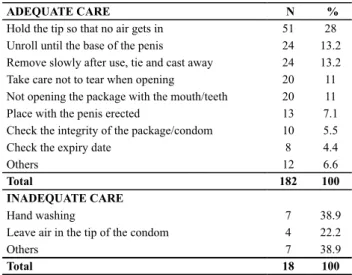
A range of care forms was described, from measures to be taken before opening the package unil ater usage.
Among inadequate care, hand washing was the most
frequent, and was menioned 7 imes (38.9%). The impor-tance of hand washing as a hygiene and protecion habit is well known, but it was classiied as inadequate, because it does not represent a necessary measure to use the method. Care described for using the female condom is dis-played in Table 2.
Table 1 – Distribution of care mentioned for adequate male con-dom use among female prisoners in Ceará - Aquiraz, CE – 2010
ADEQUATE CARE N %
Hold the tip so that no air gets in 51 28 Unroll until the base of the penis 24 13.2 Remove slowly after use, tie and cast away 24 13.2 Take care not to tear when opening 20 11 Not opening the package with the mouth/teeth 20 11 Place with the penis erected 13 7.1 Check the integrity of the package/condom 10 5.5
Check the expiry date 8 4.4
Others 12 6.6
Total 182 100
INADEQUATE CARE
Hand washing 7 38.9
Leave air in the tip of the condom 4 22.2
Others 7 38.9
Total 18 100
The descripion of the care menioned for using male condoms is displayed in Table 1.
Table 2 - Distribution of care mentioned for adequate male con-dom use among female prisoners in Ceará - Aquiraz, CE - 2010
ADEQUATE CARE N %
When placing, form an eight with the mobile ring 17 29.9 Introduce the mobile ring until the end of the vagina 12 21
When removing, irst twist and then pull 5 8.7
Not opening the package with the mouth/teeth 4 7 Place the ring externally to protect against illnesses 4 7 The female condom should cover the uterine colon 3 5.3 Check the integrity of the package/condom 3 5.3
Discard after usage 3 5.3
Others 6 10.5
Total 57 100
INADEQUATE CARE
When removing, pull without twisting 2 66.7
Hand washing 1 33.3
Total 3 100
Reports on the placement phases showed the most prevalent care forms. The prisoners menioned the care needed to open the package, check the integrity of the package and female condom, correct posiioning in the body and how to proceed ater use with lower frequency levels. Only three care forms were considered inadequate, as two women menioned that, when removing the fe-male condom, it should not be twisted to contain the seminal luid and facilitate its removal.
Aitude
The assessment of aitudes towards the need to use the male condom always and in all types of sexual pracic-es (oral, vaginal, anal) rpracic-esulted in 95 paricipants (61.3%) with adequate aitudes.
The most adequate aitude was perceived during the vaginal coitus, as only 5 (3.2%) considered it hardly neces-sary, 2 (1.3%) unnecessary and 11 (7.1%) did not opine. The aitude showed to be less posiive in answers con-cerning opinions about use during anal and oral sex. This, in turn, showed the largest number, 13 (8.4%), of asser-ions about the unnecessary use of the male condom, while 29 (18.7%) had no opinion.
Pracice
The analysis of condom use pracices showed less fa-vorable results than for the knowledge and aitude com-ponents. This asserion was based on the fact that only 29 women (18.7%) revealed adequate male condom pracic-es, i.e. they use it always, in all sexual relaions, from the start unil the end. The female condom usage situaion was even more negaive, as only two paricipants (1.3%) used it adequately.
Concerning usage consistency, 31 women (20%) used the male condom always in all sexual pracices, and two (1.3%) consistently used the female condom. The remain-ing women either did not use it always in all pracices or never used it, paricularly the female condom.
To invesigate how STD/HIV prevenion acions are be-ing developed at the research insituion, the paricipants were asked about how they received condom, at what in-terval and orientaions about usage.
The collected data showed that 63 women (40.6%, less than half) received condom use orientaions inside the prison. Among those who received some orientaion, the main sources were: educaive aciviies 23 (36.5%), nurse 19 (30.1%) and physician 8 (12.7%). These data are a source of concern, as only 19 (12.2%) out of 155 women received nursing and 8 (5.1%) medical orientaions, which demonstrates the urgent need to strengthen health edu-caion in the prison context.
Informaion about condom recepion showed that 98 (63.2%) do not get them at the insituion. Among those
who do, 15 (26.3%) airmed that they receive them exclu-sively on celebraion dates, 14 (24.5%) every two weeks, in this case women receiving inimate visits, 9 (15.7%) rarely and 5 (8.7%) only when condoms are let from other prisoners or when they ask for them. None of the paricipants menioned receiving female condoms at the insituion.
Among the main referred reasons for not using the male condom, homosexuality stands out with 36 (29%). Next are the two main botlenecks for the consistent use of the prevenion device, which is trust in the sexual part-ner, 34 (27.4%) and the fact that the man does not agree to use it, 31 (25%).
As for the diiculies menioned to use the female condom, the main reason is related to knowledge, as 52 (34%) indicated they did not know this device, airming the weakness of sexual health promoion acions. Other unfavorable reasons were never having taken any inter-est, with 14 (9.1%) and access diiculies with 11 (19.2%). Lack of knowledge, interest and perceived vulnerability aggravate access diiculies even further.
Associaions among (KAP) components
The analysis of Table 3 reveals that, despite the non-signiicant associaion (p>0.05) among the KAP compo-nents, women with adequate knowledge showed higher adequate aitude percentages for both condom types. The adequacy of knowledge and aitudes was not associ-ated with adequate pracices though, neither for the male nor for the female variant.
Table 3 – Association among adequacy of knowledge, attitude and practice for male and female condom usage among female prisoners in Ceará - Aquiraz, CE - 2010
VARIABLES
Total ADEQUATE ATTITUDE ADEQUATE PRACTICE
Adequate knowledge N(%) P N(%) P
Male condom 35 21 (60) 0.859 6 (17.1) 0.878
Female condom 11 6 (54.5) 0.608 - 0.694
Adequate attitude Total ADEQUATE KNOWLEDGE ADEQUATE PRACTICE
N(%) P N(%) P
Male condom 95 21(22.1) 0. 859 19 (20.0) 0.546
Female condom 73 6 (8.2) 0.608 2 (2.7) 0.131
DIScUSSIon
The condom is one of the most disseminated and known contracepive and STD prevenion methods, but correct use and adequate knowledge on how to use it are not as frequent as the fact of “having heard about it”(13). The weak knowledge about male and female condoms among the study paricipants relects the inefeciveness of how orientaions are being provided.
The orientaions ofered at health services, as well as in other environments, should go beyond the supericial,
which requires professional preparaion and skills to truly provide health educaion. Health professionals’ compe-tency should include orientaion, informaion and com-municaion skills(14).
be accompanied by prevenion, sensiizaion and educa-ion programs for the prisoners(9). The Ministry of Health recommends that Brazilian peniteniaries maintain per-manent informaion services for prisoners and relaives with a view to STD/HIV prevenion, ofering condoms and support needed for safe sexual pracices(8).
While diiculies are faced to put the guidelines in pracice, reality shows that women have less access to health services in the peniteniary system in comparison with imprisoned men. Health educaion material, besides informaion and services, including those focused on HIV and drugs addicion, are oten more limited at female than at male prison units(7).
Also concerning the knowledge invesigaion, the distribuion of indings about the reasons for using the condoms is similar to a populaion-based study of 3,542 people, male and female, living in Pelotas. The authors concluded that more than 75% of the women were fa-miliar with the condom as a protecion factor against ill-nesses and/or aids. Despite knowing its main funcion, when they use it, they indicate contracepion as a jusii-caion(15). Condoms can be efecive to prevent both preg-nancy and STD/HIV. Although they do not guarantee “to-tally safe sexual relaions”, condoms substanially reduce individual STD/HIV risks, provided that they are used cor-rectly in all types of sexual intercourse(16).
Mastering care for condom use is fundamental to promote safe and efecive pracice. Couples need to be oriented on the phases that guarantee the best possible use. Therefore, health professionals need to use educa-ive technologies to reach posieduca-ive results for the develop-ment of personal skills for the managedevelop-ment and handling of this contracepive and prevenive method.
The female prevenion arifact involves women’s ini-mate contact with their genital organ, a condiion that re-duces interest in the method. Knowing this, professionals should adopt strategies to arouse curiosity and encourage them. Mastering the placement steps is essenial, as the method enhances autonomy, increases self-esteem, fur-thers negoiaion ability and expands their decision-mak-ing skills(17).
Condom use is a complex behavior that involves val-ues and opinions as well as afecive and sexual aspects. Posiive aitudes enhance the populaion’s interest in the search to adopt healthy pracices. Although knowledge and aitude are not suicient to transform and maintain behaviors, the importance of these elements as parts of the empowerment process in health is well known.
The deeper analysis of aitudes towards condom use always and in all sexual pracices showed less perceived vulnerability during oral pracice. The populaion needs to be informed that STD/HIV can be transmited or acquired during any sexual act, but some acts are more risky than others.
Vaginal sex is risky for both partners when no condom is used, due to the luid exchange. Anal sex entails a great risk of STD/HIV transmission, as the anus and rectum are covered with mucous issue rich in blood vessels, which can be injured during the penetraion. The risk of HIV in-fecion is ive imes higher in unprotected recepive anal sex than in unprotected recepive vaginal sex. Oral sex is considered of lesser risk(16).
Longitudinal acions to monitor changes in opinions on the adopion of prevenive measures are not a reality at health services. Educaive aciviies to increase knowl-edge are widely disseminated, but take place punctually, without discerning the need for a coninuous process of evaluaion and re-adaptaion of strategies to achieve at-itude transformaions and true empowerment. The chal-lenge is to permit the fact that health educaion repre-sents a process that combines the ariculaion between knowledge and values, but that extends to their efect in aitudes and health pracices.
To put in pracice the prevenive methods involved, the need for correct and consistent use needs to be em-phasized, with a view to their efeciveness to reduce STD/ HIV transmission risks. Their availability should be incor-porated into health service rouines, accompanied by ad-equate orientaions. These acions extend to the prison environment, which demands not only available preven-ion inputs from the team, but also preparapreven-ion to orient on correct and safe use. It is highlighted that one of the goals of the PNSSP is to ofer condoms to 100% of prison-ers and 60% of prison guards(8).
The data obtained in the analysis of the pracical component showed that the way acions are being put in pracice to reach the established goal is not suicient to guarantee pracice. One possible route could be the World Health Organizaion’s suggesion, according to which condoms need to be easily accessible in diferent place in prisons, so that the prisoners do not have to ask and can get them without guards or other prisoners see-ing them(9).
The diiculies found concerning adequate condom pracice in this study are similar to other studies that also involved prison populaions. In Goiânia, in a sample of 82 prisoners, 54% indicated occasional and 20.7% rare use(13). A study in São Paulo, involving 299 female prisoners, inferred that the non-use of condoms in the previous year during sexual intercourse with men was observed in 95 of them (60%), while the others menioned irregular use. None of them reported regular use or use during sex with women(6).
Among the alleged reasons for not using condoms, the occurrence of homosexual women stands out. The lack of risk percepion makes it diicult to include the condom in sex between women. The male condom should be further valued, especially when sharing eroic accessories, while the female variant would be more applicable, as it decreas-es direct contact with secreions and possible ulceraions while handling these devices, and also during oral sex(19).
It should be guaranteed that the contents of educaive programs for the prison populaion addresses issues re-lated to discriminaion concerning aids, homophobia, the sigma associated with partners of the same sex, as well as with discriminaion through prosituion and drugs use(3).
Another limitaion of the method for women is the de-pendence on use by the partner, afecing their right to a free choice when he does not accept to use it. In this context, there is an increasing need to ofer the female condom as a way to expand protecion possibiliies and decrease gender inequaliies(17). The Ibope survey results showed the predominance of no condom use in the most recent sexual intercourse in 30.2% due to trust in the part-ner and 22.8% because they are married or have (a) ixed partner(s)(18). Negoiaion diiculies, fear of provoking trust in the partner and loss of the relaionship’s structure are social, personal and cultural risks many women are not willing to take(20), which can represent further obsta-cles for condom use than lack of knowledge.
What aggravates this situaion even further is that the afecive relaions female prisoners experience are some-imes marked by afecive dependence, conformism and hiding or even out of fear of the partners’ rejecion. Ac-cording to them, maintaining the partner’s support is sill important to guarantee emoional and inancial support as, someimes, it is the only form of support they have at their disposal(21).
The results described under the associaion between KAP components once again appoint the fragility of con-dom use promoion acions and strategies in the prison insituion under analysis. The fact that individuals have knowledge and posiive aitudes facilitates but does not guarantee the adopion of prevenive behaviors, espe-cially without appropriate support and condiions to en-hance this behavioral change and maintain pracice. The irregular distribuion to prisoners without inimate visits, diiculies concerning access and the sexual partner’s ac-ceptance of condom use can represent botlenecks for consistent condom use in relaions inside the prison en-vironment, which hampers the direct inluence of knowl-edge and aitudes.
concLUSIon
The socio-demographic proile found pictures many young Brazilians living in situaions of lost family, social and economic structure. The weakness of public policies to guarantee high-quality educaion, housing, leisure, food and professional qualiicaion make it diicult for many people to achieve quality of life and ascend in soci-ety. The vulnerabiliies characterisic of youth, ariculated with a life that does not envisage a promising future, cata-lyze criminality in the country.
As for knowledge about condoms, the supericiality of this component was veriied. In view of fragile informa-ion, relecion is due about the knowledge enhancement strategies the main referred sources (health profession-als, school, media) provide. Acions to promote sexual and reproducive health among female prisoners should not remain restricted to gynecological consultaions and condom distribuion. Insituional spaces like the school, work places, the recreaion area, as well as the cells, should be beter used for the development of educaion groups, based on paricipatory, dialogical and processual knowledge construcion.
The dialogical process should mainly involve aitude changes. In view of this premise, the evaluaion study di-agnosed less favorable aitudes towards female condom use and the use of male and female prevenive barriers during oral sex. These indings indicate situaions that should be taken into account in skills development for STD/HIV prevenion in the group under analysis.
Adequate condom pracice was hardly representaive, especially considering the female condom, mainly due to inconsistent use, in view of the barriers found for ad-equate pracice, strategic acion planning to prevent STD/ HIV in female prisons should address the gender issues that make women historically vulnerable, the occurrence of homosexual relaions and their restricted knowledge on health care, perhaps due to a history of few educaion-al opportuniies.
REFEREncES
1. Brasil. Ministério da Jusiça; Sistema Penitenciário do Brasil. Informações Penitenciárias: dados consolidados. Brasília; 2008.
2. Carvalho ML, Valente JGA, Assis SG, Vasconcelos AGG. Peril dos internos no Sistema Prisional do Rio de Janeiro: especiici-dades de gênero no processo de exclusão social. Ciênc Saúde Coleiva. 2006;11(2):461-71.
3. Organização Mundial da Saúde (OMS). HIV/Aids em ambien-tes prisionais: prevenção, atenção, tratamento e apoio. Marco referencial para uma resposta nacional eicaz. Genebra; 2005.
4. Dorfey ES, Meneses RS, Viana JM, Oliveira GN. Infecções sexu-almente transmissíveis: um estudo entre mulheres encarcera-das de uma cidade do oeste baiano. Rev Digital Pesquisa CON-QUER [Internet]. 2008 [citado 2010 dez. 13];3. Disponível em: htp://www.fasb.edu.br/revista/index.php/conquer/aricle/ viewFile/89/66
5. Strazza L, Azevedo RS, Boccia TMQR, Carvalho HB. Vulnerabi-lidade à infecção pelo HIV entre mulheres com alto risco de exposição: menores infratoras e detentas do estado de São Paulo, Brasil. J Bras Doenças Sex Transm. 2005;17(2):138-42.
6. Strazza L, Massad E, Azevedo RS, Carvalho HB. Estudo de com-portamento associado à infecção pelo HIV e HCV em deten-tas de um presídio de São Paulo, Brasil. Cad Saúde Pública. 2007;23(1):197-205.
7. Nações Unidas. Escritório sobre Drogas e Crimes. A mulher e o HIV em ambientes prisionais. Vienna; 2009.
8. Brasil. Ministério da Saúde. Departamento de Ações Pro-gramáicas Estratégicas. Plano Nacional de Saúde no Sistema Penitenciário (PNSSP) [Internet]. Brasília; 2005 [citado 2010 nov. 16]. Disponível em: htp://bvsms.saude.gov.br/bvs/pub-licacoes/plano_nacional_saude_sistema_penitenciario_2ed. pdf
9. World Health Organizaion (WHO). Women’s health in prison: correcing gender inequity in prison health. Geneva; 2009.
10. Brasil. Ministério da Educação; Insituto Nacional do Desen-volvimento da Educação. Manual do aplicador do estudo CAP. Brasília; 2002.
11. Brenna SMF, Hardy E, Zeferino LC, Namura I. Conhecimento, aitude e práica do exame de Papanicolaou em mulheres com câncer de colo uterino. Cad Saúde Pública. 2001; 17(4):909-14.
12. Conselho Nacional de Saúde. Resolução n. 196, de 10 de outubro de 1996. Dispõe sobre diretrizes e normas regula-mentadoras de pesquisas envolvendo seres humanos. Bioé-ica. 1996;4(2 Supl):15-25.
13. Sousa AO, Pereira GS, Souza GE, Teles AS. Avaliação do conhecimento, comportamentos de risco e adesão à vacina contra hepaite B em reeducandos da cidade de Goiânia, GO. Ciênc Cuid Saúde. 2005;4(3):250-8.
14. Moura ERF, Silva RM. Competência proissional e assistência em aniconcepção. Rev Saúde Pública. 2005;39(5):795-801.
15. Paniz VMV, Fassa AG, Silva MC. Conhecimento sobre an-iconcepcionais em uma população de 15 anos ou mais de uma cidade do Sul do Brasil. Cad Saúde Pública. 2005; 21(6):1747-60.
16. Organização Mundial de Saúde (OMS); Departamento de Saúde Reproduiva e Pesquisas. Um manual global para pro-issionais e serviços de saúde: orientações baseadas em evi-dência cieníica. Genebra; 2007.
17. Oliveira NS, Moura ERF, Guedes TG, Almeida PC. Conhe-cimento e promoção do uso do preservaivo feminino por proissionais de unidades de referência para DST/HIV de Fortaleza-CE: o preservaivo feminino precisa sair da vitrine. Saúde Soc. 2008;17(1):107-16.
18. Paiva V, Venturi G, França Junior I, Lopes F. Uso de preserva-ivos: Pesquisa Nacional MS/IBOPE. Brasília; 2003.
19. Almeida G. Argumentos em torno da possibilidade de in-fecção por DST e Aids entre mulheres que se autodeinem como lésbicas. Physis Rev Saúde Coleiva. 2009;19(2):301-31.
20. Silva CM, Vargens OMC. Women’s percepion about female vulnerability to STD and HIV. Rev Esc Enferm USP [Inter-net]. 2009 [cited 2010 Nov 16];43(2):401-6. Available from: htp://www.scielo.br/pdf/reeusp/v43n2/en_a20v43n2.pdf