Article/Artigo
1. Department of Zoology, Universidade Anhanguera, Campo Grande, MS, Brazil. 2. Department of Dermatology, Faculdade de Medicina de Botucatu, Universidade Estadual Paulista, Botucatu, SP, Brazil.
Address to: Dr. Geovane Cândido da Silva. UNIDERP. Rua Alexandre Herculano 1400, Jardim Veraneio, 79037-280 Campo Grande, MS, Brasil.
Phone 55 14 3882-4922 e-mail: [email protected] Received in 13/05/2010 Accepted in 21/07/2010
INTRODUCTION
Injuries and envenoming by aquatic animals in ishermen of Coxim and
Corumbá municipalities, State of Mato Grosso do Sul, Brazil: identiication
of the causative agents, clinical aspects and irst aid measures
Traumas
e envenenamentos por animais aquáticos em pescadores de Coxim e Corumbá,
Estado de Mato Grosso do Sul, Brasil: identiicação de agentes causadores, aspectos clínicos
e medidas de primeiros socorros
Geovane Cândido da Silva
1, José Sabino
1, Cleber José Rodrigues Alho
1, Vânia Lúcia Brandão Nunes
1and
Vidal Haddad Junior
2ABSTACT
Introduction: he ishes of continental Brazil have socioeconomic importance due to their potential for sport ishing and commercial and subsistence uses, as seen in the Upper Paraguay River Basin, particularly in the municipalities of the Pantanal region, where it is the second largest economic activity. Injuries caused in professional ishermen are common and poorly studied, as in other regions of the country. Methods: Data were obtained from questionnaires and interviews with 100 professional ishermen, 50 in each municipality, between December 2008 and October 2009. Results: All the ishermen reported some kind of injury caused by ish stings (78% of injuries) and ish, alligator and snake bites (22%) on the hands (46% of cases) and feet (35% of cases). Most of the patients had mild symptoms. he most severe cases were associated with secondary bacterial infections and required speciic treatment and prolonged recovery associated with social and economic losses. Conclusions: he results of this study indicate that the stressful work conditions, inatention to basic preventive measures and carelessness were factors that contributed to accidents and that the toxicity and ability to inlict mechanical trauma of some aquatic species, plus the inefective use of irst aid and hospital treatment, contributed to the high morbidity and complications in many cases. Data from this study are relevant to the ishing communities of the Pantanal region, since they reveal high rates of accidents, lack of knowledge concerning irst aid, initial treatment, injury prevention and lack of medical follow-up of the population.
Key-words: Fish. Venomous animals. Trauma. Fishermen. Public health. Pantanal.
RESUMO
Introdução: Os peixes continentais do Brasil têm grande importância socioeconômica, tanto pelo potencial para a pesca esportiva, quanto para a pesca comercial e de subsistência, como é notado na bacia do Alto Rio Paraguai, particularmente, nos municípios da região do Pantanal. Ferimentos e envenenamentos em pescadores proissionais são comuns e pouco estudados. Métodos: Foram entrevistados 100 pescadores proissionais, 50 em cada município, entre dezembro/2008 e outubro/2009. Resultados: Todos relataram ter sofrido algum tipo de acidente, sendo estes causados por ferrões de peixes (78% dos acidentados) e mordidas de peixes, jacarés ou serpentes (22%), estes ocorridos em maioria nas mãos (46% dos casos) e pés (35% dos casos). A maioria dos pacientes apresentou sintomas leves. Os casos mais graves apresentavam infecções bacterianas e necessitaram de tratamento especíico e tempo prolongado de recuperação, o que condicionou às vítimas prejuízos socioeconômicos. Conclusões: Os resultados deste estudo indicam que, no plano social, as condições estressantes do trabalho, a desatenção com medidas preventivas básicas e o descuido foram os fatores que mais contribuíram para os acidentes. Por outro lado, a capacidade de algumas espécies de envenenar ou de produzir traumas mecânicos e o emprego de primeiros socorros e tratamentos hospitalares ineicazes contribuíram para a grande morbidade e complicações em muitos casos. Os dados deste estudo são relevantes para as comunidades pesqueiras do Pantanal, uma vez que revelam altos índices de acidentes de trabalho, inexistência de noções de primeiros socorros ou prevenção dos acidentes e ausência de atendimento médico continuado junto a estas populações. Palavras-chaves: Peixes. Animais peçonhentos. Traumas. Pescadores. Saúde pública. Pantanal.
The f ishes of continental Brazil have socioeconomic importance for several Brazilian states, due to the potential of sport fishing and commercial and subsistence activities, as seen in the Upper Paraguay River Basin, particularly in the municipalities of the Pantanal region, where it is the second most important economic activity1. In the
Pantanal region, the towns Coxim and Corumbá, in the State of Mato Grosso do Sul, and the towns of Poconé and Cáceres, in the State of Mato Grosso, are the main representatives of the economic region for their importance in the production and marketing of catle and activities like tourism, which is fueled by the sport of amateur and professional ishing2.
Injuries to humans caused by aquatic animals, whether marine or freshwater, are common and can be observed in many situations, causing painful processes, necrosis, mutilation, high morbidity and even mortality. hese accidents are caused by teeth capable of tearing, as in piranha bites, or by perforating teeth, such as venomous snakes, when they act as instruments of inoculation, and stings, bony structures common in the ish of the order Siluriformes (catish and sorubins, among others). Most injuries occur in ishermen, who may require long recovery periods, remaining days without being able to work, causing them social and economic diiculties3.
METHODS
RESULTS
species, such as the piranhas (Serrasalminae subfamily), traíras (Hoplias malabaricus), freshwater stingrays (Potamotrygon sp), small catish (Pimelodus sp, Pimelodella sp and Rhamdia sp), thorny catish (Doradidae family), armored catish (Loricadae family) and others, are capable of cause serious accidents due to stings or bites.
A retrospective study was conducted in two stages: irst in the town of Coxim during the months of October 2008 and February 2009 and the second in Corumbá, in October and November 2009. One hundred ishermen were interviewed (50 in each town). hey were chosen randomly, following an active search made by the authors, from among the 1,750 ishermen who regularly work in the rivers that form the lood plains in Corumbá region (Paraguay River) and Coxim (Taquari River) (Figure 1) in the Z1 colony (Corumbá) and Z2 colony, in Coxim. Traveling ieldworks were held sporadically in local concentrations of ishermen in order to obtain prior contact and consent for the interviewers. he interviewers tried to get a at least six respondents in each of the diferent districts and villages of the ishermen, ending the visits ater 50 individuals had been interviewed in each municipality.
In Coxim, contacts and interviews were facilitated because the ishermen conducted ishing trips to the Pantanal and at the time of the study, many were closed for business due to the prohibition on ishing during the ish breeding season. Fishermen of the colony ailiated with the local Z1-Corumbá were interviewed in Corumbá General Harbor and Ladário Harbor.
FIGURE 1 - Let: Flooded areas of the Upper Paraguay River Basin in the States of Mato Grosso and Mato Grosso do Sul, indicating the municipalities of Coxim and Corumbá (Source: ANA, GEF, UNEP, OAS, 2004). Right (up): sorubim (let), piranha, freshwater stingray and mandi. Below: skin necrosis caused by envenoming by a freshwater stingray (with necrosis) and an earlier injury caused by the sting of a sorubim (see the sting near the wound).
he interview characterized the most recent injury sufered by the ishermen, without worrying about the time elapsed from the time of injury until the time of the interview. he interviews were combined with the application of a questionnaire regarding aspects of the injuries, which contained questions about the individual’s age, the date and time of the accident, number of accidents, the circumstances of the accident, the body site afected, the animal that caused it, the type of skin lesions, duration and intensity of pain, accompanying symptoms and treatments. Additional information was also collected, such as the layof period from work due to injury, seeking medical services, until medical treatment was received, speciic treatments and sequelae.
Ethical considerations
he ishermen were asked to read and sign a consent form for their participation in every interview, in accordance with the Ethical Commitee of UNIDERP. From the questionnaires and responses provided, data were obtained regarding the occurrence of accidents, the identiication of aquatic animals involved in trauma, clinical aspects of injuries and irst aid measures.
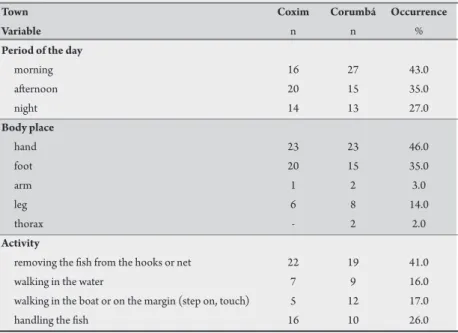
he main data are shown in Tables 1 and 3, for ease of interpretation. All the ishermen interviewed reported having had some kind of injury caused by any aquatic animal (Table 1). he conditions that favored traumas and envenoming were ordinary actions related to the exercise of their activities.
Floodep Areas Upper Paraguay River Basin
Capitals Cities > 20.000 pop. Other cities State limit International limit Basin limit Pantanal limit Pantanal Rivers
Source: EDIBAP AMA/GEF/PNUMA/OEA Scale 1:5.000.0000 50 100
Widespread Flooding
Height Duration High long High-medium long Medium-high long medium Medium-high medium-short
Partial looding Localized Flooding
Height Duration Medium Medium-long Medium Medium Low short
Analysis of the data also clariied that inatention to the proper use of primary safety equipment, such as working barefoot, recklessness when it came to handling live ish when removing them from the hook or net ishing and displacement inside the boat, all facilitated the causes of accidents, which mainly afected the hands (46%) and legs (35% of cases) of ishermen.
Bites were responsible for 22% of cases (Table 2) and were mainly caused by piranhas (Pygocentrus natereri and Serrasalmus marginatus), dourados (Salminus brasiliensis) and caiman (Caiman yacare).
Injuries caused by stings were responsible for 78% of the 100 accidents among the ishermen interviewed (Table 2). he ish that caused these types of injuries were: sorubins (Pseudoplatystoma sp), 24 cases; catish (Pimelodus, Pimelodella and Rhamdia), 23 cases;
jurupencens (Sorubim lima), 12 cases; jurupoca (Hemisorubim platyrhynchos), 3 cases; and stingrays (Potamotrygon sp),16 cases; as presented in Table 2.
Siluriformes, including sorubins (Pseudoplatystoma sp), jurupencens (Sorubim lima), jurupoca (Hemisorubim platyrhynchos) and catish (Pimelodus, Rhamdia and Pimellodella) together totaled 62% of cases (Figure 1 and Table 2), causing a wide variety of symptoms and clinical complications (Table 3).
Despite representing only 16% of the 100 cases, the results observed in Tables 2 and 3 show that the majority of injuries from stingray barbs occurred in the feet of the victims and were associated with severe pain, paresthesia, lymphadenopathy, erythema, edema and skin necrosis, resulting in deep ulcers complicated by secondary bacterial infections (Figure 1) and extensive scarring.
TABLE 1 - Distribution of the number and probability of occurrence of accidents sufered by the 100 ishermen interviewed (body segment, period of the day and activities at the moment of injury) in the towns of Coxim and Corumbá, State of Mato Grosso do Sul.
Town Coxim Corumbá Occurrence
Variable n n %
Period of the day
morning 16 27 43.0
aternoon 20 15 35.0
night 14 13 27.0
Body place
hand 23 23 46.0
foot 20 15 35.0
arm 1 2 3.0
leg 6 8 14.0
thorax - 2 2.0
Activity
removing the ish from the hooks or net 22 19 41.0
walking in the water 7 9 16.0
walking in the boat or on the margin (step on, touch) 5 12 17.0
handling the ish 16 10 26.0
TABLE 2 - Number and percentage of occurrence according to ish species and traumatic structures in the injuries observed in 100 ishermen interviewed in the towns of Coxim and Corumbá, State of Mato Grosso do Sul.
Town Coxim Corumbá Occurrence
Variable n n %
Causer animal
catish (Pimelodus sp, Pimelodella sp and Rhamdia sp) 10 13 23.0 stingrays (Potamotrygon motoro, P. falkneri, P. brachyura) 7 9 16.0
dourado (Salminus brasiliensis) 1 0 1.0
piranhas (Pygocentrus natereri, Serrasalmus marginatus) 4 12 16.0
sorubins (Pseudoplatystoma sp) 14 10 24.0
jurupencem (Sorubim lima) 9 3 12.0
jurupoca (Hemisorubim platyrhynchos) 3 0 3.0
traíra (Hoplias malabaricus) 1 0 1.0
caiman (Caiman yacare) 1 1 2.0
snake (Bothrops sp) 0 2 2.0
Cause
bites 7 15 22.0
DISCUSSION
he capture of ish in natural conditions exposes the isherman to a number of risks, since the preparation of ishing gear and coping with adverse natural conditions during the handling of ish, during or ater ishing5.
he need to catch greater quantities of ish, in contradiction with the decline in productivity and price of ish, primarily due to over-ishing, the technological development of ishing tourism6 and
negative environmental impacts caused to the Taquari River7 has led
ishermen to exceed their physical limits regarding extensive working hours, exposing themselves to immediate hazards. his fact may also have contributed to making simple activities during the handling of ish (how to remove the ish hook, to enter in the water or handle the ish in the boat) the main causes of errors that resulted in accidents (Table 1). here are reports of similar problems in an investigation
of injuries in rudimental ishermen of the Middle Araguaia River in State of Tocantins, Midwest region of Brasil8.
Some ishermen said that they remained on ishing trips in the Pantanal region for more than 60 days, oten working day and night with short rest periods and facing adverse weather conditions. Only every two weeks, is the ish collected by support boats that go down the Taquari River with this objective and to carry supplies.
he reports made by two ishermen victims of necrotic ophidism, probably caused by boca-de-sapo snakes(Bothrops matogrossensis)9,
which is the most common species in Pantanal10,were associated with
severe pain and hemorrhagic blisters, manifestations consistent with envenoming caused by this group of snakes.
Injuries caused by ish stings (Siluriformes and Rajiformes) are more frequent on the hands, but the present data show that a signiicant proportion of accidents (35% of cases) afected regions of the lower limbs (Table 1). When the sting penetrates the tissues of the victim, the barbs release toxins that low into the wound causing violent pain TABLE 3 - Relation of the ish associated with the lesions, the popular treatment used, symptoms, the duration of pain and layof from work due to injuries and accidents.
Case animal
sorubins jurupencem jurupoca catish dourado piranhas traíra stingrays caiman snakes occurrence
urine 1 1 1 3
alcohol 4 1 4 1 1 1 12
ice 1 1 2
liquor 3 1 1 1 6
gasoline 2 1 1 4
kerosene 1 1
Treatments herbs* 4 2 1 3 4 1 15
heat** 3 1 3 3 2 12
parts/ish*** 3 2 1 1 1 8
blessings and prayer 1 1 1 3
tied/squeezed 3 1 6 2 12
salt/brine 2 1 1 1 5
propolis 1 1
smoke 2 1 3
other**** 2 2 6 3 1 1 15
blisters 1 1
wounds 7 2 2 1 16 1 10 2 2 43
edema 18 4 1 8 2 13 2 48
erythema 6 4 3 5 4 2 2 26
Symptoms nausea/vomit 1 1
tachycardia 1 1 2
fever 3 2 3 2 10
numbness 5 4 1 1 3 14
adenopathy 2 3 2 7
less than 2 hours 4 8 11 9 1 33
Time/pain 2 to 8 hours 6 2 1 1 2 1 13
8 to 24 hours 1 1 2 4
up to 24 hours 11 3 1 7 6 14 1 43
less than 7 days 12 1 1 1 9 1 25
Layof 7 to 15 days 2 1 1 4
15 to 29 days 1 1 1 1 3 7
up to 30 days 6 3 5 1 1 16
ACKNOWLEDGMENTS
he authors declare that there is no conlict of interest.
CONFLICT OF INTEREST
FINANCIAL SUPPORT
REFERENCES
and throbbing. he place becomes edematous and erythematous and the pain persists for more than six hours, with the possibility of infections that can last days (Table 3). his complication may indicate the presence of fragments of the stinger (Figure 1)11. Bacterial
infections are common factors complicating the accident and, in most cases are caused by Staphylococcus and Streptococcus, but may be associated with bacteria, such as Vibrio vulniicus (more common in marine environments) and Aeromonas hidrophyla, which cause severe infections with deep tissue necrosis (Figure 1)12.
In a previous report of 84 envenoming in humans caused by freshwater stingrays, the authors demonstrated that this is the most severe local injury caused by ish in Brazil, requiring controlled and professional treatment, oten with opioid analgesics and antibiotics11.
Popular treatments reported by ishermen and used as palliative measures to ease the symptoms at the time of the accidents seem to be associated with moments of despair and lack of knowledge regarding the harmful efects of some substances used (Table 3). he use of gasoline and kerosene may aggravate the manifestations, increasing the pain and contributing to tissue necrosis.
Parts of the ish (eyes and viscera), organic and inorganic material in the soil (mud, leaves, sand), urine and pupae of termites were used in an atempt to alleviate the symptoms (Table 3), which in our view represents an increase risk due to the possibility of causing secondary infections.
All ishermen who used some thermal component on the afected sites for the treatment of injuries, by washing with hot water or placing a cloth or hot compresses or even urinating (12 cases) on the injury, said they experienced a signiicant reduction in pain, however momentary. Studies concerning the clinical and therapeutic aspects of accidents caused by mandijubas (the yellow catish) report that main efect of the venom is intense vasoconstriction and the vasodilatation caused by hot water is responsible for the improvement in pain symptoms12,13. Immersing the afected area in hot water
(around 50°C) brings rapid relief to patients who must remain with injury immersed in hot water for 30-90 minutes.
More severe cases that required longer periods of removal may be related to lack of care and treatment or the lack of irst aid measures by local health professionals, aggravated by the use of home treatment, carelessness in the treatment or the alleged delay in seeking medical atention.
In conclusion, accidents caused by aquatic animals in the regions where the ishermen were studied are very common; the animals mainly associated with the trauma are the most common ish and those of higher economic value; the severity of accidents is probably associated with inadequate and ineicient treatment; this study may be important for the ishing communities of the Pantanal region, since it provides information that assists in understanding the social, economic and environmental issues surrounding the proposed subject and there is a clear need to prepare printed material with guidance on the proposed subject that is adequately illustrated with the use of modern resources for graphic design and focused on language accessible to the ishermen.
he authors would like to thank the Universidade Anhanguera-Uniderp and Universidade Estadual de Mato Grosso do Sul for providing support and contributing signiicantly to the pursuit of knowledge relevant to the achievement of the numerous stages of this research.
Centro de Pesquisas do Pantanal (CPP). José Sabino is a fellow of CNPq (process 306169/2008-8).
1. Resende EK. Recursos pesqueiros: diagnóstico e propostas de pesquisa. [Internet]. Corumbá: EMBAPA-CPAP; 1988 [cited 2008 nov 21]. Avaliable from: htp://www.cpap.embrapa.br/publicacoes.
2. Amâncio COG. Aspectos socioeconômicos do desenvolvimento do Pantanal Sul. In: Albuquerque ACS, Silva AG, editors. Agricultura Tropical: Quatro décadas de inovações tecnológicas, institucionais e políticas. 1ª edição. Corumbá (MS): Embrapa Pantanal; 2008. p. 503-517.
3. Haddad-Jr V. Infecções cutâneas e acidentes por animais traumatizantes em aquários comerciais e domésticos no Brasil: descrição de 18 casos e revisão do tema. An Br Dermatol 2004; 10:199-206.
4. Rota MA. Situação da piscicultura Sul-mato-grossense e suas perspectivas no Pantanal. [Internet]. Corumbá: Embrapa Pantanal; 2003 Nov [cited 2008 nov 21]. Avaliable from: htp://www.cpap.embrapa.br/publicacoes.
5. Dall’Oca AV. Aspectos socioeconômicos, de trabalho e de saúde de pescadores do Mato Grosso do Sul. [Dissertação de Mestrado]. [Campo Grande]: Universidade do Estado do Mato Grosso do Sul; 2004.
6. Catella AC, Albuquerque FF, Campos FLR. Sistema de Controle da Pesca de Mato Grosso do Sul SCPESCA/MS–6 - 1999. Boletim de Pesquisa e Desenvolvimento 35. EMBAPA Pantanal; 2002.
7. Resende EK, Pereira AC, Almeida VLL, Silva AG. Alimentação de peixes carnivoros da planície inundável do Rio Miranda, Pantanal, Mato Grosso do Sul, Brasil. [Internet]. Corumbá: EMBAPA-CPAP; 1996 [cited 2008 nov 21]. Avaliable from: htp://www.cpap.embrapa.br/publicacoes.
8. Garrone-Neto D, Cordeiro R, Haddad-Jr V. Acidentes do trabalho em pescadores artesanais da região do Médio Rio Araguaia, Tocantins, Brasil. Cad Saude Publica 2005; 21:795-803.
9. Cardoso JLC, França FOS, Wen FH, Malaque CMS, Haddad-Jr V. Animais Peçonhentos no Brasil: biologia, clínica e terapêutica. São Paulo: Editora Sarvier; 2009.
10. Monteiro C, Montgomery CE, Spina F, Sawaia RJ, Martins M. Feeding, Reproduction, and Morphology of Bothrops matogrossensis (Serpentes, Viperidae, Crotalinae) in the Brazilian Pantanal. J Herpetol 2006; 40:408-413.
11. Haddad-Jr V, Garrone-Neto D, Paula-Neto JB, Marques FPL, Barbaro KC. Freshwater stingrays: study of epidemiologic, clinic and therapeutic aspects based in 84 envenomings in humans and some enzymatic activities of the venom. Toxicon 2004; 43:287-294.
12. Haddad Jr-V. Animais aquáticos potencialmente perigosos do Brasil: guia médico e biológico. São Paulo: Editora Roca; 2008.