ABSTRACT The article reports a descriptive research, under a quantitative approach, aimed at characterizing the way actions of matrix support are inserted into daily life; and the tools privileged by physicians and nurses of the Family’s Health Strategy (Estratégia Saúde da Família – ESF) and specialists of the Nucleus for Supporting the Family´s Health (Núcleo de Apoio à Saúde da Família – Nasf ) in a district at the South Region of São Paulo. Seventy-eight professionals (ESF=44, Nasf=34) have filled in a questionnaire about agenda, activities, tools and knowledge. Results indicate that teams face difficulties while performing shared actions of matrix support.
KEYWORDS Matrix support. Family Health Strategy. Health management. Education, continuing.
RESUMO O artigo relata pesquisa descritiva, com abordagem quantitativa, cujo objetivo é carac-terizar o modo como as ações de apoio matricial estão inseridas no cotidiano; e as ferramentas privilegiadas por médicos e enfermeiros da Estratégia Saúde da Família (ESF) e por especialistas do Núcleo de Apoio à Saúde da Família (Nasf ) de distrito localizado na região Sul de São Paulo. 78 profissionais (ESF=44, Nasf=34) responderam a um questionário sobre agenda, atividades, ferramentas e saberes. Os resultados indicam que as equipes têm dificuldade em executar ações compartilhadas de apoio matricial.
PALAVRAS-CHAVE Apoio matricial. Estratégia Saúde da Família. Gestão em saúde. Educação continuada.
Matrix support and actions on primary care:
experience of professionals at
ESF
and
Nasf
Apoio matricial e ações na atenção primária: experiência de
profissionais de ESF e Nasf
Rosimeire Aparecida Bezerra de Gois dos Santos1, Lúcia da Rocha Uchôa-Figueiredo2, Laura Câmara Lima3
1 Associação Saúde da Família (ASF) – São Paulo (SP), Brasil.
2 Universidade Federal de São Paulo (Unifesp) – Campus Baixada Santista – Santos (SP), Brasil.
3 Universidade Federal de São Paulo (Unifesp) – Campus Baixada Santista – Santos (SP), Brasil.
Introduction
The Family’s Health Strategy (Estratégia Saúde da Família – ESF) was conceived do consolidate the organization process of Primary Attention to Health (Atenção Primária à Saúde – APS) at the municipality level, to enable the reorganization process agreed on between adjacent municipalities to flow easier, and to coordinate health care as a whole (ANDRADE; BARRETO; BEZERRA, 2009). ESF
formulation was mirrored at care models of family care in place in Canada, Cuba, Sweden and England, which were the reference for Brazilian program (ROSA, 2005). Rizzoto (2000)
develops a critical point of view, stating that such model of decentralized public service at the community level, meant to assist poor populations, was a strategy recommended by the World Bank to transfer to individuals, families and communities the responsibility the State should answer for.
In view of health demands and needs existing in the territory, besides needs and limits faced by the teams that deal with basic attention, the Nucleus for Supporting the Family´s Health (Nasf ) was created on January 2008, meant to widen the scope of health care offered to the users (BRASIL, 2014).
The work carried out by Nasf is guided by the theoretical-methodological referential of the matrix support. According to Brasil
(2014), the matrix support is a new way to
produce health: in a process of shared con-struction, two or more teams elaborate a proposal for pedagogical-therapeutic inter-vention. Applied to APS, it means a strategy for organizing the work in health based on the need for widening the scope of actions carried out by the ESF, bringing forward a multi-professional team that will render health assistance and care in that territory, in an inter-disciplinary way, thus enlarging the potential for both integrality and resolu-tion of cases assisted. The matrix support provided to ESF by Nasf occurs by sharing problems, by professionals exchanging
knowledge and practices, as well as by the articulation of interventions agreed on, con-sidering clear accountabilities, not just those that are common to all actors involved, but also those that are specific of APS teams.
In daily work, using matrix makes pos-sible actions easier, as well as the elucidation of diagnosis, that quite often is the basis for structuring a Singular Therapeutic Project (Projeto Terapêutico Singular – PTS). According to Oliveira (2008), when a team or
a professional of matrix support meets a ref-erence team, the idea is to have the matrix support helping the reference team in per-forming a therapeutic project for a subject, either an individual or a group, in need of a health intervention that the reference team did supposedly face difficulties to perform.
In this sense, Campos and Domitti (2007)
explain that the functioning of the matrix support and the reference team depends on organizational arrangements and manage-ment concerning the health work that might enlarge the possibilities for the widened clinic practice and the dialogical integration among different specialities. For Chiaverini
(2011), the process of
health-infirmity-inter-vention is not either monopoly nor exclusive tool of whatever the speciality: it belongs to the entire health field. Therefore, the matrix process is typically one of inter-disciplinary work, with practices that involve knowledge interchanging and construction.
Matrix support aims at the widened clinic, an efficient tool for widening the work scope of ESF procedures. Over and above the biological, the widened clinic points out to the perspec-tive of transformation of individual and collec-tive attention, which enables for other aspects of the subject that might be understood and worked out by health professionals (CUNHA, 2010).
Resistance and difficulties traverse the way of these professionals, mainly those who wish to carry out differed actions in the territory they serve at, yet making sure Nasf may fully develop its function, offering matrix support, PTS, widened clinic, among other technologies involved, so that the assistance will come to meet the goals of integrality and resolution pos-sibilities as determined by the Unified Health System (Sistema Único de Saúde – SUS).
As policies are implemented, actions are gradually transformed and, sometimes, re-in-vented. Such movement has been followed and justified by research and theoretical studies
(ANDRADE; BARRETO; BEZERRA, 2009; CAMPOS; DOMITTI, 2007; CUNHA; CAMPOS, 2011; GOTTEMS; PIRES, 2009; NASCIMENTO; OLIVEIRA, 2010; OLIVEIRA; CAMPOS, 2015; RIZZOTTO, 2010; RIZZOTTO; CAMPOS, 2016; TEIXEIRA; SOLLA, 2015; VILLA ET AL., 2015; AMONG OTHERS), although much is still to be
investigated on the subject, mainly as to daily activities during live work.
To confront the complexity of health problems and attention to health, intending to solve them, one must
bring together a multiplicity of ‘knowings’ and ‘doings’, and understand the way health production is organized in the ield of clinical ‘knowings’ and practices. (MERHY; FRANCO, 2003, P. 317).
One looks at making operational, as named by Teixeira (2006, P. 25), the dimension
strictly technical-assistant, or operative, re-spective to
the relations established between the sub-jects of the practices and their work obsub-jects, which are measured by the knowledge in technology that operates in the health work process in diferent levels [promotion in health, risk prevention, damages and recovery and rehabilitation].
Based on concepts by authors in the area of collective health, especially Merhy (2003, 2013), one assumes it would be interesting
to listen to professionals who work in ESF and Nasf in regard of their actions while per-forming live work and about what is easy and difficult in their daily activities. Those profes-sionals must be attentively listened to in regard of how they have been organizing themselves to render services of health attention and care. Systematization and analysis of such informa-tion bring forward elements for thinking about what might contribute for improvement, for enriching actions in APS and for implementing public policies.
The overall objective of this article is to characterize how actions of matrix support are inserted into daily activities, and the tools that are privileged by ESF physicians and nurses and by Nasf specialists. The sec-ondary objective is to analyze similarities and differences between ways to organize the work and to operate matrix support in both services of the APS network (ESF and Nasf ), as well as the challenge of articulating those services.
Specific objectives are: to investigate, among activities that compose the daily routine of ESF professionals, what are con-sidered shared construction with Nasf and what associate to matrix support of matrix procedures; to investigate, among activi-ties that compose the daily routine of Nasf professionals, what are considered shared construction with ESF and what associ-ate to matrix procedures; to compare the answers by ESF and Nasf teams relative to matrix support or to matrix procedures; to contribute for the debate on the articulation between services aimed at making matrix support viable as a theme and to evaluate and improve APS public policies.
Methods
questionnaire on matrix procedures. The project was negotiated with the Regional Health Coordinating Body of the Social Organization (Organização Social – OS), hired by the Health Secretariat of São Paulo City to manage the APS in the South Zone. At the time the research was carried out, the region included three adminis-trative districts, counted 607,929 inhab-itants (FUNDAÇÃO SEADE, 2014), 88 ESF teams
and five Nasf teams. ESF teams include six community agents, one physician and one nurse and, according to the team, they may also have two nursing assistants and/ or one dentist. Nasf teams include mental health professionals (psychologists, oc-cupational therapists and psychiatrists), rehabilitation professionals (physiothera-pists, speech thera(physiothera-pists, nutritionists), besides pediatricians, gynecologists and social workers.
The outcomes presented are extracted from the Master Degree research (SANTOS, 2015) approved by the Ethics Committee for
Research (Comitê Ético de Pesquisa – CEP) of São Paulo Municipal Government (PMSP) and by the CEP of the University where it was developed, under Nr. 921.278/2014, ac-cording to Resolution Nr. 466/12. In its first conception, the project would be limited to one Nasf and four UBS, and would include workshops meant to deal with themes related to the organization and development of the work process of both ESF and Nasf teams. However, the Health Coordinating Body of the South Region (São Paulo) did not authorize the workshops to be carried out and suggested the universe of subjects researched to be widened, involving all teams in the region, which included 40 ESF minimum teams (spread over five UBS) and five Nasf teams. Thus, once the universe was widened and a new purpose was established, it became more appropriate do develop an exploratory, descriptive research, with qualitative approach, using the question-naire as a tool for data collection, and using
both statistic (descriptive and inferential) and qualitative analysis for reading and in-terpreting those data.
In order to make it easier to schedule the meetings, priority was assigned to the timetable of each UBS team, as those professionals have five hours per week set apart for technical and planning meet-ings, according to the local agenda as es-tablished by Health Coordinating Body of the South Region. It was then decided that, except for buccal health profession-als, all others in those meetings would be invited to participate. Data collection took place in January and February 2015. Five meetings previously scheduled were carried out, one at each UBS, lasting thirty minutes each. The researcher in charge introduced the research, explained on au-tonomy as to participation and on respect to privacy, gave out the instrument to all participants, clearing up doubts, and picked it up 20 minutes later or as partici-pants completed answering the questions. The instrument used for data collection was a questionnaire to be filled in by each participant, with 16 closed questions and four open questions, intended to obtain information on the organization of activi-ties related to daily work and on activiactivi-ties related to the matrix process, using concepts such as: PTS, widened clinic, inter-sector procedures, matrix support, permanent edu-cation, genogram, echo-map, shared activi-ties, home visits and networks.
Results and discussion
Seventy-five professionals took part in the research, which means 60% of the total invited (n=130). Among those who refused taking part, most argued with agenda dif-ficulties, although the meeting had been planned 30 days ahead. Some managers referred to absence of the professionals the day data were to be collected, others alleged they would need the time scheduled for technical meeting for organization of the work process, among other affairs, thus making it impossible to carry out an effec-tive collection. As to respondents, 44 work in ESF programs (18 physicians and 26 nurses) and 34 at Nasf: six occupational therapists, six physiotherapists, six social workers, four speech therapists, four physical educators, four psychologists, three nutritionists and three specialist physicians.
On average, Nasf and ESF profession-als are 35 to 38 years old, have from 9 to 10 years of basic graduation, and from 32 to 38 months in the service. One may notice that physicians and nurses are somewhat more experienced. Most professionals (about 805) come from private universities and have no APS specialization.
The questionnaire posed one question on the organization of the work agenda of ESF and Nasf professionals, considering the per-centage of fixed and variable commitments that led to occasional variations: a) personal needs; b) duty needs; c) managers’ or users’ needs. On average, answers were rather dif-ferent. The predominant answer – 45.2% of ESF professionals and 76.5% of Nasf profes-sionals – was that commitments are subject to some variations according to the service’s¬ needs. Such difference is important and sig-nificant (p=0.012), as it points out to the fact that the work carried out by professionals in the support team is organized differently from the work carried out by physicians and nurses, and depends more heavily on the ser-vice’s vicissitudes.
The research verified that 21.4% of ESF professionals and 17.6% of Nasf professionals answered that commitments are scheduled according to users’ and managers’ needs, which points to balance as to this item, despite a slightly larger percentage of phy-sicians and nurses. The option stating that variations occur according to the needs of the professionals themselves was mentioned by 28.3% of ESF respondents and by 5.9% of Nasf respondents. Again, the answers suggest that physicians and nurses have more au-tonomy as compared do Nasf professionals. In this same sense, 4.8% of ESF profession-als declare that their commitments are fixed, while no professional in support teams de-clares so. As a whole, data reveal that the work organization of Nasf professionals is more subject to external conditions than the work organization of ESF professionals, and that they have less autonomy regarding the time distribution of their activities.
These results are the first indicator that there is a real difference in work operational procedures for both teams, at least as they describe their own activities. The work or-ganization for physicians and nurses is an-chored in a fixed agenda of care services, while other Nasf professionals remain in a peripheral position and will be requested according to the services’ needs. Santos (2015)
remarks that ESF must be better acquainted with the organization of the work carried out in Nasf, and assign more value to the matrix practice, instead of prioritizing indi-vidual and specialized care service. In this context, according to Hirdes (2015), the work
of Nasf and ESF teams must be adapted to each other, in order to put in practice the matrix support; and this requires taking into account the professional principles that support that practice: inter-professionalism, attachment, integrality in caring, accessibil-ity, resolution capability and longitudinal procedures.
created some paradoxical situations that must be reconsidered, such as different pro-ductivity and work strategies requirements between Nasf and ESF; different demands of population care services, once, unlike Nasf, ESF is taken for the main access to APS; dif-ferent priorities of actions between Nasf and ESF, mirrored in tasks divisions and the time assigned to each of them, among others.
Regarding the work process of teams, the subjects were asked how much time over the month (in percentage) they usually dedi-cated to daily activities, considering daily practices. Chart 1 synthesizes the average percentages estimated by the respondents for each activity carried out or tools used by
ESF and Nasf teams, considering the total for each respondent should sum 100%, in-cluding the option ‘others’. The participants were also asked what would be the ideal work plan, yet asking them, if they could choose, how much time (estimated in per-centage) they would dedicate to the activities mentioned below. The comparison between the answers should lead to a measure as to how far the ‘actual’ work of respondents is from what they would consider ‘ideal’. The difference between those two measures would indicate how deeply those profession-als would or would not long for changes in those proportions.
Chart 1. Time dedicated (actually and ideally) to activities/tools of matrix support, according to estimates by professionals of both ESF and Nasf teams
Estimates of activities distribution ESF Nasf ESF Nasf
According to professionals interviewed ‘Actual’ ‘Actual’ ‘Ideal’ ‘Ideal’
1) Clinical care 43,40% 15,44% 37,55% 9,71% 2) Matrix support 6,39% 14,85% 8,17% 17,35%
3) Continued education / qualifications 3,82% 7,35% 7,40% 11,76%
4) Team meeting 9,20% 12,50% 8,61% 10,74%
5) Home visits 12,64% 13,82% 10,64% 11,18%
6) Therapeutic groups 7,52% 18,68% 10,30% 18,90%
7) Administrative tasks 5,77% 7,09% 6,38% 6,24%
8) Others 4,11% 3,00% 2,89% 2,88%
Note: Subjects estimated the percentage of time they dedicate to matrix support activities or tools (‘actual’) and the percentage they would rather dedicate (‘ideal’) in one working month. In each case, total estimates summed 100%; percentages presented on the chart are averages for each activity, for each team.
Concerning the distribution of activities, there were differences between the teams. For ESF professionals, activities mentioned as the most frequent were: clinical care, with 43.4%, and home visits, with 12.64%. It may be noticed, therefore, that according to the distribution of physician and nurses who did respond, 65.24% of the actions are (probably)
or are not shared.
Inferential analysis on how those vari-ables behave, using the model of variance analysis with repeated measures, allow for making sure that time averages in clini-cal care for the ESF group are significantly larger (p=0.001) than for the Nasf group, while time used by the Nasf group is sig-nificantly larger than for the ESF group in the following activities: matrix support (p=0.001), therapeutic groups (p=0.001) and team meetings (p=0.034). On average, professionals dedicate more time than they would like to clinical care (p=0.003) and home visits (p=0.011).
As to the comparison between ‘real’ and ‘ideal’ axes, there was, in general, little dif-ference, which could indicate that either Nasf or ESF professionals do not long for that much changes. Nevertheless, some dis-crepancies may be identified as we analyze each answer. Concerning clinical care, phy-sicians and nurses are closer to ideal condi-tions, while support professionals consider they do more than would be desired. Both teams aim at more opportunities to prac-tice the matrix support, and when it comes to continued education and qualification programs, they would long to quite twice as much as they can do.
Those are significant results, once they give evidence that assistance and care pro-vided by both teams are not the same. In general, physicians and nurses provide individual care to their patients, while
physiotherapists, occupational therapists, psychologists, social workers, physical edu-cators, nutritionists and specialist physicians provide group care. This structure indicates that the care attention model in place is an-chored on individual appointment with phy-sicians, while group care is perpetuated as a multi-professional practice for support pro-fessionals. The latter seems to be a technolo-gy adopted by Nasf professionals, not always used by physicians and nurses. On the other hand, the number of clinical attendance by Nasf professionals is significantly lower than those by ESF teams.
Researchers were curious about the real possibilities for ESF and Nasf profession-als to fulfill prerogatives established by the Ministry of Health, discussing clinical cases, carrying out shared care in both UBS and home visits, and jointly building therapeutic projects, so as to widen interventions over the territory and for health care of popula-tion groups (BRASIL, 2014). With that purpose,
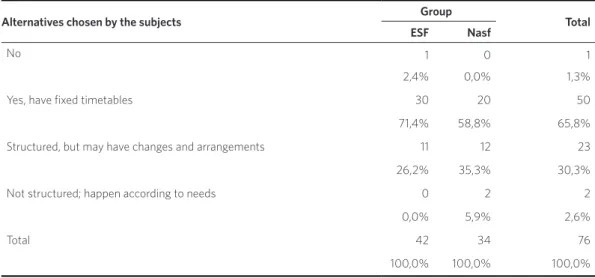
One can notice specificities in the answers provided by the teams. Most ESF professionals (71.4%) declare that their agendas include fixed timetables for meet-ings with Nasf professionals, while 58.8% of Nasf professionals declare so. On the other hand, Nasf professionals arte the majority (35.3%) among those who declare that such meetings are structured, but there might be changes and inclusion arrangements; con-cerning physicians and nurses, 26.2%. No ESF professional answered that meetings take place as they are required, while 5.9% of Nasf professionals said so. Those differences seem to be wider than could be expected if those were truly shared actions, once, if it were the case, percentages would tend to be closer between both teams.
In order to understand how inter-disci-plinary changes take place among profes-sionals of both teams, respondents were asked about the communication means they would prefer. Collective changes during team meetings were preferred by most re-spondents – 81.4% of physicians and nurses and 67.6% of Nasf professionals. Changes between teams during matrix support were the answer chosen by 25.6% of ESF
professionals and by 17.6% of Nasf profes-sionals. Interdisciplinary changes during care actions were mentioned by 14% of ESF professionals and 20.6% of Nasf profession-als; e-mail, SMS, WhatsApp and mobile phone, 18.4% for ESF and 29.4% for Nasf; informal in-person conversation, 14% for ESF and 32.4% for Nasf; and others, 7% for ESF. These results suggest that the condi-tion that would lead changes to be easier to carry out are the meetings, even though they seem more convenient to ESF purposes than to Nasf objectives. It is worth remarking that specialists make use of less formal commu-nication media, such as phone, e-mail, SMS, informal conversation and interdisciplinary changes, while physicians and nurses would rather use more formal alternatives: meet-ings and matrix support.
When asked to evaluate the proportion (in percentage) of their work they consider innovative, not just restricted to the proto-col, ESF professionals answer that 29.26% of their routine is innovative, while a larger proportion of Nasf professionals – 48.06% – report greater flexibility and creativity in their actions. These data are coherent with former answers related to the rigidity of Table 1. Organization of work agendas of ESF and Nasf teams
Alternatives chosen by the subjects Group Total
ESF Nasf
No 1 0 1
2,4% 0,0% 1,3%
Yes, have fixed timetables 30 20 50
71,4% 58,8% 65,8%
Structured, but may have changes and arrangements 11 12 23
26,2% 35,3% 30,3%
Not structured; happen according to needs 0 2 2
0,0% 5,9% 2,6%
Total 42 34 76
100,0% 100,0% 100,0%
physicians’ and nurses’ agendas, which de-termine great part of their activities and remain essentially centralized in clinical care, using procedures like ambulatory clinic procedures, meetings and scheduled home visits. It is worth evoking Cunha & Campos
(2011), who state that workers in the health
area would rather prevent from dealing with problems in knowledge nucleuses they are not sufficiently prepared to intervene, while other procedures will occasionally be con-sidered inadequate and inappropriate, or yet invasive. Those are the reasons that lead such professionals to show weak capacity to deal with uncertainties and inter-disciplin-ary procedures, thus making more difficult working in both intra- and inter-teams.
Chart 2 presents the comparison of
answers provided by both groups of subjects to two questions: what is the proportion of their own work (in percentage) they evalu-ate as innovative, defining innovation as procedures nor set down in the protocol; and how they respond to the following prac-tices in their daily performance: individual or widened clinic; protocol-driven or sin-gular therapeutic project; care provided at the health unit or actions out over the terri-tory; care provided individually or in groups; initial education or continued education. It is supposed that the answers regarding those pairs of opposed options may point out to the model of primary attention in health guiding their practices. Comparing the descrip-tive measures for both teams, the following results were obtained:
Chart 2. Comparisons between teams (ESF and Nasf) as to the innovative character of the work and to the option of variables that lead to opposed assistance models
Note: Subjects were asked to estimate (in percentage) the proportion of their own work they evaluate as innovative, not following the protocol. Then, they should choose between both extreme points of each pair of variables; they should mark a number from 1 to 5, where 1 and 2 are close to one extremity; 4 and 5, to the other; and 3, parity or neutral. In order to compare the answers by the teams (ESF and Nasf) regarding the percentage estimate and each variable, the Student’s t Test was used for not related samples.
Variables Descriptive level
Proportion of work evaluated as innovative, not following the protocol 0,002
Individual clinic/widened clinic 0,395
Therapeutic projects following the protocol/singular therapeutic project 0,055
Assistance at the unit/actions out over the territory 0,238
Individual care/group assistance 0,001
Initial formation/continued education 0,293
When reading the results, one may state that there is a statistically significant dif-ference (p<0.005) between the teams as to the following concepts: individual care/ assistance to groups, proportion of work considered innovative, not restricted to the protocol. A less remarkable difference, yet pronounced (p=0.055), appears concerning the stress between PTS and the therapeutic
project conforming to the protocol. As to the other concepts (individual or widened clinic, care provided individually or actions out over the territory, and initial education or continued education), answers by both teams did not significantly differ.
Physicians and nurses realize a less innova-tive work, centered on individual care and a therapeutic project conforming to the protocol; on the other hand, matrix support professionals come to be more innovative and more receptive for demands that might come to sight, their work based on group care and on PTS.
In order to understand matrix procedures as an action for those who take part of them, both groups were asked to evaluate their possibilities for solving cases inside ESF, choosing among the options: excellent, good, medium and bad. In the answers, matrix procedures and its solving possibilities are considered good for both groups – 50% for ESF, 57.6% for Nasf; medium – 40.5% for ESF, 12.1% for Nasf; and excellent – 4.8% for ESF, 12.1% for Nasf. The option ‘bad’ was only assigned by ESF, with 4.8% of the answers. Most answers in both teams were ‘good’, with 53.3%, although Nasf team seems more optimistic when compared to the ESF team. Regarding professional satisfaction, participants were asked how often they quit their work place satisfied with the solutions they found in their professional practice. Satisfaction seems to be greater among Nasf professionals: 79.4% answered ‘often’, while among ESF professionals only 67.4% chose that option. Among ESF professionals, only 2.3% answered ‘never’, and 23.3% chose the option ‘seldom’. Among Nasf professionals, 17.6% chose the option ‘seldom’. One may observe that physicians and nurses are more demanding and show greater level of dissat-isfaction than the support team.
Lancman et al. (2012) observe that Nasf
professionals face difficulties in articulat-ing with ESF professionals, considerarticulat-ing assistance productivity goals the latter are submitted to and work processes already in place. Data collected confirm their remarks and corroborate former researches that point out to the need of making a new pact on the work, with a new arrangement of agendas and a new dimensioning of time proportions
dedicated to the different activities (CUNHA; CAMPOS, 2011; GONÇALVES ET AL., 2015; MOLINE-AVEJONAS; MENDES; AMATO, 2010; NASCIMENTO; OLIVEIRA, 2010).
Difficulties to perform teamwork and to carry out shared actions have also been ob-served by Gonçalves et al., (2015), who warn
for the need of both time and availability for learning.
Final considerations
Nasf was created aimed at widening the scope and resolution possibilities of APS actions, and to make it easier for the popula-tion to access a more comprehensive health care system, avoiding forwarding clients to other health care levels. Nevertheless, as results indicate, there is not to date ef-fectiveness of policies proposed. Based on the research, one may affirm that services rendered by physicians and nurses is or-ganized according to a quite heavy agenda of appointments and meetings, leaving not much time available for not planned activi-ties. However, professionals can manage to adapt their agendas according to conve-niences, with some autonomy, while spe-cialist professionals organize their work according to service demands, thus partially missing the control on the organization of their own work. Analyses suggest that both operation systems are not as articulated as, in theory, they should be. ESF professionals provide less innovative services, focused on individual care and on a therapeutic project conforming to a protocol, based on inter-disciplinary changes formally carried out in meetings. On the other hand, matrix support professionals come to be more innovative and more receptive to new demands, their work based on group care and PTS, open to less standardized communication formats and agenda organization.
interdisciplinary care, assigning value to exchanging knowledge and qualification, always focusing on integrality, humanization and health promotion all over the territory they are responsible for.
Moreover, other factors must be consid-ered that do also make it difficult carrying out matrix support actions, which should be discussed and rearranged, such as: the high demand for health care and the metrics for the production evaluation that rules the performance of physicians and nurses; academic education and experience of each professional; how easy or difficult it is for
each of them to share some actions; require-ments of both the population in the territory and the local management; the fact that the network of reference services in the terri-tory, health services in particular, is not suf-ficient to fulfill existing needs, thus creating continuous overburden on all care levels.
It must be remarked that new pacts depend on both active and collective move-ment of the social actors involved, health professionals and population, involving as well political decisions and economic calcu-lations. s
References
ANDRADE, L. O. M.; BARRETO, I. C. H.; BEZERRA, R. C. R. Atenção Primária à Saúde e Estratégia Saúde da Família. In: CAMPOS, G. W. S. et al. (Org.). Tratado de Saúde Coletiva. Rio de Janeiros: Fiocruz, 2009. p. 783-830.
BRASIL. Secretaria de Atenção à Saúde. Departamento de Atenção Básica. Núcleo de Apoio à Saúde da Família, v.1: ferramentas para a gestão e para o trabalho cotidia-no. Ministério da Saúde. Cadernos de Atenção Básica. Brasília, DF, n. 39, 2014.
CAMPOS, G. W. S.; DOMITTI, A. C. Apoio matricial e equipe de referência: uma metodologia para gestão do trabalho interdisciplinar em saúde. Cadernos de Saúde
Pública, Rio de Janeiro, v. 23, n. 2, p. 399-407, 2007.
CHIAVERINI, D. H. (Org.). et al. Guia prático de matri-ciamento em saúde mental. Brasília, DF: Ministério da Saúde, 2011.
CUNHA, G. T. A construção da clínica ampliada na Atenção Básica. São Paulo: Hucitec, 2010.
CUNHA, G. T.; CAMPOS, G. W. S. Apoio Matricial e Atenção Primária em Saúde. Revista Saúde Soc. São Paulo, São Paulo, v. 20, n. 4, p. 961-970, 2011.
São Paulo. Análises e Estudos. 2014. Disponível em: <ht-tps://www.seade.gov.br/wp-content/uploads/2014/07/ spdemog_jan2014.pdf>. Acesso em: 10 nov. 2016.
GONCALVES, R. M. A. et al. Estudo do trabalho em Núcleos de Apoio à Saúde da Família (NASF), Rev. Bras. Saúde Ocup., São Paulo, v. 40, n. 131, p. 59-74, 2015.
GOTTEMS, L. B. D.; PIRES, M. R. G. M. Para além da atenção básica: reorganização do SUS por meio da in-terseção do setor político com o econômico. Saúde Soc., São Paulo, v. 18, n. 2, p. 189-198, 2009.
HIRDES, A. A perspectiva dos profissionais da atenção primária à saúde sobre o apoio matricial em Saúde mental. Ciência & Saúde Coletiva, Rio de Janeiro, v. 20, n. 2, p. 371-382, 2015.
LANCMAN, S. et al. O processo de trabalho nos Núcleos de Apoio à Saúde da Família (NASF) e seus efeitos na saúde mental dos trabalhadores. Relatório final CNPq. São Paulo, 2012. Disponível em: <https:// www.seade.gov.br/wp-content/uploads/2014/07/spde-mog_jan2014.pdf>. Acesso em: 10 nov. 2016.
MERHY, E. E. A organização não existe, a organização existe: uma conversa da micropolítica do trabalho, da educação permanente e da análise institucional. In: L´ABBATE, S.; MOURÃO, L. C.; PEZZATO, L. M. (Org.). Análise Institucional & Saúde Coletiva. São Paulo: Hucitec, p. 579-596, 2013.
MERHY, E. E.; FRANCO, T. B. Por uma Composição Técnica do Trabalho em saúde centrada no campo re-lacional e nas tecnologias leves. Apontando mudanças para os modelos tecno-assistenciais. Saúde em Debate, Rio de Janeiro, v. 27, n. 65, p. 316-323, set./dez. 2003.
MOLINE-AVEJONAS, D. R.; MENDES, V. L. F.; AMATO, C. A. H. Fonoaudiologia e Núcleos de Apoio à Saúde da Família: conceitos e referências. Revista da Sociedade Brasileira de Fonoaudiologia, São Paulo, v. 15, n. 3, p. 465-474, 2010.
NASCIMENTO, D. D. G.; OLIVEIRA, M. A. C. Reflexões sobre as competências profissionais para o processo de trabalho nos Núcleos de Apoio à Saúde
da Família. O Mundo da Saúde, São Paulo, v. 34, n. 1, p. 92-96, 2010.
OLIVEIRA, G. N. Apoio matricial como tecnologia de gestão e articulação em rede. In: CAMPOS, G. W. S.; GUERRERO, A. V. P. (Org.). Manual de práticas de atenção básica: saúde ampliada e compartilhada. 2. ed. São Paulo: Hucitec, 2010. p. 273-296.
OLIVEIRA, M. M.; CAMPOS, G. W. S. Apoios matricial e institucional: analisando suas construções. Ciência & Saúde Coletiva, Rio de Janeiro, v. 20, n. 1, Rio de Janeiro, 2015.
ROSA, W. L. R. C. Programa Saúde da Família: a cons-trução de um novo modelo de assistência. Rev. Latino-Am. Enfermagem, Ribeirão Preto, v. 13, n. 6, p.1027-34, 2005.
RIZZOTTO, M. L. F. O banco mundial e as políticas de saúde no Brasil nos anos 90: um projeto de desmonte do SUS. São Paulo, 2010. 267 f. Tese (Doutorado em Saúde Coletiva) – Faculdade de Ciências Médicas, Universidade Estadual de Campinas, 2010.
RIZZOTTO, M. L. F.; CAMPOS, G. W. S. The World Bank and the Brazilian National Health System in the beginning of the 21st century.Saúde e sociedade, São Paulo, v. 25, n. 2, p. 263-276, 2016. Disponível em: <http://www.scielo.br/scielo.php?script=sci_ arttext&pid=S0104-12902016000200263&lng=en&nrm =iso> . Acesso em: 7 nov. 2016.
SANTOS, R. A. B. G. Matriciamento na Atenção Básica: estudo de equipes ESF e NASF atuando na região da Capela do Socorro-SP, 2015. 133 f. Dissertação (Mestrado em Ciências da Saúde) Programa de Pós-Graduação Ensino em Ciências da Saúde, Universidade Federal de São Paulo, Santos, 2015. Disponível em: <http://www2.unifesp.br/centros/cedess/producao/ produto_tese_bx/030_bx_rosemeiresantos_produto. pdf>. Acesso em: 9 ago. 2017.
EDUFBA, 2006. p. 19-58. (Série Sala de Aula, n. 3). Disponível em: <http://books.scielo.org/id/f7/00>. Acesso em: 7 ago. 2015.
TEIXEIRA, C. F.; SOLLA, J. P. Modelo de atenção à Saúde no SUS: trajetória do debate conceitual, situação atual, desafios e perspectivas. In: TEIXEIRA, C. F.; SOLLA, J. P. (Org.). Modelo de atenção à saúde: vigilân-cia e saúde da família. Salvador: EDUFBA, 2006. p. 129-68. (Série Sala de Aula, n. 3) Disponível em: <http://
books.scielo.org/id/f7/03>. Acesso em: 7 ago. 2015.
VILLA, E. A. et al. As relações de poder no trabalho da Estratégia Saúde da Família. Saúde em Debate, Rio de Janeiro, v. 39, n. 107, p. 1033-1043, out./dez. 2015.
Received for publication: November, 2016 Final version: June, 2017