Cross-cultural adaptation and content validation of START
Adaptação transcultural e validação de conteúdo do START
Aline Cristina Luz
I, Márcio Galvão Oliveira
II, Lúcia Noblat
IIIProfessor Edgard Santos University Hospital Complex, Universidade Federal da Bahia (UFBA), Salvador, Bahia, Brazil
ABSTRACT
CONTEXT AND OBJECTIVE: Non-treatment of diseases or clinical conditions has been considered to con-stitute omission of care in several countries. The aim of the present study was to develop a transcultural adaptation of the Screening Tool to Alert Doctors to the Right Treatment (START) to Brazilian Portuguese and to validate the tool’s content.
DESIGN AND SETTING: Cultural adaptation and validation of the START criteria using the Delphi consen-sus technique.
METHOD: START was translated from its original language into Brazilian Portuguese, followed by back-translation and validation by means of the modiied Delphi technique. For this, an electronic form was de-veloped and sent to 20 experts, who were asked to use a Likert scale to assess the statements included in START, in relation to their pertinence to Brazilian realities. All of the statements that exhibited mean scores greater than 4.0 were considered to have attained consensus. The experts’ identities were kept conidential throughout the validation process.
RESULTS: In the irst phase of the validation process, 63.6% (14/22) of the statements in START attained consensus. The remaining statements were returned to the experts so that they could have the opportu-nity to review their comments and statements and to assess them again, based on the Likert scale used earlier. In this phase, 100% of the START instrument attained consensus.
CONCLUSION: The content of START was entirely validated for Brazil, with all of the original criteria maintained.
RESUMO
CONTEXTO E OBJETIVO: O não tratamento de doenças ou condições clínicas tem sido apontado como omissão no cuidado em diversos países. O objetivo deste estudo foi realizar a adaptação transcultural para o português brasileiro e sua validação de conteúdo do questionário START (Screening Tool to Alert Doctors to the Right Treatment).
TIPO DE ESTUDO E LOCAL: Adaptação cultural e validação dos critérios START através da técnica de consenso Delphi.
MÉTODO: O START foi submetido à tradução da língua original para o Português (Brasil), tradução reversa e validação de conteúdo por meio da técnica Delphi modiicada. Para isso, um formulário eletrônico foi desenvolvido e enviado a 20 especialistas para o julgamento das proposições presentes na ferramenta START conforme sua pertinência para a realidade brasileira, utilizando uma escala de Likert. Foram consi-deradas consensuais todas as proposições que apresentaram média superior a 4,0. A identiicação de cada especialista foi mantida em conidencialidade durante o todo o processo.
RESULTADOS: Na primeira fase da validação, foi obtido consenso em 63,6% (14/22) das proposições con-tidas na ferramenta START. As proposições não consensuais foram reencaminhadas para os especialistas, que tiveram a oportunidade de rever seus comentários e proposições e julgá-las com base na escala de Likert utilizada previamente. Nessa fase, foi obtido consenso em 100% do instrumento START.
CONCLUSÃO: O conteúdo do START foi validado para o Brasil na sua totalidade, com todos os critérios originais mantidos.
IBPharm. Clinical Pharmacist, Cardiopulmonary
Institute, Salvador, Bahia, Brazil.
IIBPharm, PhD. Adjunct Professor of Clinical
Pharmacy, Multidisciplinary Health Institute, Universidade Federal da Bahia (UFBA), Vitória da Conquista, Bahia, Brazil.
IIIBPharm, PhD. Associate Professor of Clinical
Pharmacy, School of Pharmacy, Universidade Federal da Bahia (UFBA), Salvador, Bahia, Brazil.
KEY WORDS:
Elderly.
Pharmaceutical preparations. Drug prescriptions. Health of the elderly. Drug utilization. Translations.
PALAVRAS-CHAVE:
Idoso.
Preparações farmacêuticas. Prescrições de medicamentos. Saúde do idoso.
INTRODUCTION
Older adults are a heterogeneous group that usually presents a large number of chronic diseases, thus leading these
indi-viduals to use healthcare services and medications frequently.1
herefore, several researchers have formulated instruments to assess the appropriateness of drug prescribing among older
adults.2 According to Barry et al.,3 a drug is rated inappropriate
for older people when their tolerance to it has been scientiically and clinically shown to be poor, due to the physiological changes associated with aging. Such drugs may even exacerbate clinical
problems. Page and Ruscin4 considered a prescription to be
inap-propriate when it exhibited a signiicant risk of causing adverse events or when there was evidence that equally or more efec-tive and safer alternaefec-tives existed for treating the same condition.
Most instruments published to date within this ield have assessed inappropriate prescribing of medication to older adults, but few have evaluated errors of omission with regard to
pre-scriptions.3 START (Screening Tool to Alert Doctors to the Right
Treatment) was formulated with the aim of detecting prescrib-ing omissions among elderly patients. his instrument provides a method for systematic detection of prescribing omissions based on physiological systems, and it is considered to be valid,
efec-tive and easy to use.5 he START criteria were formulated and
validated in 2006 in the United Kingdom using the Delphi6
con-sensus technique. he START criteria include 22 indicators of potential prescribing omissions among older adults, and its use for both outpatients and inpatients has become widespread
across Europe.7
OBJECTIVE
he aim of the present study was to develop and validate a cross-cultural Brazilian Portuguese adaptation of START.
METHODS
Instrument
START is a published, evidence-based screening tool for detecting potential prescribing omissions among elderly patients. START categorizes prescribing omissions according to physiological systems within the following ields: cardiology, endocrinology, rheumatology, pneumology and neurology. he tool includes 22 indicators of potential prescribing omissions among older adults, but does not provide scores for each indicator.
Translation and cross-cultural adaptation
START was published by Gallagher et al.5 Although this tool is
in the public domain, the main author was contacted by e-mail to seek permission to adapt the content to Brazilian Portuguese and validate the adapted tool, and this permission was granted.
Firstly, the original version of the START criteria (in English) was translated into Brazilian Portuguese by a sworn translator who is a native Portuguese speaker. his translation was called version 1. his was then translated into English by a second trans-lator, to produce a back-translation called version 2. his method of translation and transcultural adaptation followed the
method-ology of Guillemin et al.8 Both of these translators were blinded
to the study aims. he Delphi method6 was used to validate the
instrument.
he translations were compared by the authors of the pres-ent article. he three authors evaluated them independpres-ently. Inconsistencies were resolved by consensus to produce a START version in the Brazilian Portuguese language.
Validation of the instrument’s content
he validation study was conducted in 2013, and it included Brazilian experts in the areas of geriatrics, cardiology, endocrinol-ogy, neurolendocrinol-ogy, pulmonology and rheumatology. he modiied
Delphi technique was used to validate the instrument’s content.6
he participating experts were specialists in their ields. hey were living and working in Brazil and were known for their medical expertise and scientiic production. Each participant was sent an invitation letter by e-mail that explained the study aims and the consensus technique that would be used.
Ater the participants signed an informed consent form, each of them was sent the electronic version of START by e-mail (Delphi round 1), taking their clinical specialization into consid-eration. hus, before actually illing out the electronic form, each participant was ask to indicate his or her ield of specialization, which granted him or her access to the statements relevant to his or her specialty only. Only the geriatrists had access to the full content of the instrument, which consisted of 22 statements.
he participants were asked to judge the information relat-ing to the clinical situations described in the questionnaire and to record the answer that they considered to be most pertinent: 1. I fully disagree; 2. I partially disagree; 3. Indiferent; 4. I par-tially agree; or 5. I fully agree. Responses to each statement in START regarding prescribing omissions were provided by eight experts, namely ive geriatrists and three specialists in the corre-sponding ield.
Following the counting of responses and processing of com-ments, statements scoring less than the preset cutof point (mean: 4.0), exhibiting conidence intervals (95% CI) less than the cutof point and/or receiving substantial comments, as well as those for which changes in the information provided were requested, were sent back for reassessment (Delphi round 2).
Each participant was then given the opportunity to revise or conirm his or her previous position relative to the statements
participants were not informed of the identities of the remain-der of the participants. A statement was consiremain-dered to have attained consensus in round 2 when its mean score and 95% CI were higher than 4.0 (i.e. the cutof point representing 80% agreement). When a statement score was less than 4.0 in round 2, because of the addition of comments made in round 1, the origi-nal content was maintained.
he data analysis included calculation of the mean scores assigned to each statement and the corresponding 95% CI. Analysis was performed using the SPSS sotware, version 22.0 (Chicago, IL, USA).
he study was approved by a local ethics committee.
RESULTS
Twenty-two experts were invited to participate in the study, and 20 agreed to participate, namely ive geriatrists, three car-diologists, three endocrinologists, three pulmonologists, three neurologists and three rheumatologists. Approximately 60% (12/20) of the participants had a doctoral degree, 30% (6/20) had a master’s degree and 10% (2/20) were accredited special-ists only.
he irst phase of the validation process lasted two months. No consensus was reached for eight of the 22 statements (36.4%). One of the geriatrists dropped out of the study for personal rea-sons during round two. he second phase also lasted two months, and consensus was reached for all eight statements discussed. he
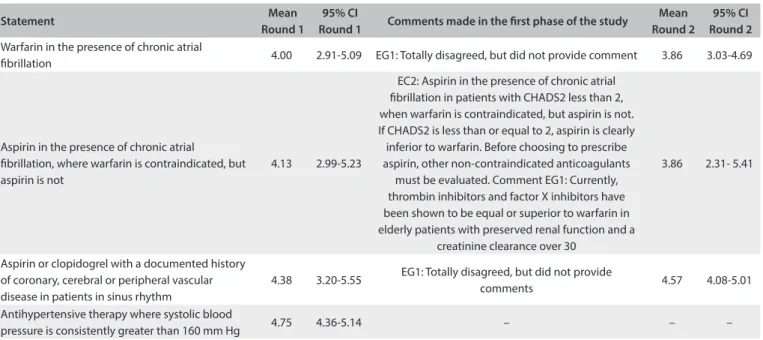
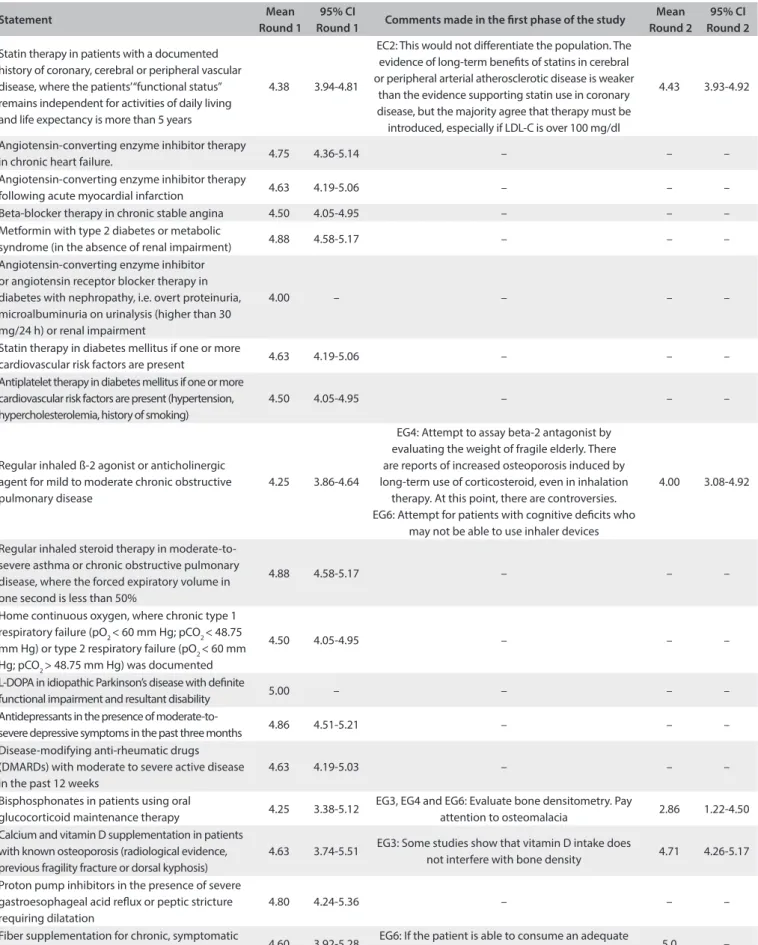
results relating to both Delphi rounds are presented in Table 1.
he START version validated and adapted for Brazilian
reali-ties is described in the Supplementary Material (in English and
Portuguese).
DISCUSSION
No consensus was reached for 36.4% of the START statements in the irst round of the Delphi survey. In the second round, all of the statements reached consensus. he likely reason for this inding was that although the START statements were published eight years ago, they exhibit current high-quality evidence sup-porting use of the drugs mentioned among older adults.
Several techniques are available for validating the content of clinical criteria, instruments or questionnaires. he Delphi tech-nique aims to reine the opinions of an expert panel to achieve a consensus, by means of several questionnaires with controlled
feedback.6 It is a systematic method based on the participants’
clinical experience, and therefore the level of expertise among
the participants needs to be assessed before its application.3,6,9
All of the START ields of expertise were assessed by a minimum of eight experts. he participants selected were well known for their medical expertise, as well as for the number of scientiic articles that they had published in Brazilian and international journals. In addition, all of the participants had had signiicant experience in relation to care for older adults, and they were ailiated to higher education institutions. hese features make it possible to obtain highly qualiied contributions and to gather together experts with diferent experiences encompassing several specialties.
Two sworn translators were selected to perform the forward translation (irst translator to the Brazilian Portuguese language) and back-translation (second translator) because these profes-sionals were certiied to perform translations, which therefore are oicially attested for the entire territory of Brazil. his choice contributed towards improving the quality of the translated doc-ument, which is an important factor, because the document was
Statement Mean
Round 1
95% CI
Round 1 Comments made in the irst phase of the study
Mean Round 2
95% CI Round 2
Warfarin in the presence of chronic atrial
ibrillation 4.00 2.91-5.09 EG1: Totally disagreed, but did not provide comment 3.86 3.03-4.69
Aspirin in the presence of chronic atrial
ibrillation, where warfarin is contraindicated, but aspirin is not
4.13 2.99-5.23
EC2: Aspirin in the presence of chronic atrial ibrillation in patients with CHADS2 less than 2, when warfarin is contraindicated, but aspirin is not. If CHADS2 is less than or equal to 2, aspirin is clearly inferior to warfarin. Before choosing to prescribe aspirin, other non-contraindicated anticoagulants
must be evaluated. Comment EG1: Currently, thrombin inhibitors and factor X inhibitors have been shown to be equal or superior to warfarin in elderly patients with preserved renal function and a
creatinine clearance over 30
3.86 2.31- 5.41
Aspirin or clopidogrel with a documented history of coronary, cerebral or peripheral vascular disease in patients in sinus rhythm
4.38 3.20-5.55 EG1: Totally disagreed, but did not provide
comments 4.57 4.08-5.01
Antihypertensive therapy where systolic blood
pressure is consistently greater than 160 mm Hg 4.75 4.36-5.14 – – –
Statement Mean Round 1
95% CI
Round 1 Comments made in the irst phase of the study
Mean Round 2
95% CI Round 2
Statin therapy in patients with a documented history of coronary, cerebral or peripheral vascular disease, where the patients’ “functional status” remains independent for activities of daily living and life expectancy is more than 5 years
4.38 3.94-4.81
EC2: This would not diferentiate the population. The evidence of long-term beneits of statins in cerebral or peripheral arterial atherosclerotic disease is weaker
than the evidence supporting statin use in coronary disease, but the majority agree that therapy must be
introduced, especially if LDL-C is over 100 mg/dl
4.43 3.93-4.92
Angiotensin-converting enzyme inhibitor therapy
in chronic heart failure. 4.75 4.36-5.14 – – –
Angiotensin-converting enzyme inhibitor therapy
following acute myocardial infarction 4.63 4.19-5.06 – – –
Beta-blocker therapy in chronic stable angina 4.50 4.05-4.95 – – –
Metformin with type 2 diabetes or metabolic
syndrome (in the absence of renal impairment) 4.88 4.58-5.17 – – –
Angiotensin-converting enzyme inhibitor or angiotensin receptor blocker therapy in diabetes with nephropathy, i.e. overt proteinuria, microalbuminuria on urinalysis (higher than 30 mg/24 h) or renal impairment
4.00 – – – –
Statin therapy in diabetes mellitus if one or more
cardiovascular risk factors are present 4.63 4.19-5.06 – – –
Antiplatelet therapy in diabetes mellitus if one or more cardiovascular risk factors are present (hypertension, hypercholesterolemia, history of smoking)
4.50 4.05-4.95 – – –
Regular inhaled ß-2 agonist or anticholinergic agent for mild to moderate chronic obstructive pulmonary disease
4.25 3.86-4.64
EG4: Attempt to assay beta-2 antagonist by evaluating the weight of fragile elderly. There are reports of increased osteoporosis induced by long-term use of corticosteroid, even in inhalation
therapy. At this point, there are controversies. EG6: Attempt for patients with cognitive deicits who
may not be able to use inhaler devices
4.00 3.08-4.92
Regular inhaled steroid therapy in moderate-to-severe asthma or chronic obstructive pulmonary disease, where the forced expiratory volume in one second is less than 50%
4.88 4.58-5.17 – – –
Home continuous oxygen, where chronic type 1 respiratory failure (pO2 < 60 mm Hg; pCO2 < 48.75 mm Hg) or type 2 respiratory failure (pO2 < 60 mm Hg; pCO2 > 48.75 mm Hg) was documented
4.50 4.05-4.95 – – –
L-DOPA in idiopathic Parkinson’s disease with deinite
functional impairment and resultant disability 5.00 – – – –
Antidepressants in the presence of
moderate-to-severe depressive symptoms in the past three months 4.86 4.51-5.21 – – –
Disease-modifying anti-rheumatic drugs (DMARDs) with moderate to severe active disease in the past 12 weeks
4.63 4.19-5.03 – – –
Bisphosphonates in patients using oral
glucocorticoid maintenance therapy 4.25 3.38-5.12
EG3, EG4 and EG6: Evaluate bone densitometry. Pay
attention to osteomalacia 2.86 1.22-4.50
Calcium and vitamin D supplementation in patients with known osteoporosis (radiological evidence, previous fragility fracture or dorsal kyphosis)
4.63 3.74-5.51 EG3: Some studies show that vitamin D intake does
not interfere with bone density 4.71 4.26-5.17
Proton pump inhibitors in the presence of severe gastroesophageal acid relux or peptic stricture requiring dilatation
4.80 4.24-5.36 – – –
Fiber supplementation for chronic, symptomatic
diverticular disease with constipation 4.60 3.92-5.28
EG6: If the patient is able to consume an adequate
luid intake 5.0 –
Table 1. Continuation
thus oicially recognized by public institutions and agencies and thus would be valid as an oicial or legal document.
Sworn translators are usually trained in the humanities and are approved for translating public edicts issued by the state boards of trade. hus, such translators might be unacquainted with some medical terms, thus resulting in slight errors in trans-lation. Such errors are expected, and therefore a review panel needs to be established in order to compare the original and translated versions before the process of content validation is started. In this manner, possible discrepancies can be resolved and the translation can be made fully understandable and can
have satisfactory cross-cultural equivalence of scales.8 he
assess-ment performed by the reviewers enabled adaptation of technical terms relating to drug classes and units of measurements, before the Delphi consensus technique was applied, without the risk of compromising the study.
In the irst phase of the study, consensus was not attained for the cardiology-related statements describing the use of warfarin for chronic atrial ibrillation. he main studies conducted with new anticoagulant agents have compared these agents with war-farin and have aimed to assess the beneits and risks associated
with these agents.10-12 However, most of these studies have been
non-inferiority trials, i.e. comparative eicacy studies, which are performed to compare a new treatment with a traditional treat-ment in order to show that the new one is not inferior, but also
not superior, to the existing treatment.13
Use of statins in cases with a known history of cerebral, peripheral or vascular disease, in which the patient remains functionally independent for activities of daily living and the life expectancy is more than ive years, was also discussed and included for discussion in the second phase of the study. In this second phase, a consensus was achieved with regard to the evi-dence showing that the long-term beneit of statins in cerebral or peripheral atherosclerotic artery disease is poorer than that for coronary artery disease. Nevertheless, most of the participants agreed that statin therapy should be used, particularly when the low-density lipoprotein cholesterol (LDL-C) level is higher than
100 mg/dl.12,14-17
Furthermore, no consensus was reached in the irst phase of the study in relation to the use of bisphosphonates in patients undergoing oral corticosteroid maintenance therapy. Bisphosphonates have antiresorptive action and increase bone mass. hey are indicated for treatment and prevention of bone disorders. hey are considered to be the irst choice for treating osteoporosis and should be used together with calcium
and vitamin supplements.18,19
A recent review failed to ind any systematic reviews or meta-analyses of studies with three-year or longer follow-ups assessing fractures as outcomes associated with use of bisphosphonates.
Nevertheless, case reports from Singapore and the United States have described occurrences of transverse fractures in the upper femoral shat in patients treated with bisphosphonates. It is worth noting that most analyses on clinical trials or large datasets have failed to demonstrated higher total numbers of bone fractures
among bisphosphonate users.20 In the second phase of the
pres-ent study, the experts agreed on the use of bisphosphonates, following comments made by their peers. Just as in the case of warfarin, lack of critical analysis about the issue discussed might have contributed to the failure to achieve consensus in the irst phase, because case reports do not suice to exclude the use of medications with proven eicacy and safety in previously per-formed, well-designed clinical trials. Under such circumstances, case reports may be considered to be a possible source of infor-mation on adverse reactions to drugs, and they could be useful in guiding the monitoring of the agents involved.
Additionally, the score for regularly inhaled ß-2 agonists or anticholinergic agents in mild-to-moderate asthma or chronic obstructive pulmonary disease was less than the cutof point of the 95% CI in the irst phase of the study. It was therefore dis-cussed again in the second phase. Some studies conducted among older adults have shown that ß-2 agonists might reduce the risk of exacerbation of asthma or chronic obstructive
pulmo-nary disease, in addition to improving the patient’s survival.19 ß-2
agonists were also used among older adults with cardiovascular and chronic obstructive pulmonary disease, and the results indi-cated that these drugs did not seem to inluence the occurrence
of cardiac and pulmonary events or death in that population.21
he lower limit of the conidence interval regarding the use of iber supplementation for chronic, symptomatic diverticular disease with constipation was less than the preset cutof point, and so it was included in the second round of discussion. All of the participants agreed with this statement in the second phase. Use of iber supplementation for treating diverticular disease has been adopted in several studies, in which iber intake seemed to be associated with better outcomes in comparisons among indi-viduals who ate iber-rich foods. Use of iber-rich foods has also been associated with the development of diverticular disease, given that the likelihood of developing this disease seemed to be
higher among individuals eating low-iber diets.22,23
he reproducibility of this study will be evaluated through the master’s degree project of one of the present authors.
Limitations of the study
held their previous positions due to the lack of new evidence requiring discussion. he Delphi consensus technique eliminates interpersonal factors that oten inluence consensus groups or committees, in which participants are face to face, and it encour-ages manifestation of honest opinions because of the lack of group pressure. he cost of applying the Delphi technique is low because there is no need for the participants to meet. he limita-tions of this technique derive from the doubts that are frequently cast on its scientiic respectability, particularly regarding the
selection and number of experts and the consensus criteria.24
To minimize these problems, a larger number of experts were
invited to participate, in comparison with the original criteria.7
Regarding the consensus criteria, the cutof point for accepting the experts’ opinions was established before the start of the study. Another limitation is that the study was not designed to add new statements to START. Doing so could have added the abil-ity to screen for possible prescription omissions that were not described in the original instrument.
CONCLUSION
START was translated and adapted to Brazilian realities. Its vali-dation by means of the Delphi consensus technique showed full agreement among the participants. START might be useful for other researchers and in clinical practice, with the aim of reducing the numbers of errors of omission with regard to prescriptions.
REFERENCES
1. Silva AL, Ribeiro AQ, Klein CH, Acurcio F de A. Utilização de medicamentos por idosos brasileiros, de acordo com a faixa etária: um inquérito postal [Use of medications by elderly Brazilians according to age: a postal survey]. Cad Saude Publica. 2012;28(6):1033-45. 2. Oliveira MG, Amorim WW, de Jesus SR, Rodrigues VA, Passos LC.
Factors associated with potentially inappropriate medication use by the elderly in the Brazilian primary care setting. Int J Clin Pharm. 2012;34(4):626-32.
3. Barry PJ, Gallagher P, Ryan C, O’Mahony D. START (screening tool to alert doctors to the right treatment) -- an evidence-based screening tool to detect prescribing omissions in elderly patients. Age Ageing. 2007;36(6):632-8.
4. Page RL 2nd, Ruscin JM. The risk of adverse drug events and hospital-related morbidity and mortality among older adults with potentially inappropriate medication use. Am J Geriatr Pharmacother. 2006;4(4):297-305.
5. Gallagher P, O’Mahony D. STOPP (Screening Tool of Older Persons’ potentially inappropriate Prescriptions): application to acutely ill elderly patients and comparison with Beers’ criteria. Age Ageing. 2008;37(6):673-9. 6. Diamond IR, Grant RC, Feldman BM, et al. Deining consensus: a
systematic review recommends methodologic criteria for reporting of Delphi studies. J Clin Epidemiol. 2014;67(4):401-9.
7. O’Mahony D, Gallagher P, Ryan C, et al. STOPP & START criteria: A new approach to detecting potentially inappropriate prescribing in old age. European Geriatric Medicine. 2010;1(1):45-51. Available from: http://www.sciencedirect.com/science/article/pii/ S1878764910000112. Accessed in 2015 (Feb 24).
8. Guillemin F, Bombardier C, Beaton D. Cross-cultural adaptation of health-related quality of life measures: literature review and proposed guidelines. J Clin Epidemiol. 1993;46(12):1417-32.
9. Noblat L, Oliveira MG, Santos-Jesus R, Noblat AC, Badaró R. Validation of criteria for nosocomial use of amikacin in Brazil with the Delphi technique. Braz J Infect Dis. 2006;10(3):173-8.
10. Connolly SJ, Ezekowitz MD, Yusuf S, et al. Dabigatran versus warfarin in patients with atrial ibrillation. N Engl J Med. 2009;361(12):1139-51. 11. Granger CB, Alexander JH, McMurray JJ, et al. Apixaban versus warfarin in patients with atrial ibrillation. N Engl J Med. 2011;365(11):981-92. 12. Patel MR, Mahafey KW, Garg J, et al. Rivaroxaban versus warfarin in
nonvalvular atrial ibrillation. N Engl J Med. 2011;365(10):883-91. 13. Pinto VF. Estudos clínicos de não-inferioridade: fundamentos e
controvérsias [Non-inferiority clinical trials: concepts and issues]. J Vasc Bras. 2010;9(3):145-51.
14. Schwartz GG, Olsson AG, Ezekowitz MD, et al. Efects of atorvastatin on early recurrent ischemic events in acute coronary syndromes: the MIRACL study: a randomized controlled trial. JAMA. 2001;285(13):1711-8.
15. Vale N, Nordmann AJ, Schwartz GG, et al. Statins for acute coronary syndrome. Cochrane Database Syst Rev. 2011;(6):CD006870. 16. Lobos Bejarano JM, Galve E, Royo-Bordonada MA, et al. Spanish
Interdisciplinary Committee for Cardiovascular Disease Prevention and the Spanish Society of Cardiology position statement on dyslipidemia management. Diferences between the European and American guidelines. Rev Esp Cardiol (Engl Ed). 2014;67(11):913-9. 17. Murphy SA, Cannon CP, Wiviott SD, McCabe CH, Braunwald E.
Reduction in recurrent cardiovascular events with intensive lipid-lowering statin therapy compared with moderate lipid-lipid-lowering statin therapy after acute coronary syndromes from the PROVE IT-TIMI 22 (Pravastatin or Atorvastatin Evaluation and Infection Therapy-Thrombolysis In Myocardial Infarction 22) trial. J Am Coll Cardiol. 2009;54(25):2358-62.
18. Kanis JA, McCloskey EV, Johansson H, et al. European guidance for the diagnosis and management of osteoporosis in postmenopausal women. Osteoporos Int. 2013;24(1):23-57.
19. Kaufman JM, Reginster JY, Boonen S, et al. Treatment of osteoporosis in men. Bone. 2013;53(1):134-44.
20. Reid IR. Osteoporosis treatment: focus on safety. Eur J Intern Med. 2013;24(8):691-7.
22. Ünlü C, Daniels L, Vrouenraets BC, Boermeester MA. A systematic review of high-ibre dietary therapy in diverticular disease. Int J Colorectal Dis. 2012;27(4):419-27.
23. Weizman AV, Nguyen GC. Diverticular disease: epidemiology and management. Can J Gastroenterol. 2011;25(7):385-9.
24. Chang CB, Chan DC. Comparison of published explicit criteria for potentially inappropriate medications in older adults. Drugs Aging. 2010;27(12):947-57.
Sources of funding: None
Conlicts of interest: None
Date of irst submission: November 17, 2014
Last received: January 15, 2015
Accepted: January 31, 2015
Address for correspondence:
Aline Cristina Luz
Av. Leovigildo Filgueiras, 361 - apto 31 Bairro Garcia - Salvador (BA) - Brasil CEP 40100-000
Statement Field of expertise
Warfarin in the presence of chronic atrial ibrillation. Cardiology
Aspirin in the presence of chronic atrial ibrillation, where warfarin is contraindicated, but not aspirin. Cardiology Aspirin or clopidogrel with a documented history of coronary, cerebral or peripheral vascular disease in patients in sinus rhythm. Cardiology
Antihypertensive therapy where systolic blood pressure is consistently greater than 160 mmHg. Cardiology
Statin therapy in patients with a documented history of coronary, cerebral or peripheral vascular disease, where the patients’
“functional status” remains independent for activities of daily living and life expectancy is more than ive years. Cardiology
Angiotensin-converting enzyme inhibitor therapy in chronic heart failure. Cardiology
Angiotensin-converting enzyme inhibitor therapy following acute myocardial infarction. Cardiology
Beta-blocker therapy in chronic stable angina. Cardiology
Metformin with type 2 diabetes or metabolic syndrome (in the absence of renal impairment). Endocrinology
Angiotensin-converting enzyme inhibitor or angiotensin receptor blocker therapy in diabetes with nephropathy, i.e. overt
proteinuria, microalbuminuria on urinalysis (higher than 30 mg/24 h) or renal impairment. Endocrinology
Statin therapy in diabetes mellitus if one or more cardiovascular risk factors are present. Endocrinology
Antiplatelet therapy in diabetes mellitus if one or more cardiovascular risk factors are present (hypertension,
hypercholesterolemia or history of smoking). Endocrinology
Regular inhaled ß-2 agonist or anticholinergic agent for mild to moderate chronic obstructive pulmonary disease. Pulmonology Regular inhaled steroid therapy in moderate-to-severe asthma or chronic obstructive pulmonary disease, where the forced
expiratory volume in one second is less than 50%. Pulmonology
Home continuous oxygen, where chronic type 1 respiratory failure (pO2 < 60 mm Hg; pCO2 < 48.75 mm Hg) or type 2 respiratory
failure (pO2 < 60 mmHg; pCO2 > 48.75 mmHg) was documented. Pulmonology
L-DOPA in idiopathic Parkinson’s disease with deinite functional impairment and resultant disability. Neurology
Antidepressants in the presence of moderate-to-severe depressive symptoms in the past three months. Neurology
Disease-modifying anti-rheumatic drugs (DMARDs) with moderate to severe active disease in the past 12 weeks. Rheumatology
Bisphosphonates in patients using oral glucocorticoid maintenance therapy. Rheumatology
Calcium and vitamin D supplementation in patients with known osteoporosis (radiological evidence, previous fragility fracture
or dorsal kyphosis). Rheumatology
Proton pump inhibitors in the presence of severe gastroesophageal acid relux or peptic stricture requiring dilatation. Gastroenterology
Fiber supplementation for chronic, symptomatic diverticular disease with constipation. Gastroenterology
Supplementary Material. START screening tool, adapted and validated by means of the modiied Delphi technique
Proposição Área de concentração
Varfarina na presença de ibrilação atrial crônica Cardiologia
Aspirina na presença de ibrilação atrial crônica, onde varfarina é contraindicada, mas não a aspirina. Cardiologia Aspirina ou clopidogrel quando há história diagnosticada de doença arterial coronariana, doença vascular cerebral ou periférica
em pacientes em ritmo sinusal. Cardiologia
Terapia anti-hipertensiva quando pressão sistólica permanecer constantemente superior a 160 mmHg. Cardiologia
Terapia com estatinas em pacientes com história diagnosticada de doença vascular periférica ou cerebral onde o “status
funcional” do paciente permanece independente para as atividades diárias e expectativa de vida superior a cinco anos. Cardiologia
Inibidor da enzima conversora de angiotensina na insuiciência cardíaca crônica. Cardiologia
Inibidor da enzima conversora de angiotensina após infarto agudo do miocárdio. Cardiologia
Beta-bloqueador na angina crônica estável. Cardiologia
Metformina no diabetes tipo 2 ou síndrome metabólica (na ausência de disfunção renal). Endocrinologia
Inibidor da enzima conversora de angiotensina ou bloqueador dos receptores da angiotensina em pacientes com nefropatia
diabética, por exemploproteinúria ou microalbuminúria evidenciada em urinálise (maior que 30mg/24 horas) ou disfunção renal. Endocrinologia Terapia com estatinas no diabetes mellitus se um ou mais fatores de risco cardiovascular estiverem presentes. Endocrinologia Terapia antiagregante plaquetária no paciente com diabetes mellitus se um ou mais fatores de risco cardiovascular coexistir
(hipertensão, hipercolesterolemia, história de fumo). Endocrinologia
Inalação regular de agonista beta-2 ou agente anticolinérgico em casos de asma leve a moderada ou doença pulmonar obstrutiva crônica. Pneumologia Inalação regular de corticosteroides em casos de asma moderada a severa ou doença pulmonar obstrutiva crônica, onde o
volume expiratório forçado em um segundo seja menor que 50%. Pneumologia
Oxigênio domiciliar contínuo em insuiciência respiratória tipo 1 documentada (pO2 < 60 mmHg, pcO2 < 48.75 mmHg) ou insuiciência respiratória tipo 2 (pO2 < 60 mmHg, pCO2 > 48.75 mmHg).
Pneumologia
L-dopa em doença de Parkinson idiopática com disfunção funcional diagnosticada e resultando em incapacidade. Neurologia Medicamentos antidepressivos na presença sintomas depressivos moderados-severos durante os últimos três meses. Neurologia Medicamentos modiicadores da doença reumática (DMARD) na doença moderada-severa ativa nas últimas 12 semanas. Reumatologia
Bifosfonatos em pacientes em uso de terapia oral de manutenção com corticoides. Reumatologia
Suplemento de cálcio e vitamina D em pacientes com osteoporose diagnosticada (evidência radiológica ou fratura devido
fragilidade anterior ou cifose dorsal adquirida). Reumatologia
Inibidores da bomba de prótons em doença do reluxo gastro-esofágico severa ou estenose péptica requerendo dilatação. Gastroenterologia
Suplemento de ibras para doença diverticular sintomática crônica apresentando constipação. Gastroenterologia