448
Primary Renal Angiosarcoma Case Report
International Braz J Urol Vol. 32 (4): 448-450, July - August, 2006
Primary Renal Angiosarcoma
Osmar E. Souza, Renata M. Etchebehere, Marcus A. Lima, Paulo R. Monti
Section of Urology and Pathology, Triangulo Mineiro School of Medicine, Uberaba, Minas Gerais,
Brazil
ABSTRACT
Primary renal Angiosarcoma is a rare neoplasm and only 24 cases have been reported in specialized literature.
We describe a case of primary renal angiosarcoma in a patient presenting with hematuria, palpable abdominal mass, left flank pain and anemia. A computerized tomography of the abdomen with contrast medium showed a tumor with 15 cm diameter, in the upper pole of the left kidney, with a low-density central area, suggesting necrosis or hemorrhage. Diagnosis was given in a morphologic base and proven by an immunohistochemical study.
Primary renal angiosarcoma should be included among differential diagnosis of retroperitoneal hematoma and hemor-rhagic renal tumors.
Key words: kidney neoplasms; angiosarcoma; nephrectomy; hematoma; retroperitoneal space Int Braz J Urol. 2006; 32: 448-50
INTRODUCTION
Sarcomas constitute 2 to 3% of primary ma-lignant renal tumors and leiomyosarcoma corresponds to 60% of them (1).
Angiosarcomas are localized or multicentric tumors, with various grades of differentiation and are originated in the endothelium of the blood and lymphatic vessels (1,2). They are high degree ma-lignant neoplasms of primary occurrence, extremely rare in the kidneys, with 24 cases described (3). They are frequently hemorrhagic tumors, being able to simulate a retroperitoneal hematoma or cause mas-sive hematuria (1-3).
We present a case of primary renal angiosar-coma and emphasize its hemorrhagic behavior.
CASE REPORT
449
Primary Renal Angiosarcoma
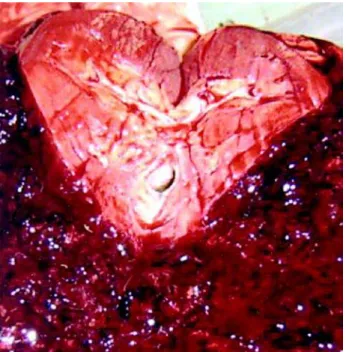
Patient received blood transfusion with 1200 mL of red blood cells and was submitted to left radi-cal nephrectomy through a transverse laparotomy. Surgical specimen was constituted by the kidney, peri-renal fat and the adperi-renal, measuring 21 x 16 x 9 cm and weighing 1407 grams. In the upper pole of the kidney we have observed an hematoma measuring
14 x 10 x 9 cm that expanded to the perirenal space (Figure-2). After the coagulum was removed we have observed an irregular nut-brown cavity, compromis-ing approximately 20% of the renal parenchyma. Microscopically it was a malignant neoplasm consti-tuted of a number of irregular vascular spaces, anas-tomosed, covered by discretely pleomorphic cells, with voluminous and hyperchromatic nuclei, with rare stratification and papilliform projections that infil-trated the circumjacent renal parenchyma. Immuno-histochemical study showed that neoplasic cells were positive for antibodies CD31, CD34 and anti-factor VIII (Figure-3). Pathologic staging was pT2pN0pMx.
Patient was discharged 11 days after the sur-gery being, however, re-admitted 15 days after the discharge with emaciation, dehydration, somnolence and mental confusion. Progressed with bilateral bron-chopneumonia and death due to sepsis, even though he was submitted to venous antibiotic therapy. No radiotherapy, chemotherapy, crane tomography, bone scintigraphy and necropsy were performed.
Figure 1 – Computerized tomography of the abdomen showing a mass in the upper pole of the left kidney with a hypodense central area.
Figure 2 – Open surgical specimen showing a large hematoma in the upper pole of the kidney, expanded to the perirenal space.
450
Primary Renal Angiosarcoma
COMMENTS
Angiosarcomas are little differentiated neo-plasms and, frequently require confirmation by im-munohistochemistry. They demonstrate positivity for endothelial cell markers, such as factor VIII, antibod-ies anti-CD34 and CD31, the latter is more sensible and specific.
These tumors are initially presented in an advanced stage, and liver, lungs and bones metasta-sis are common. Local recurrence after radical ne-phrectomy are frequent. Most common clinical mani-festations are pain in the flank in 81% of the cases, hematuria in 38% and palpable mass in 31%. Because they are hemorrhagic tumors, patients can usually present anemia. Treatment consists of radical surgery associated to radiotherapy for the local control of the disease. Systemic chemotherapy with cisplatin and isofamide or doxorubicin and isofamide presented a 44 and 71% response rate, respectively. However, patient’s mean survival rate is of 13 weeks after diag-nosis (2).
Primary renal angiosarcoma should be re-membered among differential diagnosis in cases of retroperitoneal hematoma and in hemorrhagic renal tumors.
CONFLICT OF INTEREST
None declared.
REFERENCES
1. Martinez-Pineiro L, Lopez-Ferrer P, Picazo ML, Martinez-Pineiro JA: Primary renal angiosarcoma. Case report and review of the literature. Scand J Urol Nephrol. 1995; 29: 103-8.
2. Tsuda N, Chowdhury PR, Hayashi T, Anami M, Iseki M, Koga S, et al.: Primary renal angiosarcoma: a case report and review of the literature. Pathol Int. 1997; 47: 778-83.
3. Costero-Barrios CB, Oros-Ovalle C: Primary renal an-giosarcoma. Gac Med Mex. 2004; 140: 463-6.
Accepted after revision: November 30, 2005