LAPAROSCOPIC NEPHRECTOMY IN INFLAMMATORY RENAL
DISEASE: PROPOSAL FOR A STAGED APPROACH
M. TOBIAS-MACHADO, MARCO T. LASMAR, LUCAS T. BATISTA, PEDRO H. FORSETO
JR, ROBERTO V. JULIANO, ERIC R. WROCLAWSKI
Division of Urology, ABC Medical School, Santo André, Sao Paulo, Brazil
ABSTRACT
Introduction: The present study shows and discusses the preliminary experience of custom-ized and staged approach in the minimally invasive treatment of inflammatory renal diseases, using either pure laparoscopic surgery or the hand-assisted technique.
Materials and Methods: We prospectively assessed 17 patients with inflammatory renal dis-eases operated by laparoscopic approach. Mean age was 41 years and the surgical indication was repeated pyelonephritis in 8 cases, pyonephrosis in 4 cases and renal exclusion due to staghorn stone in 5 cases. The staged laparoscopic approach was chosen based on kidney size and on the presence or not of tomographic findings showing significant perirenal infiltration. Thus, retroperitoneal access was chosen in cases where the kidney was smaller than 12 cm or in the absence of signs of significant perirenal infiltration on the computerized tomography. For the remainder, transperitoneal access was employed.
Results: Of the 17 patients, 11 underwent laparoscopic nephrectomy by retroperitoneal ac-cess, and all cases were successful. Mean surgical time was 160 minutes. In 6 cases where the nephre-ctomy was performed by laparoscopic transperitoneal access, the use of hand assistance was required. Four surgeries were successfully completed with mean time of 190 minutes and 2 were converted to open surgery with mean time of 220 minutes.
Conclusion: The laparoscopic nephrectomy for inflammatory renal disease is feasible, but presents a high degree of complexity, requiring a customized approach. The use of hand assistance is an attractive option when the inflammatory process is intense, and can avoid conversions, maintain-ing the advantages of minimally invasive treatments.
Key words: kidney; laparoscopy; nephrectomy; pyelonephritis; pyonephrosis; kidney calculi
Int Braz J Urol. 2005; 31: 22-28
INTRODUCTION
The laparoscopic nephrectomy was first de-scribed by Clayman in 1990 (1). Inflammatory renal diseases (IRD), due to their technical difficulty, were considered as relative contra-indications to the laparoscopic procedure by the first series in the lit-erature (2). The difficult individualization of the re-nal pedicle, perirere-nal adherences or adhesions to ad-jacent organs, purulent secretions inside the kidney
nephre-ctomies. It is estimated that only 15% of cases of laparoscopic nephrectomies performed in developed countries are due to an inflammatory etiology, result-ing in a lower number of publications on this surgical technique. Rassweiler et al. (2) reported the experi-ence of 482 laparoscopic nephrectomies where only 62 were due to chronic pyelonephritis or renal tuber-culosis. Shekarriz et al. (3) described 12 cases of in-flammatory renal pathology that were operated within a 2-year period.
In an effort to minimize technical difficulties and complications, some authors recommend the hand-assisted laparoscopic approach. The direct ac-cess of the hand would make the dissection of planes easier, as well as the ligation of the vascular pedicle and the control of eventual complications, reducing the surgical time, technical difficulties and morbid-ity of the surgery (4,5).
The present study shows and discusses the preliminary experience with staged and customized approach to inflammatory renal diseases, originated from pure laparoscopic technique. In more difficult cases, the hand-assisted technique is used before con-verting to open surgery, aiming to preserve minimally invasive features in the treatment of these renal con-ditions.
MATERIALS AND METHODS
Seventeen patients with mean age of 41 years (25-78 years) were treated during the period from 1998 to 2003. All patients were assessed with clinical his-tory and imaging tests (ultrasonography and comput-erized tomography - CT). All were operated by the same surgeon and prospectively followed in visits after 7, 30, 60 and 180 days from surgery. Surgical indications were repeated pyelonephritis with no evidence of lithi-asis in 8 cases, pyonephrosis in 4 cases and renal ex-clusion due to staghorn stone in 5 cases.
The proposed staged approach consists in assessing pre-operative and surgical data in order to direct the therapeutic decisions. Whenever possible, the initial intention was to avoid contamination of the peritoneal cavity, by choosing the retroperitoneal laparoscopic access with 4 ports (6). The laparoscopic access was then selected based on kidney size and on
the presence or not of tomographic findings indicat-ing significant perirenal infiltration. Thus, the retro-peritoneal access was selected in cases where the kid-ney was smaller than 12 cm or in the absence of signs of significant perirenal infiltration on the computer-ized tomography. In cases of kidneys with large di-mensions (over 12 cm) or in the presence of tomo-graphic signs of adherences or loss of contour of peri-renal fat, we initially selected the pure transperitoneal laparoscopic access through 4 ports. In this way, 11 surgeries were performed by retroperitoneoscopic approach and 6 by celioscopic approach (Figure-1).
In cases where technical difficulties were sig-nificant, hand-assistance was used in order to pro-ceed to the surgery. For institutional reasons, no de-vice for maintenance of pneumoperitoneum was used. An external pararectal incision was made, measuring the exact size of the surgeon’s wrist, which was pre-viously planned by CT at the level of the renal hilum. The presence of the hand assisted in the dissection of planes and, in more difficult cases, the renal pedicle could be ligated through this same incision using Satinsky forceps and conventional surgical retractors (7). The conversion to open surgery was indicated in cases where it would be impossible to advance with the dissection or in the occurrence of uncontrolled vascular accident.
The renal pedicle was preferably controlled with polymer clips (hem-o-lockR), only a proximal
clip and a distal one, either for renal artery or for vein. Metallic clips were used for controlling lymphatic and other smaller vessels and, in the absence of polymer clips, for controlling the renal pedicle (at least 2 proxi-mal clips). The use of an endovascular stapler is par-ticularly useful for controlling the right renal vein, being employed in only 2 cases due to institutional reasons.
Due to the higher risk of infection, at the end of the surgery, the surgical cavity was irrigated with saline solution and drained in all cases with Penrose, which was exteriorized by one of the port orifices. The incisions were closed with non-absorbable monofilament sutures.
RESULTS
Overall results are presented on Table-1.
Retroperitoneal Access
All the 11 cases were successfully operated with a mean surgical time of 160 minutes (90-180 min). There was no need for blood transfusions or conversion. In no case the hand-assisted technique
was required. There were peritoneal perforations in 4 cases. However, the isolation of the peritoneal cav-ity was preserved, and we did not observe gross tamination to the peritoneal cavity. This fact was con-firmed by the good postoperative outcome of patients, without a longer period of adynamic ileus. Patients were discharged from hospital in average at the 3rd postoperative day (1 - 5 days). Two patients had in-fection of the surgical wound, which evolved satis-factorily with antibiotics and skin drainage. Recov-ery for routine activities occurred in average within 3 weeks (15-40 days) after surgery.
Transperitoneal Access
In all 6 patients hand assistance was required due to difficulty in concluding the procedure. Among
these, 4 cases were successfully completed by sub-capsular nephrectomy. In 2 cases, laparoscopic vas-cular control was possible with endoscopic stapler, and in 2 cases with external ligation of the renal pedicle with Satinsky forceps, with no need for en-larging the incision. Conversion to open surgery was required in 2 cases, which was done by enlarging the manual incision. One case resulted from difficulty for advancing and the other one from damage to the renal vein close to the caval insertion. Transfusion of one unit of red cell concentrate was required in 2 cases.
In the 4 cases successfully completed, mean surgical time was 190 minutes (180-200 min), with discharge from hospital at the 3rd postoperative day. There were no postoperative complications. Recov-ery for routine activities occurred in average after 30 postoperative days.
In the 2 cases converted to open surgery, mean surgical time was 220 minutes (210-230 min), with discharge from hospital in average at the 7th postoperative day (6-8 days). One of the patients, who had a body mass index higher than 30, presented in-fection of abdominal wall and late incisional hernia on the follow-up. The return to routine activities oc-curred after 8 weeks postoperatively in both cases.
COMMENTS
Benign renal disease is the most frequent cause of laparoscopic nephrectomy. Rassweleir et al. (2) reported that 92% of 482 laparoscopic nephrec-tomies were due to benign pathologies. Among
the-ses, the inflammatory renal diseases are still a chal-lenging therapeutic situation. Many authors consider the laparoscopic treatment improper for such diseases due to the presence of significant perirenal adhesions and perihilar fibrosis (8). The existence of perirenal neovascularization due to the inflammatory process leads to higher technical complexity and motivate surgical conversion. Minor bleedings are frequent and can fill the surgical field preventing surgical advance-ment. Due to the difficult individualization of the main vessels trunk in the renal hilum, many times several ligations are required close to the kidney instead of a single ligation on the main vascular trunk. The dis-section of perirenal fat is usually more difficult due to the thickening of the Gerota’s fascia, and many times it is often dissected jointly with the kidney, similarly to what is performed on radical nephrectomy (9). Kidney size is also directly related to technical difficulty. Larger kidneys are more difficult to treat by laparoscopic tech-nique, especially in retroperitoneal access, where the working space is more limited.
There is controversy in the literature concern-ing the selection between transperitoneal and retro-peritoneal laparoscopic access for nephrectomy. The chosen technique apparently corresponds to the surgeon’s own choice as a result of his expertise and training.
Both approaches have been performed, but there are no clear advantages used to define the op-tion or which access would be more proper for treat-ing inflammatory renal diseases (2-4,10,11).
The retroperitoneal access allows a procedure without manipulation of intraperitoneal organs,
reduc-Table 1 – Results after 17 patients operated due to inflammatory renal disease by staged laparoscopic approach.
Access
Retroperitoneal
Transperitoneal
N
11
6
Mean surgical time (min)
160
4 HA = 190 2 C = 220
Mean hospital stay (days)
3
3 7
Complications
2
0 2
Conversions
0
0 2
Convalescence
21
30 60
with xanthogranulomatous pyelonephritis, tubercu-losis and post-traumatic atrophy. Bercowsky et al. (9) described a series of 4 laparoscopic nephrectomies (2 transperitoneal and 2 retroperitoneal) for xanthogranulomatous pyelonephritis, where one case was converted due to adhesions, other presented pro-longed paralytic ileus and another had pulmonary embolism (9).
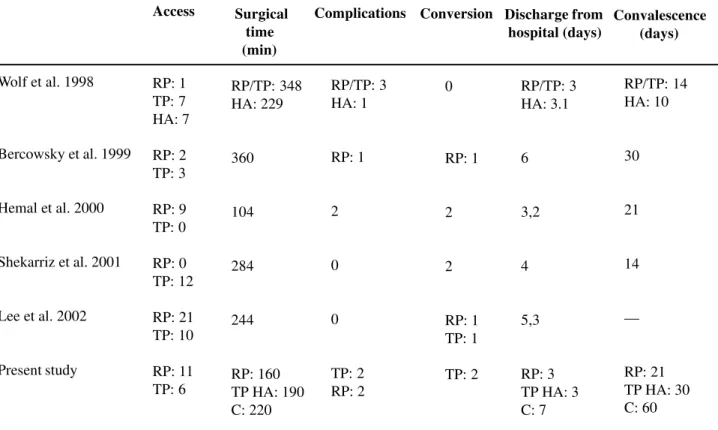
On the other hand, some works show accept-able results attesting the possibility of using the laparoscopic technique in the treatment of IRD. Keeley et al. (15) performed 79 nephrectomies, with 42 in inflammatory kidneys. Among these, 11% were converted due to absence of surgical progression and 16% had minor complications. Shekarriz et al. (2) successfully performed 83% of laparoscopic nephre-ctomies in inflammatory kidneys with no increase in morbidity, but with increased surgical time. Conver-sion was required in 17% of cases, with no other com-plications. Lee et al. (16) compared 31 transperitoneal and retroperitoneal laparoscopic nephrectomies (10 and 21 respectively) in patients with tuberculosis, with 45 simple laparoscopic nephrectomies. Mean surgi-cal time was 244 minutes for the tuberculosis group and 216 minutes for simple laparoscopic nephrecto-mies. However, 8 of the 45 simple laparoscopic ne-phrectomies were performed on inflammatory kid-neys, probably increasing surgical time. They obtained 5% of conversion due to adhesion, including cases with tuberculosis and xanthogranulomatous pyelone-phritis. There were also 2 incidental ruptures of tu-berculous kidney with abdominal contamination by caseous material, but after a 2-year follow-up, prolif-eration of disease was not detected. In another study comparing retroperitoneal laparoscopic nephrectomy with open nephrectomy for tuberculous kidney the authors found shorter hospitalization time as well as a shorter time to return to routine activities (Table-2).
In the present work, cases presenting kidneys with larger dimensions or showing evident signs of perirenal adhesions on tomography were selected for transperitoneal access. Surgical time on retroperito-neal access was shorter, maybe due to the smaller kid-ney size and/or less intense inflammatory infiltration as pre-operatively assessed by CT. Early access to ing the risk of direct and indirect damage to these
structures. In addition to reducing the incidence of adynamic ileus and adhesions, the retroperitoneal access keeps the peritoneal cavity isolated from uri-nary fistulas and post-operative infectious processes (6,8). This access also enables early control of the renal pedicle, which can result in a major advantage in cases of IRD. Hemal et al. (12,13) reported that the dissection and initial ligation of the renal pedicle in retroperitoneoscopic nephrectomy decreases the index of complications and the conversion rate.
The use of hand-assisted procedure is an al-ternative for cases that evolve to more complicated technical difficulties. It makes renal and hilar dissec-tion easier and safer, reducing the total surgical time. It allows direct access to the pedicle, as well as the digital renal dissection in the subcapsular plane, avoiding damage to organs or structures potentially adhered to the kidney (14). It is also an attractive option in cases with large kidneys where the techni-cal difficulties for pure laparoscopic surgery are ad-mittedly greater. The hand-assisted technique with-out using a device for maintaining pneumoperitoneum is accessible and cost-effective, however it presents the disadvantage of using compression by the surgeon’s wrist. Sometimes repeated mobilization or the removal of the surgeon’s hand from the surgical field are required when the surgical procedure gets longer, with the inconvenient loss of the pneumoperi-toneum occurring in these cases.
Wolf et al. (4) compared simple and hand-assisted laparoscopic nephrectomy and concluded that the surgical time was significantly shorter in hand-assisted technique, with no differences in the initia-tion of oral ingesinitia-tion, hospital stay and return to rou-tine activities. The author suggests that hand assis-tance should be indicated in surgeries with higher complexity degree before performing the conversion to open surgery (4).
Table 2 – Comparison between results of works describing series of laparoscopic nephrectomy for inflammatory diseases.
Wolf et al. 1998
Bercowsky et al. 1999
Hemal et al. 2000
Shekarriz et al. 2001
Lee et al. 2002
Present study
Access
RP: 1 TP: 7 HA: 7
RP: 2 TP: 3
RP: 9 TP: 0
RP: 0 TP: 12
RP: 21 TP: 10
RP: 11 TP: 6
Surgical time (min)
RP/TP: 348 HA: 229
360
104
284
244
RP: 160 TP HA: 190 C: 220
Complications
RP/TP: 3 HA: 1
RP: 1
2
0
0
TP: 2 RP: 2
Conversio
0
RP: 1
2
2
RP: 1 TP: 1
TP: 2
RP/TP: 3 HA: 3.1
6
3,2
4
5,3
RP: 3 TP HA: 3 C: 7
RP/TP: 14 HA: 10
30
21
14
—
RP: 21 TP HA: 30 C: 60
Complications Conversion
RP = retroperitoneal, TP = transperitoneal, HA = hand assistance, C = conversion to open surgery
the elements of renal hilum may be contributed to this fact, as well as for the surgical success.
Conversion rate was 11.7% due to adhesions or vascular lesion. In one case the conversion had tactical purposes, due to absence of surgical progres-sion. In other case, there was serious vascular dam-age, and the digital clamping of the bleeding site at-tenuated the emergency character of the conversion. In the present series, patients undergoing hand-assisted retroperitoneal and transperitoneal ne-phrectomy presented similar mean hospital stay and return to routine activities. However, those surgeries that were converted showed a longer hospital stay, as well as a longer time to return to routine activities.
In this study, hand assistance was used when surgery could not be advanced due to the intense inflammatory process, which prevented a safe dis-section of planes and vascular pedicle. The external pararectal incision for the hand allowed control of
the renal pedicle under direct visualization when it could not be accessed by pure laparoscopic ap-proach. In obese patients this maneuver is not al-ways feasible, and enlargement of the incision may be required.
Though the number of cases in this study does not allow a definitive statement, the staged approach seems to be a therapeutic option for IRD. The employed criteria allowed us to determine the most adequate cases for each laparoscopic access. Thus, we observed trends towards the decrease in complication and conversion rates, while maintaining the favorable features of mini-mally invasive surgeries, such as shorter hospital stay and quicker return to routine activities.
CONCLUSIONS
Laparoscopic nephrectomy for inflammatory renal diseases is a highly complex surgery, with higher
Discharge from hospital (days)
complication and conversion rates, which must be performed by experienced laparoscopists.
A customized and staged laparoscopic tech-nique can be offered to most patients with inflamma-tory renal diseases, including pyonephrosis. Hand-assisted nephrectomy can rescue some cases where conversion to open surgery would be required, while preserving the benefits inherent to minimally inva-sive surgeries.
REFERENCES
1. Clayman RV, Kavoussi LR, Soper NJ, Dierks SM, Meretyk S, Darcy MD, et al.: Laparoscopic nephrec-tomy: initial case report. J Urol. 1991; 146: 278-82. 2. Rassweiler J, Fornara P, Weber M, Janetschek G,
Fahlenkamp D, Henkel T, et al.: Laparoscopic nephre-ctomy: the experience of the laparoscopy working group of the German Urologic Association. J Urol. 1998; 160: 18-21.
3. Shekarriz B, Meng MV, Lu HF, Yamada H, Duh QY, Stoller ML: Laparoscopic nephrectomy for inflamma-tory renal conditions. J Urol. 2001; 166: 2091-4. 4. Wolf JS Jr, Moon TD, Nakada SY: Hand assisted
laparoscopic nephrectomy: comparison to standard laparoscopic nephrectomy. J Urol. 1998; 160: 22-7. 5. Wolf JS Jr, Moon TD, Nakada SY: Hand-assisted
laparoscopic nephrectomy: technical considerations. Tech Urol. 1997; 3: 123-8.
6. Tobias-Machado M, Juliano RV, Gaspar HA, Rocha RP, Borrelli M, Wroclawsky ER: Videoendoscopic surgery by extraperitoneal access: technical aspects and indication. Int Braz J Urol. 2003; 29: 441-9.
7. Pinto MA, Juliano RV, Tobias-Machado M, Borreli M, Wroclawski ER: Hand-assisted bilateral nephrectomy
in a patient with adult polycystic kidney disease. São Paulo Med J. 2002; 120: 189-91.
8. Merrot T, Ordorica-Flores R, Steyeart H, Ginier C, Valla JS: Is diffuse xanthogranulomatous pyelonephri-tis a contraindication to retroperitoneoscopic nephroureterectomy? A case report. Surg Laparosc Endosc. 1998; 8: 366-9.
9. Bercowsky E, Shalhav AL, Portis A, Elbahnasy AM, McDougall EM, Clayman RV: Is the laparoscopic ap-proach justified in patients with xanthogranulomatous pyelonefritis? Urology. 1999; 54: 437-43.
10. Siqueira TM Jr, Kuo RL, Gardner TA, Paterson RF, Stevens LH, Lingeman JE, et al.: Major complications in 213 laparoscopic nephrectomy cases: the Indianapo-lis experience. J Urol. 2002; 168: 1361-5.
11. Mc Dougall EM, Clayman RV: Laparoscopic nephre-ctomy for benign disease: comparison of the transperitoneal and retroperitoneal approaches. J Endourol.1996; 10: 45-9.
12. Hemal AK, Gupta NP, Wadhwa SN, Goel A, Kumar R: Retroperitoneoscopic nephrectomy and nephroureterectomy for benign nonfunctioning kidneys: a single-center experience. Urology. 2001; 57: 644-9. 13. Hemal AK, Gupta NP, Kumar R: Comparision of
retroperitoneoscopic nephrectomy with open surgery for tuberculous nonfunction kidneys. J Urol. 2000; 164: 32-5.
14. Moore RG, Chen RN, Hedican SP: Laparoscopic sub-capsular nephrectomy. J Endourol. 1998; 12: 263-4. 15. Keeley FX, Tolley DA: A review of our first 100 cases
of laparoscopic nephrectomy: defining risk factors for complications. Br J Urol. 1998; 82: 615-8.
16. Lee KS, Kim HH, Byun SS, Park K, Ahn H: Laparoscopic nephrectomy for tuberculous nonfunctioning kidney: comparison with laparoscopic simple nephrectomy for other diseases. Urology. 2002; 60: 411-4.
Received: September 9, 2004 Accepted after revision: December 17, 2004
Correspondence address:
Dr. Marcos Tobias-Machado Rua Graúna, 104 / 131