LITERA
TURE
RE
VIE
Correspondence to: Guilherme Henrique Lopes – SQS 109, bloco B, apto 604 – CEP: 70372-020 – Brasília (DF), Brasil – E-mail: [email protected] Presentation: Sep, 2012 – Accepted for publication: Jan, 2013 – Financing source: none – Conflict of interests: nothing to declare
in children with cerebral palsy: a literature review
Posturograia na análise do equilíbrio
em crianças com paralisia cerebral: revisão de literatura
Posturografía en el análisis del equilibrio en niños con parálisis cerebral: revisión de literatura
Guilherme Henrique Ramos Lopes1, Ana Cristina de David2This study was conducted at the Physical Education School of Universidade de Brasília (UnB) – Brasília (DF), Brazil.
1Master’s Degree Student of Physical Education (Infant Motor Performance) in the Postgraduate Department at the Physical Education
School at UnB – Brasília (DF), Brazil.
2PhD in Physical Education (Biomechanics); Associate Professor at the Physical Education School at UnB – Brasília (DF), Brazil.
ABSTRACT | Children with cerebral palsy (CP) have reduced
postural control given that sensory and motor functions are compromised. There are several functional protocols for bal-ance analysis, but few studies have used the force platform as an instrument of precision in this assessment. The objective of this review was to identify published articles that employed this evaluation of children with CP and to analyze the used protocols and parameters. To this effect, a search was carried out through the BVS in the following databases: LILACS, IBECS, MEDLINE, Cochrane Library, SciELO. A total of 165 articles were found, from which 16 were selected on the basis of the inclusion and exclusion criteria. Studies have shown that the parameters of medial-lateral and anterior-posterior linear dis-placement of the center of pressure and the sway ratio have been used more frequently, and that the evaluation time of the force platform, in most studies, does not exceed 20 seconds. This review demonstrates that children with typical develop-ment present better postural control, and children with CP can increase their balance via specific interventions, including the use of force platform.
Keywords | cerebral palsy; postural balance; evaluation.
RESUMO | Crianças com paralisia cerebral (PC) apresentam
menor equilíbrio postural pelo comprometimento de fun-ções motoras, sensoriais e centrais. Existem diversos proto-colos funcionais para análise do equilíbrio, mas poucos estu-dos têm utilizado a plataforma de força como instrumento de precisão nessa avaliação. O objetivo desta revisão foi iden-tificar artigos publicados que utilizaram essa avaliação em crianças com PC e analisar os protocolos e parâmetros uti-lizados. Para tanto, foi realizada uma busca nas seguintes ba-ses de dados: LILACS, IBECS, MEDLINE, Biblioteca Cochrane e SciELO, por meio da Biblioteca Virtual em Saúde. Foram en-contrados 165 artigos; a partir dos critérios de inclusão e ex-clusão, foram selecionados 16 artigos. Os estudos mostraram
que os parâmetros lineares de deslocamento médio-lateral e anteroposterior do centro de pressão e a razão desses deslocamentos têm sido utilizados com maior frequência, e que o tempo de avaliação na plataforma de força, na maioria dos estudos, não excede os 20 segundos. Foi demonstrado ainda que crianças com desenvolvimento típico apresentam melhor controle postural, e que crianças com PC podem in-crementar seu equilíbrio a partir de intervenções específicas, inclusive em plataforma de força.
Descritores | paralisia cerebral; equilíbrio postural; avaliação.
RESUMEN | Niños con parálisis cerebral (PC) presentan
me-nor equilibrio postural por el compromiso de sus funciones motoras, sensoriales y centrales. Existen diversos protocolos funcionales para el análisis del equilibrio, pero pocos estudios utilizan la plataforma de fuerza como instrumento de precisión en esta evaluación. El objetivo de esta revisión fue identificar artículos publicados que utilizaran esta evaluación en niños con PC y analizar los protocolos y parámetros utilizados. Por lo tanto, fue realizada una búsqueda en las siguientes bases de datos: LILACS, IBECS, MEDLINE, Biblioteca Cochrane y SciELO, por medio de la Biblioteca Virtual en Salud. Fueron en-contrados 165 artículos y a partir de los criterios de inclusión y exclusión, fueron seleccionados 16 artículos. Los estudios han demostrado que los parámetros lineales de desplazamien-to medio-lateral y antero-posterior del centro de presión y la proporción de estos desplazamientos, han sido utilizados con mayor frecuencia y que el tiempo de evaluación en la platafor-ma de fuerza, en la platafor-mayoría de los estudios, no excede los 20 segundos. Fue demostrado también que niños con desenvol-vimiento típico presentan mejor control postural, y que niños con PC pueden incrementar su equilibrio a partir de interven-ciones específicas, inclusive en plataforma de fuerza.
INTRODUCTION
he term cerebral palsy (CP) refers to a group of pos-tural and movement disorders resulting from a nonpro-gressive and permanent brain lesion that occurs during the development of the immature brain, causing
limi-tations in the daily life of the subject1-3. Studies point
spasticity, joint deformities and muscle imbalance as the main causes for changes in the musculoskeletal system, which are able to interfere with the postural control of children with CP, as well as sensory changes observed in these children, such as visual, auditory and
vestibular deicit1,2,4,5.
herefore, it becomes important to assess the balance in these subjects. here are many evaluation protocols, from precise instruments to observational evaluations, with qualitative and quantitative methods. However, the most precise way to assess postural control is pos-turography, measuring body oscillation during the semi
static erect posture by means of force platforms6.
However, few studies have used this instrument in
children with CP7. hus, the objective of this study
was to identify published articles that used the pos-turography to assess postural control in children with CP and analyze the used protocols and parameters.
METHODOLOGY AND RESULTS
A systematic search of publications on postural bal-ance in children with CP was conducted. he search included the databases LILACS, IBECS, MEDLINE, Cochrane library and SciELO. he following keywords were used: cerebral palsy AND postural control OR bal-ance. In the initial search, by means of resources from the databases, studies performed with children aged less than two years old or with adults which have not been published in Portuguese or English and those published prior to 2002 (Stage I) were excluded. After this initial search, the assessment based on the title, abstract and keywords was performed, and the following inclusion criterion was added: the use of a force platform as an instrument to assess balance, and, as exclusion criteria, the studies of post-surgery evaluation and literature review (Stage II). he analysis of full texts (Stage III) was performed with the objective to ind assessments of postural balance in children and adolescents with mini-mum conditions to be analyzed in the force platform, standing up or sitting down.
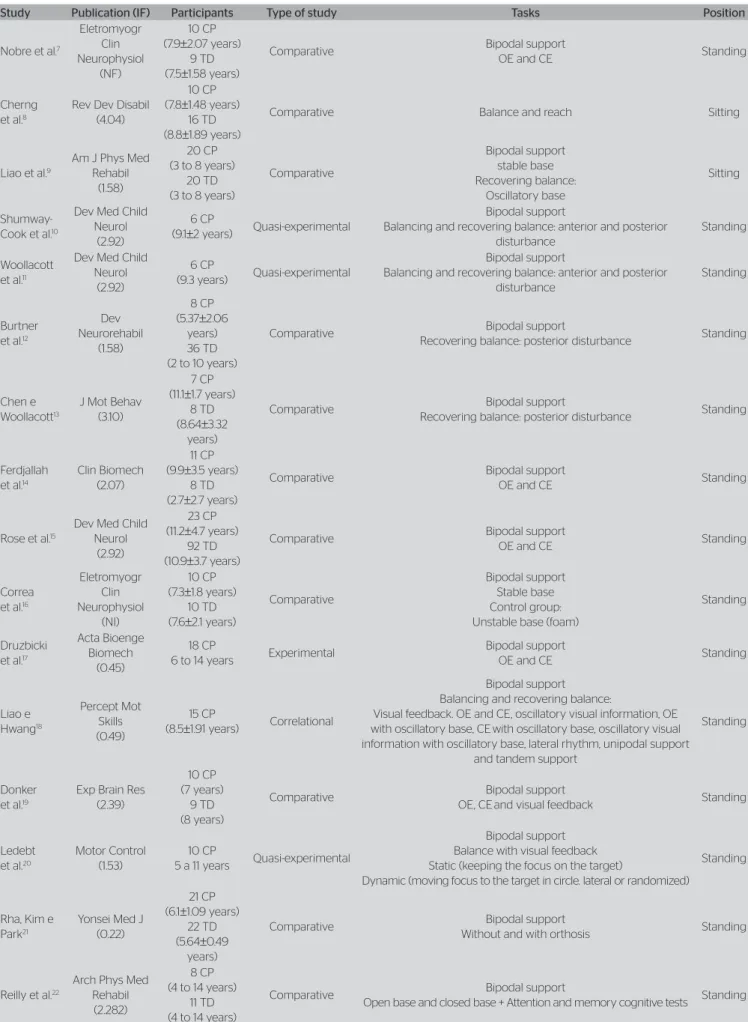
In Stage I, 165 articles were found. he evaluation of title, abstract and keywords reduced the sample to 47 studies. In Stage III, the full texts were analyzed, and at the end there were 16 articles that met the cri-teria (Table 1).
DISCUSSION
he studies presented samples of subjects that ranged
from 7 to 23 people, with mean of 12 subjects (±5.7),
and mean age of 5 to 11 years old. Two articles that assessed postural balance in the sitting position and 14 that analyzed the standing position were found.
Even though we found only two studies analyzing
children in the sitting position8,9, we recognize the
im-portance to better understand body balance in this po-sition. Due to balance changes and the global motor compromise, most subjects with CP remain sitting for a long time, and this is how they participate in the daily life activities. his situation happens because they can-not remain standing and, even if they can, they perform better when sitting down, or even because they spend
too much energy by standing up. Liao et al.9 emphasize
as a priority in the rehabilitation of these subjects that they can get maximum function in the sitting position.
Both studies used groups with spastic CP in the sample, comparing them with children with typical de-velopment (TD), but with diferent methods to assess balance (Table 2).
Cherng et al.8 assessed balance sitting down with
the feet of the subjects against the force platform. he authors concluded that postural stability in the sitting down position goes through changes according to the seat inclination and in a comparable way be-tween children with CP and TD. he anterior inclined seat provided better postural balance and functionality in the reaching task for both groups. However, with the posterior inclined seat, the displacement of the medial-lateral center of pressure (COP) was greater in the group with CP.
Liao et al. 9 used the platform as a supporting base
Table 1. Description of studies that used the force platform to assess the postural balance in children with cerebral palsy
IF: impact factor; CP: cerebral palsy; TD: typical development; OE: open eyes; CE: closed eyes; NI: not informed
Study Publication (IF) Participants Type of study Tasks Position
Nobre et al.7
Eletromyogr Clin Neurophysiol
(NF)
10 CP (7.9±2.07 years)
9 TD (7.5±1.58 years)
Comparative Bipodal support
OE and CE Standing
Cherng et al.8
Rev Dev Disabil (4.04)
10 CP (7.8±1.48 years)
16 TD (8.8±1.89 years)
Comparative Balance and reach Sitting
Liao et al.9
Am J Phys Med Rehabil
(1.58)
20 CP (3 to 8 years)
20 TD (3 to 8 years)
Comparative Bipodal support stable base Recovering balance: Oscillatory base Sitting Shumway-Cook et al.10
Dev Med Child Neurol
(2.92)
6 CP
(9.1±2 years) Quasi-experimental
Bipodal support
Balancing and recovering balance: anterior and posterior disturbance
Standing
Woollacott et al.11
Dev Med Child Neurol
(2.92)
6 CP
(9.3 years) Quasi-experimental
Bipodal support
Balancing and recovering balance: anterior and posterior disturbance
Standing
Burtner et al.12
Dev Neurorehabil
(1.58)
8 CP (5.37±2.06
years) 36 TD (2 to 10 years)
Comparative Bipodal support
Recovering balance: posterior disturbance Standing
Chen e Woollacott13
J Mot Behav (3.10)
7 CP (11.1±1.7 years)
8 TD (8.64±3.32
years)
Comparative Bipodal support
Recovering balance: posterior disturbance Standing
Ferdjallah et al.14
Clin Biomech (2.07)
11 CP (9.9±3.5 years)
8 TD (2.7±2.7 years)
Comparative Bipodal support
OE and CE Standing
Rose et al.15
Dev Med Child Neurol
(2.92)
23 CP (11.2±4.7 years)
92 TD (10.9±3.7 years)
Comparative Bipodal support
OE and CE Standing
Correa et al.16
Eletromyogr Clin Neurophysiol
(NI)
10 CP (7.3±1.8 years)
10 TD (7.6±2.1 years)
Comparative
Bipodal support Stable base Control group: Unstable base (foam)
Standing
Druzbicki et al.17
Acta Bioenge Biomech
(0.45)
18 CP
6 to 14 years Experimental
Bipodal support
OE and CE Standing
Liao e Hwang18 Percept Mot Skills (0.49) 15 CP
(8.5±1.91 years) Correlational
Bipodal support Balancing and recovering balance:
Visual feedback. OE and CE, oscillatory visual information, OE with oscillatory base, CEwith oscillatory base, oscillatory visual information with oscillatory base, lateral rhythm, unipodal support
and tandem support
Standing
Donker et al.19
Exp Brain Res (2.39)
10 CP (7 years)
9 TD (8 years)
Comparative Bipodal support
OE, CEand visual feedback Standing
Ledebt et al.20
Motor Control (1.53)
10 CP
5 a 11 years Quasi-experimental
Bipodal support Balance with visual feedback Static (keeping the focus on the target)
Dynamic (moving focus to the target in circle. lateral or randomized)
Standing
Rha, Kim e Park21
Yonsei Med J (0.22)
21 CP (6.1±1.09 years)
22 TD (5.64±0.49
years)
Comparative Bipodal support
Without and with orthosis Standing
Reilly et al.22
Arch Phys Med Rehabil
(2.282)
8 CP (4 to 14 years)
11 TD (4 to 14 years)
Comparative Bipodal support
and demonstrated that the tasks concerning static bal-ance may not be suicient to detect the diiculties of balance in this population.
he other studies assessed the balance in children with CP in the standing position (Table 3). he mobile platform was used to for the analyses and intervention
in a study (divided into two publications)10,11, and only
as an evaluation instrument in other two studies12,13.
he therapeutic use of the mobile platform seems to cause positive efects with practice, because the results showed that the postural control in children with CP can be changed after intense training (5 days with 50 anterior disturbances and 50 posterior disturbances/ day), also suggesting that children with spastic diplegia CP need more prolonged training than hemiplegic pa-tients due to the diferent forms of motor or sensory and
motor compromise found between these two groups10.
Table 2. Procedures of studies that assessed postural balance in the sitting position
AP: anterior posterior; ML: medial-lateral; COP: center of pressure
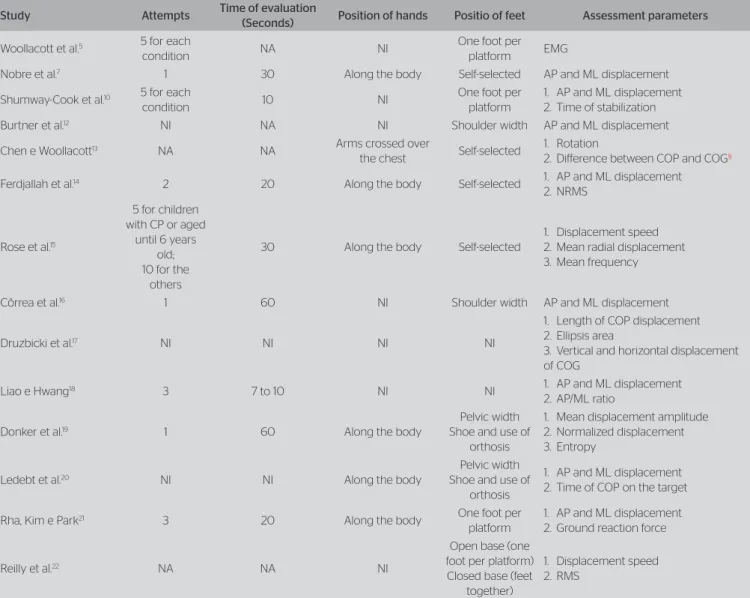
AP: anterior posterior; ML: medial-lateral; NRMS: Normalized root mean square; EMG: electromiography; COP: center of pressure; COG: center of gravity; NI: not informed; CP: cerebral palsy; RMS: root mean square; NA: Non-applicable.
Table 3. Procedures of studies that assessed postural balance in the orthostatic position
Study Attempts Time of evaluation
(seconds) Position of hands Position of feet Assessment parameters
Cherng et al.8 3 7 Under the thighs
Feet supported agains the force
platform
1. AP and ML displacement of COP 2. Sway ratio
3. Ground reaction force
Liao et al.9 1 10 Along the body Supported feet
and knees at 90°
1. AP and ML displacement of COP 2. Sway index
3. Sway ratio
Study Attempts Time of evaluation
(Seconds) Position of hands Positio of feet Assessment parameters
Woollacott et al.5 5 for each
condition NA NI
One foot per
platform EMG
Nobre et al.7 1 30 Along the body Self-selected AP and ML displacement
Shumway-Cook et al.10 5 for each
condition 10 NI
One foot per platform
1. AP and ML displacement 2. Time of stabilization
Burtner et al.12 NI NA NI Shoulder width AP and ML displacement
Chen e Woollacott13 NA NA Arms crossed over
the chest Self-selected
1. Rotation
2. Diference between COP and COG§
Ferdjallah et al.14 2 20 Along the body Self-selected 1. AP and ML displacement
2. NRMS
Rose et al.15
5 for children with CP or aged
until 6 years old; 10 for the
others
30 Along the body Self-selected
1. Displacement speed 2. Mean radial displacement 3. Mean frequency
Côrrea et al.16 1 60 NI Shoulder width AP and ML displacement
Druzbicki et al.17 NI NI NI NI
1. Length of COP displacement 2. Ellipsis area
3. Vertical and horizontal displacement of COG
Liao e Hwang18 3 7 to 10 NI NI 1. AP and ML displacement
2. AP/ML ratio
Donker et al.19 1 60 Along the body
Pelvic width Shoe and use of
orthosis
1. Mean displacement amplitude 2. Normalized displacement 3. Entropy
Ledebt et al.20 NI NI Along the body
Pelvic width Shoe and use of
orthosis
1. AP and ML displacement 2. Time of COP on the target
Rha, Kim e Park21 3 20 Along the body One foot per
platform
1. AP and ML displacement 2. Ground reaction force
Reilly et al.22 NA NA NI
Open base (one foot per platform) Closed base (feet
together)
Burtner et al.12 and Chen and Woollacott13 used
the mobile force platform only to analyze balance and veriied lower postural control in children with CP in comparison to children of the same age and level of motor development, but without CP. herefore, the hy-potheses of the authors that the balance variables can be considered in the diferentiation between children with or without CP were corroborated.
From the other analyzed studies, ive of them used the force platform aiming to compare the balance vari-ables between groups of children with CP and with TD7,14-17. hese articles also point to the lower postural
control in groups with CP.
Nobre found lower COP mean oscillation in the an-terior posan-terior direction among children with CP in the conditions of eyes open and closed. His results sug-gest that children with TD use more ankle strategies to promote balance, causing more oscillation than children with no ability to use this strategy, besides mentioning that the group with CP was under constant
interven-tion with focus on the balance training7.
he position of the body, arms and the support base, as well as the time in the force platform and the number of assessment attempts can inluence the balance evalu-ation, be it for biomechanical reasons or for the subject’s fatigue — that is why it is important to establish stan-dardization criteria for these elements. In the analyzed studies, we observed there are diferent protocols of evaluation (Table 3).
In relation to the position of the support base, most studies use the feet distance self-selected by the
research subjects7,13-15. As to the position of the arms,
we also observed convergence between most protocols, which follow the evaluation with relaxed arms along the body7,14,15,18-22. Such preference for a more comfortable
feet and arm position can be explained by the speciic characteristics of the children population, with changes in movement and comprehension, thus facilitating the application of the protocol.
he time of evaluation in the force platform does not
exceed 20 seconds in 50% of the studies9,11,14,21. In the
others, the analyses are conducted with the limit of 60
seconds16,19, and at least 7 seconds18. In the articles, we
did not ind the theoretical base for the performance of short evaluations, but we believe that the reduced time to measure balance enables the participation of these subjects who, due to the characteristics of CP, demon-strate lower tolerance to long balance assessments.
Likewise, we believe that the speciicities of CP, together with the aspects of childhood, in the sense
that it is more diicult to apply extensive and detailed methods and protocols, justify the reduced number of task attempts. Despite the diferences between pro-tocols, we observed there are usually two to Five
at-tempts in most studies8,14,15,18,21, but some make only
one attemp7,9,16,19.
he balance parameters that are most used in the studies are the maximum medial-lateral and anterior pos-terior COP displacements. Other measures are also used, such as the displacement ratio (sway ratio), and speed of COP and RMS (root mean square) displacement.
Only one study with experimental design was found, with the randomization of groups and the assessment of balance in a force platform using the blind-condition
strategy during evaluation17. he authors found that the
experimental group of children with CP using a spe-ciic ankle-foot orthosis and practicing physical ther-apy exercises presented improvement in relation to the control group, which only practiced exercises. However, as shown in Table 3, this study did not report several aspects of the evaluation protocol, like time of evalua-tion, number of attempts, position of arms and legs at the time of evaluation, which makes it diicult to repli-cate the study and better understand it.
CONCLUSION
According to the research, there are still few studies that use the force platform to understand the behavior of balance in children with CP, especially the assess-ment of balance in the sitting position. Most articles perform comparative studies between children with CP and TD. Only one study with experimental design was found, which used the force platform to assess a speciic intervention.
he sample size seems to be a limiting factor of the studies due to the reduced number of participants in the found articles.
he diiculties of movement and postural control of CP seem to be relevant aspects in the creation of assess-ment protocols for these children in the force platform, becoming less strict as to the position of the body, the number of attempts and the time of evaluation.
he evaluations of balance in the force platform demonstrated diferences between the groups of chil-dren with TD and chilchil-dren with CP, and they were able to detect the improvements caused by interventions in the force platform or speciic therapeutic practices.
herefore, we believe that new studies using this as-sessment instrument and with larger samples can col-laborate with the better understanding of aspects con-cerning postural balance of children with CP, leading to more eicient interventions and treatments.
REFERENCES
1. Bleck EE. Locomotor prognosis in cerebral palsy. Dev Med Child Neurol. 1975;17(1):18-25.
2. Rosenbaum P, Paneth N, Leviton A, Goldstein M, Bax M, Damiano D, et al. A report: the definition and classification of cerebral palsy April 2006. Dev Med Child Neurol Suppl. 2007;109:8-14.
3. Bax M, Goldstein M, Rosenbaum P, Leviton A, Paneth N, Dan B, et al. Proposed definition and classification of cerebral palsy, April 2005. Dev Med Child Neurol. 2005;47(8):571-6.
4. van der Heide JC, Hadders-Algra M. Postural muscle dyscoordination in children with cerebral palsy. Neural Plast. 2005;12(2-3):197-203; discussion 263-72.
5. Woollacott MH, Burtner P, Jensen J, Jasiewicz J, Roncesvalles N, Sveistrup H. Development of postural responses during standing in healthy children and children with spastic diplegia. Neurosci Biobehav Rev. 1998;22(4):583-9.
6. Duarte M, Freitas SM. Revision of posturography based on force plate for balance evaluation. Rev Bras Fisioter. 2010;14(3):183-92.
7. Nobre A, Monteiro FF, Golin MO, Biasotto-Gonzalez D, Corrêa JC, Oliveira CS. Analysis of postural oscillation in children with cerebral palsy. Electromyogr Clin Neurophysiol. 2010;50(5):239-44.
8. Cherng RJ, Lin HC, Ju YH, Ho CS. Efect of seat surface inclination on postural stability and forward reaching eficiency in children with spastic cerebral palsy. Res Dev Disabil. 2009;30(6):1420-7.
9. Liao SF, Yang TF, Hsu TC, Chan RC, Wei TS. Diferences in seated postural control in children with spastic cerebral palsy and children who are typically developing. Am J Phys Med Rehabil. 2003;82(8):622-6.
10. Shumway-Cook A, Hutchinson S, Kartin D, Price R, Woollacott M. Efect of balance training on recovery of stability in children with cerebral palsy. Dev Med Child Neurol. 2003;45(9):591-602.
11. Woollacott M, Shumway-Cook A, Hutchinson S, Ciol M, Price R, Kartin D. Efect of balance training on muscle activity used in recovery of stability in children with cerebral palsy: a pilot study. Dev Med Child Neurol. 2005;47(7):455-61.
12. Burtner PA, Woollacott MH, Craft GL, Roncesvalles MN. The capacity to adapt to changing balance threats: a comparison of children with cerebral palsy and typically developing children. Dev Neurorehabil. 2007;10(3):249-60.
13. Chen J, Woollacott MH. Lower extremity kinetics for balance control in children with cerebral palsy. J Mot Behav. 2007;39(4):306-16.
14. Ferdjallah M, Harris GF, Smith P, Wertsch JJ. Analysis of postural control synergies during quiet standing in healthy children and children with cerebral palsy. Clin Biomech (Bristol, Avon). 2002;17(3):203-10.
15. Rose J, Wolf DR, Jones VK, Bloch DA, Oehlert JW, Gamble JG. Postural balance in children with cerebral palsy. Dev Med Child Neurol. 2002;44(1):58-63.
16. Corrêa JC, Corrêa FI, Franco RC, Bigongiari A. Corporal oscillation during static biped posture in children with cerebral palsy. Electromyogr Clin Neurophysiol. 2007;47(3):131-6.
17. Druzbicki M, Rusek W, Szczepanik M, Dudek J, Snela S. Assessment of the impact of orthotic gait training on balance in children with cerebral palsy. Acta Bioeng Biomech. 2010;12(3):53-8.
18. Liao HF, Hwang AW. Relations of balance function and gross motor ability for children with cerebral palsy. Percept Mot Skills. 2003;96(3 Pt 2):1173-84.
19. Donker SF, Ledebt A, Roerdink M, Savelsbergh GJ, Beek PJ. Children with cerebral palsy exhibit greater and more regular postural sway than typically developing children. Exp Brain Res. 2008;184(3):363-70.
20. Ledebt A, Becher J, Kapper J, Rozendaalr RM, Bakker R, Leenders IC, et al. Balance training with visual feedback in children with hemiplegic cerebral palsy: efect on stance and gait. Motor Control. 2005;9(4):459-68.
21. Rha DW, Kim DJ, Park ES. Efect of hinged ankle-foot orthoses on standing balance control in children with bilateral spastic cerebral palsy. Yonsei Med J. 2010;51(5):746-52.