Fisioter. Mov., Curitiba, v. , n. , p. - , jan./mar. Licenciado sob uma Licença Creative Commons DO): http://dx.doi.org. . / - . . .AR
[T]
Variation in isometric force after active shortening
and lengthening and their mechanisms: a review
[)]Variação da força isométrica após encurtamento e
alongamento ativo e seus mecanismos: uma revisão
[A]
Rodrigo Troyack de Lima[a], Paulo Farinatti[b], Walace Monteiro[c], Carlos Gomes de Oliveira[d]
[a] Physical Education Teacher by Salgado de Oliveira University, master in Physical Activity Sciences by Salgado de Oliveira University, Niterói, RJ - Brasil, e-mail: [email protected]
[b] PhD in Physical Education by Freedom University of Brussels Belgium , Physical Activity and (ealth Promotion Laboratory-UERJ, Graduate Program-Master s Degree in Physical Activity Sciences of the Salgado de Oliveira University, Rio de Janeiro, RJ - Brasil, e-mail: [email protected]
[c] PhD in Physical Education by Gama Filho University, Physical Activity and (ealth Promotion Laboratory-UERJ, Graduate Program-Master s Degree in Physical Activity Sciences of the Salgado de Oliveira University, Rio de Janeiro, RJ - Brasil, e-mail: [email protected]
[d] PhD in Biomedical Engineering by COPPE/UFRJ, School of Physical Education and Sports-UFRJ, Rio de Janeiro, RJ - Brasil, e-mail: [email protected]
[R] Abstract
Introduction: The isometric force history dependence of skeletal muscle has been studied along the last
one hundred years. Several theories have been formulated to explain and establish the causes of the phe-nomenon, but not successfully, as they have not been fully accepted and demonstrated, and much contro-versy on such a subject still remains. Objective: To present a systematic literature review on the dynamics
of the mechanisms of force depression and force enhancement after active shortening and lengthening, respectively, identifying the key variables involved in the phenomenon, and to date to present the main theories and hypothesis developed trying to explaining it. Method: The procedure of literature searching
142
references were found according to the criteria used. Conclusion: Based on this review, it is suggested that
the theory of stress inhibition of actin-myosin cross-bridges is that better explain the phenomenon of force depression. Whereas regarding the force enhancement phenomenon, one theory have been well accepted, the increased number of actin-myosin cross-bridges in strong binding state influenced by the recruitment of passive elastic components, which hole is attributed to the titin filament.
[P]
Keywords: Force. Shortening. Lengthening. Active. [B]
Resumo
Introdução: A dependência entre a produção de força isométrica do músculo esquelético e o histórico da cont-ração precedente vem sendo objeto de estudo nos últimos cem anos. Diversas teorias têm sido formuladas para explicar e estabelecer as causas do fenômeno, obtendo pouco sucesso, uma vez que não foram completamente aceitas e comprovadas, suscitando ainda muita controvérsia sobre o tema. Objetivos: Apresentar uma revisão sistemática da literatura sobre a dinâmica dos mecanismos de depressão (DF) e de aumento (AF) da força isométrica após encurtamento e alongamento ativos, respectivamente, identificando as principais variáveis intervenientes nos fenômenos, e as principais teorias e hipóteses elaboradas para explicá-los até a presente data. Métodos: O procedimento de busca da literatura foi composto por uma pesquisa nas principais bases de dados, incluindo artigos que observaram diretamente os fenômenos DF e AF, ou possíveis mecanismos e causas associadas a suas respectivas manifestações, desde os primeiros estudos sobre o tema até o ano de 2010. Resultados: Foram encontradas 97 referências que atenderam aos critérios adotados. Conclusão: Com base na revisão produzida, sugere-se a teoria da inibição por estresse induzido das pontes cruzadas de actina-miosina para explicar o fenômeno DF. Quanto ao fenômeno AF uma teoria tem sido bem aceita, a do aumento do número de pontes cruzadas de actina-miosina em estado forte de ligação influenciado pelo recrutamento dos componentes elásticos passivos, atribuindo-se aos filamentos de titina este papel. [K]
Palavras-chave: Força. Encurtamento. Alongamento. Ativo.
Introduction
The dependence between the production of iso-metric force in skeletal muscle and its contraction history has been reported nearly a century ago , . (owever, its causes are not well established, and the proposed theories not fully accepted, as well as controversial. )t is relevant that such dependence is not taken into account by the models of (ill and (uxley, the two biomechanical models that try to explain the dynamics of mechanics and physiology of muscle contraction , . Moreover, despite the scientific advances in the field of muscle mechan-ics, a great difficulty is remains while accepting new discoveries and theories of force depression FD and force increased FE , , .
Studies have shown that the isometric force of a sarcomere, a fiber or even a muscle, may change up to % when compared to a known isometric force of reference, being reduced after active shortening
and increased after stretching, phenomena know as FD and FE respectively .
A concept well accepted is that force capacity of a muscle force has an inverse non-linear relationship with the speed of shortening , , , , , , , . )n an antagonist way, the capacity of power gen-eration increases due to the speed of stretching to a limited extent, mainly when the muscle is stimulated beyond its optimal length , , , , . These char-acteristics of plasticity and strength of a muscle when taken as a principle after systematic experimental observations has helped to develop the concepts as-sociated with FD and FE , , .
143 stretching, force depression, force enhancement, re-sidual force enhancement, passive elastic component, history dependence of muscle contraction, sarcomere length, shortening, lengthening, stretch- shortening cycle, stretch - shortening cycle, calcium dependent mechanism of muscle contraction, titin filament and thin. The words were used alone or combined.
To be included in the review, articles should ad-dress the observation of the phenomena of FD or FE, alone or combined, as well as present description of possible causes or physiological and biomechanical mechanisms involved in its manifestation. Were also included articles that presented theories on the me-chanics of muscle contraction and that are relevant to the topic. )n this search, references met the in-clusion criteria.
The concept of Force Depression
The term FD can be defined as the reduction of isometric force after active muscle shortening when compared to a reference isometric contraction ob-tained in the same muscle length. )n the first case, the phenomenon would be associated with reduced state of passive tension of muscle fibers, individually, during the shortening phase , , , .
)t is proposed that the phenomenon of FD would associated to the descending limb and to the peak of the SLT , , , but recent evidence suggests that this would happen too, even on a smaller scale, the ascending limb of the LTC , , , .
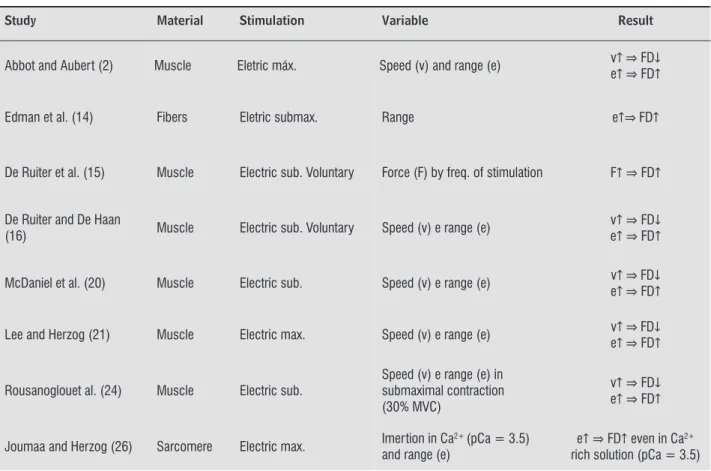
Literature data point to the idea that the intensity of the decline of isometric force is directly influenced by the extent of muscle shortening, the shortening speed and the amount of force produced during the shortening phase , , , , , , . This can be seen in the summary of the studies shown in Table , which also shows that the employed force control, in most studies, is made by frequency of the stimulation produced in the sarcomere, or to muscle fiber.
Relevant fact is that the phenomenon has a greater duration than five seconds , , , , , consid-ered expressive by the investigator of such subject. Moreover, the FD cannot be completely eliminated after a maneuver of muscle relaxation by deactiva-tion nor manipulated by shortening with fast speed, preceded by a shortening with slow and steady speed, which would result in a reduction of the isometric force to zero , , , .
stimulation combined with maximum voluntary dy-namic contractions . Furthermore, devices have relied on complex servo motors coupled to force transducers that bear little resemblance to human movement pattern , , , , , , , , ,
, , , , , .
Moreover, (erzog proposed that FD and FE might have implications in the tasks of daily life. This phenomenon, once elucidated, could also bring im-portant information when regarded to rehabilitation processes, in which small increases in strength capa-bility are crucial to patient outcomes.
Another important aspect is that recent stud-ies have observed the manifestation of FD and FE in higher muscle groups and motor gestures more similar to human routine, both in maximal voluntary and submaximal force exertions , , , , . )t is noteworthy that although there are many studies proving the existence of FD and FE as well as some hypotheses to explain such behaviors has been raised, no theory is fully accepted to explain such behaviors.
)n fact, there are many variables involved in the change of intensity force produced or even on wheth-er or not this change occurs , , . Such variables include the amount of stimulation, speed and length vs muscle tension curve LTC region. Furthermore, there are gaps in these phenomena with regard to its applicability to daily life, despite being touted as important in motor control with implications in re-habilitation , .
This paper aims to present a systematic review on the concepts related to depression and enhancement of isometric strength after active stretching and short-ening respectively. )t also intends to describe the main variables that affect the phenomena. Additionally, the main mechanisms, theories and hypotheses to explain them are presented.
Employed procedures and methods of search
This article consists of a systematic literature re-view on the topics known as FD and FE. The proce-dure consisted in literature search in major databases
PubMed, Medline, SciELO, SPORTDiscus, L)LACS and Academic Google , including the first records on the subject until the year .
144
(owever, it should be noted that, considering the application of stretching vs shortening cycle the
phe-nomenon of FD may be entirely abolished only if the previous amount of stretching is equivalent to the amount of shortening. Otherwise, the isometric force produced after deactivation maneuver will always be less than the isometric reference force , , , .
This reinforces the association between large speed, the amount of shortening and force produced during shortening, and the magnitude of the FD to be partly dependent on the elongation vs shortening cycle to stop the phenomenon , , , .
One aspect that can be argued in studies of DF is about the practical effect of the phenomenon in daily life, given the limitation of studies using large muscle groups at submaximal and voluntary actions. This is evident when looking at the data in Table , which presents only three studies used voluntary stimulation. )n this sense, one can say that there is a gap between the phenomenon itself and its ap-plicability, which must be filled by new research to be undertaken.
Mechanisms and hypotheses for FD
The main hypotheses to explain the phenomenon of FD are inhibition-induced stress in the cross-bridg-es, the non-uniformity and instability of the sarco-mere, the influx of (+ ions and inorganic phosphate
PO - , and reducing the affinity between calcium Ca+ and the active sites of actin, as detailed below.
Theory of stress-induced inhibition of cross bridges
This theory suggests a mechanical failure induced by stress generated in the active sites of actin - myosin coupling. This would occur in sites located in two helices of the F-actin chain, which suffer an angu-lar distortion that produce rotation as the muscle is shortened at low speed. Thus, the active site of actin binding is displaced from its original position, preventing the head coupling of heavy mero-myosin or MCP chain , , , , .
Table 1 - Main characteristics of the studies on FD as regard to type of stimulation, material used and the observed ef-fects considering the characteristics of the shortening applied
Study Material Stimulation Variable Result
Abbot and Aubert (2) Muscle Eletric máx. Speed (v) and range (e) v FD e FD
Edman et al. (14) Fibers Eletric submax. Range e FD
De Ruiter et al. (15) Muscle Electric sub. Voluntary Force (F) by freq. of stimulation F FD
De Ruiter and De Haan
(16) Muscle Electric sub. Voluntary Speed (v) e range (e)
v FD e FD
McDaniel et al. (20) Muscle Electric sub. Speed (v) e range (e) v FD e FD
Lee and Herzog (21) Muscle Electric max. Speed (v) e range (e) v FD e FD
Rousanoglouet al. (24) Muscle Electric sub.
Speed (v) e range (e) in submaximal contraction (30% MVC)
v FD e FD
Joumaa and Herzog (26) Sarcomere Electric max. Imertion in Ca2+ (pCa = 3.5) and range (e)
e FD even in Ca2+ rich solution (pCa = 3.5)
145
The proponents of this hypothesis propose that an increase in the rate of cross-bridge uncoupling and an angular distortion, high enough to modify the or-ganization, the structural arrangement and the ideal overlap between the actin-myosin quantity, alter the optimal sarcomere length. Such a change would be sufficient to induce a deformation in the active sites of actin-myosin. These then would substantially reduce the number of available cross-bridges, as well as the tension generated by each cross bridge , , , ,
, , , , , , .
Orlova and Egelman preclude this hypothesis by proposing a memory of the double helix of F-actin chain, where the angular distortions would be very small. This memory would defeat the mechanism of inhibition induced by stress of cross bridges actin-myosin, which would result in the removal of the actin heads MCP active site.
Such memory would keep a kind of angular or-der to retain the position of the actin subunit in an appropriate coupling and formation of the cross-bridges angle. On the other hand, for some advocates of FD , , , , , subsidies to confirm it, use the analysis of the common features of the phenomenon. They take into consideration that it increases at large amplitudes of shortening, low speed and large amounts of force produced dur-ing active shortendur-ing.
Theory of non-uniformity and instability of sarcomere
The non-uniformity of sarcomeres theory is based on the fact that the sarcomeres have a mechanical property of non-uniformity and instability. This is because the sarcomeres or half sarcomeres do not reproduce the same rate of change in length imposed to the whole muscle tissue.
Thus, it is proposed that this non-uniformity would lead to depression of isometric force follow-ing an active pre shortenfollow-ing because while some sar-comeres would resume its original shape and length
observed during isometric contraction reference , others remain shortened even after the removal of stimulus , , , , , , , , , , , .
)t should be said that, if one accepts this theory, it would be expected that the decrease in isometric force would have any relation to the LTC, since the mainte-nance of shortening at levels below the optimum length would be responsible for the reduction in force. That is what some proponents of this theory have reasoned, because the FD is a phenomenon observed primarily in the descending limb of LTC , , .
Furthermore, the FD should not occur in uniform sarcomeres, with constant and regular lengths before and after muscle shortening, as already noted , , . (owever, these arguments are refuted by studies
Table 1 - Main characteristics of the studies on FD as regard to type of stimulation, material used and the observed ef-fects considering the characteristics of the shortening applied
Study Material Stimulation Variable Result
Lee et al. (27) Muscle Electric sub. Speed (v), range (e) v FD e FD
McGowan et al. (31) Muscle Electric max. Voluntary Speed (v), range (e), Stationary Ciclism at 90 rpm
v FD e FD
Herzog and Leonard (33) Fibers Electric max. Speed (v), range (e) v FD e FD
Herzog et al. (41) Muscle Electric max. Speed (v), range (e) v FD e FD
Maréchal and Plaghki (43) Muscle Electric max. Speed (v), range (e) v FD e FD
Note: MVC: maximal voluntary contraction; range: amount of shortening employed; pCa - Ca2+: concentration. Source: Research data.
146
showing that the phenomenon also occurs, albeit to a lesser extent, in the ascending limb of the LTC.
Even in the presence of a control mechanism to stabilize and maintain uniformity, structural integrity and regulate sarcomere length, FD has been observed, also revealing a reduction in muscle passive tension
, , , , , , , , .
)n accordance with these recent studies, studies that investigated this hypothesis by manipulating sarcomere length, using stretch-shortening cycles, pre stretching or shortening only found conflicting results , , , . While indicating asymmetry, the results point to the stability and uniformity of sar-comeres and half sarsar-comeres, and ultimately call into question the validity and justification of the theory of non-uniformity and instability of sarcomeres.
Theory of reduced afi nity between calcium
(Ca2+) and the active sites of actin
)t has been attributed to Ca+ a role of regulation and control in the active sites of actin, favoring the coupling mechanism and the actin-myosin cross-bridge activation. A decrease in affinity and sensitiv-ity of active sites of actin to Ca+, the pumping rate of Ca+ into the sarcoplasm toward the active actin sites, and the Ca+ ATPase system activity has been linked to mechanisms of fatigue. Moreover, it has been pointed out as the probable cause of the mechanism of SCD and reduced muscle passive tension , , , ,
, , , .
)t is also possible that the mechanism of inhibi-tion by stress induced cross-bridge to actin-myosin responds not only to deformations and structural changes of the active actin-myosin coupling sites, but also to cellular Ca+ dependent mechanism.
Although the Ca + dependent mechanism may encourage titin filaments, generating an increase in passive tension during contraction, it could induce a reduction in the rate of decoupling of the active sites of cross bridges , , , , , .
As opposed to the action of Ca+ in the control of inhibition induced stress of cross bridges, it is suggested that two isoforms of troponin, troponin ) SSTN-) and troponin C sTn-C exert greater influ-ence on the dynamic coupling of actin -myosin fila-ments, especially thin filaments of actin, as compared to Ca+ dependent , , system. Moreover, tak-ing into account the evidence presented, it can be
thought that the mechanism of FD is only a transi-tory phenomenon, instantly abolished as soon as you recompose the sarcoplasmic Ca+ concentrations in the muscle fiber , .
(owever, the FD has long duration, and cannot be completely abolished after the instantaneous re-moval of the stimulus of muscle shortening. This fact rule out the possibility of reducing the affinity of Ca + sensitivity as the determining mechanism for this phenomenon, or in other words, the phenomenon could be simply related to muscle fatigue , , ,
, , .
Theory inl ux of protons (H+) ions and
inorganic phosphate (PO43-)
Some researchers have argued that increases in the influx of (+, and PO - into the muscle fiber are as-sociated not only to the mechanism of muscle fatigue, but to the FD, decreased passive tension during the shortening phase. The muscle fiber size should also be taken into account, whereas the concentrations of (+, and PO - in a proportional relationship that is, higher fiber size, the greater the influx of (+, and PO - , , , , , , , .
As the both ions driven cannot be removed quick-ly, one can speculate that FD could not be abolished instantaneously after quick deactivation muscle, but should persist for a long period of time , , . (owever, although the phenomenon of FD present long term stimulus while there, it is abolished in rela-tively short periods of time, . s is , leading to the rejection of this theory to explain it , , , , .
On the other hand, it should be considered the arguments that support the long-term feature of the phenomenon , , , , , , . )n addition, the contrast of the studies that show that relatively short periods that cause muscle deactivation may abolish instantly FD must also be taken into account , , , , , . Therefore, there is a need for future studies comparing the two hypotheses.
147 Compared to FD, FE is characterized by having longer duration greater than s , and also depends on the cycle of shortening, lengthening, or is reduced according to the amount of active stretching prior to shortening. Studies show that FE is instantly abol-ished if the amplitude of the preceding shortening is equal to or higher than the magnitude of stretching employed , .
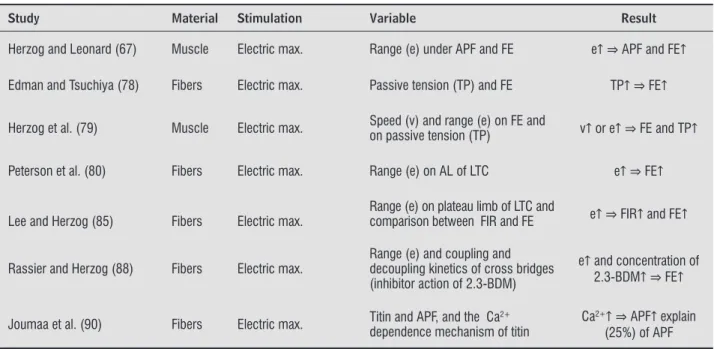
As in FD, the occurrence of FE initially was linked only to the lower limb and the peak of the LTC , , . (owever, new findings indicate that FE is also observed with reasonable stability in the ascending limb of the LCT , , , . Similarly to FD, FE researches has employed the electrical and in most cases with maximum frequency Table . (owever, although some authors justify their use in models of motor control and therapeutic procedures, it is still observed a large gap as its practical application , . The concept of Force Enhancement
FE is defined as the increase in isometric force after active muscle stretching, when compared to a reference isometric contraction obtained in the same muscle length. )n the same manner as in FD, the force produced has been measured in sarco-meres taken under stimulation, or muscle fiber. Few studies have been devoted to the investigation of the phenomenon in large muscles and submaximal voluntary actions. This can be observed with the summary presented in Table .
The main factors that influence the intensity of the increase in isometric force are the amplitude and speed of stretching , , , , . (owever the rate of stretching was not able to influence the amount of FE in isolated muscle fibers of animal specimens
, , , .
Table 2 - Main characteristics of the selected FE studies as on type of stimulation, the material used and the observed effects considering the characteristics of lengthening applied
Study Material Stimulation Variable Result
Edman et al. (17) Fibers Electric max Speed and limb of LTC v FE more on DL
Edman et al. (18) Muscle Electric max Speed and limb of LTC v FE more on DL
Lee and Herzog (22) Muscle Electric max and voluntary max. Speed v FE
Oskouei and Herzog (23) Muscle Electric max. and
Voluntary submaximal Speed and submaximal contraction
v FE more on intensive
contractions
Joumaa et al. (25) Fibers Electric max. Range (e) and limb of LTC e FE on DL
Hahn et al. (28) Muscle Electric max. and voluntary Range (e) and DL of LTC e FE active* and APF
Pinniger and Cresswell (29) Muscle Electric and voluntary
submax. Range (e) e FE
Hahn et al. (30) Muscle Voluntary max e submax. Range (e) e FE
Herzog and Leonard (33) Fibers Electric max. Speed and Range of shortening lengthening cycle v and cycle and a FE
Schachar et al. (37) Muscle Electric max. Speed and DL of LTC. v FE on DL
Herzog and Leonard (39) Muscle Electric max. and submax. Speed (v) and different parts of LTC and different freq. of Stimulation (f) v on SA and SD FE as higher f
Rassier et al. (65) Fibers Electric max. Active range and passive (e) over sarcomeres and APF e APF on sarcomeres
148
compensatory mechanism, sarcomere non-uniform and more fragile, when extended beyond the opti-mum length, recruit the CEP to restore the number of active cross-bridges in the strongest sarcomeres process known as sarcomeral popping , , .
On the other hand, some studies indicate that the sarcomeral popping stretching, thinning and disrup-tion could result in a sarcomerogenesis mechanism with the addition of new sarcomeres from the divi-sion of fragile new sarcomeres and smaller units ,
, , .
To confirm this hypothesis, Lynn and Morgan and Lynn et al. showed the occurrence of sarcomerogenese after days of training. Using a stretching protocol with progressive increases in amplitude until a point beyond optimum length, fea-tured a sub-acute mechanism and acute adaptation, contrasting with the chronic process, which requires weeks or months .
Considering these arguments, some speculations on the theory emerged about FE: a could not be ob-served in the ascending limb of the LTC muscle, b should be instantly abolished in uniform sarcomeres, with constant and regular lengths, c the magnitude of the increase in force would always be lower than the
Mechanisms and assumptions for FE
The main theories available to explain the phe-nomenon of FE are the theories of non- uniformity and sarcomere instability, and the recruitment of elastic components in parallel CEP .
Theory of non-uniformity and sarcomere instability
This hypothesis is based on the principle de-scribed above, that the mechanics of deformation and alteration of sarcomere length does not follow a regular pattern, in which all units of sarcomeres are subjects to homogeneous deformation when a lengthening is applied to the sarcomere , , , , , , , , . )t is suggested that the production of isometric force generated above the isometric con-traction reference force would cause a small degree of deformation of some sarcomeres stretching while others suffer to a greater extent.
This would lead to great changes in length and reducing the overlap between the actin and myo-sin, resulting in fewer active cross-bridges. As a
Table 2 - Main characteristics of the selected FE studies as on type of stimulation, the material used and the observed effects considering the characteristics of lengthening applied
Study Material Stimulation Variable Result
Herzog and Leonard (67) Muscle Electric max. Range (e) under APF and FE e APF and FE
Edman and Tsuchiya (78) Fibers Electric max. Passive tension (TP) and FE TP FE
Herzog et al. (79) Muscle Electric max. Speed (v) and range (e) on FE and on passive tension (TP) v or e FE and TP
Peterson et al. (80) Fibers Electric max. Range (e) on AL of LTC e FE
Lee and Herzog (85) Fibers Electric max.
Range (e) on plateau limb of LTC and
comparison between FIR and FE e FIR and FE
Rassier and Herzog (88) Fibers Electric max.
Range (e) and coupling and decoupling kinetics of cross bridges (inhibitor action of 2.3-BDM)
e and concentration of 2.3-BDM FE
Joumaa et al. (90) Fibers Electric max. Titin and APF, and the Ca2+ dependence mechanism of titin
Ca2+ APF explain (25%) of APF
Note: LTC: length x tension curve; FE: force enhancement; APF: FE due to increased passive force; RIF: residual isometric force; 2.3-BDM: butanodionemonoxime; AL: ascending limb of the LTC; DL: descending limb of LTC; *: not statistically signifi cant.
Source: Research data.
149 effect of the elastic force passive , there is ample evidence that FE is caused by muscle elasticity char-acteristics are , , , , , .
Conclusion
The phenomena of FD and FE are well described in the literature and accepted among researchers being recognized as inherent properties, both in the sar-comere as the isolated muscle fibers and, to a lesser extent to the muscle groups. (owever, the explana-tion for these phenomena is not well established.
Based on this review, it is suggested that the theory of stress-induced inhibition of cross bridges to actin-myosin may be a plausible explanation for the FD. This is due to the fragility of the theories of sarcomere instability and non-uniformity of influx of (+, PO -, and the decreased affinity of Ca+, as well as the active sites of actin filaments that do not them-selves could explain the mechanism FD. After all, it should be remembered that all have been refuted by the available studies.
As for the AF phenomenon, there seems to be evidence that is due to a component of mechanical origin, related to the increasing number of cross-bridges from actin-myosin coupled in a strong state. This component is potentially influenced by the in-creased recruitment of the elastic components of passive force, assigning to this role titin filaments. The applicability of these phenomena, little is seen of practical study in everyday life situations.
(owever, carefully noting the results, one can cor-roborate the statement made by others, that it should be taken into account in models of motor control. There are strong indications that may play a role in therapeutic procedures.
Moreover, understanding the functional dynamics of physiological and mechanical properties that regu-late the production of force can result in the discovery of new strategies for prescribing physical activity, or even potentiation of existing techniques employed in rehabilitation sciences. )n this sense, it seems quite reasonable that further studies should be developed.
References
. Levin A, Wyman J. The viscous elastic properties of muscles. Proc R Soc Lond B. ; : - .
amount of force obtained in isometric contraction of reference. These speculations are in agreement with the results obtained in some studies , , , , , .
Paradoxically, other studies have shown that FE also occurs, albeit to a lesser extent, in the ascend-ing limb of the LTC in uniform sarcomeres. They also showed that the amount of FE may exceed the amount of isometric force measured during the performance of an isometric contraction of reference, in the same muscle length , , , , , .
Elastic components in parallel recruitment theory
This theory is based on the scanning mechanism of the elastic force in parallel, with the titin filament assuming the main role , , , , , , , , , . Such filaments would be responsible for pro-ducing the voltage required to maintain the centering, the length and the ideal overlap between the actin and myosin. Also, it keeps the active sites of actin in suitable for the coupling heads of MCP angular posi-tion, and ensure the maintenance of muscle passive tension due to its mechanical properties , , .
Labeit et al. propose that the maintenance of muscle passive tension was still associated with the Ca+ dependent mechanism, due to a high affinity and coupling capacity between Ca+ and the active site of titin filaments. This possibly would play important role in stabilizing the muscle length during contrac-tion while stretching.
Thus, the mechanism of FE was associated with a significant increase in isometric force generated by the passive force after an active stretch. Confirmed this hypothesis, the amount of muscle shortening em-ployed to the muscle immediately before the stretch-ing, if equal to or of greater magnitude dose-depen-dent mechanism probably should abolish completely the phenomenon by means of inhibition of the elastic passive components , , .
Theories based on the increase of tensile strength have been confirmed in part by studies that showed an association between the increase in isometric force after active stretching and increased passive force. This association is independent of the coupling of new cross bridges actin – myosin that remains after ceased the stimulus , , , , , .
150
. Edman KPA, Elzinga G, Noble M)M. Enhancement of mechanical performance by stretch during te-tanic contractions of vertebrate skeletal muscle fi-bres. J Physiol. ; : - .
. Edman KPA, Elzinga G, Noble M)M. Residual force enhancement after stretch of contracting frog single muscle fibers. J Gen Physiol. ; : - . . Joyce GC, Rack PM(, Westbury DR. The mechanical
properties of cat soleus muscle during controlled lengthening and shortening movements. J Physiol.
; : - .
. McDaniel J, Elmer SJ, Martin JC. The effect of shorten-ing history on isometric and dynamic muscle func-tion. J Biomech. ; : - .
. Lee (D, (erzog W. Force depression following mus-cle shortening of voluntarily activated and electri-cally stimulated human adductor pollicis. J Physiol.
; : - .
. Lee (D, (erzog W. Force enhancement following muscle stretch of electrically stimulated and vol-untary activated human adductor pollicis. J Physiol.
; : - .
. Oskouei AE, (erzog W. Observations on force en-hancement in submaximal voluntary contractions of human adductor pollicis muscle. J Appl Physiol.
; : - .
. Rousanoglou EN, Oskouei AE, (erzog W. Force depres-sion following muscle shortening in sub-maximal vol-untary contractions of human adductor pollicis. J Bio-mech. ; : - .
. Joumaa V, Leonard TR, (erzog W. Residual force en-hancement in myofibrils and sarcomeres. Proc R Soc Lond B. ; : - .
. Joumaa V, (erzog W. Force depression in single myo-fibrils. J Appl Physiol. ; : - .
. Lee (D, Suter E, (erzog W. Force depression in human quadriceps femoris following voluntary shortening contractions. J Appl Physiol. ; : - . . (ahn D, Seiberl W, Schwirtz A. Force enhancement
during and following muscle stretch of maximal vol-untarily activated human quadriceps femoris. Eur J Appl Physiol. ; : - .
. Abbot BC, Aubert XM. The force exerted by active stri-ated muscle during and after change in length. J Physiol.
; : - .
. (ill AV. The heat of shortening and the dynamic constants of muscles. Proc R Soc Lond B. ;
: - .
. (uxley AF. Muscular contraction. J Physiol. ; : - .
. Brown )E, Loeb GE. Measured and modeled properties of mammalian skeletal muscle ))): effects of the stimu-lus frequency on stretch-induced force enhancement and shortening-induced force depression. J Muscle Res Cell Motil. ; : - .
. (erzog W. The Nature of force depression and force enhancement in skeletal muscle contraction. Eur J Sport Sci. ; : - .
. (erzog W. (istory dependence of skeletal muscle force production: implications for movement control. (um Movement Sci. ; : - .
. Fenn WO, Marsh BS. Muscular force at different speeds of shortening. J Physiol. ; : - .
. Katz B. The relation between force and speed in mus-cular contraction. J Physiol. ; : - . . Wilkie DR. The relation between force and velocity
in human muscles. J Physiol. ; - : - . . Abbot BC, Wilkie DR. The relation between velocity
of shortening and the tension-length curve of skeletal muscle. J Physiol. ; - : - .
. Thorstensson A, Grimby G, Karlsson J. Force-velocity relations and fiber type composition in human knee extensor muscles. J Appl Physiol. ; : - . . Sonnenblick E(. Force-velocity relations in
mamma-lian heart muscle. Am J Physiol. ; : - . . Edman KPA, Caputo C, Lou F. Depression of tetanic
force induced by loaded shortening of frog muscle fibres. J Physiol. ; : - .
. De Ruiter CJ, De (aan A, Jones DA, Sargeant AJ. Short-ening induced force depression in human adductor pollicis muscle. J Physiol. ; : - . . De Ruiter CJ, De (aan A. Shortening induced
depres-sion of voluntary force in unfatigued and fatigued human adductor pollicis muscle. J Appl Physiol.
151
. (erzog W, Leonard TR, Wu JZ. Force depression following skeletal muscle shortening is long last-ing. J Biomech. ; : - .
. (erzog W, Leonard TR. Reply from Walter (erzog on behalf of the authors and Tim Leonard. J Physiol.
; : - .
. Maréchal G, Plaghki L. The deficit of the isometric tetanic tension redeveloped after a release of frog muscle at a constant velocity. J Gen Physiol. ;
: - .
. Daniel TL, Trimble AC, Chase PB. Compliant realign-ment of binding sites in muscle: transient behavior and mechanical tuning. Biophys J. ; : - . . Goldman YE, (uxley AF. Actin compliance: are you
pulling my chain? Biophys J. ; : - . . Kojima (, )shijima A, Yanagida T. Direct measurement
of stiffness of single actin filaments with and without tropomyosin by in vitro nanomanipulation. Proc Natl Acad USA. ; : - .
. (iguchi (, Yanagida T, Goldman YE. Compliance of thin filaments in skinned fibers of rabbit skeletal muscle. Biophys J. ; : - .
. Wakabayashi K, Yasunobu S, Tanaka (, Yutaka U, Takezawa Y, AmemiyaY. X-ray diffraction evidence for the extensibility of actin and myosin filaments during muscle contraction. Biophys J. ; : - . . Forcinito M, Epstein M, (erzog W. Theoretical con-siderations on myofibril stiffness. Biophys J. ;
: - .
. Orlova A, Egelman E(. F-actin retains a memory of angular order. Biophys J. ; : - . . Julian FJ, Morgan DL. The effect on tension of
non-uniform distribution of length changes applied to frog muscle fibres. J Physiol. ; : - . . Rassier DE, (erzog W, Pollack G(. Dynamics of
in-dividual sarcomeres during and after stretch in ac-tivated single myofibrils. Proc R Soc Lond B. ;
: - .
. Telley A, Stehle R, Ranatunga KW, Pfitzer G, Stüssi E, Denoth J. Dynamic behavior of half-sarcomeres dur-ing and after stretch in activated rabbit psoas myofi-brils: sarcomere asymmetry but not sarcomere pop-ping. J Physiol. ; : - .
. Pinniger GJ, Cresswell AG. Residual force enhance-ment after lengthening is present during submaxi-mal plantar flexion and dorsiflexion actions in hu-mans. J Appl Physiol. ; : - .
. (ahn D, Seiberl W, Schmidt S, Schweizer K, Schiwirtz A. Evidence of residual force enhancement for multi-joint leg extension. J Biomech. ; : - . . McGowan CP, Neptune RR, (erzog W. A
phenomeno-logical model and validation of shortening-induced force depression during muscle contractions. J Bio-mech. ; : - .
. Rassier DE, (erzog W. Considerations on the history dependence of muscle contraction. J Appl Physiol.
; : - .
. (erzog W, Leonard TR. The history dependence of force production in mammalian skeletal muscle fol-lowing stretch-shortening and shortening-stretch cycles. J Biomech. ; : - .
. Sugi (, Tsuchiya T. Stiffness changes during enhance-ment and deficit of isometric force by slow length changes in frog skeletal muscle fibres. J Physiol.
; : - .
. Morgan, DL. New insights into the behavior of muscle during active lengthening. Biophys J. ;
: - .
. Morgan DL, Whitehead NP, Wise AK, Gregory JE, Pro-ske U. Tension changes in the cat soleus muscle fol-lowing slow stretch or shortening of the contracting muscle. J Physiol. ; : - .
. Schachar R, (erzog W, Leonard TR. Force Enhance-ment above the initial isometric force on the descend-ing limb of the force-length relationship. J Biomech.
; : - .
. De Ruiter CJ, Didden WJM, Jones DA, De (aan A. The force-velocity relationship of human adductor pollicis muscle during stretch and effects of fatigue. J Physiol.
; : - .
. (erzog W, Leonard TR. Force enhancement following stretching of skeletal muscle: a new mechanism. J Exp Biol. ; Pt : - .
152
. (erzog W, Lee EJ, Rassier DE. Residual force enhance-ment in skeletal muscle. J Physiol. ; : - . . (erzog W, Leonard TR. The role of passive structures
in force enhancement of skeletal muscle following active stretch. J Biomech. ; : - . . De Tombe PP, Belus A, Piroddi N, Scellini B, Walker JS,
Martin AF, et al. Myofilament calcium sensitivity does not affect cross-bridge activation-relaxation kinetics. Am J Physiol Regul )ntegr Comp Physiol. ; : R - .
. Moreno-Gonzalez A, Gillis TE, Rivera AJ, Bryant Chase P, Martyn DA, Regnier M. Thin-filament regulation of force redevelopment kinetics in rabbit skeletal muscle fibres. J Physiol. ; : - .
. Kreutziger KL, Piroddi N, Scellini B, Tesi C, Poggesi C, Regnier M. Thin filament Ca+ binding properties
and regulatory unit interactions alter kinetics ten-sion development and relaxation in rabbit skeletal muscle. J Physiol. ; : - .
. Stienen GJ, Roosemalen MC, Wilson MG, Elzinga G. Depression force by phosphate in skinned skeletal muscle fibers of the frog. Am J Physiol Cell Physiol.
; Pt :C - .
. Ebus JP, Stienen GJM, Elzinga G. )nfluence of phos-phate and p( on myofibrillar ATPase activity and force in skinned cardiac trabeculae from rat. J Physiol.
; : - .
. Potma EJ, van Graas A, Stienen GJM. )nfluence of inor-ganic phosphate and p( on ATP utilization in fast and slow skeletal muscle fibers. Biophys J. ; :
- .
. Stienen GJM, Papp Z, Zaremba R. )nfluence of inorgan-ic phosphate and p( on sarcoplasminorgan-ic retinorgan-icular ATPase in skinned muscle fibres of Xenopus Laevis. J Physiol.
; : - .
. Tesi C, Colomo F, Nencini S, Piroddi N, Poggesi C. The effect of inorganic phosphate on force generation in single myofibrils from rabbit skeletal muscle. Biophys J. ; : - .
. Dahlstedt AJ, Katz A, Westerblad (. Role of myoplasmic phosphate in contractile function of skeletal muscle: studies on creatine kinase-deficient mice. J Physiol.
; : - . . Telley A, Denoth J. Sarcomere dynamics during
mus-cular contraction and their implications to muscle function. J Muscle Res Cell Motil. ; : - . . Julian FJ, Moss RL. Effects of calcium and ionic
strength on shortening velocity and tension devel-opment in frog skinned muscle fibres. J Physiol. ;
: - .
. )wazumi T, Pollack G(. The effect of sarcomere non-uniformity on the sarcomere length-tension relationship of skinned fibers. J Cell Physiol. ;
: - .
. Lännergren J, Westerblad (. Force decline due to fatigue and intracellular acidification in isolated fi-bres from mouse skeletal muscle. J Physiol. ;
: - .
. Balnave CD, Allen DG. )ntracellular calcium and force in single mouse muscle fibres following repeated con-tractions with stretch. J Physiol. ; : - . . Tupling R, Green (, Grant S, Burnett M, Ranney D.
Post contractile force depression in humans is asso-ciated with an impairment of SRCa+ pump function.
Am J Physiol Regulatory )ntegrative Comp Physiol. ; :R - .
. Kabbara AA, Allen DG. The role of calcium stores in fatigue of isolated single muscle fibres from the cane toad. J Physiol. ; : - .
. Allen DG, Westerblad (. Role of phosphate and calcium stores in muscle fatigue. J Physiol. ;
: - .
. Allen DG, Lamb GD, Westerblad (. )mpaired calcium release during fatigue. J Appl Physiol. ; :
- .
. Bagni MA, Colombini B, Geiger P, Berlinguer Palmini R, Cecchi G. Non-cross-bridges calcium-dependent stiff-ness in frog muscle fibers. Am J Physiol Cell Physiol.
; :C - .
. Labeit D, Watanabe K, Witt C, Fujita (, Wu Y, Lahmers S, et al. Calcium-dependent molecular spring elements in the giant protein titin. Proc Natl Acad Sci. ;
: - .
. Rassier DE, Lee EJ, (erzog W. Modulation of pas-sive force in single skeletal muscle fibres. Biol Lett.
153
. Rassier DE, (erzog W. Active force inhibition and stretch induced force enhancement in frog mus-cle treated with BDM. J Appl Physiol. ; :
- .
. Rassier DE, (erzog W. Relationship between force and stiffness in muscle fibers after stretch. J Appl Physiol.
; : - .
. Rassier DE, (erzog W. Force enhancement and relax-ation rates after stretch of activated muscle fibres. Proc R Soc Lond B. ; : - . . Lee EJ, Joumaa V, (erzog W. New insights into the
pas-sive force enhancement in skeletal muscles. J Biomech. ; : - .
. Joumaa V, Rassier DE, Leonard TR, (erzog W. The ori-gin of passive force enhancement in skeletal muscle. Am J Physiol Cell Physiol. ; :C - . . Kellermayer MSZ, Granzier (L. Elastic properties
of single titin molecules made visible through fluo-rescent F-actin binding. Biochem Biophys Res Com.
; : - .
. Fukuda N, Granzier (L, )shiwata S, Kurihara S. Phys-iological functions of the giant elastic protein titin in mammalian striated muscle. J Physiol Sci. ;
: - .
. (orowits R. Passive force generation and titin iso-forms in mammalian skeletal muscle. Biophys J. ;
: - .
. Bagni MA, Cecchi G, Colomo F, Garzella P. Develop-ment of stiffness precedes cross-bridge attachDevelop-ment during the early tension rise in single frog muscle fibres. J Physiol. ; : - .
Received: / /
Recebido: / /
Approved: / /
Aprovado: / /
. Edman KPA, Reggiani C. Redistribution of sarcomere length during isometric contraction of frog muscle fibres and its relation to tension creep. J Physiol.
; : - .
. Edman KPA, Tsuchiya T. Strain of passive elements during force enhancement by stretch in frog muscle fibres. J Physiol. ; : - .
. (erzog W, Schachar R, Leonard TR. Characterization of the passive component of force enhancement fol-lowing active stretching of skeletal muscle. J Exp Biol.
; Pt : - .
. Peterson DR, Rassier DE, (erzog W. Force enhance-ment in single skeletal muscle fibres on the ascend-ing limb of force-length relationship. J Exp Biol.
; Pt : - .
. Pun C, Syed A, Rassier DE. (istory-dependent proper-ties of muscle myofibrils contracting along the ascend-ing limb of the force-length relationship. Proc R Soc Lond B. ; : - .
. Morgan DL. An explanation for residual increased ten-sion in striated muscle after stretch during contrac-tion. Exp Physiol. ; : - .
. Morgan DL, Proske U. Popping sarcomere hypothesis explains stretch induced muscle damage. Proc Aus Physiol Pharmac Soc. ; : - .
. Butterfield TA, Leonard TR, (erzog W. Differential se-rial sarcomere number adaptations in knee extensor muscles of rats in contraction type dependent. J Appl Physiol. ; : - .
. Lee EJ, (erzog W. Residual force enhancement exceeds the isometric force at optimal sarcomere length for optimized stretch conditions. J Appl Physiol. ;
: - .
. Lynn R, Morgan DL. Decline running produces more sarcomeres in rat vastus intermedius muscle fibers than does incline running. J Appl Physiol. ;
: - .
. Lynn R, Talbot JA, Morgan DL. Differences in rat skel-etal muscles after incline and decline running. J Appl Physiol. ; : - .