Cognitive and behavioral screening of children with learning
disabilities: a preliminary study
Triagem cognitiva e comportamental de crianças com diiculdades de aprendizagem escolar: um estudo preliminar Selección cognitiva y conductual de niños con diicultades de aprendizaje escolar: un estudio preliminar
Lúcia Helena C. Santos1, Rodrigo Fardim Pimentel2, Luana Gabriela D. Rosa3, Sandra ReginaB. Muzzolon4, Sérgio Antonio Antoniuk5,
Isac Bruck6
Instituição: Universidade Federal do Paraná (UFPR), Curitiba, PR, Brasil 1Doutora em Neurologia pela Universidade de São Paulo em Ribeirão Preto; Professor do Departamento de Pediatria da UFPR, Curitiba, PR, Brasil 2Especializando em Neuropediatria pelo Departamento de Pediatria da UFPR, Curitiba, PR, Brasil
3Residente em Neuropediatria pelo Departamento de Pediatria da UFPR, Curitiba, PR, Brasil
4Mestre em Pediatria pela UFPR; Psicóloga do Hospital de Clínicas da UFPR, Curitiba, PR, Brasil
5Doutor em Pediatria pela UFPR; Professor do Departamento de Pediatria da UFPR, Curitiba, PR, Brasil
6Fellow em Neurologia Infantil pela Universidade da Califórnia, Los Angeles, CA, EUA; Professor do Departamento de Pediatria da UFPR, Curitiba, PR, Brasil AbstrACt
Objective: To evaluate the applicability of the mini-men-tal state examination (mmse) and the Pediatric symptom Checklist (PsC) as a screening test for cognitive and psycho-social problems in children with learning disabilities.
Methods: Descriptive and cross-sectional study involv-ing 103 children aged 6 to 9 years, with possible learninvolv-ing disabilities, referred from a public school in Curitiba, Brazil, from march 1, 2002 to June 30, 2009. Data were simultane-ously collected by a multidisciplinary team using the PsC, mmse, and Wechsler Intelligence scale for Children (WIsC-III). From 2007 on the Child Behavior Checklist (CBCL) and Teacher’s Report Form (TRF) were used and compared with the PsC. Correlation coeficients between the tests were calculated, with the signiicance level set at p<0.05.
Results: Among the studied children, 10% had some type of learning disability, 76% were male, and 24% were female. The most prevalent age group was 6 to 7 years. A positive fam-ily history was found in 45% of cases, and an adverse obstetric history in 18%, with low birth weight the most common issue. Correlations were detected between the mmse and WIsC-III (r=0.73) and between the CBCL and PsC (r=0.53).
Conclusion: The mmse and PsC can be used by pediatricians as screening tools for detection of
cogni-tive and psychosocial problems in children with learning disabilities.
Key-words: learning; learning disabilities; screening.
rEsUMO
Objetivo: Avaliar a aplicabilidade do Mini-Mental State
Examination (mmse) e da lista de sintomas pediátricos (LsP)
como teste de triagem cognitiva e de problemas psicossociais em crianças com diiculdades de aprendizagem.
Métodos: estudo descritivo e transversal envolvendo 103 crianças entre seis e nove anos de uma escola pública de Curitiba (PR) com prováveis diiculdades de aprendizagem, realizado de 1º de março de 2002 a 30 de junho de 2009. Os dados foram obtidos simultaneamente por uma equipe multidisciplinar na avaliação inicial, com a aplicação do mmse, da LsP e do Wechsler Intelligence Scale for Children
(WIsC III). Após 2007 o Child Behavior Checklist (CBCL) e o
Teacher’s Report Form (TRF) foram utilizados, sendo também
comparados à LsP. Os coeicientes de correlação entre os testes foram calculados, sendo signiicante p<0,05.
Resultados: Das crianças analisadas, 10% apresentavam algum tipo de diiculdade de aprendizagem, sendo 76% do sexo masculino e 24% do feminino. A faixa etária mais prevalente foi
Endereço para correspondência: Isac Bruck
Rua Floriano Essenfelder 81 – Alto da Glória CEP 80060-270 – Curitiba/PR
E-mail: [email protected]
Conflito de interesse: nada a declarar
entre seis e sete anos de idade. História familiar positiva ocorreu em 45% dos casos e antecedentes obstétricos em 18%, sendo o baixo peso o mais frequente. O escore do mmse mostrou correlação com o do WIsC III (r=0,73) e o CBCL mostrou moderada correlação com o LsP (r=0,53).
Conclusões: O mmse e a LsP podem ser utilizados pelo pediatra como triagem cognitiva e de problemas psicossociais em crianças com diiculdade de aprendizagem.
Palavras-chave: aprendizagem; transtornos de aprendi-zagem; triagem.
rEsUMEN
Objetivo: evaluar la aplicabilidad del mini-mental state
examination (mmse) y de la lista de síntomas pediátricos
(LsP) como prueba de selección cognitiva y de problemas psicosociales en niños con diicultades de aprendizaje.
Métodos: estudio descriptivo y transversal implicando a 103 niños entre seis y nueve años de una escuela pública de Curi-tiba (Paraná, Brasil) con probables diicultades de aprendizaje, realizado desde el 1 de marzo de 2002 hasta el 30 de junio de 2009. Los datos se obtuvieron simultáneamente por un equipo multidisciplinario en la evaluación inicial, con la aplicación del mmse, de la LsP y del Wechsler intelligence scale for children
(WIsC III). Después de 2007 el child behavior checklist (CBCL) y el teacher’s report form (TRF) fueron utilizados, siendo también comparados a la LsP. Los coeicientes de correlación entre las pruebas fueron calculados, siendo signiicante p<0,05.
Resultados: De los niños analizados, el 10% presentaba algún tipo de diicultad de aprendizaje, siendo el 76% del sexo masculino y el 24% del femenino. La franja de edad más prevalente fue entre seis y siete años. Historia familiar posi-tiva ocurrió en el 45% de los casos y antecedentes obstétricos en 18%, siendo el bajo peso el más frecuente. el escore del mmse mostró correlación con el del WIsC III (r=0,73) y el CBCL mostró moderada correlación con el LsP (r=0,53).
Conclusiones: el pediatra puede utilizar el mmse y la LsP como selección cognitiva y de problemas psicosociales en niños con diicultad de aprendizaje.
Palabras clave: aprendizaje; trastornos de aprendizaje; selección.
Introduction
Under-recognition of cognitive and psychosocial disorders is common in Brazil, particularly in public
(government-run) schools. The impact of below-average intellectual development with signiicant limitations in adaptive behaviors, which deines mental retardation(1),
has long held the attention of professionals involved in caring for children with learning disabilities. Conversely, psychosocial problems are given less consideration, al-though in recent years a questionnaire has been proposed to streamline recognition of these issues and enable early referral to specialized care(2,3).
Detection of learning disabilities, whether due to cogni-tive and/or psychosocial disorders, early intervention, and the implementation of preventive measures help mitigate the impact of these issues on learning, thus contributing to healthier development(4,5). The term “learning disabilities”
shall be used throughout this article to refer to children with academic achievement below that expected for their potential, as determined on evaluation by a multidisci-plinary team(1).
Recent epidemiological studies show that 88% of Brazil-ian children are enrolled in public schools. Of these, 88.6% will graduate from fourth grade, 57.1% from primary education, and only 36.6% from secondary school(6). Data
from the Brazilian National Institute of educational stud-ies and Research (INeP) show that 59% of fourth-graders cannot read, 22% cannot complete tests because they do not understand what is required, and approximately 50% have a math-speciic learning disability(7). In most Brazilian
public schools, the issues that underlie learning disabilities are not always recognized by teachers. several factors may account for this under-recognition, including excessive student numbers, precarious working conditions, and lack of adequate teacher training(8).
Therefore, it is essential that safe instruments be avail-able that can alert pediatricians to the presence of underly-ing issues that may explain a learnunderly-ing disorder. The mini– mental state examination (mmse) (available from author), due to its speed of administration (5–10 minutes) and the Pediatric symptom Checklist (PsC) (available from author), which can be illed out in the waiting room by the child’s caregiver, are assessment instruments that can be helpful in the identiication of such issues(2,3,9,10).
Method
This was a descriptive, cross-sectional chart review study conducted on a sample of schoolchildren referred to the Hospital de Clínicas do Paraná Pediatric Neurology Center (CeNeP) by escola estadual Aline Picheth, a state-run primary school in Curitiba, state of Paraná, Brazil, between march 1, 2002 and June 30, 2009.
The criteria for inclusion were age between 6 and 9 years at the time of assessment, enrollment in the irst or second grade at escola estadual Aline Picheth, and multidisciplinary assessment by a pediatric neurologist, clinical psychologist, educational psychologist, and social worker. Patients who did not meet these criteria were excluded from the sample.
Teachers identiied students with learning disabilities and referred them to CeNeP for multidisciplinary assessment. The initial stage of assessment consisted of a history, neuro-logical examination, and administration of the mmse and PsC by Pediatric Neurology residents and fellows, under the supervision of one of the investigators (I.B.). The clinical chologist administered the WIsC-III, the educational psy-chologist carried out speciic academic assessments, and the social worker administered a social history questionnaire(11).
The CBCL and Teacher’s Report Form (TRF) were used from 2007 onward. The results of initial assessment were later discussed in a meeting between the multidisciplinary team and school coordinators, followed by an exposition of the differential diagnosis and potential therapeutic approaches in a meeting between all team members and each subject’s family. WIsC-III and CBCL results were considered the gold standard for diagnosis of mental retardation or psychosocial problems respectively.
The mmse, as modiied by Ouvrier et al(10) for school-age
children, consists of 35 items and can be administered by a pediatric neurologist or trained pediatrician. The instru-ment is designed to assess orientation, immediate and de-layed recall, attention and calculation, language, and visual constructional skills. A score of zero is assigned if the child cannot complete the task or 1 if the child can complete it adequately, for a maximum score of 35. The PsC, designed for children between the ages of 6 and 16 and to be illed out by the child’s parents or caregiver, comprises 35 items on the frequency of attention, internalizing, and externalizing symptoms. scoring relects the frequency in which the situa-tion described in each item occurs, with zero being “never,” 1 being “sometimes,” and 2 being “often”. The cutoff for positivity in the U.s. version of the checklist is 28 points,
that is, children with a score of 28 points or higher should be referred to a specialist for mental health assessment(2,3).
The CBCL was adapted and validated for Portuguese by Bordin, mari and Caeiro(12) in 1995. It is a broad,
compre-hensive, parent-report instrument, and is considered the gold standard for assessment of competencies and problems in children or adolescents between the ages of 6 and 18. It provides an analysis of the emotional, social, and behavioral proile of the evaluated subject. The CBCL is divided into two parts. The irst concerns social competence – that is, the engagement and performance of the child or adolescent in sports, play, games, pastimes, chores and daily activities; scores are proportional to the social competence of the subject. The second part tests for emotional and behavioral problems. It comprises 118 items and is scored on a scale of 0 to 2, with zero being “not true,” 1 being “sometimes true,” and 2 be-ing “very/often true”. The sum of scores is converted into a T score according to gender and age. T scores are presented on syndrome scales, that is, with indicative score ranges for a series of problems that tend to occur together. A T score of 70 or above is considered clinical; 64–69, borderline clinical; and below 63, normal. For the internalizing and externalizing behavior scales, T scores of ≤60 are considered normal, 60–63 borderline, and >63, clinical. The TRF is a teacher-report questionnaire with the same characteristics and results of the CBCL. CBCL and TRF responses are tabulated in the pro-prietary Assessment Data manager (ADm) software, which yields T scores and result plots.
The statistical methods employed were test for difference between proportions and Pearson’s chi-squared test with Yates’s continuity correction. Receiver operating characteris-tics curves were plotted for analysis of dichotomous variables and sensitivity and speciicity values were estimated. The level of signiicance was set at 5% (p<0.05).
The study was approved by the Universidade Federal do Paraná (UFPR) Human Research ethics Committee. The parents or guardians of all children provided informed consent for participation.
results
0 30 50 70 90 110 130
5 10 15
Mini-mental State Examination
Total IQ
20 25 30 35 40
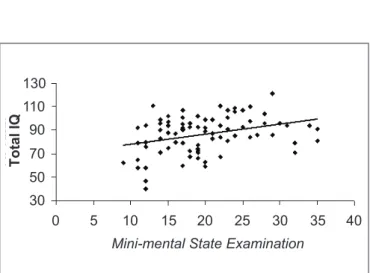
Graph 1 - Distribution of mini-mental state examination (MMSE) and total intelligence quotient (total IQ) scores of irst- and second-graders enrolled at Escola Estadual Aline Picheth, Curitiba, Paraná, Brazil.
mean age was 6.9±1.8 years (median, 7 years; range, 6–9 years). Of the 103 children in the sample, 55 (54%) were first-graders and 48 (46%) were second-graders; 45% had a positive family history of learning disabili-ties, 46% had a family history of attention deicit/hyperac-tivity disorder (ADHD), and 18% had a history of prenatal or perinatal abnormalities, with low birth weight the most common (11%). Forty-seven percent of children had a mean monthly household income of less than R$1195.00, and thus belonged to social classes C1, C2, D, or e(11).
Table 1 shows the result of cognitive assessments, includ-ing differences between mmse, WIsC-III (U.s. version) and WIsC-III (Brazilian Portuguese) scores. The mmse cutoff, considering a total intelligence quotient (IQ) >70, was 20 points for children aged 6–7 and 29 points for children aged 8–9. Therefore, mmse scores ≥20 for children aged 6–7 and
≥29 points for children aged 8–9 were considered indicative of normal cognition (IQ >70).
The correlation between WIsC-III (U.s. version) and mmse scores is shown in Figure 1. Higher mmse scores corresponded to higher WIsC-III scores, with a Pearson correlation coeficient of .73 (p<0.05).
The PsC was administered to all 103 children in the sample. Positive scores (≥28) were obtained in 58 (56%), most of whom were male (57%), irst-graders (70%), and aged 7 (40%).
Graph 2 shows the correlation between frequency of vari-ous clinical syndromes as detected with the CBCL and TRF. This reveals that rule-breaking behavior was perceived more often by teachers than by parents.
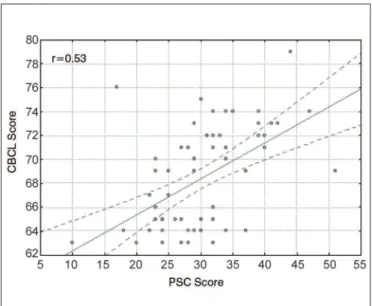
There was moderate correlation (r=0.53) between CBCL and PsC scores, as shown in Graph 3. The receiver oper-ating characteristics curve yielded a cutoff point of ≥28 points, with 65% sensitivity and 97% speciicity. The 65% sensitivity enabled detection of psychosocial disorders in a reasonable number of children by the PsC, of which 97% were conirmed by the CBCL (Graph 4).
Graph 2 - Comparison between frequency of clinical syndro-mes as reported with the Child Behavior Checklist (CBCL) and Teacher’s Report Form (TRF).
CBCL TRF
0 2 4
P
o
s
iti
v
e
r
e
s
p
o
n
s
e
(
%
)
6 8 10
Anxi ous/
depr esse
d*
With draw
n/de pres
sed* Som
atic *
Soci al
Thou ght
Atte ntio
n
Rul e-br
eaki ng**
Aggr essi
ve
*internalizing symptoms; **externalizing symptoms
table 1 - Mini-mental state examination (MMSE) and Wechsler Intelligence Scale for Children (WISC-III, U.S. and Brazilian version) scores of irst- and second-graders enrolled at Escola Estadual Aline Picheth, Curitiba, Paraná, Brazil.
Instrument Mean sD Median Min Max n
MMSE 19.9 5.8 18 9 30 103
WISC-III, U.S. version (verbal) 95.5 18 92 46 135 98
WISC-III, U.S. version (performance) 84.8 18 82 46 115 98
WISC-III, U.S. version (total) 90.7 18 88 40 121 98
WISC-III Brazilian version (verbal) 109.9 19 104 79 146 72
WISC-III Brazilian version (performance) 93.2 19 90 69 129 72
WISC-III Brazilian version (total) 102.9 19 100 79 130 72
Graph 3 - Correlation between Child Behavior Checklist (CBCL) and Pediatric Symptom Checklist (PSC) scores.
Graph 4 - Receiver operating characteristics (ROC) curve showing the cutoff point for Pediatric Symptom Checklist scores (children aged <10 years) and clinical Child Behavior Checklist scores.
Discussion
Pediatricians should be aware of and prepared for the care of children with learning disabilities, as early inter-vention can have a positive effect on the course of these
disabilities and minimize their impact on the child and on society as a whole(13,14).
In the present study, the prevalence of learning disabilities in irst- and second-graders of a state-run school was 10%, with a 3:1 male-to-female ratio. Ciasca(15) also reported a
male predominance (64%) of learning disabilities in this age range. In two U.s. studies, the prevalence of learning disabilities throughout elementary education ranged from 17 to 27%(16,17), whereas in Puerto Rico, the prevalence was
19.4%(17). In the sample reported herein, 7-year-old
irst-graders were those most often referred for multidisciplinary assessment. This was consistent with the early diagnosis and intervention purpose of the study.
A positive family history of learning disabilities was found in 45% of cases, corroborating the indings of Lima
et al(18), who reported an incidence of 37%. The children
of parents with ADHD have 50/50 odds of developing the disorder, and the parents of approximately 30% of all children with ADHD report similar complaints(18). On the
basis of CBCL indings, 26% of children had a Dsm-IV diagnosis of ADHD, and 46% had a positive family history of the disorder.
Pre- and perinatal health issues are closely related to learning disabilities. Neonates with anemia, hypoxia, low birth weight, or prematurity exhibit an increased incidence of ADHs and speciic learning disabilities(19,20). In the
pres-ent study, 18% of children had had perinatal health issues, with low birth weight (11%) and asphyxia (3%), deined by a 5-minute Apgar score of 5 or lower, being the most frequent occurrences.
Few studies have assessed use of the mmse in children. Ouvrier et al(10) and other authors(21-23) have found that scores
increase with age, reaching maximum levels (35 points) around 9 years of age, and correlate well with psychometric measures of intelligence. In Brazil, Lorenzon(9) also found a
positive correlation between total mmse scores (maximum, 30 points) and age (r=0.6; p<0.0001).
95-month-old child (7 years, 11 months), when the actual IQ should be lower. In the U.s. version of the test, the above example would yield an underestimate of the IQ. Therefore, although use of the Brazilian version is recom-mended, the possibility of erroneous scores – as proved in this study – justiies continued use of the U.s. version. In the present study, the receiver operating characteristics curve was plotted on the basis of U.s. WIsC-III scores. A comparison between mmse and WIsC-III (U.s. version) scores is shown in Figure 1, with higher mmse scores cor-responding to higher WIsC-III scores. The mmse cutoffs were 20 points for children aged 6–7 and 29 points for children aged 8–9, that is, lower scores should prompt the pediatrician to refer the child for more in-depth cognitive assessment. Rubial-Alvarez et al(24) also found a positive
correlation between mmse, chronological age, and total IQ (U.s. version) (r=0.76; p<0.001).
Pediatricians fail to diagnose psychosocial problems in up to 43% of cases(25). A U.s. study carried out in a
low-income population showed that use of the PsC can streamline detection of psychosocial problems, increasing the prevalence of these issues to 18% – up from 1.5% prior to use of the instrument(26). most studies of the PsC
have found that two out of every three children with a positive PsC score have moderate-to-severe emotional or psychosocial issues, which provides further evidence of the importance of this instrument as a screening test(25).
In the present study, the cutoff for PsC positivity was ≥28 points, with 65% sensitivity and 97% speciicity. The 65% sensitivity enabled detection of psychosocial disorders in a reasonable number of children by the PsC, of which 97% were conirmed by the CBCL. Although this (65%) is still a suboptimal percentage of detection of psychosocial problems, nearly all PsC-positive subjects (97%) had their diagnosis conirmed by the CBCL. similar indings were reported by Reijneveld et al(25) in the Netherlands (Graph 4)
and by other authors elsewhere(2,3,26).
muzzolon(27) showed the importance of the PsC as a
screening instrument for psychosocial problems, inding that subjects (recruited from a public school) with a PsC score of ≥28 required referral to a specialized service for more in-depth assessment. Likewise, the good correlation between CBCL/TRF scores and PsC scores found in the present study proved that the PsC is a useful screening instrument for detection of emotional and psychosocial problems. Williams et al(28) also found good correlation
between positive PsC scores and clinical CBCL scored
for ADHs, oppositional deiant disorder (ODD), anxiety disorder, and major depressive disorder.
Analysis of Graph 2 shows that CBCL and TRF yielded similar indings, with aggressive behavior being the pre-dominant symptom in the sample, followed by attention problems, social problems, thought problems, and rule-breaking behavior. Conversely, Canino et al(29) encountered
anxiety/depression, aggressive behavior, rule-breaking be-havior, conduct disorder and inattentiveness, in this order. Costello et al(30) showed that improvement in socioeconomic
condition reduced externalizing symptoms, with no effect on internalizing problems. In the present study, most children belonged to social classes C, D, or e, and aggressive behavior was the predominant issue detected. This corroborates the hypothesis of Costello et al(30) that economic fragility may
predispose to externalizing symptoms.
In the present study, there is a possibility of reasonable correlation between the results of CBCL and TRF (admin-istered from 2007 onward) and PsC scores, with the latter having potential as a screening instrument for detection of emotional and psychosocial problems if corroborated as such by more robust studies than those cited herein.
early detection and intervention are essential to miti-gating the negative academic and, later, social impact of learning disabilities on children and their families. Instruments that can assist pediatricians in this pursuit are highly valuable, as the pediatrician is most often in contact with children in the optimal age range for diag-nosis and intervention. Furthermore, pediatricians usu-ally have a close, long-standing relationship with their patients’ families and are thus able to raise awareness of the importance of more in-depth assessment. The use of practical, validated instruments such as the mmse and PsC can alert pediatricians to cognitive and psychoso-cial issues that may underlie learning disabilities, thus prompting referral for specialized care. Further studies of these instruments are of immeasureable importance to the early detection of learning disabilities and development of speciic approaches for use in the unique socioeconomic and cultural contexts of Brazil.
Acknowledgements
references
1. American Psychiatric Association. Diagnostic and statistical manual of mental disorders. 4th ed. Washington (DC): American Psychiatric Association; 1994.
2. Jellinek MS, Murphy JM, Burns BJ. Brief psychosocial screening in outpatient pediatric practice. J Pediatr 1986;109:371-8.
3. Murphy JM, Ichinose C, Hicks RC, Kingdon D, Crist-Whitzel J, Jordan P et al. Utility of the Pediatric Symptom Checklist as a psychosocial screen to meet the federal Early and Periodic Screening, Diagnosis and Treatment (EPSDT) standards: a pilot study. J Pediatr 1996;129:864-9.
4. Durlak JA, Wells AM. Evaluation of indicated preventive intervention (secondary prevention) mental health programs for children and adolescents. Am J Community Psychol 1998;26:775-802.
5. Nelson G, Westhues A, McLeod J. A meta-analysis of longitudinal research of preschool prevention programs for children. Prev Treat 2003;6:1-32.
6. Instituto Brasileiro de Geograia e Estatística [homepage on the Internet]. Censo Demográico Educação [cited 2009 May 10]. Available from: www.
ibge.gov/br
7. Copetti J. Diiculdades de aprendizado. Manual para pais e professores. 2nd
ed. Curitiba: Juruá; 2008.
8. Bonesi PG, Souza NA. Fatores que diicultam a transformação da avaliação na escola. Estudos em avaliação educacional. 2006;17:129-54.
9. Lorenzon SF. Utilização do instrumento “mini-mental state examination” em crianças escolares de 6 a 11 anos da rede de ensino particular de Porto Alegre, RS, Brasil [tese de mestrado]. Porto Alegre : Universidade Federal
do Rio Grande do Sul; 2001.
10. Ouvrier RA, Goldsmith RF, Ouvrier S, Williams IC. The value of the Mini-Mental State Examination in childhood: a preliminary study. J Child Neurol 1993;8:145-8.
11. Associação Brasileira de Empresas de Pesquisa [homepage on the Internet]. Critério de Classiicação Econômica Brasil 2008 – Base 2005 [cited 2009 May 10]. Available from: www.abep.org
12. Bordin IS, Mari JJ, Caeiro MF. Validação da versão brasileira do “Child Behavior Checklist” (CBCL) – Inventário de comportamentos da infância e adolescência.
Revista ABP-APAL.1995;17:55-66.
13. Hacker KA, Myagmarjav E, Harris V, Suglia SF, Weidner D, Link D. Mental health screening in pediatric practice: factors related to positive screens and the contribution of parental/personal concern. Pediatrics 2006;118:1896-906. 14. Schirmer CR, Fontoura DR, Nunes ML. Language and learning disorders. J
Pediatr (Rio J) 2004;80 (Suppl 2):S95-103.
15. Ciasca SM. Diagnóstico dos distúrbios de aprendizagem em crianças: análise de uma prática interdisciplinar [tese de mestrado]. São Paulo: Universidade de São Paulo; 1990.
16. Bernal P, Estroff DB, Aboudarham JF, Murphy M, Keller A, Jellinek MS. Psychosocial morbidity: the economic burden in a pediatric health maintenance
organization sample. Arch Pediatr Adolesc Med 2000;154:261-6.
17. Navon M, Nelson D, Pagano M, Murphy M. Use of the pediatric symptom checklist in strategies to improve preventive behavioral heatlh care. Psychiatr Serv 2001;52:800-4.
18. Lima RF, Mello RJ, Massoni I, Ciasca SM. Frequency of family antecedents and analysis of complaint in children with learning disabilities. Temas Desenvolv 2006;15:30-34.
19. Faraone SV, Sergeant J, Gillberg C, Biederman J. The worldwide prevalence of ADHD: is it an American condition? World Psychiatry 2003;2:104-13. 20. Decker MJ, Rye DB. Neonatal intermittent hypoxia impairs dopamine signaling
and executive functioning. Sleep Breath 2002;6:205-10.
21. Dick JP, Guiloff RJ, Stewart A, Blackstock J, Bielawska C, Paul EA et al. Mini-mental state examination in neurological patients. J Neurol Neurosurg Psychiatry 1984;47:496-9.
22. Folstein MF, Folstein SE, McHugh PR. “Mini-mental state”. A practical method
for grading the cognitive state of patients for the clinician. J Psychiatr Res 1975;12:189-98.
23. Molloy DW, Alemayehu E, Roberts R. Reliability of a Standardized Mini-Mental State Examination compared with the traditional Mini-Mini-Mental State Examination. Am J Psychiatry 1991;148:102-5.
24. Rubial-Alvarez S, Machado MC, Sintas E, de Sola S, Böhm P, Peña-Casanova J. A preliminary study of the mini-mental state examination in a Spanish child population. J Child Neurol 2007;22:1269-73.
25. Reijneveld SA, Vogels AG, Hoekstra F, Crone MR. Use of the Pediatric Symptom Checklist for the detection of psychosocial problems in preventive child healthcare. BMC Public Health 2006;6:197.
26. Murphy JM, Reede J, Jellinek MS, Bishop SJ. Screening for psychosocial dysfunction in inner-city children: further validation of the Pediatric Symptom Checklist. J Acad Child Adolesc Psychiatry 1992;31:1105-11.
27. Muzzolon SR. Avaliação do uso da lista de sintomas pediátricos como
instrumento para a triagem de problemas psicossociais em uma escola
pública de Curitiba [tese de mestrado]. Curitiba: Universidade Federal do
Paraná; 2008.
28. Williams J, Klinepeter K, Palmes G, Pulley A, Foy JM. Diagnosis and treatment of behavioral health disorders in pediatric practice. Pediatrics 2004;114:601-6.
29. Canino G, Shrout PE, Rubio-Stipec M, Bird HR, Bravo M, Ramírez R et al. The DSM-IV rates of child and adolescent disorders in Puerto Rico: prevalence, correlates, service use, and the effects of impairment. Arch Gen Psychiatry 2004;61:85-93.