Arquivos Brasileiros de Cardiologia - Volume 83, Nº 4, Outubro 2004
352
Based on these observations, the hemodynamics team initiated the treatment of myocardial infarction with injection of bone marrow stem cells in a retrograde way through the coronary sinus.
Case Report
The patient is a 63-year-old, obese man with diabetes, hy-pertension, dyslipemia, and a positive familial history of coronary artery disease and previous myocardial infarction in the inferior wall 4 years earlier. Twelve days previously, the patient had an acute myocardial infarction in the anterior wall, which evolved for 14 hours. The patient underwent angioplasty and successful stent implantation but began to complain of fatigue on mild effort and nocturnal paroxysmal dyspnea.
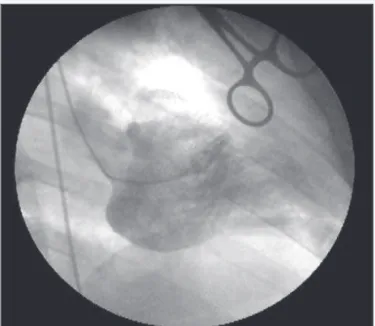
The electrocardiogram showed third-degree left bundle-branch block. The echocardiogram showed cavitary enlargement, anterior and inferior akinesia, and an ejection fraction of 24%. Thallium-201 myocardial scintigraphy showed anterior and inferior fibrosis. The cardiac catheterization evidenced a significantly enlarged ven-tricle due to anterior and inferior akinesis, and apical dyskinesis. On angiography, the ejection fraction was 25%, and the left ven-tricular Pd2 was 34 mmHg. The right coronary artery showed a diffuse lesion in its proximal segment and distal occlusion. The left main coronary artery had no obstruction, the circumflex artery had parietal irregularities and occluded marginal branches, and was opacified through the homocollaterals. The anterior descen-ding artery was diffusely damaged from the junction of the middle and distal segments onwards. The first medium-caliber diagonal branch had a severe lesion in its origin.
Taking all this into consideration, the patient and his family were presented with the possibility of retrograde bone-marrow stem cell injection through the anterior descending vein to cause myogenesis and angiogenesis. The patient agreed with the pro-cedure proposed, as did the committee on ethics subordinate to the Argentinean government and Health Ministry.
With the patient under general anesthesia, puncture of the iliac crest and bone marrow aspiration were performed.
The upper layer (leukocyte concentrate containing mononuclear cells) was separated from the erythrocytes by centrifugation, and the latter were reinfused into the patient. Then the leukocytic
Case Report
Stem Cell Therapy with Retrograde Coronary
Perfusion in Acute Myocardial Infarction.
A New Technique
Stans Murad-Netto, Rogério Moura, Luiz José Martins Romeo, Antônio Manoel Neto,
Neison Duarte, Fernando Barreto, André Jensen, Roberto Fernandez Viña,
Francisco Vraslovik, Andrin Oberdan, Frederico Benetti, Jorge Saslavsky,
Marcelo Fernandez Viña, José Geraldo Amino
Rio de Janeiro, RJ - Brazil
Instituto do Coração e da Criança do Rio de Janeiro - RJ Fundacion Don Roberto Fernandez Viña/Centro Cardiovascular San Nicolas-Argentina, Georgetown University (Department of Oncology and Immunology) - Washington-USA, Universidade Federal Fluminense - Niterói-RJ
Mailing address: Stans Murad-Netto - Av. Hildebrando de Araújo Góes, 600 - Cep 22050-000 - Rio de Janeiro, RJ, Brazil E-mail: [email protected]
Received: 01/05/2004 Accepted: 05/272004
English version by Stela Maris Costalonga
A new technique of retrograde infusion of stem cells in the coronary sinus is presented in a 63-year-old man with positive familial history of coronary artery disease and previous acute myocardial infarction. The procedure was successful, and, after 48 hours, the patient left the ICU with no complications.
Adult stem cells removed from the bone marrow have been used for the treatment of ischemia and acute myocardial infarction, improving ventricular function and/or myocardial perfusion and/or reducing the size of the infarction 1-4.
We present a new technique for retrograde stem cell infusion in the coronary sinus for the treatment of acute myocardial infarc-tion used for the first time in human beings.
Stem cells have been infused according to the 2 following routes: 1) anterograde intracoronary infusion, about which Gior-dano5 reported that the endothelium of the coronary
microcircu-lation is continuous, constituting a barrier to the passage of ma-cromolecules to the myocardium; that author also reported that another area of possible resistance is the vascular segment bet-ween the artery, in which infusion occurs, and the capillary venous segment; 2) the transendocardial route using the NOGA catheter and electromechanical mapping to identify the viable myocardium, where the mononuclear cells are then injected6.
Arquivos Brasileiros de Cardiologia - Volume 83, Nº 4, Outubro 2004
353
Stem Cell Therapy with Retrograde Coronary Perfusion in Acute Myocardial Infarction. A New Techniquelayer was processed so that enrichment in mononuclear cells could be obtained by the separation method through a density gradient
(FICOL-HYPAQUE). A satisfactory recount volume (13x106) was
obtained. The procedure was performed in a totally aseptic way, and quantification of the positive cells was performed with the CD34+ cell surface marker, correlated with the pluripotenciality and capacity for differentiation of the subpopulation precursor cells. A large amount of bone marrow blood was extracted aiming at obtaining a sufficient number of stem cells, avoiding the risk of contamination and cell differentiation.
The technique of stem cell transplantation was performed ac-cording to the following phases: 1) puncture of the right external jugular vein, followed by placement of an 8F introducer; 2) infusion of 5,000 IU of heparin; 3) catheterization of the coronary sinus with an Amplatz 8 catheter guide; 4) a 0.014 guidewire and 50x20 balloon catheter were introduced and advanced up to the distal segment of the anterior descending coronary vein; 5) a balloon catheter was positioned and inflated up to 8 atm in the middle third of the anterior descending coronary vein, and the guidewire was removed; 6) 40 mL of stem cells were infused at a pressure of 6 atm through the lumen of the balloon catheter for 5 minutes. No adverse effects occurred; 7) the balloon remained inflated up to 15 minutes after the end of the infusion of the stem cells; 8) after balloon deflation, contrast medium was injected. Opacification of the middle and distal segments of the anterior descending coronary vein and its diagonal branches predominated; 9) removal of the balloon catheter and catheter guide. The patient stayed in the ICU for 48 hours with no complications (fig. 1, 2, 3, and 4).
Discussion
We initiated our studies on coronary retroperfusion through the coronary sinus in 1962 at the service of Gofredo Gensini, MD, in Syracuse, NY. In April 1962, at the 22nd Annual Clinical Meeting of the American College of Chest Physicians, Syracuse, NY, Murad-Netto, Di Giorgi, and Gensini showed the film “Motion picture studies of the coronary venous circulation.” That film resulted
Fig. 1 - Anterior descending arteriogram showing diffuse lesion in the middle and distal segments.
Fig. 2 - Left ventriculogram prior to stem cell transplantation showing severe left ventricular systolic dysfunction.
Fig. 3 - Note the guide catheter in the coronary sinus and inflation of the balloon catheter in the anterior descending coronary vein.
from an experimental study with 25 dogs, whose chests were surgically opened. Their anterior descending artery was occluded in its origin, and, at the same time, a double-lumen catheter was positioned in the coronary sinus, with the proximal lumen con-nected to a balloon and the distal lumen free for injection of the contrast medium or the cardiogreen dye. The balloon was positioned and inflated after the merging of the posterior descending vein, occluding the coronary sinus, and, simultaneously, the anterior descending vein was occluded and the dye was injected through the free lumen of the catheter, showing its predominant distribution to the ischemic area of the occluded anterior descending artery. When the injection was performed in the anterior descending vein, the distribution to the ischemic area was more evident. These findings were filmed with the conventional device of cine coronary angiography.
Arquivos Brasileiros de Cardiologia - Volume 83, Nº 4, Outubro 2004
354
Stem Cell Therapy with Retrograde Coronary Perfusion in Acute Myocardial Infarction. A New Technique
1. Körbling M, Estrov Z. Adult stem cells for tissue repair. A new therapeutic concept? N Engl J Med. 2003; 349:570-82.
2. Strauer BE, Brehm M, Zeus T, et al. Repair of infarcted myocardium by autologous intracoronary mononuclear bone marrow cell transplantation in humans. Circu-lation. 2002; 106: 1913-8.
3. Stamm C, Westphal B, Kleine H-D, et al. Autologous bone-marrow stem-cell trans-plantation for myocardial regenaration. Lancet. 2003; 361:45-6.
4. Assmus B, Schachinger V, Tempe C, et al. Transplantation of progenitor cells and regeneration enhancement in acute myocardial infarction. Circulation. 2002; 106: 3009-17.
References
5. Giodano FJ. Retrograde coronary perfusion: a superior route to deliver therapeu-tics to the heart? J Am Coll Cardiol. 2003; 42:1129-31.
6. Perin PC, Dohman HFR, Borojevic R, et al. Transendocardial autologous bone marrow cell transplantation for severe, chronic ischemic heart failure. Circulation. 2003; 107: 2294 -302.
7. Gensini G, Di Giorgi S, Murad S. The coronary circulation: a roentgenographic stu-dyBooth # 91 Eleventh Annual Convention. The American College of Cardiology, 1962 Denver, Colorado.
8. Murad – Netto S. Importância do cateterismo do seio coronário no diagnóstico da insuficiência coronária.II Simpósio Nacional sobre aterosclerose coronária. São Paulo,1973 Editor J. Eduardo M.R. Sousa pg 63-7.
Fig. 4 - Note the contrast medium in the catheter lumen with dominant opacification of the probable ischemic area and also of the occluded right coronary artery.
Gensini et al 7 concluded that the studies about coronary
re-troperfusion allowed assessment of the venous coronary circulation and that the technique was innocuous. The easy access to the coronary sinus through catheterization, and, consequently, to the capillaries and myocardium through retrograde injection, also
pro-vided an access route for new methods of diagnosis and therapy with electrolytes and medications. Later on, in May 1962, this same study was presented at the Eleventh Annual Convention of the American College of Cardiology 7.
In 1973, at the II National Symposium on Atherosclerosis (II Simpósio Nacional sobre Aterosclerose) in São Paulo, Brazil,
Murad-Neto8 reported his experience with 20 patients with different
degrees of coronary obstruction, who received injections of contrast medium in the coronary sinus after balloon occlusion. That author8
showed the predominant distribution of the contrast medium to the areas with a significant coronary obstruction and that the opacification was even more evident when the inferior vena cava was also simultaneously occluded. No complication was observed in any of the cases studied.
We began to use the retrograde route through the coronary sinus for administration of stem cells in the service of Fernandez Viña, MD, in Argentina. To date, we have used this technique of stem cell transplantation in 2 patients with acute myocardial infarction.