Floristic composition and topographic variation in a tidal floodplain forest
in the Amazon Estuary
JOSÉ H. CATTANIO
1,4, ANTHONY B. ANDERSON
2and MANOEL S. CARVALHO
1,3(received: December 19, 2001; accepted: June 19, 2002)
ABSTRACT– (Floristic composition and topographic variation in a tidal floodplain forest in the Amazon Estuary). Slight topographic variations appear to exert dramatic effects on the structure of forests subject to inundation. In a late successional tidal floodplain forest near the Amazon port of Belém, Brazil, we examined these effects by studying floristic composition along a topographic gradient. We predicted that, relative to high sites, low sites would be characterized by high representation of life forms and taxa characteristic of inundated sites. We found striking variations in floristic composition along a slight topographic gradient. In comparison with topographically high sites, low sites were characterized by a high representation of Palm trees (Arecaceae), low diversity of trees and lianas, and high plant density. These variations appear to reflect edaphic limitations imposed by periodic flooding. The high spatial variation in floristic composition found in this ecosystem suggest caution in implementing intensive forms of agriculture.
RESUMO– (Composição florística e variação topográfica em uma floresta de várzea no Estuário Amazônico). Pequena variação topográfica aparentemente exerce um dramático efeito na estrutura florestal sujeita à inundação. Em uma floresta de várzea em avançado estágio sucessional de perto do porto amazônico de Belém, Brasil, examinamos este efeito estudando a composição florística ao longo de um gradiente de topografia. Prevíamos que, relativo a locais altos, locais baixos seriam caracterizados por alta representação de formas de vida e táxons característicos de locais inundados. Encontramos impressionantes variações ao longo de um ligeiro gradiente de topografia. Em comparação com locais de topografia alta, locais baixos foram caracterizados por uma alta representação de palmeiras arbóreas (Arecaceae), baixa diversidade de árvores e cipós, e alta densidade de plantas. Esta variação reflete, aparentemente, limitações edáficas impostas pelo alagamento periódico. A alta variação espacial na composição florística encontrada neste ecossistema sugere precaução na implementação de formas intensivas de agricultura.
Key words - Floodplain, floristic, forest, topography, várzea
Introduction
Debate on development options for the Amazon basin has frequently focused on floodplain areas, where relatively high levels of soil fertility hold the promise of supporting sustainable forms of agriculture, thus diminishing land-use pressures on the less fertile uplands (Lima 1956, Sioli & Klinge 1962, Falesi 1974, Alvim 1978). Yet the duration and predictability of the flooding period influences many ecological processes such as productivity, plant distribution, plant demography and reproductive and reproductive biology (Junk 1997)
This study focuses on such a tidal floodplain, which covers a total area of 25,000 - 30,000 km2 in the Amazon
estuary (Lima 1956). Most of this area is covered by secondary forests that - together with floodplain forests elsewhere in the Amazon basin - provided the region’s principal source of timber for nearly three centuries (Rankin 1985). Even today, the estuarine floodplain is a critical source of non-timber forest products such as palm heart, rubber, fruit, and game for local populations (Anderson 1990).
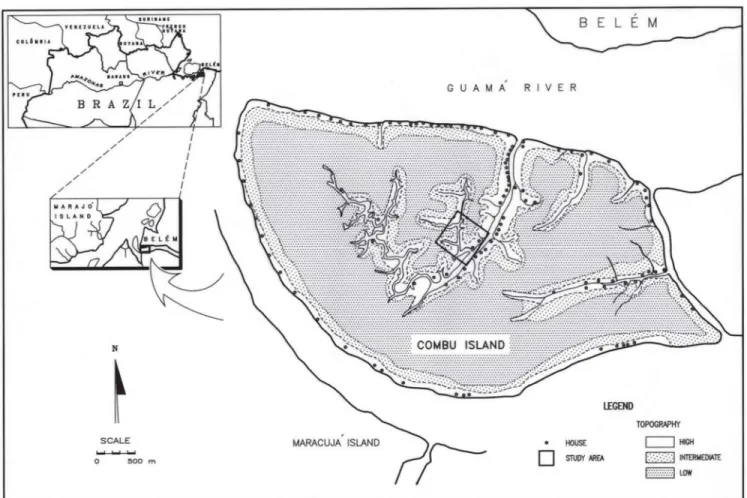
The economic importance of floodplain forests in the Amazon estuary indicates the need for sustained management of this ecosystem. Yet little ecological information has been published on these forests that could serve as a basis for their management. This study aims to fill that gap by providing a detailed analysis of the structure of a late successional floodplain forest on Combu Island, located at the mouth of the Guamá River, 1.5 km south of the major port city of Belém (figure 1). These forests are often submitted twice daily to freshwater flooding backed up from tides. High tides temporarily block the flow of the rivers in the estuarine region and cause them to flood the adjacent forest.
Preliminary observations on Combu indicated that slight variations in topography (< 1 m) are associated
1. Museu Paraense Emilio Goeldi, Departamento de Ecologia;
currently: Institute of Agriculture in the Tropics (IAT), Grisebachstr. 6, D-37077 Goettingen, Germany.
2. Museu Paraense Emilio Goeldi, Departamento de Ecologia,
Av. Perimetral s.n., 66040-170 Belém, PA, Brazil.
3. Museu Paraense Emilio Goeldi, Departamento de Ecologia;
currently: Faculdade de Ciências Agrárias do Pará, Departamento de Ciências Florestais.
with dramatic changes in the structure and floristic composition of the floodplain forest (A. Anderson, unpublished data). Such changes appear to reflect the effects of varying degrees of flooding on the vegetation. We examined the vegetation located along a topographic gradient and, consequently, subject to differing frequencies of flooding. Since flooding is associated with anaerobic soil conditions that are stressful to many plants, we predicted that, relative to high sites, low sites would be characterized by i) low diversity of plants, ii) high degree of dominance in a few flood adapted species, and iii) high representation of life forms and characteristic taxa of inundated sites. To test these predictions, we examined forest floristic composition in relation to topography on Combu Island.
Material and methods
The study took place on Combu Island (figure 1). In the nearby city of Belém, monthly temperatures vary from 26 °C to 27 °C, and annual rainfall totals 3,174 mm (mean for 1982-1989, Superintendência do Desenvolvimento da
Amazônia – SUDAM, unpublished data). Topographic relief on the island is generally low (< 4 m above mean sea level), and the predominant soil type is a low humic gley (Vieira 1979), characterized by a high percentage of kaolinite clay and silt and a low percentage of sand (Falesi 1986). Due to the low relief and fine texture of the soil, drainage is poor and oxygen levels are low for long periods (S. Subler, unpublished data).
Tide-driven floods exert a powerful effect on soils and topography in the estuarine floodplain (Falesi 1986). For example, oscillations in the water table result in alternating oxidation and reduction in the soil, which are associated with gleying (Sioli 1951, Falesi 1974). Likewise, although low, topographic relief is accentuated by differential sedimentation during floods, in which coarse sediments are deposited on levees adjacent to rivers or streams and fine sediments are deposited behind the levees (Pires 1974, Prance 1979). The effects of these processes are evident in the topography of Combu Island (figure 1). Here, high sites are restricted to areas adjacent to waterways and represent the preferred locations for settlement, while the more extensive low sites occupy most of the central portions of the island and are generally uninhabited.
To characterize the forest structure of the floodplain forest on Combu Island, we selected sampling sites covered by late successional forest that, according to local informants, had undergone little or no disturbance over the past 40 years. Such sites were scarce due to the high population density and intensive forest use on the island. As a result, we were obliged to use small (20 × 25 m, plus a 10 m wide border) sampling plots widely scattered in the central part of island (figure 1). In each plot, we measured the diameter at breast height (dbh) and identified 89, 94% and 98% of the total number de plant with dbh ≥ 5 cm for high, intermediate and low topography, respectively. Voucher specimens were deposited in the herbarium of the Museu Paraense Emilio Goeldi in Belém.
To detect structural variations in relation to topography, the vegetation was sampled along a topographic gradient. With the assistance of local inhabitants, we distinguished three types of forest according to topography (table 1) and location in relation to streams and rivers (figure 1). Four plots (totaling 0.2 ha in area) were located not continuous on topographically high sites, at a mean altitude of 366 ± 5.0 cm (average ± SE) above sea level. Altitudes were derived from a topographic reference point on Combu Island, with the lowest tide as zero (sea level)., and using standard topographic surveying techniques whit theodolite. An additional four plots (totaling 0.2 ha in area) were located not continuous on topographically low sites, at a mean altitude of 312 ± 2.5 cm.
Results
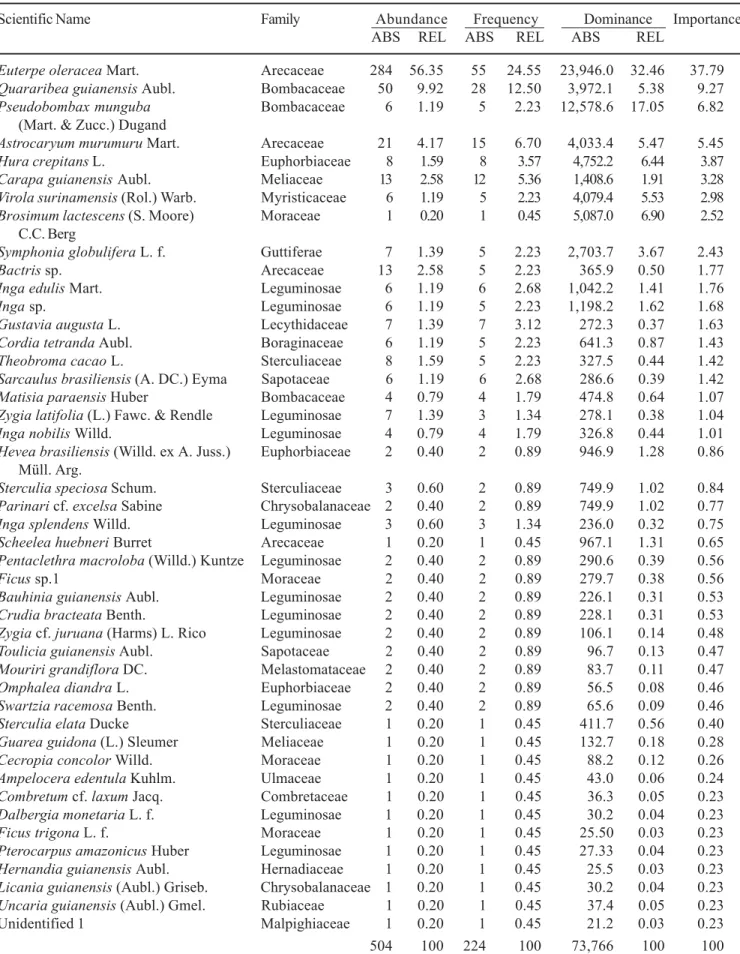
Although the topographically high, intermediate, and low sites were defined by small altitudinal differences (approximately 77 cm), the corresponding forest communities varied considerably in floristic composition. Along the slight topographic gradient on Combu Island, the largest variations involved the floristic composition of the vegetation. The distribution of palms along this gradient was especially noteworthy. On topographically high and intermediate sites, this family represented 9% and 10% of the total basal area, respectively; in contrast, on topographically low sites palms constituted 40% of the total basal area. All references to parameters of vegetation refer to plants with dbh ≥ 5.0 cm. The varying importance of palms was due largely to a single species, Euterpe oleracea
Mart., which ranged from 1% of total basal area on high sites to 32% on low sites (tables 2, 3, 4).
E. oleracea was by far the most dominant, frequent, and abundant species on the low sites, representing more than half (56%) of the individuals present.
The relative dominance of life forms other than palms also varied inversely of dicotyledonous along the topographic gradient (figure 2). The percentage of basal area in lianas (woody vines) was 2% on high sites, 2% on intermediate sites, and < 1% on low sites. The low relative dominance of lianas on topographically low sites could be due to the abundance of palms, which prevent liana establishment by shedding relatively large leaves (Putz 1984).
In addition to Arecaceae, families that exhibited greater relative dominance on topographically low sites included Bombacaceae (22% ± 6.2%), Euphorbiaceae (6% ± 3.8%), Moraceae (7% ± 6.1%), and Myristicaceae (5% ± 2.4%) (figure 3). These families were represented by species characteristic of bottomland sites in Amazon, such as Quararibea guianensis Aubl. and, especially,
Pseudobombax munguba (Mart. & Zucc.) Dugand (Bombacaceae), Hura crepitans L. and, to a lesser degree,
Hevea brasiliensis (Willd. ex A. Juss.) Müll. Arg. (Euphorbiaceae), Brosimum lactescens (S. Moore) C.C. Berg (Moraceae), and Virola surinamensis (Rol.) Warb. (Myristicaceae) (tables 2, 3, 4). H. brasiliensis had a relative dominance of 1.3% and 1.9% on topographically low and intermediate sites, respectively; it was not found on high sites (tables 2-4).
By contrast, the following families showed greater relative dominance on topographically high sites: Anacardiaceae (28% ± 8.3%), Lecythidaceae
Table 1. Number of plots and altitude (cm) above sea level of vegetation sampling plots on topographically high, intermediate, and low sites on Combu Island, Belém, PA, Brazil. The topographical survey was making with theodolite and using the lowest tide as zero (sea level).
Altitude (above sea level) Topography Number Total Min. Max. Average
of plots (ha) (cm) (cm) (cm)
High 4 0.2 359.3 383.4 366.5
Intermediate 20 1.0 328.0 343.7 335.7
Low 4 0.2 305.9 317.2 311.8
Finally, we sampled not continuous 20 plots (totaling 1 ha in area) on topographically intermediate sites, at a mean altitude of 336 ± 1.3 cm. Because of small size and discontinuity of the areas this work use small parcels for floristic survey (figure 1).
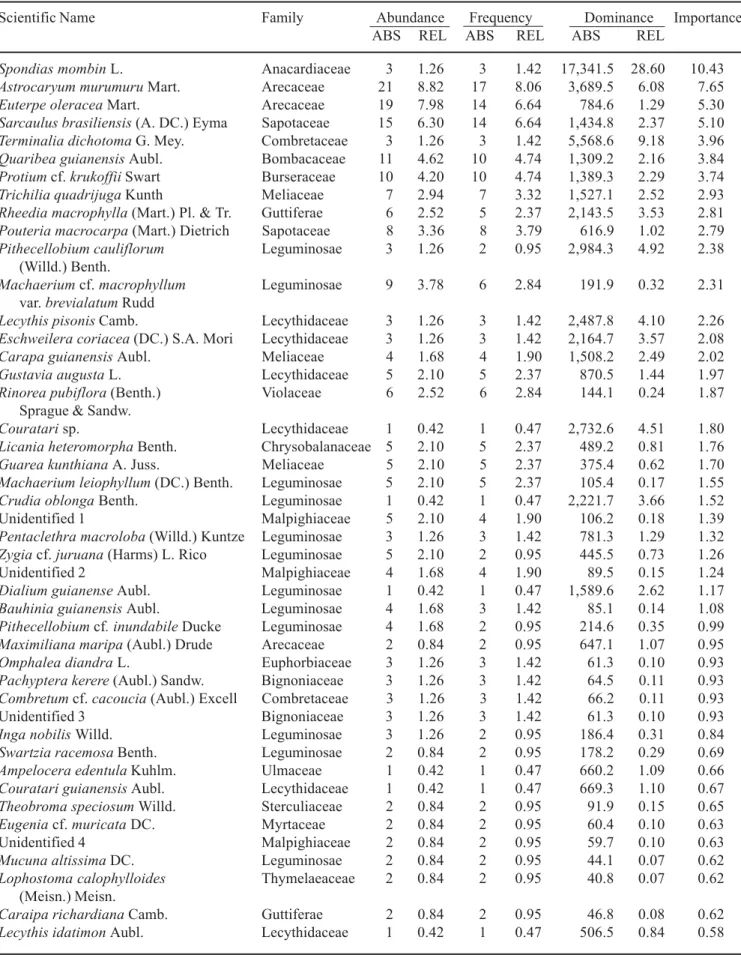
Table 2. Composition of plants with dbh ≥ 5 cm in 0.2 ha (4 × 0.05 ha) of topographically high floodplain forest on Combu Island, Pará, Brazil.
Scientific Name Family Abundance Frequency Dominance Importance
ABS REL ABS REL ABS REL
Spondias mombin L. Anacardiaceae 3 1.26 3 1.42 17,341.5 28.60 10.43
Astrocaryum murumuru Mart. Arecaceae 21 8.82 17 8.06 3,689.5 6.08 7.65
Euterpe oleracea Mart. Arecaceae 19 7.98 14 6.64 784.6 1.29 5.30
Sarcaulus brasiliensis (A. DC.) Eyma Sapotaceae 15 6.30 14 6.64 1,434.8 2.37 5.10
Terminalia dichotoma G. Mey. Combretaceae 3 1.26 3 1.42 5,568.6 9.18 3.96
Quaribea guianensis Aubl. Bombacaceae 11 4.62 10 4.74 1,309.2 2.16 3.84
Protium cf. krukoffii Swart Burseraceae 10 4.20 10 4.74 1,389.3 2.29 3.74
Trichilia quadrijuga Kunth Meliaceae 7 2.94 7 3.32 1,527.1 2.52 2.93
Rheedia macrophylla (Mart.) Pl. & Tr. Guttiferae 6 2.52 5 2.37 2,143.5 3.53 2.81
Pouteria macrocarpa (Mart.) Dietrich Sapotaceae 8 3.36 8 3.79 616.9 1.02 2.79
Pithecellobium cauliflorum Leguminosae 3 1.26 2 0.95 2,984.3 4.92 2.38 (Willd.) Benth.
Machaerium cf. macrophyllum Leguminosae 9 3.78 6 2.84 191.9 0.32 2.31 var. brevialatum Rudd
Lecythis pisonis Camb. Lecythidaceae 3 1.26 3 1.42 2,487.8 4.10 2.26
Eschweilera coriacea (DC.) S.A. Mori Lecythidaceae 3 1.26 3 1.42 2,164.7 3.57 2.08
Carapa guianensis Aubl. Meliaceae 4 1.68 4 1.90 1,508.2 2.49 2.02
Gustavia augusta L. Lecythidaceae 5 2.10 5 2.37 870.5 1.44 1.97
Rinorea pubiflora (Benth.) Violaceae 6 2.52 6 2.84 144.1 0.24 1.87 Sprague & Sandw.
Couratari sp. Lecythidaceae 1 0.42 1 0.47 2,732.6 4.51 1.80
Licania heteromorpha Benth. Chrysobalanaceae 5 2.10 5 2.37 489.2 0.81 1.76
Guarea kunthiana A. Juss. Meliaceae 5 2.10 5 2.37 375.4 0.62 1.70
Machaerium leiophyllum (DC.) Benth. Leguminosae 5 2.10 5 2.37 105.4 0.17 1.55
Crudia oblonga Benth. Leguminosae 1 0.42 1 0.47 2,221.7 3.66 1.52
Unidentified 1 Malpighiaceae 5 2.10 4 1.90 106.2 0.18 1.39
Pentaclethra macroloba (Willd.) Kuntze Leguminosae 3 1.26 3 1.42 781.3 1.29 1.32
Zygia cf. juruana (Harms) L. Rico Leguminosae 5 2.10 2 0.95 445.5 0.73 1.26
Unidentified 2 Malpighiaceae 4 1.68 4 1.90 89.5 0.15 1.24
Dialium guianense Aubl. Leguminosae 1 0.42 1 0.47 1,589.6 2.62 1.17
Bauhinia guianensis Aubl. Leguminosae 4 1.68 3 1.42 85.1 0.14 1.08
Pithecellobium cf. inundabile Ducke Leguminosae 4 1.68 2 0.95 214.6 0.35 0.99
Maximiliana maripa (Aubl.) Drude Arecaceae 2 0.84 2 0.95 647.1 1.07 0.95
Omphalea diandra L. Euphorbiaceae 3 1.26 3 1.42 61.3 0.10 0.93
Pachyptera kerere (Aubl.) Sandw. Bignoniaceae 3 1.26 3 1.42 64.5 0.11 0.93
Combretum cf. cacoucia (Aubl.) Excell Combretaceae 3 1.26 3 1.42 66.2 0.11 0.93
Unidentified 3 Bignoniaceae 3 1.26 3 1.42 61.3 0.10 0.93
Inga nobilis Willd. Leguminosae 3 1.26 2 0.95 186.4 0.31 0.84
Swartzia racemosa Benth. Leguminosae 2 0.84 2 0.95 178.2 0.29 0.69
Ampelocera edentula Kuhlm. Ulmaceae 1 0.42 1 0.47 660.2 1.09 0.66
Couratari guianensis Aubl. Lecythidaceae 1 0.42 1 0.47 669.3 1.10 0.67
Theobroma speciosum Willd. Sterculiaceae 2 0.84 2 0.95 91.9 0.15 0.65
Eugenia cf. muricata DC. Myrtaceae 2 0.84 2 0.95 60.4 0.10 0.63
Unidentified 4 Malpighiaceae 2 0.84 2 0.95 59.7 0.10 0.63
Mucuna altissima DC. Leguminosae 2 0.84 2 0.95 44.1 0.07 0.62
Lophostoma calophylloides Thymelaeaceae 2 0.84 2 0.95 40.8 0.07 0.62 (Meisn.) Meisn.
Caraipa richardiana Camb. Guttiferae 2 0.84 2 0.95 46.8 0.08 0.62
(13% ± 6.1%), and Burseraceae (2% ± 0.9%) (figure 3). Based on their topographic distribution on Combu Island, species that appear to be better adapted to relatively elevated sites include Spondias mombin L. (Anacardiaceae); Lecythis pisonis Camb., Eschweilera coriacea (DC.) S.A. Mori, Couratari sp. (Lecythidaceae) and Protium cf. krukoffii Swart (Burseraceae) (table 2).
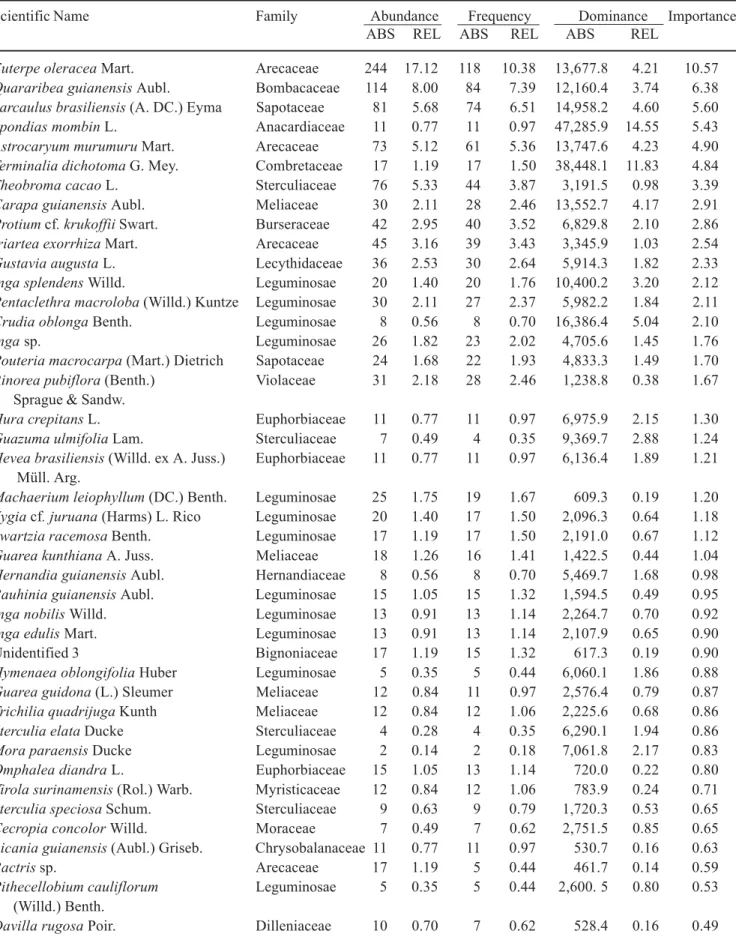
In comparison with topographically low sites, on high sites the diversity of tree and lianas was greater, while species dominance was less pronounced (table 2 and 4). In the 0.2 ha areas sampled in each community, we found a total of 45 species on the low sites and 67 species on the high sites. At the same time, the five species with greatest basal area had a combined relative dominance of 68% on the low sites and 48% on the high sites.
Plant density was also found to vary along the topographic gradient on Combu Island (tables 2-4). We found 2,520 individuals.ha-1 on the low sites, 1,425
individuals.ha-1 on the intermediate sites, and 1,190
individuals.ha-1 on the high sites. In addition to high
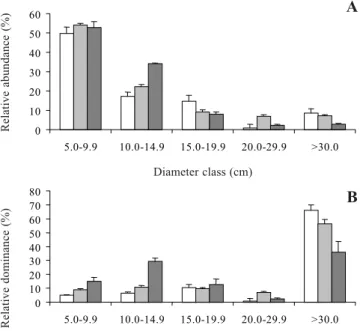
density, the topographically low sites were characterized by a relatively high representation of small-girth individuals. For example, the relative abundance of plants with dbh < 15 cm was 87% on the low sites, compared with 76% and 67% on the intermediate and high sites, respectively (figure 4A). In terms of relative dominance, the differences were even more pronounced: 45%, 20%, and 12%, respectively (figure 4B).
In contrast, the topographically high sites exhibited a relatively high presence of large-girthed individuals. For example, the relative abundance of plants with dbh > 20 cm was 5% on the low sites, compared with 14% and 18% on the intermediate and high sites, respectively (figure 4A). In terms of relative dominance, the figures were 43%, 72%, and 78%, respectively (figure 4B).
Discussion
Pires & Koury (1958) provided descriptive observations concerning the effects of small topographic changes on floodplain forests of the Amazon estuary. The variations in forest structure between the sites
(cont.)
Scientific Name Family Abundance Frequency Dominance Importance
ABS REL ABS REL ABS REL
Maytenus sp. Celastraceae 1 0.42 1 0.47 329.9 0.54 0.48
Unidentified 5 Menispermaceae 2 0.84 1 0.47 43.3 0.07 0.46
Doliocarpus dentatus (Aubl.) Stand. Dilleniaceae 2 0.84 1 0.47 43.3 0.07 0.46
Davilla rugosa Poir. Dilleniaceae 2 0.84 1 0.47 40.0 0.07 0.46
Oenocarpus distichus Mart. Arecaceae 1 0.42 1 0.47 280.4 0.46 0.45
Theobroma grandiflorum Sterculiaceae 1 0.42 1 0.47 218.9 0.36 0.42 (Willd. ex Spreng.) K. Schum.
Protium tenuifolium (Engl.) Engl. Burseraceae 1 0.42 1 0.47 145.2 0.24 0.38
Chaunochiton cf. loranthoides Benth. Olacaceae 1 0.42 1 0.47 151.7 0.25 0.38
Iriartea exorrhiza Mart. Arecaceae 1 0.42 1 0.47 103.8 0.17 0.36
Licania macrophylla Benth. Chrysobalanaceae 1 0.42 1 0.47 91.6 0.15 0.35
Parinari cf. excelsa Sabine Chrysobalanaceae 1 0.42 1 0.47 40.7 0.07 0.32
Eugenia cf. coffeifolia DC. Myrtaceae 1 0.42 1 0.47 40.7 0.07 0.32
Unonopsis guatterioides (A. DC.) Fries Annonaceae 1 0.42 1 0.47 39.6 0.07 0.32
Zygia latifolia (L.) Fawc. & Rendle Leguminosae 1 0.42 1 0.47 40.7 0.07 0.32
Sterculia speciosa Schum. Sterculiaceae 1 0.42 1 0.47 28.3 0.05 0.31
Swartzia arborescens (Aubl.) Pittier Leguminosae 1 0.42 1 0.47 23.6 0.04 0.31
Heisteria cf. acuminata (H. et B.) Engl. Olacaceae 1 0.42 1 0.47 31.2 0.05 0.32
Erythroxylum kapplerianum Peyr. Erythroxylaceae 1 0.42 1 0.47 23.8 0.04 0.31
Unidentified 6 Bignoniaceae 1 0.42 1 0.47 22.9 0.04 0.31
Casimirella ampla (Miers) R.A. Howard Icacinaceae 1 0.42 1 0.47 20.4 0.03 0.31
Elvasia sp. Ochnaceae 1 0.42 1 0.47 19.6 0.03 0.31
Unidentified 7 Bignoniaceae 1 0.42 1 0.47 22.1 0.04 0.31
Table 3. Composition of plants with dbh ≥ 5 cm in 1 ha (20 × 0.05 ha) of topographically intermediate floodplain forest on Combu Island, Pará, Brazil.
Scientific Name Family Abundance Frequency Dominance Importance
ABS REL ABS REL ABS REL
Euterpe oleracea Mart. Arecaceae 244 17.12 118 10.38 13,677.8 4.21 10.57
Quararibea guianensis Aubl. Bombacaceae 114 8.00 84 7.39 12,160.4 3.74 6.38
Sarcaulus brasiliensis (A. DC.) Eyma Sapotaceae 81 5.68 74 6.51 14,958.2 4.60 5.60
Spondias mombin L. Anacardiaceae 11 0.77 11 0.97 47,285.9 14.55 5.43
Astrocaryum murumuru Mart. Arecaceae 73 5.12 61 5.36 13,747.6 4.23 4.90
Terminalia dichotoma G. Mey. Combretaceae 17 1.19 17 1.50 38,448.1 11.83 4.84
Theobroma cacao L. Sterculiaceae 76 5.33 44 3.87 3,191.5 0.98 3.39
Carapa guianensis Aubl. Meliaceae 30 2.11 28 2.46 13,552.7 4.17 2.91
Protium cf. krukoffii Swart. Burseraceae 42 2.95 40 3.52 6,829.8 2.10 2.86
Iriartea exorrhiza Mart. Arecaceae 45 3.16 39 3.43 3,345.9 1.03 2.54
Gustavia augusta L. Lecythidaceae 36 2.53 30 2.64 5,914.3 1.82 2.33
Inga splendens Willd. Leguminosae 20 1.40 20 1.76 10,400.2 3.20 2.12
Pentaclethra macroloba (Willd.) Kuntze Leguminosae 30 2.11 27 2.37 5,982.2 1.84 2.11
Crudia oblonga Benth. Leguminosae 8 0.56 8 0.70 16,386.4 5.04 2.10
Inga sp. Leguminosae 26 1.82 23 2.02 4,705.6 1.45 1.76
Pouteria macrocarpa (Mart.) Dietrich Sapotaceae 24 1.68 22 1.93 4,833.3 1.49 1.70
Rinorea pubiflora (Benth.) Violaceae 31 2.18 28 2.46 1,238.8 0.38 1.67 Sprague & Sandw.
Hura crepitans L. Euphorbiaceae 11 0.77 11 0.97 6,975.9 2.15 1.30
Guazuma ulmifolia Lam. Sterculiaceae 7 0.49 4 0.35 9,369.7 2.88 1.24
Hevea brasiliensis (Willd. ex A. Juss.) Euphorbiaceae 11 0.77 11 0.97 6,136.4 1.89 1.21 Müll. Arg.
Machaerium leiophyllum (DC.) Benth. Leguminosae 25 1.75 19 1.67 609.3 0.19 1.20
Zygia cf. juruana (Harms) L. Rico Leguminosae 20 1.40 17 1.50 2,096.3 0.64 1.18
Swartzia racemosa Benth. Leguminosae 17 1.19 17 1.50 2,191.0 0.67 1.12
Guarea kunthiana A. Juss. Meliaceae 18 1.26 16 1.41 1,422.5 0.44 1.04
Hernandia guianensis Aubl. Hernandiaceae 8 0.56 8 0.70 5,469.7 1.68 0.98
Bauhinia guianensis Aubl. Leguminosae 15 1.05 15 1.32 1,594.5 0.49 0.95
Inga nobilis Willd. Leguminosae 13 0.91 13 1.14 2,264.7 0.70 0.92
Inga edulis Mart. Leguminosae 13 0.91 13 1.14 2,107.9 0.65 0.90
Unidentified 3 Bignoniaceae 17 1.19 15 1.32 617.3 0.19 0.90
Hymenaea oblongifolia Huber Leguminosae 5 0.35 5 0.44 6,060.1 1.86 0.88
Guarea guidona (L.) Sleumer Meliaceae 12 0.84 11 0.97 2,576.4 0.79 0.87
Trichilia quadrijuga Kunth Meliaceae 12 0.84 12 1.06 2,225.6 0.68 0.86
Sterculia elata Ducke Sterculiaceae 4 0.28 4 0.35 6,290.1 1.94 0.86
Mora paraensis Ducke Leguminosae 2 0.14 2 0.18 7,061.8 2.17 0.83
Omphalea diandra L. Euphorbiaceae 15 1.05 13 1.14 720.0 0.22 0.80
Virola surinamensis (Rol.) Warb. Myristicaceae 12 0.84 12 1.06 783.9 0.24 0.71
Sterculia speciosa Schum. Sterculiaceae 9 0.63 9 0.79 1,720.3 0.53 0.65
Cecropia concolor Willd. Moraceae 7 0.49 7 0.62 2,751.5 0.85 0.65
Licania guianensis (Aubl.) Griseb. Chrysobalanaceae 11 0.77 11 0.97 530.7 0.16 0.63
Bactris sp. Arecaceae 17 1.19 5 0.44 461.7 0.14 0.59
Pithecellobium cauliflorum Leguminosae 5 0.35 5 0.44 2,600. 5 0.80 0.53 (Willd.) Benth.
(cont.)
Scientific Name Family Abundance Frequency Dominance Importance
ABS REL ABS REL ABS REL
Trichilia micrantha Benth. Meliaceae 8 0.56 8 0.70 609.1 0.19 0.48
Zygia latifolia (L.) Fawc. & Rendle Leguminosae 8 0.56 6 0.53 652.2 0.20 0.43
Rheedia macrophylla (Mart.) Pl. & Tr. Gutifereae 5 0.35 5 0.44 1,450.3 0.45 0.41
Uncaria guianensis (Aubl.) Gmel. Rubiaceae 8 0.56 6 0.53 294.7 0.09 0.39
Mucuna altissima DC. Leguminosae 7 0.49 7 0.62 153.0 0.05 0.39
Unidentified 1 Malphighiaceae 6 0.42 6 0.53 580.8 0.18 0.38
Cordia tetrandra Aubl. Boraginaceae 3 0.21 3 0.26 2,032.8 0.63 0.37
Licania heteromorpha Benth. Chrysobalanaceae 5 0.35 5 0.44 1,012.4 0.31 0.37
Ocotea cf. caudata Mez Lauraceae 4 0.28 4 0.35 1,428.4 0.44 0.36
Hymenaea cf. palustris Ducke Leguminosae 2 0.14 2 0.18 2,495.7 0.77 0.36
Toulicia guianensis Aubl. Sapindaceae 5 0.35 5 0.44 623.8 0.19 0.33
Heisteria cf. acuminata (H. & B.) Engl. Olacaceae 6 0.42 6 0.53 148.9 0.05 0.33
Pterocarpus officinalis Jacq. Leguminosae 2 0.14 2 0.18 2,185.1 0.67 0.33
Unidentified 6 Bignoniaceae 7 0.49 5 0.44 139.0 0.04 0.32
Licaria mahuba (Samp.) Kosterm. Lauraceae 5 0.35 5 0.44 561.7 0.17 0.32
Macrolobium pendulum Willd. Leguminosae 3 0.21 2 0.18 1,821.3 0.56 0.32
Machaerium cf. macrophyllum Leguminosae 6 0.42 5 0.44 220.5 0.07 0.31 var. brevialatum Rudd
Ceiba pentandra Gaertn. Bombacaceae 5 0.35 4 0.35 673.2 0.21 0.30
Lecythis idatimon Aubl. Lecythidaceae 5 0.35 5 0.44 342.2 0.11 0.30
Mouriri grandiflora DC. Melastomataceae 5 0.35 5 0.44 164.9 0.05 0.28
Maytenus sp. Celastraceae 2 0.14 2 0.18 1,657.0 0.51 0.28
Parinari cf. excelsa Sabine Chrysobalanaceae 4 0.28 4 0.35 606.2 0.19 0.27
Ficus sp.1 Moraceae 3 0.21 3 0.26 1,109.4 0.34 0.27
Cedrelaodorata L. Meliaceae 4 0.28 4 0.35 469.1 0.14 0.26
Unidentified 1 Malphighiaceae 5 0.35 4 0.35 204.1 0.06 0.25
Theobroma speciosum Willd. Sterculiaceae 5 0.35 3 0.26 409.6 0.13 0.25
Matisia paraensis Huber Bombacaceae 3 0.21 2 0.18 1,103.8 0.34 0.24
Unidentified 3 Bignoniaceae 4 0.28 4 0.35 208.5 0.06 0.23
Combretum cf. cacoucia (Aubl.) Excell Combretaceae 4 0.28 4 0.35 92.0 0.03 0.22
Symphonia globulifera L. f. Gutifereae 3 0.21 3 0.26 474.7 0.15 0.21
Tapirira guianensis Aubl. Anacardiaceae 4 0.28 3 0.26 255.1 0.08 0.21
Coccolobalatifolia Lam. Polygonaceae 4 0.28 2 0.18 546.0 0.17 0.21
Campsiandralaurifolia Benth. Leguminosae 2 0.14 2 0.18 924.5 0.28 0.20
Maximiliana maripa (Aubl.) Drude Arecaceae 2 0.14 2 0.18 922.5 0.28 0.20
Unidentified 2 Malphighiaceae 4 0.28 3 0.26 88.3 0.03 0.19
Lecythis pisonis Camb. Lecythidaceae 1 0.07 1 0.09 1,293.9 0.40 0.19
Caraipa richardiana Camb. Guttiferae 3 0.21 3 0.26 231.6 0.07 0.18
Ampelocera edentula Kuhlm. Ulmaceae 3 0.21 3 0.26 149.3 0.05 0.17
Pachyptera kerere (Aubl.) Sandw. Bignoniaceae 3 0.21 3 0.26 70.4 0.02 0.16
Entada cf. palystachya (L.) DC. Leguminosae 2 0.14 2 0.18 377.2 0.12 0.15
Genipa americana L. Rubiaceae 1 0.07 1 0.09 849.7 0.26 0.14
Oenocarpus distichus Mart. Arecaceae 2 0.14 2 0.18 281.7 0.09 0.14
Phenakospermum guianense Endl. Musaceae 3 0.21 2 0.18 132.5 0.04 0.14
Dalbergia monetaria L. f. Leguminosae 3 0.21 2 0.18 69.6 0.02 0.14
studied in Combu Island appear to be caused by edaphic factors associated with topography. Specifically, reduced diversity and high representation of palms on topographically low sites may reflect lack of oxygen in the waterlogged soils of such sites, which limits the establishment and survival of seedlings of many plant species (Esau 1967, Lunt et al. 1973, Crawford 1989). The vegetation on excessively humid sites frequently exhibits a high abundance of aerial roots and lenticels, which are believed to assist in absorption of oxygen
(Winter 1976, Frangi & Lugo 1985). Aerial roots are especially characteristic of palm species such as
Euterpe oleracea, Mauritia flexuosa L. f., and
Iriartea exorrhiza Mart., which proliferate on topographically low sites on Combu Island. However, Scarano et al. (1993), studying root carbohydrate storage in these forests, concluded that plant survival in these floodplain forests seems to be the result of more than only one adaptive mechanism.
The comparison between the two studies in tidal
(cont.)
Scientific Name Family Abundance Frequency Dominance Importance
ABS REL ABS REL ABS REL
Licania macrophylla Benth. Chrysobalanaceae 2 0.14 2 0.18 95.0 0.03 0.12
Swartzia polyphylla A. DC. Leguminosae 2 0.14 2 0.18 112.8 0.03 0.12
Casimirella ampla (Miers) R.A. Howard Icacinaceae 2 0.14 2 0.18 100.9 0.03 0.12
Pithecellobium cf. inundabile Ducke Leguminosae 2 0.14 2 0.18 61.6 0.02 0.11
Derris sp. 1 Leguminosae 2 0.14 2 0.18 72.9 0.02 0.11
Ardisia sp. Myrsinaceae 2 0.14 2 0.18 70.7 0.02 0.11
Crudia bracteata Benth. Leguminosae 2 0.14 2 0.18 58.9 0.02 0.11
Unidentified 6 Bignoniaceae 2 0.14 2 0.18 44.1 0.01 0.11
Terminalia guianensis Eichl. Compositae 1 0.07 1 0.09 490.6 0.15 0.10
Parkia multijuga Benth. Leguminosae 1 0.07 1 0.09 320.3 0.10 0.09
Chaunochiton cf. loranthoides Benth. Olacaceae 1 0.07 1 0.09 268.7 0.08 0.08
Ficus trigona L. f. Moraceae 2 0.14 1 0.09 44.2 0.01 0.08
Eugenia cf. coffeifolia DC. Myrtaceae 1 0.07 1 0.09 128.6 0.04 0.07
Derris sp. 2 Leguminosae 1 0.07 1 0.09 136.8 0.04 0.07
Alibertia sp. Rubiaceae 1 0.07 1 0.09 211.1 0.06 0.07
Simarouba amara Aubl. Simaroubaceae 1 0.07 1 0.09 186.2 0.06 0.07
Eschweilera coriacea (DC.) S.A. Mori Lecythidaceae 1 0.07 1 0.09 56.7 0.02 0.06
Pouteria cf. glomerata (Miq.) Radlk. Sapotaceae 1 0.07 1 0.09 36.3 0.01 0.06
Theobroma grandiflorum Sterculiaceae 1 0.07 1 0.09 95.0 0.03 0.06 (Willd. ex Spreng.) K. Schum.
Sophonandra sp. Solanaceae 1 0.07 1 0.09 33.2 0.01 0.06
Chamaecrista sp. Leguminosae 1 0.07 1 0.09 43.0 0.01 0.06
Doliocarpus dentatus (Aubl.) Standl. Dilleniaceae 1 0.07 1 0.09 22.1 0.01 0.05
Sacoglottis amazonica Mart. Humiriaceae 1 0.07 1 0.09 49.0 0.02 0.06
Couepia sp. Chrysobalanaceae 1 0.07 1 0.09 49.0 0.02 0.06
Eugenia cf. lambertiana DC. Myrtaceae 1 0.07 1 0.09 31.2 0.01 0.06
Inga velutina Willd. Leguminosae 1 0.07 1 0.09 26.4 0.01 0.06
Unidentified 8 Leguminosae 1 0.07 1 0.09 22.1 0.01 0.05
Salacia sp. Celastraceae 1 0.07 1 0.09 50.2 0.02 0.06
Paullinia pinnata L. Sapindaceae 1 0.07 1 0.09 21.2 0.01 0.05
Hippocratea sp. Hippocrateaceae 1 0.07 1 0.09 45.3 0.01 0.06
Dioclea sp. Leguminosae 1 0.07 1 0.09 21.2 0.01 0.05
Table 4. Composition of plants with dbh ≥ 5 cm in 0.2 ha (4 × 0.05 ha) of topographically low floodplain forest on Combu Island, Pará, Brazil.
Scientific Name Family Abundance Frequency Dominance Importance
ABS REL ABS REL ABS REL
Euterpe oleracea Mart. Arecaceae 284 56.35 55 24.55 23,946.0 32.46 37.79
Quararibea guianensis Aubl. Bombacaceae 50 9.92 28 12.50 3,972.1 5.38 9.27
Pseudobombax munguba Bombacaceae 6 1.19 5 2.23 12,578.6 17.05 6.82 (Mart. & Zucc.) Dugand
Astrocaryum murumuru Mart. Arecaceae 21 4.17 15 6.70 4,033.4 5.47 5.45
Hura crepitans L. Euphorbiaceae 8 1.59 8 3.57 4,752.2 6.44 3.87
Carapa guianensis Aubl. Meliaceae 13 2.58 12 5.36 1,408.6 1.91 3.28
Virola surinamensis (Rol.) Warb. Myristicaceae 6 1.19 5 2.23 4,079.4 5.53 2.98
Brosimum lactescens (S. Moore) Moraceae 1 0.20 1 0.45 5,087.0 6.90 2.52 C.C. Berg
Symphonia globulifera L. f. Guttiferae 7 1.39 5 2.23 2,703.7 3.67 2.43
Bactris sp. Arecaceae 13 2.58 5 2.23 365.9 0.50 1.77
Inga edulis Mart. Leguminosae 6 1.19 6 2.68 1,042.2 1.41 1.76
Inga sp. Leguminosae 6 1.19 5 2.23 1,198.2 1.62 1.68
Gustavia augusta L. Lecythidaceae 7 1.39 7 3.12 272.3 0.37 1.63
Cordia tetranda Aubl. Boraginaceae 6 1.19 5 2.23 641.3 0.87 1.43
Theobroma cacao L. Sterculiaceae 8 1.59 5 2.23 327.5 0.44 1.42
Sarcaulus brasiliensis (A. DC.) Eyma Sapotaceae 6 1.19 6 2.68 286.6 0.39 1.42
Matisia paraensis Huber Bombacaceae 4 0.79 4 1.79 474.8 0.64 1.07
Zygia latifolia (L.) Fawc. & Rendle Leguminosae 7 1.39 3 1.34 278.1 0.38 1.04
Inga nobilis Willd. Leguminosae 4 0.79 4 1.79 326.8 0.44 1.01
Hevea brasiliensis (Willd. ex A. Juss.) Euphorbiaceae 2 0.40 2 0.89 946.9 1.28 0.86 Müll. Arg.
Sterculia speciosa Schum. Sterculiaceae 3 0.60 2 0.89 749.9 1.02 0.84
Parinari cf. excelsa Sabine Chrysobalanaceae 2 0.40 2 0.89 749.9 1.02 0.77
Inga splendens Willd. Leguminosae 3 0.60 3 1.34 236.0 0.32 0.75
Scheelea huebneri Burret Arecaceae 1 0.20 1 0.45 967.1 1.31 0.65
Pentaclethra macroloba (Willd.) Kuntze Leguminosae 2 0.40 2 0.89 290.6 0.39 0.56
Ficus sp.1 Moraceae 2 0.40 2 0.89 279.7 0.38 0.56
Bauhinia guianensis Aubl. Leguminosae 2 0.40 2 0.89 226.1 0.31 0.53
Crudia bracteata Benth. Leguminosae 2 0.40 2 0.89 228.1 0.31 0.53
Zygia cf. juruana (Harms) L. Rico Leguminosae 2 0.40 2 0.89 106.1 0.14 0.48
Toulicia guianensis Aubl. Sapotaceae 2 0.40 2 0.89 96.7 0.13 0.47
Mouriri grandiflora DC. Melastomataceae 2 0.40 2 0.89 83.7 0.11 0.47
Omphalea diandra L. Euphorbiaceae 2 0.40 2 0.89 56.5 0.08 0.46
Swartzia racemosa Benth. Leguminosae 2 0.40 2 0.89 65.6 0.09 0.46
Sterculia elata Ducke Sterculiaceae 1 0.20 1 0.45 411.7 0.56 0.40
Guarea guidona (L.) Sleumer Meliaceae 1 0.20 1 0.45 132.7 0.18 0.28
Cecropia concolor Willd. Moraceae 1 0.20 1 0.45 88.2 0.12 0.26
Ampelocera edentula Kuhlm. Ulmaceae 1 0.20 1 0.45 43.0 0.06 0.24
Combretum cf. laxum Jacq. Combretaceae 1 0.20 1 0.45 36.3 0.05 0.23
Dalbergia monetaria L. f. Leguminosae 1 0.20 1 0.45 30.2 0.04 0.23
Ficus trigona L. f. Moraceae 1 0.20 1 0.45 25.50 0.03 0.23
Pterocarpus amazonicus Huber Leguminosae 1 0.20 1 0.45 27.33 0.04 0.23
Hernandia guianensis Aubl. Hernadiaceae 1 0.20 1 0.45 25.5 0.03 0.23
Licania guianensis (Aubl.) Griseb. Chrysobalanaceae 1 0.20 1 0.45 30.2 0.04 0.23
Uncaria guianensis (Aubl.) Gmel. Rubiaceae 1 0.20 1 0.45 37.4 0.05 0.23
Unidentified 1 Malpighiaceae 1 0.20 1 0.45 21.2 0.03 0.23
Basal area (m
2.ha -1)
Figure 2. Total basal area of life forms on topographically high, intermediate and low sites on Combu Island, Belém, PA, Brazil. High sites, Intermediate sites, Low sites.
floodplain showed different diversity (table 5). Pires & Koury (1958) showed approximately the same number of plants in comparison with this study, but they found a lesser number of species, genera and families. The studied area in Combu Island was, according to local inhabitants, over the past 40 years with little or no disturbance. The different species diversity in this two areas maybe due to differences in soil chemistry and/or topography level, or recuperation of anthropogenic disturbance.
The few detailed studies focusing on floodplain forests in the Amazon basin emphasize their distinctiveness in relation to other forests. Compared with upland or “terra firme” forests, for example, floodplain forests in the Amazon are characterized by low diversity and high dominance of few flooded adapted
species, many of which are economically important (Lima 1956, Pires & Koury 1958, Salo et al. 1986, Gentry & Dodson 1987, Peters et al. 1989, Anderson 1990, Kahn & Mejia 1990).
In comparison with other primary neotropical
Figure 4. Diameter class and relative abundance (A) and dominance (B) of plants on topographically high, intermediate, and low sites on Combu Island, Belém, PA, Brazil. High sites, Intermediate sites, Low sites.
Relative abundance (%)
Relative dominance (%)
A
B
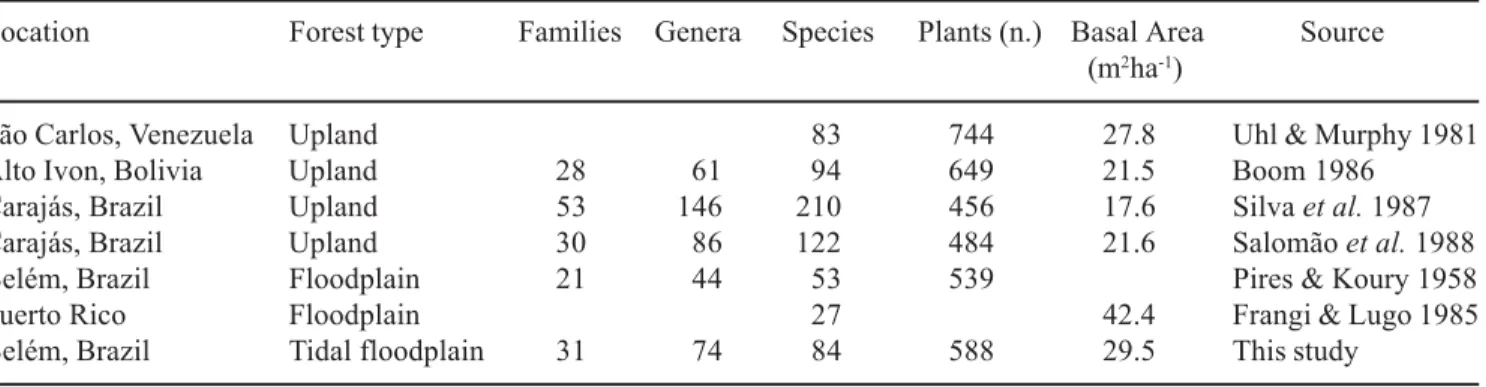
forests, the secondary tidal floodplain forest on Combu Island exhibits intermediate diversity (table 5). In contrast, the density of individuals with dbh > 10 cm is relatively high in this forest, as well as the sum of their basal areas (table 5). Intermediate low diversity may be the result of excessive soil moisture, which impedes the establishment of numerous forest species typical of upland sites; it may also be due to previous disturbance of the vegetation. High plant density, in turn, appears to reflect the dynamic nature of the floodplain ecosystem. In short, as well as floodplain forests elsewhere in the Amazon (Salo et al. 1986, Kahn & Mejia 1990), the floristic composition and structure of the floodplain forest on Combu seem to be determined by the frequency and intensity of an array of natural and anthropogenic disturbances, such as flooding and extraction of economic products.
The findings of this study have implications for the management of tidal floodplain forests such as those found on Combu Island. As noted in the introduction, these and other forested ecosystems in the Amazon
Figure 3. Dominance of selected 15 more important plant families on topography high, intermediate, and low sites on Combu Island, Belém, PA, Brazil. High sites, Intermediate sites, Low sites.
Diameter class (cm) Diameter class (cm)
0 5 10 15 20 25 30 35 40 45
Arecaceae Anacardiaceae Leguminosae Bombacaceae Combretaceae Lecythidaceae Meliaceae Euphorbiaceae Sapotaceae Sterculiaceae Moraceae Guttiferae Myristicaceae Burseraceae Chrysobalanaceae Dominance (%) 0 10 20 30 40 50 60
5.0-9.9 10.0-14.9 15.0-19.9 20.0-29.9 >30.0
0 10 20 30 40 50 60 70 80
5.0-9.9 10.0-14.9 15.0-19.9 20.0-29.9 >30.0 0 5 10 15 20 25 30 35
floodplain are frequently cited as promising sites for conversion to intensive agriculture. High topographic variation in floristic composition in the Combu Island suggests caution in implementing such land use in floodplain forests of the Amazon estuary.
Acknowledgements – This study is part of an interdisciplinary research and extension program administered by the Museu Paraense Emilio Goeldi and supported by the Ford Foundation and the Britsh Overseas Development Administration (ODA). Their financial contribution is gratefully acknowledged. We thank Eugênio Cichovsky, on whose land the study took place; Evandro T. de Azevedo Jr. and Jacirema R. da Costa for their assistance in the field; Carlos Rosário for assisting in plant collection and identification.
References
ALVIM, P.T. 1978. Floresta amazônica: equilíbrio entre utilização e conservação. Ciência e Cultura 30:9-16. ANDERSON, A.B. 1990. Extraction and forest management
by rural inhabitants in the Amazon estuary. In
Alternatives to deforestation: steps toward sustainable use of the Amazon rain forest (A.B. Anderson, ed.). Columbia University Press, New York, p.65-85. BOOM, B.M. 1986. Forest inventory in Amazonian Bolivia.
Biotropica 18:287-294.
BROWER, J.E. & ZAR, J.H. 1977. Field and laboratory methods for general ecology. W.C. Brown, Dubuque.
CRAWFORD, R.M.M. 1989. Studies in plant survival. Blackwell Scientific Publications, Oxford.
ESAU, K. 1967. Anatomy of seed plants. John Willey, New York.
FALESI, I.C. 1974. Soils of the Brazilian Amazon. In Man in the Amazon (C. Wagley, ed.). University of Florida Press, Gainesville, p.201-229.
FALESI, I.C. 1986. Estado atual de conhecimento de solos na Amazônia Brasileira. In Simpósio do Trópico Umido I, Embrapa/CPATU, Belém, Boletim Técnico p.168-191. FRANGI, J.L. & LUGO, A.E. 1985. Ecosystem dynamics of a
subtropical floodplain forest. Ecological Monographs 55:351-369.
GENTRY, A.H. & DODSON, C. 1987. Contribution of non trees to species richness of a tropical rainforest. Biotropica 19:149-156.
JUNK, W.J. 1997. General aspects of floodplain ecology with
special reference to amazonian floodplains. In The
Central Amazon floodplain: ecology of a pulsing system (W.J. Junk, ed.). Springer, Berlin, p.3-20.
KAHN, F. & MEJIA, K. 1990. Palm communities in wetland forest ecosystems of Peruvian Amazonia. Forest Ecology & Management 33/34:169-179.
LIMA, R.R. 1956. A agricultura nas várzeas do estuário
amazônico. Boletim Técnico do Instituto Agronômico
do Norte 33:1-164.
LUNT, O.R., LETEY, J. & CLARK, S.B. 1973. Oxygen requirements for root growth in three species of desert shrubs. Ecology 54:1356-1362.
MATTEUCCI, S.D., COLMA, A. & MIRANDA, F. 1982. Metodologia para el estudio de la vegetacion. Programa Regional de Desarrollo Científico y Tecnológico, Unesco, Washington, D.C., Monografia n.32.
PETERS, C.M., BALICK, M. J., KAHN, F. & ANDERSON, A.B. 1989. Oligarchic forests of economic plants in Amazonia. Conservation Biology 3:341-349.
PIRES, J.M. & KOURY, H.M. 1958. Estudo de um trecho de mata de várzea próximo a Belém. Boletim Técnico do Instituto Agronômico do Norte 36:3-44.
PIRES, J.M. 1974. Tipos de vegetação da Amazônia. Brasil Florestal 17:48-58.
PRANCE, G.T. 1979. Notes on the vegetation of Amazonia. III. The terminology of forest types subject to inundation.Brittonia 31:26-38.
PUTZ, F.E. 1984. How trees avoid and shed lianas. Biotropica 16:19-23.
Table 5. Comparison of floristic composition and basal area of neotropical forests (area = 1 ha and dbh > 10 cm). Data obtained from topographically intermediate sites (mean altitude = 3.36 m above sea level).
Location Forest type Families Genera Species Plants (n.) Basal Area Source (m2ha-1)
São Carlos, Venezuela Upland 83 744 27.8 Uhl & Murphy 1981
Alto Ivon, Bolivia Upland 28 61 94 649 21.5 Boom 1986
Carajás, Brazil Upland 53 146 210 456 17.6 Silva et al. 1987
Carajás, Brazil Upland 30 86 122 484 21.6 Salomão et al. 1988
Belém, Brazil Floodplain 21 44 53 539 Pires & Koury 1958
Puerto Rico Floodplain 27 42.4 Frangi & Lugo 1985
RANKIN, J.M. 1985. Forestry in the Brazilian Amazon.
In Key environments: Amazonia (G.T. Prance & T.E. L o v e j o y, e d s . ) . P e rg a m o n P r e s s , N e w Yo r k , p.360-392.
SALO, J., HAKKINEN, I, MAKINEN, Y., NIEMELA, P., PUHAKKA, M. & COLEY, P.D. 1986. River dynamics and the diversity of Amazon lowland forest. Nature 322:254-258.
SALOMÃO, R.P., SILVA, M.F.F. & ROSA, N.A. 1988. Inventário ecológico em floresta pluvial tropical de terra firme, Serra Norte, Carajás, Pará. Boletim do Museu Paraense Emilio Goeldi (série botânica) 4:1-46. SCARANO, F.R., CATTANIO, J.H. & CRAWFORD,
R.M.M. 1993. Root carbohydrate storage in young saplings of an Amazonian tidal várzea forest before the onset of the wet season. Acta Botanica Brasilica 8:17-27.
SILVA, M.F.F., ROSA, N.A. & OLIVEIRA, J. 1987. Estudos botânicos na área do projeto Ferro Carajás. Aspectos florísticos da mata do rio Gelado, Pará. Boletim do Museu Paraense Emilio Goeldi (série botânica) 3:1-20.
SIOLI, H. 1951. Sobre a sedimentação na várzea do baixo Amazônas. Boletim Técnico do Instituto Agronômico do Norte 24:47-67.
SIOLI, H. & KLINGE, H. 1962. Solos, tipos de vegetação e águas na Amazônia. Boletim do Museu Paraense Emilio Goeldi 1:27-47.
UHL, C. & MURPHY, P.G. 1981. Composition, structure, and regeneration of terra firme forest in the Amazon basin of Venezuela. Tropical Ecology 22:219-237.
VIEIRA, L.S. 1979. Reconhecimento dos recursos naturais da região metropolitana de Belém. Unpublished report Seplan/Codem/Idesp, Belém.