4 3 4 3 4 3 4 3 4 3
Escola de Educação Física e Esporte da USP e Parque Fernando Costa Mailing address: Cláudia Lúcia de Moraes Forjaz - Av. Prof. Mello Moraes, 65 05508-900 - São Paulo, SP, Brazil – E-mail: [email protected]
English version by Stela Maris C. e Gandour
Objective - Physical exercise helps to prevent cardio-vascular disorders. Campaigns promoting exercise have taken many people to the parks of our city. The most appro-priate exercise for preventing cardiovascular disorders is the aerobic modality; inappropriate exercise acutely increases cardiovascular risk, especially in individuals at higher risk. Therefore, assessing the cardiovascular risk of these in-dividuals and their physical activities is of practical value.
Methods - In the Parque Fernando Costa, we carried out the project “Exercício e Coração” (Exercise and He-art) involving 226 individuals. Assessment of the cardio-vascular risk and of the physical activity practiced by the individuals exercising at that park was performed with a questionnaire and measurement of the following parame-ters: blood pressure, weight, height, and waist/hip ratio. The individuals were lectured on the benefits provided by exercise and how to correctly exercise. Each participant received a customized exercise prescription.
Results - In regard to risk, 43% of the individuals had health problems and 7% of the healthy individuals had symptoms that could be attributed to heart disorders. High blood pressure was observed in a large amount of the population. In regard to the adequacy of the physical acti-vity, the individuals exercised properly. The project was well accepted, because the participants not only appre-ciated the initiative, but also reported altering their exer-cise habits after taking part in the project.
Conclusion - Data obtained in the current study po-int to the need to be more careful in assessing the health of individuals who exercise at parks, suggesting that city parks should have a sector designated for assessing and guiding physical activity.
Key words: cardiovascular risk, exercise, public park
Arq Bras Cardiol, volume 79 (nº 1), 43-50, 2002
Cláudia L. M. Forjaz, Taís Tinucci, Teresa Bartholomeu, Tiago E. M. Fernandes, Vivian Casagrande, José Geraldo Massucato
São Paulo, SP - Brazil
Assessment of the Cardiovascular Risk and Physical Activity of
Individuals Exercising at a Public Park in the City of São Paulo
Cardiovascular disorders are the major cause of death in the adult population of our country 1. The populations
mainly affected by these disorders are those living in the ma-jor urban centers, such as the city of São Paulo. Due to the great relevance of these diseases, a lot of effort has been put into avoiding them, and this can be seen in the determi-nation and control of the cardiovascular risk factors, such as sedentary lifestyle.
Currently, regular exercise practice has been well esta-blished to help in the prevention of and rehabilitation from cardiac diseases 2-4. Individuals with a sedentary lifestyle
who slightly increased the amount of exercise in their lives markedly reduced their cardiovascular risk 2,4; this was due
to the beneficial effects of exercise on the cardiovascular system 5,6 and to the control of other risk factors 6-8.
However, it is worth emphasizing that some exercises are more effective than others in promoting cardiovascular health. Currently, it has been shown that resistive exercises may produce beneficial cardiovascular effects; the benefits obtained with aerobic exercises, however, are more expres-sive. The aerobic exercises, ie, the activities involving large muscle groups, which are moved in a cyclic manner with low to moderate intensity, long duration, and performed 3 to 5 ti-mes a week, are the most recommended for primary and se-condary cardiovascular disease prevention 9.
Despite the confirmed benefits provided by physical activity, a large part of the population of the city of São Paulo, approximately 69% of the adults 10, has a sedentary lifestyle.
Therefore, health care-related entities have proposed cam-paigns 11, such as Agita São Paulo, to motivate the
popu-lation to become more active. The result is a large number of people exercising at the parks of the city. However, it is worth emphasizing that inappropriate physical exercise may result in an immediate increase in cardiovascular risk, be-cause the risk for myocardial infarction in an individual with a sedentary lifestyle is 6 times greater during intense exer-cise than that at rest 12. In addition, most parks do not have a
activi-4 activi-4 4 4 4 4 4 4 4 4
ty is significant and necessary from the public health point of view, we need to assess whether people who are exerci-sing at the parks of the city have a risk compatible with unsu-pervised exercise practice and whether the activity being performed is adequate.
Therefore, this project aimed to assess the cardiovas-cular risk (checking the presence of diseases, risk factors, and cardiovascular symptoms) and the practice of physical activity by people exercising at the Parque Fernando Costa (Parque da Água Branca). In addition, this project also aimed an educational effect, instructing those at the park about the potentialities of the exercises in preventing cardiovas-cular disorders and the correct way to practice them. And fi-nally, we tried to assess the effectiveness of this educatio-nal proposal.
Methods
The project “Exercício e Coração” was carried out du-ring 4 weekends from October to November 2000 at the Fernando Costa Park in the city of São Paulo, in the state of São Paulo. This park is characterized as being strictly urban, located close to the central region of the city of São Paulo, and provides the local population with space for walking, running, and activities related to animal breeding and plant cultivation. This project consisted of 10 sessions per wee-kend, with 6 people attending each session, and a total of 240 assisted people. Each session was conducted by 5 mo-nitors. Participation was free of charge, and anybody at the park could take part in the project, which was advertised in banners scattered throughout the park and through direct verbal contact.
The 4 major objectives of the project were as follows: 1) to assess the presence of risk factors in the population vi-siting the park; 2) to analyze the physical activity performed by that population; 3) to instruct the population about the correct practice of physical activity, with assessment of the effectiveness of this educational practice; and 4) to assess the receptivity of the project by those exercising at the park. The sessions consisted of 3 parts. In the first 20 to 25 minutes, the risk factors and health problems were asses-sed. Then, a 20- to 25-minute lecture was offered about the benefits of exercise for health and the correct way to exercise. In the last 10 to 20 minutes, individualized exercise prescrip-tions were provided.
Assessment of the risk factors and health problems was performed with a questionnaire, which was based on the concepts of the American College of Sports Medicine (ACSM) and the American Heart Association (AHA) 13.
The questionnaires were completed by the participants with the help of a monitor. The initial questions were about the presence of health problems, use of medication, and the presence of symptoms that could reflect cardiovascular di-sorders, such as chest pain, dyspnea, dizziness, and fain-ting. The second part of the questionnaire comprised ques-tions about the presence of risk factors, such as sex, age, heredity, diabetes, and smoking; the participants were also
asked whether they knew their glucose and serum choleste-rol levels.
To assess the presence of obesity, weight and height were measured (Filizola). The waist and hip circumferences were also measured with a metric tape.
Blood pressure was measured with an aneroid sphyg-momanometer 1 single time after a 5-minute sitting rest with the arm positioned at the level of the left ventricle. These measurements were taken by trained monitors. The I and V Korotkoff phases were used to determine the systolic and diastolic blood pressures, respectively. The sphygmoma-nometers calibration were constantly assessed against the mercury column during the project. To avoid measurements falsely reduced by physical activity prior to the evaluation, the participants were asked whether they had exercised pri-or to the session.
The questions about physical activities were as fol-lows: which activities were performed, how many times a week, for how long, and an assessment about the intensity, which was classified as mild, moderate, or intense. The acti-vity was considered mild if the individual did not feel signi-ficant modifications after the activity; moderate if the indivi-dual reported sweating and fatigue after the activity; and intense if the individual reported shortness of breath at the end of the activity. The last question asked permission to use the data for publication. The questionnaires were dated and signed by the participants.
The lessons were given by the previously trained mo-nitors. Posters were used in these lessons. Each lesson comprised 5 theoretical topics: 1) the importance of cardiac disease; 2) definition of coronary disease; 3) risk factors of car-diac disease; 4) benefits of exercise; and 5) the most appropriate physical activity. Each lesson also comprised a practical to-pic, which consisted of teaching how to measure heart rate by palpation of the radial pulse, and how to use this measu-rement to assess the intensity of the exercise.
Based on data from the questionnaire, each participant received an assessment of his/her individual cardiovascular risk, using the North-American table, and an individualized prescription for walking or running. The prescription con-tained the appropriate week frequency for walking or run-ning, the adequate duration of the activity, and, mainly, the range of heart rate that should be maintained during the acti-vity. For prescription, we used the software of the CD-ROM that accompanied the book Risco Cardiovascular Global 14,
which was developed by 1 of the authors. This range was determined based on the age for the healthy individuals who did not undergo a recent exercise test. For the indivi-duals with heart diseases or who were on medications that interfered with heart rate, only those with an exercise test re-ceived a prescription. The individuals with many risk fac-tors or symptoms were instructed to look for a physician, as were those with high blood pressure levels.
4 5 4 5 4 5 4 5 4 5
One to three months of the end of the project, we made telephone contact with the participants to assess the follo-wing: what they recalled from the project, whether the ject had had any results, and how they evaluated the pro-ject. In regard to the given activities, they were asked what they recalled from the session at the park, and their answers were grouped into 8 categories as follows: 1) cardiac disease as a cause of death; 2) coronary problems; 3) risk factors; 4) benefits of exercising; 5) most appropriate activity; 6) re-commendations to be considered; 7) how to assess heart rate; and 8) their training frequency or risk assessment. In regard to the effectiveness of the program, the participants were asked whether they had changed their physical acti-vity habits after the project, and, in the affirmative case, what had changed. They were asked whether they had tried to measure their heart rate, and whether they had been suc-cessful; whether they had passed the information received to other people, and whether they intended to continue fol-lowing the recommendations provided. In regard to the evaluation of the project, the participants were asked what they had found about the project and whether they would like to repeat the assessment in the future.
The results were presented only in a descriptive form with the percentages calculated as a function of the number of responses for each item, because some participants did not answer all the questions.
Results
The project comprised 227 individuals, corresponding to 95% of the total project openings. Of these individuals, only 1 did not allow his answers to be used in the study; the-refore, data here presented correspond to 226 participants. The final sample comprised 126 (56%) females and 100 (44%) males (fig. 1), most of whom were 40 years old or older (mean age = 54.5±13.8 years). Of these, 17 had cardiac pro-blems, 72 had other health propro-blems, and 137 had no health problems. It is worth noting that of the 137 individuals with no health problems, 9 were on medications, which were specific for cardiac problems in 3 individuals and antihyper-tension in 6. Therefore, the total number of individuals with heart disease was 20 (9%), and the number of individuals with health problems was 78 (34%). In addition, of the 128 (57%) remaining individuals who had no health problem and who were not on any medication, 21 (16%) frequently com-plained of symptoms, such as dyspnea, chest pain, dizzi-ness, and fainting. Therefore, only 107 individuals (47% of the total) had no health problems and no symptoms at all, and, thus, could be considered apparently healthy.
In regard to the presence of risk factors and conside-ring the entire group (fig. 1), 52% of the individuals had clo-se relatives with cardiac diclo-seaclo-ses, 10% were smokers, 29% were ex-smokers, and 10% had a sedentary lifestyle. In re-gard to glycemia, 12 individuals (6%) were diabetic, 95 igno-red their glycemia, and of the 112 who knew their glycemic levels, only 1 reported a high one. In regard to serum choles-terol levels, 74 individuals (34%) did not know their levels
and 33 (15%) reported high serum cholesterol levels. In regard to blood pressure, 22 individuals reported being hy-pertensive, and 6 were on antihypertensive medication, even though they did not consider themselves hyperten-sive. As such, the total hypertension rate was 12%. Howe-ver, it is noteworthy that of the 89 individuals who were not
Fig. 1 - Characteristics of sex, presence of diseases and risk factors of individuals exercising at the Fernando Costa Park.
Total Sample - 226
Men Women
Cardiac Problems
Other Problems No Problems
Obesity
Hypertension High cholesterol Sedentary lifestyle
Smoking
Heredity Diabetes
Active
Inactive 44%
56%
57%
9%
34%
(%)
60 50 40 30 20 10 0
52
10 10 6 15 12
20
10%
4 6 4 6 4 6 4 6 4 6
hypertensive and did not exercise prior to the session, 31 (35%) had high levels when blood pressure was measured. In regard to obesity, 20% of the individuals had body mass index >30 kg/m2, and the waist/hip ratio of 7 males was > 1
and of 47 females was > 0.85.
Considering the practice of physical activity, 193 indi-viduals (90%) reported being active (fig. 1), walking being the most common activity, reported 77% of the time. In addi-tion, most of the individuals practiced a physical activity 3 or more times a week (66%), with a duration ranging from 30 to 60 minutes (86%), and they considered that activity to be moderate (63%).
Analyzing only the data referring to the 20 individuals with heart disease, 7 did not report which was the problem, 4 had valvular diseases, 3 had coronary artery disease, 2 had arrhythmias, 1 had Chagas’ disease, and 3 used medication for cardiac diseases. Four (20%) of these individuals repor-ted frequent symptoms, such as dizziness, angina, and dysp-nea. The mean age in the cardiac group was 60.9±13.7 years.
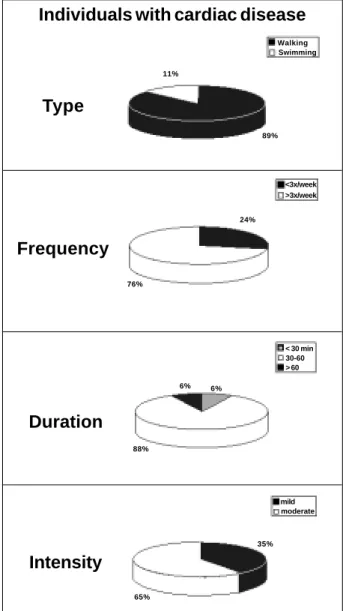
In regard to the practice of physical activity, 5 (25%) of these patients had received medical instruction to exercise, walking being the activity in 4 cases. Eighteen patients (95% of those answering the questionnaire) reported practicing physical activity, walking being the major activity (89%). In addition, they exercised 3 or more times a week (76%), for 30 to 60 minutes per session (88%), the intensity being mild in 35% and moderate in 65% (fig. 2).
Hypertension was the most prevalent health problem (12%), affecting 17 females and 11 males. The mean age of the hypertensive individuals was 60.2±9.3 years, and all of them were 40 or more years old. Of these hypertensive indi-viduals, only 15 (54%) were using some sort of medication. Only 17 hypertensive individuals had not exercised before the session, and, of these, 10 (59%) had high blood pres-sure, of whom 5 had both high systolic and diastolic levels (fig. 3). Considering all the individuals, even those who had exercised prior to the session, 18 (64%) had high blood pres-sure levels in the experimental session.
In regard to the practice of physical activity, 23 (85%) patients reported exercising regularly, 20 of whom (87%) walked (fig. 4). In addition, this activity was practiced 3 or more times a week (70%) for 30 to 60 minutes (83%) at a mo-derate intensity (68%).
As already mentioned, 107 individuals had no known health problems, no symptoms, and used no medication, being, therefore, considered apparently healthy.
Type
Frequency
Duration
Intensity
Individuals with cardiac disease
Fig. 2 - Characteristics of the physical activity practiced by individuals with heart diseases visiting the Fernando Costa Park.
Walking Swimming
<3x/week >3x/week
< 30 min 30-60 > 60
mild moderate 11%
89%
24%
76%
6% 6%
88%
35%
65%
Hypertensive individuals
Fig. 3 - Blood pressure control of the hypertensive individuals exercising at the Fernando Costa Park.
No medication Medication
normal BP SBP ≥≥≥≥≥ 140 mmHg DBP ≥≥≥≥≥ 90 mmHg
SBP ≥≥≥≥≥ 140 mmHg and DBP ≥≥≥≥≥ 90 mmHg 46%
54%
29%
24%
6%
4 7 4 7 4 7 4 7 4 7
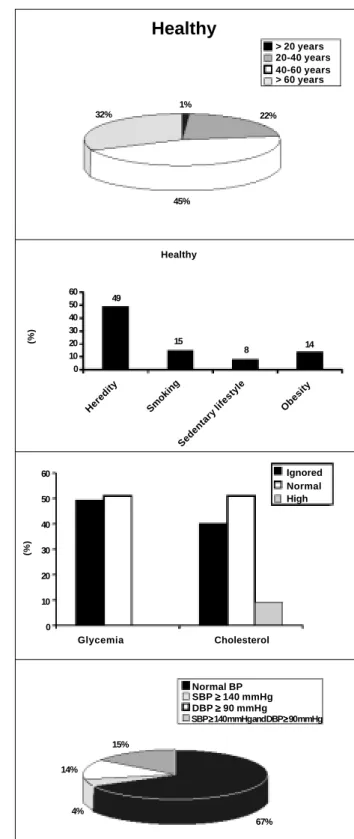
Of these 107 individuals (fig. 5), 51 were males and 56 were females. The mean age in the group was 51.5±14.1 years. Only 1 individual was less than 20 years old, 24 indivi-duals were between 20 and 40 years of age, 48 were between 40 and 60, and 34 were older than 60 years.
In regard to risk factors, 49% had close relatives with cardiovascular disease, 15% were smokers, 24% were ex-smokers, and 8% had a sedentary lifestyle. In regard to gly-cemia, 50 individuals (49%) ignored their levels and 52 (51%) reported their glycemia as normal. In regard to serum cholesterol levels, 40 (40%) individuals ignored their levels, 52 (51%) reported normal serum cholesterol levels, and 9 (9%) reported high serum cholesterol levels. In regard to blood pressure, 52 individuals had not exercised before the assessment; of these, 17 (33%) had high blood pressure levels, 8 (15%) of whom had both high systolic and diastolic levels. In regard to obesity, 14% of the individuals had a body mass index >30 kg/m2; 3 males had waist/hip ratio ≥≥≥≥≥ 1,
and 18 females had waist/hip ratio ≥≥≥≥≥ 0.85.
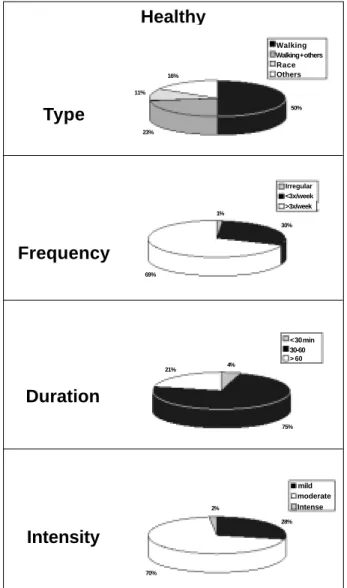
In regard to the practice of physical activity (fig. 6), 92% of the individuals reported exercising regularly,
wal-king being the most common activity (73%). The exercise was performed 3 or more times a week (69%) for 30 to 60 mi-nutes (75%) with moderate intensity (70%).
Of the 226 individuals taking part in the study, only 65 (29%) could be contacted by telephone after the project. All of them reported recalling at least 1 of the topics of the theoretical lessons given, and the most recalled were the risk
Type
Frequency
Duration
Intensity
Hypertensive individuals
Fig. 4 - Characteristics of the physical activity practiced by the hypertensive visitors of the Fernando Costa Park.
Walking Walking + others
Swimming
<3x/week >3x/week
< 30 min 30-60
> 60
mild moderate Intense 13%
26% 61%
30%
70%
17% 0%
83%
5%
68%
27%
Healthy
Fig. 5 - Characteristics of the apparently healthy population who visit the Fernando Costa Park.
> 20 years 20-40 years 40-60 years > 60 years
Heredity
Sedentary lifestyle
Smoking Obesity
Healthy
Ignored Normal High
Glycemia Cholesterol
Normal BP SBP ≥≥≥≥≥ 140 mmHg DBP ≥≥≥≥≥ 90 mmHg
SBP ≥≥≥≥≥ 140 mmHg and DBP ≥≥≥≥≥ 90 mmHg 1%
32% 22%
45%
(%)
60 50 40 30 20 10 0
49
15
8 14
(%)
60
50
40
30
20
10
0
15%
14%
4%
4 8 4 8 4 8 4 8 4 8
factors of cardiovascular diseases (26%) and the benefits of exercising (26%). In addition, 9 individuals recalled 2 topics and 4 individuals recalled 3 topics of the theoretical lessons. Twenty-five (39%) individuals reported that the expe-rience at the park modified their way of exercising; 3 of them initiated their practice, 7 changed the duration of the exercise, 7 changed the frequency, 7 altered the intensity, and 3 added a new activity to that already performed. After the experience at the park, 58% of the individuals reported being able to assess their heart rate during exercise, 17% reported not being able to, and 25% did not try to assess heart rate during exercise. In addition, 71% of the individuals reported informing other people about what they had learned in the park, and almost all of them (95%) reported intending to follow the instructions they had been given. In general, 27 people rated the project as excellent, 29 as very good, 8 as good, and 1 as regular. In addition, 88% of the participants reported that they were interested in repeating the assessment in the future.
Discussion
The first objective of the project “Exercício e Coração” was to assess the cardiovascular risk of individuals exerci-sing with no supervision at the parks of the city. We obser-ved that 43% of the individuals exercising at the park had health problems (9% had heart diseases and 34% had other problems). In addition, it was evident that many individuals did not know their actual health condition, because 7% of the people who reported not having health problems were using cardiac medications, and, in addition, 16% of those who considered themselves healthy and used no medication had frequent symptoms. In fact, the presence of symptoms, such as dizziness, chest pain, and fatigue, may indicate the presence of cardiac problems 9,13, increasing the risk of
car-diovascular disorders, mainly during exercise 9,12. These data
suggest that we need to raise the consciousness of the po-pulation about their health, and, mainly, about the signs the organism sends indicating the need for looking for a doctor.
When the population with heart disease was conside-red, we observed that, even though physical exercise is ex-tremely useful in cardiovascular rehabilitation 6, only 29% of
the patients had received a medical recommendation for that practice. It is worth emphasizing that a strong medical recommendation seems to be a fundamental factor for the patient’s adherence to the practice of physical activity 15. In
addition, those receiving that recommendation reported that the doctor had only advised them to walk. However, mo-derate exercise in individuals with heart disease should be, at least initially, performed based on an ergometric assess-ment and under supervision, according to the recommenda-tions of the ACSM/AHA 13. It is also worth emphasizing
that 20% of the individuals with heart disease reported symptoms during exercise, suggesting that these patients could be exercising under an ischemic condition, and, there-fore, be at risk for arrhythmias and cardiac arrest 9. The data
presented indicate the need for a greater medical consciou-sness in regard to the recommendation of exercises for individuals with heart disease, and also the need for an ap-propriate recommendation, so that the patients know how to exercise at lower risk. In fact, the risk of individuals with heart disease exercising is lower in supervised programs 16.
In regard to the presence of risk factors, we observed differences between the data of the general population of the municipality of São Paulo 10 and those data obtained at
the park. In addition to the methodological differences of measurement, the characteristics of the individuals who exercise at a park may explain these differences. For exam-ple, individuals who visit a park usually go there to exercise; therefore, only 10% of the individuals had a sedentary lifes-tyle in our sample, which was far below the 69% found for the city of São Paulo. Another interesting factor was the lo-wer rate of smokers among those visiting the park, 10%, as compared with 38% found for the city of São Paulo. Even though no evidence of a direct effect of exercise on control-ling smoking was observed, people who exercise tend to smoke less. In fact, the ex-smoker rate (29%) was extremely
Type
Frequency
Duration
Intensity
Healthy
Fig. 6 - Characteristics of the physical activity practiced by the apparently healthy visitors of the Fernando Costa Park.
Walking Walking + others Race Others
<3x/week >3x/week Irregular
< 30 min 30-60
> 60
mild moderate Intense
16% 11%
23%
50%
1%
30%
69%
21% 4%
75%
2%
28%
4 9 4 9 4 9 4 9 4 9
high in our population. In the current study, we found a pre-valence of obesity of 20% using as a cutpoint the body mass index value >30 kg/m217. Rego et al 10 found a similar
prevalence with a lower cutpoint, suggesting that in our po-pulation obesity was higher. This difference may be related to the fact that obese people have been instructed to exerci-se, and, therefore, they may be more frequently found at parks. These data suggest that people go to parks to exerci-se, and this may be associated with other healthy behavi-ors, such as quitting smoking and trying to lose weight.
In regard to blood pressure, we observed that 12% of the individuals were hypertensive. However, of these indi-viduals, approximately 60% had high blood pressure levels, suggesting that blood pressure was not under control, even though many of the individuals were on antihypertensive medication. In addition, 33% of the apparently healthy po-pulation also had high blood pressure levels. Therefore, these data suggest that both blood pressure control and detection of hypertensive individuals are points requiring further study.
The second objective of this study was to assess the adequacy of the physical activity that has been spontane-ously practiced by the population at the parks of the city. We could observe that walking was the most common acti-vity, and this may have been influenced by the type of the park assessed, because the Parque Fernando Costa does not have facilities for other sports practices. Another point that may have had an influence was the fact that walking is the most easily performed type of exercise 18. In regard to
frequency, duration, and intensity, we observed that in all groups, most individuals exercised 3 or more times a week for 30 to 60 minutes at a moderate intensity. In fact, according to the American College of Sports Medicine 9, this is the most
appropriate recommendation for physical activity to impro-ve health. These data show that most of the population vi-siting the park is exercising correctly, which results in low risk during the physical activity and in the possibility of obtaining cardiovascular benefits with exercise. Despite this adequacy, we observed that the control of the intensity of exercise was performed in a subjective way, because most people did not know how to measure their pulse.
The remaining objectives of this project were to ass-ess, in a subsequent phase, its educational effect and its ac-ceptability by the population assisted. We could observe that the project was well accepted, being rated from good to excellent by almost the entire population assisted, which would like to repeat it in the future. In regard to the effective-ness of the project, we observed that all the interviewees re-called something from the lessons given, and that the most recalled topics, the risk factors and the benefits of exercise,
are issues that should be stressed to increase compliance with exercise 15,19. In addition, the project had objective
re-sults, since 40% of the participants changed their exercise habits as a function of the lessons given, and 58% were a-ble to measure their own heart rate. Furthermore, 71% of the participants reported having passed the information learned to other people.
In conclusion, based on the data gathered, most peo-ple visiting the Parque Fernando Costa seem to be there to exercise. Part of these people may be exercising without gre-at risks to their health; some of them (individuals with un-controlled heart disease, those with symptoms, those with unnoticed high blood pressure), however, may be at a hi-gher risk during exercise, and, therefore, deserve to be re-ferred for medical assessment.
In general, the activity practiced by these people is correct and should benefit health, with a low immediate car-diovascular risk; however, a higher control of intensity is desirable. Despite the knowledge of these people about exercise, we observed ignorance about their own health (use of medication without knowing the reason, presence of symptoms during exercise, ignoring some risk factors, gly-cemia, serum cholesterol levels, etc.). This suggests the need for campaigns focusing on those subjects.
Based on what was said, we consider that programs, such as that reported in the current study, aimed at asses-sing the risk of individuals exerciasses-sing at public places and at providing guidelines for the correct way to exercise and for controlled physical activity, should be stimulated. In fact, each park should have a sector to deal with this subject. Therefore, the population could obtain all the benefits pro-vided by physical exercise without great risk, which would certainly result in a better quality of life for the population and in a reduction in the health costs.
The current absence of such a sector in the parks, ho-wever, should not hinder exercise practice in public places, because from the population point of view, the possible risks are by far overcome by the benefits inherent to the re-gular practice of physical exercise. However, from the indivi-dual point of view, indiviindivi-duals with heart disease or with symptoms during exercise should be assessed before be-ginning their practice.
Acknowledgments
5 0 5 0 5 0 5 0 5 0
1. Chor D, Fonseca MJM, Andrade CR. Doenças cardiovasculares. Comentários sobre a mortalidade precoce no Brasil. Arq Bras Cardiol 1995; 64: 15-19. 2. Paffenbarger Jr RS, Hade RT, Wing AL, Lee IM, Jung DL, Kampert JB. The
asso-ciation of changes in physical activity and other lifestyle characteristics with mortality among men. N Engl J Med 1993; 328: 538-45.
3. Blair SN, Kohl HW, Paffenbarger Jr RS, Clark DG, Cooper KH, Gibbons LW. Physical fitness and all-cause mortality: a prospective study in health men and women. JAMA 1989; 262: 2395-401.
4. Blair SN, Kohl HW, Barlow CE, Paffenbarger Jr RS, Gibbons LW, Macera CA. Changes in physical fitness and all-cause mortality. JAMA 1995; 273: 1093-8. 5. Negrão CE, Forjaz CLM, Rondon MUPB, Brum PC. Adaptações cardiovascula-res ao treinamento físico dinâmico. In: SOCESP: Cardiologia, Atualização e Re-ciclagem. São Paulo: Atheneu, 1996: Cap. 60: 532-40.
6. Tood IC, Wosornu D, Stewart I, Wild T. Cardiac rehabilitation following myocardial infarction; a practical approach. Sports Med 1992; 14: 243-59. 7. Hardman A. Exercise in the prevention of atherosclerotic, metabolic and
hyper-tensive diseases: a review. J Sports Sci. 1996; 14: 201-18.
8. Haapanen N, Miilunpalo S, Vuori I, Oja P, Pasanen M. Association of leisure time physical activity with risk of coronary heart disease, hypertension and diabetes in middle-aged men and women. Int J Epidemiol 1997; 26: 739-47. 9. American College Sports Medicine. ACSM’s guidelines for exercise testing and
prescription. Baltimore: Williams & Wilkins, 2000.
References
10. Rego RA, Berardo FAN, Rodrigues SSR, et al. Fatores de risco para doenças crônicas não-transmissíveis: inquérito domiciliar no município de São Paulo, SP (Brasil). Rev Saúde Pub 1990; 24: 277-85.
11. National Heart Institute. Physical activity and cardiovascular health. JAMA 1996; 276: 241-6.
12. Mittleman MA, Maclure M, Tofler GH, Sherwood JB, Goldberg RJ, Muller JE. Triggering of acute myocardial infarction by heavy physical exertion. N Engl J Med 1993; 329: 1677-83.
13. American College of Sports Medicine, American Heart Association. Recommen-dations for cardiovascular screening, staffing, and emergency policies at health/ fitness facilities. Med Sci Sports Exerc 1998; 1009-18.
14. Mion Jr D, Nobre F. Risco Cardiovascular Global. São Paulo: Lemos Editorial, 1999. 15. King AC, Blair SN, Bild DE, et al. Determinants of physical activity and
inter-ventions in adults. Med Sci Sports Exerc 1992; 24: S221-S36.
16. Van Camp SP, Peterson RA. Cardiovascular complications of outpatient cardiac rehabilitation programs. JAMA 1986; 256: 1160-3.
17. World Health Organization. Obesity: preventing and managing the global epi-demic. Report of a WHO consultation on obesity. Geneva: World Health Organi-zation, 1998.
18. Morris JN, Hardman AE. Walking to health. Sports Med 1997; 23: 306-32. 19. Biddle SJH, Nigg CR. Theories of exercise behavior. Int J Sport Psycol 2000; 31: