José Melquiades Ramalho Neto
I, Daniela Karina Antão Marques
I,
Maria das Graças Melo Fernandes
I, Maria Miriam Lima da Nóbrega
II Universidade Federal da Paraíba, Postgraduate Program in Nursing. João Pessoa, Paraíba, Brazil.
How to cite this article:
Neto JMR, Marques DKA, Fernandes MGM, Nóbrega MML. Meleis’ Nursing Theories Evaluation: integrative review. Rev Bras Enferm [Internet]. 2016;69(1):162-8. DOI: http://dx.doi.org/10.1590/0034-7167.2016690123i
Submission: 05-19-2015 Approval: 08-30-2015
ABSTRACT
Objective: to analyze the application of the theory evaluation model proposed by Meleis in Brazilian studies. Method: integrative review of online articles published from 2002 to 2012 in the databases LILACS and BDENF. Results: the 16 selected studies confi rmed the use of only three of the fi ve stages proposed for Meleis’ theories analysis: Description of the Theory, Criticism of the Theory and Analysis of the Theory, with a predominance of a single unit of analysis in each. Conclusion: the analysis of nursing theories provides support to nurses in the practice, research, education and administration of the different dimensions of care. Meleis’ model fi gures as very important by contributing to the development of knowledge of nursing discipline, considering that its use as a method allows several refl ections on theories in order that they be revalidated to support a more theoretical and practical applicability.
Key words: Nursing; Nursing Theory; Philosophy in Nursing; Nursing Models; Evaluation.
RESUMO
Objetivo: analisar a aplicação do modelo de avaliação de teorias proposto por Meleis em estudos brasileiros. Método: revisão integrativa nas bases de dados online LILACS e BDENF, de artigos publicados no período de 2002 a 2012. Resultados: das cinco fases propostas para a análise de teorias de Meleis, os 16 estudos selecionados ratifi caram a utilização de apenas três delas: Descrição da Teoria, Crítica da Teoria e Análise da Teoria, com predomínio de uma única unidade de análise em cada uma delas. Conclusão: a análise de teorias de enfermagem proporciona contribuições para enfermeiros na prática, pesquisa, educação e administração nas diferentes dimensões do cuidado. Esse modelo de Meleis impõe-se como de grande importância por contribuir para o desenvolvimento do conhecimento da disciplina Enfermagem, tendo em vista que a sua utilização como método permite refl exões diversas sobre as teorias, no intuito de que as mesmas sejam revalidadas para subsidiar uma maior aplicabilidade teórico-prática.
Descritores: Enfermagem; Teoria de Enfermagem; Filosofi a em Enfermagem; Modelos de Enfermagem; Avaliação.
RESUMEN
Objetivo: analizar la aplicación del modelo de evaluación de teorías propuesto por Meleis en estudios brasileños. Método: revisión integradora en las bases de datos online LILACS y BDENF, de artículos publicados en el período de 2002 a 2012. Resultados: de las cinco fases propuestas para el análisis de teorías de Meleis, los 16 estudios seleccionados ratifi caron la utilización de apenas tres de ellas: Descripción de la Teoría, Crítica de la Teoría y Análisis de la Teoría, con predominio de una única unidad de análisis en cada una de ellas.
Conclusión: el análisis de teorías de enfermería proporciona contribuciones para enfermeros en la práctica, investigación, educación y administración en las diferentes dimensiones del cuidado. Ese modelo de Meleis se impone como de grande importancia por contribuir para el desarrollo del conocimiento de la disciplina Enfermería, teniendo en vista que su utilización como método permite refl exiones diversas sobre las teorías, con el intuito de que las mismas sean revaluadas para subsidiar una mayor aplicabilidad teórico-práctica.
Palabras clave: Enfermería; Teoría de Enfermería; Filosofía en Enfermería; Modelos de Enfermería; Evaluación.
Meleis’ Nursing Theories Evaluation: integrative review
Análise de teorias de enfermagem de Meleis: revisão integrativa
Analisis de Teorías de Enfermería de Meleis: revisión integradora
INTRODUCTION
Nursing theory can be defined as an organized, coherent and system-atic joint of a set of claims related to significant questions of a given dis-cipline, communicated, shared in a group, in a meaningful whole, with the objective to describe the phenom-ena, explaining relations between them and predicting consequences or prescribing nursing care(1). In this con-text, such theories are developed in order to reflect the interests of the sci-entific community and the society(2).
The theory analysis/evaluation is a process of systematically examining a theory using for this flexible crite-ria that, in general, include: origin of the theory, meaning, adequacy, logic, utility, possibility of generalization
and test. The aim is to determine the potential contribution to the scientific knowledge of the theories and to investigate their relevance and applicability to practice, research, teaching or administration of nursing. This process has been developed since the late 1960s(3) as a result of the need for reflecting on nursing theories so that ideas that were raised by theories may be fully known and, moreover, they are incorporated to the practice of nurses in their various fields.
For this deepening of nursing theories happen, many anal-ysis of theories have been developed alongside professional development. The need to deepen the knowledge on the sub-ject fostered the interest of the authors of the present study in reflecting on how Brazilian researchers have applied the analysis of the theories and what is its contribution to the sci-ence of nursing.
Based on the reading of various proposed models, the theory evaluation model proposed by Meleis was selected to build this study in order to review the implementation of this model in the Brazilian nursing research published from 2002 to 2012.
METHOD
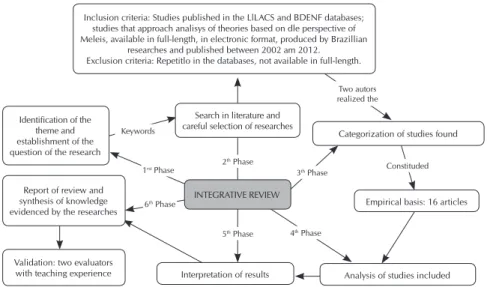
This is an integrative literature review on production of knowledge related to the analysis of nursing theories. This type of study enables the analysis of scientific research in a systematic and broad manner, favoring the characterization and dissemina-tion of knowledge produced. A methodological route proposed by some scholars of methodology(4-6) were established for the construction of this integrative review. This includes six stages: 1) identification of theme and formulation of guiding question; 2) search in literature and careful selection of researches; 3) categorization of the studies found; 4) analysis of the selected studies; 5) interpretation of results and comparisons with other researches; and 6) report of the review and synthesis of knowl-edge raised in the research(5-6) (Figure 1).
This review aims to answer the following questions: Do Brazilian researchers perform analysis of nursing theories? Is the theory analysis proposed by Meleis used in Brazilian nursing research? What phase of the theory analysis proposed by Meleis is addressed in national nursing publications from 2002 to 2012? What contributions can these studies bring to the science of nursing?
Studies were searched online in articles indexed in journals of the Virtual Health Library, consulting the Latin American and Caribbean Health Sciences database (LILACS) and the Nursing Database (BDENF). As inclusion criteria, the following char-acteristics were adopted: publications that addressed analysis of theories from Meleis’ perspective, available in full-length as scientific paper (original or review), produced by Brazilian re-searchers from 2002 to 2012. The time frame purposed to cover a good representation of research addressing the theme.
The search was conducted in February and March 2013 through descriptors combined by the Boolean connector “AND”. Initially, Descriptors in Health Sciences (DeCS) “nurs-ing theory” and “nurs“nurs-ing models” in LILACS and BDENF da-tabases wwere used and this resulted in 75 and 66 scientific papers, respectively, among which four articles were selected after reading the abstracts and checking compliance with the in-clusion criteria. However, when using the descriptors “nursing theory” and “nursing”, 528 references in the LILACS database and 454 in the BDENF database were found. After a dynamic analysis and refinement of research based on the inclusion cri-teria, reading of titles and abstracts, 12 scientific articles were selected. Noteworthy, all papers found were simultaneously available in both databases, showing a total of 16 productions.
After this selection of articles, data of interest was gathered: year of publication; which phase of Meleis’ theories analysis is used; Periodical publication; method; objectives and main re-sults. Data analysis was performed in two stages, with collabo-ration of two evaluators authors with teaching experience and who taught the course “Critical analysis of nursing theories” in Inclusion criteria: Studies published in the LlLACS and BDENF databases;
studies that approach analisys of theories based on dle perspective of Meleis, available in full-length, in electronic format, produced by Brazillian
researches and published between 2002 am 2012. Exclusion criteria: Repetitlo in the databases, not available in full-length.
Identification of the theme and establishment of the question of the research
Categorization of studies found
Empirical basis: 16 articles
Analysis of studies included INTEGRATIVE REVIEW
Interpretation of results Search in literature and careful selection of researches
Report of review and synthesis of knowledge evidenced by the researches
Validation: two evaluators with teaching experience
Two autors realized the
1rst Phase
3th Phase
5th Phase
2th Phase
4th Phase
6th Phase
Keywords
Constituded
the Postgraduate Program in Nursing, for a doctorate program, of the Federal University of Paraíba. In the first stage, data of the article are identified: year, title and phase of Meleis’ theo-ries analysis used (Table 1). In the second stage, articles were analized regarding goals, method and results, summarizing the results by similarity of content, what will be opportunely presented in the discussion ahead.
Theories Analysis Model
The theories evaluation model proposed by Meleis (Figure 2) consists of 5 phases: description, analysis, criticism, test and support, being very detailed to be presented in its en-tirety. Given that there is no theory that satisfies all the criteria proposed, this model can be applied in its entirety or in part, not being necessary to follow the order of phases(1).
The description phase comprises structural components that have as unit of analysis the assumptions, concepts and propositions; and functional componentes that include focus, client, nursing, health, environment, nurse-client interaction, nursing problems and nursing therapy(1).
The theory analysis phase is a process of identification parts and components that includes the analysis of concepts and anal-ysis of theory. The analanal-ysis of concepts is a process useful for the development and evaluation of the theory, including the analy-sis of semantics, logic and contextual derivation, besides the de-scription of antecedents and consequences of the concept. The analysis of theory involves important factors that might influence the development of the theory and its present structure, covering theoretical, paradigmatic origins and internal dimensions(1).
The phase of criticism of a theory has as objective to estab-lish the relationship between structure and function, as well as analyze clarity, consistency, simplicity, complexity, tautol-ogy teleoltautol-ogy, theory diagram, contagion circle (geographical origin of the theory, its geographic expansion and influence
of the theory), utility (in practice, research, education/training and management) and external components such as personal values, congruence with values of other professionals, con-gruence with social values and social significance(1).
The phase of test has to do with putting in practice, sub-miting to use, conducting a review. It consists actually in an inspection, a systematic process in which the theoretical pro-posals are submitted to the accuracy of research in all its forms and approaches. As a consequence of testing the theory is that the results of the studies may suggest changes and improve-ments to it. This phase is a dynamic process and provides verification of the development of the theory(1).
The support, in turn, is the phase in which the degree ex-tention and of acceptance of the proposed theory is evaluated, it identifies the existence of a scientific community applying this theory in situ or in differ-ent situations. Evaluate the support of a theory includes acceptance of declarations, ad-aptation of central problems of the discipline and recognition of new nursing phenomena(1).
RESULTS
The researched sources were considered diversified given that the theme addressed by the study brought up 16 scientific papers published in 10 differ-ent journals, with reasonable expressiveness in the scientific scenario according to Qualis as-sessment by Capes 2012.
The distribution of articles by year showed 2 publications (12.50%) in 2010; 1 (6.25%) in 2008; 3 (18.75%) in 2007; 2 (12.50%) in 2006; 3 (18.75%) in 2005; 3 (18.75%) in 2004; and 2 (12.50%) in 2003, as shown below:
Regarding the type of study, 7 (43.75%) used interpreta-tive analysis based on the theory evaluation model proposed by Meleis; 3 (18.75%) consisted of theoretical and reflective studies based on the theory evaluation model proposed by Meleis; 2 (12.50%) were descriptive and reflective studies based on the theory evaluation model proposed by Meleis; and 4 (25.00%) were literature reviews.
Theories analyzed in these studies were: Jean Watson’s Theory of Transpersonal Caring, Madeleine Leninger’s Theory of Diversity and Universality of Cultural Care, Hildegard Pep-lau’s Theory of Interpersonal Relations in Nursing, and Joyce Travelbee’s Theory of Interpersonal Relationship. Each theory was analyzed in different studies. The Imogene King’s Theory of Goal Attainment, Sister Callista Roy’s Adaptation Theory, Paterson and Zderad’s Humanistic Theory, and Orem’s Self-Care Theory were studied in two articles each. In addition, two theories that have been analyzed and are applicable in THEORY OF NURSING
THEORETICAL NURSING
CRITICISM OF THE THEORY
SUPPORT OF THE THEORY
ANALYSIS TEST OF THE THEORY
DESCRIPTION OF THE THEORY
CLARITY
CONSISTENCY
UTILITY DIAGRAMS SIMPLICITY/ COMPLEXITY
TAUTOLOGY/ TELEOLOGY
CONTAGION CIRCLE
EXTERNAL CRITERIA FUNCIONAL COMPONENTS STRUCTURAL COMPONENTS
TEST OF UTILITY
TEST OF CONCEPTS
TEST OF PROPOSITIONS TEST OF PROPOSITIONS
THAT ARE NOT FROM NURSING
ANALYSIS OF THE THEORY ANALYSIS OF THE CONCEPT THE TEORETHICAL PARADIGMATIC ORIGIN INTERNAL DIMENSIONS
Source: Meleis (2012).
Note: Free Translation of the authors.
health care, not specifically only in nursing, were also ana-lyzed by the method proposed by Meleis, they are the Theory of Reasoned Action (theory of Psychology area and applied to Nursing) and Nola Pender’s Health Promotion Model (health promotion model applied to Nursing).
Among the five phases proposed for theory analysis by Meleis, studies confirmed the use of only three of them (criti-cism, analysis and description of the theory), with a predomi-nance of a single unit of analysis in each. However, three ar-ticles(13,20-21) used more than one unit of analysis, which were Criticism of the Theory: consistency and clarity(13); Analysis of the Theory: theoretical, paradigmatic origin and internal dimensions(20); Description of the Theory: Functional compo-nents and structural compocompo-nents(21).
The Criticism of the theory was the phase more frequently approached with eight studies (50.0%) followed by Descrip-tion of the theory with six studies (37.5%) and, finally, the Analysis of the theory addressed in two studies (12.5%).
Criticism of the Theory has eight componentes according to the exposed in the Figure 2, and two of the studies that used it approached the utility component(8,16); two analyzed the diagram(11,15); one investigated the contagion circle(10); two studied the clarity(12-22); and other research used the both com-ponents consistency and clarity(13).
In the phase Description of the theory, six researches stood out: three analyzed the units of the functional components of the theory (focus, client, nursing, health, nurse-client interaction, environment, nursing problem and nursing therapy)(7,13,19); two
Box 1 - Description of national nursing publications from 2002 to 2012 according to the stage of Theory Evaluation Model proposed by Meleis
Year Title Stage of the model
2010 The theory of transpersonal caring in nursing: analysis according Meleis(7) Description of the theory: functional components
2010 Usefulness of self-care theory in assisting the patient with Human Immunodeficiency Virus/Acquired Immunodeficiency Syndrome(8) Criticism of the theory: utility
2008 Dialogue as assumption in the humanistic nursing theory: mother-nurse-newborn relationship(9) Description of the theory: structural components (assumptions)
2007 Analysis of the contagion circle of the theory of rational action and its suitability to nursing(10) Criticism of the theory: contagion Circle
2007 Sunrise Model: analysis from the perspective of Afaf Meleis(11) Criticism of the theory: Diagram
2007 Clarity in the use of social systems of the theory of goal attainment(12) Criticism of the theory: clarity
2006 Physiological mode of the Adaptation Model of Sister Callista Roy: Reflective analysis according to Meleis(13) Criticism of the theory: Consistency and clarity
2006 Functional components of Peplau theory and its confluence with the group reference(14) Description of the theory: functional components
2005 Diagram Analysis of the health promotion model of Nola J. Pender(15) Criticism of the theory: Diagram
2005 Analysis of humanistic theory and interpersonal relations of nurses in the care of newborns(16) Criticism of the theory: Utility
2005 Understanding the King Model of the paradigm of symbolic interaction(17) Analysis of the theory: paradigmatic origin
2004 Roy model in obstetric nursing: analysis from the perspective of Meleis(18) Description of the theory: structural components
2004 Applying Meleis evaluation model to Travelbee theory(19) Description of the theory: functional components
2004 King’s theory and its interface with “Family Health”(20) Analysis of the theory: The theorist,
paradigmatic origin and internal dimensions
2003 Descriptive analysis of the Orem’s nursing systems theory: applicability in teaching eye self-examination of HIV / Aids patients(21) Description of the theory: functional components and structural components
analyzed structural components(9,18); and other used both the functional and structural componentes for the analysis(21). Analy-sis of the Theory was addressed in two studies. One study strong-ly focused on the specific unit of paradigmatic origin(17) and the other focused on the analysis of corresponding units to the theo-retical, the paradigmatic origin and the internal dimensions(20).
The results described in the publications are presented in categories: Description of the Theory, Criticism of the Theory and Analysis of the Theory.
DISCUSSION
Description of the Theory
It is the stage where relevant conceptual elements to cen-tral ideas of a theory can be identified. In this context, three theories of Nursing were analyzed at this phase in its unit “func-tional components”: Theory of Transpersonal Caring(7), Peplau’s Theory of Interpersonal Relations(14) and Travelbee’s Theory of Interpersonal Relationship(19). These studies(7,14,19) were able to identify definitions of functional components of the analyzed theories, offering scholars who applied the Meleis method a more accurate view of these theories to assess their applicability in the academic and healthcare practice, reviewing the clientele that can be benefited by them, as well as realizing the need to improve the practice of nursing from its use.
As regards structural components of the description phase, the Humanistic Theory of Paterson and Zderad was analyzed from the perspective of the unit “assumptions of the theory”, with the assumption (the dialogue) seen in theory as explicitly and grounded on the philosophical bases of existentialism, hu-manism and phenomenology. Based on research findings using this theory, it was noted that this is applicable when it gives prior-ity to effective human relationships, specifically addressed in the study to investigate the mother-nurse-newborn relationship(9).
The Roy’s Adaptation Theory was also analyzed for the unit “structural component” (assumptions, concepts and proposi-tions) and its application in obstetric nursing. It was considered relevant to the understanding of situations experienced by wom-en during labor, childbirth and postpartum. Assumptions and propositions proposed by Roy are adaptable to these clients and their concepts, even when implicit at certain times(18).
A single study addressed the functional and structural com-ponents at the same time. It purposed to analyze the theo-retical model proposed by Orem and it was applied to the self-examination of the eye for people with HIV/Aids, a theme addressed in the study because studies prove that 75% of these individuals have some ophthalmic injury during the course of the disease(21). With respect to structural components, a reflec-tion focused on the concepts of self-care, therapeutic demand and nursing system was held. As for functional componen-tes, ocular self-examination, the individual with HIV/Aids, the nurse, the examination of the eye and the nurse-client interac-tion were analyzed. On the basis of the evaluainterac-tion of these components, the study developed some propositions and as-sumptions and reflect that the individual is the agente of self-care and that actions proposed by the nurse should be imple-mented taking into account the biopsychosocial context of the
client, confirming thus the applicability this theoretical model for the eye self-examination of patients with HIV/Aids(21).
Criticism of the theory
Several criteria can be observed to proceed with criticism of a theory: to establish a relationship between the structure and function of its components (clarity, consistency, degree of simplicity and complexity, tautology/teleology); diagram of the theory; contagion circle; utility and external components(1).
Two articles(8,16) analyzed the utility of theories what means a component that analyzes the potential of a theory to be used in practice, research, education and administration(1). Orem’s theo-ry was analyzed for its utility and the results confirmed that this theory has provided direction and organization to practice since works as a guide for the systematization of nursing care to the person with HIV/Aids and creation of tools for evaluate these pa-tients. A test of a teaching model of eye self-examination for this clientele was possible, and this model can be included in the nursing curriculum, providing important information for both nursing research and education. As for administration, the study with patients with HIV/Aids set clear that the findings are appli-cable to the administration of nursing services for this clientele(8). Another theory that has been critically examined for its util-ity was the Humanistic Theory of Paterson and Zderad in rela-tion to the concepts of interpersonal relarela-tionship and dialogue in caring for newborn at risk. The utility of these concepts was notorious and can be practiced in the daily Intensive Care Unit, that is, in practice, valuing the human affective relation-ship and regarded as essential in the act nursing care(16).
The “contagion circle” component was used in just one ar-ticle. The unit of analysis is the geographical origin of the theory and the influence of theoretical versus theory and investigates the field where the theory was initially introduced, the influence of the theorist in its implementation, where its development has happened and what is its purpose in research, education, ad-ministration or clinical practice(1). The evaluation of the Theory of Rational Action (TRA) with respect to adequacy for Nursing in relation to that componente showed that this is especially appro-priate to the performance of behaviors for health. However, as its ultimate goals are to understand and predict human behavior, its intended use can happen in any field of knowledge: educa-tion, sociology, health, among others. The results of this study portrayed their applicability predominantly in the areas of nurs-ing, psychology and nutrition as a possible tool for identifying factors that act as positive or negative determinants influencing the performance of a given behavior(10).
As for the “diagram” unit, two articles(11,15) analyzed theories to prove that the visual representation is a primary factor that im-proves the clarity and understanding of a theory(1). In this sense, the diagram is intended to illustrate the central proposal of the theory, highlight the key concepts, check whether the represen-tation is logical, promote understanding of different theoretical components and assure that the link between concepts are clear.
highlighted in each theory diagram as well as the possibility of assessing the weaknesses perceived when using the theory evaluation model, promoting the increase of knowledge about theoretical references to nurses.
The Imógene King’s Theory of Goal Attainment was analyzed within the aspect criticism of the theory for clarity of organiza-tion of social systems. To this end, the concept of social system and its components as well as its assumptions, propositions and related concepts were identified. The study was based on two theses and one dissertation and addresses the lack of adher-ence to hypertension treatment describing the responses of non-compliant patients and relating them to personal, interpersonal and social systems of King. A care technology to patients with dificulty to comply with the treatment was later developed and evaluated in a doctoral dissertation favoring the individual, in-terpersonal, and family participation in care. The second thesis tried to establish a diagnostic profile of responses of adolescents facing vital crisis of adolescence and premarital pregnancy(12). Operational definitions were consistent with the assumptions and propositions of the Theory of Goal Attainment in the three surveys. Although the theory favors its applicability in such di-verse contexts, interpersonal and social systems were too closely related, blurring the clarity and understanding of the way the theory can contribute to professional practice(12).
The physiological mode of Sister Callista Roy’s adaptation model underwent critical analysis regarding clarity and con-sistency. It was found that this theory has relevant aspects as its applicability to nursing care for women with angina pecto-ris as well as for the development of nursing knowledge in the areas of teaching, research and care(13).
Believing that the concepts and definitions are fundamental to the understanding of a theory, and that they pose challenges to the practice of nursing as to the clarity of its theoretical and operational definitions, the research sought to critically reflect on the semantic clarity of the concept of community, one the foundations of the Humanistic Nursing Theory. The initiating words I-YOU, I-THAT and WE proved to be important in the practice of humanistic nursing when the objective is to focus on human interaction in the living world. While the relation-ship WE characterizes the phenomenon community or com-munion, from the perspective of theoretical and equivalent terms, the researchers see them as diametrically different since the community features a physical nursing phenomenon es-sentially “on the ground” rather than inter-subjective such as communion, seized in its fullness as the perfect union of the first words I-YOU originating the US, resulting from dialogue, encounter, relationship and authentic presence(22).
Analysis of the Theory
The critical analysis of nursing theories reveals critical thinking of researchers for the development of future research based on nursing theories, providing support to nurses in practice, research, education and administration in the differ-ent dimensions of care in nursing.
The conceptual model of King was analyzed for its paradig-matic origins according to the approach of the theory of sym-bolic interaction. The paradigmatic origins seek to identify
the origins paradigm where theory was developed or whether there was another theory that may have influenced the devel-opment of the current theory(1).
Both theories are embedded in the concepts of human in-teraction and in the manner this is processed in the prepara-tion of human acprepara-tion in the face of life experiences, elucidat-ing the man as a beelucidat-ing that reacts and search to understand the meaning of things around him, planning and judging his actions and those of others. King’s theoretical conceptions are informed in the philosophical assumption that human beings are the focus of nursing because they are interacting with each other and with the environment, the purpose of which would lead them to a state of health, developing their social roles(17).
In order to explore the component “analysis” in the Theory of Goal Attainment, the profile of the theoretical, the origin of paradigms and internal dimensions of the theory were in-vestigated. The development of King’s theory resulted from his vast knowledge in the areas of cognitive and experimental domain, linked also to his professional network and socio-cul-tural context of that time (1970s), which allowed defining the concepts of nursing meta-paradigm. However, some still con-sider the definition of the concept of environment unclear(20).
Under internal dimensions, the authors point out that King’s theory was developed around the concepts of interac-tion, percepinterac-tion, communicainterac-tion, transacinterac-tion, or ego (self), role, stress, growth and development, space and time. Taking into consideration that this theory has arisen from the need to control the nurse-client interaction and that its goal is to offer a possibility of interaction between them for achieving previ-ously established goals, the interconnection of its components explains exactly this nurse-client interaction. By treating the human being as a whole, not only in meeting needs during illness, the Theory of Goal Attainment is considered a macro-theory, even though it can not be generalized to every nursing situation because it is inapplicable to small children, patients with altered level of consciousness, mentally ill patients and people who do not have the perception of a health problem(20).
CONCLUSION
The findings of the present study confirm that the applica-tion of one or more stages of the theory valuaapplica-tion model pro-posed by Meleis gives a deeper understanding of the theories and about the diversified possibilities of applicability in stud-ies that are based on the need for theoretical support.
Meanwhile, reviewing nursing theories provides contribu-tions to nurses in practice, research, education and admin-istration in the different dimensions of care. The model of Meleis, in turn, has proved to be of great importance to the development of nursing knowledge, taking into account that its use as a method allows multiple reflections on the theories, in order that the theory may be revalidated to support a larger theoretical and practical applicability.
REFERENCES
1. Meleis AI. Theoretical nursing: development and prog-ress. 5th ed. Pennsylvania: Lippincott Williams & Wilkins;
2012.
2. Hardy ME. Theories: components, development, evalua-tion. In: Reed PG, Shearer NC, Nicoli LH. Perspectives on nursing theory. 5th ed. Pennsylvania: Lippincott Williams
& Wilkins; 2009. p. 77-102.
3. McEwen M. Theory analysis and evaluation. In: McEwen M, Wills EM. Theoretical basis for nursing. 3th ed. Pennsylvania:
Lippincott Williams & Wilkins; 2011. p. 119-34.
4. Souza MT, Silva MD, Carvalho R. [Integrative review: what is it? How to do it?]. Einstein [Internet]. 2010[cited 2014 Nov 01];8(1):102-6. Avaiable from: http://apps.ein stein.br/revista/arquivos/PDF/1134-Einsteinv8n1_p102-106_port.pdf
5. Ganong LH. Integrative reviews of nursing research. Res Nurs Health [Internet]. 1987[cited 2015 May 12];10(1):1-11. Avail-able from: http://www.ncbi.nlm.nih.gov/pubmed/3644366
6. Mendes KDS, Silveira RCCP, Galvão CM. Revisão integra-tiva: método de pesquisa para a incorporação de evidên-cias na saúde e na enfermagem. Texto Contexto Enferm [Internet]. 2008 Oct-Dec[cited 2014 Nov 01];17(4):758-64. Available from: http://www.scielo.br/pdf/tce/v17n4/18.pdf
7. Silva CMC, Valente GSC, Bitencourt GR, Brito LN. A teoria do cuidado transpessoal na enfermagem: análise segundo Meleis. Cogitare Enferm [Internet]. 2010 Jul-Sep[cited 2013 Feb 14];15(3):548-51. Available from: http://ojs.c3sl.ufpr.br/ ojs/index.php/cogitare/article/view/18902/12210
8. Barroso LMM, Brito DMS, Galvão MTG, Lopes MVO. Utility of the self-care theory to assist the bearer of Human Immunode-ficiency Virus/Acquired ImmunodeImmunode-ficiency Syndrome. Acta Paul Enferm [Internet]. 2010[cited 2013 Feb 14];23(4):562-7. Available from: http://www.scielo.br/pdf/ape/v23n4/en_ 19.pdf
9. Lúcio IML, Pagliuca LMF, Cardoso MVLML. [Dialogue as a presupposition in the humanistic nursing theory: relation-ship mother-nurse-newborn]. Rev Esc Enferm USP [Inter-net]. 2008[cited 2013 Feb 14];42(1):173-80. Available from: http://www.scielo.br/pdf/reeusp/v42n1/23.pdf Portuguese.
10. Oliveira SHS, Pagliuca LMF, Barroso MGT. [Analysis of the contagion circle in rational action theory and its ade-quacy for nursing]. Rev Eletr Enferm [Internet]. 2007[cited 2013 Feb 15];9(3):866-77. Available from: http://www. fen.ufg.br/revista/v9/n3/v9n3a25.htm Portuguese.
11. Oriá MOB, Ximenes LB, Pagliuca LMF. Sunrise Model: análise a partir da perspectiva de Afaf Meleis. Rev En-ferm UERJ [Internet]. 2007 Jan-Mar[cited 2013 Feb 15];15(1):130-5. Available from: http://www.facenf.uerj. br/v15n1/v15n1a21.pdf
12. Chaves ES, Araújo TL, Lopes MVO. Clareza na utiliza-ção dos sistemas sociais da teoria de alcance de metas. Rev Esc Enferm USP [Internet]. 2007[cited 2013 Dec
11];41(4):698-704. Available from: http://www.scielo.br/ pdf/reeusp/v41n4/21.pdf
13. Oliveira TC, Lopes MVO, Araújo TL. Modo fisiológico do Modelo de Adaptação de Sister Callista Roy: análise reflexiva segundo Meleis. Online Braz J Nurs [Internet]. 2006[cited 2013 Feb 13];5(1). Available from: http://www. objnursing.uff.br/index.php/nursing/article/view/70/22
14. Moraes LMP, Lopes MVO, Braga VAB. Componentes fun-cionais da teoria de Peplau e sua confluência com o ref-erencial de grupo. Acta Paul Enferm [Internet]. 2006[cited 2014 Dec 03];19(2):228-33. Available from: http://www. scielo.br/pdf/ape/v19n2/a16v19n2.pdf
15. Victor FJ, Lopes MVO, Ximenes LB. Análise do diagrama do modelo de promoção da saúde de Nola J. Pender. Acta Paul Enferm [Internet]. 2005[cited 2014 Dec 03];18(3):235-40. Available from: http://www.scielo.br/pdf/ape/v18n3/ a02v18n3.pdf
16. Rolim KMC, Pagliuca LMF, Cardoso MVLML. Análise da teoria humanística e a relação interpessoal do en-fermeiro no cuidado ao recém-nascido. Rev Latino-Am Enfermagem [Internet]. 2005 May-Jun[cited 2013 Feb 20];13(3):432-40. Available from: http://www.scielo.br/ pdf/rlae/v13n3/v13n3a19.pdf
17. Araújo IMA, Oliveira MV, Fernandes AFC. Compreensão do Modelo de King sobre o Paradigma do Interacionis-mo Simbólico. Rev Bras Enferm [Internet]. 2005 Nov-Dec[cited 2013 Mar 10];58(6):715-8. Available from: http://www.scielo.br/pdf/reben/v58n6/a16v58n6.pdf
18. Rodrigues DP, Pagliuca LMF, Silva RM. Modelo de Roy na Enfermagem Obstétrica: análise sob a óptica de Meleis. Rev Gaúcha Enferm [Internet]. 2004 Aug[cited 2013 Mar 10];25(2):165-75. Available from: http://www.seer.ufrgs.br/ RevistaGauchadeEnfermagem/article/viewFile/4503/2440
19. Linard AG, Pagliuca LMF, Rodrigues MSP. Aplicando o modelo de avaliação de Meleis à Teoria de Travelbee. Rev Gaúcha Enferm [Internet]. 2004 Apr[cited 2013 Mar 10];25(1):9-16. Available from: http://seer.ufrgs.br/index. php/RevistaGauchadeEnfermagem/article/view/4489/2426
20. Moura ERF, Pagliuca LMF. A Teoria de King e sua interface com o programa “Saúde da Família”. Rev Esc Enferm USP [Internet]. 2004[cited 2013 Dec 11];38(3):270-9. Avail-able from: http://www.scielo.br/pdf/reeusp/v38n3/05.pdf
21. Caetano JA, Pagliuca LMF. Análise descritiva da teoria dos sistemas de enfermagem de OREM: aplicabilidade no ensi-no do auto-exame ocular dos portadores do HIV/AIDS. Esc Anna Nery Rev Enferm [Internet]. 2003 Apr[cited 2013 Mar 10];7(1):89-96. Available from: http://revistaenfermagem. eean.edu.br/detalhe_artigo.asp?id=1122