Original article
Transition I
eficiency and victory
in volleyball matches
Herbert Ugrinowitsch Guilherme Menezes Lage Federal University of Minas Gerais, Brazil
Suziane P. dos Santos-Naves Federal University of Triângulo Mineiro, Brazil
Leandro N. Dutra Maria Flávia S. P. Carvalho Federal University of Minas Gerais, Brazil
Alessandra Aguilar Coca Ugrinowitsch The University Center of Belo Horizonte, Brazil
Rodolfo N. Benda
Federal University of Minas Gerais, Brazil
Abstract—The present study investigated the correlation between Transition I with victory in volleyball matches. The 2002 South-American Youth Men’s Championship was recorded and the Transition I was analyzed and classiied as
negative, null or positive. Results of the eficiency in Transition I was calculated using t test for independent samples and
compared to the eficiency between teams during each set and matches. Spearman correlation assessed the relationship between eficiency in each set and results of the matches with the inal ranking in the championship. The results showed that the winning teams exhibited higher eficiency in Transition I, as well as a positive relationship of higher eficiency in Transition I with all of their results. The higher eficiency in Transition I is related to victory in volleyball matches.
Keywords: sport, volleyball, transitions, skills, eficiency
Resumo—“Eiciência de Transição I e vitória em partidas de vôlei.” O presente estudo investigou a correlação entre Transição I com a vitória em jogos de voleibol. O Campeonato Masculino Sul-Americano da Juventude 2002 foi
gra-vado para analisar e classiicar Transição I como negativa, nula ou positiva. Os resultados da eiciência na Transição I foram calculados por meio do teste t para amostras independentes para comparação com a eiciência entre as equipes
durante cada set das partidas. A correlação de Spearman avaliou a relação entre a eiciência em cada set e os resultados das partidas com a classiicação inal do campeonato. Os resultados mostraram que as equipes vencedoras exibiram maior eiciência na Transição I, bem como uma relação positiva de maior eiciência na Transição I com todos os seus
resultados. A maior eiciência na Transição I está relacionada à vitória em partidas de vôlei.
Palavras-chave: esporte, voleibol, transições, habilidades, eiciência
Resumen—El presente estudio investigó la correlación entre la Transición I con la victoria en las partidos de
volei-bol. El Campeonato Sur-americanas Hombres Jóvenes 2002 se registró y la transición que se analizó y clasiicó como negativo, nulo o positivo. Resultados de la eiciencia en la Transición I se calculó utilizando la prueba t para muestras
independientes y se compara con el rendimiento entre los equipos en cada set y partidas. Correlación de Spearman evaluó la relación entre la eiciencia en cada conjunto y los resultados de las partidas con la clasiicación inal del campeonato. Los resultados mostraron que los equipos ganadores exhibieron una mayor eiciencia en la Transición I, así como una
relación positiva de una mayor eiciencia en la Transición I con la totalidad de sus resultados. La mayor eiciencia en la Transición I se relaciona con la victoria en las partidas de voleibol.
Introduction
Volleyball is considered one of the most dificult sports be -cause one can neither grab nor touch the ball twice
consecu-tively. Moreover, the cyclic characteristic of volleyball skills
adds some obscurity about the analysis of this sport, and,
consequently, it is dificult to know about the most important skill that leads to a match victory. Some studies investigated
anthropometric parameters and vertical jump performance of athletes (Fattahi, Ameli, Sadeghi, & Mahmoodi, 2012). However, victory in volleyball matches means scoring more
points than the opponent (Miskin et al., 2010); therefore, other studies tried to identify the most important skill that
was associated to a match victory. Although some studies (Hughes and Daniel, 2003) found that service and reception
are the volleyball skills that differentiate elite from non-elite players. Cox (1974) found that spiking is the best predictor of a teams’ success, followed by digs. Ejem and Horak (1980) found different results, where spikes followed by reception
were the decisive winning factors. However, for Nishijima,
Ohsawa and Matsura (1987), the best predictors are spikes
followed by hits performed by the setter. Based on these
results it is impossible to deine what is the decisive winning factor or the most eficient scoring tactics in volleyball. Even though most of the studies showed the importance of spikes as a decisive factor, followed by skills like reception and setting, Marcelino et al. (2010) fail to ind any difference when analyzed the spikes performed by the top eight teams
of the FIVB Men’s World Cup 2007.
It is necessary to point out that the studies above mentioned
did not distinguish the spikes executed during the attack from the spikes executed during the counter-attack. This distinction
inspired Hebert (1991), and Eom and Schutz (1992a) to
analy-ze volleyball in a different way and describe it as two speciic processes: attack, or Transition I, and counter-attack, or Tran-sition II. It may be a pitfall because there is a cyclic process
after the irst transition, which had not been addressed before.
Assuming that there is neither a serve “ace” nor a server error,
or a setter spike, the game will be won by players attacking (spikes) and/or blocking.
As Figure 1 shows, two different spikes occur in Tran-sitions I and II, so they should be analyzed differently. The main goal of Transition II is to score points through a block
or a counter-attack, and get advantage over the opponent, especially when the team that complete the counter-attack had serviced. This process makes it possible to “win a match”
because one team can score more points than its opponent, an idea corroborated by Eom and Schutz (1992b). Otherwise, the main function of Transition I for the team that receives the service is to place the ball in the opponent’s court, to touch any opponent, and then go off the game area—or to induce an infraction by the opponent such as touching the net. Whether one of these things happens, the opponent cannot score points. Following this reasoning, it is clear, as a process, that the team that score 100% of the points in Transition I never lose the game, or even more realistically, the team that score more points in Transition I cannot lose the game.
Hence, Transition I might be understood as the process when a team “does not lose” the game, and Transition II as the process when a team “wins” the game. This idea can help to understand volleyball as a process.
Although Transition II allows scoring advantage over the opponent without a good performance in Transition I, it is still possible to lose the game. For example, a team that scores one point for every three points scored in Transition II might lose the game, while the other team scores just one point for every two points scored in Transition I. Based on this reasoning, the
irst way of winning a volleyball game is by not giving the oppo -nent the opportunity to score. Therefore, a good performance in Transition I is crucial to prevent the opponent from scoring
using blocking and/or counter attacking in Transition II. Then,
the question whether Transition I is a decisive factor for the victory in volleyball naturally arises.
To highlight the issue, Schwalm, Ugrinowitsch and
Ugri-nowitsch (1995) investigated this question with the top four
under-19 Boys’ Championship teams of São Paulo State, Brazil. Although the results gave support for the Transition I eficiency and victory, their conclusion had limited value as it was based on a side out score system rather than on a rally score system. However, the analysis of the volleyball
skills in Transition I in the Brazilian Men’s National
Cham-pionship did not show difference for attack actions (Rocha
& Barbanti, 2004). They found that in Transition I, the
confrontation spike versus the block actions seem to be
the most important factor to predict the volleyball outcome
(Rocha & Barbanti, 2006). However, the irst study did not separate the attack from both transitions. There is a gap in
the literature with regard the comparison of performances of opponents in Transition I. We hypothesized that a better
eficiency in Transition I helps not to lose sets/matches, as
well as Transition I is related to a better inal championship ranking in volleyball rally score system.
Method
Sample
The eight 2002 South-American Youth Men’s Championship teams participated as sample. This championship adopted the rally score system, and each team played against all the others, which meant that the team that obtained the highest number of victories won the championship. This is an important charac-teristic to test the paradigm since all teams played against each
other, and the inal result was not a play-off, but the result of the
performance throughout the competition. This research complies with the Local Ethic Committee (n. 0055.0.203.000-05).
Procedures and design
In order to analyze Transition I, only the “inal result” of
the attack process was considered. All games were recorded for future analysis. Typically, frequency (percentage) is the dependent variable used in this type of study (Cox, 1074; Nishijima; Marcelino et al., 2010; Ohsawa & Matsura, 1987),
but we adopted Transition I eficiency (Ef) as explained below. To achieve this goal, an ordinal three-level scale was applied:
1. (-) negative spike (the ball hit the net, was blocked or off
court, resulting in points for the opponent),
2. (0) null spike (the ball remained in play), and
3. (+) positive spike (the ball went into the opponent’s court or off
the game area after touching an opponent with a resulting score).
Ef = [(+spikes) – (-spikes)] / total spikes (Hebert, 1991; Beal et al., 1992)
Null spikes (0) are not considered the numerator in the calcu
-lation of spike eficiency. They are not very important for spike eficiency because null spikes do not affect the outcome of the
disputed point as the ball remains in play. However, this measure
is different from frequency, which uses only positive spikes in
the numerator. Particularly, this difference is decisive to test the hypothesis that Transition I helps to do not lose sets and games.
An index card was used for data collection for each match set. Each card contained the number of each player, and their respective rotation order of both teams. Hence, the collected
data provided information regarding the eficiency of each
player, rotation, set, and match. In this article, we analyzed
the eficiency of Transition I in each set and match. Finally,
championship eficiency was found by the summation of all matches eficiency.
Data analysis
The eficiency of all teams in Transition I was calculated
and speciied as “sets” and “matches” in all games played du -ring the championship for data analysis. The hypothesis that a
better eficiency in Transition I helps to not lose sets/matches was tested through the t test for independent groups comparing
the eficiency in Transition I separately for sets and matches,
comparing winning and losing teams. Subsequently, the hypo
-thesis that the highest eficiency in Transition I would have a
better outcome in the championship ranking of the volleyball
rally score system was tested using Spearman correlation test to
assess relationship between eficiency in set and match results with the inal championship ranking. The statistical package Sta
-tistic for Windows 7.0 was used with signiicance level of .05.
Results
In order of test the hypothesis that a higher eficiency in
Transition I would help not lose a set and a match in volleyball,
eficiency was measured separately in both. Based on the efi -ciency formula herein presented, the highest eficiency is equal
to 1 when a team scores all spikes; the lowest eficiency is equal to -1 when a team misses all spikes, which means 100%
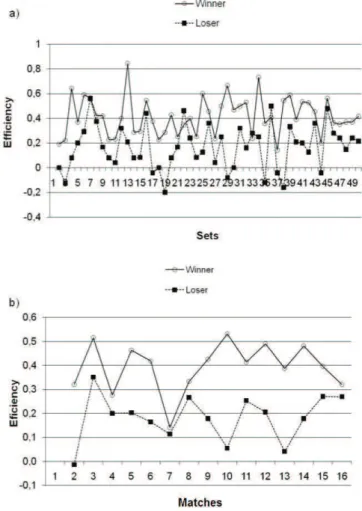
and - 100%, respectively. Figure 2a illustrates that the winning
teams exhibited higher eficiency in sets than the losing teams,
except for two of them. The t test showed that this difference
was statistically signiicant [t = 7.27, p < .01]. Moreover, Figure
2b shows that the winning teams exhibited higher eficiency
in matches than the losing teams. The t test showed that this
difference was statistically signiicant [t = 5.74, p < .04].
In order of test the hypothesis that the highest eficiency
in Transition I would result in a better championship ranking outcome in volleyball, another analysis via correlation test was performed for identifying relationships between the higher
eficiency in Transition I and the victory in sets and matches.
The irst correlation compared eficiency in the sets played by
the winning and losing teams with the results of the sets. A
signiicantly low negative correlation between the eficiency
in Transition I of winning teams and the losing sets was found [n = 49, r = -31.29, p < .01]. These results indicate that the losing
teams did not show high eficiency in Transition I. The test also
showed positive correlation between eficiency in Transition I of the losing teams with the losing sets [n = 49, r = 44.55, p < .01],
indicating that the teams with low eficiency in Transition I lose
the sets. The same test was conducted to analyze eficiency
of Transition I with the winning and the losing matches. The
results showed negative correlation between the eficiency of
Transition I of winning teams with the losing matches [n = 15, r = -66.71, p < .05], indicating that the teams with low eficiency in Transition I lost the matches. Finally, correlation between
total eficiency in Transition I and inal championship ranking
showed high signiicance [n = 6, r = 94.3, p < .04], indicating
that the teams with high eficiency in Transition I reached the
highest positions in the championship rank.
Discussion
We proposed to study the eficiency of Transition I to analyze victory in volleyball games, rather than analysis of individual
skill frequency (e.g., Nishijima; Ohsawa & Matsura, 1987; Rocha & Barbanti, 2006). The analysis of isolated skills might lead to the moot point when one speciic skill is responsible for
the victory in a volleyball match. In general, the results of the present study support this notion because most of the teams that
won the sets and the matches reached higher eficiency. Matias
and Greco (2011) found relationship between set and hit, which gives support to the proposal of analyzing the volleyball game as
Transitions, but they analyzed all spikes together. We proposed
that Transition I helps a team not lose sets and matches; contrary to Transition II that helps the team to win sets and matches.
Based on this proposal we tested the hypothesis that a higher
eficiency in Transition I would help a team not to lose sets and matches in volleyball. Our results support this claim, since the
teams that had higher eficiency in Transition I won nearly all sets
and won all the matches. In fact, the team with higher eficiency
in Transition I lost only two of 50 sets, corroborating the early proposal of Eom and Schutz (1992a) and the results of Schwalm, Ugrinowitsch and Ugrinowitsch (1995). These studies showed
the importance of distinguishing spikesperformed in Transition I from Transition II, as suggested before, and contrasted with the
results by Rocha and Barbanti (2004) that analyzed all spikes lumped together. Consequently, our results showed that Transi-tion I may be a good predictor of a match result, corroborating
the indings of McGarry, Anderson, Wallace, Hughes and Franks
(2002) that claim that it is necessary to analyze the volleyball
game as a transition instead of isolated skills.
Our second hypothesis that Transition I eficiency is rela
-ted to a better outcome in the championship ranking using the
volleyball rally score system is also supported by our results.
First of all, the analysis of the eficiency in Transition I and the results of the sets showed negative correlation between high
eficiency and losing sets, indicating that the team with higher eficiency in Transition I did not lose the game. Moreover, the
positive correlation between the lower eficiency of the losing
teams and the results of losing sets indicates that one team with
low eficiency in Transition I probably loses the set. Second,
the analysis of the eficiency in Transition I and the results of
the matches shows negative correlation between the eficiency
of the winning teams and the results of the losing matches
indicating that the teams with higher eficiency probably win
volleyball matches. In general the results shows that the higher
the eficiency in Transition I the lower the probability of losing
a set/match, which means that, empirically, we have improved
the idea of Eom and Schutz (1992b).
The characteristic of the championship (one team plays
against all) makes more important to have one good measure
to discriminate the team with potential to win matches, because
this team will likely wins the championship. We found a positive correlation between higher eficiency in Transition I (i.e., the
total eficiency during the whole championship) with the inal ranking indicating the importance of effectively performing all spikes to win the ball possession as proposed by Hebert (1991), but speciically during Transition I. This result supports the idea that Transition I occurs when the team does not lose the match.
However, it is still necessary to ind one measure to analyze the relationship between the skills in Transition I because in this study we analyzed the results from this transition and not its process.
In general, our results provide at least two work planning
guidelines for volleyball coaches: a) since the results show the correlation between Transition I eficiency and volleyball victo -ries, coaches may base the season practice planning to obtain an
eficiency higher than that of the opponents (Hebert, 1991); and b) it is not worth practicing isolated skills since winning is not accomplished by the simple sum of reception, setting, and spiking skills, but by the way they interact and that new structures that
emerge during the game, that is, the organization of Transition I.
Conclusion
In conclusion, our results showed that high eficiency in
Transition I contributes to win sets and matches, as well as to
better rank in the championship, showing that the team who is
successful in Transition I does not lose the game. These results can provide information for coaches to plan their practice based on
the eficiency in Transition I by the best team in a championship.
References
Suziane P. dos Santos-Naves ([email protected]) is with the Federal University of Triângulo Mineiro
Address: Rua Frei Paulino, 30 - Abadia, Uberaba, MG, 38025-180, Brazil
Alessandra Aguilar Coca Ugrinowitsch ([email protected]) is with the Central University of Belo Horizonte
Address: Av. Prof. Mário Werneck, 1685, Estoril, Belo Horizonte, MG, 30455-610, Brazil
Manuscript received on March 28, 2013 Manuscript accepted on January 27, 2013 Cox, R.H. (1974). Relationship between volleyball skill components
and team performance of men’s Northwest “AA” volleyball teams. Research Quarterly, 45, 441-446.
Ejem, M., & Horak, J. (1980). Selected indings from statistical analysis of individual in Czechoslovakia championships. Volleyball Tech Journal, 5, 17-30.
Eom, H.J., & Schutz, R.W. (1992). Statistical Analysis of Volleyball Team Performance. Research Quarterly for Exercise and Sport, 63, 11-18. Eom, H.J., & Schutz, R.W. (1992). Transition Play in Team Performance
of Volleyball. Research Quarterly for Exercise and Sport, 63, 261-269. Fattahi, A., Ameli, M., Sadeghi, H., & Mahmoodi, B. (2012). Rela-tionship between anthropometric parameters with vertical jump in male elite volleyball players due to game’s position. Journal of Human Sport and Exercise, 7, 714-726.
Hebert, M. (1991). Insights and Strategies for Winning Volleyball. Illions: Human Kinetics.
Hughes, M., & Daniel, R. (2003). Playing patterns of elite and non-e-lite volleyball. International Journal of Performance Analysis in Sport, 3, 50– 56.
Marcelino, R., Mesquita, I., & Sampaio, J. (2010). Eficacy of the volleyball game actions related to the quality of opposition. The Open Sports Science Journal, 3, 34-35.
Matias, C.J.A.S., & Greco, P.J. (2011). Análise da organização ofensiva dos levantadores campeões da superliga de voleibol. [Offensive organization assessment of winners of brazilian volleyball super-league setters]. Revista Brasileira de Ciências do Esporte, 33, 1007-1028.
Mcgarry, T., Anderson, D.I., Wallace, S.A., Hughes, M.D., & Franks, I.M. (2002). Sport competition as a dynamical self-organizing system. Journal of Sports Science, 20, 771-781.
Miskin, M.A., Fellingham, G.W., & Florence, L.W. (2010). Skill Im -portance in Women’s Volleyball. Journal of Quantitative Analysis in Sports, 6, 1-12.
Nishijima, T., Ohsawa, S., & Matsura, Y. (1987). The relationship between the game performance and group skill in volleyball. International Journal of Physical Education, 24, 20-26.
Rocha, C.M., & Barbanti, V.J. (2004). Uma análise dos fatores que inluenciam o ataque no voleibol masculino de alto nível. [One analysis of factors that inluence the attack in high level male volleyball]. Revista Brasileira de Educação Física e Esporte, São Paulo, 18(4), 303-314, 2004.
Rocha, C.M., & Barbanti, V.J. (2006). Brazilian volleyball: an analysis of the confrontations in the irst sequence of game action. Journal of Human Movement Studies, 50, 258-272.
Schwalm, G., Ugrinowitsch, H., & Ugrinowitsch, C. (1995, April). Eiciência no Side-Out e Vitórias nos Jogos de Voleibol. [The side out eficiency and the winning in volleyball]. In: Anais do I Momentum Congresso Brasileiro sobre Qualidade na Educação Física e no Esporte, Curitiba.
Authors’ note
Herbert Ugrinowitsch ([email protected]), Guilherme Menezes Lage ([email protected]), Leandro N. Dutra (dutraln@gmail. com), Maria Flávia S. P. Carvalho ([email protected]) and Rodolfo N. Benda ([email protected]) are with the Federal University of Minas Gerais.