Rev Bras
Cineantropom
Hum
DOI: http://dx.doi.org/10.5007/1980-0037.2016v18n6p638
original article
1 Federal University of Minas Gerais. Belo Horizonte, MG. Brazil.
2 University Center Estácio Brasília. Taguatinga, DF. Brazil.
3 Federal University of the Vale Je-quitinhonha and Mucuri. Diamantina, MG. Brazil.
4 Federal University of Goiás. Goiâ-nia, GO. Brazil.
Received: 09 May 2016
Accepted: 14 November 2016
Visual behavior and the quality of
decision-making on volleyball
Comportamento visual e qualidade da tomada de
decisão no voleibol
Henrique de Oliveira Castro1,2
Gibson Moreira Praça1,3
Gustavo De Conti Teixeira Costa4
Gustavo Ferreira Pedrosa1
Pablo Juan Greco1
Abstract – his study aims to verify the visual behavior using the analysis of both quan-tity and duration of visual ixation and the quality of the DM in volleyball players and athletes from other sports in extreming attacking (EA), cental attack (CA), setting (SE) and blocking (BL) situations. he visual behavior was analyzed during the evaluation of volleyball scenes with an eye-tracking system. he irst decision the volunteer voiced was determined as his solution for the scene presented and it was used for analyzing the DM quality. For the quantity of visual ixations, the independent t-test was used to compare groups in the following situtations, EA, SE and BL. For analyzing the quality of DM, the chi-square test of proportions was used. Moreover, for the analysis of the duration and number of visual ixations, the independent t test was addopet (or Mann-Whitney test when some of the assumptions were not met for parametric analysis). Signiicantly higher values were observed on duration of visual ixations in athletes from other sports comparing to volleyball players at CA (p = 0.042). he DM were signiicantly diferent in EA (p = 0.024) and CA (p = 0.001) between groups, showing higher frequency of correct answers for the volleyball players. We conclude that volleyball players perform faster ixations in situations of CA and take more correct decisions in attacking situation (EA and CA) compared to athletes from other sports.
Key words: Cognition; Decision-Making; Volleyball.
he analysis in volleyball that aimed to determine the factors that afect the performance in an athlete or in a team have highlighted the following parameters, technical, tactical1,2, decision-making (DM)3, psychological
factors, knowledge and other. Volleyball is considered a strategic and tactical sport where relations between the DM and the performance take a particular importance to understand the variables that inluence the game4, providing perfect tasks for the processes underlying the anticipation
of action efects, in which the athlete’s previous experience stands out as a determining factor5. he set of responses (cognitive and motor) applied
for carrying out the action, or operation of tactical behavior in volleyball concretized with the participation and support of the visual system6,7.
Searching relevant information for the task, it is evident the need for focusing attention, by vision, on the goals that emerge from it8. he
func-tion of attenfunc-tion consisits in optimizing the performance of visual tasks, lead the focus for relevant points and guide the sporting behavior to fac-tors that enable success in the task solution9. he visual system supplies
the individual with environment information related and integrated to the processes that converge to DM6. During the game, a variety of signals
arrive to the players, in other words, a large amount of information about the environment or the task, should be taking into account when they make a decision10. hus, the visual system acquires great importance in
sports, as participants and objects share the same space in high speed and in many occasions7.
Due to the high unpredictability of the volleyball game, the visual behavior is considerably requested (required), as well as the processing of this information (cognitive)4,7,11,12. herefore, it becomes important to study
the direction of attention as an integrated process of elaboration of a deci-sion during speciic times in the game. Schlappi-Lienhard and Hossner13
mentioned that although several studies have examined the DM related to visual perception and speciic knowledge in the sport, the current state of research shows limitations concerning to (1) analysis of visual percep-tion with the eye-tracking systems, (2) identiicapercep-tion of aspects of game, relevant for domain of speciic knowledge and (3) the interactions between the two points with DM.
he main question of this study consists in analyzing the information generated by the ixed eye-tracking in experimental situations aimed to understanding the diferences or similarities in the visual behavior of the volunteers and their relationship to the quality of DM. he interest in pursuit of knowledge about how the directioning of attention in volleyball athletes and non-athletes occur during the analysis of real scenes of games and how it is related to the elaboration of a response (DM) is a major contributor to the development of models and methodologies foccused for training and improvement of DM.
Decision-making on volleyball Castro et al.
of the quantity and duration of visual ixations (via ixed eye-tracking) and DM quality in volleyball players and athletes from other sports in real scenes of games such as attack performed at the extrimities of the court (EA) such as front and back row hit, central attack (CA), setting (SE) and blocking (BL).
METHODOLOGICAL PROCEDURES
Sample
A total of 48 male volunteers were divided into two groups: volleyball players (n = 25, 16.9 ± 1 years old and 3.7 ± 1.1 years of experience in systematic training on volleyball) and athletes from other sports (n = 23, 17.6 ± 1.7 years old and 1.52 ± 0.5 years of experience in school training – non systematic - on volleyball). he diference between the quantities of volunteers in each group is justiied by the loss of visual recording of two non-athletes.
As inclusion criteria the volunteers should not have any sort of blind-ness, strabismus or other vision problems that could compromise the study. For the volleyball players group, volunteers should be (1) regularly enrolled in the Volleyball Federation of the Minas Gerais State and in the Brazilian Volleyball Confederation; (2) regulary systematic training in team/club; and (3) compete at the following tournament level: state, national and / or international. For the athletes from other sports group, (1) school practice, non systematic; (2) non regulary enrolled in the Volleyball Federation; and (3) competition level school and/or regional.
Instruments
• Demographic data questionnaire
A demographic data questionnaire containing questions relevant to the research was applied in all volunteers, extracting the following informa-tion regarding to characterize the sample. he data are presented in Table 1. hese data sets become important once the results may be linked to the cognitive aspects such as attention and DM, and the technical and tactical development in volleyball2,14-16.
• Assessment test of volleyball games scenes
he evaluation test of volleyball games scenes was composed of 24 real scenes from volleyball games presented in four types of situations: EA (six scenes), CA (six scenes), SE (six scenes) and BL (six scenes). Each scene lasted 4-6 seconds and all of them were shot from 7-9 meters above the court perspective, allowing the observer full view of the court and depth perception in diferent situations.
he content validation of those scenes was carried out respecting the methodological criteria presented by Hernández-Nieto17. hus, the
validation procedure starts with the coeicient of content validity (CVC), which allows understanding of the level of agreement among the judges about each item17,18. All the scenes showing satisfactory levels of CVC
he situations of AE and AC started on the serve, going through the reception and setting, then the video went interrupted for the attack mo-ment. he situations of LE and BL start up on the serve, going through the reception and interrupted at the setting moment. In this moment, the expert volleyball coaches responded that the best action for the resolution of the scene, characterized as a DM.
• Eye-Tracking
To analyze the visual behavior during the test application, the Eye-Tracking SMI RED500®, was used. With the device on, the eyes movements were
recorded by an infrared laser system ixed to the computer screen19. he
ixed eye-tracking provides data related to the variables of visual behavior11,
quantity and duration of visual ixations and perception of relevant signals19.
• Quality Decision-Making (DM)
To evaluate the quality of DM during the test, at the moment where the video was interrupted the subjects verbalized what answer (atittude) could be more appropriate for success in the situation presented. With this proce-dure it was possible to accurately analyze the volunteer response15. In this
study, at the moment of interruption of the scene, the DM of volleyball players who were in accordance with the perits responses were considered correct, or else consider wrong.
Procedures
his project was approved by the Ethics Committee of the Federal Uni-versity of Minas Gerais - COEP / UFMG under the number 971.037 and all volunteer, as well as their legal represibles, gave written consent for participation in the study.
Volunteers were escorted to the room where the test would be per-formed. After the test each volunteer illed the demographic data question-naire. During all collections, only the volunteer and the main researcher were allowed to be in the roon.
(n = 25) (n = 23) Mean ± S.D. Mean ± S.D.
Age (years) 16.9±1.0 17.6±1.7
Decision-making on volleyball Castro et al.
After completing the questionnaire, the volunteers sat on a chair fac-ing the computer where the test scenes were watched. At this moment a standardized instruction process related to the execution test was initiated and the volunteers were submitted to the familiarization. he familiazation consisted in watching two scenes for each situation (EA, CA, SE and BL), following exaclty the experimental protocol. After the familiarization, the volunteers started the experimental tests (24 scenes) as soon as they felt ready for it. In this moment the volunteers using the ixed eye-tracking for analysis of the visual behavior (variables: quantity and duration of visual ixations) and the DM7,11,19-21.
To evaluate the quality of DM during the test, at the moment where the scene was interrupted, the computer screen went blank and the volunteer had up to three seconds to respond verbally to the evaluater the following question: “What to do?”, in other words, the volunteer had to responde what he deems most appropriate to solve the action15. he number and
percentage of correct answers took into account the responses of experts and also the well succeeded performance of the player in the scene.
Data analysis
To compare the number of visual ixations between volleyball players and athletes from other sports, we initially used the Shapiro-Wilk normality test, which presented signiicant deviations from normality for the CA variable. For the other variable, the Levene test was realized (for homo-scedasticity of variances) that presented no signiicant deviations for any variable. For the three variables with normal distribution (EA, SE and BL) the independent t test was used to compare the two groups. For the variable with signiicant deviation from normality (CA) we used the Mann-Whitney test U. Regarding the duration of visual ixations, all variables (EA, CA, SE and BL) showed signiicant deviations from the normality. In this context, we opted for the Mann-Whitney U test for comparison between groups. For the dependent variables related to the frequency of well succeded responses in decision-making, we opted to use the chi-square test of proportions. For all analyzes, we used the SPSS 20.0 software, keeping the level of signiicance equal to 5%.
RESULTS
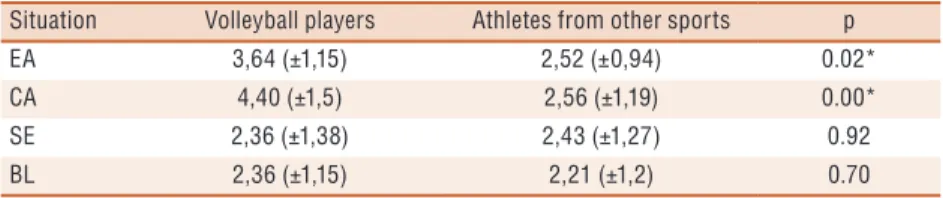
he results are shown into two sections: Visual behavior (Table 2 and 3) and DM quality (Table 4).
he Table 2 present the means and standard deviations from the number of visual ixations by each group for each game situation. As shown in table 2, the average number of visual ixations between the volleyball players and athletes from other sports groups did not show signiicant diferences in any game situation.
athletes from other sports compared to the volleyball players group for the CA situation (p = 0.04).
Table 2. Average number of visual fixations (± standard deviation) of each group for all situations.
Situation Volleyball players Athletes from other sports P EA 12,64 (±2,36) 12,37 (±2,30) 0.69 CA 13,29 (±4,28) 12,95 (±2,77) 0.17 SE 10,97 (±2,65) 11,46 (±1,85) 0.47 BL 11,55 (±2,41) 11,67 (±2,92) 0.87 EA=extreming attacking; CA=cental attack; SE=setting; BL=blocking. * p≤0,05
Table 3. Duration of visual fixation for every situation for the two groups in average and standard
deviation.
Situation Volleyball players (ms)
Athletes from other sports
(ms) P
EA 3227,22 (±993,21) 3594,11 (±787,86) 0.07 CA 3302,48 (±1362,89) 4037,24 (±891,42) 0.04* SE 2883,40 (±940,46) 3162,17 (±630,74) 0.38 BL 3088,96 (±895,73) 3243,77 (±554,73) 0.95 EA=extreming attacking; CA=cental attack; SE=setting; BL=blocking; ms=milisecond. * p≤0,05
he results in Table 4 show signiicant diferences in EA situations (x2=5.09; p=0.02) and CA (x2=12.16; p=0.00) on the comparison between
groups, obtaining a higher frequency of correct answers from the volleyball players in relation to athletes from other sports.
Table 4. Number of correct answers of the two groups for all situations (average and standard
deviation)
Situation Volleyball players Athletes from other sports p EA 3,64 (±1,15) 2,52 (±0,94) 0.02* CA 4,40 (±1,5) 2,56 (±1,19) 0.00* SE 2,36 (±1,38) 2,43 (±1,27) 0.92 BL 2,36 (±1,15) 2,21 (±1,2) 0.70 EA=extreming attacking; CA=cental attack; SE=setting; BL=blocking. * p≤0,05
DISCUSSION
Decision-making on volleyball Castro et al.
According to Liu15, studies that analyzed performance showed the
ex-perts in comparison to beginners, have more knowledge in more elaborate tasks, make more use of the available information, detect objects and have standards of visual search on the environment, encoding and retrieving information eiciently and make decisions faster and more appropriatly. Furthermore, it was demonstrated that the experts have greater ixation on relevant tasks and less in non relevant tasks, accompanied by short ixation time and allocation of selective attention14. Similar results were observed in
the study of Piras, Lobietti and Squatrito22 where expert volleyball players
were compared to novice players in a visuomotor task using video scenes of real games in attack situations. he experts with greater performance on the task were associated with lower number of visual ixations and the visual ixations were performed faster.
On the study by Alfonso and Mesquita23 with 15 female volleyball
players divided into two groups: skilled and less skillful, they used the eye-tracking and verbal reports in dynamic scenes of ofensive tasks. he results revealed signiicant diferences in the time of visual ixation. he skilled athletes group performed the visual ixations for a longer period of time comparing to the less skilled group. In the present investigation, the duration of visual ixations were longer in the athletes from other sports group compared to the group of volleyball players, which difers from the indings of Afonso and Mesquita23 work. Regarding the number of visual
ixations, the results of both studies are similar, once there is no signiicant diference in the comparison of groups.
Using nine elite female volleyball athletes, Afonso et al.20 compared
game situations, 6x6 in situ, using scene recordings and they found sig-niicant diference in the average of time ixation. he authors observed the time of ixation were higher on the in situ situation when compared to the situation based on recordings. In another study by Afonso et al.21 with
6x6 game situations that began in the service and ending at the opponent attack, a signiicant diference in the number of ixations from the very skilled group when compared to the skilled group was found.
he results above corroborate the results found in this study regarding the signiicant diference in duration of visual ixations in the situation of CA when volleyball players and athletes from other sports were compared. Observing the number of ixations, this study showed no signiicant dif-ferences between groups, corroborating with Afonso and Mesquita23 work
and difering from Piras, Lobietti and Squatrito22, and Afonso et al.20. hese
diferences can be explained by the variations in the average experience time of the athletes used in the studies and for the lack of a standardized and speciic test that uses the same scenes for evaluations.
Mes-lesser competitive performance. hese results matches with those found in this study, which presented better decisions for athletes who have more competitive successful experience in relation to non-athletes who have no experience in competitions in the volleyball modality.
On a more practical level, the understanding of the elements that support the cognitive development may contribute to highlight the factors that efectively impact not only the teaching and the sports practice, but also the performance and learning of DM in similar contexts, temporally constrained and with limited time resources. From the eye-tracking stud-ies it is possible to enable the creation of models and methodologstud-ies of Teaching-Learning-Training (T-L-T) for speciic tactical improvement of visual strategies and consequently faster and more eicient DM, especially in collective sports that have high variability and require a direct relation-ship between cognition and action.
his study had the limitation of not analyzing situations regarding the volleyball fundamentals of serving and reception, which could also discriminate the athletes according to the result of the test performance. Moreover, as the game features are diferent between genders, this study was limited to male, because the scenes chosen are from male games. here was also the limitation of the sample due to diferent competitive and vacation periods and dependence of the release of the clubs to conduct research with their athletes.
In this sense, it is suggested that further research be carried out with other volleyball fundamentals, as well as other categories and diferen-tiations related to time of practicing and quality of practice, since both aspects inluence the excellence of the player. Furthermore, it is suggested to perform a test with women’s volleyball game scenes and thus apply it in diferent categories of this gender.
CONCLUSION
Decision-making on volleyball Castro et al.
REFERENCES
1. Araújo RMF, Neves JA, Mesquita IMR. Procedural knowledge, decisión-making and performance in women’s volleyball according to age group and speciic experi-ence. he Open Sports Sci J 2012;5:167-73.
2. Gil A, Moreno MP, Moreno A, García-González L, Claver F, Del Villar F. Analy-sis of the Relationship Between the Amount of Training and Cognitive Expertise. A Study of Young Volleyball Players. J Streng Cond Res 2013;27(3):698-702. 3. Raab M. SMART-ER: a Situation Model of Antecipated Response consequences
in Tactical decisions in skill acquisition – Extended and Revised. Front Psychol 2015;5(article 1533):1-5.
4. Araújo R, Afonso J, Mesquita, I. Procedural knowledge, decisión-making and game performance analysis in Female Volleyball’s attack according to the player’s experience and competitive success. Int J Perf Analy Sport 2011;11(1):1-13. 5. Balser N, Lorey B, Pilgramm S, Naumann T, Kindermann S, Stark R, et al. he
inluence of expertise on brain activation of the action observation network during anticipation of tennis and volleyball serves. Front Hum Neurosci 2014;8(568):1-13. 6. Memmert D, Simons DJ, Grimme T. he relationship between visual attention
and expertise in sports. Psychol Sport Exerc 2009;10(1):146-51.
7. Sáez-Gallego NM, Vila-Maldonado S, Hernández JA, Jordán ORC. Análisis del comportamiento visual y la toma de decisiones en el bloqueo em Voleibol. Cuad Psicol Dep 2013;13(2):31-44.
8. Carrasco M. Visual attention: he past 25 years. Vision Res 2011;51(13):1484-525. 9. Bar-Eli M, Raab M. Editorial: Judgement and decision making in sport and
exercise: Rediscovery and new visions. Psychol Sport Exerc 2006;7(6):519-24. 10. Johnson JG. Cognitive modeling of decision making in sports. Psychol Sport
Exerc 2006;7(6):631-652.
11. Vila-Maldonado S, Saéz-Gallego NM, Abellán J, Ricardo O. Efecto del tipo de colocación en el comportamiento visual y la toma de decisions en bloqueadores de Voleibol. Cult Cien Dep 2012;7(20):103-14.
12. Vila-Maldonado S, Abellán J, Saéz-Gallego NM, García-López LM, Contreras OR. Decision-making and visual perception skills in youth volleyball players and non-players. J Sports Health Res 2014;6(3):265-76.
13. Schlappi-Lienhard O, Hossner E-J. Decision making in beach volleyball defense: Crucial factors derived from interviews with top-level experts. Psychol Sport Exerc 2015;16(1):60-73.
14. Gegenfurtner A, Lehtinen E, Saljo R. Expertise diferences in the comprehension of visualizations: a meta-analysis of eye-tracking research in professional domains. Educ Psychol Rev 2011;23(4):523-52.
15. Liu S. Research on Athletes Visual Search: A Case Study. Int J Sci Res 2015;4(1):1373-6.
16. Lola AC, Tzetzis G, Zetou H. he efect of implicit and explicit practice in the development of decision making in volleyball serving. Percep Motor Skills 2012;114(2):665-78.
17. Hernández-Nieto RA. Contributions to statistical analysis. Los Angeles: Mérida. 2002.
18. Balbinotti MA, Benetti C, Terra PR. Translation and validation of the Graham-Harvey survey for the Brazilian context. Int J Manag Fin 2006;3(1):26-48. 19. Tien T, Pucher PH, Sodergren MH, Sriskandarajah K, Yang G-Z, Darzi A.
Eye Tracking for skills assessment and training: a systematic review. J Surg Res 2014;191(1):169-78.
Henrique de Oliveira Castro Condomínimo Max Home & Mall. Rua 07 Norte Lotes 3,5 e 7 Apto. 501 Bloco A. Norte Águas Claras Brasília/Distrito Federal, Brasil. CEP: 71.908-180.
E-mail: henriquecastro88@yahoo. com.br
22. Piras A, Lobietti R, Squatrito S. Response Time, Visual Search Strategy, and Anteipatory Skills in Volleyball Players. J Ophthalm 2014;article ID 189268:1-10. 23. Afonso J, Mesquita I. Skill-based diferences in visual search behaviours and