DOI: http://dx.doi.org/10.5007/1980-0037.2016v18n4p401
1 Sport Sciences School of Rio Maior. Rio Maior, Portugal
2 Research Center in Sports Science, Health and Human Development. Vila Real, Portugal
3 University of Trás-os-Montes and Alto Douro. Vila Real, Portugal
4 Polytechnic Institute of Santarém. Life Quality Research Center. Santa-rém, Portugal
Received: 05 November 2015
Accepted: 01 May 2016
Stability of behaviour patterns in the 200m
breaststroke
Estabilidade dos padrões comportamentais nos 200m do
nado peito
Hugo Louro1,2
António J. Silva2,3
Jorge Campaniço2,3
Telmo Matos1
Ana Conceição1,2,4
Abstract – he aim of this study was to analyse the stability of the breaststroke technique in ive elite swimmers in a 200m event using a qualitative analysis. he codiication of the behaviour of each swimmer during the execution of 20 cycles was achieved using an ad hoc observational instrument comprised of a system of categories and ield formats to detect the behavioural patterns (T-patterns); software was used for identifying the technical behaviour of stable structures. he results showed that the stability behaviour varied depending on the swimmer, as the variations of codes in each round produced distinct conigurations to determine the diferences between cycles for the same swimmer. It was concluded that the instrument used in this study plays an important role through the existence of stable behaviour in the breaststroke technique. It was also concluded that there are distinct patterns and behaviours between swimmers during each lap of the race.
Key words: Observational methodology; Swimming; Technical analysis; T- patterns.
T-patterns swimmers analysis Louro et al.
INTRODUCTION
he technical evolution of image recording and the associated software for monitoring technical execution of athletic actions has become a growing line of research. In the ield of physical activity and sport, there are many
studies that use the analysis of multi-code event sequences1–5. Competitive
swimming is one of the most challenging sports in terms of performing scientiic research because it involves assessing human beings in an aquatic environment, which is not their natural environment, and other physical
principles have to be considered6. In recent years, improvement of
tech-nological resources has allowed for the development of new theoretical models and patterns of swimming techniques; increased scope and reduced limitations of these models has allowed for the optimisation of individual
performance7–10. To analyse the athletic movements of a swimmer, the
level of swimming from a kinematic perspective and in terms of technical
efectiveness should be carried out11.
he observational methodology used to analyse the situation in terms of behaviour involves the fulilment of an ordered series of tasks to collect and process data and also presents a signiicant level of importance to some scientiic procedures in the study of technical performance. In competitive
swimming, there are some studies that have used these procedures9,10,12.
According to Anguera et al.4, there are advantages to using this method,
not only because the user can take the procedures from the laboratory and move them into the ield, but it can also provide data without interfering
with or manipulating the behaviour of the observed subjects. Magnusson13
considers quantiication to be insuicient, stating that it should instead involve the structure of this behaviour expressed through patterns that are apparently hidden to the eyes of the observer, but that do exist and can be
detected. Magnusson13 presents the THEME software as a tool for the
detection of regular “temporal and sequential” structures in a data set. A temporal pattern (T-pattern) is essentially a combination of events that occur in the same order, with temporal distances between each other, and that remain relatively invariant in relation to the null hypothesis that each component is independent and is randomly distributed over time.
Bakeman and Quera14 verify that one of the main reasons for using
observational methods is the ability to capture behaviours displayed over time, which allows for the sequential analysis to be carried out.
detection of temporal structure. his type of study, which takes the time factor into account, has enabled researchers to establish the most suitable training load for each individual swimmer. Among these, we highlight the analysis of T-patterns, which allows for the detection of hidden patterns of behaviour, sequential analysis, and the demand for a signiicant relationship between behaviours recorded during these sequences.
he aim of the present research was to study, by means of descriptive and T-pattern analyses, the breaststroke technique used during the 200m event. It was hypothesised that each swimmer would have his own pattern of behaviour, characterised by diferences in the gestural stability and by the pace race strategy that each swimmer applied over the 200m event.
METHODOLOGICAL PROCEDURES
he design of the present study was nomothetic, punctual (single moment of collection), and multidimensional, with natural observation units (events and behaviours) and analysis (behaviour patterns). It is nomothetic because the sample consists of ive swimmers (n = 5) with one common bond (breaststroke cycles), it is punctual because the acquired data are obtained in a single moment, and it is multidimensional because the behaviour was studied in several dimensions simultaneously.
Subjects
Five male swimmers (age: 23.8 ± 2.6 years; height: 178.6 ± 0.6 m; weight: 73.04 ± 3.32 kg; mean ± SD) volunteered to participate in this study and provided their written consent. hey were all national level swimmers with an average personal best result in the 200m breaststroke (147.6 ± 0.041 s corresponding, respectively, to 630.75 ± 69.25 FINA ranking points). he institutional Ethics Committee approved all procedures, which were carried out according to the Helsinki Declaration.
Testing procedure
he experiments were performed in a 50 m indoor swimming pool at a temperature of 27.5ºC and a 75 percent humidity level. Subjects performed a standard warm-up of the 800m front crawl at a medium level of efort after 20 minutes of passive rest. hey then performed a 200m breaststroke trial with a push of start at maximum efort.
T-pattern data collection
T-patterns swimmers analysis Louro et al.
wall of the pool, perpendicular to the line of motion and 6 m away from the swimmer displacement trajectory. One of the cameras was placed at a depth of 30 cm and the other 10 cm above the water level. he images from both cameras were recorded simultaneously and it was possible to follow the swimmer’s trajectory and visualise ive swimming strokes for each lap.
T-patterns assessment
We used an ad hoc reference. he instrument was conigured according to the nature of the research: (i) criteria, (ii) system of codes, and (iii) units of cod-ing. he structure of the observation took individual events by the description
of time and order3, representing one or more speciic technical behaviours
of hand cycles. In order to prepare the observational instrument, a panel of experts, consisting of graduate students, researchers, and experienced coaches, were consulted to ind out what performance indicators should be included in the study. A review of the literature was also carried out.
Box 1. Moments of observation and description of the observational “ad hoc” instrument used Moments of observation and description of the observational “ad hoc” instrument used – SOCTB
First propulsive action of arms (FPAA)
Focuses on the aspects of the connection from one cycle to another, particularly in the moment that corresponds to the be-ginning of flexion until the deepest point that the hands reach. Second propulsive action
of arms (SPAA)
Focuses on the critical aspects of the second propulsive sup-port of the arms, which finishes with the extension of the arms.
First propulsive action of legs (FPAL)
The transitional approach criterion is the maximal flexion of the knees, that the terminus it´sand terminates at the moment in which the angle of the hip/leg is 45º.
Second propulsive action of legs (SPAL)
Focuses on the moment that starts with the angle of the hip/leg at 45º and finishes with the full extension of the same parts
Recovery (R)
Focuses on the moment corresponding to the end of the cycle. Recovery moment that starts with full extension of the legs away from the body until their junction.
For this study, the instrument was set with 431 alphanumeric codes and a total of 44 conigurations, used to catalog ive swimmers at a length of 20 hand cycles. he reliability of the instrument was calculated using the intra- and inter-observer agreement with the SDIS-GESQ software,
and the obtained value of 0.967 was excellent17. Each criterion represents
the algorithm for the detection of T-patterns Magnusson16 developed is
based on a binomial probability theory that allows for the identiication of sequential and temporal systems of data. he units of codiication presented like events according to duration metrics, order, and frequency, represent-ing one or more technical behaviours.
RESULTS
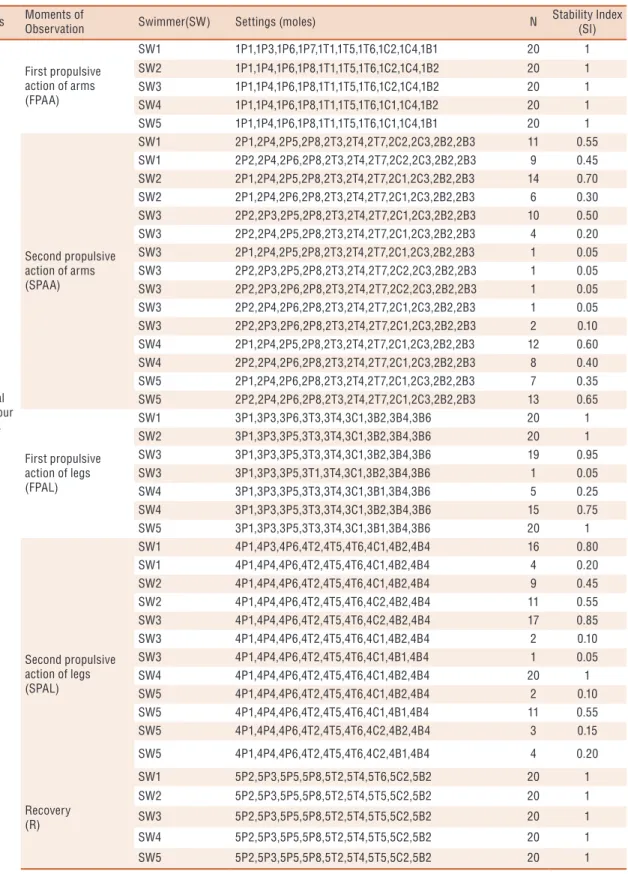
Table 1 presents the characterisation of events and the frequency of occur-rences of all swimmers in the irst ive moments of observation over the 200 metres. Swimmer 1 had no changes in the FPAA, FPAL, and R over the 20 analysed cycles, while in the SPAA, he presented changes in the position of the leg extension (SI, 0.55), lexion (SI, 0.45), and the position of the feet was parallel (SI, 0.55) or discontinuous (SI, 0.45). During the second propulsive action of the legs (SPAL), it was found that the only variation resulted from the comparison of the ankle level to the hip: the ankle may be above the hip (SI, 0.80) or below the hip with no extension (SI, 20).
Swimmer 2 presented the FPAA, FPAL, and R with no changes in the 20 cycles analysed and thus presented overall stability. here was some alteration in the SPAA, where the position of the feet varied between paral-lel (SI, 0.70) and discontinuous (SI, 0.30). In the SPAL, variation occurred in the level of the head position in relation to the water line – above the water line/intermediate (SI, 0.45) or below the water line (SI, 55).
In Swimmer 3, 100 percent technical stability was observed in the FPAA and R. In the SPAA, there were changes in criteria P5, P6, P7, and C3. he FPAL demonstrated changes in the position of the trunk in the dorsilex (SI, 0.95) position, as well as in length (SI, 0.05). In the SPAL, it was found that the variations that occurred in the head position relative to the water line were above/intermediate (SI, 0.15) or below (SI, 0.85) and there was a level position of the forearm in relation to the water line, with the arms inclined upward/parallel (SI, 0.05) and angled downwards (SI, 0.95).
Variations in the SPAA were observed in Swimmer 4, in which the position of the legs altered in length (SI, 0.60) and lexion (SI, 0.40) and the position of the feet varied between parallel (SI, 0.60) and discontinu-ous (SI, 0.40). For this swimmer, changes occurred during the FPAL in the tilt of the forearm in relation to the water line, whereas in the FPAA, SPAL, and R, there were no changes in the total 20 analysed cycles.
T-patterns swimmers analysis Louro et al.
the water line (SI, 0.35), and the level of the position of the forearms in relation to the water line, with the forearms inclined upward/parallel with the water line (SI, 0.70) or inclined downwards (SI, 0.30).
Table 1. Characterisation of events and frequency of occurrences in all swimmers. Laps Moments of
Observation Swimmer(SW) Settings (moles) N
Stability Index (SI)
Total of four laps
First propulsive action of arms (FPAA)
SW1 1P1,1P3,1P6,1P7,1T1,1T5,1T6,1C2,1C4,1B1 20 1
SW2 1P1,1P4,1P6,1P8,1T1,1T5,1T6,1C2,1C4,1B2 20 1
SW3 1P1,1P4,1P6,1P8,1T1,1T5,1T6,1C2,1C4,1B2 20 1
SW4 1P1,1P4,1P6,1P8,1T1,1T5,1T6,1C1,1C4,1B2 20 1
SW5 1P1,1P4,1P6,1P8,1T1,1T5,1T6,1C1,1C4,1B1 20 1
Second propulsive action of arms (SPAA)
SW1 2P1,2P4,2P5,2P8,2T3,2T4,2T7,2C2,2C3,2B2,2B3 11 0.55
SW1 2P2,2P4,2P6,2P8,2T3,2T4,2T7,2C2,2C3,2B2,2B3 9 0.45
SW2 2P1,2P4,2P5,2P8,2T3,2T4,2T7,2C1,2C3,2B2,2B3 14 0.70
SW2 2P1,2P4,2P6,2P8,2T3,2T4,2T7,2C1,2C3,2B2,2B3 6 0.30
SW3 2P2,2P3,2P5,2P8,2T3,2T4,2T7,2C1,2C3,2B2,2B3 10 0.50
SW3 2P2,2P4,2P5,2P8,2T3,2T4,2T7,2C1,2C3,2B2,2B3 4 0.20
SW3 2P1,2P4,2P5,2P8,2T3,2T4,2T7,2C1,2C3,2B2,2B3 1 0.05
SW3 2P2,2P3,2P5,2P8,2T3,2T4,2T7,2C2,2C3,2B2,2B3 1 0.05
SW3 2P2,2P3,2P6,2P8,2T3,2T4,2T7,2C2,2C3,2B2,2B3 1 0.05
SW3 2P2,2P4,2P6,2P8,2T3,2T4,2T7,2C1,2C3,2B2,2B3 1 0.05
SW3 2P2,2P3,2P6,2P8,2T3,2T4,2T7,2C1,2C3,2B2,2B3 2 0.10
SW4 2P1,2P4,2P5,2P8,2T3,2T4,2T7,2C1,2C3,2B2,2B3 12 0.60
SW4 2P2,2P4,2P6,2P8,2T3,2T4,2T7,2C1,2C3,2B2,2B3 8 0.40
SW5 2P1,2P4,2P6,2P8,2T3,2T4,2T7,2C1,2C3,2B2,2B3 7 0.35
SW5 2P2,2P4,2P6,2P8,2T3,2T4,2T7,2C1,2C3,2B2,2B3 13 0.65
First propulsive action of legs (FPAL)
SW1 3P1,3P3,3P6,3T3,3T4,3C1,3B2,3B4,3B6 20 1
SW2 3P1,3P3,3P5,3T3,3T4,3C1,3B2,3B4,3B6 20 1
SW3 3P1,3P3,3P5,3T3,3T4,3C1,3B2,3B4,3B6 19 0.95
SW3 3P1,3P3,3P5,3T1,3T4,3C1,3B2,3B4,3B6 1 0.05
SW4 3P1,3P3,3P5,3T3,3T4,3C1,3B1,3B4,3B6 5 0.25
SW4 3P1,3P3,3P5,3T3,3T4,3C1,3B2,3B4,3B6 15 0.75
SW5 3P1,3P3,3P5,3T3,3T4,3C1,3B1,3B4,3B6 20 1
Second propulsive action of legs (SPAL)
SW1 4P1,4P3,4P6,4T2,4T5,4T6,4C1,4B2,4B4 16 0.80
SW1 4P1,4P4,4P6,4T2,4T5,4T6,4C1,4B2,4B4 4 0.20
SW2 4P1,4P4,4P6,4T2,4T5,4T6,4C1,4B2,4B4 9 0.45
SW2 4P1,4P4,4P6,4T2,4T5,4T6,4C2,4B2,4B4 11 0.55
SW3 4P1,4P4,4P6,4T2,4T5,4T6,4C2,4B2,4B4 17 0.85
SW3 4P1,4P4,4P6,4T2,4T5,4T6,4C1,4B2,4B4 2 0.10
SW3 4P1,4P4,4P6,4T2,4T5,4T6,4C1,4B1,4B4 1 0.05
SW4 4P1,4P4,4P6,4T2,4T5,4T6,4C1,4B2,4B4 20 1
SW5 4P1,4P4,4P6,4T2,4T5,4T6,4C1,4B2,4B4 2 0.10
SW5 4P1,4P4,4P6,4T2,4T5,4T6,4C1,4B1,4B4 11 0.55
SW5 4P1,4P4,4P6,4T2,4T5,4T6,4C2,4B2,4B4 3 0.15
SW5 4P1,4P4,4P6,4T2,4T5,4T6,4C2,4B1,4B4 4 0.20
Recovery (R)
SW1 5P2,5P3,5P5,5P8,5T2,5T4,5T6,5C2,5B2 20 1
SW2 5P2,5P3,5P5,5P8,5T2,5T4,5T5,5C2,5B2 20 1
SW3 5P2,5P3,5P5,5P8,5T2,5T4,5T5,5C2,5B2 20 1
SW4 5P2,5P3,5P5,5P8,5T2,5T4,5T5,5C2,5B2 20 1
box shows the full behavioural patterns and the sequence of the technical model of each swimmer; the left-hand box indicates the ive moments of observation and the sequences of events; the images in the bottom box show diagrams with reference to the spatio-temporal occurrence of cycles, indicating the number of times that these relationships occur.
Swimmer 1 displayed a single motor pattern. his pattern was repeated 10 times, which means that in the 20 analysed cycles, this swimmer per-formed the same technical execution in 10 cycles, demonstrating greater stability, particularly at the beginning and at the end (irst lap and fourth lap) of the event.
Swimmer 2 presented two complete motor patterns. In the irst be-haviour pattern, the irst ive cycles represent a motor pattern; however, the second behaviour pattern presented seven cycles in the last half of the event (third and fourth lap). It seems that this swimmer used one pattern in the irst part of the event and changed the pattern in the second part of the event.
he two motor patterns of Swimmer 2 difer only in the C6 criterion (head position relative to the water line - SPAL). he irst motor pattern was above the water line/intermediate (4C1), while the second motor pat-tern placed the head below the water line (4C2).
Swimmer 3 demonstrated two complete motor patterns. In the irst behaviour pattern, the irst two cycles at the beginning of the event and ive cycles halfway through the event represent a motor pattern; however, the second behaviour pattern presented four cycles in the last half of the event (fourth lap). In the last moment of observation, the diference between the irst motor pattern of Swimmer 3 and the motor pattern of Swimmer 1 is that the trunk is tilted up/parallel to the water line. he last two events were similar to those that existed in the previous patterns; however, the observed changes were during the second propulsive action of the arms and legs, which in this pattern were inclined downwards/parallel to the water line (2P4), whereas in previous the pattern, the legs were tilted upward (2P3).
Swimmer 4 showed one motor pattern, presenting ive diferent events numbered from 1 to 5, as was the case in the patterns of the other swim-mers. hus, it appears that the standard motor pattern is performed in the irst four cycles of the stroke. Finally, Swimmer 5 displayed one motor
pattern (Table 1); in the 20 cycles studied, this swimmer performed the
same technical execution in six cycles, and demonstrated greater stability in the 6th, 9th, 10th, 11th, 12th and 18th cycles.
According to the schematic representations obtained for the diferent swimmers, it was found that three swimmers adopted a technical stroke model that is close to the variant, “very wavy, arched” (Swimmers 2, 3, and 4), and the remaining two swimmers adopted “wavy, slightly arched” and “very wavy, slightly arched” variants (Swimmers 1 and 5), according
T-patterns swimmers analysis Louro et al.
DISCUSSION
he present study ills an important gap in the ield of swimming research, as the temporal structure of the breaststroke technique has not previously been studied in the 200m event.
he aim of this study was to describe the breaststroke technique in the 200m event by means of the analyses of T-patterns. he main indings were that each swimmer adopted his own motor pattern behaviour; how-ever, there were some individual indicators of behaviour stability during the 200m event. he presented data highlights the potential of the motor patterns in performance analysis and motor skills in swimmers.
Characterisation of events and the frequency of occurrences
in all swimmers
Of the ive moments of observation over the 200m event, the results indicate that those that experienced the least amount of change were the FPAA, FPAL, and R, which had greater gestural stability. he moments that experienced the most changes were the SPAA and SPAL, which had less gestural stability.
hese data are consistent with the statements of Chollet et al.18,
Bar-bosa et al.6, and Seifert et al.19, who reported that swimmers adjust their
techniques with wide variations in velocity because of the greater drag components of the forward movement during underwater recovery of both arms and legs. It is also due to their capability of limiting the drop of velocity during the critical phases of movement by remaining streamlined (FPAA, FPAL, and R) and by having a high propelling eiciency (SPAA
and SPAL). Previous studies on the performance of elite swimmers12,20
show that greater gestural stability leads to better athletic performance.
Temporal sequence of motor patterns
According to Sarmento et al.21, the number, frequency, and complexity
of the detected patterns indicate that the athletic behaviour is more syn-chronised than the human eye can detect. he existence of complete mo-tor patterns across the sample places value on the observation instrument developed, making it feasible and reliable for use in similar conditions.
In this study, Swimmers 1, 4, and 5 presented one motor pattern and Swimmers 2 and 3 showed two diferent motor patterns, where in the irst part of the event, they used one pattern and in the second part of the event,
they changed that pattern. It seem that, according hompson et al.22 , the
swimmers drop of more from the irst to the second half of 200m events than do freestyle and backstroke swimmers. First of all, the split during the irst 100m includes a turn and the split during the second 100m does not, which might explain the changes in motor patterns. Second, the
breaststroke technique involves large intra-cycle velocity luctuations6,19,
et al.15. hese variants in swimming techniques are all associated with a more
or less horizontal position of the trunk but with diferent levels of energy expenditure. At slow velocities, the highest intra-cyclic velocity luctuations were observed in the undulated style with overwater recovery of the arms. One limitation, given the purpose of this study, veriied that the aquatic environment led to obtaining images that were not always perceptible, which determined the application of the observational methodology. Another limitation of the study was that the swimmers adopted swimming techniques that were appropriate for their own biophysical characteristics, which made it diicult to compare the motor patterns between swimmers.
CONCLUSION
In conclusion, each swimmer adopts his own motor pattern behaviour, since each one adjusts his swimming technique characteristics diferently. herefore, it would be useful to apply the observational methodology described here to other swimming strokes in which swimmers are diferentiated according to their gender, as this would enable the study of any potential diferences in temporal structure according to the degree of performance. A further point is that although our swimmers were all elite swimmers, it would be interesting to compare the temporal structure across age groups in situations of real competition (not simulated), thereby improving the quality of the technical evaluation of swimmers.
Acknowledgments
he authors acknowledge the support of all swimmers and their coaches that participated in this study.
REFERENCES
1. Anguera MT, Blanco-Villaseñor A, Losada JL, Mendo A. Observational meth-odology in sport: he Basics. Lect Educ Fís Deportes (B. Aires) 2000; 24.
2. Anguera MT, Blanco-Villaseñor A, Losada JL. Observational designs, funda-mental key in the process of observational methodology. Metodol Cienc Comport 2001;3(1):135–60.
3. Jonsson GK, Bjarkadottir SH, Gislason B, Borrie A, Magnusson M. Detection of real-time patterns in sports Interactions in soccer. In. Baudoin C. editor. L’éthologie appliquée aujourd’hui. Publisher: Levallois-Perret, France: 2003. p.37–45.
4. Anguera T. Possibilities and relevance of systematic observation by the psychology professional. Pap Psicól 2010;31(1):122–30.
5. Blanco A, Anguera M. Evaluación de la calidad en el registro del comportamiento: Aplicación a deportes de equipo. In: Oñate E, García Sicilia F, Ramallo L, edi-tors. Métodos Numéricos en Ciencias Sociales. Barcelona: CIMNE, 2000;30–48.
6. Barbosa TM, Marinho DA, Costa M, Silva AJ. Biomechanics of competitive swim-ming strokes. In: Biomechanics in Applications, Rijeka: In Tech, 2011;367–388.
T-patterns swimmers analysis Louro et al.
CORRESPONDING AUTHOR
Ana Conceição
Sports Sciences School of Rio Maior.
Polytechnic Institute of Santarém Av. Dr. Mário Soares
2040-413 Rio Maior – Portugal
E-mail: anaconceicao@esdrm. ipsantarem.pt
8. Costil D, Lee G, D`Aquisto L. Video-computer assisted analysis of swimming technique. J Swim Res 1987;3(1):5–9.
9. Campaniço J, Santos J, Silva A. Breaststroke swimming patterns from video sequences analyses. Produced by speciic ield formats. In: Biomechanics and Medicine in Swimming. Rev Port Cien Desp 2006;6(Supl 1):76–7.
10. Oliveira C, Santos J, Campaniço J, Jonsson GK. Detection of real-time patterns in breaststroke swimming. Port J Sport Sci 2006;6(2):241–4.
11. Marinho DA, Rouboa AI, Alves FB, Vilas-Boas JP, Machado L, Reis VM, et al. Hydrodynamic analysis of diferent thumb positions in swimming. J Sport Sci Med 2009;8(1):58–66.
12. Louro H, Silva AJ, Anguera T, Marinho D, Oliveira C, Conceição A, et al. Sta-bility of patterns of behavior in the butterly technique of elite swimmers. J Sport Sci Med 2010;9(1):36–50.
13. Magnusson MS. Hidden real-time patterns in intra- and inter-individual behavior: Description and detection. Eur J Psychol Assess 1996;12(1):112–23.
14. Bakeman R, Quera V. Sequential analysis and observational methods for the behavioral sciences. United States. Cambridge University Press, 2011.
15. Colman V, Persyn U, Daly D, Stijnen V. A comparison of the intra-cyclic velocity variation in breaststroke swimmers with lat and undulating styles. J Sports Sci 1998:16(7): 653-65.
16. Magnusson MS. Discovering hidden time patterns in behavior: t-patterns and their detection. Behav Res Meth Ins C 2000;32(1):93–110.
17. Fleiss J, Cohen J, Everitt B. Large sample standard errors of kappa and weighted kappa. Psychol Bull 1969;72(1):323–7.
18. Chollet D, Seifert L, Leblanc H, Boulesteix L, Carter M. Evaluation of arm-leg coordination in lat breaststroke. Int J Sports Med 2004;25(1):486–95.
19. Seifert L, Leblanc H, Chollet D, Deligniéres D. Inter-limb coordination in swim-ming: Efect of speed and skill level. Hum Mov Sci 2010;29(1):103–13.
20. Costa MJ, Bragada JA, Mejias JE, Louro H, Marinho DA, Silva AJ, et al. Efects of swim training on energetics and performance. Int J Sports Med 2013; 34(6): 507–13.
21. Sarmento H, Anguera T, Campaniço J, Leitão J. Development and validation of a national system to study the ofensive process in football. Medicina (Kaunas) 2010;46(6):401–7.