'#
From the Laboratory of Surgical Technique of the Department of Surgery, Federal University of Minas Gerais.
ORIGINAL ARTICLES
RELATIONSHIP BETWEEN THE RECURRENT
LARYNGEAL NERVE AND THE INFERIOR THYROID
ARTERY: A STUDY IN CORPSES
Bernardo Almeida Campos and Paulo Roberto Ferreira Henriques
RHCPFAP/3023
CAMPOS BA et al. - Relationship between the recurrent laryngeal nerve and the inferior thyroid artery: a study in corpses.
Rev. Hosp. Clín. Fac. Med. S. Paulo 55(6):195-200, 2000.
The anatomical relationship between the recurrent laryngeal nerve (RLN) and the inferior thyroid artery (ITA) was studied in
76 embalmed corpses, 8 females and 68 males. In both sexes, the RLN lay more frequently between branches of the ITA.; it was found in this position in 47.3% of male corpses and 42.8% of female ones. On the right, RLN was found between branches of the ITA in 49.3% of the cases, anterior to it in 38.04%, and posterior in 11.26%. On the left, the RLN lay between branches of the ITA in 44.45%, posterior to the ITA in 37.05%, and anterior to it in 18.05% of the cases. In 62.68% of the cases, the relationship found on one side did not occur again on the opposite side. There was a significant difference (p<0.05) in the distribution of the 3 types of relationships between the RLN and the ITA, on the right and on the left. Racial variations could contribute to an explanation of the differences observed by authors of different countries in the relationship between the RLN and the ITA.
DESCRIPTORS: Anatomy. Recurrent laryngeal nerve. Inferior thyroid artery. Thyroid gland. Thyroidectomies.
Galen was the first to describe the recurrent laryngeal nerve (RLN) as a branch of a cranial nerve47.
The vagus nerve is formed by the end of the fifth week of embryonic de-velopment, and the branch that will originate the RLN becomes apparent by the end of the sixth week. This branch of the vagus nerve is associated with the sixth branchial arch of the embryonic pharynx, and it passes di-rectly to the larynx. The embryo’s sys-tem of aortic arches is associated with the pharynx. The vagus branch lies caudal to the aortic arches.
With the embryo’s development, the neck elongates, and the larynx moves cranially while the aortic arch and associated vessels remain in the thorax, and, with them, the vagus
branch. This branch, reaching the lar-ynx directly when first developed, now forms the adult’s characteristic recur-rent loop16.
Therefore, the course of the RLN is determined by the pattern of devel-opment of the arteries with which it becomes related, and the variations of this pattern will determine variations in the anatomical disposition of this nerve16. Gray et al.16 had, at great
length, described the embryonic devel-opment of the RLN as well as diverse possibilities of variations.
If the RLN develops without alter-ations, it will originate from the vagus
nerve and, on the right, surrounds the right subclavian artery, and on the left, surround the aortic arch. Before reach-ing its point of penetration in the lar-ynx, the RLN ascends in the neck in the tracheoesophageal groove in most of the cases1,4,14,37. During this
ascend-ing passage, the RLN will cross the in-ferior thyroid artery (ITA).
'$
METHODFrom July 1995 to July 1999, 76 embalmed corpses were dissected, 8 females and 68 males.
Access to the neck was achieved through a longitudinal incision in the median line associated with a curved transverse incision, creating 2 triangu-lar flaps that were retracted laterally, al-lowing ample access to both sides of the neck. The recurrent laryngeal nerve (RLN) was dissected at its crossing point with the inferior thyroid artery (ITA).
There were 9 corpses with unilat-eral traumatic injuries to the RLN be-cause of dissection, 5 injuries on the right and 4 on the left. The 9 injured sides were not included in the study. The 9 sides that had not been injured were added to the 134 sides of 67 corpses with no injury, totaling 143 complete sides, 71 on the right and 72 on the left.
The RLN was classified in accor-dance with its position, anterior, pos-terior, or between branches of the ITA. The influence of the considered side (right or left) on the position of the RLN was analyzed. The influence of the sex of corpses on the position of the RLN was not analyzed due to the great difference in the available number of male and female specimens.
Statistical analysis of the results was conducted using the chi-square (x2) test. The results were considered
significant at p < 0.05.
RESULTS
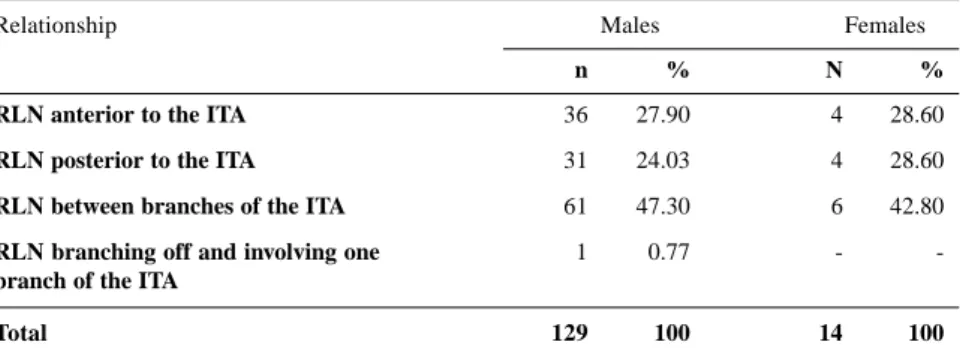
The position of the recurrent laryn-geal nerve (RLN) found in male and fe-male corpses is presented in table 1. In both sexes, the RLN lay more fre-quently between branches of the inferior thyroid artery (ITA), in 47.30% of male and 42.80% of female corpses. The available number of female corpses for
dissection was small in relation to the number of male ones. Thus, the analy-sis of the difference in the distribution of the 3 types of relationships between the RLN and the ITA between the two sexes, was not performed. In one case in a male corpse, a right RLN originated a branch before crossing the ITA and in-volved one of the branches of this ar-tery. Variations such as a non-recurrent laryngeal nerve or the absence of the ITA were not found in this study.
The relationship between the con-sidered side (right and left) and the po-sition of the RLN in relation to the ITA was analyzed (Table 2). On both sides, the RLN lay more frequently between branches of the ITA. This occurred in 49.3% of the cases on the right side and in 44.45% of the cases on the left side. There was a significant difference (p<0.05) in the distribution of the 3 types of relationships of the RLN with the ITA between the right and left sides. The possible combinations between
right and left sides found in this study were grouped (Table 3). In this study, we used only corpses in which both sides were complete, a total of 67 speci-mens. The most common combinations were: the RLN between branches of the ITA on the right and the left sides (23.88%); the RLN between branches of the ITA on the right and posterior to the artery on the left side (19.4%).
There was bilateral agreement in 37.32% of the cases (n=25). In 62.68% (n=42), the relationship found on one side did not occur again on the oppos-ing side.
DISCUSSION
Some conditions can cause recurrent laryngeal nerve (RLN) palsy15,34,41,42.
Surgical injuries produce 11 to 32% of these31,42. Some procedures that may
result in injury to the RLN are: thy-roidectomies, parathythy-roidectomies,
ex-Table 1 - Relationship between the recurrent laryngeal nerve (RLN) and the inferior
thyroid artery (ITA) in male and female corpses.
Relationship Males Females
n % N %
RLN anterior to the ITA 36 27.90 4 28.60
RLN posterior to the ITA 31 24.03 4 28.60
RLN between branches of the ITA 61 47.30 6 42.80
RLN branching off and involving one 1 0.77 -
-branch of the ITA
Total 129 100 14 100
Table 2 - Relationship between the recurrent laryngeal nerve (RLN) and the inferior
thyroid artery (ITA), considering the side of the neck.
RLN position Right side Left side Both sides
n % n % n %
Anterior to the ITA 27 38.04 13 18.05 40 27.97
Posterior to the ITA 8 11.26 27 37.05 35 24.47
Between branches of the ITA 35 49.3 32 44.45 67 46.86
RLN branching off and involving 1 1.4 - - 1 0.7
1 branch of the ITA
'%
cision of Zenker’s diverticulum, eso-phagectomies, tracheoplasties, neck dissections, correction of a patent duc-tus arteriosum, mediastinoscopy, and others11,31,42.
Thyroidectomy is the surgery in which this injury occurs most fre-quently. According to Titche42,
thy-roidectomy accounts for 35.71% of surgical causes of injury to the RLN, and accounts for 3.73% of all causes. The incidence of injury to the RLN in thyroidectomies ranges from 0 to 12%22,24,25,28,33,36,40. This injury occurs
more frequently when a branch of the ITA is inadvertently sectioned. In an attempt to achieve hemostasis, the nerve is clipped and/or separated with the arterial branch24,25,32,36,37.
Although some authors30,33 defend
the display of the RLN only in specific situations, most agree that the routine display of the RLN is essential for its protection4,14,18,21,22,24,25,28,31,36,37,39,40.
Lahey24, performing the routine display
of the RLN in 3000 cases, obtained a reduction in the incidence of injury from 1.5 to 0.3%. The same author in a subsequent work, systematically vi-sualized the nerve, in more than 3446
thyroidectomies with no injury25.
How-ever, excessive manipulation and dis-section must be avoided so the nerve is brought under visual control without risk of compromising its vasculariza-tion. To this end, the ITA functions as a fixed reference point for the location of the r.l.n.22,25,33,36. The knowledge of
the relationship between the RLN and the ITA is also important for the exte-riorization of the thyroid lobe12,37.
Reed32 described 28 different
types of relationships between the RLN and the ITA, classifying them in 3 main types. Freschi14 considered 8
possible relationships between these two structures. Most authors, beyond the classic anatomy textbooks, recog-nize 3 types of relationships between the RLN and the ITA, as fol-lows1-5,7,8,10,12,13,15,19,20,26,29,32,36,37,41,45 :
a) RLN anterior to ITA; b) RLN posterior to ITA;
c) RLN between branches of ITA.
Simon36, after the dissection of 86
nerves in 43 corpses, affirmed that the usual relationship is the one in which the RLN establishes by passing
poste-riorly the ITA. The anterior orientation of the nerve in relation to the artery was occasional, while its position be-tween the arterial branches was a rare
finding. Lahey24, based on surgical
findings, had a similar opinion. Analyzing 17 studies which re-ported this relationship, when consid-ering the both sides as a set, 16 showed that the RLN is more fre-quently located posterior to the ITA, between 39.08% to 75.58% of the time1-5,7,8,12,13,19,20,26,32,36,37,39,45.
Considering right and left sides separately, differences appear. On the left, in 15 analyzed works, 14 showed the predominance of the posterior po-sition of the nerve in relation to the ar-tery 1-5,8,12,19,20,26,32,36,37,39,45.
On the right, the variation is larger. Analyzing the same 15 works, 8 showed that the RLN passes more fre-quently between the branches of the ITA. In 5, the RLN passed posterior to the ITA in most cases, and in only 2 studies was it placed anterior to the ar-tery with higher frequency 1-5,8,12,19-20,26,32,36,37,39,45.
Flament et al.12 in France, found the
RLN between the branches of the ITA in most cases, both on the right and on the left side. In the sample presented here, we found similar results to those of the French author: the RLN lay be-tween the branches of the ITA in 46.86%, anterior to the branches in 27.97%, and posterior to the branches in 24.47% of the cases when consid-ering both sides.
On the left side, the RLN lay be-tween branches of the ITA in 44.45%, posterior in 37.05%, and anterior to the arterial branches in 18.05% of the cases. On the right, the RLN lay between branches of the ITA in 49.3%, anterior in 38.04%, and posterior in 11.26% of the cases. In 1 case, on the right, the RLN branched off before crossing the ITA, and it surrounded one of its branches. In the works in which this variation was found, it occurred from
Table 3 - Combinations of the recurrent laryngeal nerve (RLN) positions
considering both sides in the same corpse.
Position of the RLN
Right side Left side n %
Anterior to the ITA Anterior to the ITA 5 7.46
Posterior to the ITA Posterior to the ITA 4 5.97
Between branches of the ITA Between branches of the ITA 16 23.88 Anterior to the ITA Between branches of the ITA 11 16.42
Anterior to the ITA Posterior to the ITA 9 13.43
Posterior to the ITA Between branches of the ITA 1 1.5
Posterior to the ITA Anterior to the ITA 3 4.47
Between branches of the ITA Anterior to the ITA 4 5.97
Between branches of the ITA Posterior to the ITA 13 19.4 The RLN branching off and Between branches of the ITA 1 1.5 involving one branch of the ITA
Total 67 100
'&
1% to 5.4% of the cases, when consid-ering both sides3,32.
Reed32 in the U.S.A., found
differ-ent relationships on the two sides in 17% of the cases. Hirata19 in Japan,
found the same relationship on the two sides in 40% of male corpses and in 28.6% of female ones. Sturniolo39 in
Italy, found the same relationship on both the sides in 51.2% of the cases. The same author found a different re-lationship between the two sides 48.8% of the time. In the sample presented here, only in 37.32% of the cases did the orientation found on one side oc-cur again in the opposing side.
The most frequent combinations in our study were: the RLN between the branches of the ITA on the right and on the left (23.88% of the cases); and the RLN between the branches of the ITA on the right and posterior on the left (19.4% of the cases).
Hirata19 in Japan, found a
signifi-cant difference in the percentile distri-bution of the 3 types of relationships of the RLN with the ITA between the two sides. He did not find a significant difference between males and females. This author found that the difference between the two sides could be attrib-uted to the difference in the anatomi-cal course of the RLN on the right and on the left. In the present sample, the results of this analysis are similar to the ones of the Japanese author. The dif-ference between the two sides (right and left) of the orientation of the RLN in relationship to the ITA was signifi-cant. Among us, Costa et al.8 have not
found a significant difference in the re-lationship between the RLN and the ITA between the two sides.
The factors that determine these observed differences in the anatomical variations of the RLN are still not es-tablished. Pereira30 and Lages23 in
in-dependent works, when reporting cases of non-recurrent laryngeal nerve, in vivo and in a corpse respectively, em-phasized that the racial factor should
receive greater attention. Both findings had occurred in crossbred female indi-viduals, according to the authors. Steinberg et al.38 in South Africa,
dis-sected 180 nerves in 90 corpses that were not embalmed. Among the corpses, 80% were of black race, 12% were of Caucasian race, and 8% were of Asian race. The authors found, re-garding its relationship with the ITA, the RLN had divided into 2 main branches in 68% of the cases. In a small percentage, one of these branches was also subdivided. In 75% of the dissections, the branches of the RLN interdigitated with the branches of the ITA. There was no such thing as a constant relationship between these two structures.
It would be interesting to analyze the influence of racial differences on the relationship between the RLN and the ITA, based on works of different nationalities1-5,7,8,12,13,19,20,26,32,36,38,45
(Table 4), that were done primarily in populations with well-defined racial features. In those studies, which were
carried out on embalmed corpses, these racial features are frequently lost. This fact, as well as the great racial misce-genation found among us, were the reasons why this analysis was not car-ried out in the present sample. But even those works where data were obtained from corpses during autopsy, or in sur-gical cases, there is no information per-mitting a racial characterization of the samples and a rigorous evaluation of the data from this standpoint.
The idea that the RLN is more fre-quently posterior to the ITA, and moover, expecting this relationship to re-peat on both sides, gives the surgeon a false sense of security. If the nerve lies anterior to, or between the branches of the ITA, the withdrawal of the thyroid gland from its stream bed results in the withdrawal of the nerve, with injury be-ing more likely than when the nerve is posterior to the i.t.a.12,37. Understanding
of this concept is essential, especially when the surgeon must perform a total thyroidectomy. In these cases, some au-thors prefer to ligate the ITA and its
Table 4 - Relationship between the recurrent laryngeal nerve (RLN) and the inferior
thyroid artery (ITA). Results of other authors considering right and left sides together.
Author Year Country Number of RLN RLN RLN
visualized anterior posterior between nerves to the to the branches ITA(%) ITA(%) of the
ITA(%)
Fowler & Hanson13 1929 U.S.A. 400 26 65.5 8.5
Berlin4 1935 U.S.A. 140 32.14 53.57 14.29
Reed32 1943 U.S.A. 506 18.6 39.1 36.5
Bachhuber3 1943 U.S.A. 200 14.5 44 40.5
Simon36 1943 U.S.A. 86 17.44 75.58 * 6.98*
Armstrong & Hinton2 1951 U.S.A. 100 34 43 23
Bowden5 1955 U.K. 58 18.97 41.38 34.48
Wade45 1955 U.K. 200 10.5* 47.5 34.5
Hunt et al.20 1968 Australia 151 29 57 9
Skandalakis et al.37 1976 U.S.A. 204 20.6 41.6 37.3
Chang-Chien7 1980 Taiwan 100 24 56 20
Flament et al.12 1983 France • 19.45 30.2 50.35*
Al-Salihi & Dabbagh1 1989 Iraq 212 23.11 53.78 23.11
Hirata19 1992 Japan 784 18.65 46.25 35.1
Lekacos et al.26 1992 Greece 191 16 51 33
Costa et al.8 1997 Brazil 98 37.76* 39.08 22.44
Sturniolo et al.39 1999 Italy 280 31.1 43.2 25.7
Campos & Henriques 2000 Brazil 143 27.97 24.47 * 46.86
*minimum and maximum percentage value for each position.
''
branches next to glandular parenchyma, without approaching its trunk, in order not to include the RLN and at the same time, not to compromise the irrigation of the parathyroids6,40.
Therefore, the identification and vi-sual control of the RLN and the ITA, as well as the determination of their anatomical relationships, are essential principles for diminishing morbidity related to thyroidectomies.
CONCLUSIONS
On the right side in most cases, the recurrent laryngeal nerve (RLN) was
found between the branches of the in-ferior thyroid artery (ITA), followed by, in decreasing order of frequency, posi-tions anterior and posterior to the artery. On the left, the RLN was also placed more frequently between the branches of the ITA, followed by, in decreasing order of frequency, posi-tions posterior and anterior to the ITA. There was a statistically significant difference (p<0.05) in the distribution of these 3 types of relationships be-tween right and left sides.
In 62.68% of the cases, the rela-tionship found on one side did not oc-cur again on the opposing side.
Racial variations could contribute
to the explanation of the differences observed in the relationship between the RLN and the ITA.
ACKNOWLEDGEMENTS
We would like to thank Professors Ernesto Lentz de Carvalho Monteiro from the Department of Surgery, Ezequiel Rubinstein from the Depart-ment of Morfology and Geraldo Cunha Coury from the Department of Preven-tive and Social Medicine, of the Fed-eral University of Minas Gerais, for their inestimable suggestions.
RESUMO RHCFAP/3023
CAMPOS BA e col. - Relação entre o nervo laríngeo recorrente e a artéria tireóidea inferior: um estudo em cadáveres. Rev. Hosp. Clín. Fac.
Med. S Paulo 55(6):195-200,
2000.
A relação anatômica entre o nervo laríngeo recorrente (NLR) e a artéria tireóide inferior (ATI) foi estudada em 76 cadáveres formolizados, sendo oito do sexo feminino e 68 do sexo mascu-lino. Em ambos os sexos, o NLR se
colocou mais freqüentemente entre ramos da ATI, sendo encontrado nessa posição em 47,3% das vezes no sexo masculino e 42,8% das vezes no sexo feminino. À direita, o NLR foi encon-trado entre ramos da ATI em 49,3% dos casos, anteriormente em 38,04% e posteriormente em 11,26%. À es-querda, o NLR se colocou entre ramos da ATI em 44,45% das vezes, poste-riormente em 37,05% e anteposte-riormente em 18,05%. Em 62,68% das vezes a relação encontrada em um lado não se
repetiu no lado oposto, no mesmo cadáver. Houve diferença significativa (p<0,05) na distribuição dos três tipos de relação entre o NLR e a ATI, entre os lados direito e esquerdo. Variações raciais poderiam contribuir para explicar as diferenças observadas por autores de diferentes países na relação entre o NLR e a ATI.
DESCRITORES: Nervo laríngeo
recorrente. Artéria tireóide inferior. Glândula tireóidea. Tireoidectomias.
REFERENCES
1. AL-SALIHI AR & DABBAGH AW - Anatomy of the recurrent laryngeal nerve in normal Iraqis. Acta Anat 1989; 135:245-247. 2. ARMSTRONG WG & HINTON JW - Multiple divisions of the
recurrent laryngeal nerve - an anatomic study. Arch Surg 1951; 62:532-539.
3. BACHHUBER CA - Complications of thyroid surgery - anatomy of the recurrent laryngeal nerve, middle thyroid vein and inferior thyroid artery. Am J Surg 1943; 60:96-100.
4. BERLIN DD - The recurrent laryngeal nerves in total ablation of the normal thyroid gland - an anatomical and surgical study. Surg Gynecol Obstet 1935; 60:19-26.
5. BOWDEN REM - The surgical anatomy of the recurrent laryngeal nerve. Brit J Surg 1955; 43:153-163.
6. CAGNOL G, SANTINI J & DEMARD F - Anatomy of the recurrent nerve – descriptive anatomy, trajectory and relationships, variations. Acta Otorhinolaryngol Belg 1987; 41(5):821-827.
7. CHANG-CHIEN Y - Surgical anatomy and vulnerability of the recurrent laryngeal nerve. Int Surg 1980; 65(1): 23-30. 8. COSTA MAAG, CAVALCANTI JS, OLIVEIRA EL et al.
-Contribuição ao estudo das relações da artéria tireóidea inferior com o nervo laríngeo recorrente e o tronco simpático. Rev Bras Cirurgia 1997; 87(1):3-7.
9. CRILE GW - The prevention of abductor paralysis in thyroidectomy. Surg Gynecol Obstet 1929; 49:538-539.
11. EECKHAUT JVD - The recurrent laryngeal nerve. Acta Otorhinolaryngol Belg 1983; 37(3): 388-397.
12. FLAMENT JB, DELATTRE JF & PALOT JP - Les piéges anatomiques de la dissection du nerf récurrent. J Chir (Paris) 1983; 120(5): 329-333.
13. FOWLER CH & HANSON WA - Surgical anatomy of the thyroid gland with special reference to the relations of the recurrent laryngeal nerve. Surg Gynecol Obstet 1929; 49: 59-65. 14. FRESCHI G, MASI C, GRAZIANI MP et al. - Considerazioni
anatomo-chirurgiche sul nervo laringeo ricorrente in corso di tiroidectomia. Minerva Chir 1994; 49: 943-947.
15. GARDNER E, GRAY DJ & O’RAHILLY R - Anatomia: estudo regional do corpo humano. 3a. ed. Rio de Janeiro, Guanabara
Koogan, 1971.
16. GRAY SW, SKANDALAKIS JE & AKIN JT - Embryological considerations of thyroid surgery: developmental anatomy of the thyroid, parathyroids and the recurrent laryngeal nerve. Am Surg 1976; 42: 621-628.
17. HENRY JF, AUDIFFRET J & PLAN M - Le nerf laryngé inférieur non récurrent - a propos de 19 observations dont 2 du côté gauche. J Chir 1985; 122 (6-7):391-397.
18. HENRY JF, AUDIFFRET J, DENIZOT A et al. - The nonrecurrent inferior laryngeal nerve: review of 33 cases, including two on the left side. Surgery1988; 104(6): 977-984.
19. HIRATA K - Relationship between the recurrent laryngeal nerve and the inferior thyroid artery in japanese. Kaibogaku Zasshi.1992; 67(5): 634-641.
20. HUNT PS, POOLE M & REEVE TS - A reappraisal of the surgical anatomy of the thyroid and parathyroid glands. Brit J Surg 1968; 55(1):63-66.
21. KAHKY MP & WEBER RS - Complications of surgery of the thyroid and parathyroid glands. Surg Clin North Am 1993; 73(2): 307-321.
22. KARLAN MS, CATZ B, DUNKELMAN D et al. - A safe technique for thyroidectomy with complete nerve dissection and parathyroid preservation. Head Neck Surgery 1984; 6: 1014-1019. 23. LAGES L - Nervo laríngeo inferior não recurrente e artéria subclávia
direita retro-esofagiana (importância desta anomalia do ponto de vista clínico-cirúrgico). Arq Fac Nac Med 1946; 1:29-57. 24. LAHEY FH & HOOVER WB - Injuries to the recurrent laryngeal nerve
in thyroid operations. Ann Surg 1938; 108: 545-562.
25. LAHEY FH - Routine dissection and demonstration recurrent laryngeal nerve in subtotal thyroidectomy. Surg Gynecol Obstet 1938; 66: 775-777.
26. LEKACOS NL, TZARDIS PJ, SFIKAKIS PG et al. – Course of the recurrent laryngeal nerve relative to the inferior thyroid artery and the suspensory ligament of Berry. Int Surg 1992;77:287-288. 27. MANSBERGER AR & WEI JP - Surgical embryology and anatomy
of the thyroid and parathyroid glands. Surg Clin North Am 1993; 73(4): 727-746.
28. MAX MH, SCHERM M & BLAND KI - Early and late complications after thyroid operations. South Med J 1983; 76(8): 977-980.
29. MOREAU S et al. – The recurrent laryngeal nerve : related vascular anatomy. Laryngoscope 1998;108:1351-1353.
30. PEREIRA AF - Laríngeo inferior não recurrente. Rev Bras de Cirurgia 1951; 22: 347-354.
31. PREMACHANDRA DJ, RADCLIFFE GJ & STEARNS MP -Intraoperative identification of the recurrent laryngeal nerve and demonstration of its function. Laryngoscope 1990; 100:94-96. 32. REED AF - The relations of the inferior laryngeal nerve to the inferior
thyroid artery. Anatom Record 1943; 85: 17-23.
33. RIDDELL VH - Injury to recurrent laryngeal nerves during thyroidectomy - a comparison between the results of identification and non-identification in 1022 nerves exposed to risk. Lancet 1956; 2:638-641.
34. ROWE - JONES JM, LEIGHTON SEJ & ROSSWICK RP - Benign thyroid disease and vocal cord palsy. Ann R Coll Surg Eng 1993; 75(4): 241-244.
35. SANDERS I, WU BL, MU L et al. - The innervation of the human larynx. Arch Otolaryngol Head Neck Surg 1993; 119(9): 934-939. 36. SIMON MM - Recurrent laryngeal nerve in thyroid surgery - triangle for its recognition and protection. Amer J Surg 1943; 60(2): 212-220.
37. SKANDALAKIS JE, DROULIAS C, HARLAFTIS N et al. - The recurrent laryngeal nerve. Am Surg 1976; 42 : 629-634. 38. STEINBERG JL, KHANE GJ, FERNANDES CMC et al. - Anatomy
of the recurrent laryngeal nerve: a redescription. Laryngol Otol 1986; 100 : 919-927.
39. STURNIOLO G, D, ALIA C, TONANTE A et al. - The recurrent
laryngeal nerve related to thyroid surgery. Amer J Surg 1999; 177(6):485-488.
40. TCHEKMEDYIAN V, AGUIRRE C, RICCIARDI N et al. - Técnica quirúrgica en la tiroidectomía para reducir la agresión recurrencial. Cir Uruguay 1981; 51(2): 141-143.
41. TESTUT L & JACOB O - Tratado de anatomia topográfica con aplicaciones médicoquirúrgicas. 8a ed. Barcelona, Salvat Ed.
1950. [Tomo primero].
42. TITCHE LL - Causes of recurrent laryngeal nerve paralysis. Arch Otolaryngol 1976; 102 : 259-261.
43. TZINAS S, DROULIAS C, HARLAFTIS N et al. - Vascular patterns of the thyroid gland. Am Surg 1976; 42: 639-644.
44. VUILLARD P, BOUCHET A, GOUILLAT C et al. - Le nerf laryngé inférieur non récurrent - a propos de quinze cas opératoires. Bull Assoc Anat (Nancy) 1978; 62(179) : 497-505.
45. WADE JSH - Vulnerability of the recurrent laryngeal nerves at thyroidectomy. Brit J Surg 1955; 43: 164-180.
46. WAFAE N, VIEIRA MC & VOROBIEFF A - The recurrent laryngeal nerve in relation to the inferior constrictor muscle of the pharynx. Laryngoscope 1991; 101: 1091-1093.
47. WALSH J - Galen’s discovery. Ann Med History 1926; 8:176-184. apud SIMON, M M36.