1Conselho Nacional de Desenvolvimento Cientíico e Tecnológico, Programa de Pós-Graduação em Análises de Bacias e Faixas Móveis, Faculdade de Geologia,
Universidade do Estado do Rio de Janeiro – UERJ, Rio de Janeiro (RJ), Brazil. E-mail: [email protected]
2TEKTOS Grupo de Pesquisas em Geotectônica, Faculdade de Geologia, Universidade do Estado do Rio de Janeiro – UERJ, Rio de Janeiro (RJ), Brazil. E-mail:[email protected]
3
Instituto de Geocronología y Geología Isotópica, Universidad de Buenos Aires, Buenos Aires, Argentina. E-mail: [email protected] 4Votorantim Metais LTDA., São Paulo (SP), Brazil. E-mail: [email protected]
5Universidad Nacional del Comahue – UNCOMA, Buenos Aires, Argentina. E-mail: [email protected]
*Corresponding author.
Manuscript ID: 20160052. Received in: 04/12/2016. Approved in: 06/20/2016. ABSTRACT: Two regional thrust-sheets of Neoproterozoic me-tasedimentary rocks occur in the Southern Brasília Belt, northwest Minas Gerais. he lower one comprises the Vazante Group, that is formed in the studied area, from base to top, by the Serra do Garrote (metapelites interlayered with carbonaceous phyllite), Serra do Poço Verde (beige to pink stromatolitic metadolomite with interlayered greenish slates), Morro do Calcário (gray stromatolitic metadolomite interlayered with gray slates) and Serra da Lapa (phyllite with dola-renitic lenses interlayered with slates) formations. he upper thrust sheet consists of the Canastra Group (Paracatu formation): laminated sericite phyllites and carbonaceous phyllites interlayered with quart-zite. he Braziliano orogeny resulted in four phases of contractional deformation, associated with low-grade metamorphism. he irst two (D1 and D2) are ductile, while the third and fourth ones (D3 and D4) are brittle-ductile. D1 developed a slaty S1 cleavage subparallel to the primary layering, with shallow to steep dips to NW. D2 developed a crenulation cleavage (S2) that dips moderately to NW and is associa-ted with tight to isoclinal folds. D3 and D4 phases developed crenula-tions and open folds and kink bands. S3 dips steeply to NW, while S4 has moderate to steep dips to NE and SW. White mica crystallinity (Kübler index) measurements in metapelites indicate that both the Canastra and Vazante groups reached anchizone/epizone conditions, and metamorphic discontinuities along thrusts indicate that the peak of metamorphism is pre or syn-thrusting.
KEYWORDS: Neoproterozoic, Zinc-Lead, X-Ray Difraction, hrust-fold Belt.
RESUMO: O contato do empurrão dos grupos Canastra e Vazante na Faixa Brasília Meridional: evolução estrutural, cristalinidade de mica branca e impli-cações para a orogenia brasiliana. Duas escamas de cavalgamentos regionais de ro-chas metassedimentares neoproterozoicas ocorrem na Faixa Brasília Meridional, em Minas Gerais. A inferior compreende o Grupo Vazante, que na área de estudos é formado da base para o topo, pelas formações Serra do Garrote (metasiltitos e ilitos carbonosos intercalados), Serra do Poço Verde (metadolomitos estromatolíti-cos bege a rosados com intercalações de ardósias e margas esverdeadas), Morro do Calcário (metadolomitos estromatolíticos cinza com intercalações de ardósias cinza) e Serra da Lapa (metarritmitos carbonosos com lentes de dolarenitos). A escama superior é composta do Grupo Canastra (formação Paracatu): sericita ilitos laminados e ilitos carbonosos com intercalações de quartzitos. A deformação resultou em quatro fases de deformação compressivas, contemporâneas ao meta-morismo de baixo grau. D1 e D2 são de caráter dúctil, enquanto D3 e D4 são de regime rúptil-dúctil. D1 foi responsável pela clivagem ardosiana S1 subparalela ao acamamento sedimentar, com mergulhos baixos a altos para NW. D2 desen-volveu clivagem de crenulação (S2) que mergulha moderadamente para NW e está associada a dobras apertadas a isoclinais. D3 e D4 desenvolveram crenulações espaçadas e dobras abertas com kinks associadas. S3 apresenta eixos para NW, e S4, eixos para NE e SW, ambas com caimento moderados a altos. Medições por cristalinidade de mica branca (índice de Kübler) sugerem que os grupos Canas-tra e Vazante alcançaram condições de anquizona/epizona, e descontinuidades metamóricas ao longo dos planos de cavalgamento indicam que o pico metamórf-ico é anterior ou contemporâneo à tectônica de cavalgamento.
PALAVRAS-CHAVE: Neoproterozoico, Chumbo-zinco, Difração de raios X, Cinturão de dobramentos e cavalgamentos.
The thrust contact between the Canastra and
Vazante groups in the Southern Brasília Belt:
structural evolution, white mica crystallinity
and implications for the Brasiliano orogeny
O contato do empurrão dos grupos Canastra e Vazante na Faixa
Brasília Meridional: evolução estrutural, cristalinidade de mica
branca e implicações para a Orogenia Brasiliana
Manuela de Oliveira Carvalho1*, Claudio de Morisson Valeriano2,
Pamela Alejandra Aparicio González3, Gustavo Diniz Oliveira4, Agnes Impiccini5
INTRODUCTION
Since the discovery of zinc deposits within the Vazante Group metasedimentary rocks, in the early 20th century,
several structural and petrological studies have been carried out in this external portion of the Southern Brasília Belt (Figs. 1A and 1B), located in northwest Minas Gerais State (Dardenne 2000, Valeriano et al. 2004, 2008).
The Vazante Mine — with presently total assets of 40–60 Mt to 20% Zn — is the world’s largest deposit of hydrothermal nonsulfide zinc (willemite), and it is operated by Votorantim Metais (Baia 2013). The zinc ores are associated with a steeply dipping fault of NE–SW strike direction, the Vazante Fault, and are hosted in the metadolomitic rocks of the Vazante Group, which are in contact with the metapelitic rocks of the Canastra Group.
Granite-gneiss-greenstone basement
Legend for igures B and C
Neoproterozoic
Granulites Bambuí Group Ibiá Group Araxá Group
Meso/Neoproterozoic
Vazante Group
Serra da Lapa formation
Morro do Calcário and Serra
do Poço Verde formation Serra do Garrote formation
Paranoá Group
Canastra Group Paracatu formation
Serra do Landim formation
Paleo/Neoproterozoic
Araí Group
Serra da Mesa Group
Maic and ultramaic complexes Vulcanosedimentary sequences Archean/Paleoproterozoic
A
C
B
47ºN 45ºN
16ºS
Figure 1. Geological location of the study area. (A) Tectonic provinces of the South American platform (Dardenne 2000) with the Brasília Belt in black; (B) Southern Brasília Belt with location of the Paracatu–Vazante zone, of the study area (red rectangle) and of samples analyzed by Campos et al. (2015) in red circles; (C) geological map of the Vazante Group (Monteiro et al. 2006), with location of the boreholes in Vazante, Ambrósio and Fagundes areas (red dots).
he Vazante deposit (Fig. 1C) is part of an important belt of mineral deposits hosted by low-grade metasedimentary rocks of the external Brasília Belt, which also includes the Morro Agudo, Ambrósio and Fagundes lead and phosphate deposits, and the Morro do Ouro gold mine (Pinho 1990, Monteiro 2002, Monteiro et al. 2006, Diniz-Oliveira 2013, Slezak et al. 2014)
In this region (Fig. 1), the main geological feature is the thrust contact between the phyllites and quartzites of the Canastra Group and the underlying metapelites and dolo-mitic rocks of the Vazante Group (Dardenne 2000). Over the years, many proposals on the hierarchy of the deformation phases in the Southern Brasília Belt have been discussed (Campos Neto 1984a, Pinho et al. 1989, 1990, Pinho 1990, Pereira 1992, Pinho & Dardenne 1993, Rostirolla et al. 2002), and will be detailed further in this work. In addition, new knowledge (Campos et al. 2015) related to the metamorphic conditions was accepted by recent studies of X-ray difrac-tion (XRD) in the rocks from the Canastra Group, located in Distrito Federal and Goiás state (Fig. 1B).
Despite those studies, there still are many uncertainties about the geological history of stratigraphic and tectonic evo-lution of the host metasedimentary basin of the mineraliza-tion, especially the Canastra and Vazante groups. his study aimed to characterize in more detail the petrography and structural evolution of the important contact zone between the Canastra and Vazante groups surrounding the Vazante mine area. An area of 400 km2 was mapped at the scale of
1:100,000 in conjunction with structural analysis and petro-graphic characterization, with the objective to compare the tectonic evolution of these two important lithostratigraphic units (Carvalho 2013, 2015, Carvalho et al. 2014, 2015, González et al. 2014).
White mica crystallinity determinations by XRD (Yang & Hesse 1991, Verdecchia et al. 2011) were car-ried out in metapelites (slates and phyllites) in order to better characterize the degree of regional metamorphism, and whether any of the mapped thrust surfaces constitute important metamorphic discontinuities.
GEOLOGICAL SETTING
he Brasília Belt (Fig. 1B) is one of the most import-ant geotectonic domains of Central Brazil and it is a thrust-fault complex of Neoproterozoic passive margin metasedimentary successions that were thrusted eastward against the western margin of the São Francisco Craton (Dardenne 2000, Valeriano et al. 2004, 2008), during the Brasiliano Neoproterozoic orogenic collage of the Gondwana supercontinent (Almeida 1967, Almeida & Hasui 1984,
Neves et al. 1990), with the convergence of the Amazon, São Francisco and Paranapanema paleocontinental blocks (Almeida 1977, 1981, Neves et al. 1999, Dardenne 2000, Valeriano et al. 2004, 2008).
he Brasília Belt consists of (Figs. 1A and 1B): a gran-ite-greenstone-gneiss basement (Freitas-Silva 1996); the Goiás Magmatic Arc; the Goiás Massif; the Northern Brasília Belt (NE orientation), formed by Araí, Serra da Mesa and Paranoá groups and the Palmeirópolis, Juscelândia and Indaianópolis volcano-sedimentary sequences (Valeriano et al. 2004); and the Southern Brasília Belt (NW orientation), whose alloch-thones portion consists of tectonic stacking of stratigraphic terranes related to Araxá, Ibiá (Fernandes et al. 2014), Canastra, Vazante and Bambuí groups.
he Southern Brasília Belt shows a general increase in deformation and metamorphism from the cratonic zone to west, ranging from anchimetamorphic sediments in the former area to granulite facies rocks in the upper-most allochthons.
Studies dealing with the tectonic evolution of the Southern Brasília Belt in the Passos Nappe segment, south of the study area, indicate an inverted metamorphic zona-tion caused by a deleczona-tion of isotherms in a subduczona-tion zone setting and continuous non-coaxial shear expul-sion of high-pressure rocks towards shallow crustal lev-els (Simões 1995), on top of the external thrust-fold belt of low-metamorphic grade. Biotite-bearing phyllites and schists occur along the base of the Passos Nappe, whereas the metapelitic rocks of the underlying thrust-fold belt are slates and phyllites of lower-metamorphic grade indicated by quartz-chlorite-white mica assemblages (Simões 1995, Valeriano et al. 2000).
he metamorphic peak in the upper Passos Nappe is pre or syn D2 and occurred about 630 Ma (Seer & Dardenne 2000), followed by a retrogressive metamorphic event during nappe exhumation at ~610 Ma (Valeriano et al. 2004). he youngest K-Ar cooling on white mica around 600 Ma in the Passos Nappe, and around 590 Ma in the external thrust-fold domain (Valeriano et al. 2000), provides a time limit for the thrust stacking in the Southern Brasília Belt. he deformational evolution of the Brasília Belt is con-sensually polyphased, involving early sin-metamorphic low-angle nappe emplacement followed by later folding and faulting at shallower crustal levels.
associations indicate a late-D2 retrogressive event associated by those authors as related to nappe exhumation.
In the underlying low-metamorphic grade thrust-fold belt, geometric models for the deformational evolution of Ibiá, Canastra and Vazante groups vary among sev-eral previous studies, but gensev-erally with a similar over-all history involving early thrusting and late folding and faulting. Campos Neto (1984a) distinguished between seven phases of deformation in the Canastra and Vazante group rocks, north of the study area: the irst two are ductile and related to the orogenic paroxysmal period with SW folding; the following three are also ductile, but related to a late period, respectively, of thrust-sheets parallel to the principal structures, NW and NE folding; and the last two are brittle-ductile, involving E–W fold-ing and transverse faultfold-ing. Pinho et al. (1989, 1990), Pereira (1992) and Pinho and Dardenne (1993) deined only two deformation phases in the Canastra Group near Coromandel town, south of the study area: a irst one of regional character related to shear zones and thrust belts that were responsible for the formation of the main pen-etrative foliation parallel to subparallel to primary lay-ering; and a second one limited to kink bands, tension gashes and crenulations.
Two previous studies were performed around the Vazante Fault, within the study area of Vazante Group rocks. Pinho (1990) diferentiated between four phases of deformation: the irst two related with heterogeneous, brit-tle-ductile simple shear zones in progressive ductile regime; a third compressional phase characterized by reverse faults in ductile-brittle regime; and a last, extensional phase. Rostirolla et al. (2002), however, reported ive deformation phases: the irst two formed by heterogeneous brittle-ductile simple shear in a progressive ductile regime, the third one producing a ductile-brittle sinistral transcurrent pattern, and the last two developed under an extensional regime, with development of tension gashes.
Both the Canastra and Vazante groups were depos-ited in the context of the Meso to Neoproterozoic pas-sive margin basin along the southwestern margin of the São Francisco Craton, during the break-up of the São Francisco–Congo craton by west-directed subduction and consumption at 900–950 Ma (Neves et al. 1996). he main structural deformation and metamorphic grade occurred at 650–610 Ma, during the Brasiliano orogeny (Pimentel & Fuck 1992).
XRD studies by Campos et al. (2015) have shown that the rocks of the Canastra Group located in Distrito Federal and Goiás state (Fig. 1B) are composed of quartz and mus-covite with Kübler Index (KI) Full Width Half Maximum (FWHM) values ranging from 0.09 to 0.14°Δ2θ for fractions
of less than 2 µm, and from 0.30 to 0.37°Δ2θ for fractions of less than 0.2 µm. hese values, although not corrected accord-ing to the methods proposed by Warr & Rice (1994), indi-cate epizone metamorphism, while underlying rocks from the Bambuí and Paranoá groups exhibit Kübler index val-ues within the transition between diagenesis-anchizone and anchizone-epizone. here is no metamorphic data available from the Vazante Group, but, as for the Canastra Group, it is considered to be of very low-metamorphic grade.
Canastra Group
he Canastra Group succession is regarded as a regres-sive megacycle that grades from continental shelf facies dominated by currents, and shallow platform facies dom-inated by storms. he Canastra Group consists of alterna-tions of quartzite and carbonaceous phyllite with lateral and vertical gradations (Pinho & Dardenne 1993) and sub-ordinate carbonate facies. It is divided, from base to top, into the following formations (Freitas-Silva 1991, 1996, Campos Neto 1984b, Dardenne 2000): Serra do Landim (greenish calc-phyllite and calc-schist); Paracatu (carbona-ceous phyllite rich in organic matter and pyrite interlay-ered with white quartzite); and Chapada dos Pilões (regular intercalations of phyllite rich in organic matter and pyrite and quartzite on base and top).
U-Pb ages of detrital zircons from quartzites of the Canastra Group indicate a cratonic (Paleoproterozoic to Archean) provenance with subordinate Mesoproterozoic (possibly anorogenic) zircons of 1.2 to 1.5 Ga (Valeriano et al. 2004, Rodrigues 2008). Nd model ages of metapelitic rocks from this unit between 1.90 Ga and 2.34 Ga also support cra-tonic sources (Pimentel et al. 2001, 2011).
Vazante Group
metadolomite associated with oolitic and oncolytic lime-stones; and Serra da Lapa Formation — consisting of car-bonaceous phyllite with metasiltstones, metadolomite lenses and minor quartzite levels.
The Vazante Group age of sedimentation is dated between 1.35 and 0.95 Ga based on its stromatolite associ-ations (Dardenne 2005, Dardenne et al. 2005), 1.1–1.0 Ga according to Re–Os ages (Azmy et al. 2008), and detrital zircon U-Pb ages (Rodrigues 2008, Rodrigues et al. 2012), indicating a sedimentation age younger than 935±14 Ma.
METHODS
Field and petrographic studies
he ield studies involved detailed geological mapping of an area of 400 km2 with characterization of the
lithostrati-graphic units of the thrust-contact between the Canastra and Vazante groups, and the geometry and superposition of deformational phases. his characterization was associated with petrographic examination of thin sections of selected samples of both units.
White mica crystallinity studies
by X-ray diffraction analysis
Whole-rock white mica crystallinity by XRD analy-ses were carried out in the Centro de Investigaciones de Minerales Arcillosos (CIMAr) of the Universidad Nacional del Comahue, Argentina, for the measurement of KI of metapelites of the Canastra and Vazante groups.
Whole rock and clay minerals were identiied using a Rigaku DMAX-2D difractometer, employing Cu radiation, with a step size of 0.05º2θ and scanning speed of 0.01º/ min, at 40 kV and 20 mA. he preparations of the total rocks were scanned from 3º a 65º2θ, and the clay minerals (< 2 μm) were scanned from 40º2θ a 2º2θ. Clay-size fraction (< 2 μm) samples for XRD analysis were prepared follow-ing the recommendations of Moore and Reynolds (1997). A < 2 μm fraction, assumed to be representative of the neo-formed and transformed phases and conventionally used for main crystallographic index measurements, was separated from 10 metapelite samples. Clay-mineral com-position was established by the comparison of orientated aggregates that were air-dried (AD), ethylene-glycol solvated (EG; 24 hours), and heated at 500ºC (H500; 4 hours).
he XRD relections were evaluated with the Rigaku software. Quantitative analyzes of the clays were performed following the mineral intensity factor method described by Moore and Reynolds (1997). For quantitative estimation of phyllosilicate, the NEWMOD III program was used. he
KI (Kübler 1968, Kish 1991) was measured in the white mica (001 crystallographic plane) relection by the FWHM parameter of program, in AD oriented clay mineral aggregates. Crystallinity Index Standard (CIS) and KI values (Warr & Rice 1994) were established from the regression equations (1.0316x + 0.0781, R 2: 0.9945) for the difrac-tometers employed.
he interpretation of KI for diagenesis and metamor-phism is using the following boundaries for 0.25 and 0.42ºΔ2θ: more than 0.42º is diagenetic zone; between 0.25º and 0.42º the anchizone; and below 0.25º the epi-zone (Campos et al. 2015).
RESULTS
Lithostratigraphic units
he geologic map of the study area (Fig. 2) shows that the Canastra and Vazante Group rocks are in thrust contact, and therefore represent two tectonic terranes with distinct lithological and deformational characteristics. he Canastra Group, within the studied area, is represented only by the Paracatu formation quartzites and phyllites, thrusted over the carbonatic-pelitic rocks of the Vazante Group, represented by four units (from base to top): Serra do Garrote, Serra do Poço Verde, Morro do Calcário and Serra da Lapa formations (Figs. 2 and 3).
Canastra group
he local apparent thickness of the Canastra Group is 800 m, of which 600 m are quartz-sericite phyllite inter-layered with carbonaceous quartzite and 200 m are lami-nated slates (Fig. 3).
he quartz-sericite phyllite is a ine grained carbonaceous rock of gray color, with millimeter-thick quartzite lenses. he mineralogy consists of quartz, plagioclase, K-feldspar, white mica, chlorite and anhedral opaque minerals, and detrital zircon and tourmaline (Fig. 4A).
Pure or impure quartzites displays white color, medium to coarse grained quartz and subordinate plagioclase, white mica, chlorite and opaque minerals (pyrite and magnetite). Metamorphic textures show evidence of dynamic recrystal-lization (Figs. 4B and 4C) locally with polygonal grains.
he laminated slates exhibit very ine to ine grain size, with green and gray or purple color with some carbonaceous material, containing ine to medium-grained impure mus-covitic quartzite lenses.
Vazante group
(1,000 m), Serra do Poço Verde formation (800 m), Morro do Calcário formation (700 m) and Serra da Lapa forma-tion (900 m). hese units are briely described ahead, from bottom to top.
Serra do Garrote formation
This unit is predominantly composed of black car-bonaceous laminated slates of fine to medium grain size with quartz, feldspar (submillimeter plagioclase with sericitization and chloritization), white mica and anhe-dral opaque minerals. The metamorphic texture is lepi-doblastic, and primary layering is still locally preserved as differences in grain size and composition, with two distinct lithofacies: laminated metasiltstones and lami-nated metamudstone, containing millimeter- to centi-meter-thick levels of metasandstones and metasiltstones.
Serra do Poço Verde Formation
he Serra do Poço Verde formation consists of a metadolo-mitic sequence formed by: stromatolitic intensely recrystallized
gray metadolomites; beige to pink metadolomites with barite nodules interlayered with greenish metapelites, locally with mud-cracks, and stromatolitic beige metadolomites. he lamination is locally preserved as microbial/algal mats (Figs. 4D and 4E) and bird’s eyes, oncolytic marble, metasandstone lenses and intraclastic breccia intercalations occur in all of these rocks.
Morro do Calcário formation
he metadolomites of the Morro do Calcário formation dis-play bluish-gray colors and coarse grain size, with siliciication features represented by chert. Algal mat structure is locally pre-served, which reveals the primary layering of the rock. hey are interpreted as dolostone with carbonate cementation or bound-stones involving aggregation of ooids and peloids (Fig. 4F).
The gray slate intercalations have bluish-gray color, slaty texture with presence of impure ine metasandstones lenses. he particle size is ine with angular and rounded clasts, locally tectonically stretched. Mineralogy is given by sub-milimetric quartz, white mica (sericite) and chlorite, as well as anhedral opaque minerals.
292,000
292,000 296,000 300,000 304,000 308,000 312,000 316,000 296,000 300,000 304,000 308,000 312,000 316,000
8,024,000
8,020,000
8,016,000
8,012,000
8,008,000
w E
8,004,000
8,024,000
8,020,000
8,016,000
8,012,000
8,008,000
8,004,000
S2
S3
S3
W E
1,000 500
0
Vazant Fault
Legend
Canastra Group/Paracatu formation Laminated slates
Quartz-sericite carbonaceous phyllite interlayered with quartzite
Vazante Group
Serra da Lapa formation Carbonaceous metarhythmite, marble and sericite
phyllite with dolosandstone lenses
Morro do Calcário formation Gray stromatolitic metadolomite interlayered with gray slates
Serra do Poço Verde formation Gray and pink stromatolitic metadolomite interlayered with greenish metapelite and marble with mudcracks
Serra do Garrote formation Matasiltstone
Black carbonaceous phyllite with quartzite lenses
Bambuí Group
Inferred contact Normal fault Thrust-fault Vazante normal fault Sinformal fold-trace Anticline recumbent fold-trace Syncline recumbent fold-trace Slaty cleavage (S0 // S1)
Spaced cleavage (S2) / intersection lineation (L2)
Crenulation cleavage (S3) / lineation (L3)
Crenulation cleavage (S4) / lineation (L4)
Geological section S3
Serra da Lapa formation
he top unit of the local Vazante group is the Serra da Lapa formation, represented by metarhythmites and sericite phyllites with carbonaceous quartzite lenses.
hree lithofacies were described by Carvalho (2013) in the Barrocão Synform area (Fig. 5): marble with millimet-ric to centimetmillimet-ric levels of ine to medium quartzite and milimetric levels of metapelite (Fig. 4G), sericite phyllite
S S FS MS CS C
V
azante Group
Canastra Group
P
aracatu f
ormation
Serra do Garrote
formation
Serra do P
oço
V
erde f
ormation
Morro do Calcário
formation
Serra da Lapa formation
Quartz-sericite carbonaceous phyllite interlayered with quartzite lenses with laminated slates on top
Carbonaceous laminated and
stratiied metarhythmite
Gray and pink stromatolitic metadolomite with algal mats, dolosandstones lenses, intraformational gaps and barite nodules interlayered with greenish metapelites and marbles with mudcracks
Gray laminated and siliciicated stromatolitic
metadolomite interlayered with gray slates
Black carbonaceous phyllite with quartzite lenses
0 200 400 m
Figure 3. Lithostratigraphic column of the studied lithological units (modiied from Carvalho et al. 2014).
500 µm
(1)
S2
500 µm
500 µm (3)
(2)
500 µm
500 µm
(4)
500 µm
500 µm
(5)
(4)
500 µm
(6)
(6)
Figure 4. Petrographic features of Canastra and Vazante Group rocks (Carvalho 2013, Carvalho et al. 2014): (A) quartz-sericite carbonaceous phyllite with D2 crystal orientation with quartz, white mica, plagioclase and opaque minerals grains, as well as zircon. The quartz grains present oblique extinction and serrated edges; (B) impure quartzite consisting of quartz, white mica and opaque minerals; (C) quartzite composed by quartz and white mica. Some iron oxide material is observed; (D) black carbonaceous laminated phyllite with primary layering (S0) separating layers with distinct grain size and some layers with algal mats growth; (E) dolosandstone lenses in black carbonaceous laminated phyllite, with contact between preserved lamination and granular carbonate domain; (F) stromatolitic metadolomite with lithic fragments formed by quartz, white mica, plagioclase, carbonate and opaque minerals; (G) greenish marble with primary layering (S0) separating layers with distinct grain size. It is possible to determine grains of quartz, white mica, carbonate and opaque minerals; (H) black carbonaceous laminated phyllite showing S2 foliation.
A
C
E
G
B
D
F
H
S3
S3
S3 S
3
S4
296,000 300,000 304,000
296,000 300,000 304,000
8,024,000
8,020,000
8,016,000
8,024,000
8,020,000
8,016,000
A B
A (m)
1,000
0
B
Legend
Canastra Group/Paracatu formation Laminated slates
Quartz-sericite carbonaceous phyllite interlayered with quartzite
Vazante Group
Serra da Lapa formation
Carbonaceous limestones
Sericite phyllite
Marble
Morro do Calcário formation
Gray stromatolitic metadolomite interlayered with gray slates
Structure
Roads Inferred contact Normal fault Normal fault with hidrotermal breccia Thrust-fault Thrust-fault with hidrotermal breccia
Sincline fold-trace S0 // S1
292,000 300,000 308,000 316,000
292,000 300,000 308,000 316,000
8,020,000
W E
8,012,000
8,004,000
8,020,000
8,012,000
8,004,000
Figure 5. (A) Geological map; and (B) section of the Barrocão synform area (modiied from Carvalho 2013). (Fig. 4H), and carbonaceous metapelites with
metasilt-stone lenses (Fig. 4D).
Deformational evolution of the Canastra
and Vazante groups
he dominant structural style of the external zones of the Southern Brasília Belt is characterized by complex struc-tures related to regional ductile tectonics developed under low-grade metamorphism, generated by thrust-faults with general eastward tectonic transport direction. In the study area, one of these major thrust zones resulted in the juxtapo-sition of the Canastra Group rocks over those of the Vazante Group. he existence of this thrust is supported in the pres-ent work by detailed mapping of the Barrocão Synform area (Fig. 2), where the basal contact of Canastra Group rocks truncates underlying contacts within Vazante Group rocks. Based on geometric style, orientation and super-imposition of folds and associated (or absence of )
foliations and lineations, four deformation phases were recognized (Figs. 6 and 7), two pre- or syn-metamor-phic phases with development of penetrative foliations, and two post-metamorphic phases with the develop-ment of crenulation cleavages superimposed over the previous two.
he four documented deformation phases in the stud-ied area (Fig. 7) are a S1 slaty cleavage, which is diicult to
diferentiate from the primary bedding (S0); a S2 crenula-tion cleavage, with associated L2 intersection and stretching
S2
// S
1
// S
0
Deformational
phases Structure
Structure descriptions
Equal Area projections
lower hemisphere Diagrams
D1
D2
D3
D4
S1
// S
0 Slaty cleavage
generally observed parallel to the primary layering
S0 (n = 222)
S2
and L
2
(S2
// S
1
// S
0
)
(S2
oblique to S
1
// S
0
)
Crenulation cleavage related to tight folds and isoclinal folds with
two diferent lienations, one of
intersection and other of stretching.
This cleavage is, sometimes, sub-parallel or highly oblique
to S1 // S2 S
2 (n = 514) L2 (n = 111)
S1
// S
0
N
Li
S2
S2
S3
and L
3 Crenulation
cleavage and lineation with open folds and kink bands
S3 (n = 63) L3 (n = 84)
S2
// S
1
// S
0 L
3
S3 N
S4
and L
4 Crenulation
cleavage and lineation with
open folds
S4 (n = 32) L4 (n = 67)
N
L4
S4
lineation, both associated with tight to isoclinal folds with low-angle axial planes; D3 and D4 involved the formation of gentle to open folds with kink bands and crenulations,
characteristically without the development of axial plane pen-etrative foliations; and fractures and quartz veins are observed with the same direction of the D3 and D4 fold axial planes.
W E
S2 S3
S1 // S0
500 µm
S2
500 µm
S2
S2 S3 or S4
S1 // S0
500 µm
500 µm
S2
E W
S4
S1 // S0
NW SE
S3
S2 // S1 // S0
NW SE
S2 // S1 // S0 S3
A
C
E
G
B
D
F
H
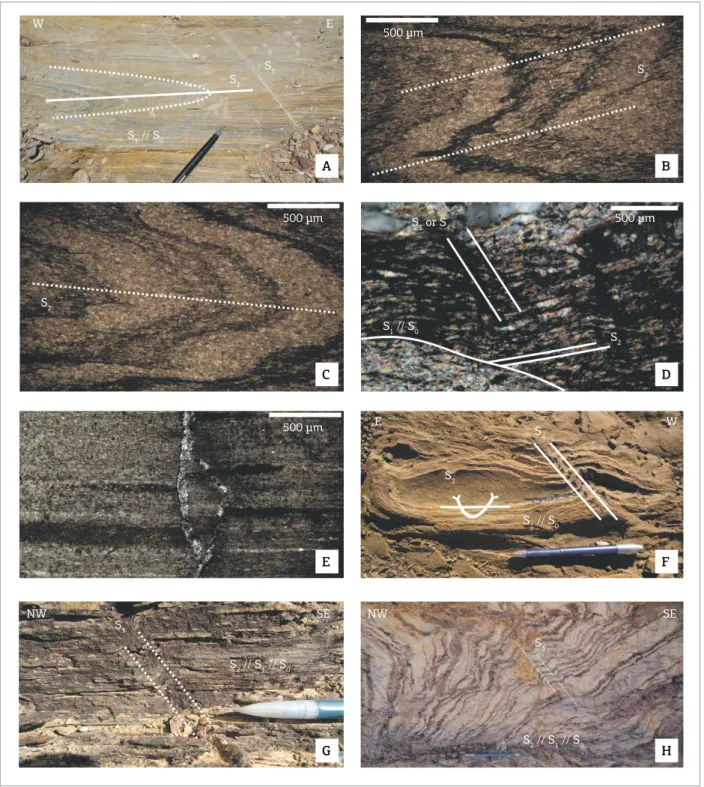
Figure 7. Common structural features of Vazante and Canastra Group rocks (Carvalho 2013, Carvalho et al. 2014): (A) carbonaceous metarhythmite from the Serra da Lapa formation with D2 isoclinal fold afecting S1–S0, superimposed by D3 kink band; (B) photomicrograph (crossed polars) of Canastra Group slate showing D2 isoclinal
folds afecting S1–S0, superimposed by D3 or D4 gentle crenulation; (C) photomicrograph (crossed polars) of Canastra Group slate showing D2 isoclinal folds afecting S1–S0; (D) photomicrograph (crossed polars) with D3 or D4 folds on S2 oblique to S1 // S0; (E) photomicrograph (crossed polars) of grey slates from Morro do Calcário formation with quartz
vein illing a fault displacing S1 // S0; (F) Canastra Group quartzite outcrop with D4 folds superimposed on D2 folds;
■ D1: the irst (D1) deformation phase is essentially observed as a penetrative slaty cleavage (S1), marked by the pref-erential orientation of phyllosilicates. As described by previous studies related to the Brasília Belt units, the S1 cleavage in the study area is only clearly identiied in S2 fold hinges, where S1 parallel to the primary layering (S0) is cross-cut by the S2 foliation (Figs. 7A, 7B and 7C). he S1 (// S0) foliation generally dips gently to WNW direction with maximum attitude of 290/22, and with a secondary concentration that dips to the opposite direc-tion (Fig. 6). No lineadirec-tion was noticed associated with S1 foliation, possibly due to the strong overprint by the D2 main deformation phase;
■ D2: the second (D2) deformation phase was respon-sible for the development of intense tight to isocli-nal folding and the main penetrative axial planar S2 foliation, and associated stretching and intersection (S2 x S1 // S0) L2 lineations. The S2 foliation predom-inantly dips moderately to NW (Fig. 6). Under the microscope, S2 is generally observed as a crenulation cleavage near D2 fold hinge zones or as an oblique foliation with respect to S0 //S1 in fold limbs. In thin sections (Figs. 7B, 7C and 7D), the S2 foliation is conspicuous in almost all rock types, except in the metadolomites, and is defined by preferred orien-tation of phyllosilicates, quartz, and platy opaque grains (Figs. 7D and 7E). D2 deformation is com-monly associated with undulose extinction of quartz grains, and dynamic recrystallization textures with polycrystalline quartz with irregular serrate boundar-ies. Sericite and chlorite recrystallization and growth were also observed. An intersection (L2) lineation, representing the axes of D2 folds, shows a large dis-persal of orientation, but with predominant low to intermediate plunges to the NW. An L2 stretch-ing lineation follows the same range of orientation (Figs. 7A, 7F, 7G and 7H);
■ D3 and D4 deformation phases: they are respon-sible for the development of open folding, gen-erally without the development of any pervasive axial plane foliation. These structures heteroge-neously overprinted the previous D1 and D2 struc-tures (Figs. 7D, 7E, 7F and 7G). D3 and D4 folds are both characteristically concentric, frequently with angular style, associated with small scale kink bands. D3 and D4 are only differentiated by orien-tation, since many outcrops display the overprint of both fold generation. D3 folds have gently plung-ing axes (and L3 crenulation lineation) with NW– SE direction. D4 folds and crenulations also show gently plunging axes (and L4 crenulation lineation),
but with predominant NE–SW orientation. Folds of both deformation phases display steep to sub-vertical axial planes (Figs. 7D, 7E, 7F and 7G). Fractures, tabular quartz veins and tension gashes are verified with the same direction of the D3 and D4 folds axial planes, locally closely spaced. Some normal faults were also observed with the same direction of the D3 axial planes, generally dipping 60º–75º to NE, SE or SW.
Although the Vazante Fault was not studied here, this structure is important because it hosts the largest silicate zinc-lead deposit in the world, related to tectonic-hydrothermal activity near the contact between lower Pamplona and upper Morro do Pinheiro members, metadolomites of the Serra do Poço Verde formation, Vazante Group (Dardenne 2000, Appold & Monteiro 2009). It dips ~60–70º NW with N40–50E strike, parallel to regional geologic contacts. he Vazante fault is considered as an extensional structure by most authors, but with still unclear relationships with the timing of orogeny (Pinho 1990, Diniz-Oliveira 2013, Slezak et al. 2014).
One of the main D3 structures in the studied area, named in this work as the Barrocão synform (Fig. 5), is a sub-ver-tical synformal fold with NW-trending axis that occurs in approximately 30 km2 of the total mapped area. he
ori-entation of this structure, which also folds several thrust surfaces, is coincident with the average orientation of D3 crenulation lineation (Fig. 6), and is related to post-thrust-ing shortenpost-thrust-ing.
White mica crystallinity studies by
X-ray diffraction analysis
Ten samples (Tab. 1) from three drill holes in Vazante, Paracatu and Fagundes (Minas Gerais) areas (Fig. 1C) were collected for white mica crystallinity studies by XRD anal-ysis (Gonzalez et al. 2014), aiming to detect a diference in metamorphic grade between the Canastra and Vazante thrust-sheets.
Eight samples from the Vazante Group consist of car-bonaceous phyllites from the Serra da Lapa (three samples) and Serra do Garrote (three samples) formations and two samples of metadolomites from the Morro do Calcário formation. Two slate samples from the Serra do Landim formation, Canastra Group, were also analyzed.
plagioclase, K-feldspar and carbonate, as observed in thin sections.
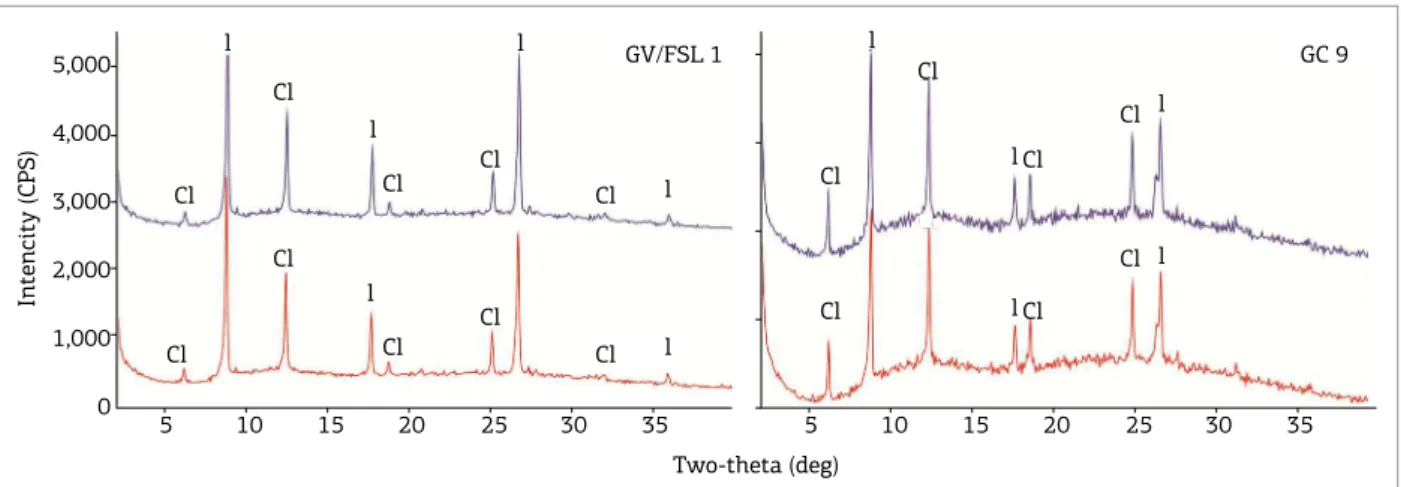
he FWHM KI for white mica varies from 0.15 to 0.21 Δº2θ, and the KICIS varies from 0.23 to 0.29 Δº2θ (Fig. 9). Values between 0.23 and 0.29 ∆º2θ suggest temperatures between 250 and 300ºC. In an average continental geo-thermal gradient of 30ºC/km, they would result in cal-culated depths of about 10 km. he measured KI results indicate a very low-grade metamorphism, in high anchi-zone to lower epianchi-zone conditions.
Only one episode of clay mineral growth in the rocks analyzed from Canastra and Vazante groups were reported by the white mica crystallinity data, which is coincident, respectively, with the phyllosilicates crystallization on the S2 foliation.
DISCUSSION
Four phases of superimposed compressive deformation are geometrically characterized in the study area. he irst two (D1 and D2) occurred in the ductile regime with the development of penetrative foliations associated with folds generated during the development of low-angle thrust-faults that afected the Canastra Group rocks. his contractional event, related to the peak activity of the Brasiliano orogeny, was also responsible for the low-grade metamorphism that originated phyllites and slates with growth of sericite and chlo-rite, also with quartz recrystallization. he third and fourth (D3 and D4) phases occurred under brittle-ductile regimes, with heterogeneous deformation involving folds, associated crenulations and kink bands, locally with faults and fractures
Intencity (CPS)
5,000
4,000
3,000
2,000
1,000
0
5 10 15 20 25 30 35 5 10 15 20 25 30 35
Two-theta (deg)
GV/FSL 1 GC 9
Cl Cl l
l
l
l
l
l
l
l
l
l l
Cl Cl Cl Cl
Cl
Cl Cl
Cl
Cl Cl
Cl Cl
Cl Cl
Cl
Figure 8. Representative white mica crystallinity studies by X-ray difraction (XRD) diagrams of Vazante/Canastra
Group samples showing illite (I) and chlorite (Cl) peaks. Normal in red and glycollated in blue.
Table 1. X-Ray difraction results for analyzed samples from the Vazante and Canastra groups.
Sample Group /
formation
Kübler Index (KICIS, Δº2θ) Clay minerals
KI FWHM (< 2 µm)
KICIS FWHM (< 2 µm)
White mica (%)
Chlorite (%)
1 VG / SLF 0.16 0.24 90 10
2 VG / SLF 0.15 0.23 95 5
3 VG / SLF 0.16 0.24 84 16
4 VG / MCF 0.18 0.26 95 5
5 VG / MCF 0.21 0.29 100
-6 VG / SGF 0.17 0.25 96 4
7 VG / SGF 0.17 0.25 96 4
8 VG / SGF 0.17 0.25 75 35
9 CG 0.21 0.29 60 40
10 CG 0.16 0.24 75 35
along axial planes. No mineral growth was observed associ-ated with D3 and D4 structures, an indication that a short-ening took place after the metamorphic peak.
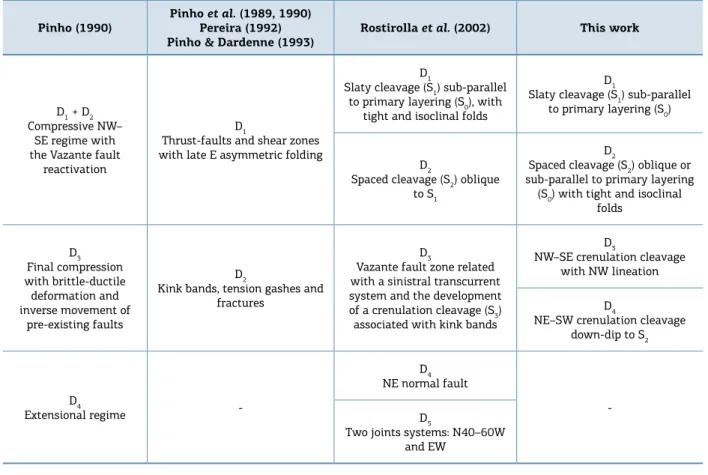
Tentative correlation of the four deformation phases deined in this work can be made with those of previ-ous studies of Vazante and Canastra groups, as follows (Tab. 2): D1 and D2 correspond to the regional compres-sional shear zones and thrust-faults responsible for the main structures in the belt (penetrative cleavage parallel and sub-parallel to the primary layering), as deined by Pereira (1992) and Pinho and Dardenne (1993), and to the heterogeneous brittle-ductile simple shear in progressive ductile regime of Pinho (1990) and Rostirolla et al. (2002). D3 and D4 may be correlated with the pure shear brit-tle-ductile regime with kink bands, tension gashes and crenulation cleavages of Pereira et al. (1994) and of Pinho and Dardenne (1993), and with the sinistral brit-tle-ductile directional and brittle extensional phases of Rostirolla et al. (2002).
KlCIS FWHM
Sampling
V
azante Group
Canastra Group
Serra da Lapa formation
Morro do Calcário formation
Serra do Garrote formation
Diagenesis Low
Anchizone
High
Anchizone Epizone
0.4 0.3 0.2 0.1
Figure 9. Kübler index diagram showing similar metamorphic grade between the Canastra and Vazante groups in the studied area. Metamorphic discontinuities along thrust planes in the Vazante Group rocks indicate that thrusting post-dated metamorphic peak.
KI: Kübler index; FWHM: full width half maximum.
A broader evolutionary model can be proposed from comparison of these local evolutionary schemes with simi-lar studies in other segments of the Southern Brasília Belt, south of the study area. As proposed by Valeriano (1992), Simões (1995) and Seer and Dardenne (2000), all four defor-mation phases are compatible with a broad E–W orogenic compression, but in progressively shallower environments. D1 and D2 phases are related to thrust tectonics resulting in folds and thrusts with movement towards the São Francisco Craton. In the southern most segments of the Brasília Belt, the aforementioned authors relate D3 folds with WNW-trending sinistral transcurrent shear zones which displaced the main thrust surfaces. D4 folds, with predominantly NS-oriented axes, are related to inal E–W shortening in a pure shear regime.
Table 2. Comparison between deformation phases in this work and selected previous works. Here is presented a correlation based in the description of each structural geometry literature data.
Pinho (1990)
Pinho et al. (1989, 1990)
Pereira (1992) Pinho & Dardenne (1993)
Rostirolla et al. (2002) This work
D1 + D2
Compressive NW– SE regime with the Vazante fault
reactivation
D1
Thrust-faults and shear zones with late E asymmetric folding
D1
Slaty cleavage (S1) sub-parallel
to primary layering (S0), with tight and isoclinal folds
D1
Slaty cleavage (S1) sub-parallel to primary layering (S0)
D2
Spaced cleavage (S2) oblique
to S1
D2
Spaced cleavage (S2) oblique or
sub-parallel to primary layering
(S0) with tight and isoclinal folds
D3
Final compression with brittle-ductile
deformation and inverse movement of
pre-existing faults
D2
Kink bands, tension gashes and fractures
D3
Vazante fault zone related with a sinistral transcurrent system and the development of a crenulation cleavage (S3)
associated with kink bands
D3
NW–SE crenulation cleavage with NW lineation
D4
NE–SW crenulation cleavage down-dip to S2
D4
Extensional regime
-D4
NE normal fault
-D5
Two joints systems: N40–60W and EW
metamorphic peak (Rostirolla et al. 2002), which was also responsible for the development of penetrative S2 cleavage in lower epizone conditions.
Campos et al. (2015) recently measured KI values of samples from the Canastra, Paranoá and Bambuí groups in the Distrito Federal and adjoining areas in Goiás state. Although those values are in KI FWHM without correc-tion, as indicated by Warr and Rice (1994) standardiza-tion’s parameters, they conclude that the Canastra Group rocks reached epizone conditions, while the Paranoá and Bambuí samples, from underlying thrust sheet, reached only anchizone conditions. hese results are consistent with the new results in this work, with both the Canastra and Vazante thrust sheet having reached high anchizone to epizone conditions, especially in the rocks above the thrust-fault contact.
As represented in Figure 9, a similar metamorphic degree is observed between the Canastra and the Vazante groups in the studied area. However, metamorphic dis-continuities along thrust planes within the Vazante Group rocks suggest that metamorphism pre-dated thrusting, which is compatible with observations in other areas of the Southern Brasília Belt (Simões 1995, Valeriano et al. 2000).
CONCLUSIONS
In this work, we present a geological and structural map of an area of approximately 400 km2 that shows that
the psammo-pelitic metasedimentary rocks of the Canastra Group and pelitic-carbonatic metasedimentary rocks of the Vazante Group are separated by a regional thrust-fault, supported by detailed mapping of Barrocão synform area, where the Canastra Group thrust fault truncates contacts between Vazante Group strata in the footwall. he defor-mation in the Canastra Group rocks was more intense than in the Vazante Group rocks, with generally tighter main phase (D2) folds in a similar style with thicker hinges and thinner limbs. Furthermore, metapelites of the Canastra Group are phyllites, in contrast with slates from the under-lying Vazante Group.
he third and fourth phases of deformation (D3 and D4) are related to post-thrust stacking and developed gentle to open folds and associated kink bands and crenulations, but without the development of penetrative foliations. he third phase of deformation was responsible for the Barrocão Synform, an expressive map-scale structure mapped in this work.
XRD data on white mica crystallinity indicate that rocks below and above the thrust-fault contact between the Canastra and Vazante groups reached similar anchi-zone/epizone conditions, typical of lower greenschist facies. he Canastra Group rocks show only one episode of clay mineral growth related to chlorite crystallization on the S2 foliation in syn-thrusting regime. In the Vazante Group, met-amorphic discontinuities along thrust planes indicate that the peak of metamorphism probably pre-dated thrusting.
ACKNOWLEDGEMENTS
he authors acknowledge invaluable help from Fernando Henrique Baia and Basílio Botura Neto, from Votorantim Metais Ltda., which provided all logistic and inancial support for ield activities. Sample preparation at the Universidade do Estado do Rio de Janeiro (UERJ) at Laboratório Geológico de Processamento de Amostras (LGPA) and Laboratório de Geocronologia e Isótopos Radiogênicos (LAGIR) is grate-fully acknowledged; National Counsel of Technological and Scientiic Development (CNPq), for the MSc scholarship. Comments from two anonymous reviewers contributed to many improvements to the manuscript. he authors are also grateful for the suggestions by Haakon Fossen, that brought sub-stantial improvements to previous versions of this manuscript.
Almeida F.F.M. (ed.). 1967. Origem e evolução da plataforma brasileira. Rio de Janeiro, DNPM/DGM, 38 p.
Almeida F.F.M. 1977. O Cráton do São Francisco. Revista Brasileira de Geociências, 7:349-364.
Almeida F.F.M. 1981. O Cráton do Paramirim e sua relação com o do São Francisco. In: Simpósio do Cráton São Francisco e suas Faixas Marginais, 1., 1981. Anais..., p. 1-10.
Almeida F.F.M. & Hasui Y. (eds.). 1984. O Pré-Cambriano do Brasil. São Paulo, Edgard Blucher, 378 p.
Appold M.S. & Monteiro L.V.S. 2009. Numerical modeling of hydrothermal zinc silicate and sulide mineralization in the Vazante deposit, Brazil. Geoluids, 9(2):96-115. [doi: 10.1111/j.1468-8123.2009.00245.x].
Azmy K., Kendall B., Creaser R.A., Heaman L., Oliveira T.F. 2008. Global correlation of the Vazante Group, São Francisco Basin, Brazil: Re-Os and U-Pb radiometric age constraints. Precambrian Research,
164(3-4):160-172. [doi: 10.1016/j.precamres.2008.05.001].
Babinski M., Monteiro L.S., Fetter A.H., Bettencourt J.S., Oliveira T.F. 2005. Isotope geochemistry of the maic dikes from the Vazante sulide zinc deposit, Brazil. Journal of South American Earth Sciences, 18(3-4):293-304. [doi: http://dx.doi.org/10.1016/j. jsames.2004.11.010].
Baia F.H. 2013. Brechas hidrotermais da mina do Cercado e das ocorrências Olho D’Água, Mata II e Pamplona: implicações metalogenéticas e prospectivas para zinco na região de Vazante, MG. MS Dissertation, Instituto de Geociências, Universidade Estadual de Campinas, Campinas, 230 p.
Campos L.F.B., Guimarães E.M., Barroso R.H.G., Gomes A.W. 2015. Inluência da pressão e temperatura na cristalinidade da illita em sequências proterozoicas: norte do Distrito Federal e Goiás, Brasil. Brazilian Journal of Geology, 45(3):383-398. [doi: 10.1590/2317-488920150030268]. Campos Neto M.C. 1984a. Geometria e fases de dobramento brasilianos superpostos no oeste de Minas Gerais. Revista Brasileira de Geociências, 14(1):60-68.
Campos Neto M.C. 1984b. Litoestratigraia e evolução paleogeográica dos grupos Canastra e Paranoá (região Vazante-Lagamar, MG). Revista Brasileira de Geociências, 14(2):81-91.
REFERENCES
Carvalho M.O. 2013. Evolução geológico-estrutural dos
metassedimentos dos grupos Vazante e Canastra na Serra do Barrocão, Faixa Brasília Meridional. Monograia de Graduação, Faculdade de Geologia, Universidade do Estado do Rio de Janeiro, Rio de Janeiro, 96 p.
Carvalho M.O. 2015. Comparação da evolução geológica entre as rochas metassedimentares dos grupos Vazante e Canastra no entorno à
Vazante, MG: litoestratigraia, estrutura e isótopos de samário-neodímio
(Sm-Nd) e estrôncio (Sr). MS Dissertation, Faculdade de Geologia, Universidade do Estado do Rio de Janeiro, Rio de Janeiro, 124 p. Carvalho M.O., Valeriano C.M., Diniz-Oliveira G., Baia F.H., Botura B.N., Aparicio González P.A. 2014. Geologia da região do entorno a Mina de Vazante, NW de Minas Gerais: comparação litológica, estrutural e isotópica entre as rochas dos grupos Canastra e Vazante. In: Congresso Brasileiro de Geologia, 47., 2014. Anais...
Carvalho M.O., Valeriano C.M., Diniz-Oliveira G., Baia F.H., Botura B.N., Aparicio González P.A. 2015. Litoestratigraia e evolução estrutural de área em Vazante, MG, Faixa Brasília Meridional. In: Simpósio de Geologia do Sudeste, 14., 2015. Anais..., 278 p.
Dardenne M.A. 2000. The Brasília fold belt. In: Cordani U.G., Milani E.J., Thomaz Filho A., Campos D.A. (eds.) Tectonic evolution of South America. 31.º International Geological Congress. Rio de Janeiro, p. 231-263. Dardenne M.A. 2005. Conophytons de Cabeludo, Grupo Vazante (MG) – Construções dolomíticas por ciano-bactérias no Proterozóico. In: Winge M., Schobbenhaus C., Berbert-Born M., Queiroz E.T., Campos D.A., Souza C.R.G. (eds.). Sítios geológicos e paleontológicos do Brasil, Brasília, Ministério de Minas e Energia. v. 2, 515 p.
Dardenne M.A., Campos J.E.G., Campos Neto M.C. 2005. Estromatólitos colunares no Sumidouro do Córrego Carrapato, Lagamar (MG) – registro de construções dolomíticas cilindro-cônicas por ciano-bactérias no Proterozóico do Brasil. In: Winge M., Schobbenhaus C., Berbert-Born M., Queiroz E.T., Campos D.A., Souza C.R.G. (eds.). Sítios geológicos e paleontológicos do Brasil, Brasília, Ministério de Minas e Energia. v. 2, 515 p.
Diniz-Oliveira G. 2013. Reconstrução paleoambiental e
quimioestratigraia dos carbonatos hospedeiros do depósito de zinco
J.C.S.P. 2014. Caracterização lito-estratigráica dos grupos Vazante, Canastra, Ibiá e Araxá, região de Coromandel-MG. In: Congresso Brasileiro de Geologia, 47., 2014. Anais...
Freitas-Silva F.H. 1991. Enquadramento litoestratigráico e estrutural
do depósito de ouro do Morro do Ouro, Paracatu (MG). MS Dissertation, Instituto de Geociências, Universidade de Brasília, Brasília,151 p. Freitas-Silva F.H. 1996. Metalogênese do depósito do Morro do Ouro, Paracatu. PhD Thesis, Instituto de Geociências, Universidade de Brasília, 338 p.
González P.A.A., Valeriano C.M., Impiccini A., Carvalho M., Olivera G. 2014. Análise mineralógica-metamórica de argilominerais em amostras de furos de sondagem dos grupos Vazante e Canastra, NW de Minas Gerais. In: Congresso Brasileiro de Geologia, 47., 2014. Anais... Kish H.J. 1991. Illite crystallinity: recommendation on sample preparation, X-ray difraction setting, and interlaboratory samples. Journal of Metamorphic Geology, 9(6):665-670. [doi: 10.1111/j.1525-1314.1991.tb00556.x].
Kübler B. 1968. Evaluation quantitative du metamorphisme par la cristallinité de Pillite. Bulletin du Centre de Recherches de Pau, 2:285-397. Monteiro L.V.S. 2002. Modelamento metalogenético dos depósitos de zinco de Vazante, Fagundes e Ambrósia, associados ao Grupo Vazante, Minas Gerais. PhD Thesis, Instituto Geociências, Universidade de São Paulo, São Paulo, 317 p. Monteiro L.V.S., Bettencourt J.S., Juliani C., Oliveira T.F. 2006. Nonsulide and sulide-rich zinc mineralizations in the Vazante, Ambrósia and Fagundes deposits, Minas Gerais, Brazil: mass balance and stable isotope characteristics of the hydrothermal alterations. Gondwana Research, 11(3):362-381. [doi: 10.1016/j.
gr.2006.04.017].
Moore D.M. & Reynolds R.C. 1997. X-ray difraction and the identiication
and analysis of clay minerals. Oxford Unversity Press, 378 p.
Neves B.B.B., Neto M.C.C., Fuck R.A. 1999. From Rodinia to Western Gondwana: an approach to the Brasiliano-Pan African cycle and orogenic collage. Episodes, 22(3):155-166.
Neves B.B.B., Teixeira W., Tassinari C.C.G., Kawashita K. 1990. A contribution to the subdivision of Precambrian in South America. Revista Brasileira de Geociências, 20(1-4):267-276.
Neves B.B.B., Winge M., Carneiro M.A. 1996. Orogêneses precedento e tafrogêneses sucedendo Rodínia na América do Sul. Boletim
IG-USO Série Cientíica, 27:1-40.
Pereira L. 1992. Relações tectono-estratigráicas entre as unidades Canastra
e Ibiá na região de Coromandel e Guarda-Mor, MG. MS Dissertation,
Instituto de Geociências, Universidade de Brasília, Brasília, 73 p. Pereira L.F., Dardenne M.A., Rosière C.A., Pedrosa-Soares A.C. 1994. Evolução Geológica dos Grupos Canastra e Ibiá na Região entre Coromandel e Guarda-Mor, MG. Geonomos, 2(1):22-32.
Pimentel M.M., Dardenne M.A., Fuck R.A., Viana M.G., Junges S.L., Fischel D.P., Seer H.J., Dantas E.L. 2001. Nd isotopes and the provenance of detrital sediments of the Neoproterozoic Brasília Belt, Central Brazil. Journal of South American Earth Sciences, 14 (6):571-585. [doi: 10.1016/S0895-9811(01)00041-4].
Pimentel M.M. & Fuck R.A. 1992 Neoproterozoic crustal accretion in central Brazil. Geology, 20:375-379.
Pimentel M.M., Rodrigues J.B., Dellagiustina M.E.S, Junges S., Matteini M., Armstrong R. 2011. The tectonic evolution of the Neoproterozoic Brasília Belt, central Brazil, based on SHRIMP and LA-ICPMS U–Pb sedimentary provenance data: a review. Journal of South American Earth Sciences, 31(4):345-357.
Pinho J.M.M. 1990. Evolução tectônica da mineralização de zinco de Vazante. MS Dissertation, Instituto de Geociências, Universidade de Brasília, Brasília, 115 p.
na região de Coromandel, MG. In: Simpósio Nacional de Estudos Tectônicos, 4., 1993. Anais..., p. 288-191.
Pinho J.M.M., Dardenne M.A., Rigobello A.E. 1989. Evolução tectônica da mineralização de zinco de Vazante. In: Simpósio de Geologia do Núcleo Minas Gerais, 5., 1989. Anais..., p. 275-276.
Pinho J.M.M., Dardenne M.A., Rigobello A.E. 1990. Caracterização da movimentação transcorrente da falha de Vazante, Vazante, MG. In: Congresso Brasileiro de Geologia, 36., 1990. Anais..., p. 89.
Rodrigues J.B. 2008. Proveniência de sedimentos dos grupos Canastra,
Ibiá, Vazante e Bambuí – um estudo de zircões detríticos e idades
modelo Sm-Nd. PhD Thesis, Universidade de Brasília, Brasília, 128 p. Rodrigues J.B., Pimentel M.M., Buhn B., Matteini M., Dardenne M.A., Alvarenga C.J.S., Armstrong R.A. 2012. Provenance of the Vazante Group: new U-Pb, Sm-Nd, Lu-Hf isotopic data and implications for the tectonic evolution of the Neoproterozoic Brasília Belt. Gondwana Research, 21(2-3):439-450. [doi: 10.1016/j.gr.2011.07.017]. Rostirolla S.P., Mancini F., Reis Neto J.M., Figueira E.G., Araújo E.C. 2002. Análise estrutural da mina de Vazante e adjacências: geometria, cinemática e implicações para a hidrogeologia. Revista Brasileira de Geociências, 32(1):59-68.
Seer, H.J. & Dardenne, M.A. 2000. Tectonostratigraphic terrane analysis on neoproterozoic times: the case study of Araxa Synform, Minas Gerais, Brazil: implications to the inal collage of the Gondwanaland. Revista Brasileira de Geociências, 30(1):78-81. Simões L.S.A. 1995. Evolução tectono-metamórica da Nappe de
Passos, sudoeste de Minas Gerais. PhD Thesis, Universidade Estadual Paulista, São Paulo, 149 p.
Slezak P.R., Olivo G.R., Oliveira G.D., Dardenne M.A. 2014. Geology, mineralogy, and geochemistry of the Vazante Northern Extension zinc silicate deposit, Minas Gerais, Brazil. Ore Geology Reviews,
56:234-257. [doi: 10.1016/j.oregeorev.2013.06.014].
Valeriano C.M. 1992. Evolução tectônica da extremidade meridional da Faixa Brasília, região da Represa de Furnas, sudoeste de Minas Gerais. PhD Thesis, Universidade de São Paulo, São Paulo, 213 p. Valeriano C.M., Dardenne M.A., Fonseca M.A., Simões L.S.A., Seer H.J. 2004. A evolução tectônica da Faixa Brasília. In: Mantesso-Neto V. & Bartoreli A. (eds.). Geologia do continente sul-americano: evolução da obra de Fernando Flávio Marques de Almeida. São Paulo, Beca, p. 575-593. Valeriano C.M., Pimentel M.M., Heilbron M., Almeida J.C.H., Trouw R.A.J. 2008. Tectonic evolution of the Brasília Belt, central Brazil, and early assembly of Gondwana. In: Pankhurst R.J., Trouw R.A.J., Brito Neves B.B., Wit M.J. (eds.). West Gondwana: Pre-cenozoic correlations across the South Atlantic region. London, Geological Society, p. 197-210. Valeriano C.M., Teixeira W., Heilbron M., Simões L.S.A. 2000. Southern Brasília belt (SE Brazil): tectonic discontinuities, K–Ar data and evolution during the Neoproterozoic Brasiliano orogeny. Revista Brasileira de Geociências, 30(1):195-199.
Verdecchia S.O., Collo G., Baldo E.G. 2011. Polyphase white mica growth in low-grade metapelites from La Cébila Metamorphic Complex (Famatinian Belt, Argentina): evidence from microstructural and XRD investigations. Andean Geology, 38(2):268-283.
Warr L.N. & Rice A.H.N. 1994. Interlaboratory standardization and calibration of day mineral crystallinity and crystallite size data. Journal of Metamorphic Geology, 12(2):141-152. [doi: 10.1111/j.1525-1314.1994.tb00010.x]. Yang C. & Hesse R. 1991. Clay minerals as indicators of diagenetic and anchimetamorphic grade in an overthrust belt, external domain of southern Canadian Appalachians. Clay Minerals, 26(2):211-236. [doi: 10.1180/claymin.1991.026.2.06].