J. Braz. Chem. Soc., Vol. 14, No. 5, 828-831, 2003. Printed in Brazil - ©2003 Sociedade Brasileira de Química 0103 - 5053 $6.00+0.00
S
ho
rt
R
e
p
o
rt
* e-mail: [email protected]
Antifungal Aromadendrane Sesquiterpenoids from the Leaves of Xylopia brasiliensis
Isabel C. Moreiraa, João Henrique G. Lago*,a, Maria Cláudia M. Youngb and Nídia F. Roquea,c
a
Instituto de Química, Universidade de São Paulo, CP 26077, 05599-970 São Paulo - SP, Brazil
b
Seção de Fisiologia e Bioquímica de Plantas, Instituto de Botânica, CP 4005, 01061-970 São Paulo - SP, Brazil
c
Instituto de Química, Universidade Federal da Bahia, 40170-290 Salvador - BA, Brazil
Um novo sesquiterpeno, aromadendrano-4β,10α,15-triol, foi isolado das folhas de Xylopia brasiliensis Spreng (Annonaceae), juntamente com quatro derivados de esqueleto aromadendrano e três esteróides. As estruturas dos metabólitos foram definidas por meio da análise dos respectivos espectros de RMN, incluindo experimentos bidimensionais, além de espectrometria de massas. Os sesquiterpenos aromadendranos diidroxilados apresentaram atividade antifúngica frente a Cladosporium cladosporioides.
A new sesquiterpenoid, aromadendrane-4β,10α,15-triol, was isolated from the leaves of Xylopia brasiliensis Spreng (Annonaceae), together with four known aromadendrane derivatives and three steroids. The structures of these compounds were defined by analysis of their NMR spectral data, including bidimensional analysis, and mass spectrometry. The isolated aromadendranediol derivatives showed antifungal activity against Cladosporium cladosporioides.
Keywords: Xylopia brasiliensis, aromadendrane sesquiterpenoids, antifungal activity
Introduction
The genus Xylopia (Annonaceae) comprises about 160 species with occurrence in South and Central America, Africa and Asia.1,2 Aproximatelly 25 species of Xylopia
were identified in Brazil, mainly in Amazonia.2 These
species produce a wide variety of metabolites including alkaloids, amides, lignoids, acetogenins and terpenoids.3-7
X. brasiliensis, a very large tree distributed in Southeastern Brazil, is known as “pindaíba”, “pindaubuna” and “bindaíba” and has been used in the folk medicine as a sedative and analgesic. Previous investigations of the chemical constituents of this plant resulted in the isolation of diterpenoids and aporphine alkaloids from the fruits and stem bark, respectively.8,9 In addition of our studies on
X. brasiliensis, we describe herein the isolation and identification of five aromadendrane sesquiterpenoids, including a new derivative, besides three known steroids. All the sesquiterpenoids were submitted to antifungal assay
against Cladosporium cladosporioides and the
dihydroxylated derivatives showed pronounced activity.
Results and Discussion
The CH2Cl2 extract from the leaves was subjected to repeated chromatography on silica gel and on Sephadex LH-20 columns. Spectrometric analysis of the fractions resulted in the identification of five aromadendrane sesquiterpenoids: spathulenol (1), aromadendrane-4α,10β -diol (2), aromadendrane-4α,10α-diol (3) and alloaroma-dendrane-4β,10α-diol (4), including a new derivative, which was characterized as aromadendrane-4β,10α ,15-triol (5) and three steroids: sitosterol (6), stigmasterol (7) and sitosterol-3-β-D-galactoside (8). To our knowledge, this is the first report of the occurrence of 2, 3 and 4 in Xylopia genus.
The sesquiterpenoids 1, 2, 3 and 4 and the steroids 6, 7
and 8 were identified by analysis of their 1H and 13C NMR
spectroscopic data and comparison with literature data.10-14
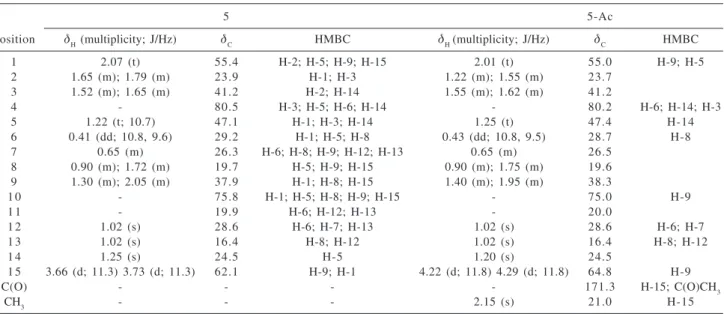
The 13C NMR spectrum of 5 displayed fifteen signals,
three of which are of carbinolic carbon atoms [δ 80.5 (C), 75.8 (C) and 62.1 (CH2)]. These data, associated to molecular ion peak at 255 Da [M+H]+ in ESIMS, suggested
the structure of a trihydroxysesquiterpenoid with molecular formula C15H26O3. The 1H NMR spectrum of 5
829 Antifungal Aromadendrane Sesquiterpenoids from the Leaves of Xylopia brasiliensis
Vol. 14, No. 5, 2002
dd, J 10.8 and 9.6 Hz) and at δ 0.65 (1H, m), which are a characteristic feature of the aromadendrane skeleton.11 This
spectrum also showed one singlet at δ 1.02 (6H), assigned to a gem-dimethyl group linked to a quaternary carbon, and one singlet at δ 1.25 (3H) assigned to one methyl group joined to a tertiary carbinolic carbon. The data of 5, compared with those of related compounds aromadendrane-4α,10α-diol (3) and aromadendrane-4β,10α-diol (3a),12 indicated that the hydroxyl groups at
C-4 and C-10 have β and α orientation, respectively.11 The
presence of an AB system at δ 3.66 (1H, J 11.3 Hz) and at
δ 3.73 (1H, J 11.3 Hz) suggested the presence of a primary alcohol in 5. Accordingly the signal at δ 62.1 in the 13C
NMR spectra (BBD and DEPT 135°) was assigned to the oxygenated methylenic group. The third hydroxyl group was thus positioned at C-15 shielding C-9 chemical shift
by a γ-gauche effect of 5 ppm, when compared with
aromadendrane-4β,10β-diol (3b).11 This proposal was
confirmed by HMBC spectrum, which showed a long range coupling between C-15/H-1, C-15/H-9 and C-10/H-15. The positioning of the hydroxyl group at C-15 was also
confirmed by analysis of 13C NMR data of the
monoacetylated derivative (5-Ac), which showed a
deshielding effect of 2.7 ppm of C-15 and a shielding effect of 0.8 ppm to C-10, due to β and γ effects respectively, when compared with those of 5. Therefore, the structure of
5 was defined as aromadendrane-4β,10α,15-triol. The antifungal activity of sesquiterpenoids 2, 3, 4 and
5 was evaluated by means of direct bioautography on TLC plate. The aromadendrane derivatives 2, 3 and 4 showed antifungal activity against C. cladosporioides and their minimun amount required to inhibit growth of this fungus were deteminedas 5 µg. Nystatin (5 µg) and miconazole (1
µg) were used as positive controls.
Experimental
General
NMR spectra were recorded at 75 and 125 MHz to 13C
and 300 and 500 MHz for 1H (Bruker DPX-300 and
DRX-500 spectrometers, respectively). The spectra were recorded in CDCl3 (Aldrich); δ values were expressed in ppm relative to the residual signal of CHCl3 in CDCl3; IR spectra were obtained using KBr pellets in a Perkin-Elmer Infrared Spectrometer model 1750; ESIMS were obtained in a Platform II-Micromass Spectrometer (quadrupole). EIMS were obtained with a 70 eV INCOS 50 Finnigan-Mat-quadrupole mass spectrometer; silica gel 60 (Merck) and Sephadex LH-20 (Pharmacia) were used for column chromatography (63-200 µm); pre-coated aluminium silica gel plates PF254 (Merck) were used for TLC analysis.
Plant material
The leaves of X. brasiliensis were collected at the Instituto de Botânica on February, 1998, São Paulo, Brazil. A voucher specimen (YOUNG10) is deposited at the herbarium of Instituto de Botânica (SMA-SP).
Extraction and isolation of the constituents
The air-dried and powdered leaves (900 g) were extracted with CH2Cl2. After removal of the solvent by evaporation under reduced pressure, a part of the crude extract (18 g) was chromatographed on a silica gel column, eluting with hexane/CH2Cl2/MeOH in gradient mixtures to give 130 fractions (125 mL each). Fractions were combined based on their TLC pattern to yield fractions designed as X-1/X-17. Fraction X-4 (280 mg) was purified by column chromatography over silica gel with CH2Cl2/ MeOH (98:2) to yield 21 mg of 1. Fraction X-7 (1 g) was applied to a silica gel column, eluted with CH2Cl2/MeOH (9:1) to yield a mixture of 6 and 7 (43 mg). Fraction X-13 (320 mg) was subjected to Sephadex LH-20 (30 g - 2x30 cm) using a gradient elution system [hexane/CH2Cl2 (1:4) followed by CH2Cl2/Me2CO (3:2) and (1:4)] to give four subfractions. Sesquiterpenes 2 (10 mg), 3 (12 mg) and 4
830 Moreira et al. J. Braz. Chem. Soc.
2 (80 mg), using increasing amount of EtOAc in hexane as eluent. Fraction X-16 was composed, mainly, by steroid 8
(20 mg). Fraction X-17 (120 mg) was aplied to a silica gel column, eluted with CH2Cl2/MeOH (8:2), to afford 5
(30 mg).
Aromadendrane-4β,10α,15-triol (5)
Colourless oil; IR (KBr) υmax /cm-1: 3605, 2941, 2873,
1461, 1375, 1070, 1026, 891. EIMS (70 eV): 254(not observed), 236(18), 218(22), 203(29), 185(29), 175(72), 160(49), 147(87), 135(64), 119(87), 105(96), 91(100), 79(79), 69(71), 55(93); ESIMS: 255 [M+H]; NMR data (1H, 13C, HMQC, HMBC) are given in Table 1.
15-Acetoxy-aromadendrane-4β,10α-diol (5-Ac)
Obtained by treatment of 5 (10 mg) with Ac2O (1.0 mL) and pyridine (1.0 mL). The usual work-up, followed by silica gel chromatography of the crude product furnished
5-Ac (10 mg) as a colourless oil. NMR data (1H, 13C, HMBC)
are given in Table 1.
Antifungal assay
Dilutions containing 100, 50, 25, 10, 5, 1 and 0.1 µg of pure compounds were applied on a pre-coated TLC plate. The plate was developed with hexane/EtOAc (7:3). The chromatogram was sprayed with a spore suspension of C. cladosporioides in glucose and salt solution and was incubated for 72 h in darkness in a moistened chamber at
25 °C.15 Clear inhibition zones appeared against a dark
blackground, indicating the minimal amount required for inhibition of fungal growth on TLC plate. Nystatin (5 µg) and miconazole (1 µg) were used as positive controls. The microorganism used in the antifungal assay, C. cladosporioides (Pemzig) SPC 491, has been maintained at Instituto de Botânica (SP).
Acknowledgments
This work was supported by FAPESP (J.H.G.L., I.C.M. and M.C.M.Y.) and CNPq (N.F.R.).
Table 1. 1H and 13C NMR data and long-range correlations observed in the HMBC for sesquiterpenoid 5 and 5-Ac (500 and 125 MHz, δ, CDCl 3)
5 5-Ac
position δH (multiplicity; J/Hz) δC HMBC δH (multiplicity; J/Hz) δC HMBC
1 2.07 (t) 55.4 H-2; H-5; H-9; H-15 2.01 (t) 55.0 H-9; H-5
2 1.65 (m); 1.79 (m) 23.9 H-1; H-3 1.22 (m); 1.55 (m) 23.7
3 1.52 (m); 1.65 (m) 41.2 H-2; H-14 1.55 (m); 1.62 (m) 41.2
4 - 80.5 H-3; H-5; H-6; H-14 - 80.2 H-6; H-14; H-3
5 1.22 (t; 10.7) 47.1 H-1; H-3; H-14 1.25 (t) 47.4 H-14
6 0.41 (dd; 10.8, 9.6) 29.2 H-1; H-5; H-8 0.43 (dd; 10.8, 9.5) 28.7 H-8
7 0.65 (m) 26.3 H-6; H-8; H-9; H-12; H-13 0.65 (m) 26.5
8 0.90 (m); 1.72 (m) 19.7 H-5; H-9; H-15 0.90 (m); 1.75 (m) 19.6 9 1.30 (m); 2.05 (m) 37.9 H-1; H-8; H-15 1.40 (m); 1.95 (m) 38.3
1 0 - 75.8 H-1; H-5; H-8; H-9; H-15 - 75.0 H-9
1 1 - 19.9 H-6; H-12; H-13 - 20.0
1 2 1.02 (s) 28.6 H-6; H-7; H-13 1.02 (s) 28.6 H-6; H-7
1 3 1.02 (s) 16.4 H-8; H-12 1.02 (s) 16.4 H-8; H-12
1 4 1.25 (s) 24.5 H-5 1.20 (s) 24.5
1 5 3.66 (d; 11.3) 3.73 (d; 11.3) 62.1 H-9; H-1 4.22 (d; 11.8) 4.29 (d; 11.8) 64.8 H-9
C(O) - - - - 171.3 H-15; C(O)CH3
CH3 - - - 2.15 (s) 21.0 H-15
Table 2. 13C NMR data to sesquiterpenes 2, 3, 3a, 3b and 4 (75 MHz, δ, CDCl3)
position 2 3 3 a 3b 4
1 52.5 54.5 56.2 56.4 49.6
2 23.7 23.7 23.7 24.3 23.8
3 39.6 40.3 41.0 41.4 38.2
4 80.5 80.1 80.1 80.3 83.1
5 45.8 47.5 48.2 47.2 48.5
6 24.9 25.0 28.3 30.1 26.4
7 27.0 26.2 26.5 26.9 24.6
8 19.1 20.3 20.0 19.2 20.4
9 42.4 44.2 44.3 42.8 39.5
1 0 72.8 75.3 74.8 71.8 74.5
1 1 20.1 18.9 19.4 20.9 20.1
1 2 29.0 28.8 28.5 28.7 28.6
1 3 16.4 16.4 16.3 16.4 15.3
1 4 25.8 25.6 24.3 25.1 24.2
831 Antifungal Aromadendrane Sesquiterpenoids from the Leaves of Xylopia brasiliensis
Vol. 14, No. 5, 2002
References
1. Hocquemiller, R.; Cavè, A.; Rahariolalao, A.; J. Nat. Prod. 1981, 44, 551.
2. Takhtajan, A.; Floristic Regions of the World, Los Angeles, Univ. California Press: Los Angeles, 1986.
3. Martins, D.; Alvarenga, M.A.; Roque, N.F.; Felício, J.D.; Quim. Nova1995, 18, 14.
4. Lajide, L.; Escoubas, P.; Mizutani, J.; Phytochemistry 1995,
40, 1105.
5. Wahl, A.; Roblot, F.; Cavè, A.; J. Nat. Prod.1995, 58, 786. 6. Colman-Saizarbitoria, T.; Gu, Z.M.; Zhao, G.X.; J. Nat. Prod.
1995, 58, 532.
7. Takahashi, J.A.; Boaventura, M.A.D.; Bayma, J.C.; Oliveira, A.B.; Phytochemistry 1995, 40, 607.
8. Vilegas, W.; Alvarenga, M.A.; Roque, N.F.; Rev. Latinoamer. Quim.1989, 20, 98.
9. Casa Grande, C.; Merotti, G.; Il Farm. Ed. Sci.1970, 25, 799. 10. Iwabushi, H.; Yoshikura, M.; Kamisako, W.; Chem. Pharm.
Bull. 1989, 37, 509.
11. Goldsbym, G.; Burke, A.B.; Phytochemistry 1987, 26, 1059. 12. Gijsen, H.J.M.; Wijnberg, J.B.P.A.; Stork, G.A.; DeGroot, A.;
Tetrahedron 1992, 48, 2465.
13. Ahmad, V.U.; Aliya, R.; Perveern, S.; Shameel, M.; Phytochemistry 1992, 31, 1429.
14. Osman, A.M.; Younes, M.E.; Moktar, A.; Phytochemistry 1975,
14, 829.
15. Homans, A.L.; Fuchs, A.; J. Chromatogr.1970, 327.
Received: August 6, 2001
Published on the web: June 2, 2003