A Theoretical Model for the Scattering of I
2Molecule from a
Perfluoropolyeter Liquid Surface
Alexandre S. Leal
a, Claudio Gouvêa dos Santos
b, Cristina M. Quintella
c,
and Heloiza H.R. Schor
d*
a,d
Depto. de Química - ICEX/UFMG 31270-901 Belo Horizonte - MG, Brazil
b
Depto. de Química/ICEB-UFOP, 35400-000 Ouro Preto - MG, Brazil
c
Depto. de Química/UFBa, 40170-280 Salvador - BA, Brazil
Neste trabalho desenvolvemos um modelo do potencial de interação para simulação de experi-mentos de espalhamento de um feixe de moléculas de I2 sobre a superfície do líquido polimérico
poliéterperfluorado e resolvemos a dinâmica do processo de colisão usando o método das trajetórias clássicas. A energia transferida no processo para os modos vibracionais da molécula de I2 e para o
líquido foram investigados como função dos parâmetros do potencial.
In order to simulate experimental results of scattering of an I2 beam from liquid perfluorpolyeter
( PFPE ) surface we developed a model potential for the gas-polymer interaction at the liquid surface and solved the dynamics of the collision process by the classical trajectory method. The energy transferred in the process to the vibrational mode of the I2 molecule and to the liquid surface was
investigated as a function of potential parameters.
Keywords:gas-surface interaction, liquid polymer, perfluorpolyether and chemical dy-namics
Introduction
Although many properties of liquids, such as surface tension, adhesion, lubrication and wetting are related to their microscopic surface chemical structure, the chemical structure of liquid surfaces is less understood than the structure of solid surfaces. Recently, methods that probe directly the liquid surfaces chemical structure have been developed employing rare-gas atomic1 and ion2 beam scat-tering, reactive ion beam scattering3, nonlinear optical spectroscopy4, and angle resolved photoelectron spectros-copy5. The understanding of the interaction of atoms, mole-cules and ions with surfaces is of great relevance to establish the dynamics of the fundamental processes occur-ring in beam/surface collision. When a gas molecule col-lides with a liquid surface it can scatter away immediately, it can exchange energy with the liquid molecules, or it can bind temporarily to surface molecules and then evaporate, react or dissolve in the liquid bulk. Relevant questions concerning the dynamics of these processes remain unan-swered such as: the mechanism of surface reaction, how is the collision energy transferred to the surface and to the vibrational and rotational degrees of freedom of the
scat-tered molecule, the spatial distribution of scatscat-tered mole-cules, and the influence of the surface and the colliding molecule in each process. Recently, scattering experiments have been performed directing a cold beam of iodine mole-cules to liquid polymer surfaces in vacuum6. The experi-ment can distinguish molecules scattered directly from the surface and molecules desorbed from the surface. The gas molecules are activated by the collision and the energy transferred to the internal modes of the gas is determined and depends on the chemical nature of the surface. Here, we present a calculation of the dynamics of this experiment aiming a characterization of the gas-liquid interaction, and a molecular description of the collision process.
Methods
The experimental results obtained suggest that the di-rect scattering is characterized by a inelastic collision where a very small amount of the gas translational energy is converted to vibrational and rotational energy or transferred to the liquid surface molecules. When the molecules are adsorbed at the surface the energy conversion and transfer processes are much more effective.
Article
* e-mail: [email protected]; be-mail: [email protected];
cemail:[email protected]; d[email protected]
J. Braz. Chem. Soc., Vol. 10, No. 5, 359-362, 1999. © 1999 Soc. Bras. Química
A theoretical approach to the gas-liquid scattering prob-lem is a diatomic molecule interacting with one liquid surface molecule represented by a model molecule with two constrained degrees of freedom. We build a model potential for the interaction of a I2 molecule with PFPE given by: V = VLEPS + VSUP, where VLEPS is a three-body LEPS (Lon-don-Eyring-Polanyi-Sato) potential employed in gas phase reaction studies7 and gas-solid interaction8, and VSUP de-scribes the motion of the model liquid surface molecule. VLEPS is a non-pairwise potential, which for a I2 molecule and a I- surface S interaction takes the form:
VLEPS= Qab+ Qac+ Qbc− [ Jab2 + Jac2 + Jbc2 −Jab Jbc −
Jac Jab− Jbc Jac]
1⁄ 2
in which
Qi(R i)=−
(1−∆i)Di(e−2α(Ri− R0i)+ 2e−2α(Ri− R0i)) 4(1 +∆i)
Ji(R i)=(
1 +∆i) Di(e−2α(Ri− R0i)− 2e−2α(Ri− R0i)) 2(1 +∆i)
are empirical functions analogous to the Coulomb and exchange integrals of diatoms i = a-b, a-c and b-c, in which a and b are the two atoms of the I2 molecule and c is the surface group. Here we follow the usual LEPS treatment for evaluation of the two-body Coulomb and exchange integrals assuming that the I-I and I-surface interactions can be adequately described by Morse potentials. ∆i, Di, R0i, and αi are the corresponding Sato parameter, dissociation energy, equilibrium distance and range parameter for the ith. two-body interaction. ∆i adjusts the topology of the potential at close interaction distance(such as the high of the barrier or depth of wells), and αi the curvature of the potential along the Ri coordinate. The parameters for the I2 molecule are known from spectroscopical data9 and the
parameters describing the interaction of the I atom and the surface are determined by an optimization procedure from this simulation. This potential function describes correctly all asymptotic atomic configurations, the internal excitation of the I2 molecule and its dissociation, and can be evaluated numerically.
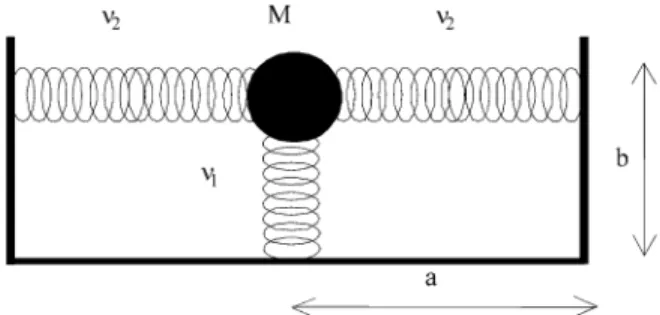
It is known that PFPE is bound in trans configuration with axial -CF3 groups10. A previous study of the liquid PFPE surface using reactive ion beams showed that its surface is primarily composed of fluorine atoms3 and more recently, X-ray photoelectron spectroscopy revealed that it is mostly composed of -CF3 chain ends oriented nearly perpendicular to the surface, suggesting that there is a high degree of order in these liquid polymer surfaces5. Starting from this experimental evidence we built a model molecule describing the surface as a diatom with a reduced mass M corresponding to the mass of the protruding group which vibrates with frequency ν1 around an equilibrium distance b corresponding to CF2-CF3 bond. The constrained move-ment of M across the surface is assumed as the rocking vibration of the protruding group with frequency ν2 and equilibrium distance a .The vibrational frequency ν1, con-sidered as the group stretching frequency, and the rocking frequency ν2 are obtained from literature10,11. Thus we have a model molecule potential representative of the liquid surface, written as a pair of coupled harmonic oscillators which should be applicable to any liquid polymer surface that exhibits some degree of order, regardless the structure of the bulk. Figure 2 shows the liquid model molecule and the parameters used to describe VSUP.
The above potential was used in quasi-classical trajec-tory calculations to determine the dynamics of the scatter-ing process. The equations of motion are the ones derived from a Hamiltonian of 9 relative coordinates and its asso-ciated momenta. The initial conditions are the ones estab-lished in the experiment: The I2 molecule has a translational energy of 10 and 40 kJ/mol and always strikes the surface at normal angle. It is initially in the ground vibrational and rotational state. The surface model molecule is considered
Vol. 10, No. 5, 1999 Leal et al. 360
Figure 2. Model molecule representing an ordered polymer surface. M = 56.0 is the reduced mass in a.m.u, a = 2.0742 and b = 2.8932 are the equilibrium distances in a.u. and ν1 = 850 and ν2 = 190 are the vibrational frequencies in cm-1.
Figure 1. Model of the scattering of a supersonic I2 beam by a liquid
also in the ground vibrational state and the remaining undefined initial coordinates for each trajectory were treated as stochastic variables and sampled randomly. The equations of motion are integrated numerically until the relative distance between the molecule and the surface is large enough so the interaction between the gas molecule and the surface vanishes.
Results
The parameters Di, αi, and ∆i for the I-surface interaction potential were systematically changed until we obtained the vibrational temperature close to the one determined from the experiment for the indirect scattering of I2 from the polymer. The vibrational energy of the scattered I2 is very sensitive to Di and ∆i, that regulate the topology of the surface, (barrier and wells) and the rotational energy of the scattered I2 is very sensitive to αi, the potential curvature, as well known from dynamical studies in the gas phase12. The initial guess of Di for the I-surface interaction was approximately the half of the I2 dissociation energy corre-sponding to 0.029 a.u. Di was changed from 0.022 to 0.036 in steps of 0.001. The choice of this interval is arbitrary but it corresponds to a set of values chemically acceptable for the energy of the I-surface bond. The initial guess of αi was 0.99, the same of the I2 molecule, and the interval of variation from 0.80 to 0.99 in steps of 0.01 a.u. For each pair of values of Di and αi, the equilibrium distance I-sur-face was taken as the C-I distance and kept constant as R0I = 4.2028 a.u and ∆i assumed the values 0.2, 0.4 and 0.6 in a total of 900 different set of parameters.
For each set of initial parameters, N = 2500 trajectories were calculated with a Monte Carlo standard error
λ = [(Pa(1 - Pa)/N]1/2 lower than 1%, where Pa, the adsorp-tion probability, was approximated by the fracadsorp-tion of the trajectories in which the I2 molecule was adsorbed by the surface. The best set of parameters obtained for Di, αi and ∆i were, respectively, 0.026, 0.93 and 0.4, corresponding to a value of λ = 0.6% for Pa = 11,4%. These results are properly converged. With 1500 trajectories, we obtained λ = 0.8% and Pa = 11,0%, values only slightly different from the ones used in this work.
The experimental vibrational temperature Tvib of I2 mole-cule scattered from PFPE surface with incident translational energy of 40 kJ/mol is 150 K in the direct inelastic scattering and 110 K in the desorption process. We determined in this work Tvib = 124 K and 134 K respectively for each collision regime with a maximum error of 17%. Tvib is determined experimentally from the integrated area of each vibrational band in the fluorescence spectra of directly scattered I2 and of desorbed I2. Here Tvib is calculated from the ratio of molecular population in vibrational states 1 and 0 for the direct collision and 2 and 1 for the trajectories that undergo multiple collisions. The two collision regimes are distinguished by a chosen
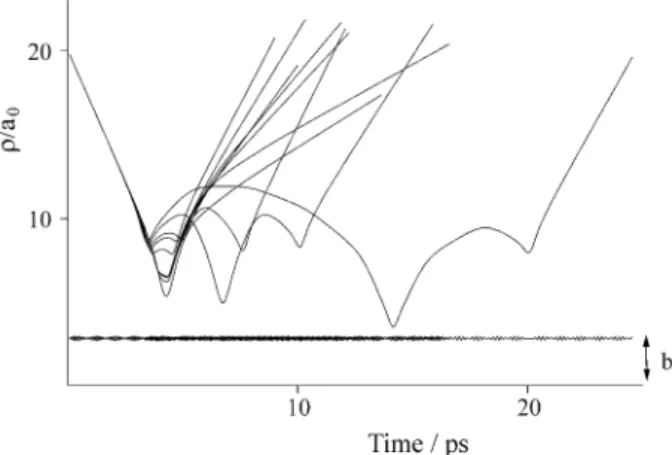
collision time limit. This is an approximate method to estimate Tvib . The time of interaction for the direct collision is less than 1ps and for the desorption of the order of 15 ps, as can be seen in Figs. 3a and 3b, respectively.
Experiments of scattering of atoms from liquid surfaces have shown that for sufficiently high collision energies the scattering is dominated by direct collisions. We observe the same result, as illustrated in Fig. 3a where one can see a set of 10 trajectories representative of the average behavior of the process with an incident energy of 40 kJ/mol. At low incident energy (10 kJ/mol) we observe the favorable ad-sorption at the surface followed by dead-sorption, after multi-ple collisions, as shown by a set of 10 typical trajectories at this collision energy represented in Fig. 3b. We also ob-served that for a given value of initial translational energy and the same set of potential parameters, a higher ∆i implying
361 Scattering of I2 Molecule from a Perfluoropolyeter Liquid Surface J. Braz. Chem. Soc.
Figure 3a. Temporal evolution of thedistance ρ between the surface and the center of mass of the I2 molecule for 10 typical trajectories in the direct
inellastic collision regime PFPE surface. The incident energy is 40 kJ/mol. The horizontal line represents the surface limit.
a higher desorption barrier, favors the occurrence of multi-ple collisions of gas molecules with the surface, because the potential traps the I2 molecule at the surface.
There is a correlation between the amount of energy transferred to the surface with the vibrational frequencies
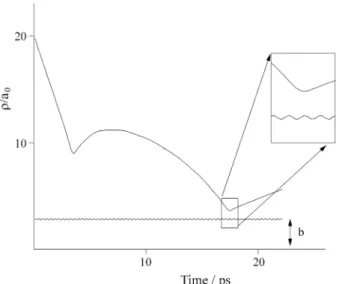
ν1 and ν2 of the protruding groups of the liquid polymer surface. The average fraction of energy transferred to the surface in the b direction is smaller than in the a direction where the vibrational frequency is lower (ν2 < ν1 ), Fig. 2, although the available energy in the collision is large enough to excite both oscillators. Fig. 4a. illustrates the coupling of the I2 molecule translational motion with respect to the surface and the vibrational motion of the surface model molecule, as the I2 molecule approaches the
surface for a particular trajectory. In Fig. 4b the PFPE surface vibrational coordinate, associated with the lower frequency mode ν2, is plotted as a function of time together with the collision coordinate for a typical trajectory. We see in detail the exchange of energy between the I2 mole-cule and the surface for the same trajectory showed in Fig. 4a.
Conclusions
We conclude that this diatom-surface potential function provides a reasonable semi-quantitative model for the interac-tion of I2 molecule with the liquid polymer surface. The experimental results can be fitted to the model reproducing the vibrational temperature of the scattered I2 molecule and some insight into the dynamics of the process is obtained. A com-parison with experimental results obtained for scattering ex-periments performed with other liquids and further refinements of the surface potential employing more realistic vibrational frequencies of the polymer and accounting for the periodicity of the ordered surface are under way.
Acknowledgments
The authors wish to acknowledge financial support of CNPq, FINEP and PADCT.
References
1. Saecker, M.E.; Govoni,S.T.; Kowalski , D.V.; King, M.E.; Nathanson, G.M. Science 1991, 252, 1421; Nathanson, G.M.; Davidovits, P.; Worsnop, D.R.; Kolb, C.E. J.Phys.Chem. 1996, 100, 1307.
2. Tassoto, M.; Gannon, T.J.; Watson, P.R. J. Chem. Phys. 1997, 107, 8899.
3. Pradeep, T.; Miller, S.A.; Cooks, R.G. J. Am. Soc. Mass Spectrom. 1993, 4, 769.
4. Huang, J.Y.; Shen ,Y.R. Phys. Rev. Lett. 1991, 66, 1066.
5. Pradeep, T. Chem. Phys. Lett. 1995, 143, 125. 6. Kenyon, A.J.; McCaffery, A.J.; Quintella, C.M.;
Zi-dan, M.D. J. Chem. Soc. Faraday Trans. 1993, 89, 3877; Faraday Discuss. 1993, 96, 245; Chem. Phys. Lett. 1992, 190, 2, 190; Quintella, C.M.; McCaffery, A.J.; Zidan, M.D. Chem. Phys. Lett. 1993, 214, 6, 563. 7. Levine, R.D.; Bernstein, R.B. Molecular Reaction Dynamics; Oxford University Press; New York, 1994. 8. Tantardini, F.; Simoneta, M. Surf. Sci. 1981, 105, 577. 9. Herzberg, G. Spectra of Diatomic Molecule; Van
Nos-trand Reinhold; New York, 1950.
10. Haslam, J.; Willis, H. Identification and analysis of Plastics; Van Nostrand; Princeton, New Jersey, 1965. 11. Albert, N.L.; Keiser, W.E.; Szymansky, H.A. Theory Practice of IR Spectroscopy; Plenum Press; New York, 1970.
12.
Received: March 15, 1999
Vol. 10, No. 5, 1999 Leal et al. 362
Figure 4a. a) Detailed particular trajectory in the multiple collision regime describing a trapped I2 at PFPE surface.
Figure 4b. Time evolution, for the same trajectory showed in Fig. 4a, of the horizontal displacement r across the surface of the reduced mass M of the model molecule representative of the surface. The trapped I2 molecule
perturbs the surface vibration mode of lower frequency. Schor, H.; Chapman, S.; Green, S.; Zare, R.N. J.