* e-mail: [email protected]
Article
Enantioselective Synthesis of
-Amino Acids. 12. Experimental and Theoretical Study of the
Diastereoselectivity of Alkylation of the Dianion of
N
’,
N
’-Bis(
-phenylethyl)-
N
-carbobenzyloxypropionamide.
Víctor Manuel Gutiérrez-García, Gloria Reyes-Rangel, Omar Muñoz-Muñiz and Eusebio Juaristi*
Departamento de Química, Centro de Investigación y de Estudios Avanzados del Instituto Politécnico Nacional, Apartado Postal 14-740, 07000, México, D.F. (México)
-Alanina, matéria-prima aquiral e de baixo custo, foi convertida na amida quiral 1 em 53% de rendimento global. A alquilação de (R,R)-1 requereu a formação de seu diânion, (R,R)-1-Li2 que foi alcançada de maneira mais eficiente pela metação direta com dois equivalentes de n-BuLi em solução de THF a –78 oC. O tratamento de (R,R)-1-Li
2 com vários haletos de alquila forneceu os produtos monoalquilados 3-6 em 24-85% de rendimento e 65-86% de diastereosseletividade. O efeito do aditivo LiCl ou de HMPA como co-solvente na diastereosseletividade da reação de alquilação foi essencialmente desprezível, embora os reandimentos tenham geralmente aumentado. A correlação química do diastereoisômero majoritário da reação de metilação com (S )--metil--alanina mostra que a adição do eletrófilo ocorre preferencialmente na face Si do enolato. Esta conclusão é também apoiada por estudos de modelagem molecular (ab initio HF/3-21G) que indicam que a conformação de menor energia para (R,R)-1-Li2 apresenta a face Re do enolato mais impedida estericamente. Os estudos teóricos também ofereceram indicações úteis sobre a importância da ligação de hidrogênio e de interações atrativas - em (R,R)-1. Adicionalmente, os cálculos prevêem um papel determinante para a quelação N-Li—O em (R,R)-1-Li assim como um interessante configuração de tripleto iônico para o diânion de lítio (R,R)-1-Li2.
Achiral, inexpensive -alanine was converted into the title chiral amide 1 in 53% overall yield. C-Alkylation of (R,R)-1 required formation of its dianion derivative, (R,R)-1-Li2, which was best achieved by direct metallation with two equivalents of n-BuLi in THF solution and at -78°C. Treatment of (R,R)-1-Li2 with various alkyl halides afforded the monoalkylated products 3-6 in 24-85% yield and 65-86% diastereoselectivity. The effect of LiCl additive or HMPA co-solvent on the diastereoselectivity of the alkylation reaction was essentially negligible, although reaction yields generally improved. Chemical correlation of the major diastereomer from the methylation reaction with (S)--methyl--alanine shows that addition of the electrophile takes place preferentially on the enolate’s Si face. This conclusion is also supported by molecular modelling studies (ab initio HF/3-21G), which indicate that the conformation of lowest energy for (R,R)-1-Li2 presents a more sterically hindered Re face of the enolate. The theoretical studies also provided useful insight into the importance of hydrogen bonding and attractive - interactions in (R,R)-1. Furthermore, the calculations predict a determining role for N-Li—O chelation in (R,R)-1-Li, as well as an interesting ion triplet configuration for dilithium dianion (R,R)-1-Li2.
Keywords: Amino acids, diastereoselective alkylation, enolates, theoretical studies.
Introduction
During the last few years, the preparation of enantiopure
-amino acids has emerged as an important and challenging synthetic endeavor. The increasing attention given to the chemistry of -amino acids is partly due to the fact that they are components of a variety of natural products such as taxol1,
the dolastatins2, and many others3. Furthermore, a number of -amino acids show interesting pharmacological properties in free form4, or as their cyclized (-lactam) derivatives5. Also, a number of research groups have embarked on the synthesis of oligomers from -amino acids, which give rise to stabilized helical structures and can exhibit a resistance to enzymatic hydrolysis6.
of chiral derivatives of -aminopropionic acid such as A -D (Figure 1) was explored8.
Motivated by the elegant work of Myers9, Berkowitz10, and McIntosh11, who have demonstrated the highly diastereoselective alkylation of chiral glycine-derived dianions E-G (Figure 2) en route to enantioenriched -amino acids, we decided to determine the diastereo-selectivity of alkylation of chiral -alanine-derived dianion H (Figure 2)12.
Results and Discussion
A. Preparation of (R,R)-N’,N’-Bis( -phenylethyl)-N-carbobenzyloxypropionamide [(R,R)-1].
Chiral substrate (R,R)-1 was obtained in 53% overall yield from -alanine, following the synthetic route shown in Scheme 1. Protection of the amino group with benzyl chloroformate (CbzCl) was followed by treatment with thionyl chloride to afford the corresponding acid chloride,
which was added to bis[(R)--phenylethyl]amine to give chiral amide (R,R)-4, accompanied with varying amounts of chiral dipeptide (R,R)-2.
B. Stereoselectivity of C-alkylation of (R,R)-1
C-Alkylation of chiral amide (R,R)-1 required employment of two equivalents of base (lithium diisopropylamide, LDA), owing to competitive N -metallation reaction (Scheme 2a). Furthermore, as Seebach has pointed out13, it is necessary to regenerate LDA from its conjugated acid since diisopropylamine does quench the reactive enolate (Scheme 2b). Therefore, only when dianion formation was followed by the addition of two equivalents of n-butyllithium in order to achieve lithiation of the produced diisopropylamine, was C-alkylation successfully accomplished (Scheme 2c).
Alternatively and more conveniently, efficient alkylation takes place when chiral amide (R,R)-1 in THF solution is added at -78°C to a THF solution of 2.2 equiv Figure 1. Open-chain, chiral -alanine derivatives.
Scheme 1.
Scheme 2.
of n-BuLi; the resulting dianion was then treated with the electrophile still at -78°C. Results are summarized in Table 1.
In the absence of additives15, diastereoselectivities of alkylation varied in the range 67-82% (entries 1, 6, 11, and 14 in Table 1), with ethyl iodide leading to the highest ds = 82%. Reaction yields were only moderate. In contrast with alkylation reactions of chiral glycine derivatives containing the -phenylethyl auxiliary, which are greatly influenced by the presence of LiCl salt or HMPA (or DMPU) as co-solvent15, the diastereoselectivity of the alkylation reaction of chiral -alanine derivative (R,R)-1 -Li2 is essentially unaffected by the incorporation of LiCl
(entries 4, 5, 9, and 10 in Table 1) or the polar aprotic HMPA solvent. Nevertheless, reaction yields generally increased in the presence of the additive.
The absolute configuration of the newly created stereogenic center in the major diastereomeric product of methylation of (R,R)-1-Li2 was ascertained by hydrogenolytic removal of the N-Cbz protecting group, followed by acid hydrolysis to the known -amino acid (S)--methyl--alanine, (S)-7 (Scheme 3).
Although we were unable to separate the diastereomeric products (R,R,S)-3 and (R,R,R)-3, chemical correlation of the major diastereoisomer (dr = 75:25) with (S)-
Scheme 3. Table 1. Diastereoselectivity of dianion (R, R)-1-Li2 alkylations
Entry RX Additive dra Yield
(equiv) (%)
1 CH3I — 73:27 60
2 CH3I HMPAb (1.0) 74:26 75
3 CH3I HMPA (3.0) 72:28 81
4 CH3I LiCl (1.0) 75:25 41
5 CH3I LiCl (3.0) 75:25 80
6 PhCH2Br — 67:33 51
7 PhCH2Br HMPA (1.0) 72:28 80
8 PhCH2Br HMPA (3.0) 86:14 73
9 PhCH2Br LiCl (1.0) 65:35 85
10 PhCH2Br LiCl (3.0) 66:34 83
11 EtI — 82:18 62
12 EtI HMPA (1.0) 78:22 42
13 EtI HMPA (3.0) 75:25 32
14 n-PrI — 72:28 24
15 n-PrI HMPA (1.0) 71:29 50
16 n-PrI HMPA (3.0) 72:28 67
a Diastereomeric ratio, after flash chromatography.14 The diastereomeric mixture proved inseparable in our hands. bHexamethylphosphoramide.
C. Molecular Modelling.
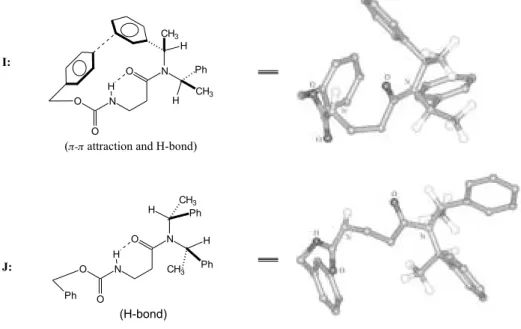
In order to rationalize the observed stereoinduction by the chiral bis(-phenylethyl)amino auxiliary in dianion (R,R)-1-Li2, we resorted to molecular modeling studies by means of semiempirical PM319 and ab initio calculations20. First of all, a search for low-energy conformations of starting chiral amide (R,R)-1 was undertook at semiempirical PM3 level, by means of the PC Spartan-Pro program19, which makes use of Monte Carlo stocastic methods21. This conformational search afforded nine structures corresponding to local minima within a
10 kcal/mol maximum energy threshold. These nine low-energy conformers were used as starting geometries for optimization at ab initio HF/3-21G and B3LYP/3-21+G(d) levels of theory. All studies converged into a global energy minimum, I, shown in Figure 3.
Salient features of structure I are (1) the N-H—O hydrogen bond stabilizing a “folded” conformation of the
A “folded” conformation in the -aminopropionic segment of monoanion (R,R)-1-Li is even more strongly favored (Figure 4). Indeed, structure K presenting a six-membered chelate N-Li—O is estimated to be 22.3 kcal/ mol more stable than an “extended” conformer L (Figure 4). Conformer K is also stabilized by - attraction23.
Finally, dianion (R,R)-1-Li2 presents the lowest-energy structure M depicted in Figure 5. Most interesting, the ion triplet24 configuration of the dilithium salt M is estimated
to be a remarkable 33.8 kcal/mol lower in energy than enolate N (Figure 5).
From observation of the calculated lowest-energy conformation for (R,R)-1-Li2 it can be appreciated that enolate face Si is less hindered towards electrophilic approach (syn to methyl vis-a-vis phenyl groups on the -phenethyl moieties) relative to the Re face, which is syn to the phenyl rings. Indeed, predicted addition of the electrophile on the Si face should lead to the preferred
Figure 4. Ab initio HF/3-21G conformation of minimun energy for (R, R)-1-Li (K). Alternative conformation L, presenting a four-membered N-Li—O chelate, calculated to be 22.3 kcal/mol higher in energy.
(- attraction and N-Li---O bond) N
O Li
H N Ph
CH3
O O
H
CH3
K:
(four-membered N-Li---O ring) O
N
O
N CH3
O Ph
Li Ph
H Ph
H CH3
L:
Figure 3. Ab initio HF/3-21G conformation of minimun energy for (R, R)-1 (I). An alternative conformation J fulfilling anticipation based on the concept of allylic A1,3 strain22 is calculated as 6.7 kcal/mol higher in energy.
(H-bond) N
O H
CH3
N H CH3
O O
H Ph
Ph
Ph
I:
N O H
H N Ph CH3
O O
H
CH3
formation of the (S)-configurated stereogenic center, as experimentally observed (Scheme 3).
Conclusions
C-Alkylation of (R,R)-1, a chiral -alanine derivative containing the bis(-phenylethyl)amine moiety, was accomplished in moderate to good yields via dianion (R,R)-1-Li2. Observed diastereoselectivities with various alkyl halides varied in the 65-86% ds range, and were essentially unaffected by the presence of additives (LiCl, HMPA).
Assignment of configuration at the newly created stereogenic center in the methylation reaction was achieved by chemical correlation with (S)--methyl--alanine. This configuration for the main product of alkylation can be rationalized in terms of the presumed conformation of minimum energy for (R,R)-1-Li2, determined by ab initio HF/3-21G calculations, which exhibits a relatively unhindered Si face of the enolate.
Experimental Section
Materials and Methods
Flasks, stirring bars, and hypodermic needles used for the generation and reactions of organolithiums were dried for ca. 12 h at 120°C and allowed to cool in a desiccator over anhydrous CaSO4. Anhydrous solvents were obtained by distillation from benzophenone ketyl25. The n
-butyllithium employed was titrated according to the method of Juaristi, et al26.
TLC: Merck-DC-F254 plates, detection by UV light. Flash column chromatography14: Merck silica gel (0.040-0.063 mm). Melting points: Mel Temp apparatus, not corrected. 1H NMR spectra: Jeol Eclipse-400 (400 MHz), Bruker Ultra Shield (300 MHz), and Jeol GSX-270 (270 MHz) spectrometers. 13C NMR spectra: Jeol Eclipse-400 (100 MHz), Bruker Ultra Shield (75 MHz), and Jeol GSX-270 (67.5 MHz). Chemical shifts () in ppm downfield from internal TMS reference; the coupling constants (J) are given in hertz. High-resolution mass spectra (HRMS) were obtained at Instituto de Química, UNAM, México.
Procedures
(R,R)-N’,N’-Bis(1’-phenylethyl)-N-carbobenzyloxy-propionamide [(R,R)-1]
A solution containing 10.0 g (112.0 mmol) of -aminopropionic acid in 112.0 mL of 1 N NaOH was cooled in an ice bath and treated with 17.6 mL (21.0 g, 0.12 mol) of benzylchloroformate, followed by slow addition of 112.0 mL of 1 N NaOH. The resulting mixture was allowed to warm up to ambient temperature and stirred overnight. The crude product was extracted with three 100 mL portions of diethyl ether, and the aqueous phase was acidified with 6 N HCl to pH < 4.0. The precipitate that developed was dissolved in CH2Cl2, dried over anhydrous Na2SO4 and concentrated in the rotary evaporator. Recrystallization of the resulting Figure 5. Ab initio HF/3-21G conformation of minimun energy for (R,R)-1-Li2 (M), presenting an ion triplet24 configuration. Alternative E-enolate N is
calculated as 33.8 kcal/mol higher in energy. N
Li
H N H O
Ph O
CH3 Ph
CH3
Ph O Li
N Li O
O
Ph
O
Ph CH3
Ph
N
CH3
Li
H H
M:
residue from ethyl acetate:ethanol (10:1) afforded 21.5 g (86% yield) of the desired product (N -carbobenzyloxy-3-aminopropionic acid), mp 103-104°C (lit.27a mp 103-105°C). This crystalline material (0.5 g, 2.2 mmol) was dissolved in 6.0 mL of CH2Cl2 and three drops of dimethylformamide. The resulting solution was treated with 0.65 mL (9.0 mmol) of thionyl chloride, and heated to reflux for 4 h. The solvent was removed in the rotary evaporator and the residue was washed three times with toluene, and then was redissolved in 4.0 mL of CH2Cl2, and added to a solution of 1.0 g (4.4 mmol) of (R,R)-N,N-bis-(1-phenylethyl)amine27b in 4.0 mL of toluene, under nitrogen at 0°C. The reaction mixture was allowed to warm up and stirred at ambient temperature for 14 h. The solvent was removed in the rotary evaporator and the product was redissolved in diehtyl ether, dried over anhydrous Na2SO4 filtered, and concentrated to give an oil that was purified by flash chromatography (hexane:EtOAc, 9:1 ® 7:3) to afford 0.60 g (62% yield) of (R,R)-1, []28
D = + 111.5 (c = 1, CHCl3). 1H-NMR (DMSO-d
6, 300 MHz, 100°C)28 1.70 (d, J 7.1, 3H), 1.71 (d, J 7.1. 3H), 2.35-2.46 (m, 1H), 2.57-2.68 (m, 1H), 3.26-3.37 (br, 2H), 5.06 (~s, 2H), 5.13 (q, J 7.1, 2H), 6.55-6.63 (br, 1H), 7.10-7.23 (m, 10H), 7.27-7.42 (m, 5H). 13C-NMR (DMSO-d
6. 75 MHz, 100°C) 19.5, 36.2, 38.4, 54.0, 66.3, 127.5, 128.1, 128.3, 128.4, 128.6, 129.1, 138.2, 142.3, 156.8, 171.5. HRMS calcd for C27H30N2O3 (M+ + 1): 431.2335. Found: 431.2354.
(R,R)-N’,N’-Bis(1’-phenylethyl)-N-(N”-carbobenzyl-oxyaminopropionyl)N-carbobenzyl-oxypropionamide [(R,R)-2]
This dipeptide was obtained as side product in the preparation of (R,R)-1. []28
D = + 82.6 (c = 1, CHCl3). 1
H-NMR (DMSO-d6, 400 MHz, 100°C) 1.65 (d, J 7.3, 6H), 2.46 (ddd, 1J 15.5, 2J 7.7, 3J 7.6, 1H), 2.64 (ddd, 1J 15.5, 2J 7.6, 3J 7.6, 1H), 3.03 (t, J 6.8, 2H), 3.35 (dt, 1J 6.6,
2J 6.6, 2H), 3.94 (dd, 1J 7.5, 2J 7.5, 2H), 5.01-5.18 (m, 4H),
5.21 (d, J 12.5, 1H), 5.25 (d, J 12.5, 1H), 6.78 (br, 1H), 7.06-7.55 (m, 20H). 13C-NMR (DMSO-d
6, 100 MHz, 100°C) 19.0, 34.4, 37.4, 38.6, 41.5, 53.5, 53.5, 65.9, 68.6, 127.1, 127.8, 128.0, 128.1, 128.2, 128.2, 128.4, 128.7, 128.9, 136.0, 137.8, 141.8, 154.3, 156.5, 170.4, 173.8 MS (15 eV) m/z 636 (M+ +1), 530, 422, 303, 259, 210, 120, 91. HRMS calcd for C38H42N3O6: 636.3074. Found: 636.3084.
General procedure for the reaction of -alaninamide dianion (R,R)-1-Li2 with electrophiles
To a solution of 0.43 mL (1.02 mmol) of 2.6 N n-BuLi in 5 mL of THF at -78°C and under nitrogen atmosphere
was added dropwise 0.20 g (0.46 mmol) of (R,R)-1 in 10 mL of THF. The resulting solution was stirred for 1 h at -78°C and then the alkylating agent (1.1 equiv) was added with continuous stirring. The reaction mixture was stirred at -78°C for 3-4 h before quenching with aq. NH4Cl. The product was extracted with three 5-mL portions of EtOAc, the combined organic extracts were dried over anhydrous Na2SO4, filtered and concentrated. Final purification of the diastereomeric mixture of products was accomplished by flash chromatography14 (hexane:EtOAc, 80:20).
(R,R)-N’,N’-Bis(1’-phenylethyl)-N-carbobenzyloxy-(2S)-2-methylpropionamide [(R,R,S)-3].
These NMR data correspond to the major product of methylation, as extracted from spectra of the unseparable diastereomeric mixture (see section B and Table 1). 1 H-NMR (DMSO-d6, 300 MHz, 100°C28) 0.72 (d, J 6.6, 3H), 1.69 (d, J 6.6 Hz, 3H), 1.71 (d, J 6.0, 3H), 2.83-2.97 (m, 1H), 3.00-3.13 (m, 1H), 3.24-3.36 (m, 1H), 5.08 (s, 2H), 5.12-5.32 (br, 2H), 6.67-6.80 (br, 1H), 7.05-7.40 (m, 15H). 13C-NMR (DMSO-d
6, 75 MHz, 100°C) 14.0, 18.3, 37.4, 44.2, 52.0, 64.9, 126.1, 126.7, 126.9, 127.0, 127.2, 127.6, 136.7, 141.0, 155.7, 174.4.HRMS calcd for C28H32N2O3: 445.2491. Found: 445.2492.
(R,R)-N’,N’-Bis(1’-phenylethyl)-N-carbobenzyloxy-(2S)-2-benzylpropionamide [(R,R,S)-4].
The following NMR data correspond to the major product of benzylation, which was separated and purified by fractional crystallization from EtOAc, mp 187-189°C. []28
D = + 89.6 (c = 1, CHCl3). It is assumed that benzylation takes place with similar stereochemical outcome as the methylation reaction. 1H-NMR (DMSO-d
6, 300 MHz, 100°C) 1.33 (br, 3H), 1.54 (br, 3H), 2.7 (d, J 6.5, 2H), 3.19 (m, 1H), 3.27-3.42 (m, 2H), 4.83 (br, 1H), 5.07 (m, 2H), 6.76 (br, 1H), 6.98-7.35 (m, 20H). 13C-NMR (DMSO-d6, 75 MHz, 100°C) 17.9, 35.9, 43.2, 44.5, 53.1, 65.0, 125.4, 127.0, 127.0, 127.5, 127.6, 128.5, 136.6, 138.8, 139.9, 141.2, 155.7, 172.7. HRMS calcd for C34H37N2O3 (M+ +1): 521.2804. Found: 521.2797
(R,R)-N’,N’-Bis(1’-phenylethyl)-N-carbobenzyloxy-(2S)-ethylpropionamide [(R,R,S)-5].
1H-NMR (DMSO-d
6, 300 MHz, 100°C) 0.63 (t, J 7.4 Hz, 3H), 1.24-1.43 (m, 2H), 1.67 (d, J 7.0 Hz, 6H), 2.91 (m, 1H), 3.14 (ddd, 1J 13.4 Hz, 2J 6.3 Hz, 3J 2.0 Hz, 1H), 3.32 (ddd, 1J 13.2 Hz, 2J 6.5 Hz, 3J 2.2 Hz, 1H), 5.05 (s, 2H), 5.14 (q, J 7.0 Hz, 2H), 6.62 (br, 1H), 7.10 (m, 10H) 7.32 (m, 5H). 13C-NMR (DMSO-d
6, 75 MHz, 100°C) 10.3, 18.1, 22.6, 42.7, 43.6, 52.5, 65.0, 126.0, 126.8, 126.9, 127.0, 127.1, 127.6, 136.7, 141.0, 155.7, 173.5. HRMS calcd for C29H35N2O3 (M+ +1): 459.2648. Found: 459.2661.
(R,R)-N’,N’-Bis(1’-phenylethyl)-N-carbobenzyloxy-(2S)-(n-propyl)propionamide [(R,R,S)-6].
The following NMR data correspond to the major product of alkylation with n-propyl iodide, as extracted from spectra of the unseparable diastereomeric mixture (see section B and Table 1), and assuming that propylation takes place with the same stereochemical outcome as the methylation reaction. 1H-NMR (DMSO-d
6, 300 MHz, 100°C) 0.71 (t, J 7.2 Hz, 3H), 0.94-1.14 (m, 2H), 1.25-1.35 (m, 2H), 1.66 (d, J 7.0 Hz, 6H), 2.90-3.00 (m, 1H), 3.08-3.19 (m, 1H), 3.31 (ddd, 1J 13.2 Hz, 2J 6.5 Hz, 3J 2.1 Hz, 1H), 5.04 (s, 2H), 5.12 (q, J 7.0, 2H), 6.61 (br, 1H), 7.05 (m, 10H) 7.28 (m, 5H). 13C-NMR (DMSO-d
6, 75 MHz, 100°C) 13.3, 18.1, 18.9, 31.9, 42.1, 42.8, 52.6, 65.0, 126.0, 126.7, 126.8, 126.9, 127.0, 127.1, 127.6, 136.7, 140.7, 155.6, 173.6. HRMS calcd for C30H37N2O3 (M+ + 1): 473.2804. Found: 473.2794.
(S)-2-Methyl-3-aminopropionic acid [(S)-7]
In a hydrogenation flask was placed 0.34 g (0.77 mmol) of the diastereomeric mixture of (R,R,S)-3 and (R,R,R)-3 (dr = 75:25), 0.035 g of 10% Pd(C), and 25 mL of methanol. The flask was pressurized to 1 atm of H2 and stirred at ambient temperature for 6 h. The reaction mixture was filtered over celite and concentrated in a rotary evaporator to afford the deprotected amine in 98% yield (0.23 g). This product was transferred to a glass ampoule and dissolved in 8.0 mL of 4N HCl and heated to 90°C for 14 h. The crude product was washed with three 20-mL portions of CH2Cl2, the aqueous phase was concentrated, and the residue was adsorbed to acidic ion exchange resin Dowex 50W X4. The residue was washed with distilled water until the washings came out neutral, and then the free amino acid was recovered with 0.1 N aqueous NH4OH. Evaporation afforded 0.07 g (93% yield) of the chiral -amino acid (S)-7 (expected ee = 50%, based on the 75:25 diastereomeric ratio of the starting material (R,R,S)- and (R,R,R)-3). []28
D = +7.9 (c = 1.03, 1 N HCl), lit. 29 []28
D = - 14.2 (c = 0.42, H2O) for the pure (R) enantiomer.
Acknowledgments
We are indebted to Conacyt-Mexico for financial support via grant L0006-E9607. We are also grateful to Víctor M. González and María Luisa Rodríguez for their assistance in the recording of NMR spectra.
References
1. See, for example: Ojima, I.; Lin, S.N.; Wang, T. Curr. Med. Chem.1999, 6, 927.
2. See, for example: Bates, R.B.; Brusoe, K.G. Burns, J.J.; Caldera, S.; Cui, W.; Gangwar S.; Gramme, M.R.; McClure, K.J.; Rouen, G.P.; Shadow, H.; Stessman, C.C.; Taylor, S.R.; Vu, V.H.; Yarick, G.V. Zhang, J.X.; Pettit, G.R.; Bontems, R. J. Am. Chem. Soc. 1997, 119, 2111.
3. For example, (R)--dopa in mushrooms; see: von Nussbaum, F.; Spiteller, P.; Ruth, M. Steglich, W.; Wanner, G.; Gamblin, B.; Stievano, L.; Wagner, F.E. Angew. Chem. Int.Ed., 1998, 37, 3292.
4. See, for example: Tamariz, J. In Enantioselective Syn-thesis of -Amino Acids; Juaristi, E., Ed.; Wiley: New York, 1997; pp 45-66.
5. See, for example: Georg, G. I., Ed., The Organic Chemistry of -Lactams; Verlag Chemie: New York, 1993.
6. See, for example: (a) Seebach, D.; Gademann, K.; Ernst, M.; Hoyer, D. Angew. Chem.Int. Ed.1999, 38, 1223. (b) Gellman, S.H. Acc. Chem. Res.1998, 31, 173.
7. (a) Juaristi, E.; Quintana, D.; Escalante, J. Aldrichim. Acta1994, 27, 3. (b) Cole, D.C. Tetrahedron 1994, 50, 9517. (c) Cardillo, G.; Tomasini, C. Chem. Soc. Rev. 1996, 23, 117. (d) Juaristi, E., Ed. Enantioselective Synthesis of -Amino Acids; Wiley: New York, 1997. (e) Juaristi, E.; López-Ruiz, H. Curr. Med. Chem.1999, 6, 983.
8. (a) Ponsinet, R.; Chassaing, G.; Vaissermann J.; Lavielle, S. Eur. J. Org. Chem.2000, 83. (b) Nagula, G.; Huber, V.J.; Lum, C.; Goodman, B.A. Org. Lett. 2000, 2, 3527. (c) Gutiérrez-García, V.M.; López-Ruiz, H. Reyes-Rangel, G.; Juaristi, E. Tetrahedron 2001, 57, 6487.
9. (a) Myers, A.G.; Gleason, J.L.; Yoon, T. J. Am. Chem. Soc.1995, 117, 8488. (b) Myers, A.G.; Gleason, J.L.; Yoon, T.; Kung, D.W. J. Am. Chem. Soc.1997, 119, 656. (c) Myers, A.G.; Schnider, P.; Kwoon S.; Kung, D.W. J. Org. Chem.1999, 64, 3322.
11. McIntosh, J.M.; Peters, S. Synthesis1999, 635. 12. See, also: (a) Seebach, D.; Estermann, H.
Tetrahe-dron Lett.1987, 28, 3103. (b) Seebach, D.; Jacobi, A.; Rueping, M.; Gademann, K.; Ernst, M.; Jaun, B. Helv. Chim. Acta 2000, 83, 2115. (c) Papa, C.; Tomasini, C. Eur. J. Org. Chem. 2000, 1569. (d) Beatty, M.; Jennings-White, C.; Avery, M.A. J. Chem. Soc., Perkin Trans.11992, 1637.
13. Seebach, D.; Imwinkelried, R.; Weber, T. In Modern Synthetic Methods 1986, Scheffold, R., Ed.; Springer Verlag: Berlin, 1986; pp 125-259 and refs. 77-79 therein.
14. Still, W.C.; Kahn, M.; Mitra, A. J. Org. Chem.1978, 43, 2923.
15. Reaction additives such as “inert” inorganic salts (LiCl, LiClO4, etc.) and polar aprotic cosolvents (HMPA, DMPU,16 etc.) can have a profound effect on the diastereoselectivity of chiral enolate alkylation. See, for example: (a) Juaristi, E.; León-Romo, J.L.; Ramírez-Quirós, Y. J. Org. Chem.1999, 64, 2914. (b) Reyes, A.; Juaristi, E. Tetrahedron: Asymmetry2000, 11, 1411. 16. DMPU, N,N-dimethylpropylene urea. For leading
ref-erences on the use of DMPU, see: (a) Seebach, D.; Beck, K.A.; Studer, A. Modern Synthetic Methods 1995; VCH Publishers: Basel, 1995; pp 1-178. (b) Juaristi, E.; Murer, P.; Seebach, D. Synthesis 1993, 1243. (c) Mukhopadhyay, T.; Seebach, D. Helv. Chim. Acta1982, 65, 385.
17. For excellent reviews on salt effects in chemical reac-tivity, see ref. 16a and also: Loupy, A. Tchoubar, B.; Astruc, D. Chem. Rev.1992, 92, 1141.
18. Juaristi, E.; Quintana, D.; Balderas, M.; García-Pérez, E. Tetrahedron: Asymmetry1996, 7, 2233.
19. PC Spartan-Pro, version 1.0; Wavefunction, Inc.: Irvine, CA, 1999.
20. Gaussian 98 (revision A.7); Frisch, M.J.; Trucks, G.W.; Schlegel, H.B.; Scuseria, G.E.; Robb, M.A.; Cheeseman, J.R.; Zakrzewski, V.G.; Montgomery, J.A.; Stratmann, R.E.; Burant, J.C.; Dapprich, S.; Millan, J.M.; Daniels, A.D.; Kudin, K.N.; Strain, M.C.; Farkas, O.; Tomasi, J.; Barone, V.; Cossi, M.: Cammi,
R.; Mennucci, B.; Pmelli, C.; Andano, Clifford, S.; Ochterski, J.; Peterson, G.A.; Ayala, P.Y.; Cui, Q.; Ortiz, J.V.; Baboul, A.G.; Stefanov, BG.B.; Liu, G.; Liashensko, A.; Piskorz, P.; Komarromi, I.; Gomperts, R.; Martin, R.L.; Fox, D.J.; Keith, D.J.; Al-Lahman, M.A.; Peng, C.Y.; Nanyakkara, A.; González, C.; Challacomble, M.; Gill, P.M.W.; Johnson, B.; Chen, W.; Wong, M.W.; Andres, J.L.; González, C.; Head-Gordon, M.; Replogle, E.S.; Pople, J.A. Gaussian, Inc.: Pittsburg, PA, 1998.
21. Chang, G.; Guida, W.C.; Still, W.C. J. Am. Chem. Soc. 1989, 111, 4379.
22. (a) Johnson, F.; Malhotra, S.K. J. Am. Chem. Soc. 1965, 87, 5492. (b) Hoffmann, R.W. Chem. Rev.1989, 89, 1841. (c) See, also: Juaristi, E.; León-Romo, J.L.; Reyes, A.; Escalante, J. Tetrahedron: Asymmetry1999, 10, 2441.
23. See, for example: Jorgensen, W.L.; Severance, D.L. J. Am. Chem. Soc.1990, 112, 4768.
24. (a) Streitwieser, A. Acc. Chem. Res.1984, 17, 353. (b) Streitwieser, A.; Bachrach, S.M.; Dorigo, A.; Schleyer, P.v.R. In Lithium Chemistry: A Theoretical and ExperimentalOverview; Sapse, A.M.; Schleyer, P.v.R., Eds.; Wiley: New York, 1995; pp 12-15. 25. Brown, H.C.; Kramer, G.W.; Levy, A.B.; Midland,
M.M. Organic Synthesis via Boranes; Wiley: New York, 1975; p 256.
26. Juaristi, E.; Martínez-Richa, A.; García-Rivera, A.; Cruz-Sánchez, J.S. J. Org. Chem.1983, 48, 2603. 27. (a) King, T.E.; Stewart, C.J.; Cheldelin, V.H. J. Am.
Chem. Soc., 1953, 75, 1290. (b) Overberger, C.G.; Marullo, N.P.; Hiskey, R.G. J. Am. Chem. Soc.1961, 83, 1374.
28. NMR spectra were recorded at 100°C in order to sim-plify their appearance, since rotation around the N-C=O amide segment is slow at ambient temperature, giving rise to a complex mixture of signals.
29. Balenovic, K.; Bregant, N. Tetrahedron 1959, 5, 44.