Article
Printed in Brazil - ©2012 Sociedade Brasileira de Química0103 - 5053 $6.00+0.00
A
*e-mail: [email protected]
A Catalytic Kinetic Spectrophotometric Determination of Organophosphorus
Pesticides in Vegetable Samples
Neetu Tiwari* and Anupama Asthana
Department of Chemistry, Govt. V.Y.T. P.G., Autonomous College, 491001 Durg, Chhattisgarh, India
Um método cinético catalítico espectrofotométrico, simples, seletivo e sensível para a determinação de quantidade traço de pesticidas organofosforados foi proposto. O método é baseado no efeito catalítico de pesticidas organofosforados (malationa, dimetoato e forato) na oxidação de LCV (leuco cristal violeta) por iodato de potássio em meio de ácido clorídrico, produzindo um corante violeta. O corante apresenta absorção máxima em 592 nm. O método de tempo fixo foi usado por 15 min. O sistema obedece a lei de Beer no intervalo de 0,02-0,2, 0,032-0,32 e 0,03-0,3 µg mL-1, para malationa, dimetoato e forato, respectivamente. Parâmetros analíticos
importantes como tempo, temperatura, concentração do reagente, acidez, etc, foram otimizados para reação completa. A sensibilidade de Sandell e absortividade molar para o sistema foram 0,0002, 0,0004, 0,0004 µg cm-2 e 1,2 × 10⁶ , 5,21 × 10⁵, 6,3 × 10⁵ L mol-1cm-1, respectivamente. O
método proposto foi aplicado satisfatoriamente à determinação de pesticidas organofosforados, em micro concentrações, em amostras vegetais.
A simple selective and sensitive catalytic kinetic spectrophotometric method for the determination of trace amount of organophosphorus pesticides has been proposed. The method is based on the catalytic effect of organophosphorus pesticides (malathion, dimethoate and phorate) on the oxidation of LCV (leuco crystal violet) by potassium iodate in hydrochloric acid medium to give a violet colored dye. The dye shows maximum absorption at 592 nm. The fixed-time method was used for 15 min. The system obeys Beer’s law in the range of 0.02-0.2, 0.032-0.32 and 0.03-0.3 µg mL-1, for malathion, dimethoate, and phorate, respectively. Important analytical
parameters such as time, temperature, reagent concentration, acidity etc, have been optimized for complete color reaction. Sandell’s sensitivity and molar absorptivity for the system were found to be 0.0002, 0.0004, 0.0004 µg cm-2 and 1.2 × 10⁶, 5.21 × 10⁵, 6.3 × 10⁵ L mol-1cm-1, respectively.
The proposed method was satisfactorily applied to micro-level determination of organophosphorus pesticides in vegetable samples.
Keywords: organophosphorus pesticides, potassium iodate, leuco crystal violet, spectrophotometry, vegetables
Introduction
Organophosphorus pesticides are potentially hazardous substances widely used in agriculture due to their high insecticidal activity.1 Organophosphates are organic
esters of phosphoric acid, thiophosphoric acid and other phosphoric acids.2 These pesticides are toxic for mammals
due to the inhibition of the acetyl cholinesterase (AChE), an enzyme necessary for the normal function of the central nervous system.3,4 The pesticide residue causes
serious health hazard, its ill effect can be reduced to minimum by detecting and then controlling it.5 A number
of methods have been developed in the last few years for the detection of organophosphorus pesticides. The most widely used methods are gas chromatography (GC),6-8
high-performance liquid chromatography (HPLC),9,10 gas
chromatography-mass spectrometry (GC-MS),11 immune
assay and fluorescence,12,13 chemiluminescence (CL).14-16
Tiwari and Asthana 323 Vol. 23, No. 2, 2012
availability in most laboratories. Some spectrophotometric methods have also been reported. Most of the methods involve the determination of organophosphorus pesticides by total phosphorous measurements based on the formation of molybdenum blue using various reducing agents.17-19 Others are based on the oxidation of pesticide
and determination of unconsumed oxidant by bleaching of dye.20 Some of the methods suffer from interference,
poor sensitivity, instability of color or involve extraction whereas other suffers from blank absorption or longer time required for the color development. To overcome these drawbacks a selective and sensitive method has been proposed for the determination of the studied organophosphorus pesticides.
In the present study a validated, rapid, sensitive, selective kinetic spectrophotometric method for the determination of organophosphorus pesticides is developed. The method is based on the catalytic effect of organophosphorus pesticides on the oxidation of LCV (leuco crystal violet) by potassium iodate in acidic medium. The proposed method is specific for thion compounds containing P=S bond like malathoin, dimethoate, phorate. Nowadays these pesticides are increasingly being used in agriculture.
Experimental
Apparatus and reagents solutions
A Systronics Visiscan 167 was used for spectral measurements. Measurements of pH were made with Systronics digital pH meter 335. All reagents used were of analytical grade, double distilled deionized water has been used for preparation of solutions. Stock solutions of organophosphorus pesticides, i.e., malathion, phorate, and dimethoate (Northern Minerals Ltd., India) were prepared by dissolving 100 mg of insecticide (technical forms and formulations) in minimum amount of glacial acetic acid (Merck, Mumbai, India) and then diluted to 100 mL with distilled water. Working standards were prepared by appropriate dilution. Potassium iodate (Merck, Mumbai, India) aqueous solution 4.7×10⁻³ mol L−1 was
prepared. This was stored in ambar bottle. To prepare 6.7×10⁻⁴ mol L−1 solution of LCV (leuco crystal violet)
(Merck, Mumbai, India), 200 mL of water, 3 mL of 85% phosphoric acid and 250 mg of LCV were added to a 1 L volumetric flask and shaken gently until the LCV dissolved. The content of the flask was then filled to 1 L with distilled water. The solution was stable for several months. Solutions of 2 mol L−1 hydrochloric acid (Merck,
Mumbai, India) and 0.2 mol L−1 sodium hydroxide
(Merck, Mumbai, India) were prepared.
Procedure
Preparation of the calibration curve
To a series of 25 mL volumetric flasks, 1.0 mL of 6.7×10⁻⁴ mol L−1 LCV solution, 1.0 mL of 2.0 mol L−1
hydrochloric acid and 1.0 mL of different concentration of organophosphorus pesticides (malathion, dimethoate and phorate) were added in sequence. Then 1.0 mL of 4.7×10⁻³ mol L−1 potassium iodate solution was added
and the pH was adjusted by adding 0.2 mol L−1 NaOH.
Following, the solution was diluted to the mark with double distilled water. The zero time was taken as the moment at which the last drop of potassium iodate solution was added and the solution was mixed well. Then the volumetric flasks were placed in a boiling water bath for 15 min at 35 °C for completion of the reaction. The content was then cooled under tap water for 3 min to stop the catalytic reaction. After that, a portion of the solution was transferred into a quartz cell and the absorbance was measured against double distilled water at 592 nm. The blank reaction was performed according to the same procedure without addition of organophosphorus pesticides and the change in absorbance was measured. The standard curve was constructed between the difference between blank and sample absorbance versus time. The absorbance of catalyzed and non-catalyzed reaction was measured simultaneously.
Determination of organophosphorus pesticide in pesticide free samples
To check the recoveries of organophosphorus pesticides, vegetable samples free from organophosphorus pesticides, were taken and treated with a known amount of the organophosphorus pesticide and kept for ca. 24 h. The samples were then washed with ethanol.20 Different
proportions of ethanol were tested for extraction and the best result was obtained with 85% of ethanol. Then washings were collected and evaporated and residue is dissolved in 0.1% acetic acid. Aliquots of these washings were used for the determination of organophosphorus pesticide by the proposed method. The proposed method was successfully applied for the determination of organophosphorus pesticide in vegetable samples. The recovery range is summarized in Table 3.
Results and Discussion
LCV (leuco crystal violet) is a compound which can be oxidized with potassium iodate at very slow reaction rate. It has been reported that organophosphates have an induction effect on iodine azide reaction.22 Similarly, in the proposed
reaction between LCV and potassium iodate in the presence of hydrochloric acid medium. An organophosphorus pesticide increases the rate of this reaction at ultra trace level. Therefore, by measuring the increase in absorbance of CV (crystal violet), which is the oxidized product of LCV, for a fixed time of 15 min of the reaction, the organophosphate content in the sample can be measured. It was observed that such type of catalytic activity was mainly exhibited by thiophosphoryl compounds and depends on the nature of the P=S bond, so the organophosphorus pesticide like monocrotophose which do not have P=S bond, does not show the catalytic activity. The probable mechanism of the catalytic reaction is given in reaction Scheme 1.
Effect of acid concentration
The effect of various acids of same concentration such as sulphuric acid, acetic acid, nitric acid has been studied. The results show that hydrochloric acid gives greater sensitivity. The effect of hydrochloric acid concentration on obtaining maximum sensitivity was investigated with 4.7×10⁻³ mol L−1 potassium iodate, and 6.7×10⁻⁴ mol L−1
LCV for catalyzed and non-catalyzed reaction at 35 oC
(Figure 1 ).
Effect of potassium iodate concentration
The effect of potassium iodate concentration in the reaction rate was studied with 2 mol L−1 hydrochloric
acid and 6.7×10⁻⁴ mol L−1 LCV at 35 oC. The results show
that by increasing the potassium iodate concentration up to 4.7×10⁻³ mol L−1 the sensitivity increases, whereas
a greater amount of reagent decreases sensitivity. Thus 4.7×10⁻³ mol L−1 potassium iodate was selected throughout
the study (Figure 2).
Effect of leuco crystal violet concentration
The influence of LCV concentration on the reaction rate was studied in the range of 1×10⁻⁴ to 10×10-4 mol L−1 with 2
mol L−1 hydrochloric acid and 4.7×10⁻³ mol L−1 potassium
iodate at 35 oC. The results show that by increasing the
LCV concentration up to 6.7×10⁻⁴ mol L−1,the sensitivity
increases, whereas a greater amount of reagent decreases
Scheme 1.
Tiwari and Asthana 325 Vol. 23, No. 2, 2012
sensitivity, thus 6.7×10⁻⁴ mol L−1LCV was selected for the
study (Figure 3).
Effect of temperature and time
The effect of temperature on the catalytic reaction was studied in the range of 10 oC to 70 oC with the optimum of
the reagent concentrations. The results showed that as the temperature increases up to 35 oC the sensitivity increases,
whereas higher temperature values decreases the sensitivity (∆A
s–∆Ab). Therefore, 35 oC was selected for further study
and 15 min time was suitable for the study of catalytic reaction (Figure 4).
Spectral characteristics and method validation
The absorption spectra of final colored product showed a maximum absorbance at 592 nm (Figure 5). The reagent blank had negligible absorbance at this wavelength. Beer’s law was obeyed over the concentration range of 0.02-0.2, 0.032-0.32, 0.03-0.3 µg mL-1 for malathion, dimethoate
and phorate, respectively (Figure 6). The curve was linear with different slopes for malathion, dimethoate, phorate
and has a good correlation. The molar absorptivities and Sandell’s sensitivity of malathion, dimethoate, phorate are given in Table 1. The slope, intercept, and the correlation coefficient were calculated by least square regression analysis (Table 1).The limits of detection and quantitation (LOD = 3.3 σ /S and LOQ = 10 σ /S, where σ is the slope of the calibration curve), SD of slope and intercept calculated are given in Table 1. The precision of the method was calculated in terms of intermediate precision (intra-day and inter-day). Three different concentrations of OPP
Figure 2. Effect of iodate concentration on the sensitivity. Conditions: OPP: 0.12 µg mL-1; hydrochloric acid: 2 mol L−1; LCV: 6.7×10⁻⁴ mol L−1; temperature: 35 oC.
Figure 3. Effect of LCV concentration on the sensitivity. Conditions: OPP: 0.12 µg mL-1; hydrochloric acid: 2 mol L−1; potassium iodate: 4.7×10⁻³ mol L−1; temperature: 35 oC.
Figure 4. Effect of temperature on the sensitivity. Conditions: OPP: 0.12 µg mL-1; LCV: 6.7×10⁻⁴ mol L−1; hydrochloric acid: 2 mol L−1; potassium iodate: 4.7×10⁻³ mol L−1.
Figure 5. Absorption spectra of colored product; A: blank, B: 0.1 µg mL-1, C: 0.14 µg mL-1 OPP.
(organophosphorus pesticides), within the working limits, were analyzed in seven replicates during the same day (intra-day precision) and seven consecutive days (inter-day precision). The RSD (%) values range of intra-day and inter-day studies showed that the precision was good for the method (Table 1).
Interference studies
The effect of foreign ions and pesticides expected to exist in field samples of organophosphorus pesticide were studied by adding known amount of different foreign ions to the test solution containing 0.1 µg mL-1 organophosphorus
pesticide. The method was found to be free from most of the interferents. The tolerance limits shown in Table 2 are the concentration of interfering species that may cause variation ≥ (±) 2% in the absorbance value.
Application
Determination of organophosphorus pesticides in real vegetable samples
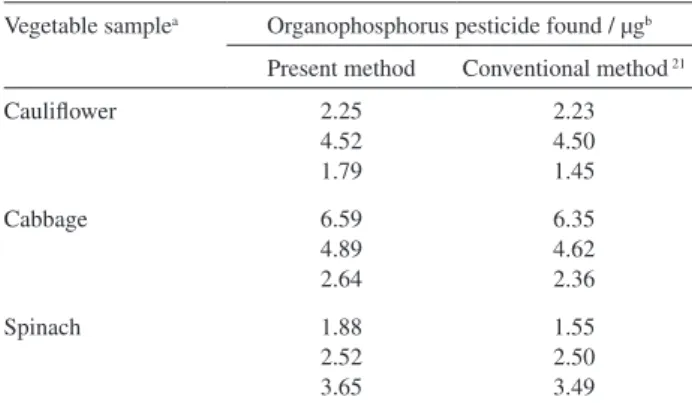
Vegetable samples were collected from agricultural field where organophosphorus pesticide (malathion) was sprayed (1 to 5 pints per acre). The samples were weighed, macerated with ethanol and then filtered through a thin cotton cloth. The filtrate was centrifuged at 1850g for 10 min. An aliquot of supernatant was taken and evaporated then residue is dissolved in 0.1% acetic acid and analyzed as described above. The filtrate which was greenish yellow due to the presence of organic matter from plant was passed through a silica gel column (10 × 1 cm) to remove chlorophyll and other interfering materials. The column was washed with 10 mL of 0.1% acetic acid. Washings were collected and analyzed as recommended above by the proposed as well as the conventional ascorbic acid method21
and the results are shown in Table 4.
Table 1. Analytical and method validation parameters
Parameters Malathion Dimethoate Phorate
λmax / nm
Range of Beer’s law / ( µg mL-1) Stability of color / h
Molar absorptivity / (L mol-1 cm-1) Sandell’s sensitivity / (µg cm-2 ) Relative standard deviation / % Intra-day
Inter-day Limit of Detection Limit of Quantification SD of slope
SD of intercept
Regression equation (y= bx+a)* Correlation coefficient Slope (b) Intercept (a) 592 0.02-0.2 48 1.2 × 10⁶
0.0002 0.466-3.278 1.11-3.37 0.004 0.01 0.084 0.006 0.999 4.37 -0.0033 592 0.032-0.32 48 5.2 × 10⁵
0.0004 0.46-2.6 0.65-1.48 0.008 0.02 0.064 0.016 0.999 2.73 0.0065 592 0.03-0.3 48 6.3 × 10⁵
0.0004 0.53-2.7 0.59-4.5 0.007 0.02 0.059 0.017 0.999 2.86 -0.0044
*Concentration in µg mL-1.
Table 2. Effect of foreign species (concentration of organophosphorus pesticides 0.1 µg mL-1)
Foreign species Tolerance limit /
(µg mL-1)a
SO42−, CO
32
−, CH
3COO
−, benzene, acetone Se 4+, Fe2+
aniline
atrazine, pyrethroid pesticide
Cr3+, Cd2+, Mg2+, Na+, K+, Mn2+, Al3+,NH 4+, NO3
−, F−
bZn2+
dithiocarbamate pesticides carbamate pesticides [Br−, I−]c
Phenol 1000 500 250 250 200 100 40 15 10 8
aCausing (±) 2% variation in absorbance value; bmasking with 0.1% EDTA solution; cremoved by addition of nitric acid as well as boiling the solution.
Table 3. Determination of organophosphorus pesticide in pesticide free samples
Samplesa
Malathion Dimethoate Phorate
Added / µg
Foundb / µg
Rec. / %
Added / µg
Foundb / µg
Rec. / %
Added / µg
Foundb / µg Rec. / % Cauliflower Cabbage Spinach 20 40 60 20 40 60 20 40 60 18.5 38.2 59.1 19.4 39.2 58.5 19.2 38.8 58.1 92.5 95.5 98.5 97 98 97.5 96 97 96.83 20 40 60 20 40 60 20 40 60 18.92 39.12 59.13 19.16 38.75 58.93 19.77 39.43 58.84 94.6 97.8 98.55 95.8 96.87 98.21 98.85 98.57 98.06 20 40 60 20 40 60 20 40 60 18.75 38.33 58.75 19.06 39.16 58.55 18.88 38.46 59.31 93.75 95.82 97.91 95.3 97.9 97.58 94.4 96.15 98.85
Tiwari and Asthana 327 Vol. 23, No. 2, 2012
Table 4. Application of the method on real samples
Vegetable samplea Organophosphorus pesticide found / µgb
Present method Conventional method 21
Cauliflower
Cabbage
Spinach
2.25 4.52 1.79
6.59 4.89 2.64
1.88 2.52 3.65
2.23 4.50 1.45
6.35 4.62 2.36
1.55 2.50 3.49
aAmount of vegetable samples (from fields where organophosphorus pesticides were sprayed): 25 g; bmean of three replicate analysis.
Ascorbic acid method involves the reaction of orthophosphate with molybdate in acid solution, which forms a yellow-colored phosphomolybdate. The phosphomolybdate complex is then reduced by ascorbic acid, causing a characteristic molybdenum blue species which is measured at 700 nm.
Conclusions
The proposed method is more sensitive, simple and selective as compared with other spectrophotometric methods for determination of organophosphorus pesticides. The reported spectrophotometric methods are indirect, lengthy, time consuming, suffer from interference, poor sensitivity, instability of color, blank absorption or involve extraction. The rapid color development, stability and easy availability of the reagent and freedom from a large group of interfering species are some advantages of the method. As the presented method is based on catalytic effect on rate of reaction it can be further applied for simultaneous determination of these pesticides by applying initial rate and partial least square regression analysis method.
Acknowledgments
The authors are thankful to Government V. Y .T. PG Autonomous College, Durg for laboratory facilities and to Northern Minerals Ltd. India for free pesticide samples.
References
1. Li, A. F.; Liu, X. Y.; Kong, J.; Hu, H. Y.; Sun, L. H.; Qian, Z.;
J. AOAC Int.2009, 92, 914.
2. Al-Samariee, A. I.; Khloud, A. M.; Al-Bassomy, M. A.; Pesticide Sci. 1988, 22, 189.
3. Taira, K.; Aoyama, Y.; Kawamata, M.; Environ. Toxicol. Pharmacol.2006, 22, 40.
4. Inoue, S.; Saito, T.; Mase, H.; Suzuki, Y.; Takazawa, K.; Yamamoto, I.; Inokuchi, S.; J. Pharm. Biomed. Anal. 2007, 44, 258.
5. Li, B. X.; He, Y. Z.; Xu, C. L.; Talanta2007, 72, 223. 6. Ahmadi, F.; Assadi, Y.; Rezaee, M.; J. Chromatogr.2006, 1101,
307.
7. Jin, Y.; Yao, J. B.; Fu, H. B.; Pan, W.; Geng, Q. H.; Ma, W.;
Chin. J. Health Lab. Technol.2007, 17, 1153.
8. Knet, A. C. L.; Seng, L.; Pertanika J. Sci. Technol.2003, 11, 93.
9. Cho, Y.; Matsuoka, N.; Kamiya, A.; Chem. Pharm. Bull.1997,
45, 737
10. Martinez, R. C.; Gonzalo, E. R.; García, F. G.; Méndez, J. H.;
J. Chromatogr. A1993, 644, 49.
11. Lu, J. Z.; Lau, C.; Lee, M. K.; Ka, M.; Anal. Lett.2002, 455, 193.
12. Suvardhan, K.; Kumar, K.; Chiranjeevi, P.; Environ. Monit. Assess.2005, 108, 217.
13. Viveros, L.; Paliwal, S.; McCrae, D.; Wild, J.; Simonian, A.;
Sensor Actuat. B-Chem. 2006, 115, 150.
14. Li, A.; Liu, X.; Kong, J.; Huang, R.; Wu, C.; Anal. Lett. 2008,
41, 1375.
15. Lau, C.; Lu,J. Z.; Kai, M.; Anal. Lett.2004, 503, 235. 16. Li, B.; Zhang, Z.; Jin, Y.; Anal. Chem.2001, 73, 1203. 17. Sunita, S.; Gupta, V. K.; J. Ind. Chem. Soc.1987, 65, 114. 18. Getenga, Z. M.; Jandiiko, J. I. O; Wandigo, S. O.; Beck, E.;
Bull. Environ. Contam. Toxicol.2000, 64, 359. 19. Raju, J.; Gupta, V. K.; Microchem. J. 1989, 39, 166.
20. Mathew, S. B.; Pillai, A. K.; Gupta, V. K.; Electron. J. Environ. Agric. Food Chem. 2006, 5, 1604.
21. Lowry, O. H.; Lopez, J. A.; J. Biol. Chem.1946, 162, 421. 22. Kotynski, A.; Kudzin, Z. H.; Ciesielski, W.; Folia Chimica2004,
13, 135.