Short Report
S
J. Braz. Chem. Soc., Vol. 22, No. 2, 372-375, 2011. Printed in Brazil - ©2011 Sociedade Brasileira de Química 0103 - 5053 $6.00+0.00*e-mail: [email protected]
New Isolavone Derivative and Other Flavonoids from the Resin of
Amburana cearensis
Paulo N. Bandeira,*, a Silvana S. de Farias,a Telma L. G. Lemos,b Raimundo Braz-Filho,c
Hélcio S. Santos,a Maria R. J. R. Albuquerquea and Sônia M. O. Costad
aLaboratório de Química Orgânica, Universidade Estadual Vale do Acaraú,
62040-370 Sobral-CE, Brazil
bDepartamento de Química Orgânica e Inorgânica, Universidade Federal do Ceará,
60451-970 Fortaleza-CE, Brazil
cLaboratório de Ciências Químicas, CCT, Universidade Estadual do Norte Fluminense Darcy
Ribeiro, 28013-602 Campos-RJ, Brazil
dDepartamento de Física e Química, Universidade Estadual do Ceará,
60749-000 Fortaleza-CE, Brazil
A investigação fitoquímica da resina de Amburana cearensis A. C. Smith permitiu o isolamento de um novo composto: 3’,4’-dimetóxi-1’-(7-metóxi-4-oxo-4H-cromen-3-il) benzo-2’,5’-quinona (1), juntamente com seis compostos conhecidos e identificados como: 4,2’,4’-triidroxichalcona (2), 7,8,3’,4’-tetrametoxiisolavona (3), 4,2’,4’-triidroxi-3-metoxichalcona (4), 3,4,5-trimetoxicinamaldeido (5), 3’,4’-dimetoxi-7-hidroxiisolavona (6) e 6,7,4’-trimetoxi-3’-hidroxiisolavona (7). As estruturas foram estabelecidas com base na análise dos dados espectrométricos de: IV, EI-EM, HR-ESI-EM e RMN incluindo experimentos 2D.
Phytochemical investigation of the resin of Amburana cearensis A. C. Smith allowed the isolation of a new compound: 3’,4’-dimethoxy-1’-(7-methoxy-4-oxo-4H-cromen-3-yl)benzo-2’,5’-quinone (1), together with six known compounds identified as: 4,2’,4’-trihydroxychalcone (2), 7,8,3’,4’-tetramethoxyisoflavone (3), 4,2’,4’-trihydroxy-3-methoxychalcone (4), 3,4,5-trimethoxycinnamaldehyde (5), 3’,4’-dimethoxy-7-hydroxyisolavone (6) and 6,7,4’-trimethoxy-3’-hydroxyisolavone (7). The structures were established from the IR, HR-ESI-MS and NMR spectral data, including 2D-NMR experiments.
Keywords:Amburana cearensis, resin, phytochemical investigation, lavonoids
Introduction
Amburana cearensis A. C. Smith (Sin. Torrensea
cearensis Fr. AlI), Leguminoseae family, Papilionoideae (Fabaceae), is a tree popularly known as “imburana de cheiro”, “cerejera” and “cumaru” in northeast of Brazi1.1,2
The syrup of trunk bark is used in folk medicine for treatment of respiratory diseases as cold, bronchits and asthma. Pharmacological studies using hydroalcoolic syrup from the bark trunk showed anti-inlammatory, analgesic, bronchodilator and antinociceptive activities.3-6 Recent
studies7 have shown that amburoside A, isokaempferide,
kaempferol and polyphenols isolated from the trunk bark of A. cearensis also showed present neuroprotective, antioxidant, antiinflamatory, anticarcinogenic and hepatoprotective activities.
Previous studies with the bark from A. cearensis resulted in the isolation of 4-(O-β -D-glucopyranosyl)-hydroxy-7-(3’,4’-dihydroxy-benzoyl)-benzyl, 4-(O-β
-D- glucopyranosyl)-hydroxy-7-(3’-methoxy-4’-hydroxy-benzoyl)-benzyl, coumarin, sucrose, vanilic acid, protocatechuic acids, afrormosin, isokaempferide, kaempferol, quercetin, 4’ -methoxy-isetin, amburoside A and a mixture of β-sitosterol and stigmasterol glucoside).8,9
Bandeira et al. 373 Vol. 22, No. 2, 2011
This paper describes the chemical investigation of the resin of A. cearensis, which resulted in the isolation of a new compound named as 3’,4’-dimethoxy-l’-(7-methoxy-4-oxo-4H-cromen-3-yl)benzo-2’,5’-quinone (1).
Experimental
General procedure
The melting point was determined using a Mettler Toledo FP82HT micromelting point apparatus. The IR spectra were measured in KBr pellets, using Perkin-Elmer, FT-IR Spectrum 1000. All the NMR data were recorded using a Bruker Avance DPX 300 and Avance DRX-500 spectrometer operating in the frequency of the hydrogen at 300.13 and 500.13 MHz in the frequency of the carbon for 75.47 and 125.75 MHz. The spectra were recorded in CDCl3, C5D5N and CD3OD. High resolution data were
obtained in a MS-IT-TOF mass spectrometer.
Plant material
The resin of A. cearensis was collected in city of Limoeiro do Norte, Ceará, Brazil. The plant material was identiied in the Departamento de Biologia do Centro de Ciências da Universidade Federal do Ceará, Brazil. A
voucher (No. 847) specimen is deposited in the Herbarium Prisco Bezzera of this University.
Extraction and isolation
The resin (400 g) was submitted to an extraction with EtOH at room temperature and yielded (23.46 g). The EtOH extract was dissolved in 200 mL of water and partitioned in the CHCl3 and EtOAc yielded (8.1 g)
and (0.7 g) respectively. The EtOAc fraction (0.7 g) was subjected to CC on SiO2 using EtOAc, CHCl3 and
MeOH. The CHCl3 fraction (0.15 g) was chromatographed
in sephadex LH-20 column using MeOH, obtaining compound 1 (18 mg) and 2 (30 mg). The CHCl3 fraction
(8.1 g) was subjected to CC on SiO2 usingEtOAc, CHCl3
andMeOH. The CHCl3 fraction (0.30 g) was successively
chromatographed in sephadex LH-20 column using MeOH and obtaining compound 3 (40 mg), 4 (23 mg),
5 (15 mg), 6 (10 mg) and 7 (16 mg).
3’,4’-Dimethoxy-1’-(7-methoxy-4-oxo-4H-cromen-3-yl) benzo-2’,5’-quinone (1)
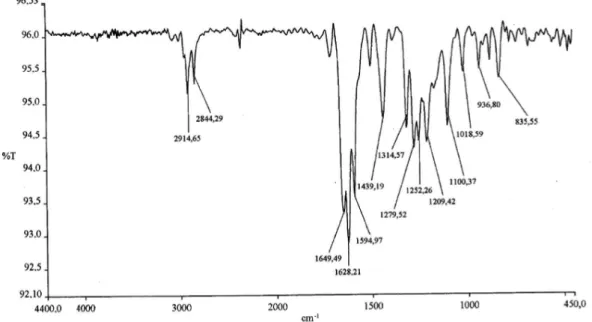
Orange solid, mp 196-198 oC; IR (KBr) ν
max/cm-1: 1649,
1628, 1595, 1439, 1279, 1100, 835; 1H and 13C NMR (see
Table 1); HR-ESI-MS spectrum revealed formation of molecular ions m/z 343.0931 (C18H14O7 + H
+), 365.0661
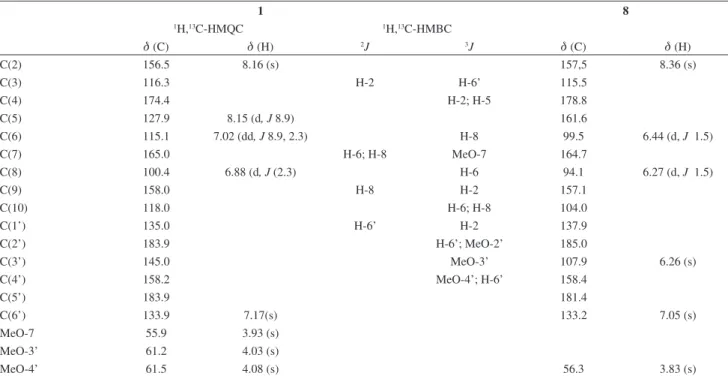
Table 1. 1H NMR (500 MHz) and 13C NMR (125 MHz) data of 1 (in CDCl
3) compared with values of 8 (DMSO-d6, (dd, ppm), J in Hz*
1 8
1H,13C-HMQC 1H,13C-HMBC
d(C) d(H) 2J 3J d (C) d(H)
C(2) 156.5 8.16 (s) 157,5 8.36 (s)
C(3) 116.3 H-2 H-6’ 115.5
C(4) 174.4 H-2; H-5 178.8
C(5) 127.9 8.15 (d, J 8.9) 161.6
C(6) 115.1 7.02 (dd, J 8.9, 2.3) H-8 99.5 6.44 (d, J 1.5)
C(7) 165.0 H-6; H-8 MeO-7 164.7
C(8) 100.4 6.88 (d, J (2.3) H-6 94.1 6.27 (d, J 1.5)
C(9) 158.0 H-8 H-2 157.1
C(10) 118.0 H-6; H-8 104.0
C(1’) 135.0 H-6’ H-2 137.9
C(2’) 183.9 H-6’; MeO-2’ 185.0
C(3’) 145.0 MeO-3’ 107.9 6.26 (s)
C(4’) 158.2 MeO-4’; H-6’ 158.4
C(5’) 183.9 181.4
C(6’) 133.9 7.17(s) 133.2 7.05 (s)
MeO-7 55.9 3.93 (s)
MeO-3’ 61.2 4.03 (s)
MeO-4’ 61.5 4.08 (s) 56.3 3.83 (s)
*Number of hydrogens bound to carbon atoms deduced by comparative analysis of 1H and DEPT 13C NMR spectra. Chemical shifts and coupling constants
(J) were obtained of 1D 1H NMR spectrum. 1H,1H COSY and 1H, 1H NOESY experiments were also used for these assignments in compared with literature
(C18H14O7 + Na+) and 381.0438 (C18H14O7 + K+ ).
LR-EI-MS m/z (rel; Int.): ([M+], 94.5%), 200 [M+− 142] 100%,
150 [M+− 193] 32.9%, 327 [M+− 15] 8.2%.
Results and Discussion
Compound 1 was obtained as orange solid. The HR-ESI-MS spectrum showed a pseudo molecular íons peaks at m/z 343.0931 (C18H14O7 + H+, requires 343.0818), 365.0661
(C18H14O7 + Na
+ , requires 365.0637) and 38l.0438 (C 18H14O7
+ K+ , requires 38l.0377). The IR spectrum exhibited bands
at 1650, 1628 and 1595 (νc=0) cm
-1 suggesting the presence of
three conjugated carbonyl groups.11,12 Comparative analysis
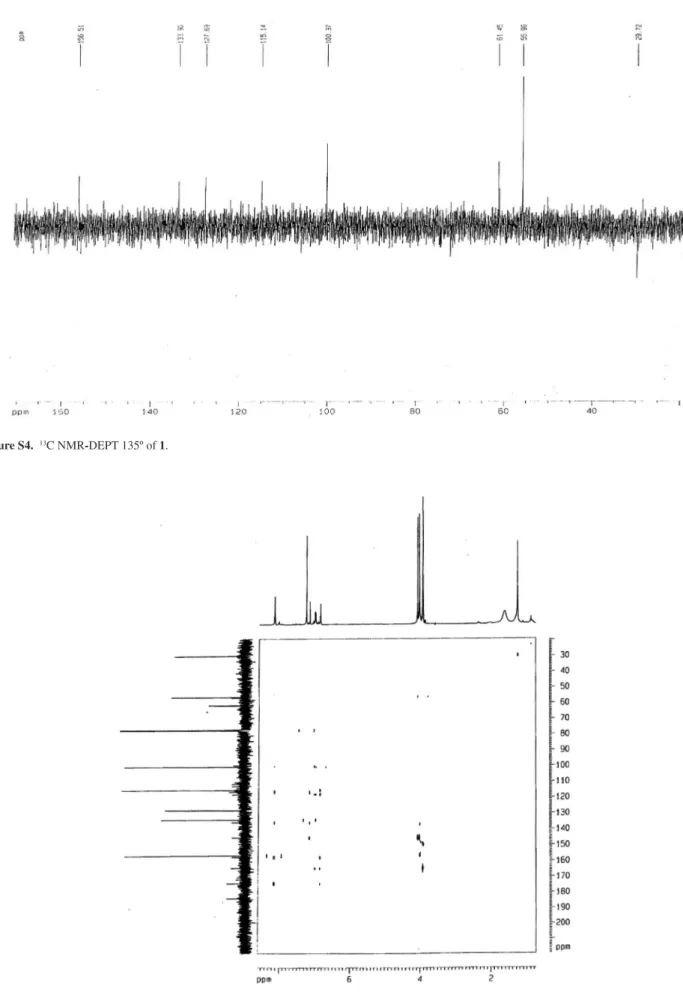
of the 1H and DEPT l3C NMR spectra (Table 1) allowed to
recognize signals for three methoxyl groups and ifteen sp2 carbons: ive methines (including one linked to oxygen
atom at dc 156.5, compatible with CH-2 of isolavones) and
ten non-hydrogenated [including three carbonyl groups at dc 174.4 (C-4),dc 183.9 (C-2’and C-5’) and four linked
to oxygen atoms: dc 165.0 (C-7),dc 158.0 (C-9),dc 145.0
(C-3’)and dc 158.2 (C-4’)].The signals observed in the 13C NMR spectra at d
c 183.9 and 174.4 were attributed to
carbonyl groups at the 1,4-benzoquinone and lavonoid moieties,13 respectively. Furthermore, the 1H NMR exhibited
a characteristic a singlet at dH 8.16, assigned to H-2 of an
isolavone, conirmed by HMQC spectrum by the presence of a transversal peak corresponding to direct correlation of this hydrogen signal with l3C signal of methine at d
c 156.5
(CH-2), and at dH 3.93, dH 4.03 and dH 4.08, corresponding
to three methoxyl groups located at C-7, C-3’ and C-4’, respectively. The location of these methoxyl groups was observed at the heteronuclear long range correlations in the HMBC spectrum (Table 1), which showed correlations of the methoxyl signal at dH 3.93 with C-7(dc 165.0,
3J CH, dH
4.03 (MeO-3’) with dc 145.0 (C-3’, 3JCH) and dH 4.08
(MeO-4’) with dc 158.2 (C-4’, 3J
CH). The presence of a methoxyl
group at C-7was additionally conirmed by nOe effects observed in the 1H, 1H NOESY spectrum, which revealed
spatial interactions with the hydrogen atoms H-6 and H-8. The multiplicities of these signals of hydrogen atoms H-6
Bandeira et al. 375 Vol. 22, No. 2, 2011
(dH 7.02, dd, J 8.9 and 2.3 Hz) and H-8 (dH 6.88, d, J 2.3 Hz)
in combination with the corresponding H-5 (dH 8.15, d, J 8.9 Hz), correlated via one bond in the HMQC spectrum with the 13C signal at 127.9, allowed to deine the ring A,
sustaining a methoxyl group at carbon atom C-7. The HMBC spectrum was also used to characterize the presence of a 2,3-dimethoxy-1,4- benzoquinone moiety at C-3 through heteronuclear long range correlation (Table 1) of the carbon C-4’ (dc 158.2), with both H-6’ (dH 7.17, s, 3JCH) and MeO-4’
(dH 4.08, s, 3J
CH), C-3’ (dc 145.0) with MeO-3’ (dH 4.03, s, 3J
CH),C-1’ (dH 135.0) with both H-2 (dH 8.16, s, 3JCH)and
H-6’ (dH 7.17, s, 2JCH)and C-3 (dc 116.3) with both H-2 (dH
8.16, s, 2J
CH)and H-6’ (dH 7.17, s, 3JCH). Additional analysis
of the l3C NMR spectra of 1 revealed, the l3C chemical
shifts (dc 145.0) for the C-3’ and (dc 158.2) for the C-4’
and for the C-2’/C-5’ (dc 183.9), whereby after comparison
of these said data with the correspondent values, dc 107.9
(CH-3’), dc 158.4 (C-4’), dc 185.0 (C-2’) and dc 181.4 (C-5’),
described in the literature,13 suggests the presence of an
additional methoxyl group at carbon C-3’ of 1 as differences observed between spectral data of 1 and of 8 (Table 1). The base peak at m/z 200 (100%) observed in the LR-EI-MS, signiicantly contributed to characterize and to locate the 2,3-dimethoxy-l,4- benzoquinone moiety at C-3 (Figure 1). Therefore, the structure of compound 1 was assigned as a new isoflavone and it is characterized as 3’,4’- dimethoxy-1’-(7 -methoxy-4-oxo-4H-cromen-3-yl)-benzo- 2’,5’-quinone.
The compounds 2, 3, 4, 5, 6 and 7 were identiied through spectroscopic data compared with literature data as: 4,2’,4’-trihydroxychalcone,14
7,8,3’,4’-tetrarnethoxy-isoflavone,15 4,2’,4’-trihydroxy-3-methoxychalcone,16
3,4,5- trimethoxycinnamaldehyde,17
3’,4’-dimethoxy-7-hydroxyisolavone18 and 6,7,4’-trimethoxy-
3’-hydroxy-isolavone19 (Figure 1) , respectively.
Supplementary Information
Supplementary data are available free of charge at http://jbcs.sbq.org.br, as PDF ile.
Acknowledgments
The authors whishes to thank CNPq/FUNCAP for inancial support, CENAUREMN by NMR spectra and LEMANOR by mass spectrum.
References
1. Corrêa, M. P.; Dicionário das Plantas Úteis do Brasil e das Exóticas Cultivadas, Ministério da Agricultura: Brasília, 1984.
2. Maia, G. N.; Caatinga: Árvores e Arbustos e Suas utilidades, D & Z ed.: São Paulo, Brasil, 2004.
3. Leal, L. K. A. M.; Matos, M. E.; Matos, F. J. A.; Ribeiro, R. A.; Ferreira, F. V.; Viana, G. S. B.; Phytomedicine1997, 4, 221. 4. Leal, L. K. A. M.; Nechio, M.; Silveira, E. R.; Canuto, K. M.;
Fontenele, J. B.; Ribeiro, R. A.; Viana, G. S. B.; Phytother. Res.
2003, 17, 335.
5. Oliveira, R. R. B.; Góis, R. M. O.; Siqueira, R. S.; Almeida, J. R. G. S.; Lima, J. T. L.; Nunes, X. P.; Oliveira, V. R.; Siqueira, J. S.; Quintons-Junior, L. J.; Braz. J. Pharmcog. 2009, 19, 672. 6. Leal, L. K. A. M.; Ferreira, A. A. G.; Bezerra, G. A.; Matos, F.
J. A.; Viana, G. S. B.; J. Ethnopharmacol. 2000, 70, 151. 7. Leal, L. K. A. M.; Canuto, K. M.; Costa, K. C. S.;
Nobre-Junior, H. V.; Vasconcelos, S. M.; Silveira, E. R.; Ferreira, M. V. P.; Fontenele, J. B.; Andrade, G. M.; Viana, G. S. B.; Basic Clin. Pharmacol. Toxicol.2008, 104, 198; Leal, L. K. A. M.; Nobre-Junior, H. V.; Cunha, G. M. A.; Moraes, M. O.; Pessoa, C.; Oliveira, R. A.; Silveira, E. R.; Canuto, K. M.; Viana, G. S. B.; Neurosci. Lett.2005, 388, 86; Leal, L. K. A. M.; Costa, M. F.; Pitombeira, M.; Barroso, V. M.; Silveira, E. R.; Canuto, K. M.; Viana, G. S. B.; Life Sci.2006, 79, 98; Costa-Lotufo, L. V.; Jimenez, P. C.; Wilke, D. V.; Leal, L. K. A. M.; Cunha, G. M. A.; Silveira, E. R.; Canuto, K. M.; Viana, G. S. B.; Moraes, M. E. A,; de Moraes, M. O.; Pessoa, C.; J. Biosci.2003, 58, 9; Leal, L. K. A. M.; Fonseca, F. N.; Pereira, F. A.; Canuto, K. M.; Felipe, C. F. B.; Fontenele, J. B.; Pitombeira, M. V.; Silveira, E. R.; Viana, G. S. B.; Planta Med.2008, 74, 497.
8. Bravo, J. A. B.; Sauvain, M.; Gimenez, A.; Muñoz, V.; Callapa, J.; Le Men-Oliver, L.; Massiot, G.; Lavaud, C.; Phytochemistry
1999, 50, 71.
9. Canuto, K. M.; Silveira, E. R.; Quim. Nova 2006, 29, 1241. 10. Canuto, K. M.; Silveira, E. R.; Bezerra, A. M. E.; Quim. Nova
2010, 33, 662.
11. Silverstein, R. M.; Webster, F. X.; Identiicação Espectrométrica de Compostos Orgânicos, 6th ed., LTC, ed.: Rio de Janeiro, 2000.
12. Marques, W. B.; Santos, H. S.; Pessoa, O. D. L.; Braz-Filho, R.; Lemos, T. L.G.; Phytochemistry2000, 55, 793.
13. Hamburger, M. O.; Cordell, G. A.; J. Nat. Prod. 1987, 50, 696. 14. Markham, K. R.; Ternai, B.; Tetrahedron1976, 32, 2607. 15. Rao, V.; Murthy, S. R.; Ward, R. T.; Phytochemistry1984, 23,
1493.
16. Nielsen, S. F.; Christensen, S. B.; Cruciani, G.; Kharazmi, A.; Liljefors, T.; J. Med. Chem.1998, 41, 4819.
17. Mohammad, I.; Watterman, P. G.; J. Nat. Prod. 1985, 48, 328. 18. Rong, H.; Stevens, J. F.; Deizer, M. L.; De Cooman, L.; De
Keukeleire, D.; Planta Med. 1998, 64, 620.
19. Razdan, T. K.; Kachroo, P. K.; Qadri, A. K.; Kalla, A. K.; Taneja, S. K.; Dhar, K. L.; Phytochemistry1996, 41, 947.
Supplementary Information
J. Braz. Chem. Soc., Vol. 22, No. 2, 1-6, 2011. Printed in Brazil - ©2011 Sociedade Brasileira de Química
0103 - 5053 $6.00+0.00
S
I
*e-mail: [email protected]
New Isolavone Derivativ
e and others Flavonoids from the Resin of
Amburana cearensis
Paulo N. Bandeira,*, a Silvana S. de Farias,a Telma L. G. Lemos,b Raimundo Braz-Filho,c
Hélcio S. Santos,a Maria R. J. R. Albuquerquea and Sônia M. O. Costad
aLaboratório de Química Orgânica, Universidade Estadual Vale do Acaraú,
62040-370 Sobral-CE, Brazil
bDepartamento de Química Orgânica e Inorgânica, Universidade Federal do Ceará,
60451-970 Fortaleza-CE, Brazil
cLaboratório de Ciências Químicas, CCT, Universidade Estadual do Norte Fluminense Darcy
Ribeiro, 28013-602 Campos-RJ, Brazil
dDepartamento de Física e Química, Universidade Estadual do Ceará,
60749-000 Fortaleza-CE, Brazil
New Isolavone Derivative and others Flavonoids from the Resin of Amburana cearensis J. Braz. Chem. Soc.
S2
Figure S2. 1H NMR spectrum of 1 (500 MHz, CDCl 3).
Figure S4. 13C NMR-DEPT 135º of 1.
New Isolavone Derivative and others Flavonoids from the Resin of Amburana cearensis J. Braz. Chem. Soc.
S4
Figure S6. 1H, 13C HMQC-NMR of 1 (500 MHz, CDCl 3).
Figure S8. 1H, 1HCOSY-NMR spectrum of 1 (500 MHz, CDCl 3).
New Isolavone Derivative and others Flavonoids from the Resin of Amburana cearensis J. Braz. Chem. Soc.
S6