Article
J. Braz. Chem. Soc., Vol. 22, No. 8, 1505-1510, 2011. Printed in Brazil - ©2011 Sociedade Brasileira de Química
0103 - 5053 $6.00+0.00
A
*e-mail: [email protected]
Improved Synthesis of 1,3,4-Thiadiazolium-2-phenylamines using Microwave and
Ultrasound Irradiation and Investigation of their Cytotoxic Activity
Camilla Moretto dos Reis,a Juliana Echevarria-Lima,b Amanda Fraga Mirandaa and
Aurea Echevarria*,a
aDepartamento de Química, Instituto de Ciências Exatas,Universidade Federal Rural do
Rio de Janeiro, 23890-000 Seropédica-RJ, Brazil
bDepartamento de Imunologia, Instituto de Microbiologia Paulo de Góes, Universidade Federal do
Rio de Janeiro, 21941-590 Rio de Janeiro-RJ, Brazil
Uma nova e eiciente síntese de oito derivados da classe 1,3,4-tiadiazolio-2-fenilaminas (1-8, sendo o derivado 8 inédito na literatura) foi realizada utilizando cloreto de tionila ou cloreto de trimetilsilano como catalisadores sob irradiação de microondas ou ultra-som. Os compostos alvos foram obtidos em bons rendimentos e em tempo extraordinariamente curtos, 5 min sob irradiação de microondas e 10 min sob irradiação de ultra-som, quando comparados com a metodologia tradicional (24 a 48 h em repouso a temperatura ambiente). Os melhores rendimentos foram obtidos usando irradiação de microondas e, de maneira geral, usando o cloreto de tionila ao invés de cloreto de trimetilsilano. A citotoxicidade foi avaliada frente à linhagem de leucemia humana K562 e do linfoma Daudi, apresentando resultados promissores para o derivado cloreto de 4-fenil-5-(4’-nitro-estiril)-1,3,4-tiadiazolio-2-fenilamina.
A new and eficient synthesis of eight 1,3,4-thiadiazolium-2-phenylamine derivatives (1-8, where 8 is novel in the literature) was performed using thionyl chloride or trimethylsilyl chloride as catalysts under microwave or ultrasound irradiation. The target compounds were obtained in good yields and remarkably short times, 5 min under microwave irradiation and 10 min under ultrasound irradiation, where compared to traditional methodology (24 to 48 h at room temperature standing). The best yields were obtained using the microwave irradiation and, in general way, using thionyl chloride instead trimethylsilyl chloride. The cytotoxicity against K562 human leukemia and Daudi lymphoma lines was evaluated and showed promising results from the 4-phenyl-5-(4’-nitro-styryl)-1,3,4-thiadiazolium-2-phenylamine chloride derivative.
Keywords: mesoionic heterocycle compounds, microwave, ultrasound, cytotoxic activity
Introduction
Mesoionic compounds are a special class of heterocycles with potential therapeutic applications due to their unique chemical properties. They possess a betaine-like character with a partial positive charge on the heterocyclic ring that is balanced by a negative charge located on an exocyclic atom or group.1,2 The
large separation between the charged regions leads to large dipole moments of about 4-5 D.3,4 These properties
suggest the possibility of interacting with biomolecules such as proteins and DNA. Additionally, the overall neutral character of these compounds enables them
to cross biological membranes. Different classes of mesoionic compounds have demonstrated a wide range of biological activities such as anti-inlammatory and analgesic,5 antiparasitic,6,7 antibacterial,8,9 antiplatelet,
ibrinolytic, thrombolytic and broncholytic effects,10 as
well as anticancer potency.11-17 The promising therapeutic
applications have led us to study these interesting compounds in our laboratory. We have previously described the survival enhancement of Ehrlich and Sarcoma 180 tumor-bearing mice treated with 4-phenyl-5-(4’-X-styryl)-1,3,5-thiadiazolium-2-phenylamine chlorides.12 Respiratory chain inhibition, transmembrane
Improved Synthesis of 1,3,4-Thiadiazolium-2-phenylamines J. Braz. Chem. Soc.
1506
were used.13,14 In addition, Senff-Ribeiro et al.15 showed
that 4-phenyl-5-(4’-nitro-styryl)-1,3,5-thiadiazolium-2-phenylamine chloride displays an important antitumor activity against murine melanoma B16F10. This compound was cytotoxic in vitro, decreasing cell viability and proliferation, and was able to inhibit tumor growth by ca. 85% in vivo as well. Additionally, it decreased the viability and proliferation of cell lines of human melanoma (MEL-85, SK-MEL, A2058 and MEWO).15,16 To contribute to the understanding of the
molecular pathways involved in the pharmacological activities of mesoionic compounds, we have recently described the effects of 4-phenyl-5-(4’-nitro-styryl)-1,3,5-thiadiazolium-2-phenylamine chloride on lipid peroxidation in rat liver mitochondria, submitochondrial particles and phosphatidylcholine, as well as its ability to scavenge radicals.17
In addition, our group has investigated new, more eficient and cleaner synthetic methods for the preparation of these mesoionic compounds,18 especially
due to important environmental concerns with the current synthesis.19,20 Therefore, the synthesis of the
1,3,4-thiadiazolium-2-phenylamine class of compounds was revisited using alternative energy sources to obtain better yields and lower reaction times.
Towards that end, this work presents the synthesis of 4-phenyl-5-(4’-X-phenyl)-1,3,5-thiadiazolium-2-phenylamine chlorides, where X = H (1), 4’−OCH3 (2),
4’−NO2 (3) and 3’,4’−OCH2O (4) (referred to as the
benzaldehyde series), and 4-phenyl-5-(4’-X-styryl)-1,3,5-thiadiazolium-2-phenylamine chlorides, where X = H (5), 2’−OCH3 (6), 4’−NO2 (7) and 4’−N(CH3)2
(8) (the cinnamaldehyde series), by two new alternative methods: using microwave irradiation and an ultrasound bath. Furthermore, derivatives of 1, 3 and 7 were assayed against K562 human leukemia and Daudi lymphoma lines.
Experimental
Chemistry
Melting points were determined with a Meltemp II apparatus and were uncorrected. Infrared spectra (KBr pellets) were recorded on a Perkin-Elmer 1605 FT-IR spectrophotometer. 1H and 13C NMR spectra
were obtained on a Bruker AC200 (200 and 50.3 MHz) spectrometer with TMS as the internal reference and DMSO-d6 as the solvent. The microwave and ultrasound bath assisted organic reactions were performed in a Panasonic Piccilo-NN-S45BH (a domestic oven) and an Ultra-cleaner 700, respectively.
General procedure for preparation of mesoionic chlorides (1-8)
Method A
Using microwave irradiation. The aldehyde (0.35 mmol) and 1,4-diphenyl-thiosemicarbazide (0.35 mmol) were mixed in the presence of a Lewis acid (TMS-Cl or SOCl2)
and a few drops of 1,4-dioxane. The resulting mixture was submitted to microwave irradiation for full 5 min in open vessel. After this continuous time, the mixture was added to 1,4-dioxane and left to stand overnight at room temperature. The obtained solid was iltered, washed with ice-cold water and 1,4-dioxane, and recrystallized from chloroform:ethanol (60:40, v/v).
Method B
Using ultrasound bath irradiation. The aldehyde (0.35 mmol) and 1,4-diphenyl-thiosemicarbazide (0.35 mmol) were mixed in the presence of a Lewis acid (TMS-Cl or SOCl2) and 1,4 dioxane as solvent.
The resulting mixture was submitted to ultrasound bath irradiation for 10 min. The solution containing the reaction mixture was left to stand overnight. The formed precipitate was treated in a similar way as described above.
Table 1 shows the yields obtained for 1-8 using the method A and method B, and the characterization data6,12,21
for all compounds are in Supplementary Information.
Cell culture
The human erythroleukemia K562 and Burkett lymphoma Daudi cell lines were maintained in culture medium RPMI 1640 (Sigma) supplemented with β-mercaptoethanol 50 µmol L−1, HEPES 25 mmol L−1
(Sigma), penicillin 60 mg L−1 (Sigma), streptomycin
100 mg L−1 (Sigma) and 10% (v/v) fetal calf serum
(Gibco, Life Technologies). They were incubated at 37 °C in a humidiied atmosphere of air and 5% CO2. The cell
line was passaged twice a week at a concentration of 1 × 10⁴ cell mL−1.
Cytotoxic assays
1 × 10⁴ cell mL−1 were seeded on a 96-well cell culture
plate. The cells were incubated with or without a mesoionic compound 1, 3 or 7 at a concentration of 3.125-50 µmol L−1
each. They were incubated for 24 h, 48 h, 72 h, 96 h and 7 days at 37 °C with 5% CO2. After, cell viability was
assessed by adding 20 µL cell−1 of MTT (5 mg mL−1;
Reis et al. 1507 Vol. 22, No. 8, 2011
read on a microplate reader (Sunrise-Basic TECAN) at a wavelength of 490 nm. The results are represented as the mean ± SD of 5 determinations.
Analysis of the cell cycle
1 × 10⁴ cell mL−1 were seeded on a 96-well cell culture
plate. The cells were incubated with or without mesoionic compound 7 at a concentration of 3.125-50 µmol L−1 each.
They were incubated for 24 h at 37 °C with 5% CO2. After,
the cells were collected and washed in Hank’s buffer. The cell cycle was assessed by adding 200 µL of cell cycle solution (5 mg mL−1). The cells were then analyzed by low cytometry.
The samples were excited at 488 nm with an argon laser; luorescence emission was detected at 585 nm (FL-2). Ten thousand cells were acquired. All low cytometry analyses were accomplished with WinMDI, version 2.9.
Statistical analysis
The values are given as a mean ± SD. The statistical signiicance was calculated by one-way analysis of variance (ANOVA) followed by Bonferroni’s t-test using Prism 5 software. P values of less than 0.05 were considered signiicant.
Results and Discussion
Chemistry
Eight mesoionic chloride salts were synthesized by two different methods, microwave irradiation and an ultrasound bath, aimed at reduction of the reaction time and adaptation to the principles of Green Chemistry.23 The convergent strategy
for mesoionic chloride salts synthesis included the reaction of 1,4-diphenyl-thiosemicarbazide with the appropriate aldehyde in the presence of a Lewis acid and 1,4-dioxane as solvent. In methods, two different Lewis acids, SOCl2 and trimethylsilyl
chloride (TMS-Cl), were investigated separately (Scheme 1). When compared to the traditional method,7,24 the use of an
aldehyde and a Lewis acid enables the elimination of a step involving a carboxylic acid and the subsequent acid chloride preparation, as well as a reduction of the time required to obtain the target compounds from 24-48 h standing at room temperature, after 8 h of stirring, to 5 min under microwave irradiation or 10 min under ultrasound irradiation.
The irst method consisted of submitting a mixture of 1,4-diphenyl-thiosemicarbazide, the appropriate aldehyde, SOCl2 (three equivalents) or TMS-Cl (two equiv.) and a few
drops of 1,4-dioxane to microwave irradiation (MW) for 5 min. Subsequently, an organic solvent was added, and the
Entry A (saturated series):
H O Ph N N N Ph H S H H S N N N H Cl– X + X a b 17 16 15 14 2 5 10 11 12 13 12' 11' 6 7 8 9
X = H (1); 4'-OCH3 (2); 4'-NO2 (3); 3',4'-OCH2O (4)
Entry B (unsaturated series):
Ph N N N Ph H S H H S N N N H Cl– X + X a b 17 16 15 14 2 5 10 11 12 13 12' 11' 6 7 8 9
X = H (5); 2'-OCH3 (6); 4'-NO2 (7); 4'-N(CH3)2 (8)
α
β
H O
Improved Synthesis of 1,3,4-Thiadiazolium-2-phenylamines J. Braz. Chem. Soc.
1508
mixture was allowed to stand overnight, after which time the precipitate was iltered and washed with ice-cold water to afford the target compounds. In the second method, using similar conditions as above, the reagents were dissolved in 1,4-dioxane and put in the ultrasound bath for 10 min, and the mixture was allowed to stand overnight. The isolation of the target compounds was performed in the same manner as for the microwave experiment. Scheme 1 shows the synthetic route of the two methods used in this work. In both methods, the mesoionic salts were obtained in good yields and high purity (Table 1). When microwave irradiation was employed, the yields were in the range of 41-95% when TMS-Cl was used and 90-98% when SOCl2
was used. Using the ultrasound bath method, the respective yields for TMS-Cl and SOCl2 were 66-98% and 72-87%.
Thus, the best results were observed using SOCl2 as the
catalyst under microwave irradiation conditions.
The mesoionic chloride structures 1-8 were fully characterized by 1H and 13C NMR and IR spectroscopies.
The 1H and 13C chemical shifts (d) were assigned based on
literature data6,12,21,25 and were consistent with the structures
proposed.
Cytotoxicity activity
In Brazil, leukemia represents about 2% of the total cancer cases and affects adults, the elderly and young individuals.26
Table 1. Mesoionic chloride yields obtained under microwave irradiation and ultrasound bath, using TMS-Cl and SOCl2 as catalys
Mesoionic chlorides
Traditionala Yield (%)
Microwaveb Yield (%)
Ultrasoundc Yield (%)
TMS-Cl SOCl2 TMS-Cl SOCl2
1 87 68 92 89 83
2 52 41 96 66 74
3 78 95 98 98 83
4 68 74 92 87 87
5 58 87 90 73 86
6 73 87 95 83 84
7 89 92 93 90 91
8 nod 93 91 68 72
a24-48 h at room temperature standing; b5 min of microwave irradiation and stand overnight; c10 min on ultrasound bath and stand overnight; d no product obtained.
Reis et al. 1509 Vol. 22, No. 8, 2011
Cases of leukemia are classiied as acute or chronic and, for lymphoid or myeloid, according to the origin of the cell type. The treatment of leukemia is performed using different combinations of chemotherapy drugs; however, the index of remission remains unsatisfactory. The lymphoma cell line Daudi and myeloid cell line K562 were used for studying the effects of the synthesized mesoionic compounds on leukemic cells. The cytotoxic activities of the 1, 3 and 7 were assayed
in vitro using MTT.22 Compounds 1 and 3 did not alter the
viability of the lymphoma cell line Daudi in 72 h of culture. The positive results obtained with 7 (the unsaturated series compound with an NO2 moiety), led us to assay it in
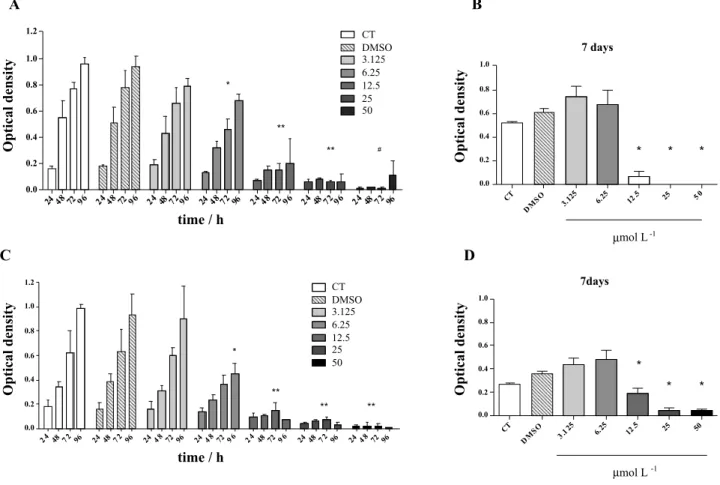
24 h, 48 h, 72 h, 96 h and 7 days incubations with Daudi cell cultures. The compound showed signiicant cytotoxic activity after 24 h. Moreover, this mesoionic derivative decreased the cellular viability in a concentration-dependent manner (Figure 1A and B). Similar results were obtained in the human erythroleukemia cell line K562. We observed that the mesoionic compound 7 reduced the cellular viability in a concentration-dependent manner for this cell line as well. The compound showed signiicant cytotoxic activity beginning at 24 h and continuously growing over time (Figure 1C and D).
The IC50 values were determined in µmol L−1 in at least
three independent experiments using 7 at concentrations in the range of 5-25 µmol L−1. The compound 7 was incubated
for 24 h, 48 h, 72 h, 96 h, and 7 days with cultures of Daudi (lymphoid origin) and K562 cells (myeloid cells). When the results with the different cell lines were compared, they showed similar sensitivities for the irst 72 h; however, the myeloid cells demonstrated more sensitivity after a long exposure time (7 days), as shown in Table 2.
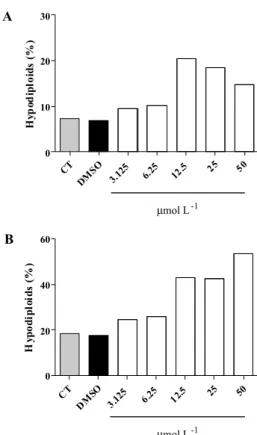
To understand the mechanism of the cytotoxicity exhibited by the mesoionic compound 7 on the Daudi and K562 cells, they were incubated for 24 h with 7 at a concentration of 3.25-50 µmol L−1. The capacity of this compound to induce
apoptosis in Daudi and K562 cells was analyzed with a cell cycle assay. The results showed an increase in hypodiploid cells, which was correlated with the cytotoxicity results
(Figure 2). This suggests that the mesoionic 7 induces cell death by apoptosis.
Conclusions
In summary, the new synthetic methods using microwave irradiation and an ultrasound bath provided the products 1-8, where 8 is novel in the literature, in shorter reaction times and higher yields when compared to the traditional method. SOCl2 proved to be a better Lewis acid
than TMS-Cl, and microwave irradiation led to a more eficient reaction when compared to the ultrasound bath. In addition to improving the synthetic route, these methods adhere to the principles of Green Chemistry. Furthermore, the 4’-nitro-styryl derivative has shown to be cytotoxic against Daudi lymphoma and K562 leukemic myeloid cells in preliminary in vitro studies of cytotoxicity.
Supplementary Information
Supplementary information with characterization data for all compounds (IR, 1H and 13C NMR data) and the
Table 2. IC50 (µmol L−1) values of compound 7 against Daudi lymphoma and K562 leukemia cells
time of culture Daudi IC50 (µmol L−1± SDa)
K562 IC50 (µmol L−1± SD)
24 h 10.76 ± 0.09 12.12 ± 0.10
48 h 8.62 ± 0.07 7.63 ± 0.06
72 h 7.93 ± 0.08 7.08 ± 0.08
96 h 10.17 ± 0.11 6.03 ± 0.07
7 days 11.55 ± 0.07 8.76 ± 0.09
aSD: standard deviation.
Improved Synthesis of 1,3,4-Thiadiazolium-2-phenylamines J. Braz. Chem. Soc.
1510
corresponding spectra for compound 8 are available free of charge at http://jbcs.sbq.org.br as PDF ile.
Acknowledgments
The authors thank CNPq (Conselho Nacional de Desenvolvimento Cientíico e Tecnológico) and CAPES (Coordenação de Aperfeiçoamento de Pessoal de Nível Superior) for inancial support and fellowships.
References
1. Ollis, W. D.; Stanforth, S. P.; Ramsden, C. A.; Tetrahedron
1985,41, 2239.
2. Newton, C. G.; Ramsden, C. A.; Tetrahedron1982, 38, 2965. 3. Moura, G. L. C.; Simas, A. M.; Miller, J.; Chem. Phys. Lett.
1996,257, 639.
4. Rakov, N.; Araujo, C. B.; Rocha, G. B.; Simas, A. M.; Athayde-Filho, P. A. F.; Miller, J.; Chem. Phys. Lett. 2000, 332, 13. 5. Satyanarayana, K.; Rao, M. N. A.; J. Pharmacol. Sci. 1995,84,
263.
6. Ferreira, W. S.; Lima, L. F.; Saraiva, V. B.; Silva, F. A.; Previato, L. M.; Previato, J. O.; Echevarria, A.; Lima, M. E. F.; Bioorg. Med. Chem. 2008, 16, 2984.
7. Silva, E. F.; Canto-Cavalheiro, M. M.; Braz, V. R.; Cysne-Finkelstein, L.; Leon, L. L.; Echevarria, A.; Eur. J. Med. Chem.
2002, 37, 979.
8. Kier, L. B.; Roche, E. B.; J. Pharm. Sci.1967, 54, 148. 9. Montanari, C. A.; Amaral, A. T.; Giesbrecht, A. M.; J. Pharm.
Sci. 1997, 3, 565.
10. Corell, T.; Pedersen, S. B.; Lissau, B.; Moilanen, E.; Metsa-Ketela, T.; Kankaanranta, H.; Vuorinen, P.; Vapaatalo, H.; Rydell, E.; Andersson, R.; Marcinkiewicz, E.; Korbut, R.; Gryglewski, R. J.; Pol. J. Pharmacol. 1994, 46, 553.
11. Schinzato, T. O.; Grynberg, N. F.; Gomes, R. M.; Echevarria, A.; Miller, J.; J. Med. Sci. Res. 1989, 17, 865.
12. Grynberg, N.; Santos, A. C. S.; Echevarria, A.; Anti-Cancer Drugs 1997, 8, 88.
13. Cadena, S. M. S. C.; Carnieri, E. G. S.; Echevarria, A.; Oliveira, M. B. M.; FEBS Lett.1998, 440, 46.
14. Cadena, S. M. S. C.; Carnieri, E. G. S.; Echevarria, A.; Oliveira, M. B. M.; Cell Biochem. Funct. 2002, 20, 31.
15. Senff-Ribeiro, A.; Echevarria, A.; Silva, E. F.; Veiga, S. S.; Oliveira, M. B. M.; Melanoma Res. 2003, 13, 465.
16. Senff-Ribeiro, A.; Echevarria, A.; Silva, E. F.; Franco, C. R.; Viegas, S. S.; Oliveira, M. B. M.; Br.J. Cancer 2004, 91, 297. 17. Mendez-Sanches, S. C.; Martinez, G. R.; Romão, S.; Echevarria,
A.; Silva, E. F.; Rocha, M. E. M.; Chem.-Biol.Interact. 2009,
179, 125.
18. Rodrigues-Santos, C. E.; Echevarria, A.; Tetrahedron Lett.2007,
48, 4505.
19. Shih, M. H.; Tsai, C. H.; Wang, Y. C.; Shieh, M. Y.; Lin, G. L.; Wei, C. Y.; Tetrahedron2007, 63, 2990.
20. Silva, F. C.; Ferreira, V. F.; Souza, M. C. B.; Quim. Nova2006,
29, 376.
21. Maciel, M. A. M.; Echevarria, A.; Rumjanek, V. M.; Quim. Nova 1998, 21, 569.
22. Mosmann, T.; J. Immunol. Methods1983, 65, 55.
23. Poliakoff, M.; Fitzpatrick, J. M.; Farren, T. R.; Anastas, P. T.;
Science 2002, 297, 807.
24. Britto, M. M.; Almeida, T. M. G.; Leitão, A.; Donnici, C. L.; Lopes, M. T. P.; Montanari, C. A.; Synth. Commun.2006, 36, 3359. 25. Santos, A. C. S.; Echevarria, A.; Magn. Reson. Chem. 2001, 39,
182.
26. INCA. Estimate 2008. Brazilian Cancer Incidence, NCI, Rio de Janeiro, Brazil, 2007, p. 23.
Submitted: November 6, 2010
Supplementary Information
S
I
J. Braz. Chem. Soc., Vol. 22, No. 8, S1-S6, 2011.Printed in Brazil - ©2011 Sociedade Brasileira de Química 0103 - 5053 $6.00+0.00
*e-mail: [email protected]
Improv
ed Synthesis of 1,3,4-Thiadiazolium-2-phenylamines Using Microwave and
Ultrasound Irradiation and Investigation of their Cytotoxic Activity
Camilla Moretto dos Reis,a Juliana Echevarria-Lima,b Amanda Fraga Mirandaa and
Aurea Echevarria*,a
aDepartamento de Química, Instituto de Ciências Exatas,Universidade Federal Rural do
Rio de Janeiro, 23890-000 Seropédica-RJ, Brazil
bDepartamento de Imunologia, Instituto de Microbiologia Paulo de Góes, Universidade Federal do
Rio de Janeiro, 21941-590 Rio de Janeiro-RJ, Brazil
Characterization data
S N N N H Cl– X 17 16 15 14 2 5 10 11 12 13 12' 11' 6 7 8 9X = H (1), 4’-OCH3 (2), 4’-NO2 (3), 3’,4’-OCH2O (4)
4,5-Diphenyl-1,3,4-thiadiazolium-2-phenylamine chloride (1)
Pale yellow solid; mp 356-358 °C (lit.21 mp 358 °C);
IR (KBr) νmax/cm−
1 3419, 3047, 2723, 1569, 1542, 1494,
1444, 1319, 755, 690; 1H NMR (CDCl
3) d12.50 (s, N−H),
7.08-7.72 (m, Harom); 13C NMR (DMSO-d
6d 163.84 (C-5),
160.48 (C-2), 138.56 (C-14), 138.28 (C-10), 138.00 (C-6), 137.46 (C-17), 135.80 (C-13), 134.07 (C-11), 132.98 (C-16), 131.19 (C-8), 130.19 (C-12), 129.88 (C-15), 129.61 (C-9), 118.33 (C-7).
4-Phenyl-5-(4’-methoxy-phenyl)-1,3,4-thiadiazolium-2-phenylamine chloride (2)
Yellow solid; mp 242-243 °C (lit.21 mp 238 °C); IR
(KBr) νmax/cm−
1 3425, 3048, 2935, 2665, 1602, 1542,
1448, 1567, 1309, 1175, 1024, 827, 752, 692; 1H NMR
(CDCl3) d12.90 (s, N−H), 7.70 (d, H-12,H-12’), 6.90
(d, H-11, H-11’), 7.63-7.08 (m, Harom), 3.86 (s, CH3O);
13C NMR (DMSO-d
6) d 163.00 (C-5), 159.48 (C-2),
138.34 (C-14), 137.74 (C-6), 131.89 (C-10), 131.07 (C-17), 129.40 (C-12), 129.73 (C-16), 125.79 (C-8), 126.10 (C-9, C-13), 123.64 (C-11), 118.18 (C-15), 114.69 (C-7), 55.54 (OCH3).
4-Phenyl-5-(4’-nitrophenyl)-1,3,4-thiadiazolium-2-phenylamine chloride(3)
Orange solid; mp 138-139 °C (lit.21 mp 138-139 °C);
IR (KBr) νmax/cm−
1 3434, 3043, 2721, 1573, 1537, 1454,
1348, 854, 746, 694; 1H NMR (CDCl
3) d12.75 (s, N−H),
8.21 (d, H-12,H-12’), 8.16 (d, H-11, H-11’), 7.71-7.00 (m, Harom);
13C NMR (DMSO-d
6) d163.84 (C-5), 159.20 (C-2),
137.95 (C-13), 136.95 (C-10), 131.43 (C-14), 131.25 (C-6), 129.46 (C-17), 128.85 (C-16), 126.00 (C-9), 125.67 (C-8), 124.90 (C-12), 123.79 (C-11), 123.33 (C-15), 118.24 (C-7).
4-Phenyl-5-(3’,4’-methylenedioxyphenyl)-1,3,4-thiadiazolium-2-phenylamine chloride(4)
Pale yellow solid; mp 290-293 °C (lit.6 mp 286-287 °C);
IR (KBr) νmax/cm−
1 3438, 3050, 2902, 2642, 1604, 1540,
1450, 1567, 1311, 1243, 1105, 1037, 754, 694; 1H NMR
(CDCl3) d 11.76 (s, N−H), 7.60-7.20 (m, Harom), 7.17 (d,
H-11’), 7.10 (d, H-12’), 7.02 (d, H-11), 6.08 (s, OCH2O);
13C NMR (DMSO-d
6) d163.05 (C-5), 160.05 (C-2), 150.70
(C-12), 148.00 (C-13), 140.50 (C-14), 138.80 (C-6), 133.45 (C-17), 130.95 (C-8), 129.75 (C-16), 126.13 (C-11’), 127.57 (C-15), 127.42 (C-9), 117.56 (C-7), 115.12 (C-10),
Improved Synthesis of 1,3,4-Thiadiazolium-2-phenylamines J. Braz. Chem. Soc. S2 S N N N H Cl– X 17 16 15 14 2 5 10 11 12 13 12' 11' 6 7 8 9 α β
X = H (5), 2’-OCH3 (6), 4’-NO2 (7), 4’-N(CH3)2 (8)
4-Phenyl-5-styryl-1,3,4-thiadiazolium-2-phenylamine chloride (5)
Yellow solid; mp 264-265 °C (lit.12 mp 266-267 °C);
IR (KBr) νmax/cm−1 3432, 3056, 2670, 1604, 1567, 1538,
1498, 1448, 1330, 954, 746, 690; 1H NMR (CDCl 3) d
12.58 (s, N−H), 7.95 (d, Hα), 7.19-7.83 (m, Harom), 7.06 (d,
Hβ); 13C NMR (DMSO-d
6) d164.90 (C-5), 160.30 (C-2),
149.84 (C-α), 138.00 (C-14), 137.82 (C-6), 135.35 (C-10), 135.90 (C-17), 134.89 (C-13), 132.30 (C-11), 131.95 (C-16), 133.64 (C-8), 130.56 (C-12), 129.20 (C-15), 127.28 (C-9), 120.79 (C-7), 115.67 (C-β).
4-Phenyl-5-(2’-methoxy-styryl)-1,3,4-thiadiazolium-2-phenylamine chloride(6)
Yellow solid; mp 198-200 °C (lit.12 mp 195-196 °C);
IR (KBr) νmax/cm−1 3423, 3054, 2925, 2786, 1604, 1594,
1540, 1444, 1565, 1295, 1249, 1110, 1031, 966, 836,
754, 690; 1H NMR (CDCl
3) d 11.90 (s, N−H), 7.92 (d,
Hα), 7.84-6.90 (m, Harom), 6.97 (d, Hβ), 3.81 (s, CH3O);
13C NMR (DMSO-d
6) d 162.29 (C-11), 159.15 (C-5),
158.57 (C-2), 144.58 (C-α), 138.26 (C-14), 136.87 (C-6), 133.94 (C-11’), 131.70 (C-13), 130.51 (C-17), 130.07 (C-16), 128.89 (C-8), 125.56 (C-15), 124.04 (C-9), 122.11 (C-10), 118.89 (C-7), 111.40 (C-β), 55.46 (OCH3).
4-Phenyl-5-(4’-nitro-styryl)-1,3,4-thiadiazolium-2-phenylamine chloride (7)
Orange solid; mp 234-236 °C (lit.12 mp 232-233 °C);
IR (KBr) νmax/cm−1 3432, 3048, 2721, 1616, 1571, 1519,
1450, 1342, 956, 840, 746, 688; 1H NMR (CDCl
3) d 12.74
(s, N−H), 8.33 (d, H-12, H-12’), 8.25 (d, Hα), 8.04 (d, H-11, H-11’), 7.96-7.39 (m, Harom), 7.33 (d, Hβ);
13C NMR
(DMSO-d6) d165.10 (C-5), 162.38 (C-2), 151.00 (C-13), 147.55 (C-α), 142.99 (C-10), 140.20 (C-14), 139.05 (C-6), 132.92 (C-17), 131.98 (C-16), 130.50 (C-8), 129.68 (C-11), 127.20 (C-15), 126.33 (C-9), 125.25 (C-12), 117.71 (C-7), 114.81 (C-β).
4 P h e n y l 5 ( 4 ’ d i m e t h y l a m i n o s t y r y l ) 1 , 3 , 4 -thiadiazolium-2-phenylamine chloride(8)
Purple solid; mp 201-203 °C; IR (KBr) νmax/cm−1:
3425, 3062, 2923, 2852, 1612, 1565, 1577, 1525, 1444,
1378, 1268, 941, 808, 750, 692; 1H NMR (CDCl
3) d12.39
(s, N−H), 7.85 (d, Hα), 7.81 (d, H-12, H-12’), 7.73 (d, H-11, H-11’), 7.71- 6.71 (m, Harom), 6.70 (d, Hβ), 3.02 (m, N(CH3)2);
13C NMR (DMSO-d
6) d 163.27 (C-13),
157.14 (C-5), 153.01 (C-2), 149.47 (C-α), 138.81 (C-14), 137.15 (C-6), 131.76 (C-11, 11’), 131.20 (C-17), 130.12 (C-16), 129.33 (C-8), 126.16 (C-15), 123.66 (C-9), 121.08 (C-10), 118.30 (C-7), 111.88 (C-12, 12’), 103.81 (C-β), 39.75 (N(CH3)2); Elemental analysis: Found: C, 66.38;
H, 5.15; N, 12.94. Calc. for C24H23N4SCl: C, 66.27; H,
5.33; N, 12.88%.
References
Same as cited in the Article
6. Ferreira, W. S.; Lima, L. F.; Saraiva, V. B.; Silva, F. A.; Previato, L. M.; Previato, J. O.; Echevarria, A.; Lima, M. E. F.; Bioorg. Med. Chem. 2008, 16, 2984.
12. Grynberg, N.; Santos, A. C. S.; Echevarria, A.; Anti-Cancer Drugs 1997, 8, 88.
21. Maciel, M. A. M.; Echevarria, A.; Rumjanek, V. M.; Quim. Nova 1998, 21, 569.
Reis et al. S3 Vol. 22, No. 8, 2011
IR, 13C NMR, DEPT-Q and 1H, spectra of compound 8
Figure S1. IR spectrum of 4-phenyl-5-(4’-dimethylamino-styryl)-1,3,4- thiadiazolium-2-phenylamine chloride (8).
Figure S2.13C NMR spectrum of 4-phenyl-5-(4’-dimethylamino-styryl)-1,3,4-thiadiazolium-2-phenylamine chloride (8) in DMSO-d
Improved Synthesis of 1,3,4-Thiadiazolium-2-phenylamines J. Braz. Chem. Soc.
S4
Figure S3. Expansion of 13C NMR spectrum of 4-phenyl-5-(4’-dimethylamino-styryl)-1,3,4-thiadiazolium-2-phenylamine chloride (8) in DMSO-d
6.
Reis et al. S5 Vol. 22, No. 8, 2011
Figure S5. Expansion of DEPT-Q spectrum of 4-phenyl-5-(4’-dimethylamino-styryl)-1,3,4-thiadiazolium-2-phenylamine chloride (8) in DMSO-d6.
Figure S6.1H NMR spectrum of 4-phenyl-5-(4’-dimethylamino-styryl)-1,3,4-thiadiazolium-2-phenylamine chloride (8) in DMSO-d
Improved Synthesis of 1,3,4-Thiadiazolium-2-phenylamines J. Braz. Chem. Soc.
S6
Figure S9. Expansion of 13C NMR spectrum of 4-phenyl-5-(4’-dimethylamino-styryl)-1,3,4-thiadiazolium-2-phenylamine chloride (8) in MeOH-d
4.
Figure S7. Expansion of 1H NMR spectrum of 4-phenyl-5-(4’-dimethylamino-styryl)-1,3,4-thiadiazolium-2-phenylamine chloride (8) in DMSO-d
6.
Figure S8.13C NMR spectrum of 4-phenyl-5-(4’-dimethylamino-styryl)-1,3,4-thiadiazolium-2-phenylamine chloride (8) in MeOH-d