Literature Re
vie
Study conducted at the Department of Physical Therapy, Speech-Language Pathology and Audiology, and Occupational Therapy, School of Medicine, Universidade de São Paulo – USP – São Paulo (SP), Brazil.
(1) Enhancement Course in Hospital Speech-Language Pathology and Au-diology in Orofacial Functions, Central Institute, General Hospital, School of Medicine, Universidade de São Paulo – USP – São Paulo (SP), Brazil. (2) Speech-Language Pathology and Audiology Sector, Central Institute, General Hospital, School of Medicine, Universidade de São Paulo – USP – São Paulo (SP), Brazil.
(3) Graduate Program (Doctorate degree) in Rehabilitation Sciences, Depart-ment of Physical Therapy, Speech-Language Pathology and Audiology, and Occupational Therapy, School of Medicine, Universidade de São Paulo – USP – São Paulo (SP), Brazil.
(4) Department of Physical Therapy, Speech-Language Pathology and Audi-ology, and Occupational Therapy, School of Medicine, Universidade de São Paulo – USP – São Paulo (SP), Brazil.
Correspondence address: Claudia Regina Furquim de Andrade. R. Cipotânea, 51, Cidade Universitária, São Paulo (SP), CEP: 05360-160. E-mail: [email protected]
Received: 3/15/2011; Accepted: 6/1/2011
literature
Deglutição e consistências alimentares pastosas e sólidas:
revisão crítica de literatura
Amanda Checchinato Pansarini1, Fernanda Chiarion Sassi2, Laura Davison Mangilli3, Talita Fortunato-Tavares3,
Suelly Cecília Olivan Limongi4, Claudia Regina Furquim de Andrade4
ABSTRACT
Purpose: To analyze published international scientific papers on the physiology of deglutition in oral and pharyngeal phases, consi-dering different food consistencies: nectar, honey, pudding, pasty heterogeneous, semi-solid, and solid. Methods: This is a qualitative literature reviews. The studies considered were selected on PubMed, using the keywords “Swallowing and consistency”, “Swallowing and solid”, and “Swallowing and pasty”, limiting the search to manuscripts published in English in the period between 2005 and 2010, and conducted with human beings over 18 years old. The methodology involved question formulation, location and selection of studies, and critical analyses of the manuscripts, according to the concepts of the Cochrane Handbook. Results: Two hundred and eleven studies were identified, out of which only 18 allowed access to the full text and were directly related to the theme. Conclusion:
The studies presented very few similarities between the applied methodologies, especially when considering assessment methods. Overall, the studies were conducted with healthy individuals or with a specific pathology, without presenting the comparison with control cases. The heterogeneity of studies allows the investigation of different swallowing disorders. However, methodological variability makes it difficult to define and generalize the identified swallowing patterns. For this reason, it is not possible to identify parameters on which to base the clinical practice of speech-language therapists, especially when considering the normal or altered physiology of swallowing different food consistencies.
Keywords: Deglutition/physiology; Deglutition disorders; Food; Feeding behavior; Eating
INTRODUCTION
Deglutition is a complex process that includes voluntary and reflex activities that involve different muscles and nerves. In addition to airway protection, the function of deglutition is to transport food from the mouth to the stomach. Deglutition
is divided into three phases: oral, pharyngeal and esophageal(1).
Dysphagia is a swallowing disorder that is caused by changes to one or more phases of deglutition. Dysphagia can be caused by neurological and/or structural problems that can trigger food intake problems, such as food entering the airway, and can cause coughing, suffocation/asphyxia, laryngotracheal aspiration, pulmonary problems, dehydration, weight loss and death(2,3). During the processing of food, food particles are
reduced in size by mastication and salivation, and they are softened until the consistency is optimum for swallowing. This process involves cyclical jaw movements that are closely coor-dinated with the movements of the mouth, tongue, cheeks and hyoid bone. Thus, knowledge of the physiology and anatomy of swallowing is essential for the evaluation and treatment of swallowing disorders(1).
This study is a qualitative literature review. The research method is based on the principles of the Cochrane Handbook(4),
which involves the formulation of a research question, the identification and selection of studies and the critical evalu-ation of articles.
The studies were selected after arriving at agreement among the researchers. The database search was independently performed by the authors to minimize possible oversights. Non-English citations and repeated citations that originated from overlapping keywords were excluded. After the citations were selected, the texts were obtained through the CAPES Journal Portal. Articles that could not be retrieved in full-text form were excluded. Case studies, literature reviews, letters to the editor and texts that were only indirectly related to the topic were also excluded.
We analyzed the texts that were related to the research proposal. The researchers independently conducted all stages of the study. When the researchers’ assessments of a text did not agree, the text was excluded from the study. The research was not single-blind in nature.
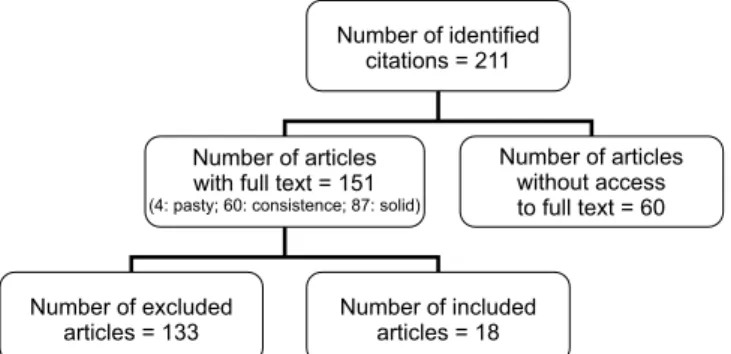
The search path that was performed for the analyzed texts is shown in Figure 1.
After the literature was reviewed, and the articles were selected, the analysis was conducted according to the study objectives; type of text; number, gender and age of participants; evaluation criteria; treatment control and results. The following section presents the analysis.
LITERATURE REVIEW
An experimental study(5) assessed the use of Levodopa
and the swallowing performance observed with various food consistencies in patients with progressive supranuclear palsy (PSP) and Parkinson’s disease (PD). The study did not include control cases and was conducted with subjects who were diag-nosed with probable PSP or PD. Patients with other diseases that occur concomitantly with dysphagia were excluded. For evaluation, a fiberoptic endoscopy video exam was performed during the swallowing of blue-stained liquid and pieces of bread. There were no observed differences between the PSP and PD groups. In both groups, penetration/aspiration occurred more frequently for liquid foods and was observed significantly less frequently for pasty and solid foods.
Another experimental study(6) assessed swallowing by
videofluoroscopy (VF) and recorded episodes of penetration/ aspiration by age, bolus size and food consistency. The study was conducted with healthy adult volunteers without dyspha-gia or neurological diseases. The subjects had not previously undergone VF and presented no symptoms that could cause swallowing difficulties. Penetration was present in 11.4% of healthy individuals, and penetration was more common with liquid bolus. Penetration was generally high and did not cons-titute a threat. The authors suggested that aspiration is not a normal finding in VF exams of healthy subjects.
A third experimental study(7) examined the effect of the
respiratory phase on the soft palate movement during feeding. With the assumption that the elevation of the soft palate that is associated with mastication would be reduced during ins-piration, the authors described how the respiratory phase is integrated with soft palate movement. The study included 11 young, healthy, asymptomatic volunteer subjects between the ages of 19 and 37 years. During the ingestion of solid foods, videofluoroscopic images were recorded, and respirations were monitored with plethysmography. During food processing, the results showed that palate uplifting occurred less frequently, and its displacement was smaller during inspiration than du-ring expiration. Dudu-ring the transport phase that occurs dudu-ring mastication, the soft palate was elevated less frequently in inspiration than in expiration. The authors suggested that the breathing control has a significant effect in raising the soft palate during mastication.
Other authors(8) experimentally investigated the immediate
effects of thermal-tactile stimulation (TTS) during swallowing in individuals with idiopathic PD and concomitant dysphagia. The authors performed a swallowing assessment and video-fluoroscopy examination with 5 ml of liquid barium and 5 ml of pasty barium before and after TTS. For the liquid barium, TTS reduced the pharyngeal transit time and delay and the total transit time with no change on the oral transit time. For the pasty barium, TTS reduced the pharyngeal and total transit time, and there were no differences in pharyngeal delay and oral transit time. The authors concluded that TTS may improve the swallowing of patients with idiopathic PD. The study had no control cases.
In another study(9), an analysis of acoustic swallowing
sounds was performed in healthy subjects and in patients with dysphagia that was caused by neurological diseases. The study tested the positive/negative predictive value of pathological patterns of swallowing sounds for penetration/aspiration. An acoustic analysis was used to determine the meaning of the swallowing sounds, and verification of penetration/aspiration was assessed with a deglutition fiberoptic endoscopy that tes-ted solids, semi-solids, pastes and liquid foods. The acoustic analysis revealed a sensitivity of 0.67 and specificity of 1.0 for penetration/aspiration. The authors concluded that the proposed technique for recording swallowing sounds can be incorporated into assessments in bed, but the technique should not replace the use of other valuable diagnostic measures.
Other authors(10) investigated statistically and/or clinically
significant changes in patients’ functional status. The authors used a functional assessment measure (SFAM) and recorded levels of diet foods and liquids to verify the levels of assistance
Figure 1. Search route conducted for selection of articles to be
and independence in swallowing. The authors also investigated the relationship between the care/dependency SFAM and the specific dietary ratings. The study did not include control cases and was performed with 100 patients with swallowing disor-ders that were associated with acute stroke. The swallowing evaluation was performed clinically at the patients’ bedsides. In cases where the assessment was inconclusive and/or addi-tional information was required to determine the swallowing strategies, a videofluoroscopic evaluation was recommended to evaluate food textures and liquids. There were differences in food classifications and SFAM levels between admission and discharge, and a high percentage of these differences were de-termined clinically. Furthermore, a high level of variability was found in the dietary evaluations in the majority of SFAM levels. These results demonstrated that specific dietary assessments with SFAM support/autonomy levels are required to obtain a complete assessment of post-stroke patients with dysphagia.
Another experimental study(11) described the
electromyo-graphic (EMG) activity patterns of the genioglossus muscle and suprahyoid muscles during swallowing and the effects of changes in the food texture/consistency in the transport of the swallowed bolus. The study was conducted with healthy adults; a videofluoroscopy exam and a surface electromyography were conducted during swallowing. The results revealed the contrac-tion pattern of the genioglossus muscle, with two peaks being observed during each swallow, which was significantly affected by food consistency. There was no difference in the bolus transit time for any of the conditions. During swallowing, the duration but not the extent of the activity of the tongue muscle and suprahyoid muscles was longer for more consistent foods.
In another study(12), the relationship between swallowing
and the initial pulmonary volume during isolated swallowing events was examined, and various volumes of food and food consistencies were considered. The experimental study was conducted among young adults between 19 and 28 years old who had no history of neurological, voice or anatomical oral cavity disorders. The pulmonary volume and respiratory pha-se data were recorded when each participant completed five repetitions of swallowing 10 ml and 20 ml of water in a glass, and spoons of thin and thick pasty bolus were randomly pre-sented. Differences in initial pulmonary volume were related to consistency but not to bolus volume. There were no diffe-rences between the pulmonary volume and respiratory phases during swallowing or between breathing patterns and food consistencies or volumes. The authors concluded that analyses of initial pulmonary volume during food swallowing and other mechanisms of biomechanical deglutition will contribute to the study of physiology and pathophysiology of swallowing.
A study was conducted(13) to test the hypothesis that people
with chronic obstructive pulmonary disease (COPD) have moderate to severe disorders in breathing coordination during oral intake. The study compared the performances of 25 COPD patients with a control group of 25 healthy individuals (12 men and 13 women) of similar ages. A respiratory inductive plethysmography and a nasal thermistry were performed simul-taneously to trace respiratory signs. Additionally, a submental surface electromyographic measurement was used to mark the presence of each swallowing event in the respiratory cycle. The
data were recorded during random and spontaneous intakes of solid, semi-solid and pasty foods. The intake of solid foods during inhalation occurred more frequently in individuals with COPD than in healthy subjects. In addition, the COPD pa-tients showed a significantly higher rate of inhalation after the ingestion of semi-solid material. The authors concluded that patients with COPD have impaired coordination of the respi-ratory cycle during swallowing, and the breathing-swallowing incoordination can increase the risk of aspiration in patients with advanced COPD and can contribute to exacerbations.
Other researchers(14) evaluated the effects of food texture
and consistency in the swallowing of healthy young adults. The authors conducted a videofluoroscopic analysis to measure tongue pressure. The experimental study was conducted to evaluate swallowing for different food consistencies (i.e., thin and thick paste, syrup and liquid) with barium sulfate. During swallowing, the anterior and posterior tongue pressures (AP and PP, respectively) were measured and the EMG activity of the suprahyoid muscles and videofluoroscopy images were recorded. The results showed that AP and PP have a single peak. When the food bolus consistency decreased, the peaks, areas and durations of AP, PP and EMG decreased. The oral swallowing and total transit times displayed greater increases by food consistency; the pharyngeal transit time did not differ by consistency, but it did differ by food viscosity.
A study was conducted(15) to explore breathing patterns
during the mastication and swallowing of a solid food bolus. The study used nasal manometry and respiratory plethysmo-graphy with healthy adult subjects. During the videofluoros-copy evaluation of a barium solid food ingestion, respiration was monitored by plethysmography and nasal air pressure; the time of the mastication event and the aggregation and transport of the bolus through the pharynx were measured, and they were related to breath. The results showed a reduction in the duration of the respiratory cycle during mastication but an increase during swallowing. Plethysmography was more effective than nasal manometry in predicting the end of active expiration during the feeding and swallowing of solid foods. The results suggest that the airflow through the pharynx has no role in preventing aspiration during bolus aggregation in the oropharynx.
An experimental study(16) identified and characterized the
Increasing the bolus volume was associated with a reduction in the temporal difference between the beginning of the UES opening and the beginning of other pharynx movements. In contrast, boluses of thicker consistency were associated with an increased temporal difference. The study also found that younger participants displayed a minor temporal difference between events compared to older participants.
Another experimental study(17) used videofluoroscopic
evaluation to investigate the effects of food bolus consistency on penetration/aspiration and swallowing time in subjects with PD. The subjects underwent six swallows of thin pasty food and six swallows of thick pasty food. The authors con-sidered the swallowing time and the presence or absence of penetration/aspiration. The results of the study show that oral transit time and the number of tongue movements are greater for thick pasty foods. Penetration/aspiration occurred less frequently for the thick pasty food compared to the thin pasty food. No differences were found for pharyngeal transit time and food consistency.
An experimental study(18) investigated the effect of volitional
acts on the transport of food and bolus aggregation during solid food ingestion. The study was conducted with eight healthy adults, including four men and four women, between 21 and 25 years old. Upon ingesting cookie pieces with barium, the movements were recorded by videofluoroscopy. Two trials were conducted per subject: the first trial did not include instructions (subjects ate the cookie as usual), and the second trial included a command to masticate, provide a sign when ready to swallow and subsequently swallow after the researcher’s signal. The num-ber of masticatory cycles, the duration of each deglutition phase and the barium bolus tip position in the video were measured at the moment of the command and at the swallowing start time. The duration of each sequence was longer with the command, mainly because of an increase in the number of mastication cycles. When the command was issued, the barium tip was generally bigger in the feed route, there was a delay in the food transport phase and there was an absence of transport to the vallecula. The authors concluded that volition has an influence on swallowing through the time of initiation and the position of the bolus food in relation to the airway.
Other authors(19) examined the effect of mastication on the
bolus transportation and start of swallowing. Healthy adult subjects were evaluated during the swallowing of liquids, solids and mixtures of liquids and solids. Subjects were in an upright position with their heads down while they underwent a videofluoroscopy to measure where the bolus triggered their swallowing. During the mastication of mixtures of liquids and solids, the food reached the hypopharynx before the subjects swallowed, demonstrating that the food transport to the hypo-pharynx was influenced by gravity. Depending on the tongue--palate contact, the transport of food to the vallecula was active during mastication. Mixtures of liquids and solids increased the risk of aspiration in certain cases such that there were no protective airway reflexes. The lowered head posture decreased the interval between the start of swallowing and the start of the hypopharyngeal transit of liquids and mixtures of liquids and solids, but the posture did not modify the swallowing time for other consistencies.
Another experimental study(20) established healthy adults’
ability by age to realize the viscosity of fluids in the oral cavity and pharynx. The study included 60 healthy volunteer adults (30 males and 30 females) who did not have dysphagia or neurological diseases, were not using drugs that could modify swallowing and sensitivity and had not undergone radiothera-py. The subjects were offered liquids that were prepared with different viscosities between thin liquid and syrup. Individuals identified the consistencies in the oral cavity and oropharynx. The study showed that perceptions of viscosity decrease with age, and the deterioration is markedly higher in men.
Other authors conducted a study(21) to analyze swallowing
sounds. The authors performed an acoustic evaluation of swallowing in healthy individuals while they ingested foods with various volumes and consistencies. The sounds were compared between genders. The study was conducted with 30 healthy adults (20 men and 10 women) between the ages of 24 and 63 years old. For the evaluation of swallowing sounds, the subjects were requested to swallow 10 ml of water and 190 cp barium during a videofluoroscopic exam. The swallo-wing sounds were recorded with a microphone. The number of sound components, the intervals among the components and the total time of each sound were analyzed. There were no gender differences in the swallowing sounds. The study identified three sound components of the decomposition of swallowing sounds and identified their normal duration times.
Finally, the authors(22) performed an experimental study
to assess normal tongue physiology during swallowing and maximal isometric tasks. The authors also aimed to verify changes in tongue function and possible relationships among age, gender and changes in food bolus consistency. The study was conducted with healthy adult subjects who were divided into age and gender groups. The Iowa Oral Performance Instru-ment (IOPI) was used to measure changes in tongue function. A pressure transducer measured the maximum tongue pressure and movement during swallowing. The results revealed that men have a significantly higher maximum isometric tongue pressure than women, and younger individuals have higher tongue pressure than older individuals. The pressure during swallowing depended on the bolus consistency type but not on age or gender.
DISCUSSION
According to the findings reviewed in this paper, deglu-tition studies have heterogeneous methodologies, especially in how to assess swallowing. To assess swallowing, studies variously use videofluoroscopy exams(5-7,11,14,18,19), digital
acoustic analysis of swallowing sounds(9,21) and surface
elec-tromyography(11). The use of control groups and participants’
ages also varied among the reviewed studies. Studies were performed with healthy subjects to obtain baseline data(6,12,14,16)
and with patients with specific pathologies(5,13,17). Studies of
direct application of findings to clinical practice.
The type of supplementary evaluation that was most fre-quently used was the videofluoroscopy exam, which is usually associated with other objective tests(9,11). The occurrence of
penetration/aspiration was minor for food with a pasty thick consistency compared to food with a thin consistency; there were no differences between pharyngeal transit time and food consistency(17). Only one study used a clinical evaluation to
assess the instrumental evaluation of swallowing(10).
The present review shows the importance of a clinical spe-ech evaluation in the evaluation process of swallowing. When it is performed by a qualified professional, a clinical speech evaluation contributes to the determination of a prognosis and treatment. Thus, the objective evaluation of swallowing should be complemented with standardized clinical protocols.
For swallowing sounds that are measured by acoustic analysis, the studies indicated that recording should be con-trolled and standardized. Additionally, this type of analysis can be incorporated into the bedside clinical evaluation(9).
In one of the studies(21), there were no gender differences in
swallowing sounds among healthy individuals. The authors observed that the swallowing sounds can be divided into three sound components, and the authors suggested normative data regarding the sound durations.
Regarding surface electromyography exams, the genio-glossus muscle contraction was significantly affected by food consistency(11). When associated with videofluoroscopy, the
oral transit time and the total swallowing time were higher for
foods with increasingly dense consistencies. The pharyngeal transit time showed no significant differences in consistency, but there were differences in food viscosity(14).
Regarding the respiratory characteristics that are associated with solid and pasty consistencies, there were no differences in pulmonary volume related to the respiratory phases during swallowing or the breathing patterns among the different food consistencies and volumes in healthy subjects(12). In patients
with COPD, there was a disturbance in the coordination of the breathing cycle during swallowing; the breathing-swallowing incoordination can increase the risk of aspiration in patients with advanced disease(13). There was a reduction in the duration
of the respiratory cycle during mastication and an increase during swallowing(15). In healthy individuals, the times among
swallowing events increased by age(16).
FINAL COMMENTS
The heterogeneity of the studies is partly a result of the different groups of diseases that have been assessed, but the methodological variability complicates the definition and generalizability of the patterns that have been found. Thus, it is not possible to highlight data that will support speech therapy in clinical practice for normal physiology compared to altered swallowing with different consistencies of food either for healthy subjects or for subjects who are affected by swallowing disorders.
RESUMO
Objetivo: Levantar artigos científicos internacionais sobre a fisiologia da deglutição de alimentos nas consistências néctar, mel, pudim, pastosa heterogênea, semissólida e sólida, nas fases oral e faríngea. Métodos: Trata-se de estudo de revisão qualitativa da literatura. Para a seleção dos artigos, foi utilizada a base de dados PubMed com emprego dos descritores “Swallowing and consis-tency”, “Swallowing and solid” e “Swallowing and pasty”, limitando-se a pesquisas publicadas no idioma inglês, entre os anos de 2005 e 2010, realizadas com seres humanos maiores de 18 anos. A metodologia empregada envolveu formulação da pergunta, localização e seleção dos estudos, e avaliação crítica dos artigos, conforme os preceitos do Cochrane Handbook. Resultados: Foram identificados 211 estudos, dos quais 18 foram analisados, pois permitiam acesso ao texto completo e eram diretamente relacionados ao tema. Conclusão: Os estudos apresentam metodologia pouco uniforme, não havendo padronização, principalmente quanto aos métodos de avaliação. Em geral, as pesquisas foram realizadas com sujeitos saudáveis ou remeteram a um tipo de patologia, sem utilização de casos-controle. A heterogeneidade dos estudos possibilita que diferentes grupos de patologias sejam avaliados, porém, a variabilidade metodológica dificulta a definição e generalização dos padrões encontrados. Sendo assim, não é possível evidenciar dados que embasem a prática clínica fonoaudiológica no que diz respeito à fisiologia normal ou alterada da deglutição de diferentes consistências alimentares, tanto para sujeitos normais quanto para os acometidos por alguma desordem.
Descritores: Deglutição/fisiologia; Transtornos de deglutição; Alimentos; Comportamento alimentar; Ingestão de alimentos
REFERENCES
1. Matsuo K, Palmer JB. Anatomy and physiology of feeding and swallowing: normal and abnormal. Phys Med Rehabil Clin N Am. 2008;19(4):691-707.
2. Padovani AR, Moraes DP, Mangili LD, de Andrade CR. Protocolo Fonoaudiológico de Avaliação de Risco para Disfagia (PARD). Rev Soc Bras Fonoaudiol. 2007;12(3):199-205.
3. American Speech-Language-Hearing Association. Model medical review guidelines for dysphagia services [Internet]. 2004 [cited 2007 Mar 3]. Available from: http://www.asha.org/uploadedFiles/practice/ reimbursement/medicare/DynCorpDysphHCEC.pdf
May 5]. Available from: http://www.cochrane-handbook.org/ 5. Warnecke T, Oelenberg S, Teismann I, Hamacher C, Lohmann
H, Ringelstein EB, et al. Endoscopic characteristics and levodopa responsiveness of swallowing function in progressive supranuclear palsy. Mov Disord. 2010;25(9):1239-45.
6. Allen JE, White CJ, Leonard RJ, Belafsky PC. Prevalence of penetration and aspiration on videofluoroscopy in normal individuals without dysphagia. Otolaryngol Head Neck Surg. 2010;142(2):208-13. 7. Matsuo K, Metani H, Mays KA, Palmer JB. Effects of respiration on
soft palate movement in feeding. J Dent Res. 2010;89(12):1401-6. 8. Regan J, Walshe M, Tobin WO. Immediate effects of thermal-tactile
stimulation on timing of swallow in idiopathic Parkinson’s disease. Dysphagia. 2010;25(3):207-15.
9. Santamato A, Panza F, Solfrizzi V, Russo A, Frisardi V, Megna M, Ranieri M, Fiore P. Acoustic analysis of swallowing sounds: a new technique for assessing dysphagia. J Rehabil Med. 2009;41(8):639-45. 10. McMicken BL, Muzzy CL. Prognostic indicators of functional outcomes
in first time documented acute stroke patients following standard dysphagia treatment. Disabil Rehabil. 2009;31(26):2196-203. 11. Tsukada T, Taniguchi H, Ootaki S, Yamada Y, Inoue M. Effects of food
texture and head posture on oropharyngeal swallowing. J Appl Physiol. 2009;106(6):1848-57.
12. Wheeler Hegland KM, Huber JE, Pitts T, Sapienza CM. Lung volume during swallowing: single bolus swallows in healthy young adults. J Speech Lang Hear Res. 2009;52(1):178-87.
13. Gross RD, Atwood CW Jr, Ross SB, Olszewski JW, Eichhorn KA. The coordination of breathing and swallowing in chronic obstructive pulmonary disease. Am J Respir Crit Care Med. 2009;179(7):559-65.
14. Taniguchi H, Tsukada T, Ootaki S, Yamada Y, Inoue M. Correspondence between food consistency and suprahyoid muscle activity, tongue pressure, and bolus transit times during the oropharyngeal phase of swallowing. J Appl Physiol. 2008;105(3):791-9.
15. Matsuo K, Hiiemae KM, Gonzalez-Fernandez M, Palmer JB. Respiration during feeding on solid food: alterations in breathing during mastication, pharyngeal bolus aggregation, and swallowing. J Appl Physiol. 2008;104(3):674-81.
16. Mendell DA, Logemann JA. Temporal sequence of swallow events during the oropharyngeal swallow. J Speech Lang Hear Res. 2007;50(5):1256-71.
17. Troche MS, Sapienza CM, Rosenbek JC. Effects of bolus consistency on timing and safety of swallow in patients with Parkinson’s disease. Dysphagia. 2008;23(1):26-32.
18. Palmer JB, Hiiemae KM, Matsuo K, Haishima H. Volitional control of food transport and bolus formation during feeding. Physiol Behav. 2007;91(1):66-70.
19. Saitoh E, Shibata S, Matsuo K, Baba M, Fujii W, Palmer JB. Chewing and food consistency: effects on bolus transport and swallow initiation. Dysphagia. 2007;22(2):100-7.
20. Smith CH, Logemann JA, Burghardt WR, Zecker SG, Rademaker AW. Oral and oropharyngeal perceptions of fluid viscosity across the age span. Dysphagia. 2006;21(4):209-17.
21. Morinière S, Beutter P, Boiron M. Sound component duration of healthy human pharyngoesophageal swallowing: a gender comparison study. Dysphagia. 2006;21(3):175-82.