Psychology & Neuroscience, 2011, 4, 3, 429 - 431 DOI: 10.3922/j.psns.2011.3.016
PSYCHOLOGY
NEUROSCIENCE
Obituary
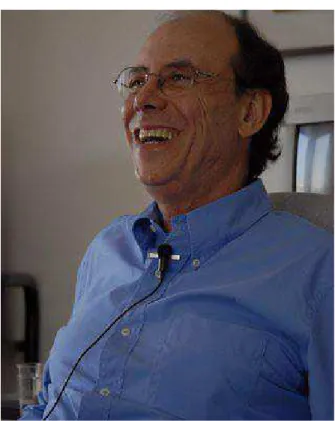
Bernardo Jablonski (1952-2011)
Aroldo Rodrigues
1and Terezinha Féres-Carneiro
21 - California State University, Fresno, CA, USA
2 - Pontifícia Universidade Católica do Rio de Janeiro, Rio de Janeiro, RJ, Brazil
Aroldo Rodrigues, Psychology Department, California State University, Fresno. 2576 E. San Ramon ST11, Fresno, CA 93740. E-mail: [email protected]. Terezinha Féres-Carneiro, Departamento de Psicologia, Pontifícia Universidade Católica do Rio de Janeiro, Ed. Cardeal Leme, Sala 201L, Rua Marquês de São Vicente 225, Gávea, RJ-Brazil, 22451-900. E-mail: [email protected]. Correspondence regarding this editorial can be directed to either author.
After a long and courageous ight against cancer,
Bernardo Jablonski—professor, social psychologist, theater and TV actor, writer, and director—passed away on October 28, 2011. Despite having been diagnosed with thyroid cancer when he was only 46 years old, Bernardo coped with the disease with amazing tenacity. He continued to engage in the numerous activities allowed by his immense talent until the day he was hospitalized to undergo what turned out to be the last of a long series of surgeries.
Bernardo was born on January 1, 1952 in Rio de Janeiro, Brazil. He was preceded by his brothers, Fernando and Silvio. The son of Polish immigrants (his parents experienced the torment of a Nazi concentration camp), Bernardo was a dedicated and loving son. He was married to a distinguished theater and TV artist, Maria Clara Gueiros, with whom he had two sons, João (age 17) and Bruno (age 14).
When he was a student in the Master’s Program at
Pontiical Catholic University in Rio de Janeiro
(PUC-Rio), Bernardo was invited by Aroldo Rodrigues, then Chair of the Psychology Department, and by his coordinators, Terezinha Féres-Carneiro, Vera Lemgruber, and Bernard Rangé, to join their group that also included Prof. Miguel Chalub and the department secretary, Norma Ferreira Soares. This group met every Thursday for lunch in different restaurants in Rio. These lunches continued, whenever possible, for many years. The last of these lunches took place in August 2011, a little over 2 months before his death. Although somewhat physically weakened by the advanced phase of his illness, Bernardo’s spirit and strong presence, combined with his unmatched sense of humor and unshakable optimism,
were unaltered. From the irst to the last of these reunions,
Bernardo inspired us and brought joy to our lives. Bernardo possessed so many talents that singling
out the most remarkable is dificult. Would it be his
dedication to his family and friends? Would it be the power of his intellect, work ethic, and achievements in psychology, theater arts, and TV? Would it be his keen and contagious sense of humor? Or would it be his dedication to his students? Numerous examples that illustrate all of these virtues can easily be evoked by anyone who knew him well.
We had the privilege of enjoying Bernardo’s friendship for more than three decades. Throughout these years, Bernardo was always the same, notwithstanding the misfortune of having been stricken with cancer at such a young age. He never complained.
Rodrigues and Féres-Carneiro 430
He never lost his optimism. He faithfully followed the recommendations of his doctors in both Brazil and the United States. As unbelievable as this may seem, he never stopped working, never ceased being productive and innovative, never stopped interacting frequently with his numerous friends, never forgot to share precious moments with his children, and never stopped infusing humor into his books, screenplays, and conversations. He always lived life to the fullest.
In the scientiic and academic domain, Bernardo
always tried to improve himself. After receiving a BA in Psychology from the Federal University of Rio de Janeiro, he joined the Master’s Program at PUC-Rio and obtained his MA. He went on and attained a Doctor of Psychology degree at the Getúlio Vargas Foundation. In the artistic domain, he also sought to advance his career. Bernardo perfected his acting skills under the guidance of the distinguished founder of Teatro Tablado, later excelling in his career as actor, writer, director, critic, and producer, both in theater and on TV. He was a Professor of Social Psychology at PUC-Rio, State University of Rio de Janeiro, and University Gama Filho, supported by the National Council of Research (CNPq). He helped in the artistic formation of numerous students in the classes he taught at Teatro Tablado, which was under his presidency for the last 10 years.
Among his books, we ind Até que a vida nos separe [Until life do us part], an analysis of contemporary
marriage derived from his doctoral dissertation;
Psicologia Social[Social Psychology], co-authored with Aroldo Rodrigues and Eveline M.L. Assmar, a textbook often used in Brazilian and Mexican universities; A luta nas classes [Struggle in the classrooms], a book of keen humor with several printings; Enlouquecendo em família [Getting crazy among relatives], another satiric and humorous book; and O mestre contra-ataca: como infernizar a vida de um estudante [The professor strikes back: how to make miserable the life of a student], the last three of which were co-authored with Ronald Fucs. In addition to these books, Bernardo published several
papers in national and international scientiic periodicals.
Psychologist by choice and humorist by nature,
Bernardo mixed his scientiic activities with his
uncontrollable inclination toward humor. Likewise, he used his knowledge of psychology in his artistic endeavors. One of us (Aroldo Rodrigues) was his dissertation advisor and co-author of Social Psychology in collaboration with Eveline M.L. Assmar. Numerous were the times, both in his dissertation and in the book, when I had to control his amazing propensity for introducing humor in his writings so that the text was kept within
the parameters of traditional scientiic publications. This was very dificult because his humor was of the highest
caliber and an integral part of his personality.
I (Therezinha Féres-Carneiro) had the privilege, in my continuous interactions with him for more than
30 years as his friend/sister and academic collaborator, of learning from him the simplicity, generosity, and wisdom of facing life with grace and being friendly and respectful to other people. During these years, I never saw Bernardo show signs of despair, pity himself, or direct negative comments toward anyone. For all of these reasons, my gratitude to him is eternal.
In psychology, Bernardo has a legacy of important contributions in the psychology of interpersonal relations (with a special emphasis on conjugal relationships),
prejudice, and social inluence. In theatrical productions
and movies and on TV, his impact was substantial as an actor, director, producer, writer, and critic. Only a truly extraordinarily talented person could have achieved such success in such disparate domains as art and science. Not even a grave illness was able to slow his pace, which was unaltered until the day of the last of his 14 surgeries in 13 years.
Numerous expressions of friendship and deep sorrow could be seen among the legion of friends and admirers who came to give him their last farewell. Bernardo had no enemies. And how could he? People received from him nothing but special attention and warmth.
For those who did not know him, we reproduce a few excerpts of an interview found on http://extra.globo. com/tv, in which he was asked by the reporter about the cancer that struck him. His humor is evident even with this traumatic event:
“It all started in the thyroid. When I found out, the disease had spread. I underwent six or seven surgeries. Everything was removed: thyroid, vocal cords, uterus, ovaries...I even had silicon implanted, you know?” he said jokingly in reference to the prosthesis needed to replace his vocal cords.
And his philosophy of life further revealed itself:
“It is a struggle. But everyone has his problems. Some have no money, others crash their cars...Obviously we feel the blow. But we forget about it and move on.”
And:
“It requires a lot of humor to get up in the morning and bear the world’s pains. And I live off of that.”
It was indeed a rare privilege to have known, admired, and shared Bernardo’s friendship. We know that all of us, both his friends and admirers, will keep him in our thoughts and discussions when we gather for Thursday lunches. Bernardo is unforgettable and irreplaceable. To him go our deepest thanks for having been who he was and for having brought so much joy and enchantment to our lives. He leaves for both his children and his friends a legacy of unsurpassed value: a remarkable example of how life should be lived.