A proile of patients with lower limb trauma treated by
the Hospital Metropolitano de Urgência e Emergência
reconstructive surgery team
Peril de pacientes vítimas de trauma em membro inferior atendidos pela equipe
de cirurgia reparadora do Hospital Metropolitano de Urgência e Emergência
This study was performed at the Hospital Metropolitano de Urgência e Emergência, Belém, PA, Brazil. Submitted to SGP (Sistema de Gestão de Publicações/Manager Publications System) of RBCP (Revista Brasileira de Cirurgia Plástica/Brazilian Journal of Plastic Surgery). Article received: March 9, 2013 Article accepted: May 2, 2013
Thamy harumi Cardoso
moToki1
karen CosTa Carvalho1
Fabiel spani vendramin2
ABSTRACT
Background: In the area of medical emergency services, the incidence of trauma to the
lower limbs is growing, and excessive damage may result in incapacity and physical disabili
ties. The aim of this study was to evaluate the epidemiological proile of patients with lower limb trauma who were treated by the reconstructive surgery team of Hospital Metropolitano de Urgência e Emergência. Methods: This prospective cohort study included patients with
lower limb trauma who were under the care of the reconstructive surgery team. Results:
The study mainly included young male road accident victims (primarily motorcycle) with dark complexions who were single and had not completed their elementary education. Ni
nety percent of the subjects had a paid occupation with a per capita mean monthly income of R$290.76 [122.76 USD]. Sixty-ive percent of these subjects were alcohol consumers and 35% were smokers. The majority of the patients came from interior areas of Pará. The most commonly sustained injuries were contused lacerated wounds of the leg with exposure of the underlying structures. The median length of time between the trauma occurrence and surgery was 32.5 days. The principal reasons for postponing surgery included delays in approval for patient assessment by the plastic surgery team and waiting for the wound condition to improve. Reconstruction with laps was used in 65% of cases with or without grafts, with the most common procedure using reverse-low sural laps. A cutaneous graft alone was used in 35% of the patients. Conclusions: Young, low-income, motorcycle-riding
males with poor education levels, dark complexions, and alcohol consuming and smoking habits are the most involved in accidents that cause injuries to the lower limbs and require surgical reconstruction.
Keywords: Plastic surgery. Lower extremity. Reconstructive surgical procedures. Surgical
laps. Wounds and injuries.
RESUMO
Introdução: Nos serviços de urgências médicas, é crescente a incidência de lesões traumá
ticas de membros inferiores com perda de substância, que podem ocasionar deiciências e incapacitação física. O objetivo deste estudo foi avaliar o peril epidemiológico das vítimas de trauma em membro inferior, atendidas pela equipe de cirurgia reparadora do Hospital Metropolitano de Urgência e Emergência. Método: Foi realizado um estudo de coorte
prospectivo com pacientes que sofreram trauma de membro inferior e que se encontravam sob os cuidados da equipe de cirurgia reparadora. Resultados: A amostra foi majoritaria
mente composta por homens jovens, vítimas de acidente de trânsito (principalmente por motocicletas), pardos, solteiros e com ensino fundamental incompleto. Noventa por cento
1. Student of Medicine at Universidade do Estado do Pará (UEPA), Belém, PA, Brazil.
INTRODUCTION
In the area of medical emergency services, it is becoming increasingly more common to encounter patients with trauma to the lower limbs and excessive damage that may be accom
panied by bone fractures1. When not fatal, these injuries
frequently result in incapacity and temporary or permanent physical disability that can negatively interfere with quality of life2.
The aim of lower limb reconstruction is the surgical cor -rection of defects and open wounds on a patient’s leg to enable a patient to resume a normal life with the ability to walk and work, and avoid the need for amputation3.
This study aimed to establish an epidemiological proile of lower limb trauma victims treated at the Hospital Metro
politano de Urgência e Emergência (HMUE). Thereby, with a better understanding of the population proile involved, trauma-related risk factors can be identiied, which can serve to prevent accidents.
METHODS
All research participants were studied in accordance with principles of the Declaration of Helsinki and the Nuremberg Code with respect to the guidelines for conducting research involving humans of the National Health Council (Resolu -tion 196/96). This followed project approval by the Núcleo de Pes quisa, Extensão e Pós-Graduação em Medicina [Re search, Extensions and Postgraduate Medical Unit] of the Universida de do Estado do Pará, e do Comitê de Ética em Pesquisa [Re search Ethics Committee] of Universidade do Estado do Pará.
All research subjects signed the free and informed consent form and completed a questionnaire.
This prospective cohort study was conducted between Fe bruary and August 2012. The population studied was com -posed of 20 individuals of both sexes who were 15–65 years of age with deep wounds, exposure of the underlying structures and/or loss of cutaneous substance or extensive tissue destruc
tion in at least one lower limb, and traumatic etiology, and who were admitted to the HMUE < 24 hours after the trauma. Exclusion criteria were as follows: individuals who did not fulill the above requirements, as well as those with a mental impairment, a dependency relation such as prisoners and the military, and those who did not correctly ill in the protocol data (e.g., did not complete the form).
Interviews were conducted to collect epidemiological data as well as information related to the experienced trauma and applied treatment.
Microsoft Excel 2010 was used to create the database, tables, and graphs, while Bioestat 5.0 was used to perform the statistical analyses.
RESULTS
The mean age of the studied patients was 30.7 years. Most were male, and all had a dark complexion (Table 1). Half of these individuals were single and had not completed elementary education (Table 2 and Figure 1). With regard to religion, 55% were Catholic, 35% were evangelical, and 10% were atheist. The vast majority (90%) of the studied sub jects had some form of paid occupation with or without an employment record book. The group’s mean monthly income per capita was R$ 290.76.
None of the researched subjects had comorbidities, such as arterial systemic hypertension, diabetes, or collagenosis.
The study veriied the diets of the individuals and found that a large number of them consumed alcohol and/or tobacco (Figure 2).
dos pesquisados exerciam alguma atividade remunerada e apresentavam renda per capita mensal média de R$ 290,76. Sessenta e cinco por cento dos pesquisados eram etilistas, dos quais 35% eram tabagistas. A maioria dos pacientes era proveniente do interior do Pará. As lesões mais comuns eram as lacerocontusas, localizadas na perna e com exposição de estruturas nobres. O tempo decorrido entre o trauma e a cirurgia apresentou mediana de 32,5 dias. Os principais motivos de retardar a cirurgia foram atrasos na solicitação para que a equipe da cirurgia plástica avaliasse o paciente e espera para melhorar as condições da ferida. Retalhos foram utilizados em 65% dos casos, acompanhados ou não de enxertos, sendo o mais frequente o sural de luxo reverso. Em 35% dos pacientes, realizou-se enxerto cutâneo isoladamente. Conclusões: Homens jovens, de baixa renda, com pouca escolari
dade, pardos, etilistas, tabagistas e usuários de motocicletas são os mais envolvidos em acidentes que ocasionam lesões em membros inferiores que necessitam de reparo cirúrgico.
Descritores: Cirurgia plástica. Extremidade inferior. Procedimentos cirúrgicos reconstru
There was a slight predominance of patients origina ting from rural areas of the state of Pará (55%) compared with Be lém and metropolitan regions (45%). In half of the cases, the irst instance of hospital care occurred at the HMUE. Au -tomobile accidents represented the principal cause of trau ma, with the majority involving motorcycles (Table 3).
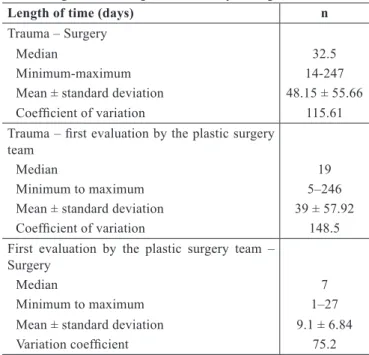
A median time of 19 days was noted between hospital admittance and first evaluation by the plastic surgery team, while the median time taken between that evaluation and subsequent reconstructive surgery was 7 days. Overall, the median time between trauma and surgery was 32.5 days (Ta ble 4). This delay in surgery was due to the delay of other specializations in requesting pre-plastic surgery eva luation as well as awaiting wound healing. It is worth no ting that some cases involved more than one associated reason (Table 5).
The most common injury found was contusion laceration (90% of cases), followed by contused puncture (10%). Sixty percent of these injuries also had exposed underlying struc
tures, such as bone or tendon. The leg was the most affected lower limb area in most of the cases (75%), principally in the middle third (40%) and distal third (45%) of the anterior surface.
Before surgical treatment was given, 90% of patients we re administered antibiotic therapy. Among the performed surgical procedures, 35% were grafts and 65% were laps with or without grafts, most being reverse sural fasciocutaneous laps followed by anterior tibial fasciocutaneous laps.
DISCUSSION
This epidemiological study demonstrated that trauma is more common in young males 15–44 years of age4. In a study
conducted by MacKenzie et al.5, 71% of patients with lower
limb trauma were 20–45 years of age and most were male, as seen in this study.
The predominance of young men is perhaps inluenced by their general tendency to be more aggressive in trafic and
Table 1 – Age and gender of the patients interviewed in the Hospital Metropolitano de Urgência e Emergência,
February to August 2012.
Characteristics n = 20
Age (years)
Mean ± standard deviation 30.7 ± 11.96
Median 29.5
Minimum to maximum 15–64
Gender, N (%)
Feminine 4 (20)
Masculine 16 (80)
Table 2 – Education data of patients interviewed at the Hospital Metropolitano de Urgência e Emergência,
February to August 2012.
Schooling n (%)
No education __
Incomplete elementary education 10 (50) Complete elementary education 3 (15) Incomplete secondary school education 4 (20) Complete secondary school education 1 (5) Incomplete higher education 1 (5) Complete higher education 1 (5)
Total 20 (100)
Figure 1 – Marital status of patients interviewed at the
Hospital Metropolitano de Urgência e Emergência, February to August 2012.
Figure 2 – Alcohol consumption and tobacco use habits
characteristics such as impulsiveness, immaturity, a desire for intense feelings, limited driving experience, motivation, peer pressure, and delinquent behavior6.
As in the study conducted in Piaui in 2008, this study had a dominance of patients with incomplete elementary and secondary education who had a low monthly per capita income less than the minimum salary6. It is possible that many
of these casualties are workers who use their vehicles in the rural properties where they work and since these motorcycles are not licensed, they have had no particular maintenance and have not been through any standard control checks by oficial bodies6. It is also worth noting that Pará still has a signiicant
number of poorly educated people who do not have a perfect knowledge of road signs.
The majority of individuals treated by the department were single, which contributed to the fact that the majority of victims were young. This particular group tends to have strong emotions, and be novelty seeking and more likely to risk their well-being to achieve these things6. With regard to
the studied habits of the subjects, especially that of tobac
coism, the Ministry of Health7 in 2011 released details of
smoking prevalence by Brazilian city. While there was a national prevalence of 7.8–22.6%, Belém had a percentage of 12.5%. This study’s sample had a higher percentage, which was similar to that observed by Mackenzie et al.5,
who reported that 37% of patients with lower limb traumas were smokers.
There are more than 4,000 chemical agents present in cigarettes. Among them, nicotine and carbon monoxide are the most signiicant in terms of negatively affecting wound healing8. The majority of institutions recommend smoking
cessation 4 weeks prior to surgery and lasting until 4 weeks after surgery8. None of our patients who were smokers used
cigarettes during the course of hospitalization.
A large proportion of our study population used alcohol; however, there are no data on whether these patients were under its effect at the time of their accidents. Alcohol use is commonly associated with motor vehicle accidents and has wide cultural acceptance and easy access. In addition to beha
vioral changes, alcohol can cause psychomotor retardation as well as loss of concentration, thought, attention, and judg
ment9. It is worth emphasizing that, in accordance with the
trafic code, driving under the inluence of alcohol is a severe violation that carries charges, the possible suspension of one’s license, and even imprisonment in some cases. In terms of educational action, advertisements are being produced that show the social repercussions of trafic accidents caused by alcohol consumption6.
With regard to injury type, this study determined that the most common injury is contusion laceration. The result corroborates the indings of Koizumi10, which demonstrated
that the most common lesions of the lower limbs were la -ce rations, contusions, excoriations, and contused wound Table 3 – Causes of trauma in absolute numbers (n) and
percentages (%) in the patients interviewed at the Hospital Metropolitano de Urgência e Emergência,
February to August 2012.
Cause of trauma n (%)
Trafic accident
Automobile accident __
Motorcycle accident 11 (55)
Run-over accidents 4 (20)
Aggression (irearms) 2 (10)
Fall 2 (10)
Crushed 1 (5)
Total 20 (100)
Table 4 – Length of time from trauma to the irst evaluation by the plastic surgery team and from the irst evaluation to surgery in the patients interviewed at the Hospital Metropolitano de
Urgência e Emergência, February to August 2012.
Length of time (days) n
Trauma – Surgery
Median 32.5
Minimum-maximum 14-247
Mean ± standard deviation 48.15 ± 55.66 Coeficient of variation 115.61 Trauma – irst evaluation by the plastic surgery
team
Median 19
Minimum to maximum 5–246
Mean ± standard deviation 39 ± 57.92 Coeficient of variation 148.5 First evaluation by the plastic surgery team –
Surgery
Median 7
Minimum to maximum 1–27
Mean ± standard deviation 9.1 ± 6.84
Variation coeficient 75.2
Table 5 – Reason for surgery delay in absolute numbers (n) and percentages (%) in the patients interviewed at the
Hospital Metropolitano de Urgência e Emergência, February to August 2012.
Reason for surgery delay n (%)
Infection 5 (25)
injuries. However, there are no current studies available for further comparison.
There were no data in the literature on the speciic regions of trauma in the lower limbs, which prevented a comparison of our results and those of other studies. An exception was the division of the leg into three parts, in which the most affected area was the middle third, followed by the distal and proximal thirds1. This study showed that the distal and middle thirds
are affected at almost equal frequencies.
The majority of our patients had exposed bones and/or tendons, which posed a risk for complications such as os -teomyelitis, osteonecrosis, and sepsis. It is worth emphasi
zing that exposed tendons can become necrotic and dry, while exposed blood vessels are at risk of rupture3.
The literature shows that motorcycle accidents constitute the most frequent accident and are identiied as the cause of trauma in 27–86% of cases1,4,11. However, in terms of lower
limb trauma speciically, the principal cause is car accidents, with a recorded incidence of 27–52%5,12. One can associate
the great number of accidents involving motorcycles to its huge popularity by virtue of the cost/beneit ratio6.
The interval identiied by this research between trauma and surgery is considered high compared to that in numerous studies supporting early reconstruction despite the fact that the deinition of “early” can be extremely variable13-15. In 1986,
Godina13 conirmed that the microsurgical reconstruction of
lower limb complex injuries must be undertaken during the irst 72 hours. Yet Byrd et al.15 reported that the complica tion
rate was lower in surgery performed during the irst week compared to that in surgeries performed after the irst week. Conversely, in 2005, Kneser et al.16 obtained better results for
the viability of laps conducted 7–15 days after trauma. Other authors believe that complete serial debridement is more important than the time taken to cover the wound17.
In contrast with this study, in 2008, Karanas et al.14 re
ported that the delays in surgery were due to the presence of other associated injuries (71%), the transfer of patients to other hospitals (36%), and the limited availability of theaters and trained teams. In terms of wound condition improve
ment, indings in the literature are in accordance with the fact that one must await local improvement by performing debridement and applying dressings, and deinitive surgery may proceed only after the appropriate clinical and local conditions are achieved1.
This study reported that the vast majority of patients also received prior antibiotic therapy. Those who did not, were generally readmitted electively. The lack of physiological wound healing can be intimately related to the presence of infection, which tends to prolong healing time. This appa
rently inhibits collagen production by ibroblasts18. There
fore, the conduction of prior antibiotic therapy in the case of infection is justiied with the aim of promoting an improved surgical response.
This study’s indings agree with those in the study by Parrett et al.19, who reported that the majority (56.6%) of
sur gical procedures involved lap reconstruction. However, in 2010, Milcheski et al.20 showed a predominance of graft
reconstruction (85.7%) in severe wounds only.
The series of cases researched in this study was small due to its inclusion and exclusion criteria as well as the time taken for data collection, which could have interfered with the deinition of a more realistic epidemiological proile.
CONCLUSIONS
Young motorcycle-riding men with low income levels, poor education, and dark complexions, who are alcohol and tobacco consumers are the most commonly involved in acci
dents causing injuries to the lower limbs requiring surgical
repair.
REFERENCES
1. Bacelar TH. Utilização do músculo sóleo para perdas musculocutâneas de terço médio da perna. Rev Bras Cir Plást. 2011;26(2):211-20. 2. Oliveira NLB, Sousa RMC. Diagnóstico de lesões e qualidade de vida
de motociclistas, vítimas de acidentes de trânsito. Rev Lat Am Enfer
magem. 2003;11(6):749-56.
3. Parret BM, Pribaz JJ. Lower extremity reconstruction. Rev Med Clin Condes. 2010;21(1):66-75.
4. Di Credo PF, Felix JVC. Peril dos pacientes atendidos em um hospital de referência ao trauma em Curitiba: implicações para a enfermagem. Cogitare Enferm. 2012;17(1):126-31.
5. MacKenzie EJ, Bosse MJ, Kellam JF, Burgess AR, Webb LX, Swion
tkowski MF, et al. Characterization of patients with high-energy lower extremity trauma. J Orthop Trauma. 2000;14(7):455-66.
6. Santos AMR, Moura MEB, Nunes BMV, Leal CFS, Teles JBM. Peril das vítimas de trauma por acidente de moto atendidas em um serviço público de emergência. Cad Saúde Pública. 2008;24(8):1927-38. 7. Brasil. Ministério da Saúde. Secretaria de Vigilância em Saúde. Vigitel
Brasil 2011: vigilância de fatores de risco e proteção para doenças crônicas por inquérito telefônico. Brasília: Ministério da Saúde; 2012. 132p.
8. Khaw RR. The effects of smoking on wound healing: ive case studies and a review. 2010. Disponível em: http://pennineacute.shared.hosting. zen.co.uk/uploads/20101021_Rong%20Khaw%20SSC%20June%20 2010.pdf. Acesso em: 12/9/2012.
9. Becker E. Peril dos pacientes usuários de um serviço de urgência e emergência [trabalho de conclusão de Curso de Enfermagem]. Novo Hamburgo: Centro Universitário Feevale; 2010.
10. Koizumi MS. Padrão das lesões nas vítimas de acidentes de motocicleta. Rev Saude Publica. 1992;26(5):306-15.
11. Vendramin FS. Retalho sural de luxo reverso: 10 anos de experiência clínica e modiicações. Rev Bras Cir Plást. 2012;27(2):309-15. 12. Sgarbi MWM, Gotfryd AO. Amputação ou reconstrução da extremidade
esmagada: utilização do Índice da Síndrome da Extremidade Esmagada. Acta Ortop Bras. 2006;14(5):264-7.
13. Godina M. Early microsurgical reconstruction of complex trauma of the extremities. Plast Reconstr Surg. 1986;78(3):285-92.
14. Karanas YL, Nigriny J, Chang J. The timing of microsurgical recons
truction in lower extremity trauma. Microsurgery. 2008;28(8):632-4. 15. Byrd HS, Spicer TE, Cierney G 3rd. Management of open tibial fractures.
16. Kneser U, Bach AD, Polykandriotis E, Kopp J, Horch RE. Delayed reverse sural lap for staged reconstruction of the foot and lower leg. Plast Reconstr Surg. 2005;116(7):1910-7.
17. Yaremchuck MJ, Brumback RJ, Manson PN, Burgess AR, Poka A, Weiland AJ. Acute and deinitive management of traumatic osteocu
taneous defects of the lower extremity. Plast Reconstr Surg. 1987; 80(1):1-14.
18. Comissão de Assistência, Assessoria e Pesquisa em Feridas da Secretaria Municipal da Saúde de Ribeirão Preto. Manual de assistência às pessoas
com feridas. 3a ed. Ribeirão Preto: Secretaria Municipal da Saúde de
Ribeirão Preto; 2011. 78p.
19. Parrett BM, Matros E, Pribaz JJ, Orgill DP. Lower extremity trauma: trends in the management of soft-tissue reconstruction of open tibia- ibula fractures. Plast Reconstr Surg. 2006;117(4):1315-22.
20. Milcheski DA, Ferreira MC, Nakamoto HA, Tuma Jr P, Gemperli R. Tratamento cirúrgico de ferimentos descolantes nos membros inferiores: proposta de protocolo de atendimento. Rev Col Bras Cir. 2010;37(3):199-203.
Correspondence to: Thamy Harumi Cardoso Motoki