O
RIGINALA
RTICLE Revista Brasileira de FisioterapiaRelationship between subjective well-being
and the functionality of elderly outpatients
Relações entre o bem-estar subjetivo e a funcionalidade em idosos em
seguimento ambulatorial
Giovana Sposito1, Maria J. D’Elboux Diogo2, Fernanda Ap. Cintra2, Anita L. Neri3, Maria E. Guariento4, Maria L. R. De Sousa5
Abstract
Objective:The aim of this study was to investigate the relationship between subjective well-being, functional independence and lower-limb performance (muscle strength, gait velocity and balance) among elderly people undergoing outpatient follow-up, stratified by sex and age groups. Methods:We evaluated125 elderly people, aged 60 years and over, who received care at a geriatric outpatient clinic. The instruments used were: 1) Functional Independence Measure (FIM) to evaluate functional dependence; 2) Short Physical Performance Battery (SPPB) to measure physical performance; and 3) Subjective Well-Being (SWB) with questions about health and satisfaction with life. Results:A convenience sample was used, with predominance of females (who had greater functional impairment). The Spearman correlation coefficients for subjective well-being and the performance tests varied from -0.16 to 0.31 for men and -0.09 to 0.29 for women, therefore there were no differences between the sexes. However, the older participants had a higher level of satisfaction than the younger participants. Perceived health was also more satisfactory among the older participants, however comparative perceived health was better among the elderly participants with moderate to good physical performance. Conclusion: The results suggest that older individuals have greater satisfaction with life and better perceived health. Moreover, good physical performance was an important variable for better perceived health when compared to other people.
Key words: functional capacity; subjective well-being; perceived health; elderly person.
Resumo
Objetivo: Este estudo teve como objetivo verificar a relação entre o bem-estar subjetivo, independência funcional e desempenho de membros inferiores (força muscular, velocidade de marcha e equilíbrio) de idosos em seguimento ambulatorial, em relação ao sexo e a grupos etários. Métodos: Foram avaliados 125 idosos de ambos os sexos com idade mínima de 60 anos, atendidos em um ambulatório de geriatria. Os instrumentos utilizados foram: 1) Medida da Independência Funcional (MIF) para avaliar a dependência funcional; 2) Short Physical Performance Battery (SPPB) para medir o desempenho físico; 3) Bem-Estar Subjetivo (BES): questões sobre a saúde e satisfação com a vida. Resultados:A amostra utilizada foi de conveniência, com predomínio do sexo feminino, que apresentou maior comprometimento funcional. As correlações do bem-estar subjetivo com o teste de desempenho não demonstraram diferenças entre os sexos, contudo os idosos mais velhos apresentaram maior nível de satisfação que os idosos mais jovens. A saúde percebida também foi mais satisfatória entre os idosos mais velhos. Entretanto, a saúde percebida comparada mostrou melhores resultados nos idosos com moderado a bom desempenho físico. Conclusão:Os resultados sugerem que indivíduos mais velhos apresentam maior satisfação com a vida e melhor saúde percebida. Além disso, o bom desempenho físico foi uma variável de relevância para melhor saúde percebida quando comparada a outras pessoas.
Palavras-chave: capacidade funcional; bem-estar subjetivo; saúde percebida; idoso.
Received: 28/01/2009 – Revised: 01/06/2009 – Accepted: 30/06/2009
1 Department of Gerontology, Universidade Estadual de Campinas (Unicamp), Campinas (SP), Brazil 2 Department of Nursing, Unicamp, Campinas (SP), Brazil
3 Department of Psychology, Unicamp, Campinas (SP), Brazil 4 Department of Clinical Medicine, Unicamp, Campinas (SP), Brazil 5 Department of Dentistry, Unicamp, Piracicaba (SP), Brazil
Introduction
he growing number of elderly people and the possible efects of old age on physical, mental and social relationships are evidence of the need to recognize the variables that pro-mote the well-being of this population. Subjective well-being (SWB), perceived and evaluated by individual experiences, is a self-assessment manifested by positive afects such as humor and sentimental behavior that outweigh negative afects and by overall satisfaction with life and domains of life such as health, work, independence, among others1. It also includes personal
comparisons with past experiences and with the well-being of individuals of the same age group2.
In addition to the subjective aspects (perception), studies highlight objective predictors that inluence SWB, among them, perceived health3-5. It is believed that this inluence does
not derive only from what elderly people feel physically, but from their perception of health or perceived health (PH). PH also involves an interaction of variables (including the conse-quences of diseases on well-being and on the activities that the elderly can perform), the comparison of their health with the health of others of the same age and the expectations of old age6-8. here are few studies on the importance of sex and age
to PH9, however there is evidence that the decline in functional
capacity or functionality of the elderly leads to a signiicant reduction in SWB2,3.
It is worth noting the importance of functional capacity in old age as it is the standard of the National Health Care Policy for the Elderly, which aims to recover, maintain and promote the autonomy and independence of elderly people, considering that the concept of health in old age is conveyed more by the condition of autonomy and independence than by the presence or absence of organic disease9. In this sense, the International
Classiication of Functioning10 includes in its deinition the
physical, environmental and subjective aspects of the individu-als and their health, making it clear that functionality encom-passes all body functions and systems, individual and social activities and positive aspects of the individual with regard to personal and environmental factors. In health care, it becomes relevant to identify the subjective aspects of the well-being of the elderly from their own point of view so that therapy can meet the demands in various spheres.
Another aspect that deserves mention is the individual’s satisfaction with domains of life, i.e. satisfaction with health, memory, relationships, care, environment, work, access to health services. Satisfaction is not only inluenced by functional capacity, but it is also one of the components of SWB, as it is included in the context of subjective evaluation. hus, the present study aims to investigate the relationship between subjective well-being, functional independence and
lower limb (LL) performance (balance, gait and strength) among elderly people undergoing outpatient follow-up in relation to age groups and sex. he study also aims to verify the inluence of performance, functional independence, age and sex on SWB.
Methods
his is a cross-sectional, exploratory study conducted at the geriatric outpatient clinic of Hospital de Clínicas da Uni-camp. he elderly outpatients were 80 years and over or at least 60 years old if they had some level of dependence. he present study is part of a larger study on frailty and subjective well-being of elderly people, held at this outpatient clinic that allowed database access to the researchers of the Graduate Nursing Program and the Graduate Gerontology Program of the Faculty of Medical Sciences of the Universidade Estadual de Campinas.
Participants
We used a non-probability sample of convenience, con-sidering the homogeneous characteristics of the population and the time of collection. he participants were 125 elderly patients, aged 60 years and over, of both sexes, interviewed from October 2005 to September 2007. hey were physically and mentally able to understand and answer the instrument and they agreed to take part in the study.
he elderly people were invited to participate at the ou-tpatient clinic and those who agreed to take part in the study signed an informed consent form. Anonymity and the conti-nuity of their treatment in case of refusal were guaranteed. he study was approved by the Ethics Committee of the Faculty of Medical Sciences of Unicamp, No. 240/2003.
Data collection
For this study, the following variables were used from the database:
- Socio-demographic data: sex and age
- Subjective Well-Being (SWB): evaluation of PH and com-parative PH (CPH), overall satisfaction with life (OSL) and satisfaction with domains of life (SDL)2. he measurement
attention and afection from others, environment, work, housing conditions, access to health services and means of transport). Each question was assigned a value of one to three, with higher scores indicating better perception and better satisfaction.
- Functional Independence Measure (FIM) 11: one of the
most widely used instruments for evaluating functional dependence in activities of daily living, i.e. for identifying the need for help from another person to carry out these activities. It consists of 18 tasks divided into: motor FIM (FIMm), which evaluates self-care activities, sphincter control, mobility, and locomotion; and the cognitive/social FIM (FIMcs), which evaluates communication and social cognition. he value assigned to each task is 1 to 7, with the value 7 corresponding to complete independence and 1 to total dependence. he total score of the evaluation varies from 18 to 126.
- Physical performance: evaluated through the instrument Short Physical Performance Battery (SPPB)12, which
eva-luates balance, gait and lower limb strength. Balance is evaluated in three positions: 1) with feet parallel; 2) with the hallux leaning on the medial edge of the heel; and 3) with the hallux leaning against the back edge of the heel. One point is attributed if the test performance time is
≤10s and zero if > 10s for the irst two tests. In the third test the score ranges from zero if <3s, 1 if between 3s and 9.99s, and 2 if ≥ 10s. For gait evaluation, a stopwatch was used to record the time that the individual took to traverse a four-meter corridor (go and come back), repeating the route twice. he score of the instrument ranges from zero to four: zero when unable; 1 if > 8.70s; 2 if between 6.21s and 8.70s; 3 if between 4.82s and 6.20s; and 4 if <4.82s. LL muscle strength was veriied by the time the participant took to rise from a chair with arms folded across the chest and repeat the test ive consecutive times. he scores vary according to the time taken: zero when unable; 1 if > 16.7s; 2 if between 13.7s and 16.69s; 3 if between 11.2s and 13.69s; and 4 if <11.19s. he total SPPB score, obtained by the sum of all test scores, ranges from zero to 12 points and represents the LL performance of elderly people through the following scale: zero to 3 points represents inability to perform or poor performance; 4 to 6 points represents fair performance; 7 to 9 points, moderate performance; and 10 to 12 points, good performance.
Data analysis
he data were submitted to the following analysis: • Descriptive with position measurements (mean,
me-dian, minimum and maximum) and dispersion (standard
deviation): for the treatment of socio-demographic data and scores of the used instruments.
• Reliability: Cronbach’s alpha coeicient to evaluate the internal consistency of the instruments, considering it sa-tisfactory when >0.70.
• Correlation (Spearman): for the analysis of the rela-tionship between numerical variables with values <0.3 in-dicating poor correlation, values ≥ 0.3 and < 0.5 indicating moderate correlation and values ≥0.5 indicating strong correlation.
• Logistic Regression Analysis: univariate and multivariate analysis was performed. he method of variable selection was the stepwise or step by step method, which considers all variables, whether or not signiicant in the univariate analysis. Only the variables that are signiicant (p<0.05) in conjunction are selected for the inal model of multivariate analysis.
he components of the SWB, PH and CPH were analyzed as dependent variables whereas sex, age group, physical perfor-mance (SPPB scores) and functional independence (FIM sco-res) were the independent variables. he choice of dependent variables was based on the relevance of PH and CPH on the SWB according to previous evidence6-8. he level of signiicance
for the statistical tests was 5% (p<0.05).
Results
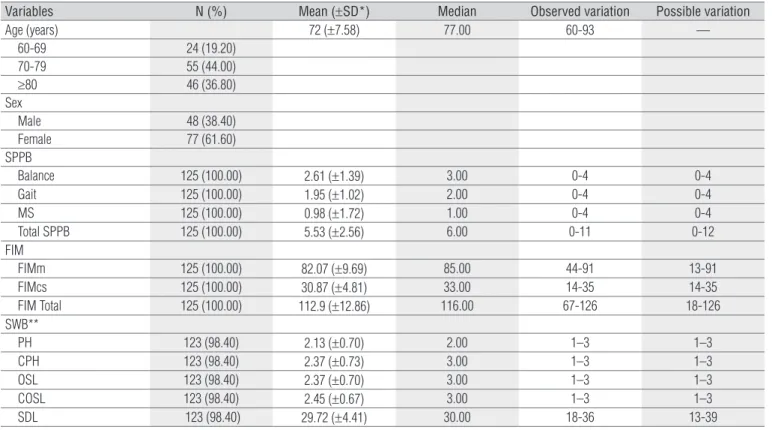
he 125 elderly participants had a mean age of 72±7.58 years and 61.6% were women. he mean SPPB score was 5.53±2.4, which corresponds to poor LL performance, and the mean FIM total score was 112.9±12.86, indicating that the elderly participants had functional independence. he items related to PH and CPH showed similar mean values, approximately 2.13 to 2.45, which corresponds to the possible variation. In the SDL, the mean was 29.72±4.41, as shown in Table 1.
In the correlation between the SPPB, FIM and SWB accor-ding to sex (Table 2), there was a moderate correlation between the CPH and gait, SDL and balance among the elderly males. here was no statistical signiicance in the relationship be-tween the FIM and the SWB. Among the females, there was a signiicant correlation between the CPH and gait, SDL and muscle strength. he variables overall satisfaction with life (OSL) and SDL showed signiicant correlation with the FIMcs. In this group, all correlations were poor.
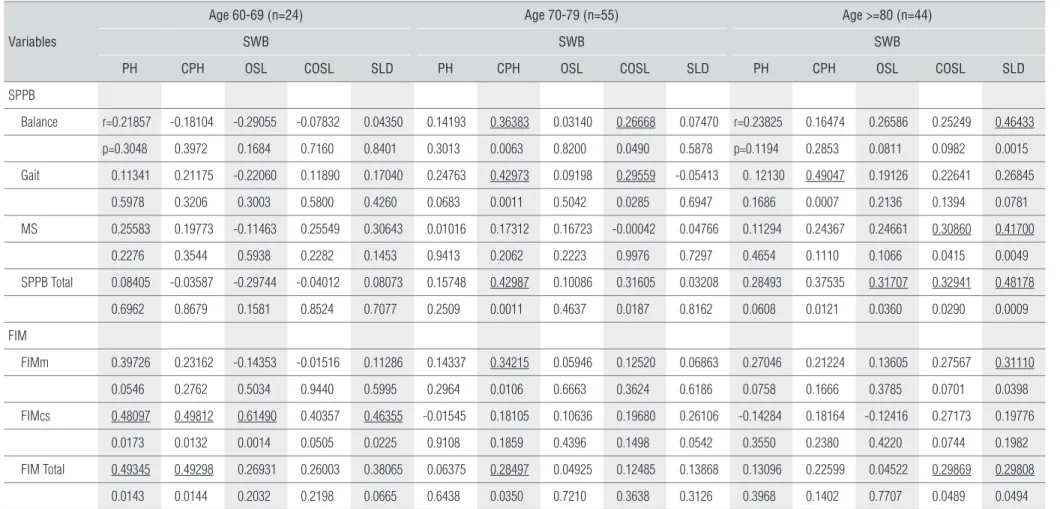
no significant correlation between SWB and SPPB, howe-ver there was a significant moderate to strong correlation among all items of SWB, except comparative overall satis-faction with life (COSL) and the FIMcs. There was also a significant moderate to strong correlation between PH and CPH and the total FIM. In the group aged 70 to 79 years, however, there was a significant poor to moderate correla-tion between CPH and balance, gait, total SPPB, FIMm and total FIM; the COSL showed a significant low to moderate correlation with balance, gait and SPPB total. In the elderly group aged ≥ 80 years, there was a significant poor to mode-rate correlation between CPH and gait, OSL and SPPB total, COSL and muscle strength, total SPPB and total FIM, and SDL and balance, muscle strength, total SPPB, FIMm and total FIM.
We opted for the analysis of univariate and multivariate logistic regression to verify the most important variable or the one that best explains the SWB, analyzed here by means of PH and CPH.
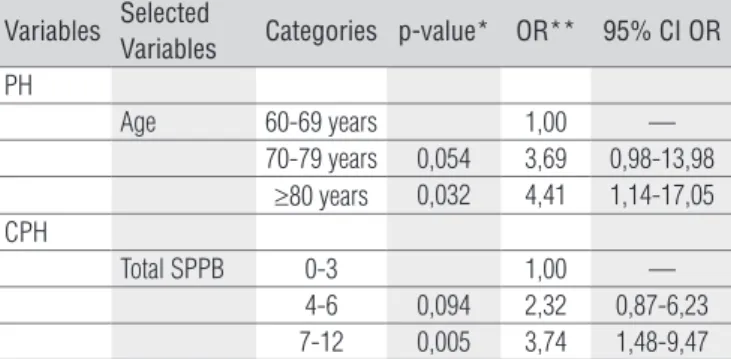
Table 4 shows the multivariate regression analysis for PH and CPH. Age was signiicant as the variable that best explains PH. In the group aged 70 to 79 years, the chance of better PH is 3.69 higher, while in the group aged ≥ 80 years, that chance is 4.41 higher. In contrast, physical performance assessed by the SPPB was the signiicant variable that most inluenced CPH.
he participants who obtained a total SPPB score of 7 to 12 points were 3.74 more likely to have a better CPH.
Discussion
he studied sample (n=125) showed a poor performance in the SPPB test (mean=5.53±2.56), but without compromising functional independence (mean FIM=112.9±12.86), speciically for the instrument activities, the majority of which are basic activities of daily living (BADLs). In fact, studies on the functio-nality of elderly people show that the BADLs are the last to be compromised as a result of aging or health problems. In a hie-rarchy of complexity, we ind irst an impairment of advanced activities of daily living (AADLs), followed by the instrumental activities (IADLs) and, inally, the BADLs, which are closely re-lated to the self-care activities13. hese results point to the need
to use instruments that evaluate the diferent levels of com-plexity of activities, to the extent that it is necessary to make early interventions aimed at the prevention of dependence and the recovery of functional independence of elderly people. his applies to geriatric services geared toward clinical and surgical care and rehabilitation services.
Similarly, SWB also showed high mean values and, as in other studies, there was a correlation among SWB items and
Table 1. Characteristics of participants - age, SPPB, FIM and SWB (n=125).
Variables N (%) Mean (±SD*) Median Observed variation Possible variation
Age (years) 72 (±7.58) 77.00 60-93 —
60-69 24 (19.20)
70-79 55 (44.00)
≥80 46 (36.80)
Sex
Male 48 (38.40)
Female 77 (61.60)
SPPB
Balance 125 (100.00) 2.61 (±1.39) 3.00 0-4 0-4
Gait 125 (100.00) 1.95 (±1.02) 2.00 0-4 0-4
MS 125 (100.00) 0.98 (±1.72) 1.00 0-4 0-4
Total SPPB 125 (100.00) 5.53 (±2.56) 6.00 0-11 0-12
FIM
FIMm 125 (100.00) 82.07 (±9.69) 85.00 44-91 13-91
FIMcs 125 (100.00) 30.87 (±4.81) 33.00 14-35 14-35
FIM Total 125 (100.00) 112.9 (±12.86) 116.00 67-126 18-126 SWB**
PH 123 (98.40) 2.13 (±0.70) 2.00 1–3 1–3
CPH 123 (98.40) 2.37 (±0.73) 3.00 1–3 1–3
OSL 123 (98.40) 2.37 (±0.70) 3.00 1–3 1–3
COSL 123 (98.40) 2.45 (±0.67) 3.00 1–3 1–3
SDL 123 (98.40) 29.72 (±4.41) 30.00 18-36 13-39
physical performance in both sexes (CPH and gait in both se-xes, SDL and balance among male participants and strength of LL among females) 14-16. In a study with elderly Japanese,
there was no signiicant correlation between SWB and overall functionality in both sexes, however the upper-limb motor coordination, an item of the functional capacity test, showed signiicant correlation with satisfaction with life17.
Also in the study on healthy elderly people and elderly people who had sufered a stroke, there was no signiicant diference between the groups in relation to SWB and func-tional capacity. However, the variables female sex, advanced age, good general health and social network were predictors of greater satisfaction with life in the studied sample18. Given the
multidimensional nature of SWB, the results suggest that the performance of speciic tasks may compromise certain areas of SWB, especially if the tasks are considered essential by the elderly person, but this performance does not compromise the overall SWB.
In the present study, the group aged ≥ 80 years also showed higher scores in the correlation between SWB and physical performance and functional independence. Psychosocial va-riables reveal coping strategies that contribute signiicantly to
the well-being of elderly people7 and prevent or restrict the
pro-gressive decline in satisfaction with life1. Survey results show
that younger elderly people are less satisied than the older elderly people with their functional independence. his fact can be explained by the resilience of the older elderly people, which consists in the adaptation to this phase of life. hey face whatever challenges and obstacles may arise and allow the subjective conditions to sustain psychological resilience, even when biological resilience is compromised19, 20.
A review on SWB and age1 found that satisfaction with life
does not decline with age even though other variables related to well-being, such as marriage and income, actually decline with age. Negative emotions remain relatively constant and po-sitive afects decline. herefore, there is reason to be optimistic about the lexibility and the ability of individuals to adapt and still achieve positive levels of satisfaction with life as they age, even in conditions often considered unpleasant.
We highlight the importance of these aspects in rehabili-tation interventions, especially among elderly patients with sequelae of diseases such as stroke or amputation, common in this age group. he rehabilitation professionals must agree with the elderly patient on the goals to be achieved,
Table 2. Correlation on the SWB score with the SPPB and FIM according to sex (n=125).
Variables
Men (n=48) Women (n=77)
SWB SWB
PH CPH OSL COSL SDL PH CPH OSL COLS SLD
SPPB
Balance r=0.23645 0.25982 0.02181 0.20566 0.30247 r=0.10438 0.00374 -0.08837 0.00148 0.04447 p=0.1057 0.0745 0.883 0.1608 0.0367 p=0.3728 0.9746 0.4509 0.9900 0.7048
n=75 75 75 75 75
Gait -0.1199 0.31217 -0.027966 0.12733 -0.15099 0.21274 0.24680 0.03770 0.11156 0.10401 0.4169 0.0308 0.0542 0.3885 0.3056 0.0669 0.0328 0.7481 0.3407 0.3745
75 75 75 75 75
MS -0.0185 0.15705 0.03188 0.16519 -0.08371 0.06530 0.09776 0.04581 0.00500 0.28977 0.9008 0.2864 0.8297 0.2619 0.5716 0.5778 0.4040 0.6963 0.9661 0.0117
75 75 75 75 75
SPPB Total 0.00849 0.25936 -0.15816 0.20112 0.04550 0.15047 0.12261 -0.00239 0.02588 0.11518 0.9543 0.0751 0.283 0.1705 0.7588 0.1976 0.2947 0.9837 0.8256 0.3251
75 75 75 75 75
MIF
FIMm 0.09819 0.20384 -0.03047 0.04732 0.03601 0.21298 0.17685 -0.04091 0.08155 0.13084 0.5067 0.1646 0.8371 0.7495 0.8080 0.0666 0.1291 0.7275 0.4867 0.2632
75 75 75 75 75
FIMcs 0.01531 0.21639 0.16348 0.13259 0.24976 -0.04263 0.17221 0.0392 0.25569 0.26151 0.9178 0.1396 0.2669 0.369 0.0869 0.7165 0.1396 0.7384 0.0268 0.0234
75 75 75 75 75
FIM Total -0.0365 0.21137 -0.02492 0.03295 0.09568 0.13702 0.21400 0.00725 0.16867 0.20688 0.8057 0.1493 0.8665 0.8241 0.5177 0.2411 0.0652 0.9508 0.1480 0.0749
75 75 75 75 75
Giovana Sposito, Maria J. D’Elboux Diogo, Fernanda Ap. Cintra, Anita L. Neri,
Maria E. Guariento, Maria L. R. De Sousa
Rev Bras Fisioter
. 2010;14(1):81-9.
Table 3. Correlation of the SWB score with SPPB and FIM according to age (n=125).
Variables
Age 60-69 (n=24) Age 70-79 (n=55) Age >=80 (n=44)
SWB SWB SWB
PH CPH OSL COSL SLD PH CPH OSL COSL SLD PH CPH OSL COSL SLD
SPPB
Balance r=0.21857 -0.18104 -0.29055 -0.07832 0.04350 0.14193 0.36383 0.03140 0.26668 0.07470 r=0.23825 0.16474 0.26586 0.25249 0.46433 p=0.3048 0.3972 0.1684 0.7160 0.8401 0.3013 0.0063 0.8200 0.0490 0.5878 p=0.1194 0.2853 0.0811 0.0982 0.0015 Gait 0.11341 0.21175 -0.22060 0.11890 0.17040 0.24763 0.42973 0.09198 0.29559 -0.05413 0. 12130 0.49047 0.19126 0.22641 0.26845
0.5978 0.3206 0.3003 0.5800 0.4260 0.0683 0.0011 0.5042 0.0285 0.6947 0.1686 0.0007 0.2136 0.1394 0.0781 MS 0.25583 0.19773 -0.11463 0.25549 0.30643 0.01016 0.17312 0.16723 -0.00042 0.04766 0.11294 0.24367 0.24661 0.30860 0.41700
0.2276 0.3544 0.5938 0.2282 0.1453 0.9413 0.2062 0.2223 0.9976 0.7297 0.4654 0.1110 0.1066 0.0415 0.0049 SPPB Total 0.08405 -0.03587 -0.29744 -0.04012 0.08073 0.15748 0.42987 0.10086 0.31605 0.03208 0.28493 0.37535 0.31707 0.32941 0.48178
0.6962 0.8679 0.1581 0.8524 0.7077 0.2509 0.0011 0.4637 0.0187 0.8162 0.0608 0.0121 0.0360 0.0290 0.0009 FIM
FIMm 0.39726 0.23162 -0.14353 -0.01516 0.11286 0.14337 0.34215 0.05946 0.12520 0.06863 0.27046 0.21224 0.13605 0.27567 0.31110 0.0546 0.2762 0.5034 0.9440 0.5995 0.2964 0.0106 0.6663 0.3624 0.6186 0.0758 0.1666 0.3785 0.0701 0.0398 FIMcs 0.48097 0.49812 0.61490 0.40357 0.46355 -0.01545 0.18105 0.10636 0.19680 0.26106 -0.14284 0.18164 -0.12416 0.27173 0.19776
0.0173 0.0132 0.0014 0.0505 0.0225 0.9108 0.1859 0.4396 0.1498 0.0542 0.3550 0.2380 0.4220 0.0744 0.1982 FIM Total 0.49345 0.49298 0.26931 0.26003 0.38065 0.06375 0.28497 0.04925 0.12485 0.13868 0.13096 0.22599 0.04522 0.29869 0.29808
0.0143 0.0144 0.2032 0.2198 0.0665 0.6438 0.0350 0.7210 0.3638 0.3126 0.3968 0.1402 0.7707 0.0489 0.0494
Table 4. Multivariate logistic regression analysis for PH and PHC
(n=125).
Variables Selected
Variables Categories p-value* OR** 95% CI OR PH
Age 60-69 years 1,00 —
70-79 years 0,054 3,69 0,98-13,98 ≥80 years 0,032 4,41 1,14-17,05 CPH
Total SPPB 0-3 1,00 —
4-6 0,094 2,32 0,87-6,23 7-12 0,005 3,74 1,48-9,47 *Stepwise criterion of variables selection for multivariate logistic regression analysis. PH=perceived health; CPH=comparative PH. Poor or fair PH (n=84); good PH (n=39); Poor or fair CPH (n=60); good CPH (n=63). ** OR=Odds ratio of better PH and CPH; 95% CI OR- 95% Confidence Interval for OR.
considering that the subjective nature of well-being (satisfac-tion and PH) varies from person to person, whether profes-sionals, relatives or the elderly person. Adaptive and coping mechanisms, such as lowering expectations, help the elderly patients to adjust their goals to their physical conditions13.
his adjustment is associated with aspects that promote their own well-being and their well-being compared to other individuals of the same age19.
hese data can be conirmed in a study with 40 elderly par-ticipants who underwent LL amputation. Even with physical limitations due to amputation, the elderly people showed high scores in the subjective evaluation of their functional indepen-dence and in satisfaction with life6. In another study with 50
el-derly people who had sufered stroke, the participants showed high satisfaction even with the possible functional changes due to stroke. Most of these elderly people had sufered stroke more than four years ago. According to the authors, the time elapsed could be considered as a mechanism of adjustment and adap-tation to a new condition and a possibility of improving the quality of life21.
From this perspective, it is possible to consider that the functional losses due to aging and disease and their consequen-ces are eventually overcome through adaptation mechanisms, and positive emotions tend to prevail over negative emotions because SWB is conceptualized and measured as a long-term, not momentary, condition. he changes in the level of satisfac-tion seem to luctuate around a set point22. With time,
individu-als who experience signiicant events in life, whether positive or negative, return to a normal positive level23. In addition, the
older group may have attained more positive aspects of SWB though efective compensatory mechanisms, such as personal beliefs, spirituality, religiousness and social support, which are considered to provide better satisfaction in this phase of life24.
Considering PH as a representation for SWB, age stands out again, showing that PH improves as age increases. his result corroborates other studies that showed better PH among the older elderly people, conirming that increasing age may in-luence the PH of this population8,25,26. his is because PH does
not depend on the comparison between the current situation and the ideal standard, but on expectations of aging7, i.e. PH
is the integration of many aspects of health with the sense of being able to achieve the desired results14.
In contrast, a study with 1239 elderly Canadians over 65 years of age found that the oldest elderly people perceived their health as “not very good”. he authors highlighted health problems and functional limitations in daily activities as pre-dictors of low scores in the PH of that population15. When CPH
was used to represent SWB, the LL performance test was the most inluential variable. Elderly people with high scores were more likely to have better CPH.
In a study on the relationship between physical capacity and PH with 44 elderly people of advanced age (80 years or more), the results of the PH questionnaire and the SPPB instru-ment showed that gait velocity had the strongest correlation with PH. However, in the total physical evaluation, physical capacity had a strong correlation with the sense of self-eicacy measured by the PH questionnaire14. A three-phase
longitudi-nal study veriied the physical evaluation and the relationship with PH of the same elderly people at 86, 90 and 94 years of age. here was a decrease in functional capacity with age, but the PH remained high among the older elderly people, even with functional changes26.
he Berlin Aging Study examined the perception of current and comparative physical health in elderly people aged 70 to 105. he indings revealed no diferences between age groups and found that, in this population, objective health remained stable throughout life. he authors attributed the results to the adaptation to functionality levels through the cognitive reorga-nization in the processes of internal comparison16.
With the results of the present study, we can emphasize that physical performance not only inluences functional ca-pacity but it is also a strong variable of CPH, conirming that functionality levels and psychological dimensions inluence the PH compared to others of the same age8, 14. Social
compa-rison has an impact on SWB and, when participants compare their lives favorably to the lives of others, they are satisied and experience positive emotions27.
Comparing oneself to other people has an important role in the evaluation and construction of reality and coping with negative events. In situations of decreased well-being, people often compare themselves to others that they consider worse of in an efort to improve their well-being, especially when there are no opportunities of instrumental actions28. Among
the elderly people with LL amputation6, the standards of
compared to other individuals of the same age, the participants of the study compared themselves to elderly people with lower performance, thus seeking to enhance their independence and their potential.
In a coping mechanism known as downward comparison29,
the individual knows that there are people in worse situations and with more problems and realizes that his or her situation is relatively more favorable, which leads to greater SWB. his me-chanism may mitigate the current negative afects and allow the individual to feel better at the moment. he adaptation to a stressful event can be easier if the elderly person shifts the focus away from removing the threat and tries to accept the losses inherent in the current situation, reorganizing goals, priorities and desires30.
Final considerations
he results of this study point to the need to develop in-tervention strategies for the elderly population, focusing on functionality, regardless of age. he adjustment mechanisms for the oldest old favor the self-perception of health and con-sequently improve SWB. Despite the limitations related to the particular characteristics of the sample (size, speciicity of the ield of study), the results showed that recovery inter-ventions and maintenance of functional independence, ho-wever small they may seem, promote gains in PH in old age. Moreover, it reinforces the need to implement instruments to obtain subjective data in the clinical health evaluations of elderly people.
References
1. Diener E, Suh E. Measuring quality of life: economic, social and subjective indicators. Soc Ind Res.1997;40(1-2):189-216.
2. Liberaslesso A. Bienestar subjetivo en la vida adulta y en la vejez: hacia una psicologia positiva en America Latina. Rev Latinoam de Psicol. 2002; 34(1-2):55-74.
3. Smiley JR. Ed Diener [homepage na internet]. Champaign: University of Illinois at Urbana-Champaign [atualizada em 2006; acesso em 13 Nov 2006]. Disponível em: http://www.psych.uiuc.edu/~ediener/
4. Sousa L, Galante H, Figueiredo D. Qualidade de vida e bem-estar dos idosos: um estudo exploratório na população portuguesa. Rev Saúde Pública. 2003;37(3):364-71.
5. Pereira RJ, Cotta RMM, Franceschini SCC, Ribeiro RCL, Sampaio RF, Priore SE, et al. Contribuição dos domínios físico, social, psicológico e ambiental para a qualidade de vida global de idosos. Rev Psiquiatr Rio Gd Sul. 2006;28(1):27-38.
6. Diogo MJD. Satisfação global com a vida e determinados domínios entre idosos com amputação de membros inferiores. Rev Panam Salud Publica. 2003;13(6):395-9.
7. Guedea MTD, Albuquerque FJB, Tróccoli BT, Noriega JAV, Seabra MAB, Guedea RLD. Relação do bem-estar subjetivo, estratégias de enfrentamento e apoio social em idosos. Pscicol Reflex Crit. 2005;19(2):301-8.
8. de Vitta A, Neri AL, Padovani CR. Saúde percebida em homens e mulheres sedentários e ativos, adultos jovens e idosos. Salusvita. 2006;25(1):22-34.
9. Ministério da Saúde – Brasil [homepage na internet]. Política nacional de atenção à saúde dos idosos [atualizado 10 Dez 1999; acesso em 15 Mar 2008]. Disponível em: http://portal.saude.gov.br/saude/area.cfm?id_area=153
10. Organização Mundial da Saúde-OMS. Classificação internacional de funcionalidade, incapacidade e saúde-CIF 1. São Paulo: Udesp; 2003.
11. Riberto M, Myazaky MH, Jorge Filho D, Sakamoto H, Battistela LR. Reprodutibilidade da versão brasileira da medida de independência funcional. Acta Fisiatrica. 2001;8(1):45-52.
12. Guralnik JM, Simonsick EM, Ferrucci L, Glynm RJ, Berkman LF, Blazer DG, et al. A short physical performance battery assessing lower extremity function: association with self-reported disability and prediction of mortality and nursing home admission. J Gerontol. 1994;49(2): 85-94.
13. Neri AL. Qualidade de vida na velhice e atendimento domiciliário. In: Duarte YAO, Diogo MJD, editores. Atendimento domiciliar: um enfoque gerontológico. São Paulo: Ateneu; 2000. p. 33-47.
14. Ferreira FFP, Izzo H, Jacob Filho W. Impacto da capacidade física na saúde percebida entre idosos em velhice avançada. Saúde Coletiva. 2007;4(17):154-7.
15. Ebly EM, Hogan DB, Fung TS. Correlates of self-rated health in persons aged 85 and over: results from the Canadian study of health and aging. Can J Public Health. 1996;87(1):28-31.
16. Baltes PB, Mayer KU. The berlin aging study aging from 70 to 100. Cambridge: Cambridge University Press; 1999.
17. Chang M, Kim H, Shigematsu R, Nho H, Nishijima T, Tanaka K. Functional fitness may be related to life satisfaction in older Japanese adults. Int J Aging Hum Dev. 2001;53(1):35-49.
26. Bravell ME, Berg S, Malmberg B. Health, functional capacity, formal care, and survival in the oldest old: a longitudinal study. Arch Gerontol Geriatr. 2008;46(1):1-14.
27. Diener E, Fujita F. Social comparisons and subjective well-being. In: Buunk BP, Gibbsons F, editors. Helath, coping, and well-being: perspectives from social comparison theory. New Jersey: Laurence Erlbawm Associates; 1997. p.305-24.
28. Buunk BP, Gibbons FX, Reis-Bergan M. Social comparison in health and illness: a historical overview. In: Buunk BP, Gibbsons F, editors. Health, coping, and well-being: perspectives from social comparison theory. New Jersey: Laurence Erlbawm Associates; 1997. p.1-23.
29. Wills TA. Modes and families of coping: an analysis of social comparison in the structure of other cognitive and behavioral mechanisms. In: Buunk BP, Gibbsons F, editors. Helath, coping, and well-being: perspectives from social comparison theory. New Jersey: Laurence Erlbawm Associates; 1997. p. 167-94.
30. Aldwin CM, Gilmer DF. Health, illness, and optimal aging: biological and psychosocial perspectives. Los Angeles: Sage; 2004.
19. Neri AL. Qualidade de vida na velhice: enfoque multidisciplinar. Campinas: Alínea Editora; 2007.
20. Wagnild G. Resilience and successful aging. Comparison among low and high income older adults. J Gerontol Nurs. 2003;29(12):42-9.
21. Rabelo DF. Incapacidade funcional, senso de ajustamento pessoal e bem-estar subjetivo em adultos e idosos afetados por acidente vascular cerebral [dissertação]. Campinas (SP): Universidade Estadual de Campinas; 2006.
22. Fujita F, Diener E. Life satisfaction set point: stability and change. J Pers Soc Psychol. 2005;88(1):158-64.
23. Diener E. Subjctive well-being. The science of happiness and a proposal for a national index. Am Psychol. 2000;55(1):34-43.
24. Wink P, Dillon M. Religiousness, spirituality, and psychosocial functioning in late adulthood: findings from a longitudinal study. Psycol Aging. 2003;18(4):916-24.