www.bjorl.org
Brazilian
Journal
of
OTORHINOLARYNGOLOGY
ORIGINAL
ARTICLE
Effect
of
sublingual
immunotherapy
on
platelet
activity
in
children
with
allergic
rhinitis
夽
Yanqiu
Chen
a,
Lifeng
Zhou
a,∗,
Yan
Yang
b,∗aGuangzhouMedicalCollege,GuangzhouWomenandChildren’sMedicalCenter,DepartmentofOtolaryngology,Guangzhou,China
bSunYat-senUniversity(NorthernCampus),SchoolofPublicHealth,DepartmentofNutrition,Guangzhou,China
Received16November2015;accepted2March2016 Availableonline22April2016
KEYWORDS Allergicrhinitis; Plateletactivation; Sublingual
immunotherapy; PlateletFactor-4; Beta-Thromboglobulin
Abstract
Introduction:The roleofplatelet activationinallergic inflammationisreceiving increasing attention.Sublingualimmunotherapyforallergicrhinitiscanmodifytheimmunologicalprocess toanallergen,ratherthansimplytreatingsymptoms.
Objective:Theaimofthisstudywastoexploretheroleofplateletactivationduringsublingual immunotherapyinchildrenwithallergicrhinitis.
Methods:Forty-twoHouseDustMite---sensitizedchildrenwithallergicrhinitiswereenrolled andreceivedHouseDustMiteallergenextractforsublingualimmunotherapyorplacebo.Serum ofdifferenttime pointsduring treatmentwas collected andused for detectionofPlatelet Factor-4andBeta-ThromboglobulinconcentrationbyEnzyme-LinkedImmunoSorbentAssay.
Results:OurdatashoweddecreasedexpressionofPlateletFactor-4andBeta-Thromboglobulin proteinafteroneyear’ssublingualimmunotherapy.Inaddition,thedecreaseofsymptomscores andserumPlateletFactor-4andBeta-Thromboglobulinproteinconcentrationswaspositively related.
Conclusion:Duringsublingualimmunotherapy,platelet activationwasinhibitedsignificantly. Ourresultsmightindicatethatinhibitionofplateletactivationwithinthesystemiccirculation isanimportantmechanismduringsublingualimmunotherapy.
© 2016 Publishedby Elsevier EditoraLtda. on behalf ofAssociac¸˜ao Brasileira de Otorrino-laringologiaeCirurgiaC´ervico-Facial.ThisisanopenaccessarticleundertheCCBYlicense (http://creativecommons.org/licenses/by/4.0/).
夽 Pleasecitethisarticleas:ChenY,ZhouL,YangY.Effectofsublingualimmunotherapyonplateletactivityinchildrenwithallergic
rhinitis.BrazJOtorhinolaryngol.2017;83:190---4. ∗Correspondingauthors.
E-mails:[email protected](L.Zhou),[email protected](Y.Yang).
PeerReviewundertheresponsibilityofAssociac¸ãoBrasileiradeOtorrinolaringologiaeCirurgiaCervico-Facial.
http://dx.doi.org/10.1016/j.bjorl.2016.03.006
PALAVRAS-CHAVE Rinitealérgica; Ativac¸ãoplaquetária; Imunoterapia sublingual;
Fator4plaquetário; Beta-tromboglobulina
Efeitodaimunoterapiasublingualsobreaatividadeplaquetáriaemcrianc¸as comrinitealérgica
Resumo
Introduc¸ão: Opapel daativac¸ãodeplaquetasnainflamac¸ãoalérgicarecebeuatenc¸ão cres-cente.Aimunoterapiasublingualpararinitealérgicapodemodificaroprocessoimunológicoa umalergeno,emvezdetratarossintomassimplesmente.
Objetivo: O objetivo deste estudo foi explorar o papel da ativac¸ão plaquetária durante a imunoterapiasublingualemcrianc¸ascomrinitealérgica.
Método: Quarentaeduascrianc¸ascomrinitealérgicasensibilizadasporÁcarosdePoeira Domi-ciliar foraminscritas ereceberam extratodealergeno de Ácaros dePoeira Domiciliarpara imunoterapiasublingualouplacebo.Osorodediferentespontosnotempoduranteo trata-mento foi recolhido e utilizadopara a detecc¸ão de fator 4plaquetárioe concentrac¸ãode beta-tromboglobulinaporEnsaioImunoenzimático.
Resultados: Nossosdados mostraramdiminuic¸ão daexpressãodefator 4plaquetárioe pro-teínabeta-tromboglobulinaapósimunoterapiasublingualdeumano.Alémdisso,adiminuic¸ão dos escores de sintomase o fator 4 plaquetáriosérico e concentrac¸ões de proteína beta-tromboglobulinaforamrelacionadosdemaneirapositiva.
Conclusão:Durante imunoterapiasublingual,aativac¸ãoplaquetária foiinibida significativa-mente.Osnossosresultadospodemindicarqueainibic¸ãodaativac¸ãodeplaquetasdentroda circulac¸ãosistêmicaéummecanismoimportanteduranteimunoterapiasublingual.
© 2016Publicadopor ElsevierEditora Ltda.em nomede Associac¸˜ao Brasileira de Otorrino-laringologia eCirurgiaC´ervico-Facial.Este ´eumartigo Open Accesssob umalicenc¸a CCBY (http://creativecommons.org/licenses/by/4.0/).
Introduction
Sublingual immunotherapy (SLIT) is the only treatment that regulatesthe immunological processduring develop-ment of allergic rhinitis (AR),ratherthan simplytreating symptoms.1,2 However, the underlying mechanisms in the processandpotentialbiomarkersarestillnotfully charac-terized.
Plateletactivationoccursduringantigen-inducedairway reactions in allergic and asthmatic subjects. Raised lev-elsofplatelet-derivedmediators,suchasthechemokines, Beta-Thromboglobulin (BTG) and Platelet Factor-4 (PF4), areobservedinplasmaandbronchoalveolarlavagefluidof atopicindividuals.Thesemediatorshavetheabilityto acti-vate eosinophils, increaseexpression of Fc-IgG andFc-IgE receptors,andstimulatebasophilstoreleasehistamine.3---6 SinceSLITcaninhibitallergicinflammationsignificantly,we postulatethatSLITmayaffectplateletactivationinAR chil-dren.
Inthecurrentstudy,weaimedtoclarifytheeffectofSLIT onplateletactivationofARchildrenbydetecting changes ofserumPF4andBTGconcentration.
Methods
Patients
Forty-twochildren aged6---12years witha clinical history of House Dust Mite (HDM) induced AR for at least one year were enrolled. Skin Prick Test (SPT) was performed toscreenchildrenallergictoHDM.Thosewithchronic dis-eases (e.g. asthma, malnutrition, anatomic malformation
oftherespiratorysystem, chroniclung disease,heart dis-ease,gastro-oesophagealrefluxdisease,cysticfibrosis)and thosewithahistoryofchronicdruguse(e.g.oralornasal corticosteroids,antiepileptics,immunesuppressives)were excludedfromthestudy.Thestudywasperformedwiththe approvalof local ethics committee and withthe parent’s writteninformedconsent.
Sublingualimmunotherapyandgrouping
TheHDMallergenextractforSLITwasmanufacturedby Wol-wopharma Biotechnology Company (Zhejiang, China) and usedintheformofdrops(n◦ 1,1mg/mL;n◦2,10mg/mL;
n◦ 3, 100mg/mL and n◦ 4,333mg/mL). According tothe
manufacture’sinstruction,thepatientswereaskedtotake increasingdoses(fromn◦ 1 ton◦ 3)during thefirst three
weeks’up-dosingphase,andthenwereinstructedtotake 3dropsofn◦ 4solutiononcedailyduringthemaintenance
Symptomscores
The nose symptoms (runny nose, sneezing, blocked nose, itchingnose) werescoredbythechildrenwiththehelpof parents. A score of 0 was defined asnone (nosymptoms present), a score of 1 was defined as mild (mild symp-toms that do not interfere with any activity), a score of 2wasdefinedasmoderate(slightlybothersomesymptoms thatslightlyinterferewithactivity/nighttimesleep),anda scoreof3wasdefinedassevere(bothersomesymptomsthat interferewithactivity/nighttimesleep).7,8Thescoreswere recordedeverymorningdailyforatleast12weeksandthen wereaveraged.
Bloodsamplespreparationandanalysis
The blood samplesfromchildren were collectedbetween 11am and 2pm by veinpuncture method. Serum was acquiredafter coagulationofthe blood for1---2h atroom temperature and centrifuged at 3000×g for 15min at 4◦C. Serum samples were stored at −80◦C and used for
Enzyme-LinkedImmunosorbentAssay(ELISA).Totalprotein concentrationwasdeterminedwithBio-Radproteinassays accordingtoBradford.ELISAkits(DiagnosticaStago,France) wereusedformeasuringserumPF4andBTGconcentration.
Statisticalanalysis
All data were expressed as mean±SD. Statistical signif-icances between different groups were determined using nonparametric Mann---Whitney U test. The Spearman rank correlationtestwasusedtoanalyzethecorrelationbetween symptomscoreandPF4orBTGconcentration;p<0.05was consideredassignificantdifference.
Results
Demographiccharacteristicsofstudypopulation
andclinicaloutcome
This study was conducted with 42 children, 21 of whom enrolledinSLIT group,withagesrangingbetween 72and 144 months (mean age: 120.7±44.0 months, 10 males), and21 ofwhomenrolled inplacebo group withages ran-gingbetween75 and141months(mean age:123.0±42.3 months,11males).Theage,sex,durationofdisease, base-linesymptomscoresbetweentwogroupswerecomparable withoutsignificance.TheSLITtreatmentwaseffectiveand thesymptomsscoresdecreasedsignificantlycomparedwith bothplacebogroupandbaselinesymptomscores(Table1).
DecreasedserumPF4andBTGproteinlevels
duringSLITtreatment
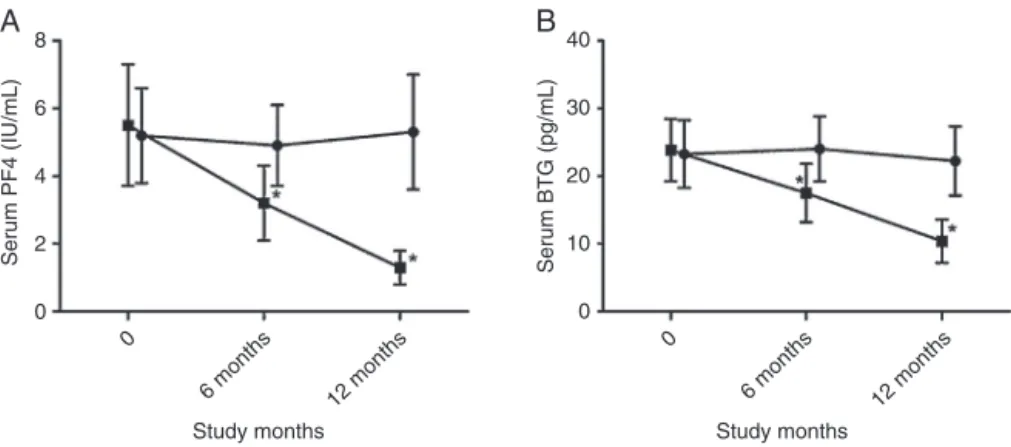
The serum PF4 and BTG protein expression during SLIT treatment were significantly lower than those in placebo group after 6 months’ treatment (PF4 3.2±1.1 vs. 4.9±1.2IU/mL; BTG 17.4±4.3 vs. 23.2±5.1IU/mL) and thistrendwasmaintainedforatleast1year(PF41.3±0.5
Table1 Demographiccharacteristicof42ARchildren.
SLITgroup Placebogroup
Number 21 21
Sex(male/female) 10/11 11/10
Age(months) 120.7±44.0 123.0±42.3
Durationofdisease(year) 5.2±2.4 6.1±3.7
TotalIgE(kU/L) 465±226 513±316
HDMspecificIgE(kU/L) 45±21 35±18
Baselinesymptoms
Runnynose 2.5±0.3 2.1±0.2 Sneezing 1.9±0.1 1.7±0.1 Blockednose 2.1±0.2 1.8±0.3 Itchingnose 1.5±0.1 2.0±0.4 Totalscore 8.2±0.6 7.9±0.5
End-pointsymptoms
Runnynose 1.5±0.2a,b 2.2 ±0.3 Sneezing 1.4±0.3a,b 1.5±0.1
Blockednose 1.2±0.1a,b 1.8 ±0.1 Itchingnose 1.1±0.2a,b 2.1±0.2
Totalscore 5.2±0.3a,b 7.8±0.2 a Comparedwithplacebogroup,p<0.05.
b Comparedwithbaselinessymptom,p<0.05.
vs. 5.3±1.7IU/mL; BTG 10.5±3.2 vs. 21.6±4.8IU/mL) (Fig.1AandB).
Relationshipbetweensymptomscoresandserum
PF4andBTGproteinlevels
To explore the effect of platelet activation on symptom score, we analyzed the relationship between symptom scoresandserumPF4andBTGproteinlevelsinSLITgroup. Afteroneyearoftreatment,theimprovementofsymptom scoreswaspositivelyrelatedtodecreaseofserumPF4and BTG protein levels(p=0.65; p=0.001; p=0.51; p=0.002) (Fig.2).
Discussion
Plateletsmayplayanimportantroleintheallergic inflam-matoryprocessbecausetheyarearichsourceofbiologically active materials capable of inducingor augmenting aller-gicinflammatoryresponses.9---12,3 Suchmaterialshavebeen demonstrated to be stored in alpha granules, which are chemokines such as PF4 and BTG. However, the role of platelets activation in SLIT was not clear, especially in children.
Ourresults showed that PF4 and BTG level decreased significantly after 6 months’ SLIT, and the improvement maintainedatleastoneyear.DespitedecreasedPF4andBTG level observed after3 months’treatment, nostatistically significant changes were found. Moreover, the improved symptom scoresafteroneyearSLITwaspositivelyrelated withdecreasesofPF4andBTGlevel.Theseresultssuggested that SLIT may modify the allergic process by inhibiting plateletfunction,atleastpartially.
40
30
20
10
0 8
6
4
2
0 0
6 months 12 months 12 mon
ths
6 months 0
Study months Study months
A
B
S
erum BTG (pg/mL)
S
erum PF4 (IU/mL)
Figure1 SerumPF4andBTGproteinexpressiondecreasedafter6months’SLITcomparedwithcontrolgroupandbaselinelevel withsignificance. Thedecrease maintainedatleastoneyear withoutrebound(*p<0.05, comparisonbetween two groups and baselinelevel;䊉,representsforplacebogroup;,representsforSLITgroup).
A B
0 1 2 3 4 5 0 1 2 3 4 5
15
10
5
0 5
4
3
2
1
0
Decrease of serum PF4 level (IU/mL) Decrease of serum BTG level (IU/mL)
Improvement of symptom scores
Improvement of symptom scores
P=.65, P=.001 P=.51, P=.001
Figure2 PositiverelationshipbetweenimprovementofsymptomscoresanddecreaseofserumPF4andBTGproteinlevelsof childrenafteroneyear’sSLITinactivetreatmentgroup(AandB).
asthma patients undergoing bronchial allergen challenge. Therelationshipbetweenthechangesofplateletactivation markers and the development of late asthmatic response suggests that platelet activation within the circulation is criticalfor thedevelopmentof chronic allergic inflamma-tion. Also,Knauer14 has demonstratedsignificant changes in PF4level of patients withpollen-induced asthma after bronchialprovocationtoragweedextract.
InAlicja’sstudy,15theyfoundthatplasmaPF4levelinthe patient off---pollenseason wassignificantly lower as com-pared with the season and did not differ significantly as comparedtothehealthysubjects.Conversely,intheirtwo other studies,16,17 the resultssuggested that PF4andBTG levelswerenotsignificantlydifferentbetweenthepatients and healthy subjects after immunotherapy. Notably, the immunotherapy in their twostudies lastedonly 6 months andbloodsamplewascollectedimmediatelyaftermaximum dose injection.In our study,theSLIT treatment lastedat leastoneyearandtheserumwassampledatdifferenttime points.WefoundthatdecreaseofserumPF4andBTGlevel lastedat least oneyear. The difference betweenour and Alicja’sstudysuggesttheimportanceofmaintenanceperiod inimmunotherapy.However,asmallnumberofpatientsis oneoflimitationsinourstudy.Futurestudieswithlarge sam-pleisneededtofurtherclarifytheroleofPF4andBTGin SLIT.Inaddition,thechangeofPF4andBTGinnasallavage beforeandafterSLITshouldbediscussedinfuturetoexplore thelocaleffectofplateletactivation inmechanismof AR andSLIT.
Conclusion
Inconclusion,ourstudywasthefirsttoshowthechangesin plateletactivityinvivoinARchildrenduringSLIT.Ourresults mightindicatethatinhibitionofplateletactivationwithin thesystemiccirculationisanimportantmechanismduring SLIT.SLITmayimprovesymptomsbyinhibitingplatelet acti-vationpartially.
Ethical
standards
Theauthorsassertthatallprocedurescontributingtothis work comply with the ethical standards of the relevant nationalandinstitutionalguidelinesonhuman experimen-tationandwiththeHelsinkiDeclarationof1975,asrevised in2008.
Conflicts
of
interest
Theauthorsdeclarenoconflictsofinterest.
References
1.Frew AJ.Sublingual immunotherapy.NEngl JMed. 2008;35: 2259---64.
3.Pitchford SC, Page CP. Platelet activation in asthma: inte-gralto theinflammatoryresponse.ClinExpAllergy.2006;36: 399---401.
4.Kasperska-ZajacA,RogalaB.Plateletactivationduringallergic inflammation.Inflammation.2007;30:161---6.
5.PageC,PitchfordS.Platelets andallergicinflammation.Clin ExpAllergy.2014;44:901---13.
6.DuarteD,Taveira-GomesT,SokhatskaO,PalmaresC,CostaR, NegraoR,etal.Increasedcirculatingplateletmicroparticlesas apotentialbiomarkerinasthma.Allergy.2013;68:1073---5. 7.BousquetJ,KhaltaevN,CruzAA,DenburgJ,FokkensWJ,Togias
A,etal.AllergicRhinitisanditsImpactonAsthma(ARIA)2008 update(in collaborationwiththeWorldHealthOrganization, GA(2)LENandAllerGen).Allergy.2008;63Suppl.:8---160. 8.CarrW,BernsteinJ,LiebermanP,MeltzerE,BachertC,PriceD,
etal.Anovelintranasaltherapyofazelastinewithfluticasone forthetreatmentofallergicrhinitis.JAllergyClinImmunol. 2012;129:1282---9.
9.PalikheS,PalikheNS,KimSH,YooHS,ShinYS,ParkHS.Elevated plateletactivationinpatientswithchronicurticaria:a compari-sonbetweenaspirin-intolerantandaspirin-tolerantgroups.Ann AllergyAsthmaImmunol.2014;113:276---81.
10.JohanssonMW,HanST,GundersonKA,BusseWW,JarjourNN, MosherDF.Plateletactivation,P-selectin,andeosinophil beta1-integrin activation in asthma. Am J Respir Crit Care Med. 2012;185:5498---507.
11.Benton AS, KumarN, LernerJ, Wiles AA, Foerster M,Teach SJ, et al. Airway platelet activation is associated with air-way eosinophilic inflammation in asthma. J Investig Med. 2010;58:987---90.
12.Tamagawa-MineokaR,KatohN,UedaE,MasudaK,KishimotoS. Elevatedplateletactivationinpatientswithatopicdermatitis andpsoriasis:increasedplasmalevelsofbeta-thromboglobulin andplateletfactor4.AllergolInt.2008;57:391---6.
13.KowalK,PampuchA,Kowal-BieleckaO,DuBuskeLM, Bodzenta-Lukaszyk A. Platelet activation in allergic asthma patients duringallergenchallengewithDermatophagoides pteronyssi-nus.ClinExpAllergy.2006;36:426---32.
14.Knauer KA, Linchtenstein LM, Adkinson NF, Fish JE. Platelet activationduringantigen-inducedairwayreactionsinasthmatic subjects.NEnglJMed.1981;304:1404---7.
15.Kasperska-ZajacA, Brzoza Z, Rogala B. Seasonal changes in plateletactivityinpollen-inducedseasonalallergicrhinitisand asthma.JAsthma.2008;45:485---7.
16.Kasperska-Zajac A, Brzoza Z, Rogala B. Effect of allergen-specificimmunotherapy on plasmalevelofplatelet factor 4 (PF-4) and beta-thromboglobulin (beta-TG), platelet activa-tionmarkersinpatientswithhousedustmiteallergy.Vaccine. 2007;25:3595---8.