alex Nogueira HaaS(a) Claudio Mendes PaNNUti(b) ana Karina Pinto de aNDraDe(c) elaine Cristina eSCOBar(c) eliete rodrigues de alMeiDa(d) Fernando Oliveira COSta(e) José roberto COrtelli(f) Sheila Cavalca COrtelli(f) Sigmar de Mello rODe(g) vinicius PeDraZZi(h) rui vicente OPPerMaNN(a)
(a) Periodontology Department, School of Dentistry,
Universidade Federal do Rio Grande do Sul - UFRGS, Porto Alegre, RS, Brazil.
(b) Periodontology Department, School of Dentistry,
Universidade de São Paulo - USP, São Paulo, SP, Brazil.
(c) Periodontology Department, School of Dentistry,
Faculdades Metropolitanas Unidas - FMU, São Paulo, SP, Brazil.
(d)Epidemiology and Pediatric Dentistry Department,
School of Dentistry, Universidade Cruzeiro do Sul - UNICSUL, São Paulo,SP, Brazil.
(e) Periodontology Department, School of Dentistry,
Universidade Federal de Minas Gerais - UFMG, Belo Horizonte, MG, Brazil.
(f)Periodontology Department, School of Dentistry,
Universidade de Taubaté - UNITAU, Taubaté, SP, Brazil.
(g)Dental Materials and Prosthesis Department, Instituto
de Ciência e Tecnologia - ICT, Univ Estadual Paulista - UNESP, São José dos Campos, SP, Brazil.
(h)Dental Materials and Prosthesis Department,
Faculdade de Odontologia de Ribeirão Preto, Universidade de São Paulo - USP, Ribeirão Preto, SP, Brazil.
Corresponding author: Claudio Mendes Pannuti E-mail: [email protected]
Mouthwashes for the control of
supragingival biofilm and gingivitis in
orthodontic patients: evidence-based
recommendations for clinicians
*abstract: Properly performed daily mechanical bioilm control is the most important prevention strategy for periodontal diseases. How-ever, proper mechanical bioilm control is not performed effectively by the majority of the population, mainly due to lack of motivation and of manual dexterity. Local bioilm retention factors may aggravate home oral hygiene quality. For this reason, patients wearing ixed orthodon-tic appliances comprise a group that may beneit from the daily use of mouthwashes. The purpose of this review was to perform a systematic search in the literature on antiseptics used to control supragingival bio-ilm and gingivitis in orthodontic patients. Six studies investigating the effect of chlorhexidine and 5 studies evaluating the effect of the daily use of antiseptics were found. Chlorhexidine showed better results in reduc-ing plaque and greduc-ingivitis. However, because of its adverse effects after continuous use, it should not be indicated for long-term periods. Among the agents considered for daily use, the ixed combination of essential oils was the only one evaluated in a clinical trial, in which a comparative group presented a statistically signiicant clinical impact. There is no di-rect evidence supporting the indication of antiseptic agents for orthodon-tic patients other than chlorhexidine and essential oils. It can be conclud-ed that, for patients undergoing orthodontic treatment, chlorhexidine should be considered for treating acute gingival inlammation, whereas essential oils should be indicated for long-term daily use in controlling supragingival bioilm.
Keywords: Mouthwashes; Bioilms; Gingivitis; Orthodontic Appliances.
introduction
Properly performed mechanical home bioilm control is the most
im-portant prevention strategy for periodontal diseases.1,2,3,4 However,
stud-ies show that proper mechanical control is not performed effectively by the majority of the population, mainly due to lack of motivation and of
manual dexterity.5,6 These indings are supported by several
epidemiolog-ical studies that reported a high prevalence of gingivitis and poor oral
hy-giene in both developed7,8 and developing countries.9,10 In Brazil, a study
with a representative urban population sample showed that the average
of tooth surfaces with visible bioilm was 60%, and only 5% of subjects
Declaration of interests: The authors certify that they have no commercial or associative interest that represents a conflict of interest inconnection with the manuscript.
Submitted: Nov 30, 2013
Accepted for publication: Apr 28, 2014 Last revision: May 28, 2014
http://dx.doi.org/10.1590/1807-3107-BOR-2014.vol28.0021
Epub Jul 11, 2014
had visible plaque on less than 20% of their tooth surfaces.11,12
Dificulties to achieve ideal mechanical plaque control have led many researchers to search for oth-er methods, such as chemical agents, which could contribute to daily bioilm control, removal, or in-hibition of plaque formation on tooth surfaces. Cur-rent evidence shows that when chemical agents are used as adjuvants to brushing and lossing, they can promote additional advantages compared to me-chanical control alone, as regards both plaque and
gingivitis reduction.13,14 Several clinical trials have
been conducted in order to test the eficacy and safety of these products. Systematic reviews of these clinical trials have demonstrated the eficacy of
mouthwashes containing chlorhexidine gluconate,15
essential oils15,16 and cetylpyridinium chloride.17 A
recent review of systematic reviews compared these three active principles, showing that mouthwashes containing chlorhexidine present higher anti-plaque
and anti-gingivitis eficacy (mean reduction of 40%
and 28%, respectively) followed by essential oils
(mean reduction of 27% and 18%, respectively) and
cetylpyridinium chloride (mean reduction of 15%
and 13%, respectively).18 However, it is important
to note that chlorhexidine-containing mouthwashes are associated with a higher incidence of adverse events, such as tooth and soft tissue staining, which
limit their long-term use.15
The presence of local bioilm retention factors aggravates home oral hygiene quality. For this rea-son, individuals with ixed orthodontic appliances comprise a group of patients that may beneit from the use of chemical agents used in association with daily mechanical bioilm control. However, the evi-dence on plaque and gingivitis reduction by chemi-cal agents in these patients is limited, and there are no systematic search reviews on this topic. The objective of this paper was, thus, to perform a sys-tematic review of the literature regarding the use of antiseptics to control supragingival bioilm and gin-givitis in orthodontic patients.
Periodontal disease in
orthodontic patients
High gingivitis prevalence is commonly found
in orthodontic patients.19 The presence of brackets,
bands and other accessories, as well as composite resin restorations and cements used to bond them, facilitate bioilm build up and hinder its removal by patients, favoring enamel demineralization and
gin-givitis,20,21 and promoting quantitative and
qualita-tive changes in the oral microbiota.19,22 Several
stud-ies have shown an association between placement of
braces and an increase in bioilm.23,24 Corroborating
the damage done by orthodontic appliances to the
periodontium, Sallum et al.25 observed signiicant
reductions in plaque, gingivitis, probing pocket depth and the presence of periodontopathogenic microorganisms after 30 days of appliance removal and professional prophylaxis.
Huser et al.26 conducted a split-mouth study,
which evaluated the clinical and microbiological ef-fects of installing orthodontic bands in 10 patients. They evaluated four sites per patient; two of them comprised the test (banded teeth) and the other two comprised the control (unbanded teeth) groups. The parameters were assessed at baseline, 5, 7, 47, 72 and 90 days after placement of orthodontic appli-ances. The results showed increases in plaque, gingi-val inlammation and spirochetes, and decreases in cocci levels in test sites compared to control sites, while probing depth remained unchanged for both groups.
Narranjo et al.24 evaluated the clinical and
mi-crobiological changes in 30 patients before and 3 months after orthodontic bracket placement (test), and 30 patients without braces (control). The results showed that probing depth and clinical attachment level remained unchanged after 3 months, but there was an increase in the amount of plaque and in the clinical signs of gingival inlammation, in addition to an increase in superinfecting microorganisms and
periodontal pathogens (Porphyromonas gingivalis,
Prevotella intermedia / Prevotella nigrescens, Tan-nerella forsythia, and Fusobacterium species).
Similar results were found by Kim et al.,27 who
ticle assessment.
The inclusion criteria applied for selecting articles
were controlled trials or randomized controlled tri-als comparing mouthwashes, published in English between 1990 and 2012, and including patients of any age undergoing orthodontic treatment with ixed appliances only. For studies to be included in the review, they had to evaluate plaque and/or gingi-vitis as clinical outcomes.
General search results
Table 1 shows the search results for papers deal-ing with the use of mouthwashes in orthodontic patients. In comparison to the overall literature on mouthwash eficacy in reducing supragingival plaque and gingivitis, there were few studies evalu-ating chemical agents in the supragingival environ-ment, speciically for orthodontic patients. It was observed that the literature mostly had articles evaluating outcomes related to dental caries, such as cariogenic bacteria reduction and reduction of caries lesions. Moreover, chlorhexidine was the most studied antiseptic, appearing in several forms such as chewing gum, toothpaste, varnish, gel and mouthwash.
Of the 380 citations found, 36 (9.5%) were
se-lected by title, 21 (5.5%) remained eligible after
ab-stract evaluation, and the search was inished after
reading the full paper, yielding 11 (2.9%) studies
that were included for review.
Chlorhexidine use in orthodontic patients
Six studies evaluating chlorhexidine met the
in-the frequency of Tannerella forsythia,Prevotella
ni-grescens and Campylobactor rectus after placement of braces, especially in the molar region.
Risk factors for periodontal changes in adult pa-tients during orthodontic treatment were assessed
in a cross-sectional study28 evaluating the
periodon-tal status of banded second molars using the gingi-val index (GI). One hundred patients were divided into test (with braces) and control (without braces) groups. The results showed that the gingival index was higher in the test group, and that the main risk factors for gingival inlammation were, in decreas-ing order of importance, plaque, subgdecreas-ingival en-croachment of the cervical margin of bands, prob-ing depth, and length of orthodontic treatment.
As can be seen, orthodontic patients experience increases in supragingival bioilm accumulation re-sulting in the worst periodontal status after the
in-stallation of braces.29,30 Clearly, this is the result of
limited eficacy of mechanical bioilm control, due to the retention effects of the orthodontic applianc-es. Therefore, the use of chemical bioilm control as a third step in one’s oral hygiene routine becomes a valuable option for these patients.
Scientific evidence of antiseptic
use in orthodontic patients
literature search systematization
The scientiic literature on the use of antiseptics for supragingival plaque control and gingivitis in orthodontic patients was reviewed using a system-atic search strategy. The Medline database was ac-cessed through PubMed. The search strategy includ-ed a combination of the following keywords:
• mouthwash,
• orthodontics,
• plaque,
• gingivitis,
• essential oils,
• chlorhexidine,
• cetylpyridinium chlorideand
• triclosan.
The search was performed by one of the authors who selected the articles in stages starting from title
evaluation, followed by the abstract and then full
ar-table 1 - Search results for articles eligible for the review.
Strategy Search
results
Papers included
mouthwash AND orthodontics AND plaque 78 4
mouthwash AND orthodontics
AND gingivitis 31 1
mouthwash AND chlorhexidine
AND orthodontics 126 6
essential oils OR cetylpyridinium chloride OR triclosan OR chlorhexidine
AND orthodontics
145 1
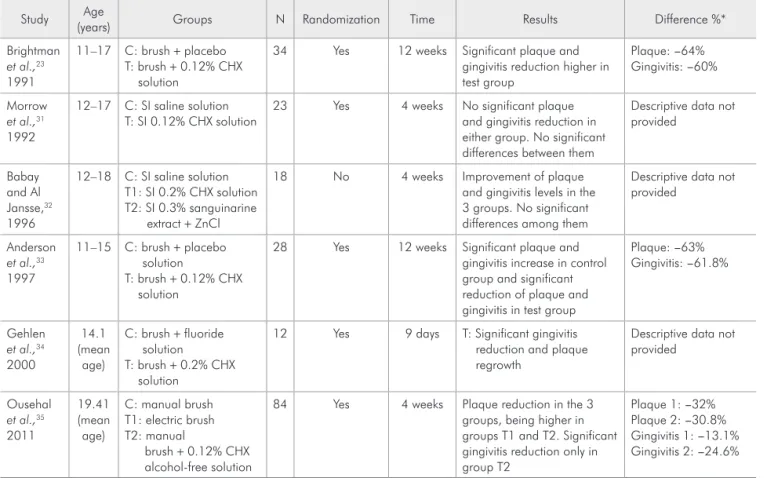
clusion criteria for this review. Two studies assessed the effects of subgingival irrigation with chlorhexi-dine solution. Four studies evaluated the effects of chlorhexidine mouthwash as an adjuvant to tooth brushing. Table 2 describes the methodological characteristics and the main indings of these stud-ies. In order to determine the extent of the clinically relevant beneit of chlorhexidine mouthwashes in orthodontic patients, we calculated the percent-age difference between test and control groups for plaque and gingivitis. This difference was calculated by subtracting the inal test group value from the control group value, and then dividing the result by
the control group value. Hence, negative values
indi-cated that the test group was superior to the control group, and vice versa.
Subgingival chlorhexidine irrigation was
evaluat-ed in two studies. The irst study31 was a randomized
split-mouth trial conducted in adolescents with
gin-givitis and banded irst molars. The clinical effects
of a 0.12% chlorhexidine digluconate single
irriga-tion were evaluated compared to saline irrigairriga-tion on 4 sites per tooth without root instrumentation. The results showed gingivitis reduction after 4 weeks for both groups with no differences between them, but with no change in the plaque index throughout the study, probably due to the absence of mechanical re-moval of supragingival plaque. Babay and Al
Jass-er32 also evaluated the effect of subgingival
irriga-tion in adolescents with gingivitis and orthodontic appliances, using 3 solutions:
• saline solution,
• chlorhexidine (0.2% chlorhexidine gluconate) and
• 0.3% sanguinarine extract and zinc chloride.
The results showed a signiicant reduction in plaque and gingivitis in the three groups, with no signiicant difference among them.
table 2 - Summary of the main methodological characteristics and results of studies evaluating chlorhexidine mouthwashes in orthodontic patients.
Study Age
(years) Groups N Randomization Time Results Difference %*
Brightman
et al.,23
1991
11–17 C: brush + placebo T: brush + 0.12% CHX
solution
34 Yes 12 weeks Significant plaque and gingivitis reduction higher in test group
Plaque: −64% Gingivitis: −60%
Morrow
et al.,31
1992
12–17 C: SI saline solution T: SI 0.12% CHX solution
23 Yes 4 weeks No significant plaque and gingivitis reduction in either group. No significant differences between them
Descriptive data not provided
Babay and Al Jansse,32
1996
12–18 C: SI saline solution T1: SI 0.2% CHX solution T2: SI 0.3% sanguinarine
extract + ZnCl
18 No 4 weeks Improvement of plaque and gingivitis levels in the 3 groups. No significant differences among them
Descriptive data not provided
Anderson
et al.,33
1997
11–15 C: brush + placebo solution
T: brush + 0.12% CHX solution
28 Yes 12 weeks Significant plaque and gingivitis increase in control group and significant reduction of plaque and gingivitis in test group
Plaque: −63% Gingivitis: −61.8%
Gehlen
et al.,34
2000
14.1 (mean
age)
C: brush + fluoride solution T: brush + 0.2% CHX
solution
12 Yes 9 days T: Significant gingivitis reduction and plaque regrowth
Descriptive data not provided
Ousehal
et al.,35
2011
19.41 (mean age)
C: manual brush T1: electric brush T2: manual
brush + 0.12% CHX alcohol-free solution
84 Yes 4 weeks Plaque reduction in the 3 groups, being higher in groups T1 and T2. Significant gingivitis reduction only in group T2
Plaque 1: −32% Plaque 2: −30.8% Gingivitis 1: −13.1% Gingivitis 2: −24.6%
Chlorhexidine mouthwashes were found in 4
studies, in two concentrations of 0.12% and 0.2%.
Brightman et al.23 assessed the eficacy of 0.12%
chlorhexidine rinses in 34 orthodontic patients with gingivitis in a randomized clinical trial. Both test and control groups showed a reduction in plaque and gingivitis at the end of the study; however, this reduction was signiicantly greater in the test group
after 12 weeks (64% less plaque and 60% less
gin-givitis). Similar results after the same observation
period (63% reduction in plaque and 61.8% in
gingi-vitis) were found in a randomized clinical trial
con-ducted by Anderson et al.33
In another randomized clinical trial, Gehlen
et al.34 observed the short-term effect of 0.2% chlorhexidine in plaque regrowth in orthodontic pa-tients. The control group used only a luoride solu-tion. The study was conducted in four phases with a 5-day washout. The results demonstrated that the test group showed signiicantly higher plaque and gingivitis reduction than the control group,
corrobo-rating indings by Anderson et al.33 and Brightman
et al.23
In a randomized controlled trial, Ousehal et
al.35 compared the eficacy of electric toothbrushes
with that of manual tooth brushing, using 0.12%
chlorhexidine solution without alcohol, designating manual tooth brushing alone as the control group. After 4 weeks, all groups showed plaque reduc-tion, which was found to be higher in the test group
(32.8% for the electric toothbrush and 30% for the
manual toothbrush plus chlorhexidine) compared to the control group. Although all groups showed gingivitis reduction, this was only signiicant in the group where the mouthwash was used followed by manual toothbrushing.
Daily use of mouthwashes for orthodontic patients
Five studies evaluating daily-use antiseptics met the inclusion criteria for this review. Two studies evaluated amino stannous luoride solution (Meri-dol, Gaba, Basel, Switzerland), two studies
evaluat-ed an essential oil mouthwash (Listerine, Johnson
& Johnson, São Paulo, Brazil), and another study evaluated a sodium benzoate mouthwash (Plax
pre-brushing rinse, Pizer, New York, USA). Table 3 summarizes the methodological characteristics and the main indings of these studies. The percentage difference between test and control groups was also calculated, as described above for chlorhexidine mouthwashes.
Pontier et al.36 investigated the eficacy of a
pre-brushing sodium benzoate rinse in a randomized crossover placebo-controlled trial with 16 orthodon-tic patients (ages 11–18 years). Plaque and gingivitis were recorded after 5 weeks of mouthwash use, in addition to non-supervised mechanical plaque con-trol. There were no signiicant differences between test and placebo regarding plaque and gingivitis at the end of the 5-week period.
Two studies assessed the effect of the combined use of toothpaste and mouthwash, containing an as-sociation of amino luoride and stannous luoride.
The irst study37 compared the eficacy of a
combi-nation of amino luoride and stannous luoride (test group) with that of sodium luoride (control), both in dentifrice and mouthwash formulations. Partici-pants used the products from the placement of the ixed appliance (bonding) until the end of the orth-odontic treatment (debonding), with a mean follow-up of 18 months. Plaque and gingivitis were mea-sured only in the upper anterior teeth. A signiicant increase in plaque and gingivitis was observed be-tween bonding and debonding in the control group, whereas no signiicant change was observed in the
test group. The other study38 assessed whether or not
using mouthwash in addition to toothpaste would promote additional beneits to plaque and gingivitis reduction. No signiicant differences were observed between the groups after one month.
The greatest effect of daily use of antiseptics in orthodontic patients was observed in two studies
that tested essential oils. Tufekci et al.39 evaluated
gingivitis were 50% lower in orthodontic patients who used mouthwash containing essential oils asso-ciated to brushing and lossing, compared with us-ing mechanical plaque control alone.
Alves et al.40 conducted a randomized clinical
trial with 30 subjects between 12 and 21 years of age who used ixed orthodontic appliances. The
re-sults are in agreement with the Tufekci et al.39 study,
and provide further evidence about the additional beneit of daily use of mouthrinses containing es-sential oils in reducing plaque and gingivitis. How-ever, these authors did not provide descriptive data to compare results.
Final considerations
Six studies included in this review investi-gated the effect of the short-term use of an agent (chlorhexidine), and 5 studies investigated the ef-fect of the daily use of antiseptics. Among these 5
studies, only two assessed the effect of a mouthrinse containing essential oils, which are considered the daily-use antiseptic with greatest anti-plaque and
anti-gingivitis eficacy.14,18 Among these, only the
Tufeki et al.39 study followed up the subjects for 6
months, according to the American Dental
Associa-tion Guidelines.41
The few number of studies retrieved in this re-view indicate a lack of information regarding the eficacy of antiseptics in orthodontic patients. The majority of the studies that were included, evaluat-ing daily use of antiseptics, showed methodological limitations, such as small sample sizes, absence of randomization, inadequate comparison groups and short follow-up periods.
Although few clinical trials were found that as-sessed the effect of oral antiseptics in orthodontic patients, it is important to remember that studies with subjects having gingivitis but not using ixed
table 3 - Summary of the main methodological characteristics and results of studies evaluating daily use of antiseptics in orth-odontic patients.
Study Age
(years) Groups N Randomization Time Results Difference %*
Pontier
et al.,36
1990
11–18 C: brush + placebo solution T: brush + sodium benzoate
solution
16 16
Yes 5 weeks Improvement of plaque and gingivitis levels in both groups with no significant differences between them
Plaque: 4.0% Gingivitis: 1.9%
Ogaard
et al.,37
2006
14 (mean
age)
C: brush + NaF dentifrice + NaF solution
T: brush + AmF/SnF dentifrice + AmF/SnF solution
47
50
Yes 1.5 years (mean)
Significant plaque and gingivitis increase in control group
Plaque: −29.4% Gingivitis: 0%
Tufekci
et al.,39
2008
10–64 C: brush + floss
T: brush + floss + essential oils 25 25
No (Matched for
sex / age)
6 months Significant plaque and gingivitis increase in control group. Lower plaque and gingivitis levels in test group during the study.
Significantly less plaque and gingivitis in test group at the end of the study
Plaque: −53.2% Gingivitis: −50.9%
Alves
et al.,40
2010
12−21 C1: OHI
C2: OHI + placebo solution T: OHI + essential oils
10 10 10
No 2 months Significantly less plaque and gingivitis using essential oils
Descriptive data not provided
Madlena
et al.,38
2012
14–32 C: brush + AmF/SnF dentifrice T: brush + AmF/SnF dentifrice
+ AmF/SnF solution
20 20
Yes 1 month Significant reduction in plaque and gingivitis for both groups. AmF/SnF solution did not provide any additional benefits
Plaque: 3.9% Gingivitis: −14.7%
orthodontic appliances clearly show the additional beneit of essential-oil-containing mouthwashes in
reducing plaque and gingivitis.15,16 It is possible to
generalize this evidence indirectly from clinical tri-als with subjects not using ixed appliances to those using them. However, it is very important that well-designed clinical trials be conducted to provide evi-dence regarding the eficacy of oral antiseptics in re-ducing plaque and gingivitis in orthodontic patients. The results of this review suggest that the use of oral antiseptics by orthodontic subjects may be beneicial in controlling plaque and gingivitis. Thus,
professionals who provide orthodontic treatment or who maintain the periodontal health of orth-odontic subjects should recommend mouthwashes. Chlorhexidine showed the best results in reducing plaque and gingivitis, but because of its adverse ef-fects associated with long-term use, it should be indicated only for short periods of time, especially in cases of acute periodontal disease. Among the daily-use agents, essential oils are recommended as the irst option, because of their signiicant eficacy. Further evidence is warranted regarding the effec-tiveness of other chemical agents.
references
1. Loe H, Theilade E, Jensen SB. Experimental gingivitis in man. J Periodontol. 1965 May-Jun;36(3):177-87.
2. Ximénez-Fyvie LA, Haffajee AD, Som S, Thompson M, Tor-resyap G, Socransky SS. The effect of repeated professional supragingival plaque removal on the composition of the su-pra- and subgingival microbiota. J Clin Periodontol. 2000 Sep;27(9):637-47.
3. Axelsson P, Albandar JM, Rams TE. Prevention and control of periodontal diseases in developing and industrialized nations. Periodontol 2000. 2002 Apr;29(1):235-46.4. Van der Weijden F, Slot DE. Oral hygiene in the prevention of periodontal dis-eases: the evidence. Periodontol 2000. 2011 Feb;55(1):104-23. 5. Addo-Yobo C, Williams SA, Curzon ME. Oral hygiene prac-tices, oral cleanliness and periodontal treatment needs in 12-year old urban and rural school children in Ghana. Com-munity Dent Health. 1991 Jul;8(2):155-62.
6. Teles RP, Teles FR. Antimicrobial agents used in the control of periodontal biofilms: effective adjuncts to mechanical plaque control?. Braz Oral Res. 2009 Jun;23 Suppl 1:39-48. 7. Morris AJ, Steele J, White DA. The oral cleanliness and
peri-odontal health of UK adults in 1998. Br Dent J. 2001 Aug 25;191(4):186-92.
8. Li Y, Lee S, Hujoel P, Su M, Zhang W, Kim J, et al. Prevalence and severity of gingivitis in American adults. Am J Dent. 2010 Feb;23(1):9-13.
9. Gjermo P, Rösing CK, Susin C, Oppermann R. Periodontal diseases in Central and South America. Periodontol 2000. 2002 Apr;29(1):70-8.
10. Albandar JM, Tinoco EM. Global epidemiology of periodon-tal diseases in children and young persons. Periodontol 2000. 2002 Apr; 29(1):153-76.
11. Susin C, Dalla Vecchia CF, Oppermann RV, Haugejorden O, Albandar JM. Periodontal attachment loss in an urban population of Brazilian adults: effect of demographic, be-havioral, and environmental risk indicators. J Periodontol. 2004 Jul;75(7):1033-41.
12. Haas AN, Gaio EJ, Oppermann RV, Rösing CK, Albandar JM, Susin C. Pattern and rate of progression of periodontal attachment loss in an urban population of South Brazil: a 5-years population-based prospective study. J Clin Periodon-tol. 2012 Jan;39(1):1-9.
13. Gunsolley JC. A meta-analysis of six-month studies of an-tiplaque and antigingivitis agents. J Am Dent Assoc. 2006 Dec;137(12):1649-57.
14. Haas AN, Reis A, Lemos CA, Pannuti CM, Escobar EC, Almeida ER, et al. Daily biofilm control and oral health: an epidemiological challenge consensus – Brazilian Advisory Panel in Oral Health. Braz J Periodontol. 2012 Sep;22(3):40-6. 15. Van Leeuwen MP, Slot DE, Van der Weijden GA. Essential
oils compared to chlorhexidine with respect to plaque and parameters of gingival inflammation: a systematic review. J Periodontol. 2011 Feb;82(2):174-94.
16. Stoeken JE, Paraskevas S, van der Weijden GA. The long term effect of a mouthrinse containing essential oils on den-tal plaque and gingivitis: a systematic review. J Periodontol. 2007 Jul;78(7):1218-28.
17. Haps S, Slot DE, Berchier CE, Van der Weijden GA. The effect of cetylpyridinium chloride-containing mouth rinses as adjuncts to toothbrushing on plaque and parameters of gingival inflammation: a systematic review. Int J Dent Hyg. 2008 Nov;6(4):290-303.
18. Gunsolley JC. Clinical efficacy of antimicrobial mouthrinses. J Dent. 2010 Jun;38 Suppl 1:S6-10.
19. Davies TM, Shaw WC, Worthington HV, Addy M, Dum-mer P, Kingdon A. The effect of orthodontic treatment on plaque and gingivitis. Am J Orthod Dentofacial Orthop. 1991 Feb;99(2):155-6.
21. Zachrisson BU, Zachrisson S. Gingival condition associated with partial orthodontic treatment. Acta Odontol Scand. 1972 Mar;30(1):127-36.
22. Paolantonio M, Di Girolamo G, Pedrazzoli V, Di Murro C, Catamo G, Cattabriga M, et al. Occurrence of Actinobacil-lus actinomycetemcomitans in patients wearing orthodontic appliances. J Clin Periodontol. 1996 Feb;23(2):112-8. 23. Brightman LJ, Terezhalmy GT, Greenwell H, Jacobs M,
Enlow DH. The effects of a 0.12% chlorhexidine gluconate mouthrinse on orthodontic patients aged 11 through 17 with established gingivitis. Am J Orthod Dentofacial Orthop. 1991 Oct;100(4):324-9.
24. Naranjo AA, Trivino ML, Jaramillo A, Betancourth M, Botero JE. Changes in the subgingival microbiota and periodontal parameters before and 3 months after bracket placement. Am J Orthod Dentofacial Orthop. 2006 Sep;130(3):275.e17-22. 25. Sallum EJ, Nouer DF, Klein MI, Gonçalves RB, Machion L,
Sallum AW, et al. Clinical and microbiologic changes after removal of orthodontic appliances. Am J Orthod Dentofacial Orthop. 2004 Sep;126(3):363-6.
26. Huser MC, Baehni PC, Lang R. Effects of orthodontic bands on microbiologic and clinical parameters. Am J Orthod Den-tofacial Orthop. 1990 Mar;97(3):213-8.
27. Kim SH, Choi DS, Jang I, Cha BK, Jost-Brinkmann PG, Song JS. Microbiologic changes in subgingival plaque before and during the early period of orthodontic treatment. Angle Or-thod. 2012 Mar;82(2):254-60.
28. Melo MMC, Cardoso MG, Faber J, Sobral A. Risk factors for periodontal changes in adult patients with banded second molars during orthodontic treatment. Angle Orthod. 2012 Mar;82(2):224-8.
29. Rego RO, Oliveira CA, Santos-Pinto A, Jordan SF, Zambon JJ, Cirelli JA, et al. Clinical and microbiological studies of children and adolescents receiving orthodontic treatment. Am J Dent. 2010 Dec;23(6):317-23.
30. Lundstrom F, Hamp SE. Effect of oral hygiene education on children with and without subsequent orthodontic treatment. Scand J Dent Res. 1980 Feb;88(1):53-9.
31. Morrow D, Wood DP, Speechley M. Clinical effect of sub-gingival chlorhexidine irrigation on gingivitis in adolescent orthodontic patients. Am J Orthod Dentofacial Orthop. 1992 May;101(5):408-13.
32. Babay N, Al Jasser N. Subgingival irrigation effects of chlorhexidine or sanguinarine on gingivitis in orthodontic patients. J Clin Pediatr Dent. 1996 Spring;20(3):225-8. 33. Anderson GB, Bowden J, Morrison EC, Caffesse RG. Clinical
effects of chlorhexidine mouthwashes on patients undergoing orthodontic treatment. Am J Orthod Dentofacial Orthop. 1997 Jun;111(6):606-12.
34. Gehlen I, Netuschil L, Berg R, Reich E, Katsaros C. The influ-ence of a 0.2% chlorhexidine mouthrinse on plaque regrowth in orthodontic patients. A randomized prospective study. Part I: clinical parameters. J Orofac Orthop. 2000;61(1):54-62. 35. Ousehal L, Es-Said R, Hamdoune H, Elquars F, Khadija A.
Evaluation of dental plaque control in patients wearing fixed orthodontic appliances: a clinical study. Int Orthod. 2011 Mar;9(1):140-55.
36. Pontier JP, Pine C, Jackson DL, DiDonato AK, Close J, Moore PA. Efficacy of a prebrushing rinse for orthodontic patients. Clin Prev Dent. 1990 Aug-Sep;12(3):12-7.
37. Ogaard B, Alm AA, Larsson E, Adolfsson U. A prospective, randomized clinical study on the effects of an amine fluoride/ stannous fluoride toothpaste/mouthrinse on plaque, gingivitis and initial caries lesion development in orthodontic patients. Eur J Orthod. 2006 Feb;28(1):8-12.
38. Madlena M, Banoczy J, Gotz G, Marton S, Kaan M Jr, Nagy G. Effects of amine and stannous fluorides on plaque accu-mulation and gingival health in orthodontic patients treated with fixed appliances: a pilot study. Oral Health Dent Manag. 2012 Jun;11(2):57-61.
39. Tufekci E, Casagrande ZA, Lindauer SJ, Fowler CE, Williams KT. Effectiveness of an essential oil mouthrinse in improv-ing oral health in orthodontic patients. Angle Orthod. 2008 Mar;78(2):294-8.
40. Alves KM, Goursand D, Zenobio EG, Cruz RA. Effectiveness of procedures for the chemical-mechanical control of dental biofilm in orthodontic patients. J Contemp Dent Pract. 2010 Mar 1;11(2):41-8.
In article “Mouthwashes for the control of supragingival bioilm and gin
-givitis in orthodontic patients: evidence-based recommendations for clini
-cians”, DOI: 10.1590/1807-3107-BOR-2014.vol28.0021; Braz Oral Res., (São Paulo) 2014;28(Spec Iss 1), where it reads:
Declaration of Interests: The authors certify that they have no commer
-cial or associative interest that represents a conlict of interest in connec
-tion with the manuscript.
It should read:
Declaration of Interests: The authors have received support from Johnson