Effects of computerized auditory training in children with
auditory processing disorder and typical and atypical
phonological system
Efeitos do treinamento auditivo computadorizado em crianças com
distúrbio do processamento auditivo e sistema fonológico típico e
atípico
Ândrea de Melo1, Carolina Lisbôa Mezzomo2, Michele Vargas Garcia2, Eliara Pinto Vieira Biaggio2
ABSTRACT
Purpose: To investigate the effects of computerized auditory training (CAT) through performance analysis of behavioral tests and Scale of Auditory Behaviors (SAB), in children with Auditory Processing Di-sorder (APD) and typical and atypical phonological system. Methods:
Forteen children with APD, seven children with APD and typical phono-logical acquisition (G1) and seven with APD and atypical phonophono-logical acquisition (G2) participated. It was performed an auditory processing behavioral evaluation with Random Gap Detection Test (RGDT), Pedia-tric Speech Intelligibility test (PSI), Nonverbal Dichotic Test (NVDT) and SAB. For composition of the groups it was performed a Child Phonological Assessment. The therapeutic intervention was performed using the Escuta Ativasoftware, with 12 sessions held twice a week. Appropriate statistical tests were used. Results: In the performance in behavioral tests of auditory processing (AP), pre-and post-CAT, there was a significant result in RGDT and NVDT, hearing stage directed to the left in both groups and NVDT to the right only in G2. There was a positive correlation between SAB and some listening conditions of the PSI test in both groups, including pre and post-CAT. Moreover, there was a negative correlation between SAB and the RGDT test post-CAT in the group with typical phonological acquisition and APD. SAB proved to be a useful tool to measure the effect of CAT. Conclusion: CAT was effective to improve/adapt the gnosis auditory processes in the studied school groups. There was a correlation between behavioral tests and the score in the SAB.
Keywords: Auditory perception; Child; Articulation disorders; Acoustic
stimulation; Software
RESUMO
Objetivo: Investigar os efeitos do treinamento auditivo computadorizado (TAC) por meio da análise do desempenho em testes comportamentais e da Escala de Funcionamento Auditivo (SAB), em crianças com distúrbio do processamento auditivo (DPA) e sistema fonológico típico e atípico.
Métodos: Participaram 14 crianças com DPA, sete crianças com DPA e aquisição fonológica típica (G1) e sete com DPA e aquisição fonológica atípica (G2). Foi realizada a avaliação comportamental do processamento auditivo com o Teste de Detecção de Intervalo Aleatório (RGDT), Teste de Inteligibilidade Pediátrica (PSI), Teste Dicótico Não Verbal (TDNV) e Escala de Funcionamento Auditivo (SAB). Para composição dos grupos realizou-se a Avaliação Fonológica da Criança. A intervenção terapêutica foi realizada por meio do software Escuta Ativa, com 12 sessões, duas
vezes por semana. Utilizou-se testes estatísticos adequados. Resultados:
No desempenho nos testes comportamentais do processamento auditivo (PA), pré-TAC e pós-TAC, o resultado foi significativo no RGDT e TDNV, etapa de escuta direcionada à esquerda em ambos os grupos e TDNV à direita apenas no G2. Houve correlação positiva entre SAB e algumas condições de escuta do teste PSI em ambos os grupos, tanto pré-TAC quanto pós-TAC, além de correlação negativa entre a SAB e o teste RGDT pós-TAC, no grupo com aquisição fonológica típica e DPA. A SAB mostrou-se um instrumento útil para mensurar o efeito do TAC. Conclusão: O TAC mostrou-se eficaz para melhorar/adequar os
processos gnósicos auditivos em escolares dos grupos estudados. Houve correlação entre os testes comportamentais e o escore na SAB.
Descritores: Percepção auditiva; Criança; Transtornos da articulação;
Estimulação acústica; Software
Work accomplished in the Postgraduate Program (Master’s degree) in Human Communication Disorders, Universidade Federal de Santa Maria – UFSM – Santa Maria (RS), Brazil.
(1) Post Graduate program (Master) in Human Communication Disorders, Universidade Federal de Santa Maria – UFSM – Santa Maria (RS), Brazil. (2) Speech Therapy and Audiology Course, Universidade Federal de Santa Maria – UFSM – Santa Maria (RS), Brazil.
Funding:Coordenação de Aperfeiçoamento de Pessoal de Nível Superior (CAPES), project CAAE nº 43171715.0.0000.5346.
Conflict of interests: No
Authors’ contribution:AM data collection, analysis and interpretation of results and writing of the manuscript; CLM analysis and interpretation of results and critical and final review of the manuscript regarding the important intellectual content; MVG critical and final review of the manuscript regarding the important
intellectual content; EPVB analysis and interpretation of results and critical and final review of the manuscript regarding the important intellectual content.
Corresponding author: Ândrea de Melo. E-mail: [email protected]
INTRODUCTION
Hearing is the sense that allows the child to have contact with the world of sounds, including the phonemes that compose the speech, which are examples of acoustic stimuli present in his/her life, since very early. Therefore, the hearing is cha-racterized as the main means of access to the development of speech. Thus, it is necessary to understand the role of Auditory Processing (AP) in childhood, because it was defined as a set of processes and mechanisms that occurs within the auditory system, from the detection to the analysis of the acoustic stimu-lus. The AP involves a number of phenomena, such as location and lateralization of sound; discrimination and auditory pattern recognition; temporal aspects of hearing, including resolution, masking, integration and ordering; hearing performance with competitive acoustic signals and degradation of the acoustic signal(1). Briefly, the AP can be defined as a set of skills that
allows the subject to understand what was heard(2).
In addition the changes in the PA, called Auditory Processing Disorder (APD), children may have difficulty in speech acqui-sition process(3,4). In such cases, there may be a Phonological
Disorder (PD), which is characterized by omission or substitution of phonemes during speech, beyond 4 years of age(5). Thus, such
children would present the called atypical phonological system(6).
In many cases, children with PD manifest greater difficul-ties in AP tests involving the ability of selective attention(3,4),
the ability of temporal resolution related to the recognition of language phonemes, the decoding and temporal organization(3).
As recommended by the American Speech-Language Hearing Association (ASHA)(1), AP skills are accessed through
hearing tests that include analysis of different auditory gnosis processes, with verbal and non-verbal stimuli for verification of different regions of brain answers the sound stimuli. It must be considered the age of the subjects for the choice of tests, as there is influence of maturation in the responses. Besides that, to the selection of tests, it is highlighted the importance of analyzing the presence of comorbidities, peripheral hearing, the level of language development, speech development, mo-tivation and fatigue at the time of assessment(1). As the ASHA
refers both to the audiologist as other professionals, all should help, providing data on speech, language and cognitive func-tion of the subject evaluated, to collaborate with the diagnosis. The results in behavioral tests bring to light shortcomings of AP in functional level(7). To complete diagnosis of APD, it is
considered the presence of change in one or more hearing skills, taking into account that the examination has been performed in an acoustically treated environment, in a motivational way and with appropriate tests(1).
One of the classifications used for APD relates itself to the loss in gnosis processes. They are: encoding - Ability to integrate auditory information with not auditory; Decoding - ability to integrate sound stimuli, adding meaning to them; organization - ability to sort the sounds in time space(8) and
non-verbal gnosis - ability to perceive suprasegmental aspects, such as intensity, frequency and duration(9).
In addition, for investigation of suspected APD, the self-assessment protocols and/or questionnaires that allow verifying the auditory behavior in school and social activities are use-ful. The Scale of Auditory Behaviors (SAB) protocol, created by Schow and Seikel(10), which in Brazil is called Escala de
Funcionamento Auditivo(11) is a tool that can be used to
ac-cess the perception of the subjects regarding their restrictions and behavioral hearing difficulties, in different degrees and in everyday situations.
After the completion of diagnosis, one of the therapeutic in-dications is the auditory training(12), which can be performed in
different ways, according to the needs of each case. One of the latest strategies is the Computerized Auditory Training (CAT), with software use, as it represents an interesting method to be adopted, especially in children therapy(12). It is a contemporary
approach that uses as a reward positive or negative reinforce-ments during the performance of activities in the game itself, generating motivation and interest. In addition, it allows the subject to have direct access to the therapy device(13). Among
the advantages of using software it is the stimulus control and hierarchy of activities(14) and perhaps its greatest distinction in
relation to other therapies is the possibility that different indi-viduals perform the same activity, due to the standardization of training(15). In addition, the use of information technology is
stimulating to the child population and enables improvement of auditory abilities in the presence of APD(13). Thus, it is a current
and innovative approach, however, its effects and effectiveness should be explored and tested for proper use and improves the quality of life of the subjects.
Considering the problems presented, this study aimed to investigate the effects of CAT through the Escuta Ativa software in children with APD and typical and atypical phonological system, in behavioral tests and score on the SAB scale. In addition, it was sought to verify whether there is a correlation between the auditory processing tests and the score shown in SAB scale, pre-CAT and post-CAT.
METHODS
This research is a comparative, cross-sectional, longitudinal and experimental study approved by the Ethics Committee of the Universidade Federal de Santa Maria, under number 43171715.0.0000.5346. Regarding the ethical issues and res-pecting the recommendations required for research involving human beings (Resolution No. 466/12), it was delivered to the responsible for the children, to sign, the Term of Free and Enlightened Consent and, to the children, the Term of Child Assent, both presenting the research objectives, as well as its stages of completion.
and 8 years and 11 months; auditory thresholds within normal limits; diagnosed APD with the completion of behavioral assessments (alteration in at least one hearing ability and corresponding gnosis process, as recommended by ASHA(1));
being a member of monolingual family, speaker of Brazilian Portuguese; atypical phonological acquisition (in this case, ex-clusive phonological disorder), or typical. Those who presented phonological system appropriate to the age were considered children with typical phonological acquisition and those who made omissions or substitutions of speech sounds during speech(5) were considered children with atypical phonological
acquisition.
The settled exclusion criteria were: evident neurological, emotional and/or cognitive commitment; oral language disor-ders, such as stuttering, cleft palate, unique phonetic deviation, among others; language disorder associated with phonological disorders; regular use of musical instruments; evident motor or organic changes; having carried out some form of auditory training previously or being in speech stimulation therapy.
To compose the study, children were received forwarded by four public state schools, acquired through disclosure in social networks, originating from research projects and internships of a Speech Therapy graduation course. Although, only were chosen children who were not receiving any kind of therapeutic intervention. The initial total of children was 105. The respon-sible of 77 were contacted, because the others had the wrong contact number, or were unwilling to participate. Considering this total of 77 children, 25 did not attend the previously sche-duled evaluations, even with rescheduling, and eight did not fit in the age group and were referred to other projects. Thus, 44 children attended to auditory evaluation processing, 28 of male gender and 16 of female gender, 18 of which showed APD. However, three did not want to adhere the therapy and one moved out the city during the therapeutic process.
The final composition, considering the eligibility criteria, was 14 children aged between 7 years and 8 years and 11 mon-ths, divided into two groups: G1 - seven children diagnosed with APD and typical phonological system and G2 - seven children diagnosed with APD and atypical phonological sys-tem. Regarding the gender classification in each group, it was observed that, in G1, 71% (n=5) were male and 29% female (n=2), while in G2, 43% (n=3) were male and 57% (n=4), fe-male. The average age of the groups was 7 years and 9 months in G1 and 8 years and 1 month in G2.
In relation to the hearing assessment procedures, the chil-dren underwent visual inspection of the external auditory canal, pure tone audiometry, logoaudiometry and acoustic immittance measures, in order to select those with hearing thresholds within the normality range. The basic audiological tests and AP behavioral tests were conducted in a soundproof booth, with digital two-channel audiometer, Madsen® brand - GN Otometrics, Itera model, type II, with TDH headphones - 39 with calibration, according to standard ISO 11957-1986. For
the measure of the acoustic impedance and auditory reflection, it was used probe tone of 226 Hz and immittanciometer AZ26, Interacoustic® brand, with TDH 39P headphones. The children were not subjected to any hearing ability screening test, such as the Dichotic Digits Test (DDT), because one of the objectives of this study was to verify the effects of CAT in different gnosis processes and listening skills of figure-ground for verbal and non-verbal sounds and temporal resolution, therefore, not being necessary to know its performance in DDT.
Later, as data collection procedures three behavioral tests were conducted to assess auditory processing: Random Gap Detection Test (RGDT)(16); Pediatric Speech Intelligibility test
(PSI)(17) and Nonverbal Dichotic Test (NVDT)(18).
The RGDT evaluates the temporal resolution by presenting pure tones, with intervals of 2 to 40 ms in a random way, inten-sity of 40 dB above the tritone average. It was considered as range detection threshold the one in which the children could see, consistently, the presence of two intervals in the smallest difference presented. However, if children understood the as-sessment, but did not obtain consistent answers, we chose to do the RGDT in the expanded version, in which the difference in milliseconds between stimuli are greater. For children without changing the time resolution ability, it is expected to have as responses the perception of silence intervals up to 10 ms, those with 8 or more years and 15 ms for those with 7 years. Each child was instructed to indicate with a finger or two, corres-ponding to hear a tone or two.
The PSI though, consists of ten sentences and their res-pective representative figures. The children were instructed to hear a story and to point out the image corresponding to the sentence that was presented simultaneously to the story, and the images were previously shown to the children for information. The test was performed with competitive message presentation of ipsilateral mode - MCI (competition in relation zero and -15 dB) and contralateral - MCC (competition in relation zero and - 40 dB).
The last test performed was the NVDT, which has six non--verbal sounds (onomatopoeia), presented in pairs (one tone in each ear simultaneously). So, it was asked the children to tell which sound they heard better in free listening. In the directed hearing assessment, they should just say the sound heard in the requested ear, pointing to the image corresponding to the sound. The equivalent figures were exposed in the soundproof booth and the level of intensity of the presentation of stimuli was 50 dBNS. It is noteworthy that the free listening responses were not considered, because none of the evaluated children presented alteration at this stage.
The SAB scale(11) was used for learning of limitations and
has a score ranging from 1 (frequent) and 5 (never) and, at the end, is held the sum of points, which can vary between 12 and 60. According to the recommendations of the authors of the protocol, the values should be interpreted as follows:
- Approximate values to 46 points indicate auditory behavior appropriate for the age group 8-11 years;
- Values below 35 points indicate the need for routing for evaluation of auditory processing;
- Values lower than 30 points are indicative of auditory pro-cessing disorder, showing, thus, need of intervention and long-term accompaniment.
The total age average of sample, without distinction of groups, was 8 years. It was chosen to use the SAB scale as a way of measuring the therapeutic effect, to be used when comparing pre and post-therapeutic intervention. Therefore, the age of the child on the scale application was not considered as strongly, because the focus was to compare the change after CAT.
For composition of groups, before the therapeutic interven-tion, all children underwent assessment of phonological system, through spontaneous appointment, with the aid of the five thematic figures that make up the Phonological Assessment of Children (AFC)(19): “vehicles”, “room”, “kitchen”, “toilet” and
“zoo”. Later, there was a contrastive analysis and the percentage calculation of Revised Correct Consonants (PCC-R)(20), based
on the calculation of the Percentage of Correct Consonants (PCC), which does not consider the phonetic distortions as errors. The evaluation was performed by the researcher and an experienced assessor, characterized as analysis with double--blind method, since none of them was aware of the analysis of each other.
The CAT was performed by the software Escuta Ativa(21),
in 12 sessions distributed in a frequency of twice a week, las-ting approximately 30 minutes each. It was used an above-ear phone, Sony brand, MDR-ZX100 model. One activity per session was held, respecting the same order of presentation for all children, as Chart 1.
All activities had four difficulty levels: easy, medium, hard and insane. In the last level, there was presence of competitive noise. There was also a time limit for children to provide the answer to the proposed activity, however, in this study, this time was not considered. Thus, it was used the opportunity of “pause” to allow more thinking time for the children.
To monitor the development originating from the CAT, a reassessment was performed two weeks after completion of therapy, with the same evaluations mentioned above (behavioral assessments) and the SAB Scale protocol(11). The
phonologi-cal system was also evaluated, but it was not the focus of this research.
For data analysis, it was used the McNemar exact test for categorical variables and the Wilcoxon test to compare the pre--CAT and postpre--CAT evaluations. The significance level adopted was 5% (p<0.05). As for the analysis of the scores obtained in the SAB scale and performance in behavioral AP ratings,
it was used the Spearman correlation test with the following coefficients and correlation values (r): 0 to 0.25: very weak; 0.25 to 0.50: weak; 0.5 to 0.75: moderate; 0.75 to 0.9: strong and 0.9 to 1: very strong.
RESULTS
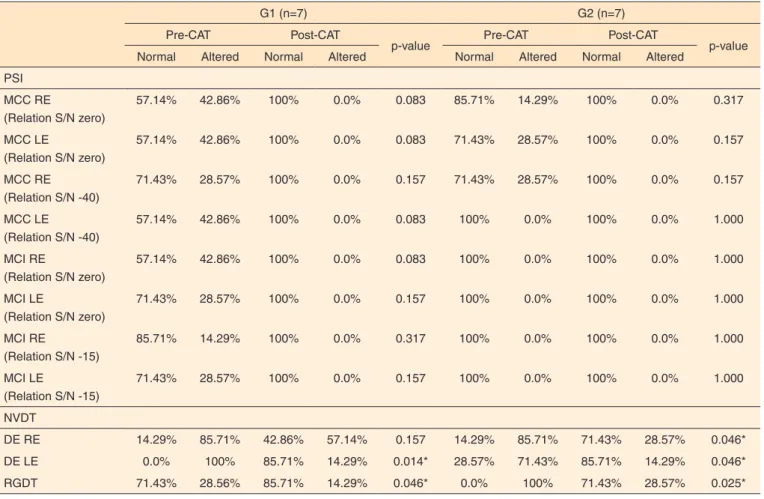
The descriptive analysis and statistical study, conside-ring the performance on selected behavioral tests (normal or abnormal), in both groups, pre-CAT and post-CAT showed significant results in RGDT test (p=0.045 G1 and 0,025 G2) and NVDT hearing stage directed to the left (p=0.014 G1 and 0.046 G2) in both groups and to the right only in G2 group (p=0.046) (Table 1).
Regarding the SAB Scale, also used to measure the effect of the proposed therapeutic intervention, it was conducted a research of pre-CAT and post-CAT scores, comparing them between groups (Table 2).
The SAB scale proved to be a useful tool to measure the effect of CAT. As for the perception of auditory behavior by the parents, in both groups, pre-CAT and post-CAT, there was a statistically significant relationship (p<0.05). The G2 average always presented itself higher than the G1.
As for the performance in SAB scale, behavioral auditory processing tests were analyzed considering all subjects without distinction of groups. It was possible to observe moderate positive correlation only pre-CAT, in PSI MCC tests left ear (zero relation), NVDT hearing stage directed to the right and RGDT (Table 3):
It was also attempted to investigate the correlation between performance on SAB scale and behavioral tests of auditory processing between the groups (Table 4).
Thus, it was observed that the G1 had a strong positive relationship in MCI stage in the right ear (relation -15 dB) post-CAT and moderate MCC step in the left ear (relation -40 dB) and RGDT pre-CAT. It was observed also moderate negative correlation with the post-CAT RGDT. As for the G2, it was obtained strong correlation in the MCC stage in the left ear (zero relation) and moderate in MCC stage in the right ear (zero relation), MCC left ear (relation -40 dB) and MCI right ear (relation -15 dB).
DISCUSSION
It was opted for the choice of behavioral tests RGDT(16),
PSI(17) and NVDT(18), because different gnosis processes were
Chart 1. Proposed activities, stimulated auditory skill, involved gnosis process and brief explanation of the tasks
Activity Hearing ability stimulated Gnosis process Operation
Follow the flute
Ordenação temporal (Padrão de duração)
Atenção e Memória
Nonverbal gnosia
Long or short duration sounds were presented and the child was asked to reproduce the same sequence heard. Easy and medium levels with presentation of three sounds, difficult with four sounds and insane with five sounds.
Follow the piano
Temporal patterning (frequency standard) Attention and Memory
Nonverbal gnosia
Sounds of different intensities (treble or bass) were presented and the child was asked to reproduce the same sequence heard. Easy and medium levels with presentation of three sounds, difficult with four sounds and insane with five sounds.
How many intervals Temporal resolution
Attention Decoding
Sounds and intervals were presented and, in this activity, when the child realized the break, He/she should click on a number or, at the end of the sequence, only in the corresponding number to the total of intervals heard.
How many sounds Temporal ordering
Attention Nonverbal gnosia
Sounds of musical instruments in different sequences Were presented and the child was requested to tell how many times He/she heard the sound.
Which sound was heard
Detection and discrimination
Attention Ordenation
Two verbal sounds and a question regarding what was heard (the words were the same or different) were presented.
Follow the sequency
Association Auditory memory for nonverbal sounds Attention
Organization
Animal sounds were presented. The child should memorize and organize them as the requested order. Easy and medium levels: put in alphabetical order the names of the animals heard, put in reverse alphabetical order the names of the animals heard, say only the third sound heard, etc. For this activity, the children had visual aid of an alphabet track. Difficult and insane levels: a story was heard and, at the end, a question that the child should interpret was presented.
Listening and attention
Recognition Auditory closure Attention
Decoding
Two words were presented aurally and in writing and the child should respond as requested in the statement (do the words rhyme? Do they start with the same sound? Do have the same number of syllables? etc). Difficult and insane levels: the written and heard words were different.
Right on the sight Binaural separation
Attention Codification
Two words were presented at the same time, one in each ear, and the child was requested to identify the target word and pointed out which side it was presented. The word target could be said before or after the presentation.
Left Right Binaural integration Codification
Words were presented, sometimes on one side, sometimes on the other, and the child should identify which were the words and which side each they came from. Easy level: one word on each side, middle level: two, difficult level: three and insane: four.
Binaural
Location Attention Memory
Decoding
Musical instrument sounds were presented, sometimes on one side, sometimes on the other, sometimes from far, sometimes near, and the child should identify the location where each sound came from. Easy and medium levels: the answer could be given as the stimuli were being heard. Medium and insane levels: the answer was given after the presentation of the sequence, requesting memorization.
Catch if you can
(bonus track) Attention Codification
A fuit trail was presented and the child should click only on the Apple that was moving. Easy and medium levels. Only apples on the trail, changing speed ou changing size. Hard level: other fruit were added and the child shoul search only for the Apple. Insane level: different fruit on the trail and costumers orders were heard; following request in the statement, the child should click on the fruit that was blinking or on the fruit requested aurally.
Follow the rhythm
(bonus track) Attention Nonverbal gnosia
A significant improvement was observed in the auditory abilities of non-verbal sounds recognition in directed listening and figure-ground for such sounds (NVDT test) and temporal resolution (RGDT), after CAT, in both groups (Table 1). These findings agree with a recent study in which the researchers verified significant changes in hearing abilities, particularly in sustained attention, and cognitive, after CAT, with non-verbal auditory stimulation and phonological approach in children with speech alteration(22).
Regarding the improvement in temporal resolution ability, it was verified that the use of other software were also effective to adapt such skill in the presence of APD(13,14). It is noteworthy
that, during the course of RGDT test, the attentional system is
also required, because the child must remain alert to identify if one or two sounds were presented, essential ability to regulate and perform the activity quickly(14).
It is noteworthy that, when assessing the temporal resolution test in the pre-CAT moment, three children of G2 and two of G1 failed to perform the normal version and the expanded version of the test, even though they were guaranteed the understan-ding of the exam. After the CAT, two children of the G2 and one of G1 maintained that difficulty with the achievement of the test, and the G1’s child presented the worst performance during the intervention process, fact that may have hindered the consolidation of the child’s learning. It is believed that the changed result, showing the inability of the population of
Table 1. Descriptive analysis and statistical study of categorical variables: performance in behavioral tests for normality in the pre and post com-puterized auditory post-training groups in students with auditory processing disorder and acquisition typical or atypical speech
G1 (n=7) G2 (n=7)
Pre-CAT Post-CAT
p-value Pre-CAT Post-CAT p-value
Normal Altered Normal Altered Normal Altered Normal Altered
PSI
MCC RE
(Relation S/N zero)
57.14% 42.86% 100% 0.0% 0.083 85.71% 14.29% 100% 0.0% 0.317
MCC LE
(Relation S/N zero)
57.14% 42.86% 100% 0.0% 0.083 71.43% 28.57% 100% 0.0% 0.157
MCC RE (Relation S/N -40)
71.43% 28.57% 100% 0.0% 0.157 71.43% 28.57% 100% 0.0% 0.157
MCC LE
(Relation S/N -40)
57.14% 42.86% 100% 0.0% 0.083 100% 0.0% 100% 0.0% 1.000
MCI RE
(Relation S/N zero)
57.14% 42.86% 100% 0.0% 0.083 100% 0.0% 100% 0.0% 1.000
MCI LE
(Relation S/N zero)
71.43% 28.57% 100% 0.0% 0.157 100% 0.0% 100% 0.0% 1.000
MCI RE
(Relation S/N -15)
85.71% 14.29% 100% 0.0% 0.317 100% 0.0% 100% 0.0% 1.000
MCI LE
(Relation S/N -15)
71.43% 28.57% 100% 0.0% 0.157 100% 0.0% 100% 0.0% 1.000
NVDT
DE RE 14.29% 85.71% 42.86% 57.14% 0.157 14.29% 85.71% 71.43% 28.57% 0.046*
DE LE 0.0% 100% 85.71% 14.29% 0.014* 28.57% 71.43% 85.71% 14.29% 0.046*
RGDT 71.43% 28.56% 85.71% 14.29% 0.046* 0.0% 100% 71.43% 28.57% 0.025*
*Significant values (p<0.05) – McNemar’s exact test to compare categorical variables intragroup
Subtitle: CAT = computerized auditory training; PSI = Pediatric Speech Intelligibility; S/R = sinal noise; RGDT = Random Gap Detection Test; NVDT = Nonverbal Dichotic Test; MCC = contralateral competitive message; MCI = ipsilateral competitive message; RE = right ear; LE = left ear; DE = directed attention
Table 2. Score obtained in Scale of Auditory Behaviors pre and post-computerized auditory training comparing the groups, according to behavioral changes reported by parents or guardians of children studied
G1 (n=7) G2 (n=7)
p-value
Average SD Average SD
SAB-Pre CAT 27.29 9.79 39.43 10.11 0.041*
SAB- Post CAT 40.57 6.05 49.00 5.10 0.025*
*Significant values (p<0.05) – Wilcoxon test for related samples
Table 3. Correlation analysis of the Scale of Auditory Behaviors and performance in behavioral assessments, pre- and post computerized auditory training, to the whole sample (n=14)
Pre-TAC Post-TAC
r (Spearman) p-value r (Spearman) p-value
PSI MCC RE
(Relation S/N zero)
0.42993 0.1249 0.31064 0.2797
MCC LE
(Relation S/N zero)
0.54176* 0.0454 0.02540 0.9313
MCC RE (Relation S/N -40)
0.09630 0.7433 0.40644 0.1493
MCC LE
(Relation S/N -40)
0.33909 0.2356 -0.12701 0.6652
MCI RE
(Relation S/N -15)
0.03212 0.9132 0.27742 0.3369
MCI LE
(Relation S/N -15)
0.25497 0.3790 0.18774 0.5204
NVDT
DE RE 0.54990* 0.0416 0.09574 0.7448
DE LE 0.44335 0.1123 -0.29669 0.3030
RGDT 0.63333* 0.0671 -0.47826 0.1367
*Significant values (p<0.05) – Spearman’s correlation coefficient (r), considering r = 0 to 0.25: very weak; 0.25 to 0.50: weak; 0.5 to 0.75: moderate; 0.75 to 0.9: strong and, 0.9 to 1: very strong
Subtitle: CAT = computerized auditory training; PSI = Pediatric Speech Intelligibility; S/N = sinal noise; RGDT = Random Gap Detection Test; NVDT = Nonverbal Dichotic Test; MCC = contralateral competitive message; MCI = ipsilateral competitive message; RE = right ear; LE = left ear; DE = directed attention
Table 4. Correlation analysis of the Scale of Auditory Behaviors and performance in behavioral tests pre and post computerized auditory training in children with auditory processing disorder and typical or atypical speech acquisition
G1 (n=7) G2 (n=7)
Pre-CAT Post-CAT Pre-CAT Post-CAT
r (Spearman) p-value r (Spearman) p-value r (Spearman) p-value r (Spearman) p-value PSI
MCC RE
(Relation S/N zero)
0.23643 0.6097 0.20597 0.6577 0.61237 0.1438 ** **
MCC LE
(Relation S/N zero)
0.0000 1.0000 0.51493 0.2370 0.75724* 0.0487 -0.40825 0.3632
MCC RE (Relation S/N -40)
-0.39406 0.3817 0.15954 0.7326* 0.31623 0.4896 ** **
MCC LE
(Relation S/N -40)
0.70412* 0.2342 ** ** 0.57735* 0.1747 0.31623 0.4896
MCI RE
(Relation S/N zero)
0.3706 0.9371 0.20597 0.6577 0.15811 0.7349 0.15811 0.7349
MCI LE
(Relation S/N zero)
0.23424 0.6132 0.51493 0.2370 0.31623 0.4896 0.40825 0.3632
MCI RE
(Relation S/N -15)
-0.35465 0.4351 0.87386* 0.0101 0.54006* 0.2108 0.11952 0.7985
MCI LE
(Relation S/N -15)
0.07881 0.8666 0.0000 1.0000 0.41833 0.3503 0.44544 0.3165
NVDT
DE RE 0.57660 0.1754 0.20000 0.6672 0.32434 0.4779 -0.18356 0.6936
DE LE 0.14415 0.7578 -0.12060 0.7967 0.16217 0.7283 -0.47809 0.2779
RGDT 0.70000 0.1881 -0.77143* 0.0724 0.0000 1.0000 0.80000 0.1041
*Significant values (p<0.05) – Spearman’s correlation coefficient (r), considering r = 0 to 0.25: very weak; 0.25 to 0.50: weak; 0.5 to 0.75: moderate; 0.75 to 0.9: strong and, 0.9 to 1: very strong
** All values of the variables were the same, not being possible to compute the correlation between them
this study to perceive aurally acoustic differences due time(23),
is directly related to immaturity in the perception of phonic speech contrasts, especially in children of the group with PD associated to the APD. There is no possible explanation for the fact that the temporal resolution inability does not result in atypical phonological development in the children of G1. It is highlighted, however, that the temporal resolution ability is one of the factors responsible for the typical phonological acquisition, but, it should not be considered in its singularity. Other aspects should be considered in this analysis, as the en-vironment in which the child is inserted, types of exhibition to language, encouraging appropriate development, family history, among others. All these aspects were not analyzed in this study, since they were not characterized as a goal.
The hearing ability of figure-ground for verbal sounds (PSI test) was rehabilitated in those children who had pre-CAT alteration. It is important to mention that the entire sample rea-ched the maximum score of correct answers in the revaluation, considering such skill (Table 1). These findings show that the CAT done through Escuta Ativa software enabled new learning for the children who had alteration and maintained the ability in those with pre-intervention normality. However, there was no significant difference, once most pre-CAT children already presented the exam within normality.
Regarding the performance in different conditions of au-ditory competition, in G1 pre-CAT, unlike what is reported in the literature(17), children presented better performance
when the competition level was higher (presented noise with intensity above the sentence presentation) and in the right ear. It is believed that this fact has occurred due to self-learning, once the same phrases are displayed in each step repeatedly. Moreover, when the level of difficulty was higher, the children were again instructed to pay attention to the fact that the noise would be in greater intensity to the sentence, which may have aroused greater challenge, attention and concentration in the activity, improving the performance. It is also highlighted that the superior result in the right ear shows activation of the left hemisphere, responsible for language, agreeing to the test, since it is an evaluation with use of verbal stimuli.
The best performance in the MCI stage, when comparing with the MCC, was not an expected finding for the study, because it is known about the higher level of difficulty in the MCI stage, in which the stimulation is unilateral. However, the data is important, since it showed better performance and ability of children in responses, without binaural separation. The binaural separation ability depends on the subject to be able to attend and make the integration of sound stimuli recei-ved from both ears, simultaneously(1), and separate them. The
children in this study had no better performance in the ability of separation but in the selective attention, which requires that the subject can select a main sound stimulus in the presence of competitive stimulus, being both skills evaluated with uni-lateral presentation (MCI step). Both binaural separation and
selective attention are related to auditory figure-ground skill(8).
It is believed that this finding is justified because the binaural separation requires greater demand in the auditory pathways, since it needs to perform integration of more processes with sounds from different ears.
A previous study(4) carried out in children with speech
al-teration showed that the PSI test in contralateral competitive message was not sensitive enough to identify alteration in this population, because the children did not present errors during the evaluation. According to the authors, this result may be related to the fact that the message is shown on one side and the phrase on another, each ear receiving verbal stimulus mo-noaurally(4). Despite the knowledge that the difficulty in the PSI
test may be associated with lack of awareness of phonemes that compose the speech(18), this test was the one that showed the
least significant results in intragroup and intergroup compari-son, as well as pre-CAT changes.
It was considered only the directed hearing stage in the NVDT, because the assessed children presented normality in the free hearing stage. However, in the guided hearing stage, even if the result was not significant, G1 children showed greater change. This step relates itself to the sustained attention ability, in which the child needs to maintain attention for longer in the message coming from only one ear. Therefore, it is assumed that major difficulties in attention skills in the studied popu-lation are directly related to their reduced ability to maintain sustained attention, since it is an easily distracted population by external events. Students in schools that have acoustically inadequate classrooms may present difficulty in concentrating and, consequently, learning(24).
When comparing pre- CAT and post-CAT, it was possible to note that there was greater hits symmetry between the ears in PSI tests, after therapeutic intervention, in both groups (Table 1). This finding suggests that the effect of compensation occurred between the ears, as a result of learning generated by auditory stimulation and the possible largest network of neural connections. According to authors, the stimulation approach through auditory training improves neural circuits, with greater participation of neurons, alteration on the neural synchrony and more synaptic connections(1,13,14,15). This improvement can be
confirmed by means of behavioral tests, comparing the subject with himself/herself and reaffirms the effect of plasticity in the central nervous system, capable of generating new connections, observed in all selected tests for this study.
In addition, confirming the effect of plasticity, there was adaptation of auditory abilities in 11 children in the ability of temporal resolution, in 11 in figure-ground skill for verbal stimuli and in eight in the figure-ground ability for non-verbal stimuli. Moreover, it was noted improvement on the temporal resolution skills in three children and on figure-ground ability for non-verbal stimuli in six.
software use in children, aiming a clearer and more didactic presentation of these findings (Chart 2).
As for the findings of Scale of Auditory Behaviors (SAB), there was a significant result in the analysis of scores between the groups, pre-CAT and post-CAT, indicating that the inter-vention produced functional auditory changes, perceived by parents/guardians (Table 2). It is noteworthy that the G2 showed higher scores, on this scale, on both moments of evaluation, while the G1 showed greater change in pre-CAT and post-CAT score. It was not expected that the children with APD and atypical phonological acquisition presented higher scores in
the SAB. Despite the 4 months difference in the age average between the groups, being superior for G2, it is believed that this factor was not decisive for better performance on the sca-le. However, the hypothesis is that these results suggest that eventual daily difficulties related to auditory skills were not perceived clearly by the parents/guardians of children in G2, since the focus of attention was facing, possibly, phonological change.
Authors report that there is a need for studies on the use of scales that measure the auditory behavior in young children, as in the current study(11). The SAB Scale was designed to be
Chart 2. Researches with software for auditory training and measuring od training for behavioral evaluation, in children with auditory processing disorder or alteration of language or speech, in the last six years
Author(s) Sample Used software Number of sessions Results
Martins; Pinheiro; Blasi (2008)(13)
Two 9 years old children with diagnosed APD
Pedro in the haunted house
Eight sessions, once a week
Adequaccy of auditory skills of figure-ground for verbal and non verbal sounds, temporal resolution and temporal ordination.
Balen; Massignani; Schillo (2008)(25)
Three children (from 9 to 14 years old) with diagnosed APD
Fast ForWord 40 sessions, 5 days a week
There was improvement in only two children and also not interest for the software.
Pinheiro; Capellini (2009)(24)
40 children with learning
difficulty Audio Training
18 sessions, twice a week
Superior performance in changed auditory skills, in children Who had CAT.
Pinheiro; Capellini (2010)(26)
40 children with learning
difficulty Audio Training
18 sessions, twice a week
Children with learning difficulty presented worse performance on phonological and auditory tasks, when compared with the normal learning process.
Comerlatto Junior; Silva; Balen (2010)(14)
18 children with APD
Assistant in Hearing Disorders Rehabilitation Software (SARDA)
Approximately 12 sessions, three times a week
There was an improvement only in temporal resolution ability, with no difference in the standard frequency and duration tests.
Cameron; Dillon (2011)(27)
Nine children aged between 6 and 11 years, identified by teachers with abnormal auditory behavior, confirmed after behavioral assessment
LiSN & Learn auditory training software
60 sessions, five times a week
There was improvement in hearing skills, as well as behavioral changes, reported by parents and children themselves.
Cameron; Glyde; Dillon (2012)(28)
Tem children aged between 6 and 9 years and 9 months, with APD
LiSN & Learn auditory training software or Earobics
84 daily sessions of 15 minutes
There were behavioral improvement reports with both CAT procedures. However, there was an improvement in the spatial location ability only in the group receiving therapy with LISN & Learn software.
Cameron et al. (2014)(29)
144 indigenous children from Australia, between 6 and 12 years old, evaluated regarding spatial processing ability. Ten presented changes and nine made CAT
LiSN & Learn auditory training software
Approximately 35 sessions, five days a week
There was a correlation between the number of sessions and the improvement of perfor mance in LISN-S tests and improvement in spatial ability.
Murphy et al. (2015)(22)
17 children with speech alteration
System for testing auditory responses-STAR
12 sessions, twice a week
There was no improvement in phonological skills.
used by teachers or parents, in order to identify hearing impair-ment in the child and appropriate referral(11). In this research,
the scale has proved to be an interesting tool for measuring the therapeutic efficacy to be used on the clinic and its use is recommended as routine, as, in the present study, such method allowed understanding of auditory functioning of children, in addition to be driven, in a personal and unique way, the dialogue with parents/guardians. It is emphasized also the importance of disclosure of this material to teachers, considering that this protocol was developed considering this population and parents, to avoid late identification and intervention of APD in students.
The findings of the current research demonstrated a posi-tive correlation between the SAB scale and some conditions of the selected tests only pre-CAT (Table 3). In the consulted literature, a study found the correlation between the SAB scale and eight behavioral tests of AP (different from those analyzed in the present study), in Portuguese children in public schools aged from 10 to 14 years incomplete. The authors observed a positive relationship between the measures, which means, the higher the score on the SAB scale, the greater the number of hits in behavioral tests(11).
In the present study, it was also verified a correlation betwe-en the SAB scale and the behavioral tests in group performance analysis, demonstrating positive relationship MCC stage in the left ear (relation -40 dB) and in G1 group and PSI at different stages of competition, in G2 group, pre-CAT. In the post-CAT analysis, there was a positive correlation MCI stage in the right ear (relation -15 dB) and negative in RGDT test only for the G1 group (Table 4). The fact that RGDT test present negative correlation with SAB scale after CAT was expected, because, the lower the value in milliseconds of gaps perception by the subject in the test, the greater should be the score on the sca-le. Remembering that, the higher the score, the better is the auditory behavior, except in RGDT test. It is understood that these correlations are reliable, because the fact that MCC was worse than expected does not diminish the importance of the finding, which were the information of best performance of children with unilateral stimulation, at the expense of binaural stimulation. Researchers(30) verified the relationship between
performance in dichotic behavioral tests, monotic and tempo-ral applied in children and young people from 6 to 16 years old with APD complaints, as well as performance in SAB scale in its application with the parents or guardians, finding correlation between the scale and behavioral tests, mainly in the temporal tests.
It must be observed the scarcity of published studies about the use of SAB scale. In order to illustrate the use of this scale in monitoring the effect provided by the CAT, in this study, it is mentioned mother and grandmother reports of two children, respectively, “’he is reading more, now he wants to read” and “the TV volume did not turn down, but if you go there and turn it down, he does not turn up as before”. Issues related to behavioral changes observed by teachers in the classroom were
also exposed by most mothers, regarding the improvement in attention and, consequently, better school performance. These statements reinforce the effects of therapeutic intervention in the auditory, social and school behavior of the child.
CONCLUSION
The CAT with the use of Escuta Ativa software showed itself effective to improve the gnosis processes of school children with typical and atypical phonological acquisition and, in some cases, even adapted such processes. There was a correlation between the behavioral tests and the score in the SAB.
REFFERENCES
1. American Speech-Language Hearing Association - ASHA. Auditory processing disorders: Working Group on Auditory Processing Disorders. [S.l.]: American Speech-Language Hearing Association; 2005. [Technical report].
2. Ramos BD. Mas, afinal, por que é importante avaliar o processamento auditivo?Braz J Otorhinolaryngol. 2013;79(5):529. http://dx.doi.org/10.5935/1808-8694.20130097
3. Attoni TM, Quintas VG, Lessa AH, Mezzomo CL, Mota HB. Avaliação do processamento auditivo pré e pós-terapia em paciente com desvio fonológico. Braz J Otorhinolaryngol. 2010;76(5):672. http://dx.doi.org/10.1590/S1808-86942010000500024
4. Quintas VG, Attoni TM, Keske-Soares M, Mezzomo C. Processamento auditivo e consciência fonológica em crianças com aquisição de fala normal e desviante.Braz J Otorhinolaryngol.
2 0 1 0 ; 7 6 ( 6 ) : 7 1 8 2 2 . h t t p : / / d x . d o i . o rg / 1 0 . 1 5 9 0 / S 0 1 0 4 -56872010000400023
5. Keske-Soares M, Blanco APF, Mota HB. O desvio fonológico caracterizado por índices de substituição e omissão. Rev Soc Bras Fonoaudiol. 2004;9(1):10-8.
6. Henrich V, Ribas LP. Emergência das róticas na aquisição fonológica atípica: relações implicacionais e de marcação. Prolíngua. 2013;8(2):41-52.
7. Neves IF, Schochat E. Maturação do processamento auditivo em crianças com e sem dificuldades escolares. Pro Fono. 2 0 0 5 ; 1 7 ( 3 ) : 3 1 1 2 0 . h t t p : / / d x . d o i . o rg / 1 0 . 1 5 9 0 / S 0 1 0 4 -56872005000300005
8. Pereira LD, Schochat E. Processamento auditivo central: manual de avaliação. São Paulo: Lovise; 1997.
9. Pereira LD. Sistema auditivo e desenvolvimento das habilidades auditivas. In: Ferreira LP, Befi-Lopes D, Limongi SCO. Tratado de fonoaudiologia. São Paulo: Roca; 2004. p. 547-52.
10. Schow RL, Seikel JA. Screening for (central) auditory processing disorder. In: Chermak G, Musiek F. Handbook of (central) auditory processing disorder: auditory neuroscience and diagnosis. San Diego, CA: Plural; 2006. p. 137-61.
CoDAS. 2013;25(3):209-15. http://dx.doi.org/10.1590/S2317-17822013000300004
12. Melo A, Costa MJ, Garcia MV, Santos Filha VAV, Biaggio EPV. O uso de software no treinamento auditivo em crianças: revisão teórica. Rev CEFAC. 2015;17(6):2025-32. http://dx.doi.org/10.1590/1982-0216201517611715
13. Martins JS, Pinheiro MMC, Blasi HF. A utilização de um software infantil na terapia fonoaudiológica de distúrbio do processamento auditivo central. Rev Soc Bras Fonoaudiol. 2008;13(4):398-404. http://dx.doi.org/10.1590/S1516-80342008000400016
14. Comerlatto Junior AA, Silva MP, Balen SA. Software para reabilitação auditiva de crianças com distúrbios no processamento auditivo central. Rev Neurocienc. 2010;18(4):454-62.
15. Balen SA, Silva LTN. Programas computadorizados no treinamento auditivo. In: Bevilacqua MC, et al. Tratado de audiologia. São Paulo: Santos; 2011. p. 805-28.
16. Keith RW. RGDT – Random gap detection test. Auditec of St. Louis 2000.
17. Ziliotto KN, Kalil DM, Almeida CIR. PSI em português. In: Pereira LD, Schochat E. Processamento auditivo central: manual de avaliação. São Paulo: Lovise; 1997. p. 113-28.
18. Ortiz KZ, Pereira LD. Não-verbal de escuta direcionada. In: Pereira LD, Schochat E. Processamento auditivo central: manual de avaliação. São Paulo: Lovise; 1997. p.151-8.
19. Yavas M, Hernandorena CL, Lamprecht RR. Avaliação fonológica da criança: reeducação e terapia. Porto Alegre: Artes Médicas; 1991. 20. Shriberg LD, Austin D, Lewis BA, McSweeny JL, Wilson DL.
The percentage of consoants correct (PCC) metric: extensions and reability data. J Speech Lang Hear Res. 1997;40(4):708-22. http:// dx.doi.org/10.1044/jslhr.4004.708
21. Alvarez A, Sanchez ML, Guedes MC. Escuta ativa: avaliação e treinamento auditivo neurocognitivo. Pato Branco: CTS Informática; 2010.
22. Murphy CFB, Pagan-Neves LO, Wertzner HF, Schochat E. Children with speech sound disorder: comparing a non-linguistic auditory approach with a phonological intervention approach to improve phonological skills. Front Psychol. 2015;6:64. http://dx.doi. org/10.3389/fpsyg.2015.00064
23. Santos JLF, Parreira LMMV, Leite CD. Habilidades de ordenação e resolução temporal em crianças com desvio fonológico. Rev CEFAC. 2010;12(3):371-6. http://dx.doi.org/10.1590/S1516-18462010005000026
24. Pinheiro FH, Capellini SA. Desenvolvimento das habilidades auditivas de escolares com distúrbio de aprendizagem, antes e após treinamento auditivo, e suas implicações educacionais. Rev Psicopedag. 2009;26(80):231-41.
25. Balen SA, Massignani R, Schillo R. Aplicabilidade do software Fast Forword na reabilitação dos distúrbios do processamento auditivo: resultados iniciais. Rev CEFAC. 2008;10(4):572-87. http://dx.doi. org/10.1590/S1516-18462008000400018
26. Pinheiro FH, Capellini SA. Treinamento auditivo em escolares com distúrbio de aprendizagem. Pro Fono. 2010;22(1):49-54. http:// dx.doi.org/10.1590/S0104-56872010000100010
27. Cameron S, Dillon H. Development and evaluation of the LiSN & Learn auditory training software for deficit-specific remediation of binaural processing deficits in children: preliminary findings. J Am Acad Audiol. 2011;22(10):678-96. http://dx.doi.org/10.3766/ jaaa.22.10.6
28. Cameron S, Glyde H, Dillon H. Efficacy of the LiSN & Learn auditory training software: randomized blinded controlled study. Audiol Res. 2012;2(1):15. http://dx.doi.org/10.4081/audiores.2012. e15
29. Cameron S, Dillon H, Glyde H, Kanthan S, Kania A. Prevalence and remediation of Spatial Processing Disorder (SPD) in indigenous children in regional Australia. Int J Audiol. 2014;53(5):326-35. http://dx.doi.org/10.3109/14992027.2013.871388