113 113 113 113 113 Mem Inst Oswaldo Cruz, Rio de Janeiro, Vol. 99(Suppl. I): 113-119, 2004
Financial support: CNPq, Fapemig
+Corresponding author. Fax: +55-31-3295.3115. E-mail: [email protected]
Received 28 May 2004 Accepted 26 July 2004
A Pedagogical Approach of Schistosomiasis – An Experience in
H ealth Education in M inas Gerais, Brazil
Cristiano Lara M assara, Virgínia Torres Schall* /+
Laboratório de Helmintoses Intestinais *Laboratório de Educação em Saúde,Centro de Pesquisas René Rachou-Fiocruz, Av. Augusto de Lima 1715, 30190-002, Belo Horizonte, MG, Brasil
The experience described here is part of an extensive program that aims to stimulate schools to develop health integrated projects from theme generators, i.e., themes that have a meaning for the community. It was developed in Jaboticatubas, a town in the metropolitan region of Belo Horizonte, capital of the state of Minas Gerais, Brazil, and the focus was schistosomiasis. The selection was based on the expressive and historical prevalence of this disease in the county, which has been known as the “capital of schistosomiasis”, in a national press release since the 1960’s. Schistosomiasis is also a theme pointed out by teachers as requiring more information and methodologies to work with their students, most of them living in areas of high risk of transmission. In addition, during the last years, this disease has been transmitted silently through an increasing rural tourism in that region, requiring integrated and effective control actions. The developed strategy included four schools, whose teachers, students, and families took part in the process. It emphasizes in a critical pedagogy approach, which focuses on health issues as themes that may mobilize the school community and awake the population to a work which integrates environment, health, and citizenship. The results demonstrate that teachers and students not only acquired new knowledge and methodologi-cal skills, but also gained confidence in their ability to improve their health conditions. Thus, the project promotes a critical education that can result a more permanent effect on the control of schistosomiasis as well as other benefits for the schools and for the population.
Key words: schistosomiasis - health education - schoolchildren - Minas Gerais - Brazil
The continuity and expansion of schistosomiasis ar-eas in Brazil may not be explained only as a biological phenomenon, requiring the understanding of historical, social, political, and cultural processes involved in its maintenance as it was pointed out by Barbosa et al. (1996). In spite of the advances on the knowledge of the disease and the consecutive control programs, with a consequent reduction of prevalence of severe forms, in some regions it is still possible to observe an expansion of the transmis-sion area. Today, schistosomiasis control is carried out based on two features: first, the morbidity control that means the reduction of severity especially avoiding or reducing the appearance of the severe form of the disease that compromises the liver and other organs. Second, the transmission control, which reduces the human and snail infections and aims to interrupt the parasite’s cycle, to which the treatment is insufficient (Katz & Peixoto 2000). On the other hand, the re-infection is a fact and it shows that the control may not be confirmed only with the re-duction of the parasite burden. This situation is a chal-lenge to reach strategies to achieve better and longer re-sults in control programs of this disease. A significant environmental contamination reduction is necessary through the improvement of public services, hygiene
con-ditions and a greater commitment of the governments and of the population to both helminths transmitted through water and those transmitted through soil. Health educa-tion and sanitaeduca-tion have important roles to reach these goals and may offer more effective opportunities to ob-tain long-lasting results. All over the world, one of the turning points of these programs is the participation of schools and communities in the endemic disease control.
METHODOLOGY
Schistosomiasis in schools - Implementing a critical pedagogical approach - The school and the community are strategic points for the success of health promotion and contribute to prevent and control diseases. Teachers and students are active agents to introduce new concepts in the community, as they are their permanent members. In accordance to Regis et al. (1996), the school was a privileged place to obtain the involvement of the popula-tion of Recife in the control of filariasis. Due to its repre-sentativeness, the school atmosphere offers favorable conditions to changes of attitudes and new alternatives to individuals and communities. Most of the families be-long the school community and this makes it easier the introduction of the theme and its follow-up.
situ-114 114 114 114
114 A Pedagogical Approach of Schistosom iasis • CL M assara, VT Schall
ate their everyday lives and culture in the social and po-litical context where they live. Thus, Health Education was included in schools as a generator of new knowl-edge, of political reflection and perception of new paths for a better quality of life. Therefore, the working up of an integrated project to control schistosomiasis and other helminths was based on the work with teachers, students and their families of four schools of São José de Almeida, county of Jaboticatubas. The project consisted of meet-ings with teachers, municipal authorities of health and education interviews with professionals of these areas and with students, and a sample of family members.
After choosing schistosomiasis as the theme, the pro-gram involves four phases as: (1) updating the preva-lence of the disease among teachers, students, and their families; (2) treatment of people infected; (3) prevention through education, including a course for teachers and a follow-up and supervision of projects developed by schools. These alternatives stimulate the education pro-cess continuity and sustainability, motivating teachers to integrate the theme to others related to health and envi-ronment (Massara et al. 2003); (4) improving access to water and sanitation facilities and health services. Phases 1 and 2 were described by Massara et al. (2003). Phase 3 is being partially described here and phase 4 is under way. Included in phase 3, as pre-requirements for pedagogi-cal measures, the social representations of the students about schistosomiasis were also investigated and ana-lyzed (Diniz et al. 2003). After that, schools were moti-vated to develop integrated projects by means of meet-ings with supervision teams and teachers. These inte-grated projects allowed a successful pedagogical ap-proach to health and environment as transversal subjects in a perspective of a health promotion school (Gavidia Catalan 2001). A qualitative follow-up of the projects has been carried out through focal groups with teachers.
Study area - The county of Jaboticatubas has been known for more than 50 years as the “capital of schisto-somiasis” (O Cruzeiro 1962) and the need to construct a correct and critical knowledge is very important to pro-mote an integrated and participative control of the dis-ease and desconstruct this label.
Jaboticatubas is located 64 km from the capital, Belo Horizonte, and belongs to its metropolitan region. It has a territorial area of 1113 km2 in the region of Serra do Cipó and a population of 13,530 inhabitants (IBGE 2000), of which two thirds are located in the rural area and devote themselves to farming and cattle-raising; mainly fruit and vegetable cultures.
It is located in the metallurgic area and is part of Belo Horizonte’s mesoregion and Sete Lagoas microregion. The county has one district, São José de Almeida; with 10 health care centers in the rural area, one emergency care center and one hospital in municipalization process.
The county is qualified for “Gestão Plena de Atenção Básica à Saúde” (Full Attention Management to Basic Health), counting on two teams of “Programa de Saúde da Família” (PSF) (Family Health Program). In accordance to an initial survey and diagnosis, malnutrition in 0 to 5-year-old children and pregnant women, was a serious prob-lem (Prefeitura Municipal 1998).
The choice criterion of schools was guided by Funasa’s reports (Fundação Nacional de Saúde – National Foundation of Health), in São José de Almeida’s district, as they indicated the presence of infected snails and some foci of high prevalence of schistosomiasis.
Schools -The work was carried out in four schools, two in the district of São José de Almeida, one in Cipó Velho and another one in São José da Serra (these two areas are part of Serra do Cipó region, a great tourism complex in Minas Gerais State).
Escola Estadual Dr. Eduardo Góes Filho (in the district of São José de Almeida), is located in the center of the district and functions in three periods with students of all social classes and villages in the region, totalizing 1010 students in primary and high schools (2001). Escola Mu-nicipal Paulo Rodrigues Aguilar, in the same district func-tions in two periods with students mainly from the rural area, totalizing 280 students from primary school (2001). Escola Municipal Padre Candinho,inCipó Velho, a smaller school, has 92 students (2001). Most of them are children of parents who work in ranches or farms or are owners of small properties, and have subsistence agriculture and animal husbandry in domestic scale. A school bus main-tained by the City Hall is responsible for taking the stu-dents to school and taking them back home. Escola Municipal Benfica Moreira Marques,in São José da Serra, is the most distant from the district of Almeida, and im-plies going along a road without asphalt for 10 km. It is located in a community that lives almost exclusively from tourism (owners of camping areas, restaurants, bars, and inns). It operates in two periods with 84 students (2001). Altogether, the project includes 1566 students, and their families, with an estimation of more than 4500 people, around 35% of the county’s population.
Project’s methodology and development -Since 2001 the research team has started to work in partnership with schools, observing a very promising participation. In the first phase of the project, teachers showed an excellent cooperation with activities concerning diagnosis and making students aware of the importance of providing material for fecal examinations. The teachers also played an essential role in providing valuable information to iden-tify areas at risk of disease transmission and where the vector molluscks could be found. Following the perspec-tive of participation research the team rented a house in the district in order to intensify the relationship with the schools and the community (Brandão 1981). This approach contributed enormously to integrate the project in the community.
In a second phase, the commitment to establish pro-jects about health in partnership with schools was rein-forced through the course “Educação em Saúde para o Controle da Esquistossomose” (Health Education in the Control of Schistosomiasis), given to 33 teachers from the four selected schools (Massara 2003).
tech-115 115 115 115 115 Mem Inst Oswaldo Cruz, Rio de Janeiro, Vol. 99(Suppl. I), 2004
Fig 1: presentation of boxes with mollusks of Biomphalaria genus, schistosomiasis vectors species and other mollusks which are not associated with the disease.
niques related to schistosomiasis issues, always having in mind a problem-solving pedagogical approach. In ad-dition to learn basic concepts of the disease such as cycle, transmission, pathology, diagnosis, treatment and preven-tion, all four schools received a kit of materials to work with.
This kit included a videotape with information about the disease (Rozemberg 1995); a collection of shells of transmitting mollusks; the book: O Feitiço da Lagoa, of the series Ciranda da Saúde (Schall 1986); worm samples (S. mansoni, Taenia sp., and A.lumbricoides); tongs and gloves. Furthermore the kit included a Manual do Agente de Saúde Pública – Esquistossomose (Handbook of the Public Health Agent – Schistosomiasis) and Guia Texto – Esquistossomose mansoni (Text Guide, Schistosomiasis Mansoni), both published by Fundação Nacional de Saúde (Ministério da Saúde, Health Ministry); a brochure about collection of mollusks’ and identification of cer-cariae, organized by Massara et al. (2002), with the coop-eration of Laboratório de Helmintoses Intestinais (Labo-ratory of Intestinal Helminthiasis) and Laboratório de Educação em Saúde (Laboratory of Health Education) and two folders about water and health – Projetos e Ações Integradas (Integrated Actions and Projects) – a hand-book for teachers, health professionals and community leaders, – Saber para Prevenir (Knowing in order to Pre-vent) – both published bySchall (2002).
Theoretical classes were carried out with lectures of invited experts in each study area related to the theme. Practical classes followed these lessons with the purpose of enriching and substantiating this new knowledge. In a dynamic process the teachers were requested to ask ques-tions about schistosomiasis which later on guided the contents, and were covered during the course. Some workshops (Miranda 1995) were used to enhance this dynamic process.
The specific content of the lectures included histori-cal aspects of the disease in Brazil, the current situation in the country and the biological cycle of S. mansoni. The teachers seemed be very interested in the classes and most of them reported their experiences with the disease, or the experience of friends and family members. During the practices boxes with mollusks of the Biomphalaria genus, that transmit schistosomiasis were compared with other boxes containing mollusks that do not transmit schistosomiasis (Fig. 1). It was explained to the students how mollusks should be collected, packed, labeled, and sent to the laboratory for analysis. Experimentally infected snails were examined with a stereomicroscope, under arti-ficial light or by crushing in order to observe the presence of cercariae. Other kinds of cercariae were shown to com-pare size, tail bifurcation and morphology.
In other classes, notions were given about diagnosis, emphasizing Kato-Katz quantitative method (Katz et al. 1972). In the practical part each participant had the op-portunity to prepare two slides with their own fecal mate-rial. Pre prepared positive slides were brought from the laboratory to observe eggs of S. mansoni and other helm-inths through microscopes (Fig. 2).
After a lecture about the symptoms, treatment, cure, and re-infection, given by the team’s physician an open
discussion clarified issues which were raised by teach-ers. This activity was enriched by statements about their own experience with the disease or experiences of their families.
The results obtained with the research in phase 1 (Massara et al. 2003) were presented to the teachers and included data about disease prevalence in students and their families, percentage of families who have access to sewage system, water system (with the use of filter), dry or septic tank (and its location), electric energy and the destination of their garbage frequency and reasons of water contact with water of local creeks, number and loca-tion as well as the percentage of infected snails collected with the percentage of infected ones. Consequently the partnership with the health care center as a reference for periodic exams and treatments, with teams of Programa de Saúde da Família (Family Health Program) and residents of the rural internship program of Faculdade de Medicina (Medical School) of UFMG was improved.
dis-116 116 116 116
116 A Pedagogical Approach of Schistosom iasis • CL M assara, VT Schall
Fig. 2A: class about the Kato-Katz quantitative method (Katz et al. 1972), in which each teacher had the opportunity to prepare a slide with their own fecal material. Positive slides were set and placed in microscopes to observe eggs of Schsitosoma mansoni and other helminths; B: students observing eggs and larvae of S. mansoni in he microscope.
A B
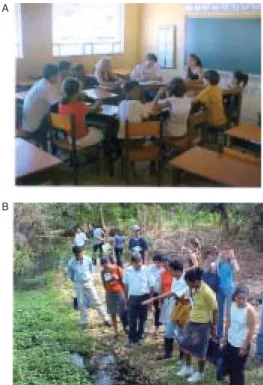
Fig. 3: activities with teachers and students in the classroom (A) and in the field (B)
A
B
ease and its transmission; (c) perspectives of the critical pedagogy and the importance of schistosomiasis as a generator which may motivate reflections about the envi-ronment, the water issue, citizens rights, and public poli-cies in the city; (d) elaboration of a project which can be used as a roadmap for the students; (e) the need for an explanatory analysis of schistosomiasis in the region, iden-tifying and investigating the forms of transmitting the disease and its relationship to the environment and people’s lifestyles.
Furthermore there were prioritized strategies for projects that guarantee the involvement of students and the observation of their habits, interviews with families (to register data and write down reports), creation of a newspaper or magazine to reveal the results, collective creation of stories of their own community, organization of science fairs, contest among schools which included family members and the establishment of a plan of sanita-tion improvements (Fig. 3).
It was also found necessary to develop a plan for evalu-ation of the project, preferably with the support of the local authorities (Health and Education Departments), of local non-governamental associations, and of the fami-lies.
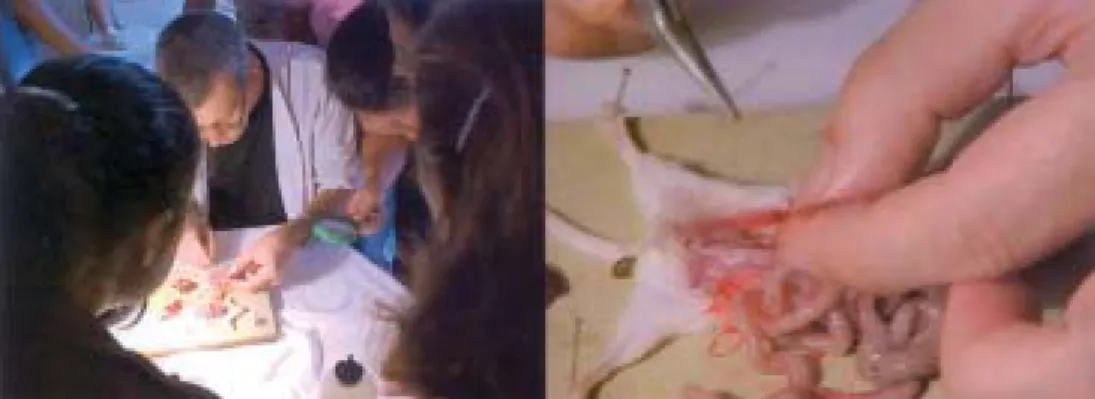
A point of great interest during the practice in the course was the dissection of experimentally infected mice and their comparison with not infected ones. This en-abled to show the difference between animals with pa-thology alterations caused by the disease, with especially alterations of infected mice’s livers and the presence of worms in these animals (Fig. 4). This exercise increased the degree of perception about the severe forms of the disease and the attention to control it, as verified in focal groups later in the process.
The course also provided the opportunity to discuss environment issues with special focus on sanitation. Data about the general situation in Brazil were presented, in-cluding information water supply service (98% of the coun-ties are assisted by same sort of water supply and only 64 % are run by the public system. Less than 50% of the
counties have sewage system and in 85%, the sewage is direct into rivers without treatment.
The debate about relation of several diseases with a lack of sanitation generated ideas to review proposals, actions and interventions in order to minimize the prob-lem.
dur-117 117 117 117 117 Mem Inst Oswaldo Cruz, Rio de Janeiro, Vol. 99(Suppl. I), 2004
Fig. 4: dissection of experimentally infected and not infected mice. This enabled the comparison between animals with pathological alterations of the disease and the observation of the presence of worms in these animals with the help of a stereomicroscope.
ing the second semester of 2003. Teachers who would be responsible for the process in each school were identi-fied.
The continuation of the project in 2004 was under-taken through focal groups including teachers and stu-dents of the four schools. This was done in a way to stimulate the continuity of pedagogical process and inte-grated projects.
RESULTS
The project is still ongoing. However some results, allow us to verify the potential of community mobilization through school for joint participative work. During the course, teachers illustrate the potential of this alternative approach as lined out by the following statements:
Taking part in the course increase my knowledge and I acquired new (and much information) that I didn’t know before. Therefore. I needed to continue studying about the subject, because I will have a greater and better base in sensibilizing people (students, students’ fami-lies, and the community in general) about the impor-tance of the matter: transmission, causes and conse-quences .I didn’t imagined that this subject could be so interesting. It was important that it was still unknown to us, opinion makers for others, fighting for citizen-ship… (Teacher A)
I willl try to use the acquired knowledge to make people aware of the importance of this subject. I’ll be able to apply this knowledge in the social field in which I work (family, school, school community; community through Associação Comunitária, Projeto Manuelzão, and Conferência São Vicente de Paula). In all of them we try to help people improve their living conditions and have good health. I’ll be able to use certain resources: lec-tures, movies, technical visits, informative folders, search for partnerships and others. (Teacher H)
I intend to do my best to collaborate with the community, families and school. I’ll try to help the community with my knowledge working with students, establishing projects, giving lectures and performing other activi-ties. (Teacher E)
After the course, the teachers developed several projects with the students which included a large variety of class and extra-curricular activities. One of the
teach-ers expressed the possibilities of integrating health is-sues in all curricular subjects, as she states:
It was possible to include health in everything: Math-ematics, Portuguese, History, Geography, globalization, sciences, and even into religious teaching, we devel-oped a project about this issues and we worked them within the range on, of the new words they were discov-ering. (Teacher D)
Big event was organized at the end of the year to present the projects that were carried out during 2003. Some families participated in the event as well as the team of researches which received all produced and presented material for analysis. Since then the team has been able to follow-up the project through focal groups. The teachers have continued the activities developing several projects, field observation trips and environmental interventions thus mobilizing the community. Some of these activities focused on water preservation, collection of separated garbage, and city tours, which all together showed the commitment and participative nature of these activities.
Specifically in the area of schistosomiasis, there are interesting reports of teachers and students who point out more positive attitudes concerning personal health habits and prevention of the disease. In the group of people involved, a greater perception and understanding of the risks of the disease was observed, which result in the search for diagnosis, including the teachers’ families, this is referred in the focal groups, as follows:
They already observed a lot, before getting into the wa-ter they look out for snails, my children too. We live near a creek and they always say,”watch out for snails” even when they play. (Teacher H)
I read a book with the children in the classroom called “O menino e o rio”(The boy and the river), I was read-ing and on the cover of the book there was a paunchy boy. I didn’t say anything about schistosomiasis and when I was in the middle of the chapter they said” it is schisto”. (Teacher N)
118 118 118 118
118 A Pedagogical Approach of Schistosom iasis • CL M assara, VT Schall
write down one word under these two groups. When it came to Bad Water, the first word was “schisto”and then they wrote poems and almost all of the poems about the Bad Water had something to do with schistosomia-sis, and that means they didn’t forget it. (Teacher R)
Another statement of one of the teachers in the focal group emphasizes this issues:
I think that our medical and sanitary conditions are precarious and also the population is poor. The poorer the population the more difficult for us to work. That’s why I think the work we’re developing here is very good and serious and it makes people know about cases and makes them aware of how bad the disease is. Many people asked for examination stop us on the streets and asked us how to do it, you know. (Teacher V)
There is also a greater attention to environmental is-sues concerning transmission, which arose a comment of one of the schools supervisor:
Had an intervention of this cope started 10 years ago, perhaps the disease could be under control today.
DISCUSSION
All 33 teachers involved pointed out the importance of taking part in the project, emphasizing their previous difficulties in dealing with the issue, not only based on the lack of understanding the process but also because of few informative material available. They did not feel motivated to work this topic with their students and they did not have any experience in organizing participative projects involving them and their families. Until them, ev-erything was limited to science fairs at the schools.
Thus, it is remarkable that from the theme schistoso-miasis it was possible to generate multiple approaches and educational features which involve health issues, their impact on the construction of as healthier environment and the possibilities of changes in behavior, as well as the consequences on the rights and duties of each citizen.
From a scientific point of view, the course made it pos-sible for the participating teachers to achieve a better understanding about the disease and related issues, such as pedagogical alternatives to work with the students, not only restricted to written papers and posters.
It has been possible to discuss with the teachers the structural problems which maintain schistosomiasis in the county, by remembering and representing its history and its relation to the living conditions of the population. It was possible to observe the irregularity of the distribu-tion of different groups of risk, the reladistribu-tion of the produc-tive process with the transformation of the environment as well as of the society which contributed in the mainte-nance of the disease. The change from the agricultural system of small farmers by transforming their properties in to leisure and rural tourism areas (Enk et al., 2003) has generated discussions about the urgent need for mea-sures to control the disease by the local public authori-ties together with the inhabitants. These features associ-ated with stimuli from other projects that are taking place in the region such as “Projeto Manuelzão” (UFMG) have induced several pedagogical actions, associated with projects to enlarge the knowledge of the community,
ini-tiating extra-curricular activities such as informative pa-rades, visits to local water springs, collection of sepa-rated garbage. Discussions about risk of deforestation, which surpass the focus on the disease and emphasize health promotion. These aspects define the characteris-tics of the Healthy School(Gavidia Catalan 2001), makes it visible that the project is heading into this direction.
The participanting teachers felt more confident and better equipped to work this issue with the students. At the same time, the students showed much more interest in the work developed in schools, specially with integrated projects and practical activities such as mice dissection, identification of vector and non vector mollusks, as well as worms in their larval and adult stages.
The project assessment has shown a wide range of creativity from the part of the teachers and students. Among the activities developed in the projects, we may emphasize the interest for the problem calling more atten-tion to the environment next to their households and the community surroundings.
During classes, songs, poems, plays, texts were elabo-rated elaboration, which are currently analyzed. The use of knowledge acquired during the course is applied in more specific subjects such as Mathematics, Portuguese, Geography and History, making health into an integrating and transversal theme.
It is important to register that the elaboration, coordi-nation and implementation of the project integrated the team and satisfied all participants. The invited experts who gave lectures during the course unanimously men-tioned the teachers’ interest and concern in taking part and clarifying their doubts in order to feel prepared for their future work withing the school community.
Today, these teachers who participated in the course and in the projects are key persons to introduce the issue in the curriculum and to build knowledge together with , students, families and other teachers. Furthermore, they have estimulated a critical reflection within the commu-nity about the relationship between health, the environ-ment and quality of life. They did not only acquire new knowledge and methodological skills, but also gained con-fidence in their own ability to improve their and their stu-dents health conditions.
At the moment, the coordination team is using the, strengthening pedagogical bases through focal groups with teachers and students to continue the work in 2004, project step by step a tool for critical education and trans-formation in the county.
This project has been a reference for the region and other counties which already have declared their inter-est. As a result, in 2003, two other counties joined the project and others are scheduled to participate in 2004, indicating the achievement of the general goal to develop an applicable methodology for other endemic regions in the state.
ACKNOWLEDGEMENTS
119 119 119 119 119 Mem Inst Oswaldo Cruz, Rio de Janeiro, Vol. 99(Suppl. I), 2004
REFERENCES
Barbosa CB, Silva CB, Barbosa FS 1996. Esquistossomose: reprodução e expansão da endemia no Estado de Pernambuco no Brasil. Rev Saúde Púb 30: 609-616.
Brandão CR 1981. Pesquisa Participante, Editora Brasiliense, São Paulo.
Diniz MCP, Braga R, Schall VT 2003. As representações sociais da esquistossomose de escolares de uma área endêmica de Minas Gerais. Rev Bras Pesq em Educ Ci, in press. Enk M, Amorim A, Schall VT 2003. Acute schistosomiasis
outbreak in the metropolitan area of Belo Horizonte, Minas Gerais: alert about the risk of unnoticed transmission incresead by growing ruaral tourism. Mem Inst Oswaldo Cruz 98 (Suppl. 6): 745-750.
Freire P 1994. Pedagogia da Esperança: um Reencontro com a Pedagogia do Oprimido,Paz e Terra, São Paulo.
Gavidia Catalán V 2001.The transversality and the health pro-motion schools. Rev Esp Salud Publica 75: 505-516. Katz N, Peixoto SV 2000. Crititical analysis of the estimated
number of schistosomiasis mansoni carriers in Brazil. Rev Soc Bras Med Trop 33: 303-308.
Katz N, Chaves A, Pellegrino J 1972. A simple device for quan-titative stool thick-smear technique schistosomiasis mansoni. Rev Ins Med Trop São Paulo 14: 397-400. Massara CL 2003. Curso de Educação em Saúde para controle
da esquistossomose. Relatório técnico apresentado ao Programa de Pós-Graduação em Ciências da Saúde,
CPqRR-Fiocruz, Minas Gerais, 15 pp.
Massara CL, Barros HS, Silva JGA 2002. Coleta de moluscos e identificação de cercarias. Apostila integrante do Curso de capacitação sobre controle integrado de esquistossomose nos municípios, 7 pp.
Massara CL, Barros HS, Carvalho OS, Schall, VT 2003. Devel-opment and evaluation of integrated schistosomiasis con-trol programs in the metropolitan área of Belo Horizonte, MG, Brazil. A report about experiences and perspectives. 9º International Symposium on Schistosomiasis, 2 to 5 November, Salvador, BA Brazil.
Miranda, S 1995. Oficina de Dinâmica de Grupos, Papirus, Campinas.
O Cruzeiro, 1962. Um caramujo que hospeda a morte. 24/11/ 1962, p. 99-107.
Regis L, Furtado AF, Oliveira CNF, Bezerra CB, Silva LRF, Araujo J, Maciel A, Silva-Filha NH, Silva SB 1996. Inte-grated control of the filariasis vector with community par-ticipation in an urban area of Recife, Pernambuco. Brazil. Cad Saúde Pública 12: 473-82.
Rosemberg B 1995. Doença do caramujo. Direção de Brani Rozemberg. Rio de Janeiro. Multimeios/CICT/Fiocruz. 28 min., color (Fita de vídeo – VHS).
Schall VT 1986. O Feitiço da Lagoa. Série Ciranda da Saúde, Antares, Rio de Janeiro.