Transposable elements
P
and
gypsy
in natural populations
of
Drosophila willistoni
Adriana Koslovski Sassi1, Fabiana Herédia1, Élgion Lucio da Silva Loreto2, Vera Lucia da Silva Valente1and Claudia Rohde1
1
Universidade Federal do Rio Grande do Sul, Instituto de Biociências, Departamento de Genética, Porto Alegre, RS, Brazil.
2
Universidade Federal de Santa Maria, Instituto de Ciências Exatas e Naturais, Departamento de Biologia, Santa Maria, RS, Brazil.
Abstract
The presence and integrity of thePtransposon and thegypsyretrotransposon in the genome of 18 samples of naturalDrosophila willistonipopulations collected from a large area of South America were Southern blot screened using Drosophila melanogasterprobes. The aim of this screening was provide further knowledge-base on the geographical distribution ofD. willistoniand to carry out an inter-population analysis of thePandgypsyelements present in the genomes of the populations analyzed. The fragment patterns obtained indicate that both thePand
gypsyelements are ancient in theD. willistonigenome, but whereas thegypsyretroelement appears to be invariable and stable thePelement varies between populations and appears to still have some capacity for mobilization.
Key words: Drosophila willistoni,transposable element,P,gypsy. Received: July 23, 2004; Accepted: May 4, 2005.
Introduction
The fruit flyDrosophilawillistoni is widely distrib-uted in the Neotropics, highly polymorphic for chromo-somal inversions and possesses a high level of genetic variability expressed by several genetic markers. It is capa-ble of exploiting very different environments for feeding and breeding throughout a wide geographical range stretch-ing from Florida and Mexico in North America to northern Argentine in South America (Spassky et al., 1971). Be-cause of this,D. willistoniand its sibling species has been the subject of many evolutionary studies and is considered an organism of choice for this type of research.
The transposable elements (TEs) P and gypsy are some of the best-known mobile sequences inDrosophila melanogasterand are widely represented in the repetitive portion of theDrosophilagenome, appearing to be resident members of the genome of several species (Bayevet al., 1984; Daniels and Strausbaugh, 1986; Staceyet al., 1986; Danielset al., 1990; Loretoet al., 1998a, b). These ele-ments are members of two large groups of mobile sequences (Finnegan, 1989) represented by Class I
retro-transposons such asgypsyand412which use an intermedi-ary RNA molecule and a reverse transcriptase to transpose and Class II DNA transposons such as the Pand hobo transposons which use a transposase to mobilize.
Thegypsyelement is a long 7.3 kb retrotransposon containing 0.5 kb of well-conserved long terminal repeats (LTRs) and is widely distributed inDrosophilaand the sub-genus Sophophora (Stacey et al., 1986; Loreto et al., 1998b), the retroviral properties ofgypsyprobably explain-ing this wide distribution (Bayevet al., 1984; Terzianet al., 2000; Vázquez-Manriqueet al., 2000; Mejlumianet al., 2002; Pélisson et al., 2002; Heredia et al., 2004). The strong pattern similarity betweengypsy strains found by Bayevet al. (1984) using Southern blotting suggests that this element invaded theD. melanogastergenome early in the evolutionary history of this species, the same appearing to be true forDrosophila simulans(Loretoet al., 1998b). However, little information is available about howgypsy element sequences evolved in the genomes of different Drosophilapopulations around the world.
The completePelement is 2.9 kb long and codifies two differentially spliced polypeptides (66 kDa and 89 kDa) inD. melanogaster(O’Hare and Rubin, 1983), dif-fering in only one nucleotide over the entire element from the sequence inD. willistoni(Danielset al., 1990). In addi-tion to autonomous elements, there are smaller,
non-www.sbg.org.br
Send correspondence to Vera Lucia da Silva Valente. Universidade Federal do Rio Grande do Sul, Instituto de Biociências, Depar-tamento de Genética, Av. Bento Gonçalves 9500, Prédio 43323, Caixa Postal 15053, 91501-970 Porto Alegre, RS, Brazil. E-mail: [email protected].
autonomousPelements which are heterogeneous in size (ranging from about 500 to 2500 pb) and which are derived from autonomous elements by deletion of some internal se-quences. ThePelement has been extensively studied be-cause of its ability to promote a phenomenon known as hybrid dysgenesis (a syndrome of related traits including male recombination, gonad atrophy, mutations and chro-mosome aberrations) in the offspring of crosses in which males carryingPelements (termed P strains) are mated to females that lack autonomously mobilePelements (termed M strains) (Kidwellet al., 1977). We recently detected a similar phenomenon inD. willistonicharacterized by go-nad atrophy in the F1generation of crosses between certain
D. willistonistrains (Regneret al., 1999), but the involve-ment ofPelements as a causal agent was considered un-likely because bothD. willistonistrains havePelements in their genomes (Regneret al., 1996). In fact, noD. willistoni strains have been recorded as being free of P elements (Lansmanet al., 1985; Regneret al., 1998).
The study described in this paper was designed to contribute to knowledge of the dynamics of mobile se-quences in different populations of a widely distributed species within a broad territory. Our study used Neotropical D. willistoni because the wide distribution of this drosophilid over very diverse environments means that dif-ferent selective forces have been operating on the D. willistoni genome, our specific interest being to under-standing the role of transposable elements as an intrinsic source of variability subject to natural selection. We choose the Class I gypsy retrotransposable and Class II P transposable elements because of their different mobiliza-tion mechanism. We also usedD. willistonias a model to ascertain the copy number of these mobile sequences in a complex host genome characterized by a wide repertoire of genetic variability (Ehrman and Powell, 1982). The objec-tive of our work was to characterize the presence or absence and the fragment patterns ofPandgypsyinsertions gener-ated by restriction enzymes in the genome of natural popu-lations ofD. willistoniusing Southern blot assays.
Materials and Methods
Strains ofDrosophila willistoni
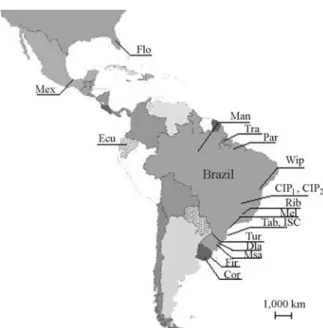
We studied 18Drosophila willistonipopulations (Ta-ble 1) collected at various times from several areas (Figure 1) of its geographical distribution as defined by Spasskyet al., (1971). The flies were maintained in the laboratory by mass crosses and reared on corn flour culture medium (Marqueset al., 1966) at 17 ± 1 °C and 60% relative humid-ity.
DNA extraction, probes and Southern blotting
For each population, approximately 100 adult D. willistoniwere macerated in liquid nitrogen in a 1.5 mL microcentrifuge tube and 750mL of lysis buffer (Tris-HCl
0.1 M; EDTA 0.1 M; SDS 1% and NaCl 0.06 M) added to
the homogenized mass which was then incubated for 30 min at 65 °C. After incubation, proteins and lipids were solvent-extracted by adding an equal volume of phenol (pH 8.0) and slowly agitating the mixture for 10 min before centrifugation at 9,447x g for 10 min, the aqueous layer be-ing transferred to a new tube and extracted with an equal volume of chloroform:isoamyl alcohol (24:1 v/v), centri-fuged as above and the supernatant extracted with chloro-form. The DNA was precipitated from the aqueous phase by the addition of 20% (v/v) of 1M NaCl and two volumes of 100% ethanol followed by centrifugation at 9,447x g for 5 min, the aqueous phase being discarded and the pellet rinsed three times with 70% (v/v) aqueous ethanol, dried and resuspended in 30mL of Tris-EDTA (TE). After
ex-traction, the DNA was digested with RNAse and tested with a suitable restriction endonucleases to assess its qual-ity before use.
Approximately 10mg of DNA per sample were
di-gested with theXhoI,AvaII andBamHI restriction enzymes (Invitrogen). These enzymes were chosen because the frag-ment pattern they generate provides information on the presence of complete or deleted elements, probable copy
Table 1- Geographical origin of the Drosophilawillistonipopulations investigated in the present study.
Population Origin* Year collected
Flo Florida, USA#
-Mex Apazapan, Mexico 1997 Ecu Jaton Sacha, Ecuador 1997 Man Manaus, Amazonas state, Brazil 1986 Tra Traquateva, Pará state, Brazil 1990 Par Belém, Pará state, Brazil 1997 Wip Ipitanga, Bahia state, Brazil 1965 Cip1 Cipó Hill, Minas Gerais
state, MG, Brazil
1995
Cip2 Cipó Hill , Minas Gerais state, MG,
Brazil
1996
Rib Ribeirão Preto, São Paulo state, Brazil 1995 Mel Island of Mel, Paraná state, Brazil 1994 Tab Tabuleiro Hill, Santa Catarina
state, Brazil
1997
Isc Island of Santa Catarina, Santa Catarina state, Brazil
1997
Tur Turvo Park, Rio Grande do Sul state, Brazil
1994
Dla Dois Lajeados, Rio Grande do Sul state, Brazil
1995
Msa Morro Santana, Rio Grande do Sul state, Brazil
1995
Pir Piriápolis, Uruguay 1995 Cor Coronilla, Uruguay 1995
*Most northerly location first.
number and the occurrence of restriction sites in the genomes of the flies based on the expected the restriction pattern the D. melanogaster elements. The probes used were the complete 2.9 kb sequence of theD. melanogaster P canonic element, contained in the pp 25.1 plasmid
(O’Hare and Rubin, 1983) and a 6.9 kb fragment liberated from the pGGHS plasmid by theD. melanogaster gypsy retroelement restriction enzymeXhoI (Dorsettet al., 1989). For each sample, the DNA fragments were separated on 1% (w/v) agarose gel and transferred to a Hybond N+
mem-brane (GE Healthcare) and hybridized to the random prime-labeled probes at 60 °C in a mixture containing 0.1% (w/v) SDS, 5% dextran sulfate and a 20-fold dilution of liq-uid block (Gene Image kit, GE Healthcare) in 5X SSC. Af-ter hybridization, the filAf-ters were washed at 60 °C by agitating for 15 min with 1X SSC followed by 0.1% SDS and then with 0.5X SSC followed by 1% SDS. Hybridized fragments were detection using the Gene Image CPD-Star kit (GE Healthcare) according to the manufacturer’s in-structions.
Results and Discussion
Digestion of theD. melanogaster Pelement with the AvaII restriction enzyme resulted in three fragments (1.8, 0.54 and 0.48 kb) (Figure 2A), the occurrence of these frag-ments being diagnostic for the presence of completeP ele-ment in the genome. The internal sequence recognized by theXhoI restriction enzyme is present only once in the ca-nonicalPelement (Figure 2A), because of which theP ele-ment copy number can be estimated as half the number of Southern blot bands produced when the P element is cleaved withXhoI.
In the case of the D. melanogaster gypsy element (Figure 2B), the sequence recognized by theXhoI restric-tion enzyme only occurs in LTRs and a 6.9 kb fragment is generated when the gypsy element is cleaved by XhoI. Since the sequence recognized byBamHI does not occur in theD. melanogaster gypsyelement the number of Southern blot bands produced whenD. melanogasterDNA is treated withBamHI can be used to estimate the gypsy copy num-ber. This reasoning can also be applied to studies ofD. willistoni, assuming, of course, that the correspondingD. willistonielements have the same restriction sites as those inD. melanogaster.
All of theD. willistonipopulations studied produced three restriction sites after treatment withAvaII, showing that these populations contained completePelement se-quences as shown in the banding patterns of the five popu-lations given in Figure 3A. However, in two popupopu-lations (Cor and Dla) the 0.48 kb fragment was very weak and was only visible in blots with higher exposure times (data not shown) and there were cases where we also observed sev-eral other bands that probably were either deleted copies or fragments of otherPelements with divergentAvaII cleav-age sites (Figure 3A). Other authors have found compara-ble results forPelements in otherD. willistonipopulations (Daniels et al., 1990; Regner et al., 1998) and no D. willistonipopulation yet investigated, including those in our study, have proved to be free ofPelements, the popula-tion with the lowestPelement copy number (one complete copy) as detected byAvaII digestion being from the south-ern Brazilian islandIlha das Cobras(Regneret al.1998).
The D. willistoni P element XhoI banding pattern showed variation in the expectedD. melanogaster1.8 and 0.48 kb fragment pattern, as shown by the 10 populations given in Figure 3B. This variation may have been caused by the following: i) variation in the position of theXhoI restric-tion site within the element due to loss of the expected site and/or gain of new sites; ii) different copies of theP ele-ment may be located at different genomic sites in these pop-ulations, implying activation of the P element at some
Figure 1- Map of the Americas indicating the original collection sites of theDrosophila willistonipopulations (see also Table 1).
Figure 2- Structure of thePcanonic transposable element (A) and the
gypsyretroelement (B) ofDrosophila melanogaster. The numbers above
moment during the diversification of these populations; iii) alterations in the host genomic DNA surrounding theP ele-ment sequence, leading to an alteration in the length of the fragments. Although we detected variation, we also found that some bands were shared by more than one population (Figure 3B). As outlined above, thePelement copy number was estimated by considering two bands to equal one copy because sinceXhoI recognizes one internal site in the ca-nonical P element sequence of D. melanogaster and genomic sites downstream and upstream the element. By analyzing blots with different exposure times (data not shown) we estimated that in our populations thePelement copy number ranged from three to seven. This low copy number was less than that seen inD. melanogaster, and confirms the findings of various authors (Lansmanet al., 1985; Danielset al., 1986; Danielset al., 1990; Regneret
al., 1998). Regner et al. (1998) screened 11 natural D. willistoni populations in an attempt to find strains without Pelements, but none of them contained the M strains re-ported in D. melanogaster. The findings of Clark and Kidwell (1997) reporting the existence of differentP ele-ment families in theD. willistonigenome support the idea that this element is an old resident of the genome of this fly, and that differentPsequences are the result of its evolution-ary diversification over time. Silva and Kidwell (2000) have determined that the canonicalPsubfamily invaded the species of thesaltansandwillistonigroups in several inde-pendent horizontal transfer events within the last three mil-lion years. However, the very high degree of sequence similarity amongD. willistoni Pelements, which contrasts sharply with the recent results fromD. sturtevanti, suggests that the sampled D. willistoni canonical elements last shared a common ancestor much more recently than the time of diversification of the two species (Silva and Kidwell, 2004). These authors also emphasize that if a given sample is representative of all canonicalPelements inD. willistoni, then this species might have been one of the last fruit fly species within the two New World Sophophora groups to be invaded by canonicalPelements. Castro and Carareto (2004a,b) observed the presence of a highly ho-mologous sequence in both Drosophila prosaltans and Drosophila saltans, suggesting thatPelements might have been be present in the common ancestor of thesaltans sub-group.
A few other instances of horizontal transfer involving P elements have already been documented (Clark and Kidwell, 1997; Loretoet al., 1998a; Castro and Carareto, 2004a), suggesting that this phenomenon is present in other taxa carryingPelements.
Castro and Carareto (2004a) analyzed eight species of the saltans group and detected transposase mRNA in germline tissues of D. prosaltans and D. saltans and repressor mRNA in the somatic tissues ofD. saltansand Drosophila sturtevanti. Sequencing analysis suggested that these transcripts might belong to the canonical subfamily and that they can be transpositionally active only in D. saltans. The fact thatD. willistonisamples in our study pre-sented some different patterns of fragments produced by XhoI digestion of their genomic DNA suggests a recent ac-tivation of thePelement. It still seems, however, that a better understanding ofPelement distribution is needed and its putative activity needs proving.
Sequences sharing some homology to thegypsy retro-element probe were also detected in all theD. willistoni populations screened. The cleavage of gypsy with XhoI (Figure 4A shows the pattern of 10 of the 18 populations studied),AvaII (Figure 4B shows the pattern of five of the 18 populations studied) andBamHI (Figure 4C shows the pattern of 10 of the 18 populations studied), produced a cer-tain conserved pattern of fragments among the different populations studied. Although the hybridization signals in-dicated only weak homology between theD. melanogaster
Figure 3- Southern blot hybridization of genomic DNA fromDrosophila willistoni strains probed with the complete sequence of Drosophila melanogaster Pcanonic element contained in the pp25.1 plasmid, lane C
gypsy probe used and the sequences present in the D. willistoniDNA, we observed the 6.9 kb fragment expected fromXhoI cleavage (Figure 4A), suggesting conservation of restriction sites and the existence of complete copies of thegypsyretroelement in the genomes of theD. willistoni populations analyzed. In all the populations studied we also
observed the shared lower molecular weigh bands, one of about 5.5 kb and two other bands of around 3 kb (Figure 4A) which may correspond to either deleted gypsy se-quences and/or new internalXhoI restriction sites. Other authors also have also found deleted fragments of around 5.2 and 3.7 kb inDrosophila subobscura(Alberola and De Frutos, 1993).
The results of theAvaII cleavage (Figure 4B) showed a well-conserved pattern ofgypsyfragments among theD. willistonipopulations observed. One of the expected bands (about 1.07 kb) seemed to be present in the genome of all populations studied. The remaining fragments observed in D. melanogasterbyAvaII cleavage were not detected in all ourD. willistonisamples, suggesting divergence between the probe and the gypsy sequences present in the D. willistonigenome.However, there were other fragments which were conserved in all theD. willistonipopulations. SinceAvaII cuts DNA at manygypsyelement sites only a few modifications are needed to explain this pattern, al-though this pattern could also be due to the putative coexis-tence of two types ofgypsyelement inD. willistoni. These alterations probably appeared before the diversification of populations.
We estimated the copy number of the gypsy retro-element by DNA cleavage withBamHI, using several blots with different exposure times (Figure 4C) to calculate that there were between nine and sixteen sequences homolo-gous to the probe used in theD. willistonisamples. How-ever, only 10 to 30% of these bands were of a size corresponding to complete copies of theD. melanogaster gypsy retroelement.The great majority of the bands ob-tained could correspond to incomplete sequences and/or to new restriction site sequences.
It is also important to mention the similarity of the pattern ofgypsy BamHI fragments among theD. willistoni populations (Figure 4C), such conservation suggesting lit-tle or no mobilization of thegypsyretroelement during the time in which the geographical dispersion and the diversifi-cation of D.willistonipopulations occurred. The results above are compatible with the data of Loretoet al. (1998) and Herediaet al. (2004), who studied other Drosophila species. When thegypsysequences of different species are comparatively analyzed, however, the occurrence of some horizontal transfer between species is suggested (Staceyet al., 1986; Alberolaet al., 1997; Terzianet al., 2000; Here-diaet al., 2004).
According to Capyet al. (1998), such considerations are plausible in the light of the available models that try to explain the dynamics of transposable elements in the genomes of host species, these authors stating that each transposable element has a distinct evolutionary histories caused by factors intrinsic to the transposable element itself and by the regulatory strategies of the host.
By comparison with the fragment patterns revealed by the Southern blot assays performed with the probes of mobile Class I and Class II elements, our results point to the
Figure 4- Southern blot hybridization of genomic DNA fromDrosophila willistonistrains probed with a 6.9 kb fragment liberated by theXhoI re-striction enzyme from the gypsy retroelement of the Drosophila melanogaster pGGHS plasmid, lane C is D. melanogaster(Harwich strain). The Genomic DNA from the differentD. willistonipopulations
notion that both thePandgypsyelements are ancient inD. willistoni, but whereas thePelement still seems to be un-dergoing diversification and is susceptible to mobilization thegypsyretroelement appears to be stable.
Acknowledgments
We would like to express our gratitude to Drs Dale Dorsett and Alfred Handler for gifts of the TE clones and Drs Margaret Kidwell, Beatriz Goñi, Marlúcia Martins, Carlos R. Vilela and Daniela De Toni for fruit fly strains. We are grateful to the Associate Editor and two anonymous reviewers for their critical comments. This study was made with grants and fellowships of the Brazilian agencies CNPq, FAPERGS, PROPESQ-UFRGS and FINEP.
References
Alberola TM and De Frutos R (1993) Gypsyhomologous
se-quences inDrosophila subobscura(gypsyDs). J Mol Evol
36:127-135.
Alberola TM, Bori L and De Frutos R (1997) Structural analysis of Drosophila subobscura gypsy elements (gypsy Ds).
Genetica 100:39-48.
Bayev Jr. AA, Lyubomirskaya NV, Dzhumagaliev EB, Ananiev EV, Amiantova IG and Ilyin YV (1984) Structural organiza-tion of transposable element mdg4 from Drosophila melanogasterand a nucleotide sequence of its long terminal repeats. Nucleic Acids Res 12:3707-3723.
Capy P, Bazin C, Higuet D and Langin T (1998) Dynamics and Evolution of Transposable Elements. Landes Bioscience, Austin, 197 pp.
Castro JP and Carareto CMA (2004a) CanonicalPelements are transcriptionally active in thesaltansgroup ofDrosophila. J
Mol Evol 59:31-40.
Castro JP and Carareto CMA (2004b)Drosophila melanogaster P
transposable elements: Mechanisms of transposition and regulation. Genetica 121:107-118.
Clark JB and Kidwell MG (1997) A phylogenetic perspective on
Ptransposable element evolution inDrosophila. Proc Natl Acad Sci USA 94:11428-11433.
Daniels SB and Strausbaugh LD (1986) The distribution ofP -ele-ment sequences inDrosophila: Thewillistoniandsaltans
species groups. J Mol Evol 23:138-148.
Daniels SB, Peterson KR, Strausbaugh LD, Kidwell MG and Chovnick A (1990) Evidence of horizontal transmission of thePtransposable element betweenDrosophilaspecies. Ge-netics 124:339-355.
Dorsett D, Viglianti GA, Rutledge BJ and Meselson M (1989) Al-teration ofhsp82 gene expression by thegypsytransposon and suppressor genes inDrosophila melanogaster. Genes & Development 3:454-468.
Ehrman L and Powell JR (1982) TheDrosophila willistoni spe-cies group. In: Ashburner M, Carson HL and Thompson Jr JN (eds) The Genetics and Biology ofDrosophila. Aca-demic Press, New York, v. 3b, pp 193-225.
Finnegan DJ (1989) Eukaryotic transposable elements and ge-nome evolution. Trends Genet 5:103-107.
Heredia F, Loreto ELS and Valente VLS (2004) Complex evolu-tion ofgypsyin drosophilid species. Molecular Biology and Evolution 21:1831-1842.
Kidwell MG, Kidwell JF and Sved JA (1977) Hybrid dysgenesis inDrosophila melanogaster: A syndrome of aberrant traits
including mutation, sterility, and male recombination. Ge-netics 36:813-833.
Lansman RA, Stacey SN, Grigliatti TA and Brock HW (1985) Se-quences homologous to thePmobile element ofDrosophila melanogaster are widely distributed in the subgenus
Sophophora. Nature 318:561-563.
Loreto ELS, Basso da Silva L, Zaha A and Valente VLS (1998a) Distribution of transposable elements in neotropical species ofDrosophila.Genetica 101:153-165.
Loreto ELS, Zaha A and Valente VLS (1998b) Transposable ele-ments in South American populations of Drosophila simulans.Genet Sel Evol 30:171-180.
Marques EK, Napp M, Winge H and Cordeiro AR (1966) A corn meal, soybean flour, wheat germ medium forDrosophila.
DIS 41:187.
Mejlumian L, Pélisson A, Bucheton A and Terzian C (2002) Com-parative and functional studies ofDrosophilaspecies inva-sion by the gypsy endogenous retrovirus. Genetics
160:201-209.
O’Hare K and Rubin GM (1983) Structures ofPtransposable
ele-ments and their sites of insertion and excision in the
Drosophila melanogastergenome. Cell 34:25-35. Pélisson AL, Mejlumian V, Robert C, Terzian C and Bucheton A
(2002)Drosophila germline invasion by the endogenous retrovirusgypsy: Involvement of the viralenvgene. Insect Biochemistry and Molecular Biology 32:1249-1256. Regner LP, Pereira MSO, Alonso CEV, Abdelhay E and Valente
VLS (1996) Genomic distribution of P elements in
Drosophila willistoniand a search for their relationship with
chromosomal inversions. J Heredity 87:190-211.
Regner LP, Zaha A, Abdelhay E and Valente VLS (1998)P
ele-ments in natural populations ofDrosophila willistonifrom different geographical origins. DIS 81:156-160.
Regner LP, Abdelhay E, Rohde C, Rodrigues JJS and Valente VLS (1999) Temperature-dependent gonadal hybrid dysgenesis in Drosophila willistoni. Genet Mol Biol 22:205-211.
Silva JC and Kidwell MG (2000) Horizontal transfer and selection in the evolution of P elements. Mol Bio Evol 17:1542-1557. Silva JC and Kidwell MG (2004) Evolution ofPelements in
natu-ral populations ofDrosophila willistoniandD. sturtevanti.
Genetics 168:1323-1335.
Spassky B, Richmond RC, Pérez-Salas S, Pavlovsky O, Mourão CA, Hunter AS, Hoenigsberg H, Dobzhansky T and Ayala FJ (1971) Geography of the sibling species related to
Drosophila willistoni, and the semi-species of the
Drosophila paulistorumcomplex. Evolution 25:129-143.
Stacey SN, Lansman RA, Brock HW and Grigliatti TA (1986) Distribution and conservation of mobile elements in the ge-nusDrosophila.Mol Biol Evol 3:522-534.
Terzian C, Ferraz C, Demaille J and Bucheton A (2000) Evolution of the gypsy endogenous retrovirus in the Drosophila melanogastersubgroup. Mol Biol Evol 17:908-914. Vázquez-Manrique RP, Hernandez M, Martínez-Sebastián MJ
and De Frutos R (2000) Evolution of gypsyendogenous retrovirus in theDrosophila obscura species group. Mol Biol Evol 17:1185-1193.