Unraveling the evolutionary scenario of the
hobo
element in populations of
Drosophila melanogaster
and
D. simulans
in South America using the TPE
repeats as markers
Geovani T. Ragagnin
1, Larissa P. Bernardo
2and Elgion L. S. Loreto
31
Curso de Ciências Biológicas, Universidade Federal de Santa Maria, Santa Maria, RS, Brazil.
2Programa de Pós-Graduação em Biodiversidade Animal, Universidade Federal de Santa Maria,
Santa Maria, RS, Brazil.
3
Departamento de Bioquímica e Biologia Molecular, Universidade Federal de Santa Maria, Santa Maria,
RS, Brazil.
Abstract
Transposable elements (TEs) are nucleotide sequences found in most studied genomes. These elements are highly diversified and have a large variation in nucleotide structure and mechanisms of transposition.hobo is a member of class II, belonging tohAT superfamily, described in Drosophila melanogaster, and it presents in its Open Reading Frame, a repetitive region encoding the amino acids threonine-proline-glutamic acid (TPE), which shows variability in the number of repeats in some regions of the world. Due to this variability some evolutionary scenarios of thehobo element are discussed, such as the scenario of the invasion ofhobo element in populations of D. melanogaster. In the present study, we investigated 22 DNA sequences ofD. melanogaster and seven sequences of D. simulans, both from South America, to check the number of repetitions of TPE, in order to clarify the evolutionary scenario of thehobo element in these populations. Our results showed a monomorphism in populations of both species in South America, with only three TPE repeats. Hence, we discuss and propose an evolutionary scenario of the invasion of the hobo element in populations of D. melanogaster and D. simulans.
Keywords: transposable elements, transposons, hAT, genomic evolution, molecular evolution.
Received: February 17, 2015; Accepted: August 11, 2015.
Transposable Elements (TEs) are sequences of DNA that have the intrinsic ability to move in the host genome (Biémont and Vieira, 2006). This ability gives TEs a wide distribution in the genome of eukaryotes. In humans, 45% of genetic material is composed of TEs, while in
Drosophila melanogasterabout 20% and 80% of genome in maize (International Human Genome Sequencing Con-sortium, 2001; Meyerset al., 2001; Biémont and Vieira, 2006). Furthermore, the TEs can be involved in events of Horizontal Transfer (HT), a process by which the genetic material is transferred to another who is not his or her de-scendant (Capyet al., 1994).
TEs are considered mutagenic agents causing struc-tural and regulatory changes in genes. Also, they promote chromosome rearrangements and epigenetic modifications (Biémont 2010; Hua-Vanet al., 2011). TEs show a great di-versity in nucleotide sequence and structural organization and are classified based in these characteristics. The first
classification was proposed by Finnegan (1989) who di-vided TEs into two major groups, using the transposition mechanisms and the type of intermediary in the transposi-tion process as criteria. Class I, or retrotransposons, utilize RNA as intermediary and use a mechanism called “copy-and-paste” to replicate. Class II, or transposons, use DNA as intermediary and use a mechanism called “cut-and-paste”. Wickeret al.(2007) proposed a new classification system, retaining the two described classes and creating new inclusive categories such as subclass, order, super-family, family and subfamily based on sequence similari-ties and structural relationships.
The superfamilyhATbelongs to class II. Its name is given by the initial of the first elements described and in-cluded in this superfamily:hobofromD. melanogaster,Ac
from maize andTAM 3fromAntirrhinum majus(Warrenet al., 1994). These elements have characteristics in common, such as the presence of terminal inverted repeats (TIRs), generally 12 base pairs (bp) long and produce a duplication of the target site (TSDs) of eight bp. The hAT superfamily is old and their wide occurrence in higher taxonomic Send correspondende to Élgion L.S. Loreto, Departamento de
Bioquímica e Biologia Molecular, Universidade Federal de Santa Maria (UFSM), Av. Roraima 1000, Campus Camobí, Predio 16-A, 97105-900 Santa Maria, RS, Brazil. E-mail: [email protected]
groups (animals, plants and fungi) suggests the results of many HT events (Rubinet al., 2001).
Thehoboelement described inD. melanogasterby McGinniset al.(1983) is observed in three different forms in the host genome: i) as a canonical and autonomous ele-ment, ii) canonical elements with internal deletion, and iii) the “relic” elements that are degenerated copies (Ortiz and Loreto, 2008). Evidence has shown that the autonomous el-ements as well as those sequences showing internal dele-tions are recent in the genomes, but the “relics” are old and probably the result of ancient invasions (Periquetet al., 1994; Simmonset al., 1998; Galindoet al., 2001; Torreset al., 2006).
hobohas in its Open Reading Frame (ORF) a repeti-tive sequence ACTCCAGAA that encodes the threonine-proline-glutamic acid amino acids (TPE) and presents vari-ability in the number of copies of this repetitions (Calviet al., 1991; Bazin and Higuet, 1996; Souameset al., 2003a, b). The majority of natural populations ofD. melanogaster
are monomorphic, with three copies of repetitions, while others are polymorphic. These are found in the center of Europe, in equatorial Africa and western South America, with differences in the number of copies, ranging from three to nine repetitions (Bazin and Higuet, 1996; Bonni-vardet al., 2000). A temporal and geographic distribution pattern relative to TPE copy number have been observed in the populations of D. melanogaster. From this pattern, some evolutionary scenarios are proposed. For example, it is suggested that the first invasion ofhoboelements in pop-ulations of D. melanogaster, throughout the world, was made by elements containing three repeats (Periquetet al., 1989), followed by another invasion ofhoboelements con-taining five to seven repetitions of TPE (Bonnivardet al., 2000; Souameset al., 2003a, b). The TPE region ofhobo el-ements also appears to be related to the invasive ability of the element. Comparative studies with transgenic strains of
D. melanogaster,containing 3 or 5 TPE repeats suggests that the TPE region has a relationship with transposition or activation ofhoboelements, such that copies ofhobo ele-ments containing three TPE increased the transposition ac-tivity in the host genome compared to copies containing five repetitions (Souameset al., 2003a).
Thehoboelement has an interesting history in rela-tion to this pattern. Research with old strains of D. melanogasterof South America (collected before 1950) showed that the canonical element was absent in these pop-ulations, while recent strains present the element. This sug-gests that the element has been introduced in D. melanogasterby HT (Periquet et al., 1989; Boussy and Daniels, 1991; Pascual and Periquet, 1991). Strecket al.
(1986) and Boussy and Daniels (1991) described thehobo
element inD. simulans,and the evolutionary history of the element in this species is quite similar to the history inD. melanogaster. However, these authors suggest that D. simulans may have been the donor of the element to D.
melanogaster, as thehoboelement is similar between the two species, and yet it apparently was present in D. simulansbeforeD. melanogaster.
Thus, using the TPE region of thehoboelement as a marker, the objective of this study was to investigate the polymorphism in populations ofD. melanogasterin South America, trying to establish a geographic distribution sce-nario of the element in these populations. We also analyzed the TPE regions in Brazilian populations ofD. simulans
trying to determine the monomorphic condition of three repetitions of TPE, as supposed by the invasion theory of
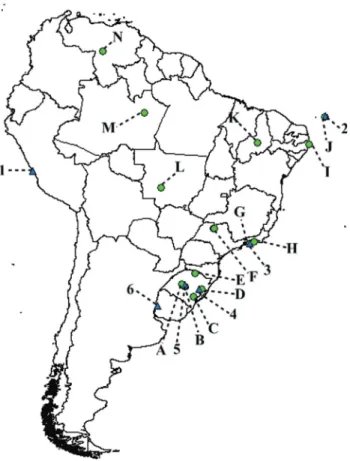
hoboelements inD. melanogasterfromD. simulans. We utilized populations ofD. melanogasterandD. simulans from different locations in South America and Europe (see Table 1 and Figure 2). European populations were used as a control since they are known to possess polymorphisms in the TPE region. The polymorphism analyses were made by Sanger DNA sequencing and polyacrylamide gel electrophoresis (PAGE). DNA extrac-tion was performed in approximately 15 individuals of each population studied according to the protocol of Oliveiraet al.(2009).
The polymerase chain reaction (PCR) was performed under the following conditions: 35 cycles of 15 s at 94°C, 15 s at 53.5°C, and 15 s at 72°C, using the primers TPEf -5’TGCATTTCACAAATTCAAGTCC, TPEr -5 ‘CTTCCCAAAGCCAGTA. These primers were designed from the sequence of the canonical hobo element (GenBank access number X04705), using the Primer3 soft-ware. This primer pair amplified the fragment of approxi-mately 240 bp over-passing the TPE region.
The products obtained by the PCR reaction were pre-cipitated in 13% polyethylene glycol (PEG8000) and NaCl (1.6 M) and then sequenced directly using a MegaBACE 500 automated sequencer and the DYEnamic ET® kit (Amersham) according to the manufacturer’s protocol.
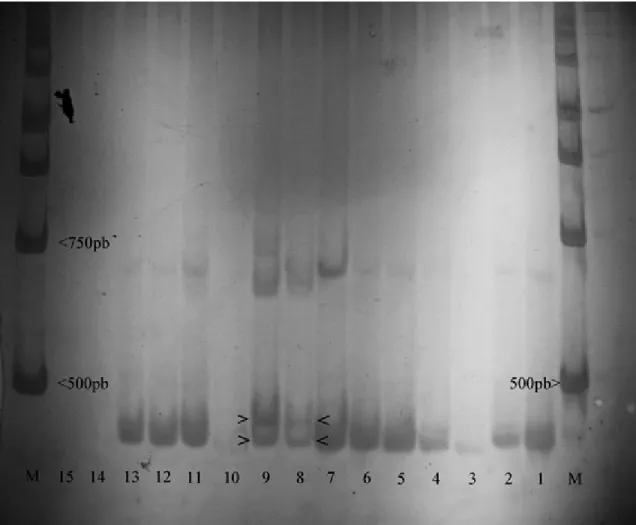
The sizes of PCR fragments were also estimated by non-denaturing 7% PAGE performed according to the pro-tocol described by Sanguinettiet al. (1994). These gels measured 21x23 cm with a thickness of 2 mm and electro-phoresis was done at 50V for 12 h. The DNA bands were detected using silver staining following the protocol de-scribed by Bassam and Gresshoff (2007).
shows the origins (collection sites) of the studied popula-tions, the number of TPE repetitions and methods that were used for determining the number of repetitions. The geo-graphic distribution of the South American population sampled is depicted in Figure 2.
Seven populations ofD. simulanswere analyzed by PAGE electrophoresis and all showed only the band corre-sponding to three TPE repetitions (Table 1). The popula-tions of D. simulanswere similar in their band patterns with Brazilian populations ofD. melanogasterand showed no polymorphism. The geographic distribution of these stud-ied populations can also be found in Figure 2.
As proposed by Periquetet al.(1989), American pop-ulations ofD. melanogasterdid not contain thehobo ele-ment before the 1950s, being characterized as strains E
(empty). Thereafter, the element was found in American populations and these were characterized as H (hobo) strains. Bonnivardet al.(2000) and Periquetet al.(1989) argued that European populations began to present the
hoboelement since the 1960s, proposing a direction for the invasion ofhoboelement. Periquetet al.(1989) suggested that the invasion of thehoboelement began in America, and from it, the populations carrying thehoboelement spread all over the world. This element contained three TPE re-peats and is commonly found around the world. Bonnivard
et al.(2000, 2002) added to the evolutionary history of the invasivehoboelement ofD. melanogasterthe hypothesis of a subsequent invasion of the element containing five or seven TPE repeats. They found polymorphic populations in three regions, central Europe, southern Africa and western
Table 1- Table showing the number of repetitions of TPE in populations ofD. melanogasterandD. simulansin South America and the United States, in-cluding four European populations.
Population Species Collection site; (State / Province); country TPE repeats Method used to obtain the number of repetitions of TPE
1 D. melanogaster Rio de Janeiro; (RJ); Brazil 3 Sequencing
2 D. melanogaster Erechim; (RS); Brazil 3 Sequencing and PAGE
3 D. melanogaster São José do Rio Preto; (SP); Brazil 3 PAGE
4 D. melanogaster São José do Rio Preto; (SP); Brazil 3 PAGE
5 D. melanogaster São José do Rio Preto; (SP); Brazil 3 Sequencing and PAGE
6 D. melanogaster Santa Maria; (RS); Brazil 3 Sequencing
7 D. melanogaster Porto Alegre; (RS); Brazil 3 Sequencing and PAGE
8 D. melanogaster Rio Grande; (RS); Brazil 3 Sequencing and PAGE
9 D. melanogaster Tangará da Serra; (MT); Brazil 3 Sequencing and PAGE
10 D. melanogaster Jari; (RS); Brazil 3 Sequencing and PAGE
11 D. melanogaster Serra da Capivara; (PI); Brazil 3 Sequencing
12 D. melanogaster Manaus; (AM); Brazil 3 Sequencing and PAGE
13 D. melanogaster Fernando de Noronha; (PE); Brazil 3 Sequencing
14 D. melanogaster Fernando de Noronha; (PE); Brazil 3 Sequencing
15 D. melanogaster Recife; (PE); Brazil 3 Sequencing
16 D. melanogaster Ilha Governador; (RJ); Brazil 3 Sequencing
17 D. melanogaster Santa Teresa; (RJ); Brazil 3 Sequencing
18 D. melanogaster Venezuela 3 Sequencing
19 D. melanogaster Vienna; Austria 3 Sequencing and PAGE
20 D. melanogaster Athens; (Attica); Greece 3 Sequencing and PAGE
21 D. melanogaster Prunay; (Marne); France 5 Sequencing and PAGE
22 D. melanogaster La Broche; (Upper Normandy); France 5 Sequencing and PAGE
23 D. simulans Eldorado do Sul; (RS); Brazil 3 PAGE
24 D. simulans Farrapos; (Río Negro); Uruguay 3 PAGE
25 D. simulans Fernando de Noronha; (PE); Brazil 3 PAGE
26 D. simulans Santa Maria; (RS); Brazil 3 PAGE
27 D. simulans Lima; (Lima); Peru 3 PAGE
28 D. simulans Havaí; (HI); United States 3 PAGE
29 D. simulans Rio de Janeiro; (RJ); Brazil 3 PAGE
South America. In North America, Bonnivardet al.(2000) studied 13 populations and found only 3 repeats in nine populations and 3 and 5 repeats in other four populations. From this, the authors suggested that the possible origin of this invasion happened in South America, since in North Africa only populations containing three regions were found. However, North Africa is the geographic region that promotes a connection between the European continent and southern Africa, thus the authors excluded these two re-gions as possible origins of invasion, suggesting that South America would be the region of origin for the second inva-sion.
Our results argue against the supposition for the ori-gin of the second invasion, since, like the region intermedi-ate between Europe and southern Africa, our study area, in the East of America also had no polymorphism, hence ex-cluding South America as a possible area of origin for the second invasion.
Thus, of the three regions containing polymorphisms, none is a candidate for the origin of the invasion. From this standoff we suggest that the second invasion of thehobo el-ement may not have occurred in South America or in equa-torial Africa, and the polymorphism found in these regions may be due to new mutations occurring in these regions fol-lowed by selection or genetic drift.
Souameset al.(2003a) analyzed the mutation rate of TPE repetitions of thehoboelement during 20 generations ofD. melanogasterand found that the mutation rate in this region was a hundred times higher when compared to other regions of neutral microsatellite genome of D. melanogaster. Thus, we suggest that the polymorphism found in western South America and southern Africa could be the result of mutations that were selected or suffered ge-netic drift, because none of these places has the potential to be the geographic region of origin of the supposed second invasion.
Unlike these regions, Central Europe has certain pe-culiarities not shared by South America and Africa. In Eu-rope, the TPE polymorphism frequency is much higher than in any other region and, in addition, presents many kinds of polymorphisms with copies ranging from three re-peats and others containing up to ten repetitions (Bonnivard
et al., 2002). Thus it is possible that this polymorphism is a local one generated by new mutations.
The monomorphism found inD. melanogasterin the TPE regions was shared byD. simulans. So far, the TPE re-gion ofD. simulanshas not been widely studied, but for this current study it is important to discuss the supposed donor of thehoboelement inD. melanogaster, the sister species,
D. simulans. Boussy and Daniels (1991) indicated a direc-tion of the origin of thehoboelement inD. melanogaster, indicating that the donor species of the element would be the sister speciesD. simulans, and this direction of invasion is supported for two reasons:hobowould be present inD. simulansbeforeD. melanogasterand the high similarity of
the element between the two species. Periquetet al.(1989) and Bonnivardet al.(2000, 2002) argued that the invasion of thehoboelement in populations ofD. melanogaster hap-pened in the 1950s in Central America and thehobo ele-ment had three repetitions of TPE, so forD. simulansto be the donor element it would also have to present thehobo el-ement with three repetitions. Our results supported the hy-pothesis proposed by Boussy and Daniels (1991) of D. simulans as the donor of the hobo element to D. melanogaster because all populations studied had three replications of TPE (Figure 2 and Table 1). In this way we can infer with more clarity thatD. simulanswas possibly the donor of thehoboelement toD. melanogaster.
The TPE region has been used by the scientific com-munity because it contains information about the history of thehoboelement and its dynamics. Based on the TPE re-peats, the evolutionary scenario of thehobo element was proposed and their history was better understood (Calviet al., 1991; Bazin and Higuet, 1996; Bonnivardet al., 2000, 2002;). Our results are in accordance with the hypothesis of multiple origins for the second hobo invasion, as suggested by Bonnivardet al.(2000).
Acknowledgments
We thank Dr. Jean David, Dr. Claudia Rohde and Dr. Blanche Bitner-Mathe for sending us fly strains. This study was supported by research grants and fellowships from CAPES (Coordenação de Aperfeiçoamento de Pessoal de Nível Superior), CNPq (Conselho Nacional de Desenvol-vimento Científico e Tecnológico) and FAPERGS (Fun-dação de Amparo a pesquisa do Estado do Rio Grande do Sul).
References
Bassam BJ and Gresshoff, PM (2007) Silver staining DNA in polyacrylamide gels. Nat Protoc 2:2649-2654.
Bazin C and Higuet D (1996) Lack of correlation between dys-genic traits in the hobo system of hybrid dysgenesis in Drosophila melanogaster. Genet Res 67:219-226.
Biémont CA (2010) Brief history of the status of transposable ele-ments: from junk DNA to major players in evolution. Genet-ics 186:1085-1093.
Biémont C and Vieira C (2006) Junk DNA as an evolutionary force. Nature 443:521-524.
Bonnivard E, Bazin C, Denis B and Higuet D (2000) A scenario for thehobotransposable element invasion, deduced from the structure of natural populations of Drosophila melanogasterusing tandem TPE repeats. Genet Res 75:13-23.
Bonnivard E, Bazin C and Higuet D (2002) High polymorphism of TPE repeats within natural populations of D. melanogaster: a gradient of the 5TPEhoboin Western Eu-rope. Mol Biol Evol 19:2277-2284.
Boussy IA and Daniels SB (1991)hobotransposable elements in
Drosophila melanogaster and D. simulans. Genet Res
58:27-34. Figure 2- Map of South America with the sampling points of the
Calvi BR, Hong TJ, Findley SD and Gelbart WM (1991) Evidence for a common evolutionary origin of inverted repeat transposons inDrosophilaand plants:hobo,Activatorand Tam3. Cell 66:465-471.
Capy P, Anxolabérè D and Langin T (1994) The strange phylo-genies of transposable elements: are horizontal transfers the only explanation? Trends Genet 10:7-12.
Finnegan DJ (1989) Eukaryotic transposable elements and ge-nome evolution. Trends Genet 5:103-107.
Galindo MI, Bigot Y, Sánchez MD, Periquet G and Pascual L (2001) Sequences homologus to thehobotransposable ele-ment in E strains ofDrosophila melanogaster. Mol Biol Evol 18:1532-1539.
Hua-Van A, Le Rouzic A, Boutin TS, File EJ and Capy P (2011). The struggle for life of the genome’s selfish architects. Biol Direct 6:19.
International Human Genome Sequencing Consortium (2001) A physical map of the human genome. Nature 409:860-921. McGinnis W, Shermoen AW and Beckendorf S (1983) A
trans-posable element inserted just 5’ to aDrosophilaglue protein gene alters gene expression and chromatin structure. Cell 34:75-84.
Meyers BC, Tingey SV and Morgante M (2001) Abundance, dis-tribution, and transcriptional activity of repetitive elements in the maize genome. Genome Res 11:1660-1676.
Oliveira LFV, Wallau GL and Loreto LSV (2009) Isolation of high quality DNA: a protocol combining “rennet” and glass milk. Electr J Biotechnol 12:1-6.
Ortiz MF and Loreto ELS (2008) Thehobo-related elements in the melanogasterspecies group. Genet Res 90:243-252. Pascual L and Periquet G (1991) Distribution of hobo
trans-posable elements in natural populations of Drosophila melanogaster. Mol Biol Evol 8:282-296.
Periquet G, Hamelin MH, Bigot Y and Lepissier A (1989) Geo-graphical and historical patterns of distribution ofhobo ele-ments inDrosophila melanogasterpopulations. J Evol Biol 2:223-229.
Periquet G, Lemeunier F, Bigot Y, Hamelin MH, Bazin C, Lade-vèze V, Eeken J, Galindo MI, Pascual L and Boussy I (1994)
The evolutionary genetics of thehobotransposable elements inDrosophila melanogastercomplex. Genetica 93:79-90. Rubin E, Lithwick G and Levy AA (2001) Structure and evolution
of thehATtransposon superfamily. Genetics 158:949-957. Sanguinetti CJ, Dias Neto E and Simpson AJG (1994) Rapid
sil-ver staining and recosil-very of PCR products separated on polycrylamide gels. Biotechniques 17:914-921.
Simmons GM, Plummer D, Simon A, Boussy IA, Frantsve J and Itoh M (1998) Horizontal and vertical transmission of hobo-related sequences betweenDrosophila melanogastere Drosophila simulans. In: Syvanen M and Kado CI (eds), Horizontal Gene Transfer. Chapman and Hall, New York, pp 285-294.
Souames S, Bazin C, Bonnivard E and Higuet D (2003a) Behavior of thehobotransposable element with regard to TPE repeats in transgenic lines of Drosophila melanogaster. Mol Biol Evol 20:2055-2066.
Souames S, Bonnivard E, Bazin C and Higuet D (2003b) High mutation rate of TPE repeats: a microsatellite in the putative transposase of the hobo element in Drosophila melanogaster. Mol Biol Evol 20:1826-1832.
Streck RD, MacGaffey JE and Beckendorf SK (1986) The struc-ture of hobo transposable elements and their insertion sites. EMBO J 5:3615–3623.
Torres FP, Fonte LFM, Valente VLS and Loreto ELS (2006) Mo-bilization of a hobo-related sequence in the genome of Drosophila simulans. Genetica 126:101-110.
Warren WD, Atkinson PW and O’Brochta D (1994) The Hermes transposable element from the house fly,Musca domestica, is a short inverted repeat-type element of thehobo, Ac,and Tam3 (hAT) element family. Genet Res 64:87-97.
Wicker T, Sabot F, Hua-Van A, Bennetzen JL, Capy P, Chalhoub B, Flavell A, Leroy P, Morgante M, Panaud O,et al.(2007) A unified classification system for eukaryotic transposable elements. Nat Rev Genet 8:973-982.
Associate Editor: Louis Bernard Klaczko